
Synopsis
Covers the whole plot, including the ending.
- Difficulty
- Easy
- Pacing
- Moderate
- Mood
- Adventurous, Educational, Hopeful, Mildly suspenseful
- Read it if
- You're a young reader (ages 6-9) who enjoys historical adventures, mild suspense, and stories about helping others. Perfect for Magic Tree House fans or those interested in learning about historical events through fiction.
- Skip it if
- You prefer complex plots, deep character development, or stories with a darker tone. This book is for younger readers and has a straightforward narrative.
Earthquake in the Early Morning Plot Summary
Covers the whole plot, including the ending.
A Mission from Morgan: The California Earthquake
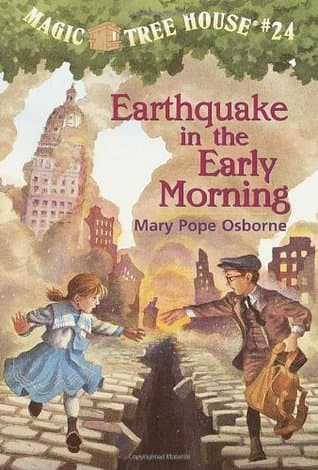
Jack and Annie, fresh from their last adventure, are summoned by Morgan le Fay. She explains that they need to travel to San Francisco in 1906, specifically to the early morning of April 18th, to find a story for the library. She gives them a riddle: 'When the earth shakes, and the sky is bright, you'll find a story in the morning light.' Jack is nervous, remembering past dangerous missions, but Annie is excited. They climb into the Magic Tree House, wish to go to San Francisco, 1906, and with a whoosh, they are transported. They arrive in a quiet, foggy street of a city, unaware of the disaster to come.
Arrival in San Francisco: Before the Storm
The Magic Tree House lands in a tree in a residential area of San Francisco. Jack and Annie step out into the foggy morning. The city is still mostly asleep, though they hear some distant sounds of horse-drawn carriages and people beginning their day. They meet a boy named Henry, who is around their age, sweeping the steps of his house. Henry is friendly and offers to show them around. Jack, ever careful, checks his research book for information about San Francisco in 1906, but finds nothing immediately alarming. As Henry leads them down the street, they see the beauty of the Victorian houses and the peacefulness of the morning, completely unaware of the cataclysm about to unfold.
The Great Earthquake Strikes
As Henry is showing Jack and Annie a stained-glass window in a nearby house, the ground suddenly begins to tremble. At first, it's a gentle rumble, but quickly escalates into violent shaking. Buildings sway, windows shatter, and bricks rain down from chimneys. Jack, Annie, and Henry are thrown to the ground. The noise is deafening, a roar of collapsing structures, breaking glass, and terrified screams. Jack's research book falls open to a page about the San Francisco earthquake of 1906, and he finally understands the true danger of their mission. They scramble for cover, trying to avoid falling debris, as the very streets crack and buckle around them. Henry, though scared, tries to stay calm and guide them.
Seeking Safety in the Aftermath
After the initial violent shaking subsides, the city is a scene of devastation. Buildings are partially collapsed, streets are impassable with rubble, and dust fills the air. People emerge from their homes, dazed and frightened. Jack, Annie, and Henry decide they need to get to higher ground, away from the collapsing buildings and potential fires. They carefully pick their way through the debris-strewn streets. Henry, familiar with the city, tries to remember routes, but many are blocked. They see other survivors, some injured, others simply in shock. The children witness the immediate aftermath, including people trying to help each other and the general sense of confusion and fear that grips the city.
The Threat of Fire
As the morning progresses, a new and even more terrifying threat emerges: fires. Broken gas lines and overturned stoves ignite, and with the city's water mains ruptured by the earthquake, firefighters are helpless. Small fires quickly spread, fueled by the wooden structures of San Francisco. Jack, Annie, and Henry see smoke rising in multiple directions. The air grows thick with the smell of burning wood and ash. They realize they are now in a race against time, not just to survive the collapsed buildings, but to escape the rapidly encroaching inferno. Henry's street is directly in the path of one of the larger fires, forcing them to abandon any hope of returning home.
A Refugee Camp in the Park
Following the advice of other survivors and their own instincts, Jack, Annie, and Henry decide to head towards Golden Gate Park, a large open space that offers refuge from the spreading fires. They join a growing stream of people, carrying what few possessions they could salvage, all moving in the same direction. The journey is hard, through streets filled with rubble and past burning buildings. Annie tries to offer words of encouragement to other children they meet along the way. Henry, though exhausted, continues to be a brave guide. They finally reach the park, which is already filling with thousands of displaced people, setting up makeshift camps and trying to find their loved ones.
Finding a Story in Kindness
In the crowded, chaotic refugee camp in Golden Gate Park, Jack and Annie observe the resilience and kindness of the people. They see neighbors sharing food and blankets, doctors tending to the injured, and families comforting each other. Henry, though worried about his own family, helps an elderly woman find her missing cat. Jack realizes that the 'story' Morgan le Fay sent them to find isn't a written tale, but rather the story of human courage and compassion in the face of disaster. He begins to write notes in his notebook about the acts of bravery and generosity he witnesses, capturing the spirit of the survivors. Annie, with her usual empathy, helps a mother calm her frightened baby.
Henry's Family and a Difficult Farewell
As evening approaches, amidst the thousands of people in Golden Gate Park, Henry spots his parents. The reunion is tearful and joyful, a beacon of hope in the midst of despair. Henry introduces Jack and Annie to his family, who express their gratitude for the children's companionship. Jack and Annie feel a pang of sadness, knowing they must soon leave their new friend. They exchange heartfelt goodbyes, promising Henry they will never forget him or the bravery and kindness they witnessed during the disaster. The experience has impacted them, showing them the strength of the human spirit even in the direst circumstances.
The Return to Frog Creek
With their mission complete, having found the 'story' of human kindness and resilience, Jack and Annie discreetly make their way back to the Magic Tree House, which remains hidden in the park. As they climb inside, Jack looks one last time at the smoke-filled sky over San Francisco, a reminder of the city's devastation but also its enduring spirit. Annie holds the small stone from the earthquake they picked up as a memento. They wish to go back to Frog Creek, Pennsylvania. With a final whoosh, the Magic Tree House spins them away from the burning city and back to the safety and familiarity of their own time, changed by their experience.
Earthquake in the Early Morning Characters
Jack
Protagonist
The cautious and studious elder brother, responsible for research and note-taking.
Jack is the older of the two siblings, known for his cautious nature and his reliance on facts and his research book. He often feels nervous about the dangers of their missions but pushes through for the sake of the library and Morgan le Fay. In 'Earthquake in the Early Morning,' he initially focuses on finding specific information about San Francisco, but the earthquake forces him to confront real-world danger and adapt. He eventually understands that the 'story' they need is not a written one, but the story of human kindness and resilience, which he diligently records in his notebook.
Relationships: Annie (Younger sister and adventure partner); Morgan le Fay (Magical mentor and mission-giver); Henry (New friend and guide in San Francisco)
Annie
Protagonist
The brave and empathetic younger sister, always eager for adventure and quick to connect with others.
Annie is Jack's younger sister, characterized by her adventurous spirit, fearlessness, and deep empathy. She is often the first to suggest a risky move or to connect with strangers. In this story, her compassionate nature shines as she tries to comfort other children and people in distress during the earthquake's aftermath. Her immediate connection with Henry and her ability to find hope and kindness amidst the destruction help Jack understand the true purpose of their mission, proving her emotional intelligence is as vital as Jack's intellectual one.
Relationships: Jack (Older brother and adventure partner); Morgan le Fay (Magical mentor and mission-giver); Henry (New friend and guide in San Francisco)
Morgan le Fay
Supporting
The magical librarian of Camelot who sends Jack and Annie on their time-traveling missions.
Morgan le Fay is a magical enchantress and the librarian of Camelot, responsible for sending Jack and Annie on their missions through time and space using the Magic Tree House. She gives them cryptic riddles or instructions for their quests, always with the underlying goal of helping them learn and grow. In this book, she assigns them the task of finding a 'story' in San Francisco, 1906, foreshadowing the impending disaster and the lesson they are meant to learn about human resilience and compassion.
Relationships: Jack (Protege/Student); Annie (Protege/Student)
Henry
Supporting
A friendly local boy in San Francisco who guides Jack and Annie before and after the earthquake.
Henry is a boy from San Francisco in 1906, around Jack and Annie's age, who they meet just before the earthquake. He is friendly, helpful, and initially serves as their local guide, showing them around his neighborhood. When the earthquake strikes, Henry remains brave and resourceful, helping Jack and Annie navigate the collapsing city and later find refuge in Golden Gate Park. His personal experience of the disaster and his eventual reunion with his family highlight the human impact of the event and provide a personal connection for Jack and Annie.
Earthquake in the Early Morning Themes
Resilience in the Face of Disaster
The central theme explores how individuals and communities cope with and recover from catastrophic events. The book portrays the immediate aftermath of the San Francisco earthquake, focusing on the fear, destruction, and loss. However, it quickly shifts to the strength of the human spirit. Characters like Henry, and the refugees in Golden Gate Park, show courage, resourcefulness, and a will to survive and help each other. This theme is clear when Jack realizes the 'story' is about the kindness and bravery of the people, not just the destruction.
“Jack knew that the story Morgan wanted was the story of the people. The story of their bravery. The story of their kindness.”
Compassion and Community
Amidst the chaos and devastation, the book emphasizes the importance of compassion and community. Jack and Annie witness many acts of kindness, from Henry helping an elderly woman find her cat to strangers sharing food and comfort in the refugee camps. Annie's empathy leads her to comfort a crying baby, while Jack notes instances of generosity. This theme suggests that in times of crisis, human connection and mutual support are vital for survival and rebuilding.
“People were sharing their food. People were sharing their blankets. People were helping people they didn't even know.”
The Nature of 'Story'
Initially, Jack searches for a literal written story or historical fact, but the events redefine his understanding of what a 'story' truly is. Morgan le Fay's riddle about finding a 'story in the morning light' is ultimately fulfilled not by a book, but by the lived experience of human bravery, kindness, and resilience during the earthquake. Jack's realization that the 'story' is about the people and their spirit marks a significant thematic point, suggesting that the most meaningful stories are often found in real-life events and human actions.
“He knew he had found the story. It wasn't in a book. It was in the hearts of the people.”
The Power of Preparation vs. Unpredictability
This theme is explored through Jack's character. Jack always relies on his research book for information and preparation. However, the earthquake strikes with sudden force, making much of his prior knowledge inadequate for the immediate danger. The unpredictable nature of natural disasters is clear, forcing the children to adapt and react rather than rely solely on planning. This contrasts Jack's usual methodical approach with the raw, unpredictable power of nature, showing that sometimes, survival depends on quick thinking and resilience over foreknowledge.
“Jack stared at the words. The Great San Francisco Earthquake. April 18, 1906. He had been so busy looking at facts, he hadn't seen the danger.”
Plot Devices & Literary Techniques
The Magic Tree House
A magical vehicle for time and space travel, driving the plot of the entire series.
The Magic Tree House serves as the primary plot device, enabling Jack and Annie's adventures. It is their means of transportation to different historical periods and locations, initiated by Morgan le Fay's missions. In 'Earthquake in the Early Morning,' it deposits them precisely at the moment of the impending disaster, setting the stage for their challenge. Its ability to return them safely to their own time also provides a comforting framework for the intense dangers they face, ensuring their ultimate safety while allowing them to experience profound historical events.
Jack's Research Book
A source of information and a tool for Jack's learning and understanding.
Jack's research book is a recurring plot device that provides historical context and facts for their missions. In this story, it initially serves to highlight Jack's meticulous nature, but also his initial ignorance of the specific danger. When the earthquake strikes, the book opens to the exact page detailing the San Francisco earthquake of 1906, serving as a dramatic reveal of their predicament. Later, it becomes a tool for Jack to record the 'story' of human resilience, shifting its function from factual reference to a personal journal of observation and understanding.
Morgan le Fay's Riddle
A cryptic clue that guides the children's mission and deepens their understanding.
Morgan le Fay's riddle, 'When the earth shakes, and the sky is bright, you'll find a story in the morning light,' acts as a driving force for the plot. It initially misleads Jack into thinking he needs to find a literal book or written account. However, as the earthquake unfolds, the riddle's true meaning is revealed: the 'story' is the human experience of the disaster – the bravery, kindness, and resilience of the people. This device encourages the children (and readers) to think beyond surface-level interpretations and discover deeper truths within their experiences.
The San Francisco Earthquake of 1906
The central historical event that forms the setting and conflict of the story.
The San Francisco Earthquake of 1906 is not just a setting but a pivotal plot device. It creates the immediate conflict, danger, and urgency for Jack and Annie. Its historical accuracy grounds the fantasy elements of the Magic Tree House in a real-world event, allowing young readers to learn about a significant historical disaster. The earthquake's destructive power and subsequent fires provide the challenges that test the characters, reveal human nature, and ultimately lead to the 'story' of resilience that Morgan le Fay tasked them to find.
Earthquake in the Early Morning Quotes
“Suddenly the tree house started to spin. Faster and faster it spun!”
“A huge, furry tarantula crawled toward them. It had eight hairy legs and beady eyes.”
“The ground began to rumble. The tree house shook. The book fell off Jack's lap.”
“The ground was shaking so hard, Jack and Annie couldn't stand up. They fell to their knees.”
“Houses were falling apart. Bricks were flying. People were screaming.”
“A man with a big mustache and a fancy hat was standing in front of a fallen building.”
“The ground stopped shaking. Everything was quiet for a moment. Then the screaming started again.”
“Smoke was rising from all over the city. Tiny fires were starting everywhere.”
“We have to help people! We can't just leave!”
“Jack pointed to a horse pulling a wagon. 'Look! They're helping people get away!'”
“It was strange to be standing in the middle of such a huge disaster, yet feeling so small and helpless.”
“Even in the middle of all the trouble, people were helping each other.”
“The tree house was still waiting for them, a quiet promise of another adventure.”
Quiz
10 questions on the plot and the characters. Each answer comes with a short explanation.
Question 1
What is the very first thing Jack and Annie notice when they arrive in San Francisco in the Magic Tree House?
- The Golden Gate Bridge
- A cable car
- A bustling marketplace
- A large ship in the harbor
Show answer
B. A cable car Upon their arrival, Jack and Annie immediately see a cable car, which is a distinctive feature of San Francisco, even in 1906.
Question 2
What is the name of the kind man who helps Jack and Annie navigate the city and later during the earthquake?
- Mr. Henderson
- Mr. Lee
- Mr. Jin
- Mr. Tanaka
Show answer
C. Mr. Jin Mr. Jin is the friendly Chinese man who guides Jack and Annie, first to the library and then helps them find safety during the earthquake.
Question 3
What item are Jack and Annie specifically looking for in San Francisco to help Morgan le Fay?
- A rare book on natural disasters
- A special poem about courage
- A lost scroll of ancient wisdom
- A story to inspire hope
Show answer
D. A story to inspire hope Their mission from Morgan le Fay is to find a story that will inspire hope and courage, which they eventually find in a newspaper account.
Question 4
What time of day does the major earthquake strike San Francisco in the book?
- Late morning
- Early afternoon
- Just before sunrise (early morning)
- Late evening
Show answer
C. Just before sunrise (early morning) The title 'Earthquake in the Early Morning' directly refers to the time the earthquake hit, which was just after 5 AM.
Question 5
After the initial earthquake, what secondary disaster causes even more widespread destruction in San Francisco?
- A tsunami
- Mass flooding
- Fires
- A volcanic eruption
Show answer
C. Fires The fires that broke out after the earthquake, fueled by broken gas lines and lack of water, caused more damage and devastation than the quake itself.
Question 6
What specific type of building does Mr. Jin lead Jack and Annie to for safety after the earthquake starts?
- A tall, sturdy skyscraper
- An open park or square
- A reinforced basement
- A church with strong walls
Show answer
B. An open park or square Mr. Jin, knowing that open spaces are safest during an earthquake, guides them to an open park area away from falling buildings.
Question 7
What is the main theme explored in 'Earthquake in the Early Morning' regarding natural disasters?
- The inevitability of fate
- The importance of preparedness and community resilience
- The futility of human efforts against nature
- The scientific causes of earthquakes
Show answer
B. The importance of preparedness and community resilience The book highlights how people come together to help each other and rebuild after a disaster, emphasizing resilience and community spirit.
Question 8
How do Jack and Annie eventually find the 'story of hope' they are looking for?
- In a forgotten diary in the library
- Written on a plaque in a damaged building
- In a newspaper headline and article
- Through a song sung by survivors
Show answer
C. In a newspaper headline and article They find the story of courage and resilience in a newspaper that reports on the immediate aftermath and the spirit of the people.
Question 9
What specific detail does the book mention about the destruction of the library where Jack and Annie initially sought information?
- It was completely swept away by a flood.
- Its roof collapsed, but many books were saved.
- It was consumed by fire, destroying all its contents.
- It remained largely intact, serving as a shelter.
Show answer
C. It was consumed by fire, destroying all its contents. The library, like many other wooden structures in San Francisco, was ravaged by the fires that followed the earthquake, leading to the loss of countless books.
Question 10
What is one important lesson Jack learns about earthquakes from his experience?
- That all earthquakes are followed by tsunamis.
- That staying indoors in a doorway is always the safest option.
- That the ground can move like waves and fires are a major danger.
- That people always panic and become selfish during disasters.
Show answer
C. That the ground can move like waves and fires are a major danger. Jack observes the ground moving in waves during the quake and later understands the devastating impact of the subsequent fires, highlighting key dangers.
Earthquake in the Early Morning FAQ
What is 'Earthquake in the Early Morning' about?
'Earthquake in the Early Morning' is about Jack and Annie's magical tree house adventure to San Francisco in 1906, just before the Great Earthquake and Fire. Their mission from Merlin is to find a special, lost library book, but they quickly find themselves in the midst of historical chaos, needing to help others while completing their quest.
Why should I read 'Earthquake in the Early Morning'?
You should read it for an engaging blend of adventure, history, and a touch of magic, perfect for young readers. It offers a gentle introduction to a significant historical event, the 1906 San Francisco earthquake, through the eyes of two relatable children, while emphasizing themes of courage, helpfulness, and the power of stories.
What is the background/setting of 'Earthquake in the Early Morning'?
The story is primarily set in San Francisco, California, specifically on April 18, 1906, just hours before and during the devastating earthquake and subsequent fires. Jack and Annie explore the bustling city streets, ride a cable car, and witness the immediate aftermath of the natural disaster, including the widespread destruction and the spirit of community among survivors.
What are the most memorable quotes?
While the Magic Tree House series isn't known for profound quotes, memorable lines often highlight the children's wonder or the historical context, such as Annie exclaiming 'Wow, a real cable car!' or Jack's repeated logical observations like 'We have to be careful.' The story also features the historical detail of people saying 'All's well!' before the quake.
What writing style does the author use?
Mary Pope Osborne uses a simple, direct, and engaging writing style, characteristic of early chapter books for children. Her prose is clear and accessible, with short sentences and paragraphs that maintain a brisk pace, making complex historical events digestible and exciting for young readers. She often incorporates dialogue to move the plot forward and reveal character.
What minor details add significant meaning?
The detail of the lost library book being about the 'Spirit of San Francisco' is significant, as it not only drives their quest but also subtly foreshadows the resilience and community spirit the city's inhabitants will show after the disaster. Also, the description of the city's vibrant pre-quake life, like the busy streets and cable cars, contrasts sharply with the devastation, making the impact more profound.
What are some subtle foreshadowing moments?
Subtle foreshadowing includes the slight tremors Jack and Annie feel before the main quake, which they initially dismiss as something else. Also, the mention of people going about their early morning routines, seemingly oblivious, creates a sense of impending doom for the reader, building tension before the earthquake strikes.
What unexpected character connections exist?
While there aren't deep, unexpected character connections in the traditional sense, Jack and Annie form a significant, though brief, connection with a kind woman on the cable car who helps them navigate the city. This connection highlights the unexpected kindness of strangers and the immediate bonds formed during a crisis, even if they are temporary.
What are unspoken character motivations?
Beyond their explicit mission from Merlin, Jack and Annie are implicitly motivated by a deep sense of empathy and a desire to help. Even when their primary goal is to find the book, their immediate reaction to the earthquake is to assist those in need, showcasing their innate goodness and courage without needing explicit internal monologues.
What psychological complexities do characters exhibit?
For children's literature, Jack exhibits complexity through his internal conflict between his fear and his logical desire to help. He's often scared but pushes through it by focusing on facts and solutions, while Annie's immediate, fearless empathy drives her to act, showcasing different coping mechanisms in a crisis.
What are the major emotional turning points?
The most significant emotional turning point is the moment the earthquake hits, shifting the children's adventure from a playful exploration to a serious survival and aid mission. Another is when they realize the widespread destruction and the need for everyone to work together, moving from individual fear to collective responsibility and hope.
How do relationship dynamics evolve?
Jack and Annie's sibling dynamic evolves as they face the crisis. Jack, usually the cautious one, relies more on Annie's quick thinking and bravery, while Annie, often impulsive, learns to appreciate Jack's planning and factual knowledge. Their teamwork strengthens, showing how adversity can solidify bonds and highlight complementary strengths.
Which parts remain ambiguous or open-ended?
The ultimate fate of some of the background characters Jack and Annie briefly encounter, like the kind woman from the cable car, remains open-ended, reflecting the chaotic nature of the disaster. While the children are safe, the full extent of the city's recovery is beyond the scope of their immediate adventure, leaving the long-term future to the reader's imagination.
What are controversial scenes or decisions?
For a children's book, there are no truly 'controversial' scenes. However, some might debate Jack and Annie's decision to stay and help people during the immediate aftermath of the earthquake, rather than immediately returning to the tree house. While heroic, it puts them in more danger, reflecting a common dilemma in adventure stories.
'Earthquake in the Early Morning' ending explained: how it ends & what it means
The book ends with Jack and Annie successfully finding the lost book and returning to the tree house, safe from the disaster. They reflect on the incredible destruction but also the resilience of the people they witnessed. The ending means they fulfilled their mission and gained valuable historical insight and empathy, understanding that even in tragedy, there's a 'Spirit of San Francisco' – a spirit of courage and community.
About the author

Mary Pope Osborne is an American author known for her children's fiction, particularly the Magic Tree House series. Her notable works include "The Knight at Dawn," "Dolphins at Daybreak," "Afternoon on the Amazon," "Tonight on the Titanic," "Ghost Town at Sundown," and "Hour of the Olympics," which combine adventure with historical and educational themes.
Similar books
- Dolphins at Daybreak
Mary Pope Osborne
4.0 (14k) average on GoodreadsFantasyA classic Magic Tree House book involving a mission and a journey to a new place.
- Harry Potter and the Sorcerer's Stone
J.K. Rowling
4.5 (7M) average on GoodreadsFantasyRescued from a miserable life under the stairs, an orphaned boy discovers he's a wizard destined for a magical school, where he uncovers a dangerous secret tied to the dark wizard who murdered his parents.
- The Hunger Games
Suzanne Collins
4.3 (6.4M) average on GoodreadsFantasyIn a future where children fight to the death on live television, Katniss Everdeen volunteers for the arena, turning a death sentence into a fight for survival and a spark of rebellion.
- 1984
George Orwell
4.2 (3.1M) average on GoodreadsPoliticsIn a future where surveillance and thought control are absolute, a man's search for truth clashes with the Party, showing that hope can be a form of rebellion.
- Divergent
Veronica Roth
4.2 (2.9M) average on GoodreadsFantasyIn a society divided by virtues, a sixteen-year-old's difference from the norm starts a rebellion that threatens her world.
- The Hobbit, or There and Back Again
J.R.R. Tolkien
4.3 (2.9M) average on GoodreadsFantasyA comfort-loving hobbit named Bilbo Baggins is whisked away by a mischievous wizard and a band of dwarves on an unexpected journey to reclaim stolen treasure from a fearsome dragon, discovering courage and a magical ring along the way.





Enjoyed the summary?
A summary gives you the shape of the book. The book itself has the detail, the examples and the voice.
Find Earthquake in the Early Morning on AmazonAs an Amazon Associate, BookBrief earns from qualifying purchases. How we're funded