
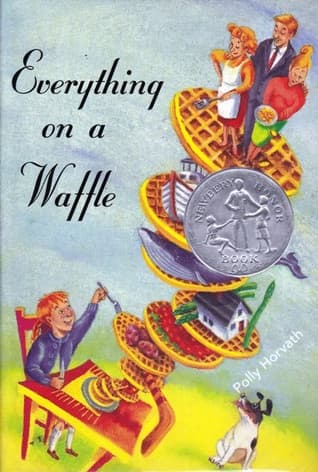
Synopsis
Covers the whole plot, including the ending.
- Difficulty
- Easy
- Pacing
- Moderate
- Mood
- Quirky, Heartwarming, Hopeful, Whimsical
- Read it if
- You enjoy quirky, heartwarming stories about resilience, community, and the power of a child's unwavering hope.
- Skip it if
- You prefer fast-paced plots or stories without eccentric characters and a more realistic tone.
Everything on a Waffle Plot Summary
Covers the whole plot, including the ending.
The Storm and the Loss
Eleven-year-old Primrose Squarp lives in the fishing village of Coal Harbour, British Columbia. One day, her parents, Elna and Hans Squarp, go out on their fishing boat despite a storm. Primrose feels uneasy and tries to stop them, but they reassure her and leave. The storm hits hard, and after a search, their boat is found empty and capsized. The community, including her Uncle Jack, her father's brother, and the police, conclude that Primrose's parents are lost at sea and presumed dead. However, Primrose believes they will return.
Life with Uncle Jack and Miss Perfidy
After her parents disappear, Primrose moves in with her Uncle Jack, a kind but often absent fisherman who struggles with his own grief and raising a child. To ensure Primrose is cared for, Uncle Jack hires Miss Perfidy, an elderly woman known for her odd habits and dislike of children, to be her guardian. Miss Perfidy mostly ignores Primrose, leaving her to herself and complaining about the smell of children. Primrose navigates this new, lonely life, holding onto her belief that her parents are alive.
The Girl on the Red Swing
Primrose finds a special place in Coal Harbour: 'The Girl on the Red Swing,' a restaurant owned by the kind Kate Bowzer. At Kate's restaurant, every dish, from lasagna to fish and chips, is served on a waffle. Kate takes an interest in Primrose, offering her a place and teaching her to cook. Unlike other adults, Kate never talks down to Primrose or dismisses her belief that her parents will return. This restaurant becomes a source of comfort and stability for Primrose, and Kate becomes a needed confidante and mentor.
School and Miss Honeycut
At school, Primrose is assigned to Miss Honeycut, the guidance counselor, to help her cope with her loss. However, Miss Honeycut, an overly dramatic and self-absorbed British woman, is unhelpful. Instead of listening to Primrose, Miss Honeycut tells long, irrelevant stories about her own past adventures and romantic troubles. Primrose quickly learns that Miss Honeycut cares more about herself than providing support, further isolating Primrose in her grief and unique perspective.
The Guinea Pig Incident
While learning to cook with Kate Bowzer, Primrose brings her guinea pig, 'Lady,' to the restaurant. In a moment of childish curiosity, Primrose places Lady too close to the oven. Lady's fur catches fire, and the guinea pig dies. This accidental incident deeply upsets Primrose and shows her sometimes naive approach to the world. Kate, true to her character, handles the situation with understanding and compassion, helping Primrose process the event without judgment.
Primrose's Persistent Hope
Despite time passing and the community accepting her parents' death, Primrose never stops believing that Elna and Hans Squarp are alive and will come home. She prepares for their return, keeping their house ready, their clothes clean, and even cooking their favorite meals. This hope defines Primrose, setting her apart from others and often causing confusion or concern among adults, who see her persistence as a refusal to accept reality.
A Community's Concern
The adults in Coal Harbour, especially Uncle Jack, Miss Perfidy, and Miss Honeycut (in her own self-centered way), worry about Primrose's belief that her parents are alive. They see her conviction as denial or an inability to process grief. They try to gently (or not-so-gently) persuade Primrose to accept the truth, but she remains firm. This concern shows the community's struggle to understand and support Primrose in her unique way of coping with loss.
The Discovery of the Message
One day, while cleaning her parents' old fishing gear, Primrose finds a hidden message carved into wood by her father, Hans. The message, though cryptic, suggests that he and Elna are alive and trying to return. This discovery excites Primrose, giving her proof for her long-held belief. It strengthens her resolve and gives her new energy to continue waiting and preparing, now with a concrete piece of information to hold onto, further separating her perspective from the rest of the town.
The Fire and the New Home
Tragedy strikes again when Primrose's house, where she waited for her parents, catches fire. The fire, whose origin is unclear, destroys the house and everything in it. This event forces Primrose to face another loss, but also moves her into a new living situation. With her home gone, Uncle Jack, overwhelmed, arranges for Primrose to move in permanently with Kate Bowzer at 'The Girl on the Red Swing,' which brings Primrose much-needed stability and emotional support.
Life with Kate
Living with Kate at the restaurant is a transformative experience for Primrose. She thrives under Kate's unconventional, yet loving and understanding, guardianship. Primrose continues to improve her cooking skills, learns about life from Kate's perspective, and finds a true home where her beliefs are accepted. Kate's practical wisdom and support give Primrose the emotional foundation she needs, allowing her to grow and maintain her hopeful outlook without feeling isolated or misunderstood.
The Return
One day, as Primrose is at 'The Girl on the Red Swing,' a boat pulls into Coal Harbour. To the community's surprise, Primrose's parents, Elna and Hans Squarp, step off the boat, alive. They tell their story of survival, having been shipwrecked on a remote island and spending months finding their way back. Their return confirms Primrose's belief and shows the power of her intuition and hope, bringing a joyful end to her long wait.
Reunion and New Beginnings
The reunion of Primrose with her parents is a moment of joy and relief for the Squarps and the entire community of Coal Harbour, who must re-evaluate their skepticism. Elna and Hans are welcomed back, and the family begins to rebuild their lives. Primrose, no longer alone in her conviction, can finally share her experiences with her parents. The story ends with a sense of restored order, and the magic of Primrose's unique perspective having been proven right, leaving the community with a deeper appreciation for the unexpected.
Principal Figures
Primrose Squarp
Protagonist
An eleven-year-old girl with an unwavering belief in her parents' return.
Primrose is an intelligent, observant, and deeply intuitive eleven-year-old girl. She possesses an extraordinary resilience and an unshakeable belief that her parents, lost at sea, are still alive. This conviction sets her apart from the pragmatic adults around her. She is resourceful and finds solace in cooking and the unique environment of Kate Bowzer's restaurant. Despite her profound loss, Primrose maintains a hopeful and often whimsical outlook on life, interpreting events through her own distinct lens.
Relationships: Elna Squarp (Mother, with whom she shares a deep bond and intuition.); Hans Squarp (Father, with whom she shares a deep bond and intuition.); Uncle Jack (Kindly but overwhelmed guardian after her parents' disappearance.); Miss Perfidy (Eccentric, neglectful guardian/babysitter.); Kate Bowzer (Mentor, friend, and surrogate mother figure.); Miss Honeycut (Ineffective and self-absorbed school guidance counselor.)
Kate Bowzer
Supporting
The owner of 'The Girl on the Red Swing' and Primrose's mentor.
Kate Bowzer is a warm, unconventional, and deeply understanding woman. She owns the unique restaurant 'The Girl on the Red Swing,' where everything is served on a waffle. Kate acts as a much-needed mentor and surrogate mother figure to Primrose, offering her a safe haven, teaching her to cook, and, most importantly, listening to and validating Primrose's feelings and beliefs without judgment. She is practical, kind, and provides a stable, loving presence in Primrose's tumultuous life.
Relationships: Primrose Squarp (Mentor, friend, and eventual guardian.); Uncle Jack (Acquaintance in the community, with whom she eventually shares guardianship of Primrose.)
Uncle Jack
Supporting
Primrose's well-meaning but overwhelmed uncle.
Uncle Jack is Primrose's father's brother and her legal guardian after her parents' disappearance. He is a kind, hardworking fisherman who genuinely cares for Primrose but is often overwhelmed by his own grief and the unexpected responsibility of raising a child. He struggles to understand Primrose's unwavering belief in her parents' return and often tries to guide her towards 'acceptance,' but always with a gentle heart. He represents the pragmatic, grieving adult world that Primrose navigates.
Relationships: Primrose Squarp (Guardian and uncle.); Elna and Hans Squarp (Brother and sister-in-law, whose loss he deeply mourns.); Miss Perfidy (Employee hired to care for Primrose.)
Miss Perfidy
Supporting
Primrose's eccentric and child-averse guardian.
Miss Perfidy is an elderly woman hired by Uncle Jack to look after Primrose. She is highly eccentric, smells perpetually of mothballs, and openly dislikes children, viewing them as bothersome nuisances. Her method of guardianship largely involves ignoring Primrose, allowing the girl to be fiercely independent. Despite her gruff exterior and lack of warmth, she is not malicious, but simply ill-suited for childcare, providing a source of comedic relief and highlighting Primrose's isolation.
Relationships: Primrose Squarp (Nominal guardian, though their relationship is distant and often humorous.); Uncle Jack (Employer.)
Miss Honeycut
Supporting
Primrose's self-absorbed and ineffective school guidance counselor.
Miss Honeycut is Primrose's school guidance counselor, a British woman who is more concerned with her own dramatic life stories and perceived sophistication than with Primrose's emotional well-being. She is long-winded, self-centered, and utterly fails to provide any meaningful support or guidance. Her character serves as a humorous critique of well-intentioned but ultimately unhelpful adults, further emphasizing Primrose's need to find her own path and support system.
Relationships: Primrose Squarp (Student/counselor, though the relationship is one-sided and ineffective.)
Elna Squarp
Supporting
Primrose's mother, lost at sea.
Elna Squarp is Primrose's mother, who disappears at sea with her husband, Hans. While not physically present for most of the story, her memory and Primrose's unwavering belief in her return drive much of the plot. She is remembered as loving and adventurous, and her strong bond with Primrose is evident in the girl's intuition. Her eventual return validates Primrose's steadfast hope and brings the family's journey to a fulfilling conclusion.
Relationships: Primrose Squarp (Daughter, with whom she shares a deep, intuitive bond.); Hans Squarp (Husband.); Uncle Jack (Brother-in-law.)
Hans Squarp
Supporting
Primrose's father, lost at sea.
Hans Squarp is Primrose's father, who disappears at sea with his wife, Elna. Like Elna, his physical absence is a central catalyst for the story, but his memory and Primrose's belief in his return are powerful forces. He is remembered as a kind fisherman, and his hidden message provides crucial evidence for Primrose's hope. His miraculous reappearance at the end of the story is the ultimate validation of Primrose's extraordinary intuition and resilience.
Relationships: Primrose Squarp (Daughter, with whom he shares a deep, intuitive bond.); Elna Squarp (Wife.); Uncle Jack (Brother.)
Lady
Mentioned
Primrose's pet guinea pig.
Lady is Primrose's beloved pet guinea pig. Her unfortunate demise due to an accidental fire at Kate's restaurant is a poignant moment in the story, highlighting Primrose's occasional naivete and her need for careful guidance. Lady's brief presence underscores Primrose's capacity for love and her sometimes clumsy attempts to navigate the world around her, and her death is handled with compassion by Kate.
Relationships: Primrose Squarp (Pet owner and beloved companion.)
Themes & Insights
The Power of Belief and Hope
The main theme is Primrose's belief that her parents are alive, despite all evidence and the town's opinion. Her hope carries her through loneliness and loss, allowing her to cope in her own way. This theme challenges the idea that 'acceptance' is the only valid response to grief, suggesting that some forms of hope, however illogical to others, can be sustaining. Her parents' return ultimately confirms the power of her conviction, as seen when she finds her father's hidden message (Plot Summary 8) and prepares for their return daily (Plot Summary 6).
“Just because you can't see something, doesn't mean it's not there.”
Unconventional Family and Support Systems
The novel explores how family can appear in unexpected places and how unconventional support can be more nurturing than traditional structures. Primrose finds belonging and guidance not with her well-meaning but overwhelmed Uncle Jack, nor with the neglectful Miss Perfidy or self-absorbed Miss Honeycut, but with the eccentric and kind Kate Bowzer. Kate's restaurant, 'The Girl on the Red Swing,' becomes a safe place where Primrose is understood and loved for who she is, showing that emotional connection and acceptance are more important than conventional family units or societal expectations. This is clear when Primrose moves in with Kate after her house burns down (Plot Summary 9, 10).
“Sometimes the right people find you when you least expect it, and they're exactly who you need.”
Grief and Coping Mechanisms
The story offers a portrayal of grief, especially through Primrose's coping mechanism. While the adults around her expect her to 'accept' her parents' death, Primrose's refusal is not denial but a personal, intuitive way of processing her loss. Her actions, like keeping her parents' house ready and cooking their favorite meals, are her ways of mourning and staying connected. The book suggests that there is no single 'right' way to grieve and that children, in particular, might process trauma in ways that seem illogical to adults. The community's concern over Primrose's 'unusual' coping (Plot Summary 7) highlights this theme.
“Grief is a peculiar thing. It takes its own shape in every heart, and no two are quite the same.”
The Nature of Reality and Perception
The novel questions what 'reality' is and how individual perception shapes it. For Coal Harbour, Primrose's parents are dead, a fact based on evidence. For Primrose, her parents are alive, a reality based on intuition and faith. The story ultimately confirms Primrose's subjective reality, making the community reconsider their own certainties. This theme suggests that truths exist beyond what can be seen or logically explained, and that a child's perspective can sometimes hold a deeper understanding. The climax, with the parents' return (Plot Summary 11), is the ultimate example of this theme.
“The world is full of things that can't be explained, if you just open your eyes to them.”
Plot Devices & Literary Techniques
The Unreliable Narrator (Child's Perspective)
The story is told from Primrose's innocent and unique point of view, shaping the perception of events.
While not strictly unreliable in the sense of lying, Primrose's narration is 'unreliable' in that her perception of reality differs drastically from the adult world. Her unwavering belief in her parents' return, despite all evidence, colors the narrative. This device allows the reader to experience the world through her hopeful, often whimsical, and sometimes naive lens, creating a sense of wonder and challenging conventional adult logic. The reader is invited to trust Primrose's intuition over the adults' pragmatism, leading to a satisfying resolution when her 'unreliable' perspective is proven correct.
Symbolism of the Waffle
The waffle represents comfort, unconventionality, and the ability to adapt.
At 'The Girl on the Red Swing,' everything is served on a waffle. This seemingly whimsical detail serves as a powerful symbol. The waffle, a humble and comforting food, becomes a foundation for unexpected pairings, mirroring how Primrose finds comfort and a new foundation in an unconventional setting. It signifies that support and nourishment can come in unusual forms, and that seemingly disparate elements can come together harmoniously. The waffle embodies Kate's unique approach to life and her ability to make the unconventional feel perfectly natural and comforting.
Foreshadowing (The Hidden Message)
A cryptic message from Primrose's father hints at his survival, validating her hope.
The discovery of a hidden message carved by Primrose's father into a piece of wood (Plot Summary 8) serves as a subtle yet crucial piece of foreshadowing. It provides the first tangible 'proof' within the story that Primrose's belief might not be entirely unfounded, strengthening her resolve and offering the reader a glimmer of hope that her intuition is correct. This device builds suspense and anticipation for the eventual climax, affirming the power of Primrose's connection to her parents and setting the stage for their miraculous return.
Everything on a Waffle Quotes
“When you're a kid, you don't realize you're being raised by people who are as confused as you are.”
“Sometimes when you lose everything, you find yourself.”
“There are two kinds of people in the world: those who love waffles and those who are wrong.”
“Being lonely is not the same as being alone.”
“Life is like a waffle. You have to make it yourself.”
“It's a strange thing, but sometimes the people who are the most different from you are the ones who understand you best.”
“Every day is an adventure if you look at it right.”
“Grown-ups often don't see what's right in front of their noses.”
“You can't always choose what happens to you, but you can choose how you react to it.”
“A good story always has a beginning, a middle, and an ending. And sometimes the ending is just the beginning of another story.”
“Sometimes the most important things are the ones you can't see.”
“Hope is a very stubborn thing.”
“It takes a village to raise a child, and sometimes that village is full of peculiar people.”
“Waffles are a symbol of home, comfort, and the possibility of anything.”
Quiz
10 questions on the plot and the characters. Each answer comes with a short explanation.
Question 1
What is the name of the restaurant where everything is served on a waffle?
- The Red Swing Cafe
- The Waffle House
- The Girl on the Red Swing
- Kate's Kitchen
Show answer
C. The Girl on the Red Swing The restaurant, a central setting in the story, is explicitly named 'The Girl on the Red Swing' in the book's description.
Question 2
Who takes Primrose under her wing and teaches her how to cook?
- Miss Perfidy
- Miss Honeycut
- Kate Bowzer
- Her Aunt
Show answer
C. Kate Bowzer Kate Bowzer, the owner of The Girl on the Red Swing, is described as taking Primrose under her wing and teaching her to cook.
Question 3
What is Primrose's uncle's name, who takes her in after her parents are lost at sea?
- Uncle Jim
- Uncle Jack
- Uncle John
- Uncle Joe
Show answer
B. Uncle Jack The text states that her Uncle Jack kindly takes her in after her parents' disappearance.
Question 4
What unusual incident occurs when Primrose tries to cook with her guinea pig nearby?
- The guinea pig eats some of the ingredients.
- The guinea pig makes a mess in the kitchen.
- The guinea pig catches fire.
- The guinea pig escapes from its cage.
Show answer
C. The guinea pig catches fire. The description specifically mentions that her guinea pig catches fire when placed too close to the oven, an example of Primrose's quirky nature.
Question 5
What is the general consensus among the townspeople regarding Primrose's parents?
- They believe the parents are still alive.
- They believe the parents have abandoned Primrose.
- They believe the parents are dead.
- They are indifferent to the parents' fate.
Show answer
C. They believe the parents are dead. The text clearly states, 'everyone but her thinks they are dead,' referring to Primrose's parents.
Question 6
How does Miss Perfidy, Primrose's paid babysitter-guardian, generally feel about children?
- She adores them.
- She is indifferent to them.
- She really doesn't like children.
- She finds them amusing.
Show answer
C. She really doesn't like children. Miss Perfidy's character is described as someone who 'really doesn't like children,' contrasting with her role as a guardian.
Question 7
What is the primary reason Miss Honeycut, the guidance counselor, is not a good confidante for Primrose?
- She is too stern and strict.
- She is too caught up in her own long-winded stories.
- She actively dislikes Primrose.
- She is often absent from school.
Show answer
B. She is too caught up in her own long-winded stories. Miss Honeycut is characterized as 'too caught up in her own long-winded stories to be any kind of confidante,' highlighting her self-absorption.
Question 8
What is the specific smell associated with Miss Perfidy?
- Lavender
- Mothballs
- Old books
- Cinnamon
Show answer
B. Mothballs The text provides a specific detail about Miss Perfidy, stating she 'smells like mothballs,' contributing to her unappealing characterization.
Question 9
Which of the following best describes the town Primrose lives in?
- A bustling metropolis
- A large suburban area
- A small Canadian town called Coal Harbour
- A remote island village
Show answer
C. A small Canadian town called Coal Harbour The very beginning of the description establishes the setting as 'the small Canadian town of Coal Harbour,' a crucial detail for the story's atmosphere.
Question 10
What is the central conflict or unique perspective Primrose holds regarding her parents' fate?
- She believes they were kidnapped.
- She thinks they are still alive, unlike everyone else.
- She is convinced they faked their own disappearance.
- She blames herself for their disappearance.
Show answer
B. She thinks they are still alive, unlike everyone else. The description highlights Primrose's unique belief: 'Her parents were lost at sea, and everyone but her thinks they are dead.' This sets up a core theme of hope and denial.
Everything on a Waffle FAQ
What is the central premise of 'Everything on a Waffle'?
The story centers on eleven-year-old Primrose Squarp, an orphan whose parents are lost at sea. She holds onto the belief that they are still alive, while navigating life in the eccentric town of Coal Harbour, where she finds solace and culinary education at The Girl on the Red Swing restaurant, famous for serving everything on a waffle.
Who is Kate Bowzer and what is her significance to Primrose?
Kate Bowzer is the owner of The Girl on the Red Swing restaurant and becomes a pivotal maternal figure for Primrose. She teaches Primrose to cook, respects her intelligence, and offers unwavering support and a sense of belonging without judgment, contrasting sharply with other adults in Primrose's life.
What is unique about The Girl on the Red Swing restaurant?
The restaurant, owned by Kate Bowzer, is famous for its quirky menu where every dish, no matter how unconventional (like lasagna or fish), is served on a waffle. This unusual culinary theme reflects the charming eccentricity of Coal Harbour and provides a comforting, predictable environment for Primrose.
Describe Primrose's relationship with her Uncle Jack.
Uncle Jack kindly takes Primrose in after her parents' disappearance. While he is a good-hearted and well-meaning guardian, his busy schedule often leaves Primrose feeling neglected. He provides a home but struggles to offer the consistent emotional support and attention she craves.
Who are Miss Perfidy and Miss Honeycut, and how do they interact with Primrose?
Miss Perfidy is Primrose's paid guardian, characterized by her mothball scent and general dislike for children, making her an ineffective caregiver. Miss Honeycut is Primrose's school guidance counselor, an uppity British woman more interested in her own verbose anecdotes than truly listening to or helping Primrose.
What is the significance of the guinea pig incident with the oven?
The incident where Primrose's guinea pig catches fire near the oven highlights her childlike curiosity and occasional lack of foresight, but more importantly, Kate Bowzer's non-judgmental response. Instead of chastising Primrose, Kate uses it as a teaching moment, reinforcing her role as a compassionate mentor.
Are there any subtle hints that Primrose's parents might still be alive, beyond her own conviction?
The narrative subtly weaves in elements that suggest her parents' possible return, though it's often filtered through Primrose's perspective. The ongoing lack of definitive proof of death, combined with the town's general uncertainty about how to handle the situation, keeps the hope alive for both Primrose and the reader.
How does the town of Coal Harbour itself function as a 'character' in the story?
Coal Harbour is portrayed as a small, insular community filled with quirky individuals who, despite their eccentricities, collectively contribute to Primrose's upbringing. Its unique customs, like the waffle restaurant, and its inhabitants' distinct personalities create a supportive, if sometimes bewildering, environment.
What role does food play as a metaphor in the book?
Food, particularly the waffles, symbolizes comfort, community, and the unconventional ways people find nourishment, both literally and emotionally. Kate's cooking represents love and stability, providing Primrose with a sense of home and belonging that is otherwise lacking.
How does Primrose's unwavering belief in her parents' return impact her emotional development?
Primrose's steadfast belief serves as a coping mechanism, allowing her to maintain hope and agency in a situation where she otherwise feels powerless. It shapes her unique perspective on the world and her interactions, making her resilient but also isolating her from adults who try to make her accept reality.
Analyze the psychological impact of the adults' varied reactions to Primrose's grief.
The adults' reactions range from dismissive (Miss Perfidy), self-absorbed (Miss Honeycut), well-meaning but distant (Uncle Jack), to genuinely supportive (Kate). This spectrum highlights how different approaches to grief can either hinder or foster a child's processing, with Kate's acceptance proving most beneficial for Primrose's emotional well-being.
How does Primrose navigate the feeling of being an outsider in her own community?
Primrose navigates her outsider status by observing her community with a keen, often humorous, eye. She doesn't fully understand the adults around her, but her resilience and unique perspective allow her to form connections, especially with Kate, who appreciates her individuality rather than trying to change it.
What psychological need does Kate Bowzer fulfill for Primrose?
Kate Bowzer fulfills Primrose's deep psychological need for a consistent, nurturing, and non-judgmental maternal figure. She provides a safe space for Primrose to express herself, learn, and simply exist without the pressure of conforming to adult expectations or accepting a painful reality she isn't ready for.
Is the ending ambiguous regarding the fate of Primrose's parents, or does it offer a clear resolution?
The ending provides a clear resolution to the mystery of Primrose's parents, confirming her steadfast belief. While the journey is filled with ambiguity and doubt for the reader and other characters, the conclusion ultimately validates Primrose's unique perspective and hope.
What is the primary message or theme the author conveys through Primrose's story?
The author primarily conveys themes of hope, resilience, the power of unconventional families, and the importance of finding one's own truth. Primrose's unwavering belief and the unconditional love she receives from Kate demonstrate that sometimes, holding onto hope, even against all odds, can lead to unexpected outcomes.
How does the book challenge traditional notions of 'family'?
The book challenges traditional notions of family by presenting a diverse array of caregivers and showing that family extends beyond blood relations. Kate Bowzer, a non-relative, provides more genuine familial support and love than some of Primrose's direct guardians, highlighting that emotional connection defines family.
Could Primrose's belief in her parents' return be interpreted as a form of magical realism?
While the book is grounded in reality, Primrose's unwavering belief, despite overwhelming evidence, does lean into a subtle form of magical realism. Her conviction creates a sense of wonder and possibility that transcends typical childhood denial, suggesting that her unique perspective might tap into something beyond the mundane.
What commentary does the book make about how adults perceive and treat children?
The book offers sharp commentary on how adults often patronize, misunderstand, or neglect children's emotional needs. Miss Perfidy and Miss Honeycut exemplify adults who are self-absorbed or ill-equipped, while Kate Bowzer stands out as an adult who genuinely respects and listens to a child, demonstrating the profound impact of such regard.
Similar books
- Pippi Longstocking
Astrid Lindgren
4.1 (168k) average on GoodreadsFantasyFeatures an independent, unconventional young girl with a unique perspective on the world.
- The Tale of Despereaux
Kate DiCamillo
4.0 (162k) average on GoodreadsFantasyA whimsical tale with unique characters and a focus on hope and unexpected heroism.
- Walk Two Moons
Sharon Creech
4.0 (151k) average on GoodreadsChildren'sAlso deals with a child coping with a missing mother, but offers a more direct and emotionally intense exploration of grief and identity. Creech's narrative uses a road trip for literal and metaphorical journey, while Horvath's uses humor and quirky characters to cushion emotional impact, making it more accessible for younger readers.
- Harry Potter and the Sorcerer's Stone
J.K. Rowling
4.5 (7M) average on GoodreadsFantasyRescued from a miserable life under the stairs, an orphaned boy discovers he's a wizard destined for a magical school, where he uncovers a dangerous secret tied to the dark wizard who murdered his parents.
- The Hobbit, or There and Back Again
J.R.R. Tolkien
4.3 (2.9M) average on GoodreadsFantasyA comfort-loving hobbit named Bilbo Baggins is whisked away by a mischievous wizard and a band of dwarves on an unexpected journey to reclaim stolen treasure from a fearsome dragon, discovering courage and a magical ring along the way.
- Harry Potter and the Goblet of Fire
J.K. Rowling
4.6 (2.6M) average on GoodreadsFantasyA bewildered Harry Potter, underage and thrust into a deadly Triwizard Tournament, must brave dragons, mermaids, and a resurgent dark magic to survive a year that will forever alter the wizarding world.





Enjoyed the summary?
A summary gives you the shape of the book. The book itself has the detail, the examples and the voice.
Find Everything on a Waffle on AmazonAs an Amazon Associate, BookBrief earns from qualifying purchases. How we're funded