
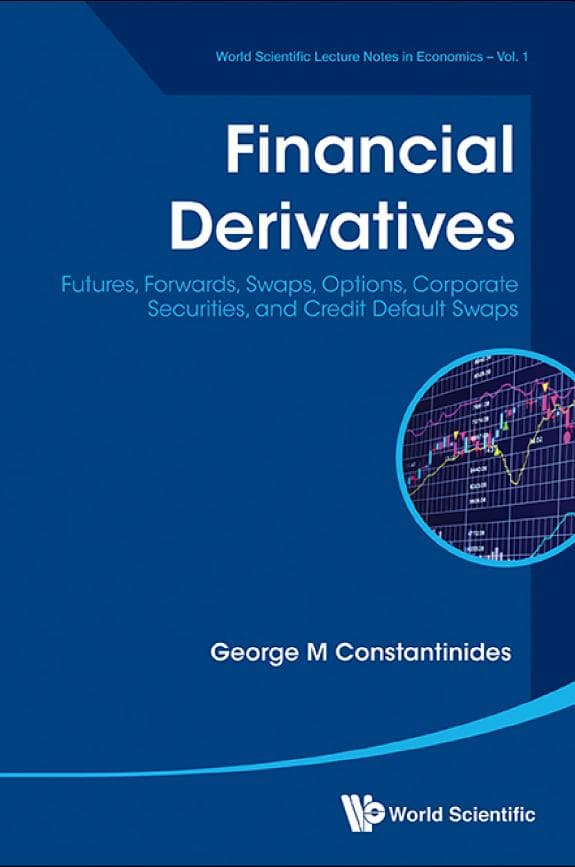
Core Idea
- Difficulty
- Medium
- Read it if
- You want a thorough introduction to the core financial derivatives (futures, forwards, swaps, options), understand their practical applications for hedging and risk management, or are interested in how derivatives are embedded in corporate securities and the function of credit default swaps. This book is suitable for finance students, professionals, and anyone seeking a detailed, practical guide to these instruments.
- Skip it if
- You are looking for a purely theoretical or highly mathematical treatment of derivatives, already have an advanced understanding of all the listed derivative types, or are interested only in proprietary trading strategies rather than the foundational mechanics and risk management aspects.
Key Takeaways from Financial Derivatives
Understanding Forward Contracts
A foundational derivative for locking in future prices today.
Forward contracts are over-the-counter (OTC) agreements to buy or sell an asset at a predetermined price on a future date. Unlike futures, they are highly customizable in terms of underlying asset, quantity, delivery date, and settlement terms. This customization, while beneficial for specific needs, also introduces counterparty risk because there is no clearing house guarantee. For example, a farmer might enter a forward contract to sell their corn harvest to a food processor at a fixed price in six months, mitigating price volatility risk. However, if the processor goes bankrupt, the farmer faces default risk. Their illiquidity also makes them difficult to unwind before maturity, often requiring direct negotiation with the counterparty. This contrasts sharply with standardized, exchange-traded futures.
“The forward contract is the simplest derivative, representing a customized agreement between two parties to buy or sell an asset at a specified price on a future date.”
In the book: Analysis of OTC market structures and counterparty risk in customized agreements.
Try this: Businesses can use forward contracts to hedge against future price fluctuations of raw materials or foreign currencies, provided they conduct thorough due diligence on their counterparty.
Related ideas: forward-contract, otc-market, counterparty-risk
Futures: Standardized Price Hedging
Exchange-traded contracts offering price discovery and risk mitigation.
Futures contracts are standardized agreements to buy or sell an asset at a predetermined price on a future date, traded on exchanges like the CME or ICE. Standardization in terms of quantity, quality, and delivery dates enhances liquidity and price discovery. The clearing house acts as an intermediary, guaranteeing performance and mitigating counterparty risk through daily mark-to-market adjustments and margin requirements. For instance, an airline might buy crude oil futures to lock in fuel costs, protecting against rising prices. If oil prices fall, they incur margin calls, but if prices rise, their futures position gains value, offsetting higher spot market costs. This system effectively transfers risk and provides transparent pricing for a wide range of commodities, currencies, and financial instruments.
“Futures contracts are standardized forward contracts that are traded on organized exchanges, characterized by daily margining and a clearing house guarantee.”
In the book: Mechanism of exchange-traded derivatives, clearing house operations, and margin systems.
Try this: Investors and corporations can use futures to hedge commodity price exposure, speculate on market movements, or gain exposure to asset classes efficiently.
Related ideas: futures-contract, clearing-house, margin-call, mark-to-market
Interest Rate Swaps for Risk Management
Transforming interest rate exposures between fixed and floating rates.
Interest rate swaps (IRS) are OTC contracts where two parties agree to exchange interest payments for a specified period, based on a notional principal. The most common type is a 'plain vanilla' swap, where one party pays a fixed interest rate and receives a floating rate (e.g., LIBOR or SOFR), while the other party does the opposite. This allows companies to manage their interest rate risk. For example, a company with floating-rate debt might enter an IRS to pay a fixed rate, hedging against rising interest rates. Conversely, a company with fixed-rate debt anticipating falling rates might swap into a floating rate. The notional principal itself is never exchanged. The primary benefit lies in customizing interest rate exposure to match risk appetite or exploit perceived market advantages, while also leveraging comparative advantages in borrowing markets.
“An interest rate swap is an agreement between two parties to exchange future interest payments based on a notional principal amount, often used to convert floating-rate debt into fixed-rate debt or vice versa.”
In the book: Examples of corporate debt restructuring and risk management strategies using IRS.
Try this: Corporations and financial institutions can use interest rate swaps to manage their balance sheet interest rate risk, optimize borrowing costs, or speculate on future interest rate movements.
Related ideas: interest-rate-swap, notional-principal, fixed-rate, floating-rate
Options: Rights, Not Obligations
Providing flexibility to buy or sell an asset without commitment.
Options are powerful derivatives that offer asymmetric payoffs, providing insurance-like protection or leveraged speculation. A call option grants the holder the right to buy an asset, while a put option grants the right to sell. The specified price is the 'strike price,' and the specified date is the 'expiration date.' The buyer pays a 'premium' for this right. For example, an investor bullish on a stock but wary of downside risk could buy a call option. If the stock price rises above the strike, they profit; if it falls, their loss is limited to the premium paid. Conversely, a put option can protect a portfolio from declines. This 'right, not obligation' feature makes options highly versatile for hedging, income generation (selling options), and directional bets, with predefined maximum losses for the buyer.
“An option is a contract that gives the buyer the right, but not the obligation, to buy or sell an underlying asset at a specified price on or before a specified date.”
In the book: Black-Scholes model for option pricing and empirical studies on option trading strategies.
Try this: Investors can use options to hedge existing stock portfolios, speculate on market direction with limited risk, or generate income by selling covered calls.
Related ideas: call-option, put-option, strike-price, premium, expiration-date
Corporate Securities as Embedded Derivatives
Hybrid instruments blending debt/equity with option-like features.
Corporate securities often contain features that behave like standalone derivatives. Convertible bonds, for instance, are debt instruments that give the holder the option to convert them into a specified number of common shares. This embedded call option provides upside potential if the company's stock performs well, while the bond component offers downside protection. Callable bonds, conversely, give the issuer the option to redeem the bond before maturity, typically when interest rates fall, allowing them to refinance at a lower cost. These embedded derivatives significantly impact the valuation, risk, and return characteristics of the securities. Understanding these components is crucial for investors to accurately assess the true value and risk profile of such complex financial instruments, as they can behave very differently from plain vanilla bonds or stocks.
“Many corporate securities, such as convertible bonds and callable bonds, contain embedded derivatives that alter their payoff profiles and risk characteristics.”
In the book: Valuation models for convertible and callable bonds, incorporating option pricing methodologies.
Try this: Investors should analyze the embedded options in corporate securities to understand their true risk-reward profile, while companies can use them to tailor financing to specific needs.
Related ideas: convertible-bond, callable-bond, embedded-derivative, hybrid-security
Credit Default Swaps (CDS): Transferring Credit Risk
A powerful tool for insuring against bond defaults or speculating on credit quality.
Credit Default Swaps (CDS) are OTC contracts that allow the transfer of credit risk from one party (the protection buyer) to another (the protection seller). The protection buyer pays periodic premiums to the seller. In return, if a specified 'credit event' (e.g., bankruptcy, failure to pay) occurs for a particular reference entity's debt, the seller compensates the buyer for the loss. For example, a bank holding corporate bonds can buy CDS protection to hedge against the bonds defaulting, thereby reducing its exposure to credit risk. Alternatively, investors can use CDS to speculate on the creditworthiness of companies or countries without actually owning their debt. While offering efficient credit risk management, the lack of transparency and potential for systemic risk, as seen in the 2008 financial crisis, underscore the importance of understanding their complex interdependencies.
“A credit default swap (CDS) is a financial derivative that allows an investor to 'swap' or offset their credit risk with that of another investor, essentially providing insurance against a bond default.”
In the book: Case studies of CDS usage in the 2008 financial crisis and their role in credit risk transfer.
Try this: Financial institutions can use CDS to manage their loan portfolios' credit risk, while sophisticated investors can use them to express views on corporate or sovereign credit quality.
Related ideas: credit-default-swap, credit-risk, credit-event, protection-buyer, protection-seller
The Role of Margining and Collateral
Mitigating counterparty risk in derivatives through daily adjustments.
Margining is a critical risk management process in derivatives, especially for futures and cleared OTC derivatives. Participants are required to post initial margin, a good-faith deposit, to cover potential losses. Futures contracts are then 'marked-to-market' daily, meaning profits and losses are settled each day. If a position incurs losses, the account holder receives a 'margin call' to deposit additional variation margin to bring the account back to the required level. Failure to meet a margin call can lead to forced liquidation of the position. This daily settlement and collateralization process, overseen by clearing houses, significantly reduces counterparty risk by ensuring that losses are absorbed incrementally and that both parties have sufficient funds to cover their obligations, preventing a cascading default scenario.
“Margining and collateral requirements are fundamental mechanisms in the derivatives market, particularly for exchange-traded contracts, to ensure financial integrity and mitigate counterparty default risk.”
In the book: Clearing house rules and regulations, and empirical analysis of default rates in cleared vs. uncleared markets.
Try this: Understanding margin requirements is essential for anyone trading futures or cleared options, as it dictates capital allocation and potential liquidity demands.
Related ideas: margining, initial-margin, variation-margin, margin-call, collateral
Derivatives for Risk Management and Speculation
Dual utility in hedging exposures and taking directional market bets.
Derivatives are versatile financial instruments used both to manage risk (hedging) and to profit from anticipated market movements (speculation). A manufacturer might use futures contracts to lock in the price of raw materials, hedging against potential price increases. This reduces uncertainty in their production costs. Conversely, a speculator might buy call options on a stock they believe will rise, aiming for a leveraged return. The key difference lies in the underlying motivation: hedging seeks to reduce or offset an existing risk exposure, while speculation involves taking on new risk in pursuit of profit. While often viewed with caution due to their complexity and potential for large losses, derivatives, when used judiciously, play a vital role in efficient capital markets by facilitating risk transfer and price discovery across various asset classes.
“Derivatives serve a dual purpose: they are powerful tools for hedging existing risks and efficient instruments for speculating on future market movements.”
In the book: Studies on corporate hedging effectiveness and the impact of speculative trading on market liquidity and price efficiency.
Try this: Companies should assess their risk exposures and determine appropriate hedging strategies, while individual investors can use derivatives for controlled speculation or portfolio protection.
Related ideas: hedging, speculation, risk-transfer, price-discovery
Valuation Principles: No-Arbitrage and Replication
Derivatives pricing relies on constructing equivalent portfolios.
The core of derivative valuation, particularly for options, rests on the principle of no-arbitrage. This means that if two assets or portfolios have identical future payoffs, they must trade at the same price today; otherwise, an arbitrage opportunity would exist, allowing risk-free profit. This principle leads to the concept of replication: a derivative's payoff can often be replicated by a dynamic portfolio of the underlying asset and a risk-free bond. For instance, the Black-Scholes-Merton model for option pricing implicitly assumes such replication, where a portfolio of stock and borrowing/lending can mimic the option's payoff. This methodology ensures that derivative prices are internally consistent and reflect the economic value of their underlying components, preventing persistent mispricing in efficient markets.
“The fundamental principle underlying derivative valuation is the absence of arbitrage, implying that a derivative's price must be consistent with that of a portfolio of underlying assets that replicates its payoffs.”
In the book: Derivation of the Black-Scholes-Merton option pricing model and its reliance on dynamic replication strategies.
Try this: Financial professionals use no-arbitrage pricing models to value complex derivatives, identify mispricings, and construct hedging portfolios.
Related ideas: no-arbitrage, replication, option-valuation, black-scholes-merton
Understanding Greeks: Sensitivity Measures
Quantifying how option prices react to market variables.
The 'Greeks' are a set of risk parameters that help traders and portfolio managers understand and manage the various sensitivities of options. Delta measures the option's price sensitivity to changes in the underlying asset's price. Gamma measures the rate of change of Delta, indicating how fast Delta changes as the underlying moves. Vega quantifies sensitivity to changes in the underlying asset's volatility. Theta measures the time decay of an option's value (how much value is lost as time passes). Rho measures sensitivity to changes in interest rates. For example, a high Delta option moves almost one-for-one with the underlying. A portfolio manager can use Delta to hedge their portfolio, aiming for a 'Delta-neutral' position to mitigate small price movements. Understanding these Greeks is vital for constructing robust hedging strategies, managing risk exposures, and making informed trading decisions in the complex options market.
“The 'Greeks' – Delta, Gamma, Vega, Theta, Rho – are essential measures that quantify the sensitivity of an option's price to changes in its underlying parameters, crucial for risk management.”
In the book: Applications of Greek letters in option portfolio management and dynamic hedging strategies.
Try this: Option traders and portfolio managers use Greeks to monitor and adjust their risk exposures, implement dynamic hedging, and optimize their strategies based on market outlook.
Related ideas: greeks, delta, gamma, vega, theta, rho, option-sensitivity
Financial Derivatives Quotes
“A derivative is a financial instrument whose value is derived from the value of an underlying asset or index.”
“Futures contracts are standardized, exchange-traded agreements to buy or sell an asset at a predetermined price on a specified future date.”
“Forwards are customized contracts between two parties to buy or sell an asset at a specified price on a future date.”
“Interest rate swaps allow two parties to exchange interest rate payments based on a notional principal amount.”
“An option gives the holder the right, but not the obligation, to buy or sell an underlying asset at a specified price on or before a certain date.”
“A call option grants the holder the right to buy the underlying asset, while a put option grants the right to sell.”
“The Black-Scholes-Merton model is a cornerstone for pricing European-style options.”
“Hedging is the practice of using financial instruments to offset the risk of adverse price movements.”
“Speculation involves taking a position in a derivative to profit from anticipated price changes.”
“Arbitrage seeks to profit from temporary price discrepancies between identical or similar assets in different markets.”
“Credit default swaps (CDS) are derivative contracts that allow an investor to 'swap' or offset their credit risk with that of another investor.”
“The notional principal in a swap is a reference amount used to calculate payment exchanges, but it is never actually exchanged.”
“Margin requirements in futures markets are designed to ensure that participants have sufficient funds to cover potential losses.”
“Counterparty risk is the risk that one of the parties to a financial contract will not fulfill its obligations.”
Quiz
10 questions on the main ideas. Each answer comes with a short explanation.
Question 1
Which of the following best describes a 'forward contract'?
- A standardized contract traded on an exchange to buy or sell an asset at a specified future date and price.
- A customized contract between two parties to buy or sell an asset at a specified future date and price.
- A contract giving the holder the right, but not the obligation, to buy or sell an asset.
- An agreement to exchange future cash flows based on different interest rates.
Show answer
B. A customized contract between two parties to buy or sell an asset at a specified future date and price. A forward contract is an over-the-counter (OTC) agreement, making it customized, unlike a standardized futures contract.
Question 2
What is the primary difference between a future contract and a forward contract?
- Futures are customized, forwards are standardized.
- Futures are traded OTC, forwards are traded on exchanges.
- Futures are exchange-traded and standardized; forwards are OTC and customized.
- Futures always result in physical delivery, forwards always result in cash settlement.
Show answer
C. Futures are exchange-traded and standardized; forwards are OTC and customized. Futures contracts are standardized and traded on organized exchanges, while forward contracts are customized and traded over-the-counter.
Question 3
Which of the following is NOT a characteristic of a 'swap' contract?
- It involves an exchange of cash flows between two parties.
- It is typically a standardized contract traded on an exchange.
- It is often used to manage interest rate or currency risk.
- The principal amount is usually not exchanged, but used as a notional amount.
Show answer
B. It is typically a standardized contract traded on an exchange. Swaps are typically customized, over-the-counter agreements, not standardized exchange-traded contracts.
Question 4
An 'American option' allows the holder to exercise the option:
- Only at expiration.
- Only on specific dates prior to expiration.
- At any time up to and including the expiration date.
- Only if the underlying asset price reaches a certain barrier.
Show answer
C. At any time up to and including the expiration date. American options offer flexibility as they can be exercised at any point during their life, unlike European options which can only be exercised at expiration.
Question 5
What does it mean for a 'call option' to be 'in the money'?
- The strike price is equal to the underlying asset's price.
- The strike price is higher than the underlying asset's price.
- The strike price is lower than the underlying asset's price.
- The option has no intrinsic value.
Show answer
C. The strike price is lower than the underlying asset's price. A call option is in the money when the holder can buy the underlying asset at a price (strike price) that is lower than its current market price.
Question 6
A Credit Default Swap (CDS) is primarily used for:
- Speculating on interest rate movements.
- Hedging against the risk of a bond issuer defaulting.
- Exchanging fixed interest payments for floating interest payments.
- Gaining exposure to commodity price changes.
Show answer
B. Hedging against the risk of a bond issuer defaulting. A CDS acts like an insurance policy against the default of a specific borrower (reference entity).
Question 7
Which of the following statements about 'corporate securities' is generally true in the context of derivatives?
- They are always the underlying assets for derivatives, never derivatives themselves.
- They can be structured as derivatives, such as convertible bonds or warrants.
- They are exclusively government-issued debt instruments.
- They have no relationship with derivative products.
Show answer
B. They can be structured as derivatives, such as convertible bonds or warrants. Many corporate securities, like convertible bonds (which contain an embedded option) or warrants, are themselves hybrid instruments with derivative characteristics.
Question 8
The 'payoff' of a long position in a 'futures contract' for an asset is:
- Fixed at the strike price regardless of the asset's price.
- The asset's spot price at maturity minus the futures price.
- The futures price minus the asset's spot price at maturity.
- Limited to the premium paid for the contract.
Show answer
B. The asset's spot price at maturity minus the futures price. For a long futures position, the profit (payoff) is the difference between the spot price at maturity and the agreed-upon futures price.
Question 9
What is the primary role of a 'clearing house' in futures trading?
- To provide investment advice to traders.
- To act as a counterparty to every trade, guaranteeing performance.
- To set the prices of futures contracts.
- To conduct physical delivery of the underlying assets.
Show answer
B. To act as a counterparty to every trade, guaranteeing performance. The clearing house acts as the buyer to every seller and the seller to every buyer, mitigating counterparty risk in futures markets.
Question 10
When an investor sells a 'put option', they are hoping the underlying asset's price will:
- Increase or stay above the strike price.
- Decrease significantly below the strike price.
- Remain highly volatile.
- Be exactly equal to the strike price at expiration.
Show answer
A. Increase or stay above the strike price. Selling a put option (short put) means the seller profits if the price stays above the strike price or rises, as the option will expire worthless or be exercised at a loss to the buyer.
Financial Derivatives FAQ
What is the primary focus of 'Financial Derivatives' by Unknown?
This book provides a comprehensive overview of various financial derivative instruments. It covers key types such as futures, forwards, swaps, and options, along with corporate securities and credit default swaps, explaining their mechanics and applications.
How does the book differentiate between futures and forwards?
The book meticulously details the differences, explaining that futures are standardized contracts traded on exchanges with daily margining, while forwards are customized, over-the-counter agreements between two parties. It highlights the implications of these structural differences for risk and flexibility.
What types of swaps are discussed in the book?
The book covers various types of swaps, including interest rate swaps, currency swaps, and potentially equity swaps. It explains how these instruments are used to manage risk, speculate, or gain exposure to different asset classes or interest rate regimes.
Does the book cover both vanilla and exotic options?
While the core focus would likely be on vanilla options (calls and puts) to establish foundational understanding, a comprehensive derivatives text often touches upon more exotic options to illustrate the breadth of the market. It explains their pricing and payoff structures.
How does the book explain the role of corporate securities in relation to derivatives?
The book likely integrates corporate securities by discussing how derivatives can be used to hedge risks associated with corporate bonds or equities, or how certain corporate securities themselves might have embedded derivative features. It highlights the interplay between these financial instruments.
What is a Credit Default Swap (CDS) and why is it important?
A Credit Default Swap is a financial swap agreement where the seller of the CDS compensates the buyer in the event of a loan default or other credit event. The book explains its role as a form of insurance against credit risk, its pricing, and its implications for financial stability.
Is this book suitable for beginners or experienced financial professionals?
Given its comprehensive nature covering multiple complex instruments, the book is likely suitable for both. It would serve as an excellent foundational text for students and a valuable reference for professionals looking to deepen their understanding or review specific derivative types.
Does the book provide practical examples or case studies?
A textbook of this nature typically includes numerous practical examples and potentially case studies to illustrate the application, pricing, and risk management of derivatives. This helps readers bridge the gap between theoretical concepts and real-world scenarios.
What mathematical background is required to understand this book?
While the book explains concepts clearly, a solid understanding of basic financial mathematics, probability, and statistics would be beneficial. It likely involves formulas for pricing and risk assessment, making a quantitative background helpful for deeper comprehension.
Similar books
- The Diary of a Young Girl
Anne Frank
4.2 (2.7M) average on GoodreadsBiographyDuring the Nazi occupation, a teenage girl's diary, written from a secret annex, shares observations on humanity, hope, and the wait for freedom.
- Twisted 1. Twisted love
Ana Huang
3.7 (1.7M) average on GoodreadsA quiet billionaire with a difficult past finds his guarded heart opening to the woman he must protect, but their growing passion uncovers dangerous secrets and a shared, traumatic history.
- Eat, Pray, Love
Elizabeth Gilbert
3.6 (1.5M) average on GoodreadsLifestyleA heartbroken writer leaves her conventional life for a year-long global search for pleasure in Italy, spiritual devotion in India, and unexpected love and balance in Bali.
- Night
Elie Wiesel
4.3 (970k) average on GoodreadsBiographyIn the darkness of Auschwitz and Buchenwald, a teenage Elie Wiesel faces the extermination of his family, the loss of his faith, and the lasting scars of humanity's deepest cruelty.
- Steve Jobs
Walter Isaacson
4.1 (957k) average on GoodreadsBusinessSteve Jobs was a visionary who fused creativity and technology to revolutionize six industries and shape our digital world.
- The Glass Castle
Jeannette Walls
4.3 (903k) average on GoodreadsBiographyJeannette Walls's memoir describes her unusual childhood with brilliant, free-spirited parents whose poverty-stricken life shaped her independence and love despite family problems.






Enjoyed the summary?
A summary gives you the shape of the book. The book itself has the detail, the examples and the voice.
Find Financial Derivatives on AmazonAs an Amazon Associate, BookBrief earns from qualifying purchases. How we're funded