
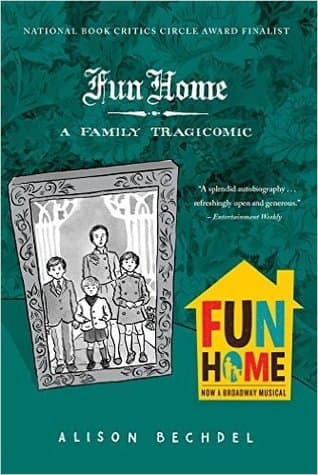
Core Idea
- Difficulty
- Medium
- Read it if
- You are interested in the intersection of memoir, LGBTQ+ themes, literary analysis, and the unique storytelling capabilities of graphic novels, particularly those exploring complex family dynamics and the nature of memory.
- Skip it if
- You prefer straightforward, linear narratives without frequent literary allusions, or if you are uncomfortable with the explicit exploration of sexuality and death in a family context.
Key Takeaways from Fun Home
The Fun Home as a Stage
Life and performance blur in a house of the dead.
Bechdel shows the family home, a funeral parlor, as a stage where life and death, authenticity and performance, mix. Her father, Bruce, carefully arranged their environment, from antique furniture to their public images, creating a facade that both protected and stifled. This performance extended to their emotional lives, where real feeling was often hidden by aesthetic perfection or literary allusions. The 'Fun Home' becomes a literal and metaphorical stage for the family's repressed desires and unspoken truths, where even grief is styled. This constant interplay between the real and the artificial, the living and the dead, helps explain the Bechdel family dynamic and Alison's own search for self-discovery.
“Our house, in the midst of all this, was a kind of fun house, a place of endless amusement and ingenious contrivances. It was also, of course, a funeral home, a house of the dead.”
In the book: Bruce Bechdel's obsession with restoring the Victorian house, his theatrical directing of local plays, and the family's public presentation versus their private struggles.
Try this: Reflect on the 'stages' in your own life – places or roles where you feel compelled to perform. How do these performances shape your identity, and what might you be obscuring from yourself or others?
Related ideas: performance-identity, familial-dynamics, architectural-metaphor
Parallel Lives, Divergent Paths
Discovering a shared secret through different expressions of identity.
A key revelation in the memoir is Alison's discovery of her father's homosexuality shortly after she comes out as a lesbian. This creates a sense of parallel lives, where both father and daughter dealt with their sexual identities, though with very different results. Bruce Bechdel's life was marked by repression, secret affairs, and a tragic end, while Alison's journey is one of liberation and self-acceptance. This contrast highlights the societal changes in attitudes towards homosexuality between their generations and the personal cost of living an inauthentic life. The shared secret creates a tragic bond, helping Alison understand her father's complexities and shaping her own identity.
“It was just a few weeks after I'd come out to my parents that my mother revealed to me that my father was also gay.”
In the book: Alison's coming out story juxtaposed with her mother's confession about Bruce's affairs and his subsequent death.
Try this: Consider how societal norms of different eras impact personal identity and expression. How might understanding the struggles of previous generations inform your own choices and empathy?
Related ideas: sexual-identity, generational-differences, repression-liberation
The Literary Lens
Life filtered through the pages of books.
Both Alison and her father, Bruce, had a strong connection to literature, using books not just for escape but as a way to understand and express their lives. Bruce, an English teacher, lived his life through literary allusions, often quoting poets and authors to express emotions he could not directly voice. Alison, in turn, uses literature—from Proust to Joyce to Fitzgerald—to understand her father's personality and her own developing identity. This shared intellectual world, while connecting them, also created a barrier, as emotional expression was often turned into literary critique. The memoir itself is structured with a literary sensibility, drawing connections between the Bechdel family and various literary works.
“My father was not a reader. He was a re-reader. He read the same books over and over again. He didn't read for pleasure, it seemed, but for structure.”
In the book: Bruce's frequent literary quotes, Alison's analysis of her father through authors like Camus and Fitzgerald, and the memoir's structural nods to classical literature.
Try this: Explore how you use art or literature to process your own experiences. Does it enhance understanding or sometimes create a distance from direct emotion?
Related ideas: literary-analysis, intellectual-connection, emotional-expression
The Art of Obsessive Detail
A coping mechanism for chaos and unspoken truths.
Bruce Bechdel's careful attention to detail, whether restoring the house, arranging flowers, or dressing his children, was a way to cope with his inner turmoil and the reality of his suppressed desires. This obsession with external perfection was an attempt to control an inner world he could not reconcile. Alison inherits a similar, though more productive, drive for detail in her art, especially in her graphic memoir. Her detailed drawings and precise narrative structure reflect her father's carefulness, but instead of hiding, Alison uses detail to reveal complex truths. The memoir itself is an act of analysis, putting together fragments to understand the whole.
“He'd spend hours arranging the flowers, pruning the shrubs, waxing the floors. It was as if he could impose order on the world by imposing it on our house.”
In the book: Descriptions of Bruce's house renovations, gardening, and clothing choices, contrasted with Alison's detailed illustrations and narrative structure.
Try this: Observe how you or others use order and control in external environments. What might this reveal about underlying anxieties or a desire for internal stability?
Related ideas: coping-mechanisms, perfectionism, artistic-process
The Unreliable Narrator of Memory
Piecing together a past from fragments and perspectives.
Bechdel addresses the unreliability of memory and the subjective nature of truth, especially when reconstructing the life of someone as guarded as her father. She acknowledges the gaps in her understanding, her own biases, and the impossibility of fully knowing another person's inner world. The memoir is not a definitive account but an ongoing investigation, a mosaic built from childhood memories, family stories, letters, and literary parallels. This self-awareness about memory's limits strengthens the narrative, inviting the reader to interpret rather than just presenting a fixed reality. It shows that even personal histories are constructed stories.
“I can only imagine what it must have been like for him. But imagining is not knowing, is it?”
In the book: Alison's direct admission of not fully knowing her father's thoughts, her use of multiple perspectives, and the fragmented, non-linear storytelling.
Try this: When reflecting on your own past or the lives of others, consider what assumptions you might be making. How can you embrace ambiguity and multiple perspectives?
Related ideas: memory-reconstruction, subjective-truth, narrative-limitations
The Weight of the 'Closet'
The destructive power of societal shame and self-denial.
Bruce Bechdel's closeted existence serves as a warning about the destructive psychological and emotional cost of societal shame and self-denial. His inability to live authentically led to a life of emotional distance, secrecy, and a tragic, ambiguous death. This repression affected the entire family, creating an atmosphere of unspoken truths and emotional guardedness. While Alison's generation had more freedom, her father's story is a reminder of the impact of oppressive social norms on individual lives and family systems. The memoir argues that the 'closet' is not just a personal space but a force that distorts relationships and identities.
“He was a closeted homosexual, and his struggle to contain that truth shaped not only his life but ours.”
In the book: Bruce's secret affairs, his emotional distance from his family, and the ambiguity surrounding his death, heavily implied to be suicide.
Try this: Reflect on any areas in your life where you might be withholding your true self due to fear or societal pressure. What are the costs of this concealment?
Related ideas: homophobia-impact, emotional-repression, societal-shame
Fathers and Daughters: A Complex Mirror
Seeking oneself in the reflection of a parent's life.
The relationship between Alison and her father is central to the memoir, presented as a complex mirror where Alison tries to understand herself through him. Despite Bruce's emotional distance and hidden life, Alison sees similarities, especially in their shared intellect, artistic temperament, and eventually, their homosexuality. This connection is both fascinating and painful, as she deals with inheriting aspects of a man whose life ended in tragedy. The memoir is an act of reconciliation, where Alison uses her art to bridge the gap between their lives, transforming inherited trauma into a way for self-understanding and acceptance. Her father, in his complexity, becomes an important, though flawed, model for her own identity.
“And in the end, it was my father, not my mother, who provided the template for my own life.”
In the book: Alison's detailed comparisons of her own interests and struggles with her father's, their shared love for books, and the eventual revelation of their shared sexual orientation.
Try this: Consider how your parents' lives, both their triumphs and struggles, have influenced your own identity and choices. What lessons, both positive and cautionary, have you drawn?
Related ideas: parent-child-dynamics, inherited-traits, self-discovery
The Power of the Graphic Memoir
Visual storytelling as a unique tool for complex narratives.
Bechdel's choice of the graphic memoir format is not just aesthetic; it is part of the narrative's depth and impact. The visual medium allows her to layer meaning, combining images and text to convey unspoken emotions, historical context, and literary allusions in ways prose cannot. The detailed illustrations, from architectural blueprints to character expressions, give a concrete reality to the abstract complexities of memory and identity. This visual storytelling enhances the themes of performance and hidden truths, as panels can show what characters hide, and the reader can visually 'read' between the lines. It is an active form of engagement that immerses the reader in Alison's investigative process.
“The graphic novel is a perfect medium for this story. The pictures allow me to show things I can't say, and the words allow me to say things I can't show.”
In the book: The intricate panel layouts, detailed character renderings, visual metaphors (e.g., the house as a stage), and the integration of text with images to convey nuanced meaning.
Try this: When consuming information, consider how the medium itself influences your understanding. How do different formats (e.g., text, visual, audio) shape the message?
Related ideas: graphic-novel-medium, visual-narrative, intermediality
Ambiguous Endings, Enduring Questions
Some mysteries are meant to remain unsolved.
The memoir ends without solving the mystery of Bruce Bechdel's death, which is officially ruled an accident but strongly suggested to be suicide. This ambiguity is key to the memoir's power, reflecting the difficulty of fully understanding another person, especially one as guarded as her father. Instead of providing neat answers, Bechdel embraces the enduring questions, recognizing that some truths are too complex or painful to be neatly packaged. This open-endedness invites the reader to accept discomfort and uncertainty, mirroring Alison's own ongoing process of dealing with her father's legacy. It suggests that closure is not always about definitive answers, but about accepting the unknown.
“I can’t help but feel that his death was a suicide. But I can’t know for sure. It’s a question that will always hang over me.”
In the book: The differing accounts of Bruce's death, the lack of a suicide note, and Alison's continuous reflection on the 'accident' versus 'suicide' debate.
Try this: Consider situations in your own life where you've sought definitive answers but found ambiguity. How can you find peace or understanding within that uncertainty?
Related ideas: ambiguity-in-narrative, unresolved-grief, personal-interpretation
The Architecture of Self
Constructing identity from inherited blueprints and personal renovations.
Bechdel consistently uses architectural metaphors to describe the construction of identity, both her father's and her own. Bruce Bechdel's obsession with renovating their Victorian home can be seen as an attempt to carefully build and control an external self, while his true self remained hidden in 'secret passages.' Alison, in turn, uses her memoir to deconstruct and reconstruct, examining the 'blueprint' of her father's life to understand the foundations of her own. She takes the inherited materials—his intellect, his artistic sensibility, his sexuality—and consciously re-engineers them into her own authentic structure. This metaphor shows that identity is not static but a dynamic process of building, tearing down, and renovating.
“My father's blueprint, as it were, was a complex one, and I've spent my life trying to decipher it, to build my own structure on its foundation.”
In the book: Bruce's extensive house renovations, Alison's detailed drawings of the house's floor plans, and the repeated imagery of architecture throughout the memoir.
Try this: Think about the 'architectural blueprints' you've inherited from your family or culture. What elements do you choose to keep, renovate, or discard in building your own identity?
Related ideas: identity-formation, inherited-legacy, self-construction
Fun Home Quotes
“In our house, we were all of us in the closet. My father, with his secret, and my mother and I, with our complicit silence.”
“It was a vicious cycle, the way my father's aesthetic perfectionism mirrored his sexual repression. The more he tried to control the external world, the more chaotic his inner world became.”
“I was a lesbian before I even knew what a lesbian was. I was just a girl who liked to wear boys' clothes and read books.”
“My father's death was not a suicide. It was a self-inflicted fatality.”
“The feeling of being on the outside, of not belonging, was a familiar one. It was the air I breathed.”
“We were a family of bookworms, but our books were not for sharing. They were for hoarding, for escaping, for building walls.”
“He was a sphinx, my father. A riddle I would spend my life trying to solve.”
“What I couldn't see, what I hadn't realized, was that I was not the only one in the family who was 'different.'”
“It was an odd coincidence, my coming out and his going in.”
“My father's life was a grand, tragicomic play, and I was merely a bit player, a ghost in the wings.”
“His taste was impeccable, his execution flawless. But his heart, I sometimes suspected, was made of stone.”
“I was caught between a rock and a hard place, between the truth and the story.”
“We convert the world into ourselves, and like all conversions, it is a violent one.”
“The past is a foreign country; they do things differently there. But the past is also a mirror, reflecting our present selves.”
Quiz
10 questions on the main ideas. Each answer comes with a short explanation.
Question 1
What was the primary business operated by Alison Bechdel's family, which they affectionately (or ironically) referred to as the 'Fun Home'?
- A toy store
- A funeral home
- A local theater
- A general store
Show answer
B. A funeral home The family business was a funeral home, which Alison and her family called the 'Fun Home,' a central location and namesake for the memoir.
Question 2
Besides managing the funeral home, what other profession did Alison's father, Bruce Bechdel, hold?
- A librarian
- A carpenter
- An English teacher
- A journalist
Show answer
C. An English teacher Bruce Bechdel was an English teacher in addition to running the funeral home, highlighting his intellectual and performative aspects.
Question 3
When did Alison Bechdel discover her father was gay?
- During her childhood
- After his death
- While she was in college, shortly after she came out as a lesbian
- Through a letter he left behind
Show answer
C. While she was in college, shortly after she came out as a lesbian Alison discovered her father's homosexuality in college, around the same time she came out herself, a crucial parallel in their lives.
Question 4
Which literary work is frequently referenced and used as a structural parallel throughout 'Fun Home' to explore themes of identity and the father-daughter relationship?
- The Odyssey by Homer
- Ulysses by James Joyce
- To Kill a Mockingbird by Harper Lee
- A Portrait of the Artist as a Young Man by James Joyce
Show answer
B. Ulysses by James Joyce Bechdel uses 'Ulysses' by James Joyce as a significant literary framework, drawing parallels between Stephen Dedalus and Leopold Bloom to her own relationship with her father.
Question 5
What is a central theme explored through the juxtaposition of the funeral home setting and the Bechdel family's personal lives?
- The normalcy of death in everyday life
- The performative nature of gender and identity, and the concealment of true selves
- The economic struggles of small-town businesses
- The importance of community support in times of grief
Show answer
B. The performative nature of gender and identity, and the concealment of true selves The funeral home, a place of staging and appearances, mirrors the 'staging' of identity and the hidden lives within the Bechdel family, particularly regarding sexuality.
Question 6
How does the graphic novel format specifically contribute to the storytelling in 'Fun Home'?
- It simplifies complex emotional narratives for a younger audience.
- It allows for a linear, straightforward narrative without digressions.
- It enables the visual depiction of memory, literary allusions, and the interplay between past and present, enhancing complex themes.
- It primarily serves to make the book more accessible to non-readers.
Show answer
C. It enables the visual depiction of memory, literary allusions, and the interplay between past and present, enhancing complex themes. The graphic format is crucial for 'Fun Home,' allowing Bechdel to visually layer meaning, connect disparate elements, and show, rather than just tell, the complexities of her memories and literary references.
Question 7
Which term best describes the narrative structure of 'Fun Home'?
- Strictly chronological
- A fragmented, non-linear exploration of memory, literary parallels, and personal history
- A series of independent vignettes
- An objective, journalistic account
Show answer
B. A fragmented, non-linear exploration of memory, literary parallels, and personal history 'Fun Home' is characterized by its non-linear, fragmented narrative, weaving together memories, literary analysis, and historical context to construct meaning.
Question 8
Alison Bechdel's father died shortly after her revelation about her own sexuality and his own secret was revealed. How does Bechdel primarily explore the ambiguity surrounding his death?
- By explicitly stating it was a suicide and detailing the method.
- By presenting it as a clear accident with no underlying implications.
- By dissecting the circumstances, his character, and literary allusions to suggest it was likely a suicide while maintaining a degree of uncertainty.
- By focusing on the police investigation and official reports.
Show answer
C. By dissecting the circumstances, his character, and literary allusions to suggest it was likely a suicide while maintaining a degree of uncertainty. Bechdel never definitively labels her father's death as suicide, but through careful exploration of his character, his repressed desires, and literary parallels (like Icarus), she strongly implies it, leaving a lingering ambiguity.
Question 9
What is the significance of the Bechdel family's meticulous restoration of their old house, as depicted in the memoir?
- It symbolizes their commitment to preserving historical architecture.
- It reflects Bruce Bechdel's obsession with appearances, control, and creating a perfect facade that contrasts with the hidden realities within the family.
- It was a practical necessity due to financial constraints.
- It was a hobby shared by the entire family, fostering closeness.
Show answer
B. It reflects Bruce Bechdel's obsession with appearances, control, and creating a perfect facade that contrasts with the hidden realities within the family. The house restoration symbolizes Bruce's meticulous control and obsession with creating an aesthetically perfect, almost theatrical, facade that masked the internal turmoil and secrets of the family.
Question 10
How does Alison Bechdel's coming out as a lesbian influence her understanding and portrayal of her father?
- It makes her reject him entirely due to his hypocrisy.
- It creates a profound sense of shared identity and empathy, allowing her to understand his hidden life and struggles.
- It has no bearing on her perception of him, as their experiences were too different.
- It fuels her anger and resentment, making her focus solely on his flaws.
Show answer
B. It creates a profound sense of shared identity and empathy, allowing her to understand his hidden life and struggles. Alison's own journey of coming out creates a powerful and painful resonance with her father's hidden life, fostering a profound, albeit complex, empathy and understanding of his struggles and identity.
Fun Home FAQ
What is 'Fun Home: A Family Tragicomic' about?
'Fun Home' is a graphic memoir by Alison Bechdel that explores her complex relationship with her late father, Bruce Bechdel. It delves into their shared experiences as closeted homosexuals, her father's secret life, and the mysteries surrounding his death, all set against the backdrop of their family's funeral home business.
Is 'Fun Home' a true story?
Yes, 'Fun Home' is an autobiographical work. Alison Bechdel meticulously recounts her own life experiences, family history, and personal reflections, making it a non-fiction memoir.
What is a 'graphic memoir'?
A graphic memoir is a subgenre of memoir that uses the comic book medium to tell a true story from the author's life. It combines text with sequential art to convey narrative, emotion, and information, offering a unique visual storytelling experience.
Does 'Fun Home' explore LGBTQ+ themes?
Yes, LGBTQ+ themes are central to 'Fun Home.' The memoir openly discusses Alison Bechdel's coming out as a lesbian and her later discovery of her father's hidden homosexuality, exploring the complexities of identity, secrecy, and societal expectations for gay individuals in different eras.
How does 'Fun Home' differ from a traditional written memoir?
'Fun Home' distinguishes itself from traditional written memoirs through its use of illustrations and paneling. The visual elements not only enhance the narrative but also provide additional layers of meaning, character development, and emotional depth that can't be achieved with text alone, often revealing subtext or unspoken feelings.
What is the significance of the 'Fun Home' title?
The title 'Fun Home' is a play on words, referring to the family's funeral home business, which they affectionately (or ironically) called the 'Fun Home.' It subtly hints at the dark humor, the macabre setting, and the underlying family dysfunctions explored within the memoir.
Does Alison Bechdel resolve the mystery of her father's death?
While Bechdel investigates her father's life and the circumstances of his death throughout the book, the memoir doesn't offer a definitive, simple resolution to the 'mystery.' Instead, it explores the complexities of his life and choices, leaving readers with a nuanced understanding rather than a clear-cut answer.
Is 'Fun Home' suitable for all readers?
'Fun Home' deals with mature themes including sexuality, death, and complex family dynamics. While critically acclaimed, its content is generally recommended for adult readers or mature young adults due to its sensitive subject matter and nuanced exploration of personal identity.
What impact did 'Fun Home' have on literature and graphic novels?
'Fun Home' was groundbreaking for its literary depth and artistic merit, elevating the graphic novel medium to new critical heights. It demonstrated the power of comics to explore profound personal narratives and complex psychological themes, paving the way for more literary graphic works and memoirs.
About the author

Alison Bechdel is an acclaimed graphic novelist celebrated for her deeply personal and introspective works. Her breakout memoir, "Fun Home: A Family Tragicomic," earned widespread critical praise and was adapted into a Tony Award-winning musical. Bechdel's "Dykes to Watch Out For" also garnered significant attention for its witty social commentary and exploration of lesbian culture.
Similar books
- Persepolis: The Story of a Childhood
Marjane Satrapi
4.3 (158k) average on GoodreadsBiographyA graphic memoir exploring personal and political history through a child's eyes, dealing with identity and family.
- The Diary of a Young Girl
Anne Frank
4.2 (2.7M) average on GoodreadsBiographyDuring the Nazi occupation, a teenage girl's diary, written from a secret annex, shares observations on humanity, hope, and the wait for freedom.
- Eat, Pray, Love
Elizabeth Gilbert
3.6 (1.5M) average on GoodreadsLifestyleA heartbroken writer leaves her conventional life for a year-long global search for pleasure in Italy, spiritual devotion in India, and unexpected love and balance in Bali.
- Night
Elie Wiesel
4.3 (970k) average on GoodreadsBiographyIn the darkness of Auschwitz and Buchenwald, a teenage Elie Wiesel faces the extermination of his family, the loss of his faith, and the lasting scars of humanity's deepest cruelty.
- Steve Jobs
Walter Isaacson
4.1 (957k) average on GoodreadsBusinessSteve Jobs was a visionary who fused creativity and technology to revolutionize six industries and shape our digital world.
- The Glass Castle
Jeannette Walls
4.3 (903k) average on GoodreadsBiographyJeannette Walls's memoir describes her unusual childhood with brilliant, free-spirited parents whose poverty-stricken life shaped her independence and love despite family problems.





Enjoyed the summary?
A summary gives you the shape of the book. The book itself has the detail, the examples and the voice.
Find Fun Home on AmazonAs an Amazon Associate, BookBrief earns from qualifying purchases. How we're funded