
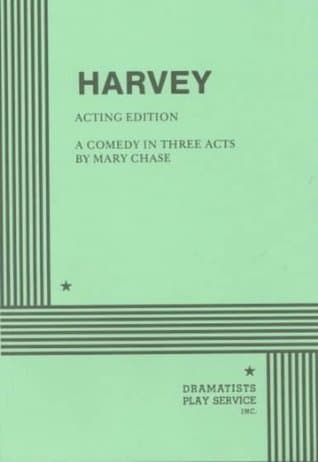
Synopsis
Covers the whole plot, including the ending.
- Difficulty
- Easy
- Pacing
- Moderate
- Mood
- Whimsical, Heartwarming, Humorous, Thought-provoking
- Read it if
- You enjoy whimsical, character-driven stories about acceptance and the power of imagination.
- Skip it if
- You prefer fast-paced plots or stories with clear, tangible conflicts.
Harvey Plot Summary
Covers the whole plot, including the ending.
The Dinner Party Disaster
The play starts in the Dowd family home. Veta Louise Simmons tries to host a dinner party for her daughter, Myrtle Mae. Her kind but eccentric brother, Elwood P. Dowd, constantly interrupts by introducing everyone to his best friend, Harvey, an invisible, six-and-a-half-foot-tall rabbit. Elwood's insistence on Harvey's presence, including offering him a seat and talking to him, embarrasses Veta and Myrtle Mae, especially when Elwood escorts an imaginary Harvey out, causing a guest to fall. Veta decides Elwood's behavior is too much and plans to have him committed to a sanitarium.
Chumley's Rest Sanitarium
Veta, with Myrtle Mae's help, takes Elwood to Chumley's Rest, a local sanitarium. She explains Elwood's delusion to Dr. Lyman Sanderson, a young psychiatrist, hoping for a quick admission. However, as Veta describes Elwood's long-standing belief in Harvey and her own frustration, she sounds erratic. Dr. Sanderson, misunderstanding her frantic account and Veta's casual mention of seeing Harvey herself due to stress, concludes that Veta is hallucinating and orders her committed instead. Elwood, unaware, wanders off, thinking Veta is just resting.
The Mix-Up Revealed
Myrtle Mae, upset by her mother's commitment, tries to explain the mistake to Dr. William Chumley, the head of the sanitarium. She clarifies that Elwood sees Harvey, not Veta. Dr. Chumley, a respected psychiatrist, is at first skeptical but then realizes the serious error. He is furious with Dr. Sanderson for his incompetence. The immediate concern becomes finding Elwood, who has left the sanitarium, as he is key to Veta's release and the sanitarium's reputation. Dr. Chumley personally takes charge of the search.
Elwood's Serene Return
While Dr. Chumley and the staff frantically search for Elwood, Elwood P. Dowd calmly returns to Chumley's Rest on his own. He is looking for Harvey, whom he thinks he left behind. Elwood's gentle manner and complete lack of awareness of the chaos he caused further frustrate the staff. He continues to speak of Harvey as if he were there, confusing Dr. Sanderson and the nurses. This return sets up the doctors to finally confront Elwood about his 'delusion'.
Chumley's Encounter with Harvey
Dr. Chumley tries to interview Elwood to understand his delusion. During their talk, Elwood tells a story of how Harvey appeared to him after he'd been drinking at a bar, introducing himself as a pooka. Elwood describes Harvey's ability to stop time and his general pleasantness. Dr. Chumley, at first dismissive, starts to be subtly affected by Elwood's genuine belief and vivid descriptions. He even finds himself alone for a moment, thinking he hears a faint whistle and sees a large rabbit-shaped shadow, making him question Harvey's reality.
The Injection Plan
To 'cure' Elwood, Dr. Sanderson and Nurse Ruth Kelly prepare an injection, Formula 977, which will make him 'normal' by removing his belief in Harvey. Veta, after spending time confined and thinking, starts to feel regret. She overhears talks about Elwood's gentle nature and the happiness he brings others. She begins to wonder if taking Harvey away from Elwood is right, realizing that Elwood's unique view, though unconventional, also makes him kind and well-liked.
Veta's Change of Heart
As Elwood is led to receive the injection, a taxi driver, Mr. Wilson, arrives to pick him up. Mr. Wilson describes Elwood as a kind man who always has a friendly word and never complains. He also recounts how Elwood paid his fare for a struggling young mother. This story, with Veta's growing unease, strengthens her decision. Just as Dr. Sanderson is about to give the injection, Veta intervenes, pulling Elwood away and declaring she doesn't want him 'cured' if it means losing the kind, gentle Elwood she knows. She realizes Harvey is part of what makes him special.
The True Nature of Harvey
The taxi driver then reveals a peculiar detail: he's driven many people to the sanitarium to be 'cured' of their imaginary friends, and almost all of them, upon leaving, become irritable, selfish, and unhappy. He explains that pookas like Harvey can influence people, sometimes making them kind and happy, or, if removed, leaving them bitter. This revelation deeply affects Veta, Dr. Sanderson, and Nurse Kelly, making them question reality and the impact of Elwood's unique perspective.
Elwood's Decision
Elwood, understanding that Veta has accepted Harvey, decides not to take the injection. He asks Veta if she's ready to go home, and she agrees. Dr. Sanderson, after hearing the taxi driver's story and Veta's change of heart, now sees Elwood not as a patient to be cured, but as a man who brings joy and kindness. The play ends with Elwood and Veta leaving Chumley's Rest, Elwood still with his invisible friend Harvey, and Veta, for the first time, truly at peace with her brother's companion.
Harvey Characters
Elwood P. Dowd
Protagonist
A kind, eccentric man whose best friend is an invisible, six-and-a-half-foot rabbit named Harvey.
Elwood is a perpetually cheerful, polite, and gentle man, seemingly unbothered by the world's perception of his imaginary friend, Harvey. He finds joy in simple things, loves people unconditionally, and is always ready for a friendly chat or a drink. His primary motivation is to spread happiness and kindness, often engaging strangers in conversation and offering small acts of generosity. He genuinely believes in Harvey's existence and views him as a constant, comforting companion. He is never angry or confrontational, even when others are trying to commit him.
Relationships: Harvey (Best friend, constant companion, imaginary or real pooka); Veta Louise Simmons (Sister, initially embarrassed and frustrated, later accepting and protective); Myrtle Mae Simmons (Niece, embarrassed by him, but also cares for him); Dr. William Chumley (Psychiatrist, initially sees him as a patient, later intrigued and possibly affected by him); Dr. Lyman Sanderson (Psychiatrist, initially dismissive, later influenced by Elwood's perspective); Mr. Wilson (Taxi driver, respects and understands Elwood's unique charm)
Veta Louise Simmons
Supporting
Elwood's social-climbing sister, initially desperate to commit him.
Veta is a high-strung, social-conscious woman, deeply concerned with appearances and her family's standing in society. She is easily flustered and prone to dramatic outbursts, especially when Elwood's behavior threatens her social aspirations for her daughter, Myrtle Mae. Her initial motivation is to 'cure' Elwood and remove the embarrassment he causes. She loves Elwood, but her love is often overshadowed by her desire for normalcy and social acceptance. She is torn between familial affection and societal pressure.
Relationships: Elwood P. Dowd (Brother, initially frustrated and embarrassed by him, later accepting and protective); Myrtle Mae Simmons (Daughter, wants to secure her social future, often exasperated by her); Dr. Lyman Sanderson (Initially trusts him to 'cure' Elwood, later defies him); Dr. William Chumley (Seeks his authority to resolve her family's 'problem')
Harvey
Supporting
An invisible, six-and-a-half-foot-tall rabbit (pooka) and Elwood's best friend.
Harvey is a mysterious and unseen character, existing solely through Elwood's descriptions and the reactions of others. He is a pooka, a mythological creature known for mischief but also for bringing good fortune. He is portrayed as kind, loyal, and a good listener, always present by Elwood's side. Harvey's existence challenges the audience and the characters to question the nature of reality and sanity. His influence is said to make people kind and happy, and his absence can lead to bitterness. He never speaks or appears directly, but his presence is profoundly felt.
Relationships: Elwood P. Dowd (Best friend, constant companion, source of his happiness); Dr. William Chumley (His existence is challenged and possibly experienced by Chumley); Veta Louise Simmons (Initially feared and denied, later accepted)
Myrtle Mae Simmons
Supporting
Veta's daughter, desperate to find a husband and embarrassed by Elwood.
Myrtle Mae is a young woman desperate to secure a husband and maintain a respectable social image. She is acutely aware of how Elwood's eccentricities hinder her romantic prospects and social standing. She is often exasperated and embarrassed by her uncle, but she also genuinely cares for her mother. She is less complex than Veta, primarily driven by external validation and societal norms. She is a foil to Elwood's carefree nature, representing conventional desires.
Relationships: Veta Louise Simmons (Mother, shares her desire for social standing); Elwood P. Dowd (Uncle, source of embarrassment, but also a family member she cares for)
Dr. William Chumley
Supporting
The esteemed, authoritative head of Chumley's Rest sanitarium.
Dr. Chumley is a renowned psychiatrist, proud of his institution and his ability to 'cure' patients. He is initially arrogant, authoritative, and quick to dismiss anything outside his established medical understanding. His motivation is to maintain the sanitarium's reputation and uphold his scientific principles. However, his encounter with Elwood and the mysterious influence of Harvey begin to challenge his rigid worldview, leading him to a moment of personal doubt and wonder. He is a man of science who briefly flirts with the inexplicable.
Relationships: Elwood P. Dowd (Patient, subject of his professional curiosity and later, personal bewilderment); Dr. Lyman Sanderson (Subordinate, initially critical of his mistake, later shares a moment of confusion); Nurse Ruth Kelly (Staff member)
Dr. Lyman Sanderson
Supporting
A young, ambitious psychiatrist at Chumley's Rest.
Dr. Sanderson is a well-meaning but somewhat inexperienced and overly confident young psychiatrist. He is eager to prove himself but is also prone to making hasty judgments, as evidenced by his initial misdiagnosis of Veta. He is driven by a desire to follow established medical protocols and believes firmly in his ability to 'cure' mental illness. He is initially dismissive of Elwood's 'delusion' but, by the end, shows signs of being influenced by Elwood's gentle nature and the enigmatic presence of Harvey.
Relationships: Dr. William Chumley (Superior, initially earns his ire, later collaborates with him); Veta Louise Simmons (Patient, then later a source of defiance); Elwood P. Dowd (Patient, whose influence changes his perspective); Nurse Ruth Kelly (Colleague and romantic interest)
Nurse Ruth Kelly
Supporting
A kind and observant nurse at Chumley's Rest, in love with Dr. Sanderson.
Nurse Kelly is a compassionate and observant nurse who works at Chumley's Rest. She is in love with Dr. Sanderson and often tries to guide him, sometimes with exasperation. She is generally more empathetic than Sanderson and is quicker to notice the positive impact Elwood has on others. She represents a grounded, caring perspective within the sanitarium's clinical environment. She is capable and professional, but also possesses a human warmth that contrasts with the doctors' initial detachment.
Relationships: Dr. Lyman Sanderson (Colleague and romantic interest); Elwood P. Dowd (Patient, whose kindness she observes and appreciates)
Mr. Wilson
Supporting
A perceptive taxi driver who understands the true nature of pookas.
Mr. Wilson is a minor but pivotal character, a taxi driver who brings a dose of practical wisdom and mystical insight to the play's climax. He is observant and has a unique understanding of human nature and the power of imaginary friends (pookas). His testimony about the effects of the 'cure' on his past passengers provides a crucial turning point, validating Elwood's way of life and influencing Veta's decision. He represents a folk wisdom that challenges the scientific authority of the sanitarium.
Relationships: Elwood P. Dowd (Customer, whom he respects and understands); Veta Louise Simmons (Customer, to whom he imparts crucial wisdom)
Harvey Themes
The Nature of Reality and Sanity
The play constantly asks what 'reality' and 'sanity' mean. Elwood's belief in Harvey challenges the doctors' clinical definitions of delusion. While the doctors try to 'cure' him, the audience wonders if Harvey is truly imaginary or if Elwood simply sees a reality others cannot. The play suggests that 'sanity' can be isolating and rigid, while Elwood's 'delusion' brings him joy and kindness, showing that what is considered normal is subjective. Dr. Chumley's possible encounter with Harvey and the taxi driver's story further blur these lines, suggesting there might be more to existence than science can explain.
“In this world, Elwood, you must be oh so smart or oh so pleasant. Well, for years I was smart. I recommend pleasant.”
The Value of Kindness and Empathy
Elwood P. Dowd shows pure kindness and empathy. Despite his quirks, he is liked by everyone he meets, from the barman to the taxi driver, because he is pleasant, non-judgmental, and always ready with a kind word. The play contrasts Elwood's good influence with the often harsh environment of the sanitarium. Veta changes when she realizes that 'curing' Elwood would remove the qualities that make him unique and loved, suggesting that kindness, even if from an unconventional view, is more valuable than strict adherence to normalcy. His simple acts of generosity, like paying a young mother's taxi fare, show the impact of his gentle nature.
“I've wrestled with reality for 35 years, Doctor, and I'm happy to state that I finally won out over it.”
Social Conformity vs. Individual Happiness
Veta and Myrtle Mae show the pressure to fit in with society. They worry about appearances, social standing, and what others think, especially about Elwood's 'embarrassing' behavior. The sanitarium itself represents society's attempt to force people into a set mold. However, Elwood, through his constant happiness and acceptance of himself and Harvey, shows the joy that comes from rejecting conformity for personal contentment. Veta's final decision to accept Elwood and Harvey means she rejects superficial social pressures for her brother's happiness and her own peace. The taxi driver's warning about 'cured' patients becoming bitter reinforces that conformity can have a high personal cost.
“Well, I've had a wonderful evening. You know, I've always wanted to have a dinner party for some of my friends, but I never got around to it. Tonight, I did.”
The Power of Imagination and Belief
Elwood's imagination is not just the source of his 'delusion' but also his greatest strength. His belief in Harvey lets him live with optimism and kindness. The play suggests that imagination, even when it appears as an invisible six-and-a-half-foot rabbit, can be a strong force for good. Harvey, as a pooka, is a mythical creature born of belief. The play asks the audience to consider the power of belief itself—whether in an imaginary friend, a scientific cure, or a social ideal. Elwood's belief in Harvey is so strong that it starts to influence those around him, making them question their own perceptions and what is possible, especially with Dr. Chumley's encounter and the taxi driver's stories.
“He's a pooka. He's very big and very white and he can stop clocks.”
Plot Devices & Literary Techniques
The Invisible Companion (Harvey)
A central character who is never seen, yet profoundly impacts the plot and themes.
Harvey, the invisible six-and-a-half-foot rabbit, serves as the primary catalyst for all the play's events. His unseen presence drives the initial conflict (Veta's embarrassment and attempt to commit Elwood), the mistaken identity at the sanitarium, and the subsequent search for Elwood. More importantly, Harvey functions as a symbol for the subjective nature of reality and the power of belief. His 'existence' forces characters and the audience to question what is real and what defines sanity. He is both a source of conflict and, ultimately, a conduit for Elwood's enduring kindness and happiness.
Mistaken Identity
Veta is committed instead of Elwood, creating comedic and thematic tension.
The mistaken commitment of Veta instead of Elwood is a classic comedic plot device that drives a significant portion of the play's action and thematic exploration. This error highlights the arbitrary nature of 'sanity' as judged by external authorities. It forces Veta to experience the very confinement she intended for her brother, leading to her eventual change of heart. The mix-up also creates urgency for Dr. Chumley to find Elwood, propelling the plot forward and leading to crucial character interactions and revelations. It underscores how easily perceptions can be skewed and how quickly one can be labeled 'insane'.
The 'Cure' (Formula 977)
A proposed medical intervention that serves as a moral dilemma for the characters.
Formula 977, the injection intended to 'cure' Elwood of his delusion, functions as a powerful plot device that creates a moral turning point. It represents society's desire to normalize and control individuals who don't fit conventional molds. The impending administration of the 'cure' forces Veta to confront the true cost of stripping Elwood of his unique identity and happiness. Her intervention, prompted by the taxi driver's testimony, prevents the 'cure' and signifies her acceptance of Elwood's unique reality, highlighting the play's central theme that happiness and kindness might be more valuable than forced conformity.
The Taxi Driver's Revelation
A seemingly minor character delivers a pivotal speech that redefines the play's central conflict.
The taxi driver, Mr. Wilson, appears late in the play but delivers a crucial monologue that acts as a deus ex machina, resolving the central conflict and reinforcing the play's themes. His casual recounting of how 'cured' patients become bitter and how pookas influence people provides an external validation for Elwood's 'delusion' and Veta's decision. This device shifts the narrative from a simple medical problem to a more profound philosophical question about the nature of happiness, kindness, and reality. It provides the final push for Veta to accept Harvey and for the doctors to reconsider their rigid definitions of sanity.
Harvey Quotes
“I've wrestled with reality for 35 years, doctor, and I'm happy to state I finally won out over it.”
“Well, I've always felt that my brother Elwood was not a problem, but a challenge.”
“My mother told me, 'In this world, Elwood, you must be oh so smart or oh so pleasant.' For years I was smart. I recommend pleasant.”
“You see, Doctor, I've come to the conclusion that if I want to get along with people, I have to be pleasant.”
“What does he do? He just sits there and smiles. And the world smiles back.”
“We all have our own little Harvey, don't we, Doctor?”
“I've learned to get along with them. And I've learned to like them.”
“I always have a wonderful time, wherever I am, and whoever I'm with.”
“It isn't a bad thing to have an imaginary friend.”
“He said, 'When you get to be my age, you'll find that you don't have to be smart. You just have to be nice.'”
“My dear, I'm not a man, I'm a man-eater.”
“I'm sure he's a very nice rabbit, but I really don't think he's good for Elwood.”
“A human being couldn't be as nice as Harvey.”
“We're all just trying to get along, aren't we?”
“Every day is a beautiful day for Elwood P. Dowd.”
Quiz
10 questions on the plot and the characters. Each answer comes with a short explanation.
Question 1
What is the name of Elwood P. Dowd's imaginary friend?
- Charlie
- Harvey
- Bernard
- Stanley
Show answer
B. Harvey Elwood's imaginary friend is a six and a half foot rabbit named Harvey.
Question 2
What is Harvey's physical description?
- A small, invisible mouse
- A six and a half foot tall rabbit
- A talking dog
- A three-foot-tall squirrel
Show answer
B. A six and a half foot tall rabbit Harvey is described as a six and a half foot tall rabbit.
Question 3
Who initially tries to have Elwood committed to a sanitarium?
- Myrtle Mae
- A concerned neighbor
- Veta Louise Simmons
- Dr. Chumley
Show answer
C. Veta Louise Simmons Elwood's sister, Veta, decides to have him committed to a sanitarium due to his eccentric behavior.
Question 4
Why does Veta initially want to commit Elwood?
- She is jealous of his popularity.
- She wants his inheritance.
- She is embarrassed by his imaginary friend and wants to spare her daughter.
- Elwood has threatened her and her daughter.
Show answer
C. She is embarrassed by his imaginary friend and wants to spare her daughter. Veta wants to commit Elwood to spare her daughter, Myrtle Mae, and their family from future embarrassment caused by his imaginary friend, Harvey.
Question 5
What mistaken identity occurs at the sanitarium?
- Elwood is mistaken for a doctor.
- Myrtle Mae is committed instead of Veta.
- Veta is mistakenly committed instead of Elwood.
- Harvey is believed to be a real person.
Show answer
C. Veta is mistakenly committed instead of Elwood. Veta herself is mistakenly assumed to be on the fringe of lunacy and is committed instead of Elwood.
Question 6
What is the primary reason the doctors at the sanitarium initially commit Veta?
- She displays violent tendencies.
- She claims to have seen Harvey herself, after years of living with Elwood's delusion.
- She confesses to a history of mental illness.
- She attempts to escape the sanitarium.
Show answer
B. She claims to have seen Harvey herself, after years of living with Elwood's delusion. Veta's explanation that she has also started seeing Harvey leads the doctors to believe she is the one who needs commitment.
Question 7
How does Elwood react to his sister's attempt to commit him?
- He becomes angry and confrontational.
- He seems largely oblivious and maintains his gentle demeanor.
- He immediately seeks legal counsel.
- He pretends to be cured to escape.
Show answer
B. He seems largely oblivious and maintains his gentle demeanor. Elwood P. Dowd maintains his mild-mannered and gentle demeanor throughout, even when his sister attempts to have him committed. He is generally oblivious to the social repercussions of his friendship with Harvey.
Question 8
What is the ultimate realization Veta has about Harvey at the end of the story?
- Harvey is a dangerous figment of Elwood's imagination.
- Harvey is a real being that only she can see.
- Maybe Harvey isn't so bad after all, and Elwood's life with him is preferable.
- Harvey is a symbol of Elwood's deep-seated psychological problems.
Show answer
C. Maybe Harvey isn't so bad after all, and Elwood's life with him is preferable. At the end, Veta realizes that perhaps Harvey isn't so bad and that Elwood's life with his imaginary friend brings him happiness and peace.
Question 9
How does Elwood's 'delusion' impact some of the doctors at the sanitarium?
- They become frustrated and hostile towards him.
- They successfully cure him of his hallucination.
- His mild-mannered delusion has a strange influence on them, making them question their own perceptions.
- They dismiss him as just another typical patient.
Show answer
C. His mild-mannered delusion has a strange influence on them, making them question their own perceptions. The story mentions that Elwood's mild-mannered delusion has a 'strange influence on more than one of the doctors,' suggesting it makes them reflect on their own understanding of reality and happiness.
Question 10
What is the central conflict of the play?
- Elwood's struggle to find a job.
- The conflict between societal norms and individual happiness/perception.
- Myrtle Mae's search for a husband.
- The doctors' disagreement on medical procedures.
Show answer
B. The conflict between societal norms and individual happiness/perception. The central conflict revolves around the clash between Veta's desire for social acceptance and Elwood's contented life with his imaginary friend, highlighting the theme of challenging conventional notions of sanity and happiness.
Harvey FAQ
What is the central conflict that drives the plot of 'Harvey'?
The central conflict arises when Veta Louise Simmons attempts to have her eccentric brother, Elwood P. Dowd, committed to a sanitarium due to his imaginary friend, a six-and-a-half-foot tall rabbit named Harvey. This decision quickly backfires when Veta herself is mistakenly committed, leading to a frantic search for Elwood and a reevaluation of what constitutes sanity.
Who is Harvey, and what role does he play in Elwood P. Dowd's life?
Harvey is Elwood P. Dowd's imaginary friend, a Pooka in the form of a six-and-a-half-foot-tall white rabbit. He serves as Elwood's constant companion, allowing Elwood to maintain a perpetually cheerful and gentle demeanor, often inviting Harvey to social gatherings and introducing him to everyone he meets.
Why does Veta Louise Simmons initially want to commit Elwood?
Veta wants to commit Elwood because his eccentric behavior, particularly his insistence on introducing Harvey to everyone, is causing significant social embarrassment for her and her daughter, Myrtle Mae. She believes his delusions are jeopardizing Myrtle Mae's chances of finding a suitable husband and maintaining their family's social standing.
How does the mix-up at Chumley's Rest Home occur, leading to Veta's commitment?
The mix-up occurs when Veta, distraught and trying to explain Elwood's delusion, describes seeing Harvey herself to Dr. Sanderson. Because she talks about a large invisible rabbit, and Elwood has already left, Dr. Sanderson assumes Veta is the delusional one and has her admitted to the sanitarium instead of Elwood.
What is a 'Pooka' as described in the play, and how does it relate to Harvey?
A Pooka is an Irish mythological creature, often a mischievous but benevolent spirit that can take animal form. In the play, Harvey is identified as a Pooka, suggesting he is more than just a figment of Elwood's imagination, possessing a magical quality that might allow him to be perceived by others under certain circumstances.
What evidence, if any, suggests that Harvey might be real rather than just imaginary?
Several instances suggest Harvey's reality: the moving portrait of Elwood and Harvey, the way people's hats fly off their heads when Harvey passes, and the moment Dr. Chumley admits to having seen Harvey himself. Also, at the end, Veta momentarily sees Harvey, solidifying the idea that he might be a genuine supernatural entity.
How does Dr. Chumley's character arc reveal a hidden desire for fantasy or escape?
Dr. Chumley initially seeks to understand and cure Elwood, but after encountering Harvey himself, he becomes obsessed with the Pooka, desiring to travel the world with him. This reveals Chumley's hidden desire for adventure and escape from his mundane reality, suggesting he yearns for the magic and freedom that Harvey represents.
What is the significance of the taxi driver's testimony about Harvey at the end of the play?
The taxi driver's testimony provides external, unbiased confirmation that Harvey has a tangible effect on the world, even if he's invisible. His anecdote about Harvey stopping the taxi and tipping him further blurs the line between delusion and reality, reinforcing the idea that Harvey might be truly present.
How does Elwood P. Dowd's unwavering optimism and politeness affect those around him?
Elwood's unwavering optimism and politeness have a disarming and often positive effect on others, even those initially skeptical or hostile. He inspires kindness and introspection, causing characters like Nurse Kelly, Dr. Sanderson, and even Veta to question their own perceptions and priorities.
Discuss the play's exploration of sanity versus madness through the characters of Elwood and Veta.
The play blurs the lines between sanity and madness, suggesting that Elwood's 'delusion' brings him joy and kindness, while Veta's 'sanity' makes her anxious and socially driven. The mistaken commitment of Veta highlights how societal norms can arbitrarily define mental health, questioning whether a harmless fantasy is truly worse than a stressful reality.
What psychological effect does Harvey's perceived presence have on Dr. Chumley and Dr. Sanderson?
Harvey's perceived presence profoundly affects both doctors. Dr. Chumley, after seeing Harvey, becomes obsessed with possessing the Pooka for himself, indicating a regression to a childlike desire for wonder. Dr. Sanderson, initially dismissive, begins to question his scientific certainty and becomes more open to the possibility of the unexplainable.
How does the character of Myrtle Mae Simmons represent societal pressure and conformity?
Myrtle Mae Simmons embodies societal pressure and the desire for conformity. She is deeply concerned with appearances, social acceptance, and finding a husband, constantly embarrassed by Elwood's behavior. Her character highlights the struggle between individual eccentricity and the demands of social norms.
Is 'Harvey' ultimately an endorsement of embracing fantasy, or a cautionary tale about delusion?
'Harvey' leans heavily towards endorsing the embrace of harmless fantasy. While it touches on the societal discomfort with delusion, Elwood's joy, kindness, and positive influence on others suggest that his 'delusion' is far more beneficial than the rigid, often unhappy 'sanity' of those around him. The play celebrates the power of imagination and good nature.
What message does the play convey about happiness and the pursuit of it?
The play suggests that true happiness comes from inner peace, kindness, and accepting oneself, rather than conforming to societal expectations or accumulating material wealth. Elwood finds profound happiness through his simple, imaginative life with Harvey, contrasting with Veta's constant anxiety over social standing and appearances.
How does Veta's final decision about Elwood and Harvey signify a change in her perspective?
Veta's final decision to stop Elwood from receiving the 'cure' and to accept Harvey signifies a profound shift. She realizes that Elwood's happiness and the unique charm he brings to their lives are more valuable than fitting into conventional society. She chooses love and acceptance over social conformity.
Could Harvey be interpreted as a metaphor for the power of positive thinking or a coping mechanism?
Yes, Harvey can certainly be interpreted as a metaphor for both. For Elwood, Harvey is a coping mechanism that allows him to navigate a sometimes harsh world with unwavering optimism. He also represents the transformative power of positive thinking, as Elwood's belief in Harvey consistently brings joy and kindness into his life and the lives of those he encounters.
What role does the setting of a sanitarium play in the themes of the story?
The sanitarium setting is crucial for exploring themes of sanity, perception, and societal judgment. It's a place where 'normalcy' is enforced, yet it becomes the very location where definitions of sanity are challenged, and where the 'sane' characters like Dr. Chumley and Dr. Sanderson are confronted with the inexplicable.
How does the play challenge the audience's own definitions of 'normal'?
The play constantly challenges the audience's definition of 'normal' by presenting Elwood's 'abnormal' behavior as endearing and harmless, while the 'normal' characters often appear stressed, judgmental, or unhappy. It prompts viewers to question whether societal norms truly equate to well-being or if there's value in embracing harmless eccentricity.
Similar books
- The Phantom Tollbooth
Norton Juster
4.2 (242k) average on GoodreadsFantasyFeatures a journey into a world of imagination and wordplay, with a similar whimsical tone.
- A Man Called Ove
Fredrik Backman
4.4 (569k) average on GoodreadsFictionExplores how an unconventional character profoundly impacts those around them, leading to heartwarming changes.
- One Flew Over the Cuckoo's Nest
Ken Kesey
4.2 (631k) average on GoodreadsPsychologyKesey's work is far more confrontational, cynical, and ultimately tragic in its critique of mental institutions and the oppressive nature of psychiatric care. Harvey maintains a lighter, more optimistic tone, suggesting sanity can be found in unexpected places, even embracing a Pooka.
- Six Characters in Search of an Author
Luigi Pirandello
3.9 (14k) average on GoodreadsFictionPirandello's play delves into the nature of reality and illusion through meta-theatrical devices, offering a more intellectually rigorous and philosophically dense exploration of identity. Harvey provides a more accessible and less abstract examination of illusion and human connection.
- Harry Potter and the Sorcerer's Stone
J.K. Rowling
4.5 (7M) average on GoodreadsFantasyRescued from a miserable life under the stairs, an orphaned boy discovers he's a wizard destined for a magical school, where he uncovers a dangerous secret tied to the dark wizard who murdered his parents.
- The Hunger Games
Suzanne Collins
4.3 (6.4M) average on GoodreadsFantasyIn a future where children fight to the death on live television, Katniss Everdeen volunteers for the arena, turning a death sentence into a fight for survival and a spark of rebellion.





Enjoyed the summary?
A summary gives you the shape of the book. The book itself has the detail, the examples and the voice.
Find Harvey on AmazonAs an Amazon Associate, BookBrief earns from qualifying purchases. How we're funded