
Core Idea
- Difficulty
- Medium
- Read it if
- You are a business leader, strategist, or manager looking to understand how to leverage technology for competitive advantage, drive digital transformation, implement AI strategies, or scale agile practices within your organization. This collection is ideal for those seeking actionable insights and best practices from leading experts.
- Skip it if
- You are looking for a deep technical dive into specific technologies (e.g., coding, AI algorithms) or a single, unified narrative from one author. This is a curated collection of articles, offering diverse perspectives rather than a monolithic thesis.
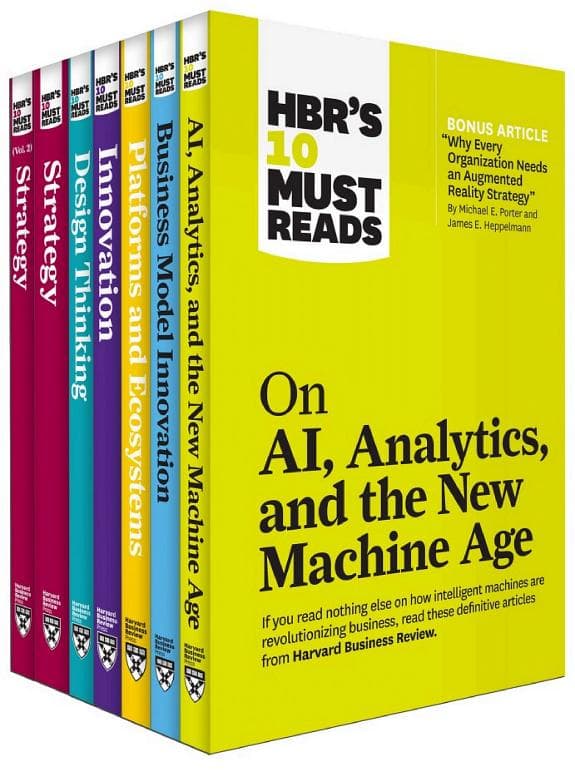
Key Takeaways from HBR's 10 Must Reads on Technology and Strategy Collection (7 Books)
Platform Leadership
How to build and manage a dominant digital ecosystem.
Building and leading a successful platform requires a strategic shift from product-centric thinking to ecosystem management. A platform leader must attract and retain diverse participants (developers, users, partners) by providing compelling value propositions for each group. This involves defining clear rules of engagement, offering robust tools and APIs, and fostering a collaborative environment. Key strategies include cultivating network effects, managing multi-sided markets, and continuously innovating to maintain relevance and competitive advantage. The leader must balance openness with control, ensuring quality and preventing opportunism while encouraging innovation from external contributors. The long-term success of a platform hinges on its ability to evolve with technological advancements and user needs, often requiring significant investment in infrastructure and community support.
“The fundamental role of a platform leader is to maximize the overall value of the ecosystem, not just the value of its own products.”
In the book: Case studies of companies like Apple (iOS App Store) and Amazon (AWS, Marketplace) demonstrating successful platform strategies and the challenges of managing multi-sided markets and developer ecosystems.
Try this: Businesses can apply platform thinking by identifying potential multi-sided markets in their industry, investing in API-first strategies, and actively cultivating communities around their core offerings to generate network effects.
Related ideas: platform-strategy, network-effects, ecosystem-management, multi-sided-markets
Digital Transformation Imperative
Reimagining business models and operations for the digital age.
Digital transformation is a holistic organizational change, not merely the adoption of new technologies. It necessitates rethinking fundamental aspects of the business, including customer experience, operational processes, business models, and organizational culture. Leaders must articulate a clear vision for digital transformation, secure executive buy-in, and foster a culture of experimentation and continuous learning. Key areas of focus include leveraging data analytics for informed decision-making, automating processes, enhancing customer engagement through digital channels, and developing agile organizational structures. The challenge lies in overcoming legacy systems, resistance to change, and the need for new skill sets across the workforce. Successful transformation requires a blend of top-down strategic direction and bottom-up innovation, ensuring that technology serves strategic objectives rather than being implemented in isolation.
“Digital transformation is not just about technology; it's about strategy, leadership, and new ways of thinking.”
In the book: Examples of traditional companies like Netflix and Adobe successfully pivoting their business models from physical products to digital services, demonstrating the necessity of comprehensive transformation.
Try this: Organizations should conduct a thorough digital maturity assessment, define clear strategic objectives for transformation, and invest in both technological infrastructure and reskilling their workforce to embrace digital-first approaches.
Related ideas: digital-transformation, business-model-innovation, organizational-agility, data-driven-strategy
AI as a Strategic Asset
Leveraging artificial intelligence to gain competitive advantage.
Artificial intelligence offers profound strategic advantages when integrated thoughtfully into business processes and decision-making. Beyond automation, AI's true power lies in its ability to analyze vast datasets, identify patterns, predict outcomes, and personalize experiences at scale. Companies must move beyond pilot projects to embed AI into core business functions, such as customer service, supply chain optimization, product development, and marketing. This requires a clear AI strategy, access to high-quality data, and the development of specialized AI talent or partnerships. Ethical considerations, data privacy, and explainability are crucial aspects that must be addressed from the outset to build trust and ensure responsible AI deployment. The competitive edge comes from not just adopting AI, but from developing unique AI capabilities that are difficult for competitors to replicate.
“AI is not a magic bullet, but a powerful tool that, when strategically applied, can fundamentally alter an organization's competitive landscape.”
In the book: Studies on companies like Google (search algorithms, autonomous driving) and Amazon (recommendation engines, logistics) showcasing how AI integration provides significant operational efficiencies and market differentiation.
Try this: Businesses should identify high-value use cases for AI, invest in building a robust data infrastructure, and develop an ethical AI framework to guide development and deployment, focusing on areas that enhance unique competencies.
Related ideas: artificial-intelligence, ai-strategy, machine-learning, data-analytics, ethical-ai
Agile at Scale
Implementing agile methodologies across large enterprises.
Scaling agile methodologies beyond small teams to an entire enterprise presents significant challenges but offers substantial rewards in terms of responsiveness, innovation, and employee engagement. It requires a fundamental shift in organizational structure, leadership style, and cultural norms. Key elements include breaking down silos, empowering cross-functional teams, establishing clear strategic priorities, and implementing consistent agile practices across different departments. Leaders must act as facilitators, removing impediments and fostering psychological safety. Metrics should shift from individual output to team outcomes and business value. Common frameworks like SAFe, LeSS, or Scrum@Scale provide blueprints, but successful implementation often involves tailoring these to the specific context of the organization, focusing on continuous improvement and feedback loops at all levels.
“True agility means not just delivering faster, but continuously learning and adapting to changing customer needs and market dynamics.”
In the book: Companies like Spotify and ING Bank have shared their journeys and frameworks for scaling agile development, demonstrating improved time-to-market and adaptability to changing customer demands.
Try this: Organizations should start with pilot programs, identify clear value streams, train leaders and teams in agile principles, and gradually expand implementation while continuously adapting the approach based on feedback.
Related ideas: agile-methodology, scaled-agile, organizational-design, cross-functional-teams, continuous-delivery
Data as a Strategic Asset
Unlocking value from organizational data for competitive advantage.
In the digital economy, data is a critical strategic asset, yet many organizations struggle to extract its full value. Building a data-driven culture requires more than just collecting data; it involves establishing robust data governance, ensuring data quality, and developing analytical capabilities across the organization. Companies must define a clear data strategy that aligns with business objectives, identifying which data points are most valuable and how they can be leveraged to inform decisions, personalize customer experiences, optimize operations, or create new products and services. Investing in data infrastructure, tools, and talent (data scientists, analysts) is essential. Furthermore, ethical considerations, privacy regulations (e.g., GDPR, CCPA), and data security must be paramount to maintain trust and avoid reputational damage.
“Data is the new oil, but only if you know how to refine it and put it to work.”
In the book: The success of companies like Capital One (using data for credit risk assessment) and Target (predictive analytics for customer behavior) highlights the profound impact of a well-executed data strategy on business outcomes.
Try this: Companies should establish a chief data officer role, invest in a unified data platform, implement strict data governance policies, and foster data literacy across all departments to empower data-driven decision-making.
Related ideas: data-strategy, data-governance, big-data, data-literacy, predictive-analytics
Mastering Digital Innovation
Fostering a culture of continuous innovation in a rapidly changing tech landscape.
In the face of rapid technological advancements, organizations must cultivate a continuous innovation capability to remain competitive. This involves moving beyond traditional R&D departments to embed innovation into the fabric of the organization. Key strategies include encouraging experimentation, creating psychological safety for failure, allocating dedicated resources for new ventures (e.g., innovation labs, incubators), and fostering cross-functional collaboration. Leaders play a crucial role in championing new ideas, providing strategic guardrails, and celebrating learning from both successes and failures. The focus should be on building minimum viable products (MVPs), gathering rapid feedback, and iterating quickly. Partnerships with startups and academic institutions can also provide external sources of innovation and accelerate development cycles, ensuring the organization stays at the forefront of technological change.
“Innovation is not a single event, but a continuous journey of exploration, experimentation, and adaptation.”
In the book: Companies like Google (20% time for innovation) and 3M (culture of experimentation) demonstrate how dedicated time and resources, coupled with a supportive culture, can lead to groundbreaking products.
Try this: Establish dedicated innovation budgets, create cross-functional 'squads' for exploring new ideas, implement hackathons or innovation challenges, and develop a clear process for evaluating and scaling promising innovations.
Related ideas: innovation-management, design-thinking, minimum-viable-product, experimentation, corporate-venturing
Cybersecurity as a Business Risk
Integrating cybersecurity into enterprise risk management and strategy.
With increasing digital interconnectedness, cybersecurity has evolved from a technical concern to a critical business risk impacting reputation, financial stability, and operational continuity. Boards and senior leadership must integrate cybersecurity into their overall enterprise risk management framework, moving beyond compliance to proactive threat intelligence and resilience. This involves understanding the organization's unique threat landscape, identifying critical assets, and implementing a multi-layered security strategy. Key components include employee training, robust incident response plans, third-party risk management, and continuous monitoring. Leaders must foster a security-aware culture, ensuring that every employee understands their role in protecting organizational assets. Investing in advanced security technologies and expert talent is crucial, alongside regular audits and simulations to test preparedness.
“Cybersecurity is no longer just an IT problem; it's a fundamental business risk that requires board-level attention.”
In the book: Major data breaches (e.g., Equifax, Target) illustrate the devastating financial and reputational consequences of inadequate cybersecurity, leading to increased regulatory scrutiny and board accountability.
Try this: Establish a CISO reporting directly to the CEO or board, conduct regular cybersecurity risk assessments, develop and test a comprehensive incident response plan, and implement mandatory security awareness training for all employees.
Related ideas: cybersecurity, risk-management, data-breach, incident-response, information-security
Orchestrating Ecosystems
Managing complex networks of partners and collaborators for strategic advantage.
Modern competitive advantage often stems not from isolated internal capabilities, but from the ability to effectively orchestrate a diverse ecosystem of partners, suppliers, customers, and even competitors. This involves strategically identifying potential collaborators, defining clear roles and value propositions for each, and establishing robust governance mechanisms. Orchestrators must foster trust, facilitate communication, and manage potential conflicts of interest. Key activities include co-creating value, sharing risks and rewards, and leveraging complementary assets to achieve collective goals that no single entity could accomplish alone. This goes beyond traditional supply chain management to encompass broader strategic alliances, open innovation networks, and platform-based collaborations, requiring strong leadership and diplomatic skills to navigate complex interdependencies and shared objectives.
“In a hyper-connected world, no single company can innovate or compete effectively alone; success lies in orchestrating vibrant ecosystems.”
In the book: Examples such as the automotive industry's shift towards electric vehicles (requiring battery suppliers, charging infrastructure partners) or the pharmaceutical industry's R&D collaborations highlight the necessity of ecosystem orchestration.
Try this: Map out your current and potential ecosystem partners, define clear value exchange mechanisms, establish formal governance structures for key alliances, and invest in relationship management capabilities.
Related ideas: ecosystem-strategy, strategic-alliances, open-innovation, partner-management, value-co-creation
Tech-Driven Organizational Design
Structuring organizations to thrive in a technology-centric world.
The rapid pace of technological change demands a fundamental rethinking of traditional organizational structures. Hierarchical, siloed organizations struggle to adapt and innovate. Modern organizational design emphasizes flatter structures, cross-functional teams, and decentralized decision-making to foster agility and responsiveness. This often involves adopting product-centric or customer-centric structures, empowering autonomous teams, and creating mechanisms for rapid information flow and collaboration. Key considerations include balancing centralization and decentralization, designing for modularity, and developing new leadership capabilities focused on coaching and enablement rather than command and control. The goal is to build an organization that can continuously learn, experiment, and reconfigure itself to leverage new technologies and respond to market shifts effectively, often integrating principles of sociocracy or holacracy in adapted forms.
“The organizational chart is no longer a static hierarchy, but a dynamic network designed for speed, flexibility, and continuous learning.”
In the book: Companies like Valve (flat structure, self-organizing teams) and Zappos (experimentation with Holacracy) demonstrate alternative organizational designs that prioritize agility and employee empowerment in tech-driven environments.
Try this: Evaluate current organizational silos, empower cross-functional teams with clear objectives, invest in tools that facilitate collaboration, and train leaders to adopt a more facilitative and coaching-oriented style.
Related ideas: organizational-design, agile-organization, flat-structure, decentralized-decision-making, team-autonomy
The Future of Work and Technology
Navigating the impact of automation and AI on jobs and skills.
The pervasive integration of advanced technologies like AI, robotics, and automation is profoundly reshaping the nature of work. While some routine tasks may be automated, new jobs requiring uniquely human skills – creativity, critical thinking, emotional intelligence, and complex problem-solving – are emerging. Organizations must proactively address the future of work by investing heavily in workforce development, including upskilling current employees and reskilling for new roles. This involves strategic talent planning, fostering a culture of lifelong learning, and potentially collaborating with educational institutions. Leaders need to manage the transition ethically, ensuring that technology augments human capabilities rather than simply replacing them. The focus should be on building a 'human-in-the-loop' system where technology empowers employees to perform higher-value tasks, leading to increased productivity and job satisfaction.
“Technology will not eliminate work, but transform it, requiring a continuous commitment to upskilling and reskilling the workforce.”
In the book: Studies by McKinsey and the World Economic Forum consistently highlight the shift in required skills, predicting growth in roles that leverage human-machine collaboration and complex cognitive abilities.
Try this: Conduct a workforce skills gap analysis, develop comprehensive upskilling and reskilling programs, design jobs that emphasize human-machine collaboration, and foster a culture of continuous learning and adaptability.
Related ideas: future-of-work, automation, upskilling, reskilling, human-ai-collaboration
HBR's 10 Must Reads on Technology and Strategy Collection (7 Books) Quotes
“Strategy is about making choices, and in the digital age, those choices must increasingly revolve around technology.”
“Digital transformation isn't just about adopting new technologies; it's about fundamentally rethinking how your business creates value.”
“The greatest threat in a fast-changing technological landscape is not failing to innovate, but failing to adapt.”
“Data is the new oil, but only if you have the refinery to process it and the distribution network to deliver its value.”
“Agility is paramount. Companies that can quickly sense and respond to technological shifts will outperform those that cannot.”
“Platform strategies are reshaping industries, creating network effects that can be incredibly powerful, or incredibly destructive.”
“AI isn't just a tool; it's a co-worker, a decision-maker, and a strategic partner that demands new organizational capabilities.”
“Cybersecurity is no longer just an IT issue; it's a board-level strategic imperative that impacts trust and resilience.”
“Experimentation, not perfection, should be the mantra for technology-driven innovation.”
“The future of work will be defined by how humans and machines collaborate, not by which one replaces the other.”
“Building a digital culture means fostering a mindset of continuous learning and embracing ambiguity.”
“Disruption often comes from unexpected places, powered by technology that initially seems niche or irrelevant.”
“Technology alone doesn't create competitive advantage; it's the unique way an organization deploys and integrates it.”
Quiz
10 questions on the main ideas. Each answer comes with a short explanation.
Question 1
According to the HBR's 10 Must Reads on Technology and Strategy Collection, what is a key challenge for established companies when new technologies emerge?
- Lack of funding to invest in new technologies.
- Difficulty integrating new technologies with existing business models and processes.
- Inability to attract talent skilled in new technologies.
- Resistance from customers to adopt new technological solutions.
Show answer
B. Difficulty integrating new technologies with existing business models and processes. Many articles in the collection emphasize that established companies often struggle with adapting their core business and operational models to leverage new technologies, rather than just acquiring them.
Question 2
The collection frequently discusses the concept of 'disruptive innovation.' Which of the following best describes disruptive innovation in this context?
- An innovation that significantly improves an existing product for high-end customers.
- An innovation that creates a new market and value network, eventually displacing established market-leading firms, products, and alliances.
- An innovation that only focuses on cost reduction without significant product changes.
- An innovation that makes minor, incremental improvements to a company's offerings.
Show answer
B. An innovation that creates a new market and value network, eventually displacing established market-leading firms, products, and alliances. Disruptive innovation, as popularized by Clayton Christensen and extensively covered in the HBR collection, refers to innovations that start by serving a simpler, often overlooked market, and then improve to challenge incumbents.
Question 3
When developing a technology strategy, what is a crucial first step highlighted in the HBR collection?
- Investing heavily in the latest trending technologies.
- Aligning technology strategy with overall business strategy.
- Outsourcing all technology development to third-party vendors.
- Focusing solely on immediate cost savings from technology adoption.
Show answer
B. Aligning technology strategy with overall business strategy. A recurring theme is that technology strategy must be a direct enabler and reflection of the overarching business strategy, ensuring investments drive strategic goals.
Question 4
The collection often discusses the importance of data. What is emphasized as critical for companies to leverage data effectively for strategic advantage?
- Collecting as much data as possible, regardless of its relevance.
- Having robust analytics capabilities and a culture of data-driven decision making.
- Storing data exclusively in on-premise servers.
- Sharing all collected data publicly to foster collaboration.
Show answer
B. Having robust analytics capabilities and a culture of data-driven decision making. The HBR collection stresses that raw data alone is not enough; companies need the tools, skills, and organizational mindset to derive insights and act upon them.
Question 5
What role does organizational structure play in a company's ability to adapt to technological change, according to the HBR collection?
- A rigid, hierarchical structure is best for controlling technology initiatives.
- Flexible, agile, and cross-functional structures are more conducive to innovation and adaptation.
- Organizational structure has minimal impact on technology adoption.
- A centralized IT department should dictate all technology decisions.
Show answer
B. Flexible, agile, and cross-functional structures are more conducive to innovation and adaptation. Many articles advocate for more agile and adaptable organizational structures that can respond quickly to technological shifts and foster collaboration across different functions.
Question 6
The HBR collection highlights that digital transformation is not just about adopting new technologies. What else is considered a critical component?
- Reducing the workforce to cut costs.
- A fundamental change in culture, leadership, and business processes.
- Outsourcing all customer interactions.
- Maintaining existing business models while adding digital tools.
Show answer
B. A fundamental change in culture, leadership, and business processes. Digital transformation is presented as a holistic organizational change, requiring shifts in mindset, leadership, and how work is done, not just a technology upgrade.
Question 7
What common pitfall do companies face when trying to innovate with new technologies, as discussed in the HBR series?
- Under-investing in R&D.
- Focusing too much on technological capabilities and not enough on customer needs and value creation.
- Over-reliance on internal innovation without external partnerships.
- Not having enough technology options to choose from.
Show answer
B. Focusing too much on technological capabilities and not enough on customer needs and value creation. A key lesson is that technology for technology's sake is often ineffective. Innovation must be driven by solving real customer problems and delivering tangible value.
Question 8
Regarding competitive advantage in a technology-driven landscape, what does the HBR collection suggest is increasingly important?
- Owning all proprietary technology patents.
- Speed of execution and continuous learning and adaptation.
- Having the largest market share in existing products.
- Minimizing any risk exposure by avoiding new technologies.
Show answer
B. Speed of execution and continuous learning and adaptation. In rapidly evolving tech environments, the ability to quickly develop, test, learn, and adapt is often more critical than static assets or traditional market dominance.
Question 9
What is a key recommendation for leaders to effectively drive technology and strategy initiatives within their organizations?
- Delegate all technology decisions to junior staff.
- Be actively involved, articulate a clear vision, and foster a culture of experimentation.
- Focus solely on financial metrics and leave technology to the experts.
- Implement technology solutions without consulting employees.
Show answer
B. Be actively involved, articulate a clear vision, and foster a culture of experimentation. Leadership engagement, vision-setting, and creating an environment where employees feel empowered to experiment and learn are crucial for successful tech-driven strategy.
Question 10
The HBR collection often addresses the 'platform economy.' What is a characteristic feature of a successful platform business model?
- Owning all assets and resources required to deliver a service.
- Facilitating interactions and transactions between independent producers and consumers.
- Focusing on selling physical products exclusively.
- Operating in a single, highly specialized market segment without expansion.
Show answer
B. Facilitating interactions and transactions between independent producers and consumers. Platform businesses thrive by connecting different user groups (e.g., buyers and sellers, content creators and consumers) and enabling value-creating interactions.
HBR's 10 Must Reads on Technology and Strategy Collection (7 Books) FAQ
What is the primary focus of the 'HBR's 10 Must Reads on Technology and Strategy Collection'?
This collection focuses on providing essential insights and frameworks for leaders and managers to understand, leverage, and strategically integrate technology within their organizations. It explores how technology impacts business models, competitive advantage, and organizational design.
Who is the target audience for this 7-book collection?
The target audience includes business leaders, strategists, managers, entrepreneurs, and anyone interested in understanding the intersection of technology and business strategy. It's particularly useful for those looking to drive digital transformation or innovate their business models.
Does this collection offer practical advice or is it purely theoretical?
The collection offers a blend of foundational concepts and practical advice, drawing from extensive research and real-world case studies. It aims to equip readers with actionable strategies and frameworks to apply in their own organizations, making it highly practical.
How does this collection help businesses adapt to rapid technological change?
It provides insights into anticipating technological shifts, understanding their strategic implications, and developing agile organizational structures and strategies to respond effectively. The books emphasize continuous innovation and the importance of a tech-savvy leadership mindset.
Are the books in the collection independent, or do they build on each other?
While each book can be read independently, they collectively offer a comprehensive view of technology and strategy, often building on shared themes and concepts. Reading them together provides a more holistic understanding of the subject matter.
What kind of technologies are discussed in the collection?
The collection covers a broad range of technologies and their strategic implications, including digital transformation, artificial intelligence, big data, platforms, and other emerging technologies. It focuses more on the strategic impact rather than deep technical details of specific technologies.
Is this collection suitable for small businesses or primarily large corporations?
The strategic principles and frameworks discussed are applicable to organizations of all sizes, from startups and small businesses to large corporations. While examples might vary, the core lessons on technology adoption and strategy are universally valuable.
How does this collection differ from other books on technology management?
This collection distinguishes itself by offering curated, essential readings from the Harvard Business Review, focusing on high-level strategic thinking rather than just operational management. It emphasizes the 'why' and 'how' of leveraging technology for competitive advantage.
Will reading this collection help me in my career development?
Absolutely. Understanding the strategic interplay of technology and business is crucial for career advancement in today's digital economy. The insights gained can enhance your decision-making, leadership skills, and ability to contribute to organizational innovation.
Similar books
- The Diary of a Young Girl
Anne Frank
4.2 (2.7M) average on GoodreadsBiographyDuring the Nazi occupation, a teenage girl's diary, written from a secret annex, shares observations on humanity, hope, and the wait for freedom.
- Twisted 1. Twisted love
Ana Huang
3.7 (1.7M) average on GoodreadsA quiet billionaire with a difficult past finds his guarded heart opening to the woman he must protect, but their growing passion uncovers dangerous secrets and a shared, traumatic history.
- Eat, Pray, Love
Elizabeth Gilbert
3.6 (1.5M) average on GoodreadsLifestyleA heartbroken writer leaves her conventional life for a year-long global search for pleasure in Italy, spiritual devotion in India, and unexpected love and balance in Bali.
- Night
Elie Wiesel
4.3 (970k) average on GoodreadsBiographyIn the darkness of Auschwitz and Buchenwald, a teenage Elie Wiesel faces the extermination of his family, the loss of his faith, and the lasting scars of humanity's deepest cruelty.
- Steve Jobs
Walter Isaacson
4.1 (957k) average on GoodreadsBusinessSteve Jobs was a visionary who fused creativity and technology to revolutionize six industries and shape our digital world.
- The Glass Castle
Jeannette Walls
4.3 (903k) average on GoodreadsBiographyJeannette Walls's memoir describes her unusual childhood with brilliant, free-spirited parents whose poverty-stricken life shaped her independence and love despite family problems.






Enjoyed the summary?
A summary gives you the shape of the book. The book itself has the detail, the examples and the voice.
Find HBR's 10 Must Reads on Technology and Strategy Collection (7 Books) on AmazonAs an Amazon Associate, BookBrief earns from qualifying purchases. How we're funded