
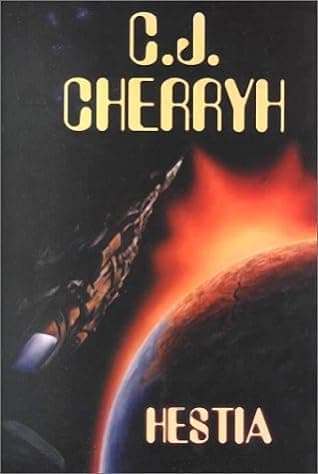
Synopsis
Covers the whole plot, including the ending.
- Difficulty
- Medium
- Pacing
- Moderate
- Mood
- Introspective, Mysterious, Tense, Hopeful
- Read it if
- You enjoy first-contact narratives where communication and understanding are key, and you like stories about human perseverance against an alien environment with a touch of mystery.
- Skip it if
- You prefer fast-paced action or clear-cut heroes and villains, or if you dislike stories with significant focus on cultural clashes and misunderstandings.
Hestia Plot Summary
Covers the whole plot, including the ending.
Arrival on Hestia
Sam Merrit, a skilled but jaded engineer, arrives on Hestia after the colony requests help. He meets a small, isolated community led by Administrator Mabon and Foreman Skeen. Sam is quickly disappointed by the colony's primitive state and the many problems, including hostile wildlife and a lack of technology. He wants to leave, seeing the colony as a lost cause. However, Mabon explains that a shuttle cannot leave without major repairs and resources, trapping Sam on the planet. He is assigned to the dam project, the colony's last hope for expansion and survival.
The Dam Project and Initial Resistance
Sam reluctantly begins surveying the dam site, a project meant to expand the colony's land and provide more resources. He works with colonists who are suspicious of him and his critical attitude. During his initial explorations, Sam encounters 'haunts,' large, aggressive creatures that threaten the colony. He is unnerved by their silent movement and apparent intelligence. His attempts to use more efficient engineering methods are met with skepticism and tradition from Mabon and Skeen, who are set in their ways after a century of isolation.
Unveiling the 'Haunt' Threat
Driven by engineering curiosity and a growing unease, Sam studies the 'haunts' and their behavior. He observes their hunting, territorial markings, and organized attacks. He notices differences in the colonists' accounts of the creatures, realizing they have hidden or forgotten details about the 'haunts' to maintain a sense of normalcy. Sam's investigations lead him to believe the 'haunts' are more intelligent and coordinated than the colonists admit, posing a systemic threat. He tries to warn Mabon and Skeen, but they dismiss his concerns as an outsider's overreaction.
Confrontation and Isolation
Sam's insistence on understanding the 'haunts' creates conflict with Mabon and other elders, who see his questions as a challenge to their authority. During a patrol, Sam's group is ambushed by 'haunts.' His quick thinking saves lives, but the incident only increases the colonists' fear and their reluctance to face the true nature of the threat. Sam becomes isolated, his expertise questioned and his warnings ignored. He realizes the colony's survival depends not just on building a dam, but on changing their approach to the planet and its dangers, a truth the leadership will not accept.
The First Breakthrough
Despite the friction, Sam's engineering skills prove useful. He introduces more efficient methods for excavation and construction, slowly making progress on the dam project. He begins to earn the respect of some younger, more open-minded colonists, especially those tired of the stagnant, fear-driven existence. He finds an ally in Elene, a capable colonist who shares his curiosity about the 'haunts.' Their collaboration marks a turning point, as Sam builds a small support network within the colony, challenging the established order.
Uncovering a Deeper Truth
Working together, Sam and Elene venture further into the wilderness, discovering ancient structures and unusual geological formations that suggest a deeper history to Hestia. They find evidence that the 'haunts' are not just animals, but perhaps sentient beings integrated into the planet's ecosystem, possibly its guardians. They uncover signs of intelligence and purpose in the 'haunts'' actions, challenging the simple 'monster' story the colonists have held for generations. This discovery hints at a symbiotic relationship between the 'haunts' and the planet, a relationship the colonists have unknowingly disrupted.
The 'Haunt' Communication
Based on their discoveries, Sam theorizes the 'haunts' might communicate, though not verbally. He experiments with light and sound patterns, trying to create a basic dialogue. To the shock of Elene and a few other allies, his efforts work. The 'haunts' respond, showing a sophisticated understanding and clear territorial imperative. This breakthrough confirms Sam's suspicions: the 'haunts' are intelligent, and their attacks are not random aggression but a defense of their territory and the planet's ecological balance. The dam, representing human encroachment, is a direct threat to the 'haunts'.
The Colony's Reckoning
With clear evidence, Sam and Elene confront Mabon and the colony elders with their findings about the 'haunts.' The truth is hard for the leadership to accept, but the increasing attacks and Sam's proof force them to acknowledge the creatures' intelligence. This revelation shatters the colonists' long-held beliefs and their sense of superiority. They realize their hundred years on Hestia have been spent in ignorance and conflict, misunderstanding the world they sought to conquer. The colony faces a crisis: continue their destructive path or find a way to coexist with the planet's true inhabitants.
A New Path
Sam, now recognized for his foresight, proposes a new approach: instead of fighting the 'haunts' and imposing their will on Hestia, the colonists must learn to coexist. He suggests abandoning the dam project as planned and focusing on understanding and adapting to the planet's natural systems. This means establishing new boundaries, learning the 'haunts'' patterns, and potentially forming a truce. Many meet this proposal with fear, as it requires abandoning a century of tradition and admitting profound error. However, the alternative is extinction, forcing Mabon and the others to consider Sam's ideas.
Building a Bridge, Not a Dam
Under Sam's guidance, the colony slowly changes its strategy. The dam project is repurposed or its scope altered to minimize impact on the 'haunts'' territory. Efforts are made to understand and respect the alien ecosystem. Communication attempts with the 'haunts' continue cautiously, as the colonists try to establish a fragile peace. This new direction has many challenges, but it represents a fundamental change in the colonists' relationship with Hestia. Sam, once an unwanted outsider, becomes the reluctant leader of this new path, guiding them toward coexistence rather than conquest, with Elene as his steadfast partner.
Hestia Characters
Sam Merrit
Protagonist
A jaded, brilliant engineer trapped on Hestia, forced to confront his cynicism and the colony's ignorance.
Sam Merrit is a highly competent but deeply cynical engineer. He arrives on Hestia with a detached, professional attitude, viewing the colony's problems as solvable through logic and technology. Initially, he is dismissive of the colonists and their antiquated ways, longing to escape the planet. However, his innate curiosity and engineering integrity compel him to investigate the 'haunts' and the planet's anomalies more deeply than anyone before him. He struggles with the colonists' resistance to change and their ingrained fears, but ultimately becomes the catalyst for their survival.
Relationships: Administrator Mabon (Antagonistic and later grudgingly respectful professional relationship.); Foreman Skeen (Skeptical working relationship that slowly develops into trust.); Elene (Collaborative and developing romantic partnership.)
Administrator Mabon
Antagonist/Supporting
The stern, traditional leader of the Hestia colony, resistant to change and deeply entrenched in the colony's established ways.
Administrator Mabon is the aging, authoritative leader of the Hestia colony. He represents the old guard, committed to the traditions and hard-won knowledge of a century of struggle. He is stern, pragmatic, and deeply protective of his people, but also rigid and resistant to any ideas that challenge the established order or admit past failures. His initial interactions with Sam are marked by suspicion and conflict, as he views Sam's modern methods and critical questions as a threat to his authority and the colony's stability. He embodies the colonists' collective denial and fear of the unknown.
Relationships: Sam Merrit (Antagonistic, professional, and later grudgingly respectful.); Foreman Skeen (Long-standing professional and personal alliance.); Elene (Superior and subordinate relationship, with Elene eventually challenging his authority.)
Elene
Supporting
A capable, observant colonist who becomes Sam's closest ally and romantic interest.
Elene is a younger, intelligent colonist who works closely with Sam on the dam project. Unlike many of the older generation, she possesses a keen sense of observation and a willingness to question the established narratives about Hestia and its 'haunts.' She is pragmatic and resourceful, having grown up in the harsh colonial environment, but she also harbors a hidden curiosity and an openness to new ideas. She quickly recognizes Sam's competence and the validity of his concerns, becoming his most trusted confidante and partner in uncovering the planet's secrets.
Relationships: Sam Merrit (Collaborative, supportive, and developing romantic partnership.); Administrator Mabon (Subordinate, but increasingly challenging his authority.); Foreman Skeen (Working relationship, respectful but not always agreeable.)
Foreman Skeen
Supporting
The colony's pragmatic and experienced foreman, initially skeptical but eventually swayed by Sam's competence.
Foreman Skeen is Mabon's right-hand man and the practical manager of the colony's day-to-day operations and labor. He is a gruff, no-nonsense individual, deeply experienced in the challenges of Hestia's environment. While initially skeptical of Sam's outsider status and his modern methods, Skeen is ultimately a pragmatist. He values competence and results, and as Sam demonstrates his engineering prowess and the validity of his concerns about the 'haunts,' Skeen's resistance slowly gives way to grudging respect and eventual support. He acts as a bridge between Mabon's rigid leadership and Sam's innovative ideas.
Relationships: Sam Merrit (Skeptical working relationship that slowly develops into trust and respect.); Administrator Mabon (Long-standing professional and personal alliance.); Elene (Respectful working relationship.)
The 'Haunts'
Antagonists
The indigenous, intelligent, and territorial life forms of Hestia, initially perceived as dangerous beasts.
The 'haunts' are the dominant, indigenous life forms of Hestia. They are large, predatory creatures, initially perceived by the colonists as mere savage animals. However, Sam's investigations reveal them to be highly intelligent, territorial, and capable of complex communication and coordinated action. They are deeply integrated into Hestia's ecosystem, acting as its guardians. Their 'attacks' on the colony are not random aggression but a defensive response to human encroachment and the disruption of the planet's delicate balance. They represent the alien otherness of Hestia that the colonists have failed to understand.
Relationships: Hestia Colonists (Antagonistic, driven by territorial defense versus perceived invasion.); Sam Merrit (Initial conflict, evolving towards a tentative, experimental form of communication.)
The Colony (as a collective)
Supporting/Antagonist
The isolated human settlement on Hestia, characterized by fear, tradition, and a struggle for survival.
The Hestia colony is a small, isolated human settlement, having endured a century of hardship. Its members are largely descendants of the original pioneers, steeped in tradition and a collective fear of the surrounding wilderness, particularly the 'haunts.' They are hardworking and resilient but also insular, resistant to outside ideas, and prone to denial about the true nature of their planet. Their existence is defined by a constant struggle for survival and a desperate hope for expansion, which the dam project represents. They collectively embody humanity's struggle to adapt to an alien environment, often through misunderstanding and conflict.
Relationships: Sam Merrit (Initially suspicious and resistant, later reluctantly accepting of his leadership.); The 'Haunts' (Antagonistic, based on fear and territorial conflict, moving towards uneasy coexistence.)
Hestia Themes
The Perils of Colonialism and Misunderstanding the 'Other'
The novel explores the dangers of colonizing an alien world without understanding its life and ecosystem. The Hestia colonists, for a century, saw the 'haunts' as beasts to be overcome, not as intelligent beings with their own place in the ecosystem. This misunderstanding leads to constant conflict and prevents the colony's growth. Sam's arrival forces them to confront this ignorance, showing how human-centric views can lead to destructive outcomes when encountering alien life. The dam project itself symbolizes this colonial mindset – an attempt to impose human will on the environment without considering its natural inhabitants.
“They had been a hundred years on Hestia, and they knew nothing. Nothing that mattered.”
Adaptation vs. Conquest
A main theme is the need for adaptation over conquest when faced with a truly alien environment. The colonists' initial strategy is to dominate Hestia, clear land, build dams, and fight the 'haunts.' This approach proves unsustainable. Sam Merrit's engineering mind, initially focused on conquering the environment, slowly shifts to understanding and adapting to it. The realization that the 'haunts' are intelligent and deeply connected to the planet forces the colony to abandon its conquest mentality and embrace coexistence, learning to live within Hestia's natural order.
“You can't fight a planet, Mabon. You have to live with it, or it will kill you.”
The Weight of Tradition and Denial
The colony's old traditions and denial hinder their ability to survive and adapt. Administrator Mabon and the elders cling to methods and beliefs passed down through generations, even when they fail. Their refusal to acknowledge the 'haunts'' intelligence is a form of denial, born of fear and the desire to maintain a familiar, though precarious, existence. Sam's arrival challenges these traditions, forcing the colonists to confront uncomfortable truths about their past and future. This theme shows how fear of the unknown can lead to self-destructive adherence to outdated practices.
“They had built a wall of ignorance around themselves, a century thick, against the things they feared.”
The Nature of Intelligence and Communication
The novel explores different forms of intelligence and the challenges of interspecies communication. The 'haunts' are first seen as animals, but Sam's investigation reveals a complex, non-human intelligence. Their communication is not verbal; it involves patterns, territorial markings, and coordinated actions the colonists initially fail to interpret. The story challenges human-centered views of intelligence, suggesting that alien life forms may have sophisticated cognitive abilities that appear in ways humans do not immediately recognize. Sam's efforts to establish a basic form of communication with the 'haunts' is a turning point, bridging a vast evolutionary and cognitive gap.
“They spoke not with words, but with a language of pattern and presence, a language the humans had been deaf to for a hundred years.”
Plot Devices & Literary Techniques
The Dam Project
A central symbol of the colony's aspirations for growth and their initial approach to conquering Hestia.
The dam project is the ostensible reason for Sam Merrit's arrival and serves as a major plot driver. Initially, it symbolizes the colonists' desperate hope for expansion and their desire to impose human order on the alien wilderness. As the story progresses, it transforms into a symbol of their destructive colonial mindset, directly conflicting with the 'haunts'' territory and the planet's ecological balance. Ultimately, the dam's repurposing or abandonment signifies the colony's shift from conquest to coexistence, making it a powerful symbol of their evolving relationship with Hestia.
The 'Haunts' as a Mirror
The indigenous creatures that reflect the colonists' fears, ignorance, and ultimately, their potential for understanding.
The 'haunts' are more than just antagonists; they act as a mirror reflecting the colonists' own flaws and potential. Their perceived 'savagery' initially highlights the colonists' fear and their anthropocentric view of intelligence. As Sam uncovers their true nature, the 'haunts' force the colonists to confront their own ignorance and the destructive consequences of their actions. They become the catalyst for the colony's self-reflection and the imperative for change, showing humanity a different, more integrated way of existing on Hestia.
Sam Merrit's Outsider Status
Sam's perspective as an off-worlder allows him to see the colony's problems and the planet's truths objectively.
Sam Merrit's status as an outsider is a crucial plot device. Having just arrived from off-world, he is not burdened by the colony's hundred years of tradition, fear, and denial. This allows him to observe the 'haunts' and the colony's situation with an objective, scientific eye, free from the ingrained biases of the colonists. His detached perspective enables him to ask the uncomfortable questions and make the radical observations that the entrenched leadership cannot, ultimately leading to the breakthroughs necessary for the colony's survival. His cynicism, initially a flaw, ironically provides the emotional distance needed for rational analysis.
The Century of Isolation
The colony's long period of isolation from Earth that fostered their unique culture, traditions, and ignorance.
The fact that the Hestia colony has been isolated for a hundred years is a significant plot device. This prolonged isolation has allowed a unique, insular culture to develop, characterized by strong traditions, self-reliance, and a deep-seated fear of the unknown. Crucially, it has also led to a collective amnesia or denial regarding the true nature of Hestia and its 'haunts,' as outside knowledge and perspectives were cut off. This isolation makes the colonists resistant to change and Sam's ideas, but also highlights their resilience and the depth of the challenge he faces in trying to enlighten them.
Hestia Quotes
“The gods are not what they were, but they are still gods.”
“You cannot outrun your fate, but you can choose how you meet it.”
“Love is a choice, not a curse.”
“The oldest magic is the magic of the land itself.”
“Sometimes, the greatest strength is found in yielding.”
“Memory is a double-edged sword; it can heal or it can wound.”
“Fear makes monsters of us all, whether they are real or imagined.”
“To truly belong, one must first be willing to be vulnerable.”
“The future is not written, but it is shaped by every breath we take.”
“Even a god can be lonely.”
“There are truths that lie beyond human understanding, and some are best left undisturbed.”
“Trust is a fragile thing, easily broken and rarely mended whole.”
“Home is not a place, but a feeling of peace.”
“The greatest battles are often fought within one's own heart.”
Quiz
10 questions on the plot and the characters. Each answer comes with a short explanation.
Question 1
What is the primary reason the Hestia colony is in decline after a hundred years?
- Frequent raids by hostile alien civilizations.
- A deadly plague affecting the colonists.
- Hostile fauna confining them to a single river valley.
- Lack of water resources on the planet.
Show answer
C. Hostile fauna confining them to a single river valley. The book states that 'Everywhere else hostile fauna hedged them in,' limiting their expansion to 'a single river in one valley,' which is the core problem leading to the colony's decline.
Question 2
What specific engineering project do the Hestia colonists believe will 'break the deadlock' of their situation?
- A new communication array to contact Earth.
- A dam to expand their habitable territory.
- A fortress wall to keep out hostile fauna.
- A terraforming device to change the planet's atmosphere.
Show answer
B. A dam to expand their habitable territory. The book explicitly states, 'A dam could break the deadlock, and they needed an engineer to build it for them.'
Question 3
Who is the engineer who arrives on Hestia in response to the colony's SOS?
- Captain Rianna
- Doctor Aris
- Sam Merrit
- Commander Kael
Show answer
C. Sam Merrit The narrative introduces him directly: 'Sam Merrit was the man who came in answer to their S.O.S.'
Question 4
What was Sam Merrit's initial reaction upon landing on Hestia?
- Excitement to begin the dam project.
- Desire to leave as soon as possible.
- Confusion about the colony's dire state.
- Immediate concern for the colonists' safety.
Show answer
B. Desire to leave as soon as possible. The text states that Sam Merrit 'wanted out as soon as he landed,' indicating his initial desire to depart.
Question 5
What is the primary constraint that forces Sam Merrit to stay on Hestia despite his initial desire to leave?
- A contractual obligation with the colonial authority.
- The destruction of his return shuttle.
- The realization that 'it was live or die within the colony.'
- Persuasion from the colony's leader.
Show answer
C. The realization that 'it was live or die within the colony.' The narrator explains, 'But once down on Hestia, it was live or die within the colony. So Sam stayed,' implying the lack of external support or means to leave.
Question 6
What does Sam Merrit begin to discover after committing to stay within the Hestia colony?
- Hidden reserves of advanced technology.
- A secret plot by a rival colony.
- Certain anomalies the colonists had ignored.
- Evidence of a previous, more advanced civilization.
Show answer
C. Certain anomalies the colonists had ignored. The final sentence of the synopsis states Sam stayed '—to discover certain anomalies that the hardscrabble colonists had thrust from their minds.'
Question 7
The description 'hardscrabble colonists' suggests what about their nature or circumstances?
- They are wealthy and well-resourced.
- They are resilient and accustomed to hardship.
- They are prone to laziness and complaining.
- They are highly educated and intellectual.
Show answer
B. They are resilient and accustomed to hardship. 'Hardscrabble' implies struggling for existence, often with limited resources, thus suggesting resilience and a life of hardship.
Question 8
The phrase 'live or die within the colony' suggests a theme of:
- Individualism and self-reliance above all else.
- The critical importance of community and mutual dependence for survival.
- The futility of fighting against overwhelming odds.
- Strict adherence to rules and regulations for order.
Show answer
B. The critical importance of community and mutual dependence for survival. The phrase indicates that survival is only possible by integrating into and contributing to the colony, highlighting the theme of community dependence in a hostile environment.
Question 9
Given the description of 'hostile fauna' and 'anomalies that the hardscrabble colonists had thrust from their minds,' what might be a likely thematic conflict in the story?
- Interstellar warfare between human factions.
- The conflict between scientific understanding and willful ignorance in the face of danger.
- A struggle against a tyrannical colonial government.
- The ethical dilemmas of genetic engineering.
Show answer
B. The conflict between scientific understanding and willful ignorance in the face of danger. The 'anomalies' that colonists 'thrust from their minds' suggest a deliberate avoidance of unpleasant truths or scientific realities, setting up a conflict with Sam Merrit's role as an engineer who relies on objective analysis, especially in the context of persistent 'hostile fauna'.
Question 10
What does the phrase 'After a hundred pioneer years' imply about the colony's current state and outlook?
- They are celebrating a century of prosperity and growth.
- They are still in a foundational, struggling phase, far from established stability.
- They have lost all connection with their homeworld.
- They are on the verge of abandoning the planet.
Show answer
B. They are still in a foundational, struggling phase, far from established stability. A 'pioneer' phase implies initial settlement and ongoing struggle, not established stability. One hundred years into this phase, and still facing decline, suggests they haven't moved past the initial challenges.
Hestia FAQ
What is the central conflict driving the plot of Hestia?
The central conflict revolves around the failing human colony on the planet Hestia, which is hemmed in by hostile native fauna and limited to a single river valley. Their survival hinges on building a crucial dam to expand their territory and resources, but they face both external environmental threats and internal societal stagnation, demanding an engineer like Sam Merrit to resolve their predicament.
Who is Sam Merrit and what is his initial motivation for coming to Hestia?
Sam Merrit is an engineer who answers the colony's SOS for assistance. His initial motivation is purely professional, driven by the challenge of the dam project. However, upon arrival, he quickly realizes the dire situation and the colonists' desperation, making him want to leave immediately, but circumstances force him to stay.
What kind of 'hostile fauna' does the colony face, and how do they impact daily life?
The hostile fauna on Hestia includes large, aggressive predators like the 'whiptails' and other dangerous creatures that make venturing outside the colony's immediate perimeter incredibly risky. These creatures enforce the colony's isolation, limiting their expansion and forcing them to live in constant vigilance, impacting everything from farming to resource gathering.
What 'anomalies' does Sam Merrit discover among the colonists?
Sam Merrit discovers a profound psychological stagnation and a collective denial among the colonists regarding the true nature of their predicament and the planet itself. They have suppressed knowledge about the planet's history and their own past, creating a rigid, almost ritualistic society that resists change and external input, even when their survival depends on it.
How does the proposed dam project symbolize more than just engineering for the colonists?
For the colonists, the dam project is not just an engineering feat but a symbol of hope, expansion, and a potential break from their century of stagnation and fear. It represents their last chance at survival and a future, embodying their desperate desire to reclaim control over their destiny and overcome the planet's challenges.
What is the significance of the 'whiptails' beyond being dangerous animals?
The 'whiptails' are more than just dangerous predators; they represent the untamed, primordial force of Hestia itself, an overwhelming natural power that has kept the colonists confined. Their behavior and the colonists' reactions to them hint at a deeper, almost intelligent antagonism from the planet that the colonists have failed to fully comprehend or acknowledge.
Are there any clues about the true origin or nature of the Hestian ecosystem?
The narrative subtly suggests that the Hestian ecosystem might not be naturally occurring in its current form or that there's an underlying intelligence or ancient mechanism at play. The extreme hostility and the specific ways the fauna interact with the colonists hint at a designed or managed environment, rather than a purely random evolutionary one.
What hidden history or past events have the colonists collectively 'thrust from their minds'?
The colonists have suppressed the knowledge of their initial landing, the true scale of their losses, and potentially the reasons why previous attempts to expand or build failed. They've forgotten or actively ignored the full implications of Hestia's dangers, creating a simplified, almost mythical version of their own history to cope with their isolation and fear.
Is there a romantic subplot, and if so, how does it intertwine with the main conflict?
Yes, there is a romantic subplot, primarily involving Sam Merrit and one of the colonists, often a strong female character who is also struggling with the colony's rigid traditions. This relationship serves to humanize Sam's struggle and grounds him within the colony, while also providing a personal stake in its survival and a challenge to the established social order.
How does the isolation on Hestia affect the colonists' psychology and decision-making?
The century of isolation has led to a collective psychological stagnation, fostering a deep-seated fear of the unknown and an extreme resistance to change. This manifests in rigid traditions, a narrow worldview, and an inability to adapt, making them distrustful of outsiders like Sam and reluctant to embrace his radical solutions, even when their lives depend on it.
What psychological defense mechanisms do the colonists employ to cope with their dire situation?
The colonists primarily employ denial and collective memory suppression as defense mechanisms. They actively ignore inconvenient truths about their past and the planet's dangers, creating a simplified, almost ritualistic existence to reduce anxiety. This allows them to function day-to-day but prevents them from addressing the root causes of their decline.
How does Sam Merrit's initial reluctance and eventual commitment reflect a psychological journey?
Sam's journey reflects a shift from detached professional pragmatism to deep personal investment and empathy. Initially seeing Hestia as a problem to be solved or escaped, he gradually becomes emotionally entangled with the colonists and their plight, moving from an outsider's perspective to a committed member fighting for their collective survival, even at great personal risk.
In what ways do the colonists exhibit a 'cult-like' mentality, and is it intentional?
The colonists exhibit a 'cult-like' mentality through their rigid adherence to traditions, unquestioning obedience to elders, and deep suspicion of outsiders and new ideas. While not intentionally formed as a cult, this behavior is a natural psychological consequence of extreme isolation, shared trauma, and the need for communal survival in a hostile environment, leading to a closed, insular society.
Is Hestia ultimately a story about human resilience or human folly?
Hestia is arguably a story about both human resilience and human folly. It showcases resilience in the colonists' sheer survival against overwhelming odds for a century, yet also highlights folly in their self-imposed stagnation, denial, and resistance to change that almost leads to their undoing. Sam Merrit's arrival becomes the catalyst for a potential shift towards renewed resilience.
What is the ultimate message or theme Cherryh is exploring through the Hestia colony?
Cherryh appears to be exploring themes of adaptation, the dangers of stagnation, and the psychological impact of isolation on human society. The Hestia colony serves as a microcosm to examine how fear and tradition can hinder progress, and how external catalysts or fresh perspectives are often necessary to break cycles of decline and enable true survival.
Could the 'hostile fauna' be interpreted metaphorically, rather than literally?
While literally dangerous, the 'hostile fauna' can also be interpreted metaphorically as representing the overwhelming and indifferent forces of nature, or even the internal fears and psychological barriers that prevent the colonists from thriving. They symbolize the challenges that must be confronted, both externally and internally, for humanity to truly adapt and evolve.
How does Hestia compare to other 'lost colony' narratives in science fiction?
Hestia stands out by focusing less on the mystery of how the colony became lost and more on the psychological and societal decay resulting from prolonged isolation and environmental pressure. Unlike many 'lost colony' narratives that emphasize external threats or rescue, Hestia delves deeply into the internal mechanisms of stagnation and the necessity of internal change for survival.
Does the ending offer a definitive resolution, or is it open to interpretation regarding the colony's long-term future?
The ending typically offers a hopeful but not entirely definitive resolution. While Sam's efforts might provide the immediate means for the colony's survival and expansion (e.g., the dam), the long-term future often remains open to interpretation. It suggests that while the immediate crisis is averted, the colonists still face a continuous struggle for adaptation and must actively choose to overcome their ingrained psychological barriers for true prosperity.
About the author

C. J. Cherryh is a Hugo Award-winning author celebrated for her intricate and meticulously researched science fiction. Her works, including the critically acclaimed novel "Cyteen" and the "Foreigner" series, are known for their complex political intrigue, alien cultures, and realistic portrayals of interstellar societies. Cherryh's dedication to world-building and character development has earned her a significant following among science fiction enthusiasts.
Similar books
- The Left Hand Of Darkness
Ursula K. Le Guin
4.1 (120k) average on GoodreadsFantasyFeatures a lone human envoy trying to understand and integrate with an alien culture.
- Harry Potter and the Sorcerer's Stone
J.K. Rowling
4.5 (7M) average on GoodreadsFantasyRescued from a miserable life under the stairs, an orphaned boy discovers he's a wizard destined for a magical school, where he uncovers a dangerous secret tied to the dark wizard who murdered his parents.
- The Hunger Games
Suzanne Collins
4.3 (6.4M) average on GoodreadsFantasyIn a future where children fight to the death on live television, Katniss Everdeen volunteers for the arena, turning a death sentence into a fight for survival and a spark of rebellion.
- 1984
George Orwell
4.2 (3.1M) average on GoodreadsPoliticsIn a future where surveillance and thought control are absolute, a man's search for truth clashes with the Party, showing that hope can be a form of rebellion.
- Divergent
Veronica Roth
4.2 (2.9M) average on GoodreadsFantasyIn a society divided by virtues, a sixteen-year-old's difference from the norm starts a rebellion that threatens her world.
- The Hobbit, or There and Back Again
J.R.R. Tolkien
4.3 (2.9M) average on GoodreadsFantasyA comfort-loving hobbit named Bilbo Baggins is whisked away by a mischievous wizard and a band of dwarves on an unexpected journey to reclaim stolen treasure from a fearsome dragon, discovering courage and a magical ring along the way.





Enjoyed the summary?
A summary gives you the shape of the book. The book itself has the detail, the examples and the voice.
Find Hestia on AmazonAs an Amazon Associate, BookBrief earns from qualifying purchases. How we're funded