
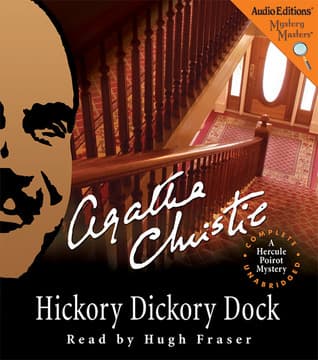
Synopsis
Covers the whole plot, including the ending.
- Difficulty
- Medium
- Pacing
- Moderate
- Mood
- Intriguing, Puzzling, Classic
- Read it if
- You enjoy classic Golden Age mysteries with intricate plots, a quirky setting, and Hercule Poirot's brilliant deductions.
- Skip it if
- You prefer modern, fast-paced thrillers or mysteries without a strong focus on intellectual puzzle-solving.
Hickory Dickory Dock Plot Summary
Covers the whole plot, including the ending.
The Peculiar Kleptomania Outbreak
Mrs. Hubbard, the warden of a student hostel called Hickory Road, asks Hercule Poirot about a series of strange thefts and vandalism among her residents. Poirot initially dismisses these as petty crimes, but he becomes interested in the illogical list of stolen items: a stethoscope, flannel trousers, a box of chocolates, a cut rucksack, and a diamond ring found in soup. He senses a darker purpose than simple student pranks. The atmosphere at the hostel is tense, with students showing fear rather than just annoyance, suggesting the thefts are a cover or a distraction from something more serious.
Poirot's Investigation Begins
Poirot, with Miss Lemon, begins his investigation at Hickory Road. He interviews the residents, a diverse group of international students including Nigel Chapman, Sally Finch, Colin McNabb, and Akibombo. He quickly notices their individual habits, goals, and hidden worries. The students are generally unhelpful and secretive, each seemingly hiding something. Poirot focuses on the random nature of the stolen items, believing them to be clues in a larger, still unknown, puzzle. He also notes the general mess and lack of order within the hostel, which Mrs. Hubbard struggles to manage.
The First Murder: Celia Austin
The seemingly harmless thefts quickly escalate when Celia Austin, a resident, is found dead in her bed from a morphine overdose. Her death first appears to be a suicide, but Poirot immediately suspects murder. Celia had admitted to some of the earlier petty thefts, saying they were a cry for attention. Her death confirms Poirot's belief that the thefts were a smokescreen. The diamond ring, one of the stolen items later returned, becomes important, as it belonged to Celia, who had reported it stolen.
The Nursery Rhyme Connection
As Poirot examines the seemingly random items, he suddenly realizes something: the stolen objects match lines from the nursery rhyme 'Hickory Dickory Dock'. The clock (Hickory Road's name), the mouse (a small figurine), the bell (a stolen handbell), and so on. This discovery changes the investigation, providing a structure for the seemingly arbitrary thefts. He now believes the thief, and likely the murderer, is carefully following this pattern, using the rhyme as a twisted guide for their actions, possibly to mock investigators or as a reminder for a larger plan.
The Missing Rhyme Book
Poirot discovers that Celia Austin had a children's book of nursery rhymes, which has now vanished. He deduces that this book contains the specific version of 'Hickory Dickory Dock' the culprit uses as their guide. The book's disappearance is a major setback, preventing Poirot from fully understanding the killer's next moves or the complete list of items they plan to target. He suspects the murderer either stole or destroyed it to hide their method, further complicating the already complex puzzle and showing the killer's cleverness.
The Second Murder: Mrs. Nicoletis
The investigation takes another dark turn with the murder of Mrs. Nicoletis, an elderly resident who often spoke randomly about various things. She is found dead, also appearing to be from natural causes, but Poirot again suspects foul play. It becomes clear that the killer is removing anyone who might accidentally discover their secret or provide a key clue. Mrs. Nicoletis's death further strengthens the idea that the thefts were merely a cover for a much more serious criminal operation, and that the risks are incredibly high for the perpetrator.
The Smuggling Operation
Through careful investigation and observation of the residents, Poirot uncovers a sophisticated diamond smuggling operation running out of Hickory Road. The seemingly random stolen items, especially the diamond ring and a specific edition of a children's rhyme book, are connected to this illegal trade. The book, in particular, contains a hidden code or message essential to the operation. The petty thefts were staged to create confusion, diverting attention from the real criminal activity and allowing the smugglers to operate unnoticed.
The True Identity of the Mastermind
Poirot gathers all the suspects in the common room for his big reveal. He explains how the nursery rhyme was a memory aid for the smuggling operation and to confuse the police. He then names Nigel Chapman as the mastermind behind the diamond smuggling. Nigel, an outwardly charming and smart young man, had used the hostel as a base for his illegal activities, employing Celia Austin and others, who were either unaware pawns or forced participants. Celia's death was a desperate act to silence her after she became a problem or threatened to expose him.
The Motive and the Accomplices
Nigel's motive is pure greed, along with a desire for excitement and to prove his intelligence. This desire for wealth led him to plan elaborate schemes, manipulate those around him, and commit murder without remorse. Celia Austin and Mrs. Nicoletis became disposable obstacles in his pursuit of riches. The diamond ring, originally Celia's, was a crucial part of the smuggling puzzle. Valerie Hobhouse, another resident, was Nigel's accomplice, devoted to him and willing to take part in his plans. She helped him with the thefts and disposing of evidence, acting as his loyal, though misguided, partner in crime.
Justice is Served
With Poirot's detailed explanation, Nigel Chapman and Valerie Hobhouse are exposed and arrested. The full extent of their criminal enterprise, including the murders of Celia Austin and Mrs. Nicoletis, is revealed. The remaining students and Mrs. Hubbard are left to deal with the shocking truths. The hostel, once a place of study and youthful friendship, is forever marked by the crimes committed within its walls. Poirot, having again solved a complex and unique case, leaves, allowing the police to handle the formal procedures and the hostel to slowly recover from the ordeal.
Hickory Dickory Dock Characters
Hercule Poirot
Protagonist
The eccentric Belgian detective known for his 'little grey cells'.
Poirot is a brilliant, fastidious, and supremely confident detective. He relies heavily on psychology and observation, often allowing others to underestimate him due to his slightly theatrical mannerisms. He is driven by a profound belief in order and logic, which makes the seemingly random nature of the thefts at Hickory Road particularly intriguing to him. His vanity is often played for comedic effect, but it never detracts from his sharp intellect. He is deeply committed to justice and uncovering the truth, no matter how convoluted the path.
Relationships: Mrs. Hubbard (Client seeking his help); Miss Lemon (His highly efficient and loyal secretary)
Mrs. Hubbard
Supporting
The well-meaning but overwhelmed warden of Hickory Road hostel.
Mrs. Hubbard is the warden of Hickory Road, a woman who tries her best to manage the diverse and often unruly group of students, but frequently finds herself out of her depth. She is earnest and genuinely concerned for her residents, but lacks the disciplinary skills or shrewdness to effectively control the hostel. She is initially baffled and distressed by the thefts, and later deeply shaken by the murders, relying entirely on Poirot to make sense of the chaos. She represents the well-intentioned but ultimately naive authority figure.
Relationships: Hercule Poirot (Her employer/consultant); The Students (Her charges at the hostel)
Nigel Chapman
Antagonist
A charming and intelligent student, secretly the mastermind behind the crimes.
Nigel is presented as an intelligent, articulate, and seemingly well-adjusted student. He is a master manipulator, using his charm and intellect to deceive those around him. Beneath his amiable exterior lies a ruthless and calculating criminal mind, driven by greed and a desire to outwit others. He is the architect of the diamond smuggling operation and the orchestrator of the 'kleptomania' spree, as well as the murderer of Celia Austin and Mrs. Nicoletis to protect his scheme. He views his crimes as a clever game.
Relationships: Valerie Hobhouse (His accomplice and romantic interest); Celia Austin (His victim and former pawn)
Valerie Hobhouse
Supporting
A resident at the hostel and Nigel Chapman's accomplice.
Valerie is a student at Hickory Road, deeply infatuated with Nigel Chapman. Her love for him makes her complicit in his crimes, participating in the thefts and helping to cover his tracks. She is portrayed as somewhat vulnerable and easily swayed, her moral compass distorted by her devotion to Nigel. She is not as inherently malicious as Nigel, but her loyalty leads her down a dangerous path, making her an active participant in a criminal enterprise and a murder cover-up.
Relationships: Nigel Chapman (His accomplice and romantic interest)
Celia Austin
Supporting/Victim
The first murder victim, a seemingly troubled student who confessed to some thefts.
Celia is a resident at Hickory Road who initially confesses to some of the petty thefts, claiming she did them for attention. She is depicted as somewhat fragile and possibly a bit unstable, making her an easy target for manipulation. She was involved, likely unwillingly or unknowingly, in Nigel's smuggling scheme. Her death, initially disguised as suicide, is the catalyst that transforms the investigation from petty crime to murder, revealing the true gravity of the situation at the hostel. She owned the crucial children's rhyme book.
Relationships: Nigel Chapman (Her manipulator and murderer)
Mrs. Nicoletis
Supporting/Victim
An elderly, eccentric resident and the second murder victim.
Mrs. Nicoletis is an elderly, often rambling resident of Hickory Road. She is portrayed as a harmless, somewhat senile woman who frequently loses her belongings and makes seemingly irrelevant comments. However, it is her seemingly innocuous chatter that inadvertently puts her in danger, as she possesses fragmented information or observations that could expose the smuggling ring. Her murder, like Celia's, is made to look like an accident or natural causes, underscoring the killer's ruthlessness and determination to silence anyone who might pose a threat.
Sally Finch
Supporting
An American student at the hostel, often outspoken and observant.
Sally is an American student known for her directness and keen observations. She is one of the more outspoken residents, often voicing her opinions and frustrations about the thefts and the general atmosphere at the hostel. Her perspective provides an outsider's view on the British eccentricities and the unfolding mystery. While not directly involved in the crimes, she is a useful source of information and reactions for Poirot, often inadvertently providing him with insights through her candid remarks.
Relationships: Colin McNabb (Fellow student and friend)
Colin McNabb
Supporting
A student struggling with his studies and often anxious.
Colin is another student at Hickory Road, often depicted as nervous and preoccupied with his academic performance. He is not directly involved in the criminal activities but is affected by the general tension and fear in the hostel. His anxieties and introverted nature make him a less direct source of information for Poirot, but his reactions to the events contribute to the overall atmosphere of suspicion and unease. He represents the innocent students caught in the crossfire of the criminal enterprise.
Relationships: Sally Finch (Fellow student and friend)
Hickory Dickory Dock Themes
Appearance vs. Reality
This theme is central to the entire story. The seemingly minor thefts act as a carefully built cover for a much more serious criminal operation—diamond smuggling and murder. Characters like Nigel Chapman present a charming and intelligent appearance, completely hiding his ruthless and calculating nature. The whole idea of the nursery rhyme thefts is a deliberate misdirection, making the crimes seem whimsical and illogical, when they are actually part of a carefully planned scheme. Poirot consistently looks past appearances to uncover the dark truth, as seen when he immediately dismisses suicide for Celia's death.
“'The trouble with you, Mrs. Hubbard, is that you are too ready to believe what you see, and not ready enough to believe what you don't see.”
The Corrupting Power of Greed
Greed is the main reason for Nigel Chapman's actions. He is not driven by emotion or revenge, but by the desire for illegal wealth from diamond smuggling. This greed leads him to plan complex schemes, manipulate those around him, and ultimately commit murder without apparent regret. Celia Austin and Mrs. Nicoletis become expendable obstacles in his search for riches. The diamond ring, a symbol of wealth, is a recurring object that highlights the core of the criminal enterprise, showing how the pursuit of material gain can lead to moral decay and violence within the seemingly harmless setting of a student hostel.
“'Money... it is the root of much evil, is it not?'”
Order and Disorder
This theme is a constant undercurrent, especially through Poirot's view. The initial state of Hickory Road hostel is somewhat messy, with Mrs. Hubbard struggling to control her diverse student population and their minor rule-breaking. The thefts introduce a deeper level of disarray, but it is a false, organized disorder designed to hide true criminal order. Poirot, with his need for logic and patterns, tries to bring order to this chaos, turning the illogical list of stolen items into a coherent pattern based on the nursery rhyme. His investigation is a process of restoring intellectual and moral order to a situation intentionally made confusing.
“'There must be order and method. Without them, there is chaos.”
The Deceptiveness of the Ordinary
The novel skillfully uses the ordinary setting of a student hostel to conceal extraordinary crimes. The residents appear to be typical students, focused on their studies and daily lives, but beneath this normal facade lies a complex web of smuggling and murder. Ordinary objects like a children's rhyme book, a stethoscope, or flannel trousers gain hidden meaning, becoming clues to a much larger, darker plot. This theme shows how evil can hide in the most unexpected places and among the most seemingly harmless people, challenging the reader's assumptions about normalcy.
“'It is always the simple things that are the most baffling.”
Plot Devices & Literary Techniques
Red Herring
Misleading clues or suspects designed to divert attention from the real culprit.
The entire kleptomania outbreak serves as a massive red herring. The initial focus on petty thefts and the suggestion of a troubled student (Celia Austin) as the culprit for these minor crimes is a deliberate misdirection. This device effectively distracts both the characters and the reader from the true nature of the criminal activity – a sophisticated diamond smuggling operation and subsequent murders. Other minor characters or their suspicious behaviors also act as red herrings, leading Poirot and the reader down various investigative paths before the true mastermind is revealed.
The Nursery Rhyme as a Cipher
Using a children's rhyme to organize and conceal criminal activity.
The 'Hickory Dickory Dock' nursery rhyme is a pivotal plot device. It is initially introduced as the namesake of the hostel, but Poirot later realizes it is being used as a mnemonic or a coded blueprint for the stolen items. This device provides a seemingly nonsensical pattern that, once deciphered, reveals the meticulous planning of the criminal. It adds a layer of intellectual challenge and macabre whimsy to the crimes, while also acting as a key to understanding the killer's method and predicting their next moves, particularly when the specific rhyme book goes missing.
The Closed Circle Mystery
A limited number of suspects confined to a specific location.
Hickory Dickory Dock primarily functions as a closed circle mystery, with the crimes occurring within the confines of the Hickory Road student hostel. This limits the pool of suspects to the residents, staff, and a few close associates of the hostel. This device heightens the tension and suspicion among the characters, as everyone is potentially a murderer or an accomplice. It allows Poirot to meticulously examine the interactions, alibis, and motivations of a contained group, making the unraveling of the complex plot more focused and intense.
Dramatic Irony
The audience or a character knows something that another character does not.
Dramatic irony is employed subtly throughout the novel, particularly concerning Nigel Chapman. The reader is initially led to believe he is just another student, while his true, sinister nature as the mastermind is slowly revealed. This creates tension as the reader might pick up on subtle cues or Poirot's observations that suggest something is amiss with Nigel, even while other characters trust him. The most significant instance is the initial view of the 'kleptomania' as mere student pranks, when the audience, through Poirot's growing suspicion, understands there is a deeper, murderous plot at play.
Hickory Dickory Dock Quotes
“Crime is terribly revealing. Try and make a man confess and you learn nothing. But let him write a book, or paint a picture, or commit a crime, and in each case he cannot help but incriminate himself.”
“It's odd, isn't it, how the most trivial things can sometimes be the most important?”
“One does not have to be a murderer to understand murder. One has only to be human.”
“The human mind is a strange and convoluted thing, full of dark corners and unexpected twists.”
“Order and method, my friend, are the twin pillars of success.”
“It is always the simple things that trip us up.”
“People are very good at deceiving themselves, even better than they are at deceiving others.”
“Every lock has a key, if you only know where to look.”
“The truth, my friend, is often far stranger than fiction.”
“One must not jump to conclusions, however tempting it may be.”
“Money is a powerful motive, my friend. It drives men to do many things, both good and evil.”
“The past is never truly gone. It always leaves its echoes.”
“Even the cleverest of criminals makes a mistake somewhere. It is my job to find it.”
Quiz
10 questions on the plot and the characters. Each answer comes with a short explanation.
Question 1
What is the initial crime that Mrs. Hubbard reports to Hercule Poirot?
- A series of violent assaults on students.
- An outbreak of kleptomania and vandalism at the student hostel.
- The theft of valuable examination papers.
- A poisoning incident affecting several residents.
Show answer
B. An outbreak of kleptomania and vandalism at the student hostel. The synopsis clearly states that Mrs. Hubbard reports 'an outbreak of kleptomania at a student hostel.'
Question 2
Which item from the list of stolen/vandalized goods was found in a bowl of soup?
- A stethoscope
- Some old flannel trousers
- A diamond ring
- A box of chocolates
Show answer
C. A diamond ring The provided text specifically mentions 'a diamond ring found in a bowl of soup'.
Question 3
What is the name of the warden of the student hostel?
- Miss Lemon
- Mrs. Hubbard
- Ariadne Oliver
- Miss Marple
Show answer
B. Mrs. Hubbard Poirot 'congratulated the warden, Mrs Hubbard,' indicating her name.
Question 4
Why does Hercule Poirot initially become interested in the case, despite it being seemingly petty crime?
- He was bored with other cases and needed a new challenge.
- The list of stolen and vandalized items made no sense, presenting a unique problem.
- He knew one of the students personally.
- He was offered a substantial fee to investigate.
Show answer
B. The list of stolen and vandalized items made no sense, presenting a unique problem. Poirot 'congratulated the warden... on a 'unique and beautiful problem'' because 'The list made absolutely no sense at all.'
Question 5
Which of the following items was NOT mentioned as being stolen or vandalized?
- A stethoscope
- A pair of reading glasses
- A slashed rucksack
- A box of chocolates
Show answer
B. A pair of reading glasses The list includes a stethoscope, old flannel trousers, a box of chocolates, a slashed rucksack, and a diamond ring. Reading glasses are not mentioned.
Question 6
What is Poirot's initial observation about the nature of the problem based on the list of items?
- It suggests a highly organized criminal gang.
- It is a 'unique and beautiful problem' because the list makes no sense.
- It points to a simple case of student pranks gone awry.
- It indicates a clear motive of financial gain.
Show answer
B. It is a 'unique and beautiful problem' because the list makes no sense. Poirot 'congratulated the warden, Mrs Hubbard, on a 'unique and beautiful problem'' and noted, 'The list made absolutely no sense at all.'
Question 7
What key detail makes Poirot suspect the situation is more serious than mere petty theft?
- The high monetary value of the stolen items.
- The involvement of an international spy ring.
- The fact that everyone at the hostel was so frightened.
- A direct threat made against his own life.
Show answer
C. The fact that everyone at the hostel was so frightened. Poirot reasoned, 'if this was merely a petty thief at work, why was everyone at the hostel so frightened?' This fear elevates his interest.
Question 8
What is the primary genre of 'Hickory Dickory Dock'?
- Romance
- Fantasy
- Mystery
- Science Fiction
Show answer
C. Mystery The prompt explicitly states the book's genre as 'Mystery'.
Question 9
Beyond the physical items, what underlying theme or problem does Poirot's interest in the 'frightened' residents suggest he is beginning to investigate?
- The economic hardships faced by students.
- A deeper, more dangerous crime than simple theft, possibly murder.
- The psychological effects of living in close quarters.
- The academic pressure on university students.
Show answer
B. A deeper, more dangerous crime than simple theft, possibly murder. Poirot's logic is that fear implies a greater threat than petty theft. In Christie's mysteries, inexplicable fear often foreshadows murder or a serious, complex criminal plot.
Question 10
What is Hercule Poirot's primary motivation for taking on a case that doesn't immediately appear to be a serious crime?
- He is always looking to increase his personal wealth.
- He is driven by intellectual curiosity and the challenge of an illogical puzzle.
- He feels a personal obligation to Mrs. Hubbard.
- He believes the case will bring him significant public fame.
Show answer
B. He is driven by intellectual curiosity and the challenge of an illogical puzzle. Poirot's reaction to the 'unique and beautiful problem' and the illogical nature of the list highlights his intellectual drive to solve challenging puzzles, not monetary gain or fame.
Hickory Dickory Dock FAQ
What is the initial mystery that brings Hercule Poirot into the case at Hickory Road hostel?
Hercule Poirot is initially intrigued by a seemingly random outbreak of petty theft and vandalism at a student hostel located on Hickory Road. The stolen items range from mundane objects like old flannel trousers and a box of chocolates to more unusual things such as a stethoscope, a slashed rucksack, and a diamond ring discovered in soup, making the pattern of thefts illogical and highly perplexing.
Who is Mrs. Hubbard and what is her role at the Hickory Road hostel?
Mrs. Hubbard is the diligent and somewhat flustered warden of the Hickory Road student hostel. She is the one who initially contacts Hercule Poirot, presenting him with the bizarre list of stolen and vandalized items, hoping he can make sense of the seemingly senseless crimes plaguing her establishment and its residents.
What makes Poirot realize the thefts are more serious than mere kleptomania?
Poirot initially finds the case an amusing puzzle, but he quickly recognizes its deeper implications when he observes the pervasive atmosphere of fear among the hostel's residents. He deduces that if the thefts were truly just petty kleptomania, the students would not be so genuinely terrified, indicating a more sinister underlying motive.
Which character is the first murder victim in the story?
Celia Austin is the first murder victim in 'Hickory Dickory Dock'. She is found dead after taking an overdose of morphine, which is initially suspected to be suicide but is later revealed to be murder, directly linked to the bizarre thefts occurring at the hostel.
What is the significance of the nursery rhyme 'Hickory Dickory Dock' in the plot?
The nursery rhyme 'Hickory Dickory Dock' serves as a crucial hidden clue, with each line corresponding to a specific stolen item or a character involved in the mystery. Poirot eventually deciphers that the items are not stolen randomly but are carefully selected to represent parts of the rhyme, pointing towards the killer's motive and identity.
How does the diamond ring found in the soup bowl connect to the larger plot?
The diamond ring found in the soup bowl is a pivotal item. It belongs to Patricia Lane and its recovery, along with other seemingly random objects, is part of a larger scheme to distract from the true objective: smuggling a valuable cache of industrial diamonds. The theft of the ring itself serves as misdirection within the broader criminal enterprise.
What role does the 'mouse' play in the overall scheme of the thefts and murders?
The 'mouse' in the context of the nursery rhyme, and the story, refers to the industrial diamonds being smuggled. The entire kleptomania scheme is orchestrated to divert attention from the real prize, the diamonds, which are hidden within various innocuous items and slowly being moved out of the hostel.
Who is Colin McNabb and what is his connection to the stolen items?
Colin McNabb is a psychology student at the hostel who is initially suspected of being the kleptomaniac due to his field of study. However, he becomes instrumental in helping Poirot understand the psychological aspects of the case, though he is not the actual thief or murderer. His expertise helps to frame the initial psychological red herring.
How does the 'innocent' nature of the initial thefts manipulate the residents' psychology?
The seemingly petty and random nature of the initial thefts is designed to create confusion and psychological distress, making the residents doubt their own perceptions and each other. This atmosphere of distrust and paranoia prevents anyone from connecting the thefts to a larger, more sinister plot, thereby aiding the criminal's true intentions.
What psychological profile can be attributed to the murderer in 'Hickory Dickory Dock'?
The murderer exhibits a highly manipulative and calculating psychological profile, capable of orchestrating a complex scheme of misdirection using seemingly trivial thefts to mask a much larger crime. They are ruthless in eliminating anyone who gets too close to the truth, demonstrating a lack of empathy and a strong drive for self-preservation.
How does the fear among the students contribute to the murderer's advantage?
The pervasive fear among the students paralyses their ability to think clearly and cooperate effectively. It makes them suspicious of each other and less likely to share crucial information, creating a chaotic environment that the murderer can exploit to continue their operations and evade detection.
What role does memory and observation play in Poirot's solution to the case?
Poirot heavily relies on meticulous observation of seemingly insignificant details and the careful analysis of inconsistencies in witness testimonies. His exceptional memory for facts and his ability to link disparate pieces of information, combined with his understanding of human psychology, are crucial in piecing together the complex puzzle.
Why did the murderer choose such an elaborate and risky method involving a nursery rhyme?
The murderer chose this elaborate method, using the nursery rhyme as a framework, primarily for misdirection and to create a sense of randomness and absurdity. This convoluted approach was intended to confuse investigators and make the thefts appear to be the work of a mentally unstable individual rather than a calculated criminal mastermind, thereby diverting suspicion from the true motive.
Is the ending of 'Hickory Dickory Dock' considered satisfying or controversial among Christie fans?
The ending of 'Hickory Dickory Dock' is generally considered satisfying by Christie fans, as Poirot meticulously uncovers the complex web of deceit and reveals a clever, albeit convoluted, motive. While some might find the nursery rhyme connection a bit whimsical, the logical unraveling of the plot and the reveal of the murderer's identity align with Christie's characteristic style of intricate plotting.
What broader commentary on human nature might Christie be making through the 'kleptomania' facade?
Christie might be commenting on how easily people can be deceived by appearances and how readily they jump to simplistic conclusions (like kleptomania) to explain complex phenomena. The story highlights human vulnerability to manipulation and the tendency to overlook deeper, more sinister motives when presented with a plausible, albeit misleading, surface narrative.
How does the character of Patricia Lane contribute to the unfolding of the mystery?
Patricia Lane is a key character, not only because her diamond ring is stolen, but also because she possesses valuable knowledge that makes her a target. Her eventual murder further signals to Poirot that the thefts are connected to something far more serious than petty crime, pushing him to look beyond the obvious.
What is the role of the industrial diamonds in the overall criminal enterprise?
The industrial diamonds are the true prize and the central motivation behind the entire elaborate scheme. They are being smuggled out of the country, and the 'kleptomania' at the hostel is a carefully constructed smokescreen designed to distract from the real crime of diamond smuggling, allowing the perpetrator to move the valuable gems undetected.
How does Hercule Poirot's method of investigation adapt to such an unusual case?
Poirot's method adapts by initially embracing the absurdity of the thefts, recognizing that their very illogic is a clue in itself. He uses his 'little grey cells' to look beyond the surface, focusing on human reactions, the absence of logic, and the subtle connections between seemingly random events and objects, rather than relying on conventional criminal motives.
About the author
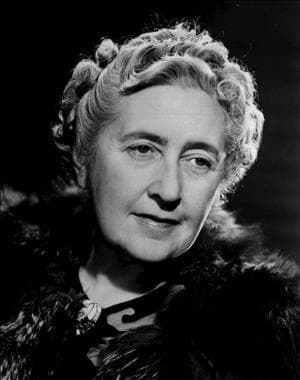
Dame Agatha Mary Clarissa Christie, Lady Mallowan, was an English writer known for her 66 detective novels and 14 short story collections, particularly those revolving around fictional detectives Hercule Poirot and Miss Marple. She also wrote the world's longest-running play, the murder mystery The Mousetrap, which has been performed in the West End since 1952. A writer during the "Golden Age of Detective Fiction", Christie has been called the "Queen of Crime". She also wrote six novels under the pseudonym Mary Westmacott. In 1971, she was made a Dame (DBE) by Queen Elizabeth II for her contributions to literature. Guinness World Records lists Christie as the best-selling fiction writer of all time, her novels having sold more than two billion copies.
Similar books
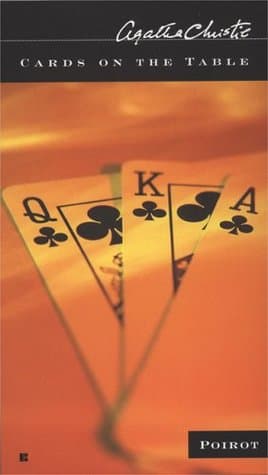
- Cards on the Table
Agatha Christie
3.9 (37k) average on GoodreadsThrillerShowcases Poirot solving a murder committed during a seemingly innocent gathering with psychological depth.
- Gaudy Night
Dorothy L. Sayers
4.2 (23k) average on GoodreadsHistorical FictionA Golden Age mystery set in an academic institution with a focus on intellectual puzzles and a female detective.
- THE MURDER OF ROGER ACKROYD
Agatha Christie
4.2 (153k) average on GoodreadsThriller"Hickory Dickory Dock" lacks the groundbreaking narrative twist and psychological depth found in "The Murder of Roger Ackroyd." While both feature Poirot, "Ackroyd"'s unreliable narrator and shocking revelation are far more innovative and impactful, solidifying its place as a genre-defining work. "Hickory Dickory Dock" offers a more traditional, albeit complex, puzzle.
- A Study in Scarlet
Arthur Conan Doyle
4.2 (324k) average on GoodreadsHistorical FictionWhile both feature iconic detectives, "Hickory Dickory Dock" showcases Christie's preference for intricate, self-contained puzzles over the more action-oriented and geographically varied investigations often found in Conan Doyle's Sherlock Holmes stories. "A Study in Scarlet" introduces Holmes with a focus on his unique methods and a dual narrative spanning continents, whereas Christie's novel is confined to a specific, domestic setting, emphasizing the 'whodunit' over broader adventure.
- Angels & Demons
Dan Brown
3.9 (2.7M) average on GoodreadsThrillerA Harvard symbologist races through Rome's ancient sites, deciphering cryptic clues to unmask the Illuminati and stop a vengeful plot to destroy the Vatican with a stolen antimatter weapon.
- Gone Girl
Gillian Flynn
4.1 (2.3M) average on GoodreadsThrillerA wife's sudden disappearance on her fifth anniversary reveals a web of lies and psychological warfare, exposing the secrets within a seemingly perfect marriage.



Enjoyed the summary?
A summary gives you the shape of the book. The book itself has the detail, the examples and the voice.
Find Hickory Dickory Dock on AmazonAs an Amazon Associate, BookBrief earns from qualifying purchases. How we're funded