BookBrief
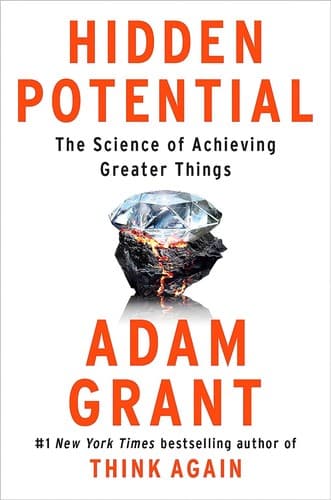
Hidden Potential cover

Hidden Potential Summary

Adam Grant (2023)

Get the book

Goodreads Rating

4.08/ 5(51,470 reviews)

Genre

General

Summary Read

14 min

Book Length

4 hours

By BookBrief EditorialLast updated August 30, 2026verifiedReviewed by BookBrief Editorial

Track Your Reading

Sign in to track this book

My Notes

Only visible to you
Adam Grant shows that true achievement comes not from natural talent, but from developing character, mastering motivation through intentional practice and rest, and building systems that value potential beyond typical measures.

Core Idea

Adam Grant's "Hidden Potential" challenges the conventional understanding of potential, arguing that it is not a fixed, innate trait but rather a dynamic capacity that can be cultivated and expanded. Grant posits that true growth comes not from inherent talent but from character skills, supportive systems, and the deliberate pursuit of challenges. He emphasizes the importance of 'scaffolding'—creating environments and processes that enable continuous learning and improvement, often through the development of 'skill chips' and the embrace of discomfort as a catalyst for progress. The book advocates for a mindset shift from merely discovering potential to actively developing it, highlighting that the greatest achievements often come from those who master the art of learning and adaptation.
Reading time
4 hours
Difficulty
Medium
✓ Read this if...
You believe potential is fixed, want to understand how to foster growth in yourself or others, or are looking for practical strategies to unlock hidden capabilities in any domain.
✗ Skip this if...
You are only interested in books focused on raw talent or innate genius, or prefer a purely theoretical discussion without actionable advice.

Chat with this book

Ask anything about Hidden Potential and get instant answers grounded in the summary.

Key Takeaways from Hidden Potential

1

Character Trumps Personality

Character is the conscious choice to act on values, not just instincts.

Quote

Character is your capacity to prioritize your values over your instincts.

Grant distinguishes personality from character. Personality is our default way of being; character is the deliberate practice of our values. For example, an introverted person (personality) can still develop the character to speak up for their beliefs (value). This is not about changing who you are, but about building the ability to act on your principles, even when it feels uncomfortable.

Supporting evidence

Grant cites research on how individuals can develop traits like integrity or courage through intentional practice, rather than being born with them. He provides examples of people who, despite initial shyness or fear, learned to embody leadership qualities by consistently choosing their values over their comfort.

Apply this

Identify a core value you hold (e.g., honesty, compassion, growth). Reflect on an instinctual reaction you often have that might contradict this value. Practice choosing your value over your instinct in a low-stakes situation, building your 'character muscle' over time.


character-developmentvalue-alignmentself-overcoming
2

Embrace Discomfort for Accelerated Growth

The fastest path to improvement lies in actively seeking out challenges that make you feel awkward or incompetent.

Quote

The fastest way to grow is to seek out challenges that make you feel awkward or incompetent.

This is one of the book's best ideas. It challenges the common human tendency to avoid looking foolish or failing. Grant argues that real learning happens at the edge of our abilities, in the 'stretch zone.' When we put ourselves in situations where we do not immediately know the answer or have the skill, our brains adapt and learn faster. This is not about being reckless, but about intentionally exposing ourselves to new and difficult tasks, understanding that initial awkwardness is necessary for mastery.

Supporting evidence

Grant references studies on 'desirable difficulties' in learning, where introducing obstacles (like spaced repetition or varied practice) initially slows performance but leads to better long-term retention and deeper understanding. He might also point to examples of successful individuals who deliberately took on roles or projects outside their comfort zone early in their careers.

Apply this

Identify a skill you want to develop. Instead of practicing only what you're good at, seek out a specific task or project related to that skill that makes you feel genuinely uncomfortable or out of your depth. Embrace the initial struggle as a sign of growth.

stretch-zonedesirable-difficultiesgrowth-mindset
3

Beyond Hard Work: Become a 'Sponge'

True progress isn't just about effort, but about actively absorbing and implementing feedback.

Quote

Moving beyond just being a hard worker to being someone who actively absorbs and implements feedback.

Grant differentiates between 'hard work' and effective 'sponge-like' learning. Many people work hard but do not improve because they are not truly open to, or good at, using feedback. Being a 'sponge' means actively listening, asking clear questions, seeking different viewpoints, and, most importantly, trying out the feedback received. This cycle of effort, feedback, and adjustment is what turns activity into real progress. Without this open and adaptable approach, even intense effort can lead to stagnation or reinforce bad habits.

Supporting evidence

He often cites studies on deliberate practice, which emphasizes immediate and accurate feedback as a cornerstone of expert performance. Examples might include athletes who meticulously review game footage with coaches, or musicians who work with mentors to refine technique based on critical assessment.

Apply this

After completing a task or project, actively solicit specific, constructive feedback from a trusted peer or mentor. Don't just listen; ask 'What's one thing I could do differently next time?' and then commit to trying that specific change in your next attempt.

deliberate-practicefeedback-loopactive-learning
4

The Imperfectionist: Optimizing for 'Good Enough'

Shift from debilitating perfectionism to finding the optimal level of flawlessness for the task at hand.

Quote

Shifting away from debilitating perfectionism and toward finding the 'optimal' level of flawlessness.

Perfectionism, often seen as a good quality, is shown by Grant to hinder progress. The 'imperfectionist' does not settle for sloppy work but understands that there is a point where striving for absolute flawlessness offers diminishing returns. This idea is especially useful in a world that often demands unrealistic standards. The key is to know when 'good enough' is truly best, allowing for faster work, more learning, and avoiding the paralysis that often comes with chasing unattainable perfection. It is a smart way to pursue excellen...

Supporting evidence

Grant might refer to research on 'satisficing' versus 'maximizing' decision-making, showing that satisficers often report higher well-being and faster task completion without a significant drop in quality for many tasks. He could also provide examples of successful innovators who prioritize rapid prototyping and iteration over perfect initial launches.

Apply this

Before starting a new project, explicitly define what 'good enough' looks like for a first draft or initial version. Set a time limit for that stage and commit to moving on once that threshold is met, resisting the urge to endlessly refine.

perfectionismsatisficingiterationoptimal-quality
5

Harmonious Passion Prevents Burnout

Balance intense focus with rest to sustain motivation and avoid exhaustion.

Quote

Balancing intense focus with rest to prevent exhaustion.

Grant highlights the difference between obsessive passion and harmonious passion. Obsessive passion drives people to work constantly, often leading to burnout and resentment. Harmonious passion involves a deep love for the activity itself, allowing for intense focus balanced with planned breaks and rest. This is not about working less, but working smarter; understanding that recovery is not a luxury but a necessary part of sustained high performance. This idea has major implications for well-being and long-term productivity, questioni...

Supporting evidence

He likely draws on research by Robert Vallerand on harmonious vs. obsessive passion, demonstrating that harmonious passion correlates with greater well-being, psychological adjustment, and sustained engagement in activities. Examples could include athletes who meticulously plan their off-season recovery or artists who take sabbaticals.

Apply this

Identify an activity you're passionate about. Schedule dedicated periods of intense, focused work, but also intentionally schedule and protect periods of complete rest or engagement in unrelated, enjoyable activities. Treat rest as a non-negotiable part of your training.

harmonious-passionburnout-preventionrest-recoverysustainable-performance
6

Deliberate Play Transforms Practice

Turn tedious practice into engaging, skill-building games to maintain motivation.

Quote

Transforming tedious practice into something engaging. For example, instead of repetitive drills, athletes or musicians might create games that test the same skills but keep the mind fresh.

This idea offers a strong solution to the monotony often linked with learning new skills. Grant argues that by adding elements of play—curiosity, challenge, and immediate feedback—to deliberate practice, we can maintain motivation and learn faster. This is not about avoiding hard work, but about making hard work more appealing and effective. It uses our natural human desire for engagement and novelty, turning what could be a boring task into a dynamic, enjoyable process. Grant suggests that the best learners are often the best players...

Supporting evidence

He would likely cite examples from various fields, such as musicians creating improvisational games to practice scales, or athletes inventing new drills that mimic game situations but with an added playful element. Research on gamification and intrinsic motivation would also support this.

Apply this

Choose a skill you need to practice regularly. Brainstorm ways to turn a repetitive aspect of that practice into a game: add a timer, create a scoring system, introduce a 'penalty' for errors, or collaborate with a friend to make it a competition.

gamificationintrinsic-motivationskill-acquisitionplayful-learning
7

Scaffolding to Overcome Plateaus

Utilize temporary support systems to push past stagnation points in learning and development.

Quote

Using temporary support systems (mentors, tools, or habits) to overcome 'plateaus' where progress usually stalls.

Grant addresses the common experience of hitting a plateau in skill development, where progress seems to stop. His solution is 'scaffolding'—the planned introduction of temporary support systems designed to help learners reach the next level. This might involve a mentor giving specific guidance, a new tool automating a complex step, or a structured habit simplifying a challenging routine. The key is that these supports are temporary; once the learner masters the skill or overcomes the obstacle, the support is gradually removed, buildi...

Supporting evidence

This concept is rooted in Vygotsky's Zone of Proximal Development. Grant would provide examples of successful mentorship programs, the use of training wheels for learning to ride a bike, or even software that simplifies complex tasks for beginners, which are then removed as expertise grows.

Apply this

Identify a specific plateau you're currently facing in a skill or project. Brainstorm potential 'scaffolds': could you find a mentor for specific guidance, use a temporary template or tool, or establish a strict micro-habit to get past the sticking point? Implement one, with the intention of removing it once you've progressed.

scaffoldingzone-of-proximal-developmentmentorshipskill-plateaus
8

Judge by 'Distance Traveled', Not Just Starting Point

Evaluate potential based on growth and obstacles overcome, not just current achievement.

Quote

We should judge people not just by where they are, but by how far they have come and the obstacles they overcame to get there.

This is a major shift in how we judge talent and potential, especially for organizations and schools. Grant argues against the common practice of only valuing individuals who have always excelled or had clear advantages. Instead, he supports recognizing 'distance traveled'—the progress made compared to one's starting point and the challenges faced. This view not only finds people with hidden abilities who might not have had traditional opportunities but also creates a more fair and motivating environment, rewarding persistence and gro...

Supporting evidence

Grant would present case studies of individuals who started from disadvantaged backgrounds but achieved remarkable success through sheer determination and learning. He might also refer to research showing that grit and resilience, often developed through overcoming adversity, are stronger predictors of long-term success than initial IQ or talent.

Apply this

When evaluating candidates for a role or promotion, or even when assessing your own progress, consider not just the final outcome, but the journey taken. Ask: 'What were the initial conditions? What obstacles were overcome? How much growth has occurred?'

distance-traveledgritresilienceequitable-evaluation
9

The 'Diamond in the Rough' Effect

Design selection processes to uncover potential in overlooked candidates.

Quote

Creating selection processes that look for hidden gems rather than just polishing existing stars.

Building on the 'distance traveled' idea, Grant extends this to organizations, urging them to actively seek out 'diamonds in the rough.' This means looking beyond traditional hiring metrics that often favor polished resumes and conventional successes. Instead, organizations should design processes that look for raw potential, curiosity, resilience, and the ability to grow—qualities that might not be immediately obvious. This approach broadens the talent pool and creates a more dynamic and innovative workforce, as these individuals oft...

Supporting evidence

He might discuss studies on diverse hiring practices and how they lead to better team performance and innovation. Examples could include companies that use skill-based tasks over traditional interviews, or those that focus on learning agility and problem-solving over specific prior experience.

Apply this

If you are involved in hiring or team selection, challenge the conventional criteria. Instead of just looking for specific past achievements, design an assessment that reveals a candidate's curiosity, their approach to learning new things, or their ability to adapt to unforeseen challenges. Look for growth potential over proven perfection.

hidden-potentialdiversity-equity-inclusiontalent-acquisitiongrowth-potential
10

The Science of Progress, Not the Myth of Talent

Potential is not fixed; it's a dynamic process of continuous improvement through intentional effort.

Quote

The central thesis is that the limit of your potential is not defined by your starting point. By focusing on the 'science of progress' rather than the 'myth of talent,' Grant provides a roadmap for individuals and organizations to rise above their current ceilings.

This summarizes the core message of 'Hidden Potential.' Grant shows that the idea of talent as an innate, fixed trait that determines our ultimate abilities is wrong. Instead, he presents potential as a dynamic, adaptable capacity for growth, driven by character development, strategic learning, and supportive systems. This reframing is liberating, shifting the focus from 'what you have' to 'what you do.' It empowers individuals to take charge of their development and encourages organizations to invest in nurturing potential rather tha...

Supporting evidence

The entire book serves as evidence, synthesizing research from psychology, education, and organizational behavior to demonstrate how character skills, motivation structures, and systems of opportunity collectively contribute to unlocking potential far beyond initial endowments. Each chapter builds on this central premise with specific studies and examples.

Apply this

Adopt a 'growth mindset' in all areas of your life. When faced with a challenge, remind yourself that your current ability is not your limit. Focus on the process of improvement, seeking feedback, embracing discomfort, and strategically practicing, rather than fixating on an inherent lack of talent.

growth-mindsetdynamic-potentialcontinuous-improvementanti-talent-myth

Hidden Potential Quotes

Grit is the tendency to sustain interest in and effort toward very long-term goals.

Defining grit as a key component of success.

The greatest leaders are the greatest learners.

Highlighting the importance of continuous learning for leadership.

When you're a novice, you're more likely to be open to new ideas. When you're an expert, you might be more resistant.

Explaining the advantages of being a novice in certain situations.

We tend to overestimate our foresight and underestimate our hindsight.

Discussing cognitive biases related to planning and decision-making.

The most effective people are often those who can admit they don't know everything.

Emphasizing the strength in acknowledging limitations and seeking knowledge.

We are often paralyzed by the pressure to be perfect.

Addressing the detrimental effects of perfectionism on progress.

Success is not a straight line. It's a messy, winding road.

Describing the non-linear nature of achieving success.

Embrace the possibility that you might be wrong. It's the first step to being right.

Encouraging intellectual humility and a willingness to be corrected.

The people who are most successful are often the ones who are willing to fail.

Connecting willingness to fail with the pursuit of success.

Don't just chase your dreams, build them.

Advocating for proactive creation over passive dreaming.

The antidote to burnout is not rest, but purpose.

Suggesting that a strong sense of purpose can combat exhaustion.

It's not about being the smartest person in the room, but about being the most willing to learn.

Reiterating the value of learning over innate intelligence.

The greatest predictor of future success is not talent, but tenacity.

Highlighting tenacity (a form of grit) as more crucial than natural talent.

We are all works in progress.

A fundamental belief in the continuous development of individuals.

Quiz

Test Your Knowledge

Ready to see how well you understood this book? Take our interactive quiz with 10 questions.

10
Questions
~5
Minutes
?
Best Score

Hidden Potential FAQ

'Hidden Potential' by Adam Grant challenges the idea of innate talent, arguing that anyone can achieve greater things through character development and better learning systems. It focuses on how to grow, sustain motivation, and create opportunities for progress.

About the author

Adam Grant is an organizational psychologist and a professor at the University of Pennsylvania's Wharton School. He is a New York Times bestselling author known for his work on motivation, generosity, and the psychology of giving.

Enjoyed the summary?

Support the author — grab the full book.

As an Amazon Associate, BookBrief earns from qualifying purchases, at no extra cost to you. How we're funded.

Get the book