
Synopsis
Covers the whole plot, including the ending.
- Difficulty
- Medium
- Pacing
- Moderate
- Mood
- Mythological, Reverent, Ancient, Poetic, Explanatory
- Read it if
- You are interested in ancient Greek mythology, the origins of Greek gods, or the foundational texts of Western literature and spirituality.
- Skip it if
- You prefer modern narrative structures, dislike poetry, or are looking for a continuous, overarching plot rather than episodic praises.
Homeric Hymns Plot Summary
Covers the whole plot, including the ending.
Hymn to Apollo
The hymn tells of Apollo's birth on Delos and his search for a place to build his oracle. He travels across Greece, considering several sites before choosing Crisa, near Mount Parnassus. There, he kills the dragoness Python, who guarded the spring, earning him the name 'Pythian Apollo.' He then gathers priests for his temple, turning into a dolphin to lead a ship of Cretan sailors to Crisa. He shows his divine form and tells them to serve as guardians of his sacred place and interpreters of his prophecies at Delphi, promising them a prosperous life.
Hymn to Demeter
The hymn describes the abduction of Persephone, Demeter's daughter, by Hades, lord of the underworld, with Zeus's help. Demeter, heartbroken, searches for her daughter across the earth, neglecting her divine duties. Her grief causes a terrible famine, as no crops grow, threatening humanity. Disguised as an old woman, Demeter arrives in Eleusis and is taken in by King Celeus and Queen Metaneira. She tries to make their son, Demophoon, immortal, but is interrupted, revealing her divine identity and demanding a temple built in her honor.
Hymn to Demeter (Continued)
As the famine worsens and the gods worry, Zeus sends Hermes to the underworld to demand Persephone's release. Hades agrees but cleverly offers Persephone a pomegranate seed, which she eats, binding her to the underworld for part of the year. A compromise is reached: Persephone will spend two-thirds of the year with her mother and one-third with Hades. Demeter, satisfied, restores fertility to the earth. The cycle of Persephone's descent and return establishes the rhythm of the seasons, explaining periods of agricultural abundance and scarcity.
Hymn to Hermes
Born to Maia in a cave on Mount Cyllene, the infant Hermes shows his cunning nature immediately. On his first day, he invents the lyre from a tortoise shell and then, at night, steals fifty of Apollo's sacred cattle. He cleverly hides their tracks and the cattle, sacrificing two. Apollo, angry at the theft, eventually tracks Hermes to his cave, but Hermes pretends to be a helpless baby in swaddling clothes. The dispute goes before Zeus for judgment.
Hymn to Hermes (Continued)
Before Zeus, Hermes continues to deny his actions, but Zeus, amused by his son's cleverness, orders him to return the cattle. Hermes, however, charms Apollo with the beautiful music of his new lyre. Apollo is so captivated that he trades his cattle for the instrument. This exchange solidifies their relationship: Hermes gives Apollo the lyre and later invents the panpipes, while Apollo grants Hermes the caduceus and control over flocks, trade, and messages. Zeus makes Hermes his personal messenger and the guide of souls to the underworld.
Hymn to Aphrodite
The hymn describes Aphrodite's power over gods and mortals, even making Zeus fall in love. However, Zeus, tired of her boasts, causes Aphrodite herself to desire a mortal man, Anchises, a Trojan prince. Disguised as a mortal maiden, Aphrodite approaches Anchises as he tends his cattle on Mount Ida. She invents a story of being a princess abducted by Hermes and brought to him, claiming to be destined to be his wife. Anchises, captivated, falls in love and sleeps with her.
Hymn to Aphrodite (Continued)
After their union, Aphrodite reveals her true divine form to a terrified Anchises. She scolds him for his fear but comforts him by predicting the birth of their son, Aeneas, who will be a great hero. She warns Anchises never to boast of having slept with a goddess, fearing the gods' wrath, especially Zeus. She recounts stories of other mortals who consorted with immortals, like Tithonus, who gained immortality but not eternal youth. She leaves, leaving Anchises both in awe and fearful, yet proud of their divine child.
Hymn to Dionysus
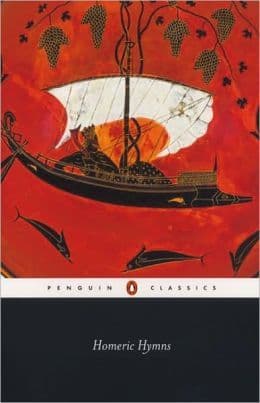
The hymn tells of an event where Dionysus, appearing as a young man, is captured by Tyrrhenian pirates who mistake him for a wealthy prince. Only the helmsman recognizes his divine presence and warns his crew, but they ignore him, planning to sell Dionysus into slavery. Dionysus then shows his power. Miracles begin on the ship: wine flows, vines entwine the mast, and ivy covers the sails. The terrified pirates jump overboard and turn into dolphins, except for the wise helmsman, whom Dionysus spares and blesses.
Hymn to Ares
This hymn addresses Ares directly, portraying him as a mighty, golden-helmeted god of war, strong and tireless in battle. He is described as a force that brings both terror and courage, a slayer of men, yet also a protector of cities. The hymnist asks Ares to temper his fierce nature, to send away 'mad rage' and 'bitter strife,' and instead to inspire peace and courage. He is asked to grant the supplicant strength to avoid cowardice and to live a just life, showing his power to both destroy and uphold order through strength.
Hymn to Hecate
Hecate is praised as a powerful goddess honored by Zeus above all others, with dominion over earth, sea, and sky. She is described as a benevolent deity who grants success in various efforts: in battle, assemblies, contests, and in fishing and animal husbandry. She nurtures the young and bestows wealth. The hymn emphasizes her ancient origins and continued reverence, especially concerning Demeter and Persephone, highlighting her role in the underworld and her ability to grant or withhold blessings, making her a universal and influential goddess.
Hymn to Artemis
This hymn celebrates Artemis, the virgin goddess of the hunt, wilderness, wild animals, and childbirth. She is depicted as a majestic figure, delighting in her silver bow and swift arrows, ranging across mountains and forests with her hunting dogs. She is often with nymphs and is revered for her purity and independence. The hymn also mentions her role in helping women in childbirth, despite her own virginity, and her connection to her twin brother, Apollo. She is a formidable goddess, swift and true, both a bringer of death to animals and a fierce protector of the innocent.
Hymn to Zeus
This hymn exalts Zeus, the king of the gods and ruler of Olympus. He is praised as the most powerful deity, the father of gods and men, and the wielder of the lightning bolt. His control over the cosmos is absolute, and he maintains order and justice. The hymn emphasizes his wisdom and his role as the ultimate authority, to whom all other gods defer. He is invoked as a protector and a giver of blessings, ensuring the balance of the world and the fate of both mortals and immortals. His presence is felt throughout the universe, a constant force.
Hymn to Poseidon
The hymn honors Poseidon, the mighty god of the sea, earthquakes, and horses. He is depicted as a powerful deity whose trident can stir the oceans into storms or calm them. He is the shaker of the earth, causing tremors and creating new lands. His connection to horses is also noted, as he is often associated with their creation and mastery. He is invoked as a protector of sailors and a provider of safe passage, yet also a force to be feared for his destructive potential, embodying the dual nature of the sea.
Hymn to Athena
This hymn celebrates Athena, the powerful and wise goddess who sprang fully armed from Zeus's head. She is revered as the patron of heroes, strategy in warfare, and various crafts, especially weaving and pottery. Her intelligence and strategic skill are emphasized, making her a formidable ally and a terrifying opponent. She is a virgin goddess, known for her stern demeanor and commitment to justice and order. The hymn highlights her role in protecting cities and inspiring innovation, embodying both fierce martial skill and intellectual wisdom.
Hymn to Helios
The hymn glorifies Helios, the Titan god of the sun, who drives his fiery chariot across the sky each day, bringing light to gods and mortals. He is depicted as a radiant and all-seeing deity whose golden rays illuminate the entire world. His journey from east to west marks the passage of day, and he is a vital force for life and growth. The hymn emphasizes his unwavering course and his importance in maintaining cosmic order, making him a central figure in the daily experience of the ancient Greeks and a symbol of constant, life-giving energy.
Principal Figures
Apollo
Olympian God
God of music, poetry, light, healing, and prophecy.
Apollo is a complex and powerful Olympian deity, son of Zeus and Leto, and twin brother of Artemis. He is associated with the lyre, the bow, and laurel wreaths. He is often depicted as youthful and handsome, embodying ideals of harmony and order, yet capable of swift and deadly vengeance. His oracle at Delphi is central to his worship, making him a key figure in guiding human destiny through prophecy.
Relationships: Zeus (Father); Leto (Mother); Artemis (Twin sister); Python (Adversary, slain by Apollo)
Demeter
Olympian Goddess
Goddess of agriculture, fertility, and the harvest.
Demeter is a nurturing and powerful goddess, sister of Zeus, and mother of Persephone. She is deeply connected to the earth's fertility and the cycles of life and death. Her grief over Persephone's abduction highlights her profound maternal love and her immense power to affect the natural world, demonstrating that even divine beings are susceptible to sorrow and loss. Her actions directly lead to the establishment of the Eleusinian Mysteries.
Relationships: Zeus (Brother and father of Persephone); Persephone (Daughter); Hades (Brother-in-law, abductor of her daughter)
Persephone
Olympian Goddess
Goddess of spring growth and queen of the underworld.
Persephone is the beautiful daughter of Demeter and Zeus, a maiden associated with the blossoming of spring. Her abduction by Hades is the central catalyst for the narrative of the Hymn to Demeter. Her eating of the pomegranate seed symbolizes her unbreakable bond with the underworld, and her annual return to the surface represents the rebirth of nature. She embodies the dual aspects of life and death, fertility and decay, as both a goddess of the living earth and the queen of the dead.
Relationships: Demeter (Mother); Hades (Husband and abductor); Zeus (Father and complicit in her abduction)
Hermes
Olympian God
God of trade, eloquence, messages, travel, thievery, and guide to the underworld.
Hermes is the cunning, mischievous, and quick-witted son of Zeus and Maia. Even as an infant, he displays extraordinary cleverness and ingenuity, inventing the lyre and successfully stealing Apollo's cattle. He is characterized by his swiftness, his ability to cross boundaries (between worlds, between gods and mortals), and his role as a mediator. He embodies intelligence, adaptability, and the power of persuasion, often serving as a divine trickster and messenger.
Relationships: Zeus (Father); Maia (Mother); Apollo (Brother, initially an adversary, later a friend and trading partner)
Aphrodite
Olympian Goddess
Goddess of love, beauty, pleasure, and procreation.
Aphrodite is the exquisitely beautiful goddess of love, desire, and fertility, born from the sea foam (or as daughter of Zeus and Dione). She possesses immense power to incite desire in gods and mortals alike, often using it for her own amusement or to fulfill Zeus's will. Despite her divine status, she is shown to be vulnerable to Zeus's influence, as he compels her to fall in love with a mortal. She embodies both the irresistible force of attraction and the potential dangers of divine-mortal unions.
Relationships: Zeus (Father (in some traditions), and the one who compels her to love Anchises); Anchises (Mortal lover, father of Aeneas); Aeneas (Son)
Hades
Olympian God
King of the Underworld and god of the dead.
Hades is the somber and powerful ruler of the underworld, brother of Zeus and Poseidon. He is often portrayed as stern and unyielding, a solitary figure who rarely leaves his dark domain. His abduction of Persephone, though sanctioned by Zeus, highlights his role as a force beyond mortal control and a symbol of inevitable death. Despite his fearsome reputation, he adheres to agreements and is depicted as a just, if grim, ruler of his realm.
Relationships: Zeus (Brother and accomplice in abduction); Demeter (Sister-in-law, mother of his wife); Persephone (Wife and queen)
Zeus
Olympian God
King of the gods, ruler of Mount Olympus, and god of the sky, lightning, and thunder.
Zeus is the supreme ruler of the Olympian pantheon, depicted as a powerful, authoritative, and often cunning figure. He maintains cosmic order, mediates disputes among the gods, and wields the formidable lightning bolt. While he is a figure of ultimate justice and power, he also demonstrates a capricious side, often engaging in affairs with goddesses and mortals, and manipulating events to suit his will, as seen in the abduction of Persephone and the humbling of Aphrodite. He is the ultimate arbiter of fate and the source of divine law.
Relationships: Demeter (Sister and father of Persephone); Hades (Brother and accomplice); Hermes (Son and messenger); Apollo (Son); Aphrodite (Daughter (in some traditions), and target of his divine manipulation)
Anchises
Mortal
A Trojan prince, beloved by Aphrodite and father of Aeneas.
Anchises is a mortal Trojan prince, distinguished by his beauty and noble lineage. He is chosen by Zeus as the object of Aphrodite's desire, serving as a vessel for the goddess to experience human love. His interaction with Aphrodite highlights the awe, fear, and ultimate danger inherent in unions between mortals and immortals. He is a pivotal figure as the father of Aeneas, a foundational hero in Roman mythology, thus connecting the divine world to future heroic narratives.
Relationships: Aphrodite (Divine lover); Aeneas (Son)
Dionysus
Olympian God
God of wine, revelry, fertility, and ecstasy.
Dionysus is a vibrant and often contradictory god, associated with wine, madness, ecstasy, and the breaking of social conventions. He represents the wild, untamed aspects of nature and human emotion. His story in the hymns demonstrates his swift and dramatic power to punish those who fail to recognize his divinity and to reward those who show him reverence. He is a god of transformation, both literally (as seen in the pirates) and in the spiritual sense, inspiring both joy and terror.
Relationships: Zeus (Father); Semele (Mortal Mother)
Artemis
Olympian Goddess
Goddess of the hunt, wilderness, wild animals, and childbirth.
Artemis is the fierce and independent virgin goddess, twin sister of Apollo. She is a skilled archer, often depicted roaming the wilderness with her bow and hunting dogs. She embodies purity, wildness, and protection, especially of young girls and wild creatures. While she is a bringer of swift death in the hunt, she also aids in childbirth, showcasing her multifaceted nature as a goddess connected to both life and death in the natural world. Her unwavering independence is a defining characteristic.
Relationships: Zeus (Father); Leto (Mother); Apollo (Twin brother)
Poseidon
Olympian God
God of the sea, earthquakes, storms, and horses.
Poseidon is a powerful and often tempestuous god, brother of Zeus and Hades. He rules the vast oceans with his trident, capable of both creating calm seas and unleashing devastating storms and earthquakes. He is a formidable figure, whose domain is both life-giving and destructive. His connection to horses highlights his dominion over powerful, untamed forces. He represents the raw, unpredictable power of nature, a force to be respected and feared by mortals.
Athena
Olympian Goddess
Goddess of wisdom, warfare, handicrafts, and strategic battle.
Athena is a formidable and intelligent goddess, who sprang fully armed from the head of Zeus. She is known for her strategic prowess in battle, her wisdom, and her patronage of various crafts, particularly weaving and pottery. As a virgin goddess, she embodies self-control, reason, and justice. She is a protector of cities and heroes, offering guidance and strength. Her character represents the fusion of intellectual might and martial skill, always acting with purpose and keen foresight.
Relationships: Zeus (Father)
Themes & Insights
The Power and Majesty of the Gods
A central theme in the Homeric Hymns is the great power of the Olympian gods. Each hymn praises a deity, showing their domain and influence over the cosmos and human life. From Zeus's authority to Demeter's control over harvest, Apollo's insight, and Poseidon's command of the sea, the hymns show deities shaping destiny, causing disasters, or giving blessings. Mortals depend on their favor and are vulnerable to their anger, emphasizing the vast difference between divine and human realms. This is clear when Dionysus turns pirates into dolphins (Hymn to Dionysus) or when Aphrodite, made by Zeus, experiences human love (Hymn to Aphrodite), showing even a goddess's submission to a higher power.
“For easy it is for the immortals to bring all things to pass, according to their will.”
Divine-Mortal Interaction and its Consequences
The hymns often explore the difficult and sometimes dangerous relationship between gods and mortals. While gods can give gifts and protection, direct interaction often leads to big consequences for humans, from awe and favor to terror, punishment, or death. Mortals are rarely ready for the full display of divine power, and even willing unions, like Aphrodite and Anchises, come with warnings and risks. The stories serve as warnings, reminding mortals of their place and the importance of respect. The transformation of the pirates in the Hymn to Dionysus shows the danger of not recognizing a god, while Anchises's fear after Aphrodite reveals herself (Hymn to Aphrodite) highlights the overwhelming nature of divine presence.
“But Anchises was seized with terror, and covered his face with his robe, and said: 'Goddess, I pray you by all that is holy, have mercy on me! For no man lives in strength who lies with immortal goddesses.'”
The Origin of Natural Phenomena and Cultural Practices
Many hymns explain the origins of natural events, religious rituals, or cultural practices. The Hymn to Demeter, for instance, explains the changing seasons through Persephone's yearly descent to the underworld and her return. The Hymn to Apollo details the founding of the oracle at Delphi and its priesthood. The Hymn to Hermes tells of the invention of the lyre and panpipes, as well as Hermes's role as a messenger and patron of trade. These stories not only entertain but also provide a way to understand the world and its sacred traditions, placing the divine directly into daily life and natural cycles.
“And so, when Persephone came up from the darkness, the earth bore fruit in abundance, and the broad ways of the world were full of flowers and leaves.”
The Establishment of Divine Domains and Authority
A recurring theme is how gods establish or solidify their unique domains, powers, and places of worship within the Olympian pantheon. Each hymn often focuses on a deity's important achievement or defining moment. Apollo's journey to establish Delphi and kill Python marks his claim over prophecy and sacred sites. Demeter's grief and actions establish the agricultural cycle and the Eleusinian Mysteries. Hermes's youthful actions and cleverness secure his roles as messenger, guide, and patron of human endeavors. These stories show the dynamic process of divine self-assertion and the structuring of cosmic order, defining the roles and relationships among the gods.
“Here first you shall build a rich temple for me, and all men shall always bring perfect hecatombs to this place.”
Plot Devices & Literary Techniques
Etiological Myth
A story that explains the origin of a natural phenomenon, custom, or ritual.
Many Homeric Hymns serve as etiological myths, providing mythical explanations for aspects of the natural world or human culture. For example, the Hymn to Demeter explains the changing seasons through Persephone's abduction and return, while the Hymn to Apollo recounts the founding of the Delphic oracle and the origin of the Pythian games. These myths ground the divine within the observable world, offering a sacred narrative for phenomena and practices that would otherwise be unexplained, thus reinforcing the relevance and presence of the gods in daily life.
Divine Intervention
The direct involvement of gods in the affairs of mortals or other deities.
Divine intervention is a pervasive plot device. Gods frequently interfere in the lives of mortals, often with profound and transformative consequences. Zeus's orchestration of Persephone's abduction, his compelling of Aphrodite to fall in love with Anchises, or Dionysus's direct transformation of the pirates are prime examples. This device highlights the immense power of the gods and their often unpredictable will, emphasizing the limited agency of mortals and the constant presence of the divine in the ancient Greek worldview. It drives much of the narrative conflict and resolution.
Transformation
The physical alteration of a character, often from divine to mortal, or mortal to animal/plant.
Transformation is used to demonstrate divine power, enact punishment, or facilitate a god's interaction with the mortal world. In the Hymn to Dionysus, the god transforms the impious pirates into dolphins as punishment for their hubris. In the Hymn to Apollo, Apollo transforms himself into a dolphin to lure the Cretan sailors to Crisa. Aphrodite disguises herself as a mortal maiden to approach Anchises. These transformations underscore the fluid boundaries between divine and mortal, and the gods' ability to manipulate form and reality to achieve their ends, often with awe-inspiring or terrifying results.
Theophany
The visible manifestation of a deity to a human.
Theophany is a crucial device for illustrating the power and awe of the gods. When a god reveals their true divine form to a mortal, it is often an overwhelming and terrifying experience. Anchises's terror upon Aphrodite's revelation (Hymn to Aphrodite) and the helmsman's recognition of Dionysus (Hymn to Dionysus) are clear examples. These moments emphasize the vast difference between divine and human nature, the danger of encountering the sacred directly, and the profound impact such encounters have on mortal perception and understanding of the cosmos.
Divine Trickster
A character, often a god, who uses cunning, deception, and mischief to achieve their goals.
The 'Divine Trickster' archetype is most prominently embodied by Hermes in his hymn. From his birth, Hermes uses cunning and deception to steal Apollo's cattle, invent the lyre, and charm the other gods, including Zeus, with his wit and music. This device introduces an element of playful subversion within the divine order, showcasing intelligence and cleverness as powerful forces. The trickster's actions often lead to unexpected outcomes, the establishment of new traditions, or the acquisition of new powers, adding complexity and humor to the divine narratives.
Homeric Hymns Quotes
“Sing, Muses, and Apollo, you who strike the lyre, and Artemis, who delights in arrows!”
“For from Zeus are kings, and from Zeus are singers.”
“Happy is he among men upon earth who has seen these things.”
“But when the earth blossomed with fragrant spring flowers, the wide-wayed earth, with crocuses and hyacinths and roses and lilies, and with narcissus, which Gaia grew as a snare for the maiden.”
“For there is no way for mortals to escape the mind of Zeus.”
“And the goddess, greatly angered, sat apart from the blessed gods, pining with desire for her deep-girdled daughter.”
“Sing to me, Muse, of Hermes, the son of Zeus and Maia, the slayer of Argus, the lord of Cyllene and Arcadia rich in flocks, the ingenious, thievish, cattle-raiding, dream-interpreting, night-watching, gate-door-stealing god.”
“For from me comes both song and lyre.”
“So he spoke, and the goddess, bright-eyed Athena, smiled.”
“Farewell, daughter of Zeus, and grant me victory in this contest, and I will remember you in another song.”
“And the sweet sound of the lyre filled the house, and the gods were delighted.”
“For all things are from Zeus, and all things return to Zeus.”
“And from that time forth, the mysteries were established, holy and awesome, which no one may transgress or speak of.”
“But when she had drunk the kykeon, she took it from the hand of Iambe, and her spirit was eased.”
Quiz
10 questions on the plot and the characters. Each answer comes with a short explanation.
Question 1
Which god is the subject of the longest and most detailed Homeric Hymn?
- Aphrodite
- Apollo
- Demeter
- Hermes
Show answer
B. Apollo The Hymn to Apollo is notably long and detailed, recounting his birth on Delos and the establishment of his oracle at Delphi.
Question 2
In the Hymn to Demeter, what causes Demeter's grief and withdrawal from Olympus?
- Zeus's infidelity
- The abduction of her daughter Persephone
- A quarrel with Hera
- The destruction of a sacred grove
Show answer
B. The abduction of her daughter Persephone Demeter's profound grief and subsequent withdrawal are directly caused by Hades's abduction of Persephone with Zeus's consent.
Question 3
Which infant god, in one of the hymns, steals Apollo's cattle shortly after his birth?
- Ares
- Dionysus
- Hermes
- Hephaestus
Show answer
C. Hermes The Hymn to Hermes famously recounts how the cunning infant god invents the lyre and steals Apollo's cattle on the very day of his birth.
Question 4
What is the primary purpose of the Homeric Hymns, as indicated by their composition for recitation at festivals?
- To record historical events accurately
- To provide moral instruction to mortals
- To honor and invoke specific deities, often preceding epic recitations
- To serve as military marching songs
Show answer
C. To honor and invoke specific deities, often preceding epic recitations The Hymns were performative pieces, designed to praise and invoke a specific god or goddess, setting the tone for religious festivals and often serving as preludes to longer epic performances.
Question 5
In the Hymn to Aphrodite, what is Zeus's motivation for making Aphrodite fall in love with a mortal man, Anchises?
- To punish her for making other gods fall for mortals
- To bless Anchises with divine favor
- To create a new lineage of heroes
- To prove his own power over all gods
Show answer
A. To punish her for making other gods fall for mortals Zeus orchestrates Aphrodite's affair with Anchises as a form of divine retribution, making her experience the same vulnerability she often inflicted upon other gods by making them desire mortals.
Question 6
What significant aspect of the relationship between the divine and human worlds is vividly dramatized in the Hymns when gods 'first appear before mortals'?
- The gods' consistent indifference to human suffering
- The awe, fear, and transformative power of divine presence
- The regular, casual interaction between gods and humans
- The gods' need for human approval to maintain their power
Show answer
B. The awe, fear, and transformative power of divine presence The hymns frequently depict mortals reacting with profound awe, fear, and often confusion or terror at the sudden, overwhelming appearance of a god, highlighting the vast power differential and the sacred nature of such encounters.
Question 7
Which of the following elements is NOT a common feature in the structure or content of the Homeric Hymns?
- An invocation of the deity
- A recount of a key episode in the god's life or birth
- A detailed genealogical account of every mortal character involved
- A farewell formula, often requesting a blessing
Show answer
C. A detailed genealogical account of every mortal character involved While genealogies are present for important figures, the hymns do not typically provide 'detailed genealogical accounts of every mortal character involved.' The focus remains on the deity and their significant interactions.
Question 8
In the Hymn to Demeter, what is the ultimate compromise reached between Hades, Zeus, and Demeter regarding Persephone's time?
- Persephone must remain in the Underworld permanently
- Persephone will spend two-thirds of the year with Demeter and one-third with Hades
- Persephone will spend half the year with Demeter and half with Hades
- Persephone is allowed to choose where she resides each year
Show answer
B. Persephone will spend two-thirds of the year with Demeter and one-third with Hades The compromise reached is that Persephone will spend two-thirds of the year on Earth with her mother Demeter, bringing spring and summer, and one-third in the Underworld with Hades, resulting in winter.
Question 9
The Hymn to Dionysus describes him transforming pirates into dolphins. What deeper theme does this episode illustrate about the nature of Dionysus?
- His role as a god of navigation and seafaring
- His connection to the wild, untamed aspects of nature and his power to punish those who fail to recognize his divinity
- His preference for animal companions over human followers
- His ability to bring wealth and prosperity through trade
Show answer
B. His connection to the wild, untamed aspects of nature and his power to punish those who fail to recognize his divinity This episode powerfully illustrates Dionysus's untamed, often terrifying power, his connection to metamorphosis, and his swift, severe retribution against mortals who disrespect or fail to recognize his divine authority.
Question 10
Why is the invention of the lyre by Hermes, as described in his hymn, significant beyond just being a musical instrument?
- It symbolizes Hermes's desire to become a musician like Apollo
- It serves as a peace offering and a means of reconciliation between Hermes and Apollo, establishing their respective domains of influence
- It represents the first instance of divine technology being shared with mortals
- It is a magical artifact used by Hermes for his thieving exploits
Show answer
B. It serves as a peace offering and a means of reconciliation between Hermes and Apollo, establishing their respective domains of influence Hermes's invention of the lyre and his subsequent gift of it to Apollo is crucial for resolving their conflict over the stolen cattle. It establishes a form of truce and defines their spheres: Apollo becomes the god of music, while Hermes retains his cunning and role as messenger/trickster.
Homeric Hymns FAQ
What is the primary purpose and content of the Homeric Hymns?
The Homeric Hymns are a collection of 33 ancient Greek poems, composed for recitation at festivals, that honor various Olympian gods and goddesses. They recount significant myths and origin stories, often focusing on the deity's birth, deeds, or the establishment of their cult, providing vivid insights into their character and domains.
How do the Hymns depict the relationship between gods and mortals?
The Hymns frequently dramatize the awe-inspiring and sometimes terrifying moments when gods reveal themselves to mortals, such as Demeter's grief-stricken arrival at Eleusis or Apollo's founding of his oracle at Delphi. These encounters highlight the vast power differential, the gods' arbitrary nature, and the human need to appease and honor the divine for prosperity and order.
Which specific gods and goddesses are most prominently featured in the longer hymns?
The four longest hymns are dedicated to Demeter, Apollo, Hermes, and Aphrodite. The Hymn to Demeter recounts Persephone's abduction and the establishment of the Eleusinian Mysteries, while the Hymn to Apollo details his birth and the founding of his oracle. Hermes' hymn describes his mischievous infancy and invention of the lyre, and Aphrodite's hymn tells of her seduction of Anchises.
What role do these Hymns play in understanding ancient Greek religious practices?
The Hymns offer invaluable glimpses into ancient Greek cult practices, such as the establishment of sacred sites like Delphi, the origins of specific rituals like the Eleusinian Mysteries, and the expected behaviors and offerings from worshipers. They illustrate the mythological foundations that justified and gave meaning to religious festivals and sanctuaries.
Are all the Homeric Hymns attributed to Homer himself?
Despite their traditional attribution, it is highly unlikely that Homer, the epic poet, composed all 33 hymns. Scholars generally agree they were written by various poets over several centuries, sharing stylistic and linguistic similarities with Homeric epics but dating from roughly the 7th to 4th centuries BCE. The name 'Homeric' primarily refers to their epic style and dactylic hexameter meter.
How does the Hymn to Demeter subtly connect the agricultural cycle with human grief and renewal?
The Hymn to Demeter intricately links the barrenness of the earth during Demeter's grief over Persephone's abduction with the concept of death and rebirth. Her refusal to let crops grow until Persephone's return directly explains the seasons, but also metaphorically connects human suffering and the promise of renewal through the Eleusinian Mysteries, offering hope beyond mortality.
What hidden details in the Hymn to Hermes reveal his cunning nature from infancy?
The Hymn to Hermes details his birth at dawn and by evening he has already invented the lyre, stolen Apollo's cattle, and cleverly disguised his tracks. His immediate ingenuity, deceptive oaths, and ability to charm even Apollo with music, all within his first day of life, highlight his inherent trickster nature and swift development as a deity of communication and thievery.
In the Hymn to Apollo, what significance does the detail of Apollo slaying the dragon Python hold beyond a simple heroic act?
Apollo's slaying of Python, a female dragon, at Delphi is not just a heroic act but a symbolic triumph of Olympian order over older, chthonic, and potentially chaotic forces. It marks Apollo's assertion of authority over the site and the establishment of a new, patriarchal religious order, replacing older earth-goddess cults with his own prophetic power.
How does the Hymn to Aphrodite hint at the precariousness of divine-mortal love affairs?
Aphrodite's lament about being forced to lie with a mortal, Anchises, and her fear that their son Aeneas will reveal her shame, underscores the inherent fragility and potential humiliation for a goddess involved with a mortal. It highlights the gods' concern for their immortal status and the strict boundaries between divine and human realms, even for the goddess of love.
From a psychological perspective, how does Demeter's grief in the Hymn to Demeter resonate with human experience?
Demeter's overwhelming grief, manifested as withdrawal, refusal to eat, and a profound sense of loss after Persephone's abduction, mirrors the psychological stages of human bereavement. Her despair, anger, and eventual negotiation for her daughter's return reflect the universal human struggle with loss, the desire to regain control, and the eventual adaptation to changed circumstances, albeit with lingering sorrow.
What psychological motivations drive Hermes' actions in his eponymous hymn, particularly his cattle theft?
Hermes' actions in his hymn, particularly the audacious theft of Apollo's cattle, can be seen as driven by a desire for immediate recognition and to assert his precocious intellect and cunning. His playful yet strategic deceptions, coupled with his invention of the lyre, suggest a psychological need to define his unique divine identity and demonstrate his multifaceted talents from birth.
How do the Hymns collectively reflect the ancient Greek psychological need for divine explanations of natural phenomena?
The Hymns consistently attribute natural phenomena and human conditions to divine actions, fulfilling a psychological need for order and understanding in a pre-scientific world. Demeter explains seasons, Apollo brings plagues and healing, and Hermes governs travel and commerce. This divinization provides comfort, a sense of control through ritual, and a framework for interpreting the unpredictable world.
What psychological impact might the depiction of powerful, often capricious gods have had on ancient Greek worshipers?
The depiction of gods as powerful, sometimes vengeful, and often capricious, could instill a mix of awe, reverence, and anxiety in worshipers. It would likely foster a psychological state of humility and dependence, emphasizing the importance of piety, sacrifice, and ritual to maintain divine favor and avoid retribution, thus shaping moral and social behavior.
To what extent do the Homeric Hymns present a unified theological vision of the Greek pantheon?
While the Hymns celebrate individual deities, they collectively contribute to a relatively unified theological vision by depicting an Olympian hierarchy under Zeus, with established domains and interrelationships. However, variations in tone, focus, and specific myths across different hymns, composed over centuries, suggest a dynamic and evolving rather than rigidly monolithic theological understanding.
How might the Eleusinian Mysteries, as hinted at in the Hymn to Demeter, offer a different perspective on death than other Greek beliefs?
The Hymn to Demeter suggests the Eleusinian Mysteries offered initiates a unique hope for the afterlife, perhaps a more favorable fate than the gloomy Hades typically described. While not explicitly detailed, the promise of 'blessedness' for initiates implies a spiritual insight or connection that mitigated the fear of death, contrasting with the general Greek view of a shadowy existence after life.
Are the Hymns more concerned with glorifying the gods or with explaining the origins of their cults and rituals?
The Hymns serve a dual purpose: they certainly glorify the gods by recounting their magnificent deeds and powers. However, they are equally, if not more, concerned with providing a mythic etiology for their cults, temples, and associated rituals. This blend validates religious practices by grounding them in divine history, making them indispensable for understanding cult origins.
How does the portrayal of Zeus in the Hymns, particularly in relation to other gods, contribute to his role as king of the gods?
Zeus is consistently portrayed as the ultimate authority, even when other gods act independently or mischievously (like Hermes). His decisions, such as allowing Hades to abduct Persephone or mediating disputes, reinforce his supreme power and role as maintainer of cosmic order. He is the final arbiter, solidifying his position as king even in hymns not directly about him.
What is the significance of the gods' 'epiphany' (appearing before mortals) in the Hymns?
The epiphanies in the Hymns are profoundly significant as they are moments of direct divine intervention and revelation, often leading to the establishment of a cult or the granting of a blessing. These dramatic appearances solidify the gods' reality and power for mortals, reinforcing the need for worship and explaining the sacredness of specific places where such encounters occurred.
Do the Hymns ever challenge the traditional morality or wisdom of the gods, or do they solely endorse it?
While primarily celebratory, the Hymns occasionally present ambiguous divine actions that might challenge modern morality, such as Hades' abduction of Persephone or Aphrodite's manipulation. However, within the ancient Greek context, these actions are generally presented as part of the gods' inherent nature and divine prerogative, not as moral failings that undermine their authority, thus largely endorsing their wisdom within their own framework.
About the author

Homer is an ancient Greek poet traditionally said to be the author of epic works that have shaped Western literature. He is best known for the "Iliad" and the "Odyssey," but his contributions also include the "Homeric Hymns," a collection of poems honoring various Greek gods. His works have had a profound influence on literature and storytelling throughout history.
Similar books
- Eat, Pray, Love
Elizabeth Gilbert
3.6 (1.5M) average on GoodreadsLifestyleA heartbroken writer leaves her conventional life for a year-long global search for pleasure in Italy, spiritual devotion in India, and unexpected love and balance in Bali.
- Educated
Tara Westover
4.5 (796k) average on GoodreadsBiographyRaised in the Idaho mountains by fundamentalist survivalists, a young woman forges her own path to education, battling fierce family loyalty and personal demons to discover a world beyond her isolated upbringing.
- The Poisonwood Bible
Barbara Kingsolver
4.1 (659k) average on GoodreadsLiterary FictionA zealous missionary's rigid faith clashes with the Belgian Congo's wilderness and people, unraveling his family through the eyes of his five unforgettable women.
- Siddhartha
Hermann Hesse
4.0 (583k) average on GoodreadsHistorical FictionSiddhartha leaves a life of privilege and piety, embracing asceticism, wealth, and love to find enlightenment not in dogma, but in the whispers of a river and the unity of all existence.
- The Five People You Meet in Heaven
Mitch Albom
3.9 (578k) average on GoodreadsFantasyAn amusement park mechanic, Eddie, dies saving a child and awakens in an afterlife where five souls, some familiar, some strangers, reveal the meaning of his ordinary life.
- The Shack
Young, William Paul Young
3.8 (538k) average on GoodreadsSpiritualityAfter his daughter's abduction and presumed murder, a father receives a note, seemingly from God, inviting him back to the shack where her last traces were found. There, he confronts his pain and questions divine love amid suffering.






Enjoyed the summary?
A summary gives you the shape of the book. The book itself has the detail, the examples and the voice.
Find Homeric Hymns on AmazonAs an Amazon Associate, BookBrief earns from qualifying purchases. How we're funded