
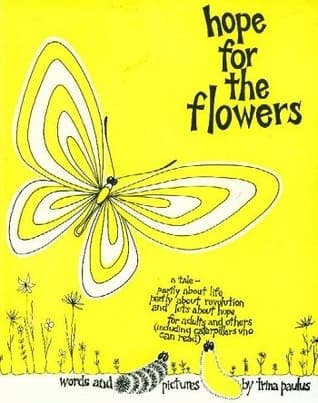
Synopsis
Covers the whole plot, including the ending.
- Difficulty
- Easy
- Pacing
- Moderate
- Mood
- Inspirational, Reflective, Thought-provoking, Hopeful
- Read it if
- You enjoy allegorical tales about self-discovery, purpose, and spiritual growth, or are looking for a gentle introduction to philosophical concepts for young adults.
- Skip it if
- You prefer fast-paced, plot-driven narratives with complex characters, or are averse to stories with overt spiritual or philosophical messaging.
Hope for the Flowers Plot Summary
Covers the whole plot, including the ending.
Yellow's Restlessness and the Call of the Pile
Yellow, a young caterpillar, feels restless despite having many leaves to eat. She senses there is more to life. One day, she sees other caterpillars crawling towards a distant, tall pile of caterpillars. Curious, and feeling an inner pull, she leaves her comfortable leaf and joins the procession. She believes that reaching the top of this pile will answer her yearning and show her what she is meant to do, driven by a vague but strong hope for something better.
Meeting Stripe and the Climb Begins
As Yellow begins her climb towards the tall pile, she meets Stripe, another caterpillar who wants to reach the top. Stripe is more practical and focused on climbing, while Yellow is driven by a more abstract hope. They bond and decide to climb together, finding comfort and encouragement. The climb is hard and competitive, with many other caterpillars pushing, all aiming for the same goal. Yellow and Stripe learn to manage the chaotic environment, sometimes helping each other, sometimes getting separated.
The Hardship and Disillusionment of the Climb
The journey up the caterpillar pile is much harder and more brutal than Yellow first thought. The pile is a chaotic mass of bodies, with caterpillars constantly crawling over each other; some fall, some are pushed down. Yellow sees the desperation and ruthlessness of others, and she herself feels fear, exhaustion, and despair. She starts to question the climb's purpose, noticing that many caterpillars seem to have forgotten why they started, driven only by the crowd's momentum. Despite her growing doubts, the collective ambition keeps her moving up, alongside Stripe.
Stripe's Ruthlessness and Yellow's Retreat
As they climb higher, Stripe becomes more determined and ruthless, pushing harder to keep his place. Yellow, increasingly bothered by the violence and lack of kindness, finds she cannot continue in the same way. The climb's competitive nature conflicts with her inner sense of peace and purpose. Overwhelmed by the ugliness and meaninglessness she sees in the struggle, Yellow decides to leave the pile, breaking away from Stripe and the constant upward push. She descends, seeking solitude and a different way to understand her existence, leaving a confused Stripe behind.
Yellow's Solitude and Introspection
After leaving the pile, Yellow finds a quiet leaf to rest and think. Alone, she watches other caterpillars, some still climbing, some just eating. She starts to notice something strange: some caterpillars disappear, only to reappear later as beautiful butterflies. This observation leads to a realization. She learns that caterpillars are not meant to climb piles forever, but to change. This new understanding begins to fill the void she felt, showing a deeper purpose than simply reaching the 'top' of a physical structure.
The Wisdom of the Old Butterfly
Curious to learn more about butterflies, Yellow seeks out an old, wise butterfly. The butterfly explains metamorphosis, saying that caterpillars must first eat and grow, then enter a chrysalis – a time of quiet change – before becoming butterflies. The old butterfly says that a caterpillar's purpose is to become, not to climb. This conversation greatly affects Yellow, confirming her instincts and giving her a clear path. She now understands that her restlessness was a yearning for this change, not for the illusion of the pile's 'top.'
Stripe's Brief Triumph and Emptiness
Meanwhile, Stripe, not deterred by Yellow's departure, continues his climb, eventually reaching what he thinks is the very top of the massive caterpillar pile. His victory is brief. He finds no glory, no answers, no meaning at the summit. The 'top' is just a risky, crowded platform, as empty and unsatisfying as the climb itself. He looks down at the struggling mass below, feeling a deep sense of emptiness and disappointment. All his effort and ambition led to a hollow victory, leaving him more despairing than before.
Stripe's Despair and Yellow's Return
Overwhelmed by his empty win, Stripe begins to descend the pile, feeling lost and defeated. Yellow, who has learned about metamorphosis, feels drawn to return to the pile and find Stripe. She finds him sad and broken. With kindness, Yellow shares her new understanding of transformation, explaining that a caterpillar's true purpose is to become a butterfly, not to climb a pile. Stripe is at first doubtful and resistant, his mind still focused on the competitive struggle he has known.
Stripe's Transformation and Yellow's Guidance
Despite Stripe's initial reluctance and fear, Yellow gently guides him. She encourages him to eat, grow, and prepare for the change. Stripe is scared of the unknown, of letting go of his old identity and the familiar struggle of climbing. Yellow reassures him, explaining that the process is natural and beautiful. Slowly, Stripe begins to trust Yellow and the promise of transformation. He lets go of his old ways of thinking, beginning the internal preparation for the chrysalis, a journey he must take alone but with Yellow's support.
Emergence and the True Freedom
Yellow, having already prepared, enters her chrysalis first, emerging as a magnificent butterfly. She experiences the freedom of flight, soaring above the pile she once struggled to climb. Stripe, inspired by Yellow's example and her encouragement, eventually finds the courage to enter his own chrysalis. After a time of quiet change, he too emerges as a beautiful butterfly. Together, they fly above the world, feeling peace, joy, and purpose, having realized their destiny and understanding that their struggles were part of a larger, more beautiful plan.
Principal Figures
Yellow
Protagonist
A curious and introspective caterpillar seeking deeper meaning in life.
Yellow is a young caterpillar who feels a deep sense of dissatisfaction with her conventional existence of simply eating leaves. She is driven by an innate curiosity and a yearning for something more profound than the endless scramble of the caterpillar pile. Yellow is sensitive, compassionate, and willing to question the status quo, eventually choosing to abandon the competitive climb in search of true purpose. Her journey is one of self-discovery, intuition, and ultimately, spiritual transformation.
Relationships: Stripe (initially climbing companion, later mentor and guide)
Stripe
Protagonist/Foil
A pragmatic and ambitious caterpillar focused on reaching the 'top' of the pile.
Stripe is initially a determined and pragmatic caterpillar, driven by the ambition to reach the 'top' of the caterpillar pile. He is more focused on the external goal and the mechanics of climbing, often becoming ruthless and competitive to achieve his aim. While he shares Yellow's initial desire for something 'more,' his interpretation of that 'more' is defined by societal expectations and the physical summit. He experiences profound disillusionment upon reaching the top, realizing its emptiness, and later undergoes a transformation guided by Yellow.
Relationships: Yellow (initially climbing companion, later student and friend)
The Old Butterfly
Supporting
A wise mentor who reveals the secret of metamorphosis to Yellow.
The Old Butterfly serves as a crucial mentor figure for Yellow. Having already undergone the transformation, this butterfly possesses the wisdom and understanding of a caterpillar's true destiny. He patiently explains the process of metamorphosis to Yellow, confirming her intuitive feelings and providing the concrete knowledge she needs to pursue her own transformation. The Old Butterfly represents enlightened wisdom and the guidance available to those who seek a deeper truth beyond superficial goals.
Relationships: Yellow (mentor and student)
The Other Caterpillars
Supporting/Collective
The anonymous mass of caterpillars endlessly striving to climb the pile.
The 'Other Caterpillars' represent the societal norm, the collective unconscious driven by an unquestioned ambition to reach the 'top.' They are depicted as a chaotic, competitive, and often ruthless mass, pushing and shoving without fully understanding their ultimate purpose. They embody the pressures of conformity and the danger of losing oneself in a collective, unexamined goal. Their presence highlights the courage and individuality required for Yellow and Stripe to break free from the conventional path.
Relationships: Yellow (the crowd she leaves behind); Stripe (the crowd he competes within)
Themes & Insights
Identity and Self-Discovery
The main theme is Yellow and Stripe's journey to understand their true nature and purpose beyond what society expects. Yellow's initial restlessness and her leaving the pile show a search for her real self. The metamorphosis is the ultimate act of self-discovery, showing that their caterpillar identity was only temporary, and their true self is a butterfly. The book says that true identity is found not in external achievement but in inner change.
“How does one become a butterfly? You must want to fly so much that you are willing to give up being a caterpillar.”
The Meaning of Success
The story questions the common idea of success, shown by 'climbing to the top' of the caterpillar pile. Stripe's empty victory at the summit shows how meaningless externally defined achievements are when they lack inner purpose. In contrast, Yellow's change into a butterfly represents a different kind of success: one based on inner growth, purpose, and reaching one's full potential, rather than competitive dominance. The book suggests that true success is about becoming, not just achieving.
“He got to the top. And when he got to the top, he looked out. And there was nothing.”
Conformity vs. Individuality
The many caterpillars endlessly climbing the pile without questioning their purpose represent the dangers of conformity and blindly following the crowd. Yellow's decision to leave the pile is an act of individuality and courage, choosing to listen to her inner voice instead of societal pressure. Her journey shows the importance of breaking free from group delusion to find a personal path. Stripe's initial conformity and later disappointment also show this theme, illustrating a path many take but few find fulfilling.
“It was impossible to see what was at the top, but everyone said it was worth it. So they pushed on.”
Transformation and Growth
Metamorphosis is the central symbol for personal and spiritual growth. The journey from caterpillar to butterfly shows a deep change in perspective, purpose, and being. It requires letting go of the old self (the caterpillar) and accepting a time of vulnerability (the chrysalis) to become a new, more developed being (the butterfly). The theme emphasizes that growth is often uncomfortable and needs courage, but it leads to a higher state of existence and freedom.
“To fly, you have to give up being a caterpillar.”
Spiritual Awakening
Beyond just physical change, the transformation in the book has strong spiritual meanings. Yellow's initial restlessness is a spiritual longing, and her discovery of metamorphosis is an awakening to a higher truth about existence. Becoming a butterfly represents rising above earthly struggles and connecting to a more expansive, joyful reality. The story suggests that true fulfillment comes from aligning with one's spiritual purpose, which often involves a 'death' of the old self and a 'rebirth' into a new awareness.
“He saw that he had been created to fly.”
Plot Devices & Literary Techniques
Allegory
The entire story functions as a symbolic narrative for human life and spiritual journey.
The entire narrative of 'Hope for the Flowers' is an allegory. The caterpillars represent humans, the pile represents societal rat races and competitive ambitions, and the metamorphosis into a butterfly symbolizes spiritual awakening, self-realization, and achieving one's true potential. Every element of the story, from the characters' names (Yellow for vibrancy, Stripe for conventional markings) to their actions, serves a symbolic purpose, conveying deeper philosophical and spiritual messages about life's meaning.
Symbolism of the Pile
Represents competitive, externally-driven societal goals and the illusion of success.
The towering 'pile' of caterpillars is a potent symbol. It represents the endless, often meaningless, climb for external success, status, or wealth that many humans pursue. It embodies the competitive nature of society, where individuals push each other down to get ahead, driven by an unexamined belief that 'the top' holds the answers. The pile's ultimate emptiness for Stripe reveals the hollowness of such pursuits when disconnected from inner purpose and true identity.
Metamorphosis
The central metaphor for profound personal and spiritual transformation.
Metamorphosis is the core plot device and central metaphor of the book. It is the literal biological process of a caterpillar becoming a butterfly, but it serves as a powerful symbol for human spiritual awakening and self-actualization. It signifies the shedding of an old, limited identity and embracing a new, expanded state of being. The chrysalis represents a period of quiet introspection and internal work necessary for this profound transformation, emphasizing that true growth often requires letting go and surrendering to a higher process.
Yellow and Stripe as Foils
Two protagonists representing contrasting approaches to life's challenges.
Yellow and Stripe serve as narrative foils to each other, highlighting different ways of approaching life's questions and challenges. Yellow represents intuition, introspection, and a willingness to question the status quo, eventually leading her to spiritual truth. Stripe, on the other hand, embodies ambition, pragmatism, and a focus on external achievement. Their contrasting journeys and eventual shared transformation illustrate that while paths may differ, the ultimate destination of self-realization is available to all who are willing to change.
Hope for the Flowers Quotes
“How does one get to the top? By climbing.”
“If you really want to fly, you have to let go of the things that weigh you down.”
“The caterpillar does not question its transformation. It simply becomes.”
“It was not enough to be on the pile; he wanted to be at the top.”
“Just when the caterpillar thought the world was over, it became a butterfly.”
“What if the pile isn't the only way up?”
“Sometimes, the only way to get to the top is to be willing to fall.”
“There are greater journeys than just climbing up a pile of other caterpillars.”
“The struggle itself is the lesson.”
“To be truly free, one must first be truly oneself.”
“Hope is not a dream, but a way of making dreams a reality.”
“The most beautiful flight begins with the humblest crawl.”
“It's not about reaching the top, but about what you become on the way.”
“The world needs more butterflies, not just caterpillars climbing a pile.”
Quiz
10 questions on the plot and the characters. Each answer comes with a short explanation.
Question 1
What is the primary goal of the caterpillars, Stripe and Yellow, at the beginning of the story?
- To find the most beautiful flower to live on
- To climb to the very top of the pile of other caterpillars
- To eat as many leaves as possible
- To learn how to spin the strongest silk
Show answer
B. To climb to the very top of the pile of other caterpillars At the beginning of their journey, both Stripe and Yellow are driven by the ambition to 'climb to the top' of the seemingly endless pile of other caterpillars, believing this is where success and happiness lie.
Question 2
What is the initial reaction of Stripe when Yellow expresses a desire for something beyond climbing?
- He encourages Yellow to explore new possibilities.
- He dismisses Yellow's thoughts as foolish and distracting.
- He tries to climb even faster to show Yellow the true path.
- He suggests they take a break from climbing together.
Show answer
B. He dismisses Yellow's thoughts as foolish and distracting. Stripe is initially focused solely on the traditional goal of climbing and views Yellow's questioning and desire for something more as a distraction or a sign of weakness, urging Yellow to 'forget all that and climb!'
Question 3
What does the act of 'climbing the pile' primarily symbolize in the allegory?
- The natural life cycle of insects
- The pursuit of conventional success, power, or material gain
- The struggle to find enough food
- The importance of community and cooperation
Show answer
B. The pursuit of conventional success, power, or material gain The 'climbing' represents the human drive for worldly success, status, and accumulation, often at the expense of others, without understanding a deeper purpose.
Question 4
What significant event causes Yellow to separate from Stripe and the climbing pile?
- Yellow gets pushed off the pile by another caterpillar.
- Yellow becomes ill and can no longer climb.
- Yellow sees an old caterpillar transform into a butterfly.
- Yellow decides to try eating a different type of leaf.
Show answer
C. Yellow sees an old caterpillar transform into a butterfly. Yellow's true turning point comes from witnessing an older caterpillar undergo metamorphosis and emerge as a butterfly, which ignites a deep curiosity and longing for a different kind of existence.
Question 5
What is the 'Great Crumble' that the caterpillars fear?
- A sudden lack of food that causes mass starvation.
- The collapse of the caterpillar pile under its own weight.
- A predator that eats many caterpillars at once.
- A disease that turns caterpillars into dust.
Show answer
B. The collapse of the caterpillar pile under its own weight. The 'Great Crumble' is the constant fear among the climbing caterpillars that the entire structure will collapse, sending everyone tumbling down, representing the inherent instability and anxiety of a life built on competition and superficial goals.
Question 6
What does Yellow learn from the 'old caterpillar' about transformation?
- That transformation is a quick and easy process.
- That one must be willing to let go of their old self and 'die' to become something new.
- That only the strongest caterpillars are chosen to transform.
- That transformation requires a special kind of leaf to eat.
Show answer
B. That one must be willing to let go of their old self and 'die' to become something new. The wise old caterpillar teaches Yellow that the process of becoming a butterfly involves a complete surrender and a metaphorical 'death' to the caterpillar self, emphasizing the theme of letting go of the old to embrace the new.
Question 7
How does Stripe eventually come to understand Yellow's journey?
- Yellow returns to the pile and explains it to him directly.
- Stripe climbs high enough to see Yellow's chrysalis.
- Stripe's own dissatisfaction with climbing leads him to question his purpose, and he eventually sees Yellow as a butterfly.
- Another caterpillar tells Stripe about Yellow's transformation.
Show answer
C. Stripe's own dissatisfaction with climbing leads him to question his purpose, and he eventually sees Yellow as a butterfly. Stripe's enlightenment doesn't come from being told, but from his own growing disillusionment with the relentless climbing. His personal crisis of meaning, combined with eventually seeing Yellow as a butterfly, opens his eyes to the possibility of a different way of being.
Question 8
What is the ultimate 'hope for the flowers' that the butterflies represent?
- That caterpillars will stop eating their leaves.
- That their beauty will be appreciated by flying creatures.
- That they will be pollinated and produce seeds, fulfilling their purpose.
- That they will be protected from the wind and rain.
Show answer
C. That they will be pollinated and produce seeds, fulfilling their purpose. The butterflies, once transformed, are able to pollinate the flowers, allowing them to fulfill their own purpose of creating new life. This symbolizes how individuals realizing their true potential can also contribute to the greater good and the 'hope' of the world.
Question 9
What physical sensation does Stripe experience that foreshadows his own readiness for transformation?
- A sudden urge to eat a specific type of flower.
- A feeling of deep tiredness and a desire to rest.
- A strange, deep ache or yearning inside him that he can't explain.
- A fear of falling from the pile.
Show answer
C. A strange, deep ache or yearning inside him that he can't explain. Stripe experiences a deep, unnamable ache or longing, a feeling of 'something more' that gnaws at him even when he's at the 'top' of the pile. This internal dissatisfaction is the first sign of his awakening and readiness for personal change.
Question 10
The book is described as an 'allegory.' What does this mean in the context of 'Hope for the Flowers'?
- It is a true story about caterpillars and butterflies.
- It is a story where the characters and events represent deeper moral or spiritual meanings.
- It is a fictional story written specifically for young children.
- It is a scientific explanation of metamorphosis.
Show answer
B. It is a story where the characters and events represent deeper moral or spiritual meanings. An allegory is a story, poem, or picture that can be interpreted to reveal a hidden meaning, typically a moral or political one. In this book, the caterpillars, climbing, and transformation are symbolic of human life, ambition, and spiritual growth.
Hope for the Flowers FAQ
What is "Hope for the Flowers" about?
"Hope for the Flowers" is an allegorical tale about two caterpillars, Stripe and Yellow, who embark on a journey to climb a massive pillar of other caterpillars, believing that 'the top' holds the ultimate meaning and success. Through their struggles and eventual separation, they learn that their true purpose isn't to climb, but to undergo metamorphosis and fly, discovering their inherent destiny as butterflies.
Why should I read "Hope for the Flowers"?
You should read "Hope for the Flowers" for its timeless message about self-discovery, purpose, and the courage to break free from societal expectations. It's a profound yet simple story that encourages readers of all ages to question their own 'pillars' and embrace their unique potential, offering a powerful metaphor for spiritual and personal growth.
What is the background/setting of "Hope for the Flowers"?
The story is set primarily on a large, chaotic pillar formed by countless caterpillars ceaselessly climbing over one another, driven by an unspoken desire to reach the top. This pillar is a powerful metaphor for the competitive, often meaningless, rat race of human society, contrasting sharply with the peaceful, transformative cocoons found later in the story.
What are the most memorable quotes?
Some memorable quotes include "How does one get to the top?" which encapsulates the initial ambition, and "How does one become a butterfly?" which signals the shift in understanding. Another poignant quote is about the 'messy' process of transformation, highlighting that true growth often requires letting go of old forms.
What writing style does the author use?
Trina Paulus employs a simple, direct, and poetic writing style, characteristic of allegorical literature. The language is accessible, making complex philosophical and spiritual themes understandable for both children and adults, often using vivid imagery and personification to bring the caterpillar's journey to life.
What minor details add significant meaning?
The detail of the 'golden thread' that Yellow spins around herself before entering her chrysalis is significant, symbolizing the inner resources and self-reliance needed for personal transformation. The constant, almost unconscious, pushing and shoving on the pillar also subtly emphasizes the often-unexamined nature of competitive pursuits.
What are some subtle foreshadowing moments?
Early in the story, the occasional sight of a butterfly flying freely above the pillar subtly foreshadows the caterpillars' true destiny, though they initially dismiss it as an irrelevant, unattainable phenomenon. Stripe's initial discomfort with the relentless climbing and his brief moments of looking outward also hint at his eventual disillusionment.
What unexpected character connections exist?
The most significant connection is between Stripe and Yellow, who find each other amidst the chaotic climb, forming a bond that temporarily distracts them from their individual quests. Their shared journey and eventual separation are crucial for their independent discoveries, highlighting that relationships can both support and challenge personal growth.
What are unspoken character motivations?
While Stripe and Yellow explicitly state their desire to reach 'the top,' an unspoken motivation for many caterpillars on the pillar is a fear of being left behind or a lack of imagination to conceive of an alternative path. Stripe's initial motivation is also partly driven by a desire for validation and understanding from Yellow, beyond just reaching the summit.
What psychological complexities do characters exhibit?
Stripe exhibits psychological complexities through his initial ambition, followed by deep disillusionment, despair, and ultimately, a leap of faith into the unknown of transformation. Yellow, on the other hand, shows resilience and a more introspective nature, questioning the 'climb' earlier and having the courage to embrace her vulnerability and transform alone.
What are the major emotional turning points?
A major emotional turning point is when Stripe and Yellow separate, as it forces each to confront their individual paths and fears. Another is Yellow's decision to embrace the 'messy' process of spinning a chrysalis, representing her surrender to the unknown, and Stripe's subsequent despair and eventual inspiration to follow her example.
How do relationship dynamics evolve?
The relationship dynamics between Stripe and Yellow evolve from a shared, competitive pursuit on the pillar to a period of mutual support and affection, followed by a necessary separation for individual growth. Ultimately, their transformed selves, as butterflies, find each other again, symbolizing a higher form of connection based on shared understanding and purpose.
Which parts remain ambiguous or open-ended?
The ultimate destination or purpose of the 'top' of the pillar remains intentionally ambiguous, highlighting that the value was never in the destination itself but in the journey and the realization of its futility. The exact nature of the 'voice' or inner knowing that guides Yellow is also left somewhat open, allowing for individual spiritual interpretation.
What are controversial scenes or decisions?
One potentially controversial decision is Yellow's choice to leave Stripe behind to begin her transformation, which could be seen as abandoning a loved one. However, the narrative frames it as a necessary act of self-preservation and individual growth, emphasizing that some paths must be walked alone for true metamorphosis to occur.
"Hope for the Flowers" ending explained: how it ends & what it means
The book ends with both Stripe and Yellow having successfully transformed into beautiful butterflies. They reunite in the sky, no longer striving to climb but freely soaring. This ending signifies that true fulfillment and destiny are found not in external achievement or competition, but in embracing one's authentic self and undergoing the necessary, often solitary, process of inner transformation.
Similar books
- The Little Prince
Antoine De Saint Exupéry
Both are allegorical novellas exploring profound philosophical themes through simple, charming narratives.
- Jonathan Livingston Seagull
Richard Bach
3.8 (202k) average on GoodreadsFantasyFeatures an animal protagonist seeking a higher purpose beyond the mundane existence of its peers.
- THE ALCHEMIST
Paulo Coelho
3.6 (3k) average on GoodreadsFictionA journey of self-discovery and following one's personal legend, filled with symbolic meaning.
- Harry Potter and the Sorcerer's Stone
J.K. Rowling
4.5 (7M) average on GoodreadsFantasyRescued from a miserable life under the stairs, an orphaned boy discovers he's a wizard destined for a magical school, where he uncovers a dangerous secret tied to the dark wizard who murdered his parents.
- The Hobbit, or There and Back Again
J.R.R. Tolkien
4.3 (2.9M) average on GoodreadsFantasyA comfort-loving hobbit named Bilbo Baggins is whisked away by a mischievous wizard and a band of dwarves on an unexpected journey to reclaim stolen treasure from a fearsome dragon, discovering courage and a magical ring along the way.
- Harry Potter and the Goblet of Fire
J.K. Rowling
4.6 (2.6M) average on GoodreadsFantasyA bewildered Harry Potter, underage and thrust into a deadly Triwizard Tournament, must brave dragons, mermaids, and a resurgent dark magic to survive a year that will forever alter the wizarding world.




Enjoyed the summary?
A summary gives you the shape of the book. The book itself has the detail, the examples and the voice.
Find Hope for the Flowers on AmazonAs an Amazon Associate, BookBrief earns from qualifying purchases. How we're funded