
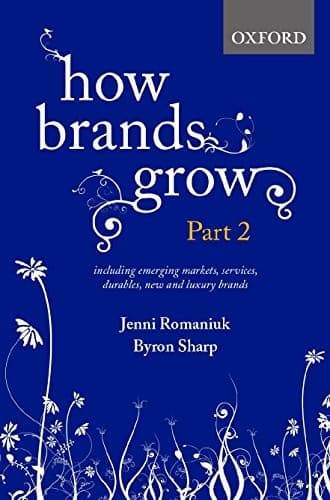
Core Idea
- Difficulty
- Medium
- Read it if
- You are a marketing professional, brand manager, or business leader interested in evidence-based strategies for brand growth. You want to understand the universal laws that govern consumer behavior and brand performance, and how to apply them to improve your brand's market share and profitability. You are open to challenging traditional marketing beliefs with empirical data.
- Skip it if
- You are looking for a book focused on digital marketing tactics, social media strategies, or highly differentiated niche marketing. You prefer qualitative, anecdotal marketing advice over quantitative, data-driven insights, or you are already deeply familiar with the Ehrenberg-Bass Institute's work and its implications.
Key Takeaways from How Brands Grow
Mental Availability Trumps Loyalty
Brands grow by being easily thought of in more buying situations, not by fostering deep emotional bonds.
Romaniuk shows that brands do not need intense loyalty or unique selling points. Instead, she says brand growth comes from mental availability—how easily a brand comes to mind when someone is buying. Brands achieve this by building and strengthening 'memory structures' or 'cues' that link the brand to different buying situations (Category Entry Points, or CEPs). The book highlights that these memory links are often simple but powerful when combined. A brand doesn't need to be loved; it needs to be remembered at the right time. This idea goes against much of traditional marketing's focus on deep emotional connections, shifting efforts toward broad, consistent recognition.
“The greater the number of associated memory structures (memory links) for a brand, the more mentally available it is.”
In the book: Extensive empirical data analysis from the Ehrenberg-Bass Institute, showing that brands with higher mental availability tend to have higher market share and grow more effectively across diverse categories.
Try this: Marketers should audit and expand their brand's Category Entry Points (CEPs) and develop distinctive assets (logos, colors, slogans) that are consistently linked to these CEPs to build strong memory structures. Focus on broad reach and consistent messaging over niche targeting or deep engagement campaigns.
Related ideas: mental-availability, category-entry-points, distinctive-assets, memory-structures
Physical Availability: The Other Half
Being easy to buy is as crucial as being easy to think of; both are necessary for growth.
While 'How Brands Grow: Part 1' introduced mental availability, Romaniuk's Part 2 explains the equally important role of physical availability. This means more than just distribution; it involves making sure a brand is present in all relevant retail and purchasing channels, so it is available to as many category buyers as possible, as often as possible. This includes things like shelf placement, store type, online presence, and even package size. The book stresses that even the most mentally available brand will fail if a customer cannot easily buy it. This idea confirms the basic, often overlooked, importance of good operations in marketing.
“Brands grow when they are both easy to think of and easy to find/buy.”
In the book: Studies illustrating how even slight improvements in distribution metrics or shelf facings can lead to significant sales increases, independent of advertising spend. Examples include Coca-Cola's pervasive distribution network across diverse retail environments.
Try this: Brands must conduct regular audits of their physical availability across all relevant channels, identifying and addressing distribution gaps. This includes optimizing shelf presence, e-commerce visibility, and ensuring product availability in various formats to suit different buying occasions.
Related ideas: physical-availability, distribution, omnichannel, route-to-market
Distinctive Assets Over Differentiation
Focus on owning unique sensory cues rather than trying to be fundamentally different from competitors.
This is one of the book's best ideas. Romaniuk argues that true 'differentiation,' as often taught in marketing (e.g., unique product features), is rare and doesn't last long. Instead, brands should focus on building 'distinctive assets'—elements like specific colors, fonts, jingles, characters, or package shapes that are consistently linked to the brand. These assets do not need to convey a unique message; their strength is in making the brand instantly recognizable and memorable in a crowded market. Think of the McDonald's golden arches or the Tiffany blue. The goal is to make the brand unmistakable, not necessarily better in every functional way.
“Distinctive assets are non-brand elements that trigger the brand in the buyer's mind. They make the brand stand out and easy to find.”
In the book: Analysis of brand recognition studies showing the effectiveness of consistent use of distinctive assets (e.g., Cadbury purple, Coca-Cola script) in aiding brand recall and identification, even without explicit branding.
Try this: Identify, audit, and consistently deploy distinctive assets across all brand communications and touchpoints. Marketers should prioritize strengthening these assets over continuously seeking novel product differentiators that consumers often don't perceive or care about.
Related ideas: distinctive-assets, differentiation, brand-recognition, sensory-cues
Category Entry Points (CEPs) Drive Growth
Understanding and linking a brand to all relevant buying situations is paramount for mental availability.
Romaniuk explains Category Entry Points (CEPs) as key drivers of mental availability. These are the thoughts, feelings, or situations that make a buyer think of a product category and, ideally, a specific brand within it. For example, 'thirsty' is a CEP for drinks, 'need a gift' for chocolates, or 'bored on a commute' for entertainment. The more CEPs a brand is linked to, the more often it will be remembered. This changes the focus from 'who is my target audience?' to 'when and why do people buy this category?'. The book offers a clear way to find and use these different triggers.
“CEPs are the cues or situations that consumers associate with buying and consuming a product from a particular category.”
In the book: Research showing that brands that successfully link themselves to a broader range of CEPs consistently outperform those with narrower associations. For instance, linking coffee not just to 'morning' but also 'afternoon slump' or 'meeting a friend'.
Try this: Conduct thorough research to map out all relevant CEPs for your category. Develop communication strategies that explicitly link your brand to these diverse CEPs, expanding the occasions when consumers might consider your product.
Related ideas: category-entry-points, mental-availability, buying-situations, consumer-triggers
Reach Trumps Targeting
Broad reach advertising is more effective for growth than highly targeted campaigns.
This idea challenges the common belief in hyper-targeting in modern digital marketing. Romaniuk argues that brands grow by gaining new, light buyers from across the entire category, not by converting a small group of 'loyal' heavy users. Therefore, advertising should aim for broad reach to consistently remind all potential buyers (including those who rarely buy the category) of the brand. Highly targeted campaigns, while seemingly efficient, limit growth by excluding many people, including future light buyers. This view supports mass marketing principles, even with many different media options.
“All category buyers are potential buyers of your brand.”
In the book: The 'Law of Double Jeopardy,' which states that smaller brands have fewer buyers and those buyers buy less frequently. This suggests that growth comes from attracting more buyers, not just making existing ones buy more. Studies on media effectiveness consistently show the power of broad reach in building mental availability.
Try this: Prioritize media channels and strategies that achieve the broadest possible reach within the category's buyer base. Re-evaluate overly narrow targeting strategies, understanding that even light buyers contribute significantly to overall brand health and growth over time.
Related ideas: broad-reach, targeting, light-buyers, double-jeopardy
Marketing is About Repetition, Not Persuasion
Consistent, repetitive messaging builds memory structures more effectively than persuasive arguments.
Romaniuk argues against the traditional view that advertising is mainly for persuasion or deep emotional manipulation. Instead, she says its main job is to build and refresh memory structures that link the brand to various CEPs and distinctive assets. This requires consistent, repeated exposure to simple, clear messages over time, rather than complex, 'clever' campaigns that try to change attitudes. The goal is familiarity and recognition, not necessarily strong belief. This idea has big implications for creative briefs, shifting focus from 'what message will convince them?' to 'what cues will remind them?'.
“Advertising's main role is to refresh and build memory structures, making the brand easier to notice and remember.”
In the book: Studies on advertising wear-in and wear-out, demonstrating that consistent exposure to a brand's advertising, even without new information, strengthens memory links and mental availability over time.
Try this: Develop advertising campaigns that prioritize consistent brand recognition and the reinforcement of existing memory structures. Focus on clear, simple messaging and distinctive assets, accepting that repetition is key to building mental availability, even if it feels mundane to marketers.
Related ideas: repetition, persuasion, memory-structures, advertising-effectiveness
Brand Loyalty is a Myth (Mostly)
Most 'loyal' buyers are merely light buyers of many brands, not deeply committed to one.
This idea directly challenges a core belief in traditional marketing. Romaniuk states that the idea of deeply loyal, exclusive customers is mostly false. Instead, most consumers use a variety of brands within a category. What looks like loyalty is often just the statistical result of larger brands having more buyers who buy them slightly more often (Double Jeopardy). This means that marketing efforts focused only on 'rewarding loyalty' or 'deepening engagement' with current customers are often less effective than efforts aimed at expanding the brand's reach to new and light buyers.
“True loyalty is rare; what marketers observe as loyalty is often just a reflection of buying patterns consistent with the Double Jeopardy law.”
In the book: Empirical studies of consumer purchasing behavior across numerous categories, consistently showing that even 'loyal' customers still purchase competitor brands, and that the vast majority of a brand's buyers are 'light' users.
Try this: Shift focus from trying to 'lock in' existing customers to constantly attracting new and light buyers. Loyalty programs should be re-evaluated to ensure they contribute to broader mental and physical availability, rather than just rewarding existing behavior.
Related ideas: brand-loyalty, polygamous-loyalty, double-jeopardy, light-buyers
Data-Driven, Not Intuition-Driven
Marketing decisions should be based on empirical evidence and observed behavior, not subjective beliefs or creative intuition.
Romaniuk's work, and that of the Ehrenberg-Bass Institute, is about bringing scientific accuracy to marketing. This book stresses that marketers need to base their strategies on observed consumer behavior and solid data, rather than on stories, personal opinions, or unproven theories. It supports a test-and-learn approach, emphasizing the importance of measurement and accountability. This view requires a change in marketing culture, moving away from purely creative or subjective decisions toward a more evidence-based, analytical approach. This is the method that makes all other ideas so convincing.
“Marketing needs to be treated as a science, relying on empirical data and evidence rather than assumptions or 'gut feelings'.”
In the book: The entire book is built on empirical data from extensive consumer panels and market research, directly challenging widely held marketing beliefs with statistical evidence.
Try this: Implement robust measurement systems for marketing activities, focusing on metrics that reflect mental and physical availability. Challenge assumptions with data, and foster a culture of evidence-based decision-making within marketing teams.
Related ideas: data-driven-marketing, evidence-based-marketing, marketing-science, empirical-research
Innovation is Overvalued (for Growth)
Breakthrough innovation rarely drives sustained growth; consistent execution of basics is more effective.
Marketers often focus on 'innovation' as the main way to grow, looking for the next big product or feature. Romaniuk, however, suggests that while innovation has a place, its effect on long-term brand growth is often overrated. Small improvements and consistent execution of the basics (mental and physical availability, distinctive assets) tend to be much more effective and reliable for growth. Real breakthroughs are rare, quickly copied, and do not remove the need for strong mental and physical presence. This view encourages brands to focus on doing the basics very well, rather than chasing hard-to-find 'game-changers'.
“Most 'innovations' are incremental; true breakthroughs are rare and often don't provide a sustained competitive advantage.”
In the book: Analysis of product launches and market share data, showing that most 'innovations' have limited long-term impact on market share, and that consistent, pervasive brands maintain their position through superior availability.
Try this: Prioritize perfecting the fundamentals of mental and physical availability and distinctive assets. Evaluate innovation efforts critically, ensuring they genuinely enhance availability or provide a truly unique, defensible advantage, rather than being pursued for their own sake.
Related ideas: innovation, incremental-innovation, brand-growth, marketing-fundamentals
All Buyers are Light Buyers (of your brand)
Even a brand's 'heavy' buyers are light buyers of that category overall; marketing must appeal to everyone.
This is a subtle but important extension of the 'light buyer' concept. Romaniuk explains that even the most frequent buyers of a specific brand (its 'heavy buyers') are often still light users in the overall category. They buy the category infrequently, or spread their purchases across many brands. This reinforces the idea that brands cannot ignore any part of the market. Marketing messages and distribution strategies must be broad and inclusive, designed to reach and appeal to the large majority of infrequent, 'light' purchasers who collectively make up most sales and potential growth. This challenges the idea of a dedicated, niche 'target audience' in favor of appealing to everyone.
“Even for your brand, most of your buyers are light buyers, and even your heavy buyers are light users of the category overall.”
In the book: Detailed purchasing data showing that even within a single brand's customer base, the majority of sales come from a large number of infrequent purchasers, and that even the most frequent brand buyers still engage with competitor brands.
Try this: Design marketing communications and product strategies with a broad appeal, avoiding niche messaging that might alienate the vast majority of light buyers. Ensure product availability and messaging caters to the entire category user base, not just a perceived 'core' segment.
Related ideas: light-buyers, heavy-buyers, category-buyers, universal-appeal
How Brands Grow Quotes
“The more you need to be noticed, the more you need to be available and visible.”
“Brands that are not seen or not available are not considered.”
“The most effective way to grow a brand is to make it more salient.”
“Availability is not just about physical presence, but also mental availability.”
“The law of double jeopardy: smaller market share brands have fewer buyers and these buyers also tend to buy fewer of the brand's products.”
“Distinctive assets are the sensory cues that allow consumers to identify a brand.”
“Brands grow by attracting new buyers, not just by increasing the loyalty of existing ones.”
“The more frequently a brand is bought, the more frequently it will be bought in the future.”
“Brand salience is built through consistent and memorable communication.”
“Mass marketing is essential for mass market brands to achieve scale.”
“Brands that are too niche struggle to grow because they limit their potential customer base.”
“The paradox of advertising: you advertise to grow, but growth requires that you are already noticed.”
“Effective branding is about creating strong and consistent mental associations.”
“The best way to ensure your brand is remembered is to make it distinctive and frequently present.”
Quiz
10 questions on the main ideas. Each answer comes with a short explanation.
Question 1
According to 'How Brands Grow: Part 2', what is the primary driver of brand growth?
- Increasing brand loyalty among existing customers.
- Attracting new, less frequent buyers.
- Reducing advertising spend to increase profit margins.
- Focusing solely on niche market segments.
Show answer
B. Attracting new, less frequent buyers. The book emphasizes that attracting new, less frequent buyers is the most effective way to achieve sustainable brand growth, as opposed to solely relying on increasing the purchase frequency of existing customers.
Question 2
What does the concept of 'mental availability' refer to in the context of brand growth?
- The number of social media followers a brand has.
- The ease with which consumers can recall a brand when thinking about a product category.
- The perceived quality of a brand's products.
- The accessibility of a brand's physical stores.
Show answer
B. The ease with which consumers can recall a brand when thinking about a product category. Mental availability is a key concept, referring to how easily a brand comes to mind when a consumer encounters a buying situation. Higher mental availability leads to more frequent consideration and purchase.
Question 3
Which of the following is NOT a typical characteristic of a 'weak' brand according to the principles discussed in the book?
- Low mental availability.
- Low physical availability.
- High emotional connection with consumers.
- Infrequent purchase by a small customer base.
Show answer
C. High emotional connection with consumers. A strong emotional connection is a characteristic of a strong brand, not a weak one. Weak brands typically suffer from low mental and physical availability and are purchased infrequently by a small base.
Question 4
The book discusses the importance of 'physical availability'. What does this primarily relate to?
- The brand's presence in online advertising.
- The ease with which consumers can find and purchase the brand's products when they want them.
- The brand's ability to offer a wide range of product variations.
- The brand's customer service responsiveness.
Show answer
B. The ease with which consumers can find and purchase the brand's products when they want them. Physical availability refers to the ease of finding and buying the product. This includes distribution, shelf space, and stock availability, ensuring the brand is there when the consumer decides to buy.
Question 5
What is the concept of 'distinctive assets' as described in 'How Brands Grow: Part 2'?
- Unique product features that differentiate a brand.
- Elements that consumers consistently associate with a particular brand, aiding recognition.
- The brand's market share compared to competitors.
- The financial value of a brand's intellectual property.
Show answer
B. Elements that consumers consistently associate with a particular brand, aiding recognition. Distinctive assets are the sensory cues (like logos, colours, jingles, slogans) that consumers link to a specific brand. They are crucial for recognition and mental availability.
Question 6
According to the book, what is a common mistake brands make when trying to grow?
- Over-investing in advertising that reaches a broad audience.
- Focusing too much on satisfying existing loyal customers.
- Ensuring wide distribution channels.
- Developing strong distinctive assets.
Show answer
B. Focusing too much on satisfying existing loyal customers. A common pitfall is over-serving the existing customer base or focusing too heavily on loyalty programs, which can starve the brand of the new buyers needed for significant growth.
Question 7
The book advocates for 'penetration' as a key growth strategy. What does penetration specifically measure?
- The depth of emotional connection a brand has with its customers.
- The proportion of a target market that buys a brand within a given period.
- The average spending of customers on a brand's products.
- The number of new product lines a brand has launched.
Show answer
B. The proportion of a target market that buys a brand within a given period. Penetration is defined as the percentage of the total potential market that has bought a brand at least once in a given time period. Higher penetration means more people are buying the brand.
Question 8
What is the 'double jeopardy law' as discussed in the context of brand growth?
- Larger brands are always more profitable than smaller brands.
- Brands with more buyers tend to have higher average purchase frequency.
- Brands with more buyers tend to have fewer buyers, and vice versa.
- Larger brands (with more buyers) tend to have higher average purchase frequency, and smaller brands (with fewer buyers) tend to have lower average purchase frequency.
Show answer
D. Larger brands (with more buyers) tend to have higher average purchase frequency, and smaller brands (with fewer buyers) tend to have lower average purchase frequency. The double jeopardy law states that the brands with the largest market share also have the highest average purchase frequency, and the smallest brands have the lowest purchase frequency. This is counterintuitive but empirically supported.
Question 9
The book critiques the focus on 'customer lifetime value' (CLV) as the primary metric for marketing investment. What is a key limitation of focusing solely on CLV for growth?
- CLV doesn't account for the cost of acquiring customers.
- It discourages brands from acquiring new customers.
- CLV is too difficult to calculate accurately.
- It prioritizes short-term gains over long-term brand building.
Show answer
B. It discourages brands from acquiring new customers. A strong focus on CLV can lead marketers to prioritize retaining existing, high-value customers and neglect the acquisition of new customers, which is essential for overall brand growth according to the book's principles.
Question 10
Which marketing activity is most likely to increase a brand's 'mental availability' according to the research presented?
- Offering deep discounts to existing customers.
- Running highly targeted, niche advertising campaigns.
- Consistent and broad advertising that uses distinctive assets.
- Implementing a complex loyalty rewards program.
Show answer
C. Consistent and broad advertising that uses distinctive assets. Consistent advertising that prominently features distinctive assets helps embed the brand in consumers' minds, making it more easily recalled when a need arises. Broad reach ensures more people see these cues.
How Brands Grow FAQ
What is the core message of 'How Brands Grow: Part 2'?
'How Brands Grow: Part 2' delves deeper into the principles of brand growth, focusing on how to effectively apply the research-backed strategies for sustainable market share expansion and increased profitability.
How does 'How Brands Grow: Part 2' build on the first book?
While the first book laid out the foundational laws of brand growth, Part 2 provides more nuanced insights and practical applications, addressing common challenges and offering advanced strategies for brands at different stages of maturity.
What are the key concepts discussed in 'How Brands Grow: Part 2'?
The book elaborates on concepts like mental availability, physical availability, brand salience, and the importance of distinctive assets, offering detailed explanations and real-world examples to illustrate their impact on brand growth.
What is 'mental availability' according to Romaniuk?
Mental availability refers to the likelihood that a brand will come to mind when a consumer thinks about a particular need or context. It's about being salient and easily retrievable in the consumer's memory.
How is 'How Brands Grow: Part 2' different from other marketing books?
Unlike books that rely on anecdotal evidence or fads, 'How Brands Grow: Part 2' is firmly grounded in decades of empirical research, providing evidence-based frameworks for brand building that have been proven to work.
What are some practical strategies for increasing brand salience?
The book suggests strategies such as consistent advertising, creating strong distinctive assets, ensuring broad distribution, and making the brand easy to find and choose at the point of purchase.
How important are distinctive assets in brand growth?
Distinctive assets, like logos, jingles, or unique packaging, are crucial for brand recognition and recall. They act as mental shortcuts, helping consumers identify and choose a brand quickly and effortlessly.
Who should read 'How Brands Grow: Part 2'?
This book is essential reading for marketers, brand managers, business owners, and anyone involved in strategic brand management who wants to understand the science behind successful brand growth.
Does the book offer advice for small businesses?
Yes, while the principles are universal, the book provides actionable insights and examples that can be adapted by businesses of all sizes, including smaller enterprises looking to grow their market presence.
What is the role of physical availability in brand growth?
Physical availability ensures that consumers can easily find and purchase the brand when they decide they want it. It involves having the product in the right place, at the right time, and in sufficient quantities.
Similar books
- The Diary of a Young Girl
Anne Frank
4.2 (2.7M) average on GoodreadsBiographyDuring the Nazi occupation, a teenage girl's diary, written from a secret annex, shares observations on humanity, hope, and the wait for freedom.
- Twisted 1. Twisted love
Ana Huang
3.7 (1.7M) average on GoodreadsA quiet billionaire with a difficult past finds his guarded heart opening to the woman he must protect, but their growing passion uncovers dangerous secrets and a shared, traumatic history.
- Eat, Pray, Love
Elizabeth Gilbert
3.6 (1.5M) average on GoodreadsLifestyleA heartbroken writer leaves her conventional life for a year-long global search for pleasure in Italy, spiritual devotion in India, and unexpected love and balance in Bali.
- Night
Elie Wiesel
4.3 (970k) average on GoodreadsBiographyIn the darkness of Auschwitz and Buchenwald, a teenage Elie Wiesel faces the extermination of his family, the loss of his faith, and the lasting scars of humanity's deepest cruelty.
- Steve Jobs
Walter Isaacson
4.1 (957k) average on GoodreadsBusinessSteve Jobs was a visionary who fused creativity and technology to revolutionize six industries and shape our digital world.
- The Glass Castle
Jeannette Walls
4.3 (903k) average on GoodreadsBiographyJeannette Walls's memoir describes her unusual childhood with brilliant, free-spirited parents whose poverty-stricken life shaped her independence and love despite family problems.






Enjoyed the summary?
A summary gives you the shape of the book. The book itself has the detail, the examples and the voice.
Find How Brands Grow on AmazonAs an Amazon Associate, BookBrief earns from qualifying purchases. How we're funded