
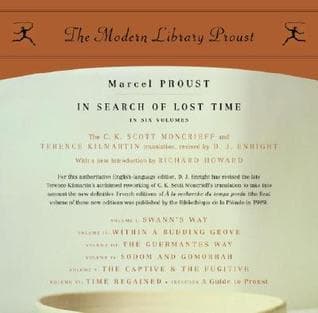
Synopsis
Covers the whole plot, including the ending.
- Difficulty
- Hard
- Pacing
- Slow
- Mood
- Introspective, Philosophical, Melancholy, Evocative, Contemplative
- Read it if
- You are a patient reader who enjoys deep psychological introspection, philosophical musings on memory and time, and vivid descriptions of early 20th-century French society. Perfect for those who appreciate stream-of-consciousness narrative and a profound exploration of human emotions.
- Skip it if
- You prefer fast-paced plots, clear and concise narratives, or a straightforward chronological story. This book is not for readers seeking immediate gratification or a simple, action-driven plot.
In Search of Lost Time Plot Summary
Covers the whole plot, including the ending.
Combray: The Overture of Memory
The story begins with the narrator, Marcel, remembering his childhood nights at his family's country house in Combray. He describes his sadness when his mother does not come to kiss him goodnight, a routine broken when Monsieur Swann, a family friend, visits. This early feeling of longing sets a tone for much of the book. Marcel also describes his walks along the Méséglise way and the Guermantes way, two paths that come to stand for different parts of society and experience. A key moment happens when the taste of a madeleine dipped in lime-blossom tea brings back a strong, involuntary memory of his entire childhood in Combray, bringing a rush of forgotten sensations, images, and feelings. This event is the basis for his later artistic search.
Swann's Way: The Love of Swann and Odette
Mixed with Marcel's childhood memories is a long section about the difficult love affair between Charles Swann, a cultured and rich man, and Odette de Crécy, a beautiful but mysterious courtesan. Swann, at first not interested in Odette, becomes consumed by a passionate, jealous, and finally unreturned love for her. He suffers greatly from her casual unfaithfulness and the uncertainty of her feelings, even though he knows she is not his equal in mind or social standing. This section details the psychology of jealousy, the false ideas of love, and the social scene of Parisian salons and the demi-monde. Swann's love for Odette, though it eventually fades, leaves him with a deep sense of loss and the understanding that his passion was for someone not worth it, hinting at Marcel's own future disappointments in love.
In the Shadow of Young Girls in Flower: Balbec and Albertine
Marcel, now a young man, travels with his grandmother to the seaside town of Balbec. There, he becomes interested in a group of stylish young women who spend time on the beach. He is especially drawn to Albertine Simonet, a beautiful, mysterious, and seemingly hard-to-reach girl. Marcel's first tries to make friends with them are met with disinterest, but he eventually becomes close with Robert de Saint-Loup, a charming and aristocratic officer, and gets to know the girls. He experiences the difficulties of friendship, social climbing, and the exciting, yet often frustrating, search for love. His strong liking for Albertine begins here, marked by close watching, longing, and the first feelings of the jealousy that will later control their relationship.
The Guermantes Way: Society and Aristocracy
Marcel, now wanting to be a writer, becomes more and more interested in the aristocratic Guermantes family, especially the Duchesse de Guermantes, whom he had admired from afar since childhood. Through his friendship with Saint-Loup and his family's connection to the Guermantes, he gets into their exclusive social group. He carefully watches their manners, conversations, and the complex social rules of the Faubourg Saint-Germain. He is at first drawn to the glamour of this world, but slowly becomes disappointed by its shallow nature, snobbery, and moral failures, realizing that the reality is not as good as his childhood fantasies. His rise in society gives him many characters and observations, but it is not satisfying in the end.
Sodom and Gomorrah: The Revelation of Vice
This volume looks at the subject of homosexuality, both male and female, as Marcel becomes more aware of the secret lives and desires of several characters. He sees the hidden relationship between Monsieur de Charlus, an eccentric aristocrat, and Jupien, a tailor. This discovery breaks Marcel's innocent views and shows him the complex and often painful realities of forbidden love and social judgment. He also starts to suspect that Albertine might have same-sex relationships, adding to his already strong jealousy. The title refers to biblical cities connected with sexual sin, showing the moral and social judgments around these relationships in the high society Marcel observes.
The Captive: Albertine's Imprisonment and Marcel's Jealousy
Marcel, overcome by extreme jealousy and suspicion about Albertine's past and possible unfaithfulness, especially with other women, brings her to live with him in his apartment in Paris. He tries to control her movements, her friends, and her whole life, believing that by keeping her confined, he can fully possess her and ease his suffering. However, this 'captivity' only makes his suffering worse, as his jealousy becomes a cycle of doubt, questioning, and paranoia. Albertine's presence, instead of bringing peace, increases his worries, turning their relationship into a psychological battleground where love and hatred are deeply connected. He constantly tries to find out the truth about her, but the truth remains out of reach.
The Fugitive (Albertine Gone): Her Escape and Marcel's Grief
One morning, Marcel wakes to find that Albertine has secretly left his apartment, leaving only a note. Her sudden leaving throws him into deep sadness, regret, and renewed jealousy. He tries to find her, sending Saint-Loup to ask questions, and even thinks about marrying her if she comes back. However, news of her death in a riding accident brings a different kind of sorrow, at first deep despair, but slowly leading to a long, painful process of forgetting. Marcel's love for Albertine, kept alive by her absence and then her death, slowly changes and lessens, showing how even the strongest passions fade when faced with time and distance. He realizes that forgetting is an unavoidable, though harsh, part of love.
Finding Time Again: The Revelation of Art and Memory
Years later, Marcel goes to an afternoon gathering at the Prince de Guermantes's home. During the event, a series of involuntary memories are brought back by different sensations: the unevenness of paving stones, the sound of a spoon hitting a plate, the starched napkin. These experiences are like the madeleine incident, but now Marcel understands their deep meaning. He realizes that these moments of involuntary memory, which connect past and present, hold the essence of true reality and can only be captured through art. He recognizes his true calling as a writer, whose purpose is to find and change these lost moments into a lasting work of art. This sudden understanding marks the end of his long journey, giving him the meaning and direction he had looked for his whole life.
Finding Time Again: The Social Masquerade and the March of Time
At the same afternoon gathering, Marcel watches the guests, many of whom he has known for years, and is struck by the great changes time has made. He sees them aged, disfigured, and changed, almost unrecognizable. The social scene has also changed a lot, with old aristocrats fading and new money gaining power. He sees a strange show of time, where people hold onto past identities while their bodies show the steady march of decay. This clear example of death and the temporary nature of human life strengthens his belief that only art can truly go beyond time and keep the essence of experience. The social gathering becomes a sad picture of human weakness and the illusion of permanence.
Finding Time Again: The Artist's Vocation and the Structure of the Work
Having understood the deep meaning of involuntary memory and the destructive power of time, Marcel decides to start his great writing project. He realizes that his entire life, with all its sufferings, loves, social observations, and aesthetic experiences, has been a preparation for this task. The novel he plans to write will not just tell his life but will put it back together, giving meaning to the seemingly unconnected parts of his past through art. He imagines a work that mirrors how memory works, where past moments can be recovered and understood truly. The final pages describe his resolve to begin this major work, which is, in effect, the very book the reader has just finished, bringing the story to a strong, self-referential close.
In Search of Lost Time Characters
Marcel (the Narrator)
Protagonist
A sensitive, introspective, and often sickly young man who becomes a writer.
Marcel is the central consciousness through which the entire novel is filtered. He is highly sensitive, prone to illness, and deeply introspective, constantly analyzing his own emotions, memories, and perceptions. Initially portrayed as a passive observer, he struggles with unrequited love, social anxieties, and a search for meaning. His journey is one of gradual self-discovery, culminating in his realization of his artistic vocation. His primary drive is to understand the nature of memory, time, and the human condition, particularly through his experiences with love, society, and art.
Relationships: Maman (Mother) (Deeply affectionate, dependent, and idealized); Grandmother (Loving, protective, and a source of comfort and moral guidance); Albertine Simonet (Obsessive, jealous, and ultimately painful love affair); Charles Swann (Early idol, later a figure of tragic love and social connection); Robert de Saint-Loup (Close and enduring friendship); Odette de Crécy (Object of fascination, connected to Swann's suffering); Duchesse de Guermantes (Idealized figure of aristocracy, later a source of disillusionment); Monsieur de Charlus (Figure of fascination, repulsion, and a window into hidden desires)
Charles Swann
Supporting
A wealthy, cultivated, and intelligent man from a Jewish background, friend of Marcel's family.
Swann is a central figure in the early parts of the novel, particularly in 'Swann's Way.' He is a refined art collector, a connoisseur of society, and a man of great sensitivity. Despite his intelligence and social standing, he falls victim to a consuming, jealous, and ultimately unrequited love for Odette de Crécy. His suffering and eventual disillusionment serve as a profound precursor to Marcel's own romantic struggles. Swann represents a certain type of cultivated, yet vulnerable, individual within Parisian society, and his story highlights the destructive power of obsessive love.
Relationships: Odette de Crécy (Obsessive, jealous, and ultimately painful love affair (later his wife)); Marcel (the Narrator) (Family friend, a figure of early admiration for Marcel); Gilberte Swann (His daughter, later a love interest for Marcel)
Odette de Crécy
Supporting
A beautiful, enigmatic, and socially ambitious courtesan who becomes Swann's great love.
Odette is a woman of ambiguous social standing, initially a 'demi-mondaine' who captivates Charles Swann. She is beautiful, fashionable, and possesses a certain elusive charm, but lacks depth and intellectual sophistication. Her capricious nature and casual infidelities drive Swann to distraction, embodying the destructive power of an ill-placed passion. She later becomes Madame Swann and a prominent figure in Parisian society. Odette represents the allure and ultimate emptiness of superficial beauty and social climbing.
Relationships: Charles Swann (Object of his obsessive love, later his wife); Gilberte Swann (Her daughter); Marcel (the Narrator) (A distant figure of fascination, later a social acquaintance)
Albertine Simonet
Supporting
A beautiful, enigmatic young woman, the object of Marcel's intense and jealous love.
Albertine is a member of the 'little band' of girls Marcel meets at Balbec, and she becomes the central focus of his romantic obsession for several volumes. She is beautiful, sporty, and initially appears carefree, but her true nature remains elusive to Marcel. His love for her is inextricably linked with intense jealousy, suspicion, and a desire to possess and control her. Her sudden departure and subsequent death plunge Marcel into profound grief and ultimately lead to a painful process of forgetting. Albertine embodies the impossibility of truly knowing another person and the destructive nature of possessive love.
Relationships: Marcel (the Narrator) (Intense, jealous, and ultimately tragic love affair)
Robert de Saint-Loup
Supporting
An aristocratic, charming, and loyal friend of Marcel, nephew of the Duchesse de Guermantes.
Robert de Saint-Loup is one of Marcel's closest friends, a highly intelligent and sensitive aristocrat. Despite his military career and social standing, he is depicted as kind, generous, and genuinely fond of Marcel. He provides Marcel with a gateway into the Guermantes' aristocratic world. His own romantic life is complex, marked by his relationship with Rachel and his later, implied homosexual leanings. Saint-Loup represents the best of the aristocracy, possessing both charm and a certain intellectual curiosity, but he too is subject to the changing tides of time and societal norms.
Relationships: Marcel (the Narrator) (Close and enduring friendship); Duchesse de Guermantes (His aunt); Rachel (His mistress, an actress); Monsieur de Charlus (His uncle)
The Duchesse de Guermantes (Oriane)
Supporting
The epitome of Parisian high society, an elegant and witty aristocrat.
Oriane de Guermantes is initially an idealized figure for Marcel, representing the pinnacle of aristocratic grace and beauty. As Marcel gains entry into her social circle, he observes her wit, charm, and the subtle power she wields. However, he also becomes increasingly aware of the superficiality, snobbery, and moral compromises inherent in her world. She embodies the allure and ultimate disillusionment that Marcel experiences with high society. Her character highlights the gap between idealized fantasy and mundane reality.
Relationships: Marcel (the Narrator) (Object of early admiration, later a social acquaintance); Robert de Saint-Loup (Her nephew); Monsieur de Charlus (Her brother-in-law)
Monsieur de Charlus (Palamède)
Supporting
A powerful, eccentric, and complex aristocrat, uncle of Robert de Saint-Loup.
Monsieur de Charlus is one of the most memorable and complex characters in the novel. A highly intelligent, cultured, and aristocratic man, he is initially perceived as intimidating and enigmatic. Marcel gradually uncovers Charlus's hidden life as a homosexual, which leads to a series of fascinating observations on desire, social codes, and hypocrisy. Charlus is a figure of both immense pride and profound vulnerability, capable of both great kindness and extreme cruelty. His character explores themes of hidden identities, societal prejudice, and the destructive nature of suppressed desires.
Relationships: Marcel (the Narrator) (Figure of fascination, fear, and observation); Robert de Saint-Loup (His nephew); Jupien (His lover)
Gilberte Swann
Supporting
Daughter of Charles Swann and Odette, Marcel's first childhood love.
Gilberte is Marcel's first love interest during his childhood in Combray. She represents the innocent, yet often frustrating, pangs of youthful affection. Her initial indifference and later, the complexities of their friendship, cause Marcel considerable anguish. She serves as a bridge between Marcel's childhood and his later entry into Parisian society. Her eventual marriage to Robert de Saint-Loup highlights the intricate web of relationships and the passage of time.
Relationships: Marcel (the Narrator) (First childhood love, later a friend); Charles Swann (Her father); Odette de Crécy (Her mother); Robert de Saint-Loup (Her husband)
Françoise
Supporting
The family's loyal but often formidable housekeeper.
Françoise is the long-serving housekeeper for Marcel's family. She is a figure of immense loyalty and dedication, but also possesses a formidable, often harsh, character. She represents a connection to the traditional, rural world of Combray and embodies a certain provincial morality. Her presence provides a grounding, sometimes humorous, counterpoint to Marcel's more refined social observations. She is a constant presence throughout Marcel's life, a witness to his family's changes and a symbol of unchanging domesticity.
Relationships: Marcel (the Narrator) (Family housekeeper, a figure of both comfort and occasional fear)
In Search of Lost Time Themes
Memory and Time
This is the novel's main subject, looking at voluntary and involuntary memory and how they relate to time passing. Proust separates conscious, intellectual memory (voluntary) from spontaneous, sensory memory (involuntary), which he says is the only real way to get back and experience the past purely. The madeleine incident is the main example of involuntary memory. The novel shows how time steadily wears away experiences and identities, but also how art, through memory, can save and immortalize these 'lost times,' creating a world where past and present exist together.
“And suddenly the memory revealed itself. The taste was that of the little piece of madeleine which on Sunday mornings at Combray (because on those mornings I did not go out before mass), when I went to say good morning to her in her bedroom, my aunt Léonie used to give me, dipping it first in her own cup of lime-blossom tea.”
Love, Jealousy, and Suffering
Proust closely examines the psychology of love, often showing it as suffering, false ideas, and finally, disappointment. Both Swann's love for Odette and Marcel's love for Albertine include strong jealousy, suspicion, and a constant wish to own the person loved. Love is shown to be less about the person loved and more about the lover's own thoughts and worries. The pain of jealousy and separation, while terrible, also helps lead to deeper self-reflection and artistic understanding, making the characters face what they and others truly are.
“One is not in love with a woman, one is in love with an ideal, one is in love with a dream.”
Society and Aristocracy
The novel gives a detailed and often funny picture of Parisian high society, especially the Faubourg Saint-Germain. Marcel's journey through this world shows its complex social rules, snobbery, moral hypocrisy, and the constant fight for status. At first drawn to the glamour of the aristocracy, Marcel slowly becomes disappointed, seeing the shallow nature and moral emptiness beneath the polished surface. This subject looks at the illusion of social permanence and the changing power, as old aristocratic families fade and new money rises.
“For society, the most important thing is not what you do, but how you do it.”
Art and the Artist's Vocation
In the end, 'In Search of Lost Time' is a novel about its own creation. Marcel's lifelong search for meaning ends with the understanding that true reality and the essence of 'lost time' can only be brought back through art. The suffering, disappointments, and observations of his life are not ends themselves but material for his art. The novel suggests that art is the only way to overcome time's destructive effects, to make sense of broken experiences, and to show the deep truths hidden beneath everyday life. It shows the artist's unique ability to see and express these truths.
“A book is a vast cemetery in which for the most part the names upon the tombs are effaced.”
Identity and Self-Discovery
Marcel's journey is mainly about discovering himself, as he deals with his own desires, fears, and perceptions. His identity constantly changes, shaped by his relationships, his social interactions, and his inner thoughts. The novel explores how memory builds and rebuilds the self, and how past experiences shape present understanding. Through watching others and his own inner struggles, Marcel slowly comes to understand who he is and what his purpose in life is, ending with his acceptance of his artistic calling. This subject highlights how personal identity is not fixed and can be hard to grasp.
“We are not provided with wisdom, we must discover it for ourselves, after a journey through the wilderness which no one else can take for us, which no one else can spare us, for our wisdom is the point of view from which we come at last to regard the world.”
Plot Devices & Literary Techniques
Involuntary Memory (Mémoire involontaire)
Sensory triggers that spontaneously unleash vivid, forgotten past experiences.
This is the most crucial plot device. Unlike voluntary memory, which is conscious and intellectual, involuntary memory is triggered by an accidental sensory experience (e.g., the taste of the madeleine, the uneven paving stones). These moments transport Marcel directly back to the past, allowing him to re-experience emotions and sensations with an intensity that provides profound insight into the true nature of time and self. It is through these moments that Marcel understands the possibility of redeeming 'lost time' through art, forming the philosophical backbone of the entire work and justifying its structure.
The Narrator's First-Person Perspective
The entire story is filtered through Marcel's highly subjective and evolving consciousness.
The novel is told entirely from Marcel's first-person perspective, making his subjective perceptions, memories, and reflections the primary lens through which the reader experiences the world. This allows for deep psychological introspection and a detailed exploration of his inner life, but also means that events and characters are often presented with bias, idealization, or misinterpretation, reflecting the fallibility of human perception. This device emphasizes the personal and psychological nature of reality, making the reader complicit in Marcel's journey of understanding and misunderstanding.
The Metaphor of the Two Ways (Méséglise and Guermantes)
Two distinct paths representing different social worlds and aesthetic ideals.
From his childhood in Combray, Marcel's walks along the Méséglise way (Swann's way) and the Guermantes way become powerful metaphors. The Méséglise way, associated with the common, the natural, and Swann's love, initially seems less grand. The Guermantes way, associated with aristocracy and the Duchesse de Guermantes, represents a distant, idealized world. As the narrative progresses, Marcel realizes that neither path holds the ultimate truth or satisfaction he seeks. This device symbolizes the narrator's evolving understanding of social classes, beauty, and the disillusionment that comes with confronting reality versus fantasy.
The Recurring Motif of Sleep and Waking
Transitions between states of consciousness that frame the narrative and trigger memory.
The novel frequently begins and ends chapters, or even entire volumes, with Marcel describing his state of falling asleep, waking up, or being in a liminal state between the two. These transitions are not merely descriptive; they serve as a metaphor for the shifting nature of consciousness and memory. It is often in these semi-conscious states that memories surface, or that Marcel reflects most deeply on his past, blurring the lines between dream, memory, and reality. This device highlights the novel's exploration of subjective experience and the subconscious mind.
The Self-Referential Narrative (mise en abyme)
The novel itself becomes the subject of its own creation.
In the final volume, 'Finding Time Again,' the narrator, Marcel, realizes his artistic vocation and resolves to write the very book the reader has just finished reading. This self-referential loop, or mise en abyme, elevates the novel beyond a mere autobiography; it becomes a meditation on the act of writing and the purpose of art. It suggests that the entire preceding narrative has been a preparation for this ultimate act of creation, making the novel's form and content inextricably linked and providing a profound, circular closure to the monumental work.
In Search of Lost Time Quotes
“The real voyage of discovery consists not in seeking new landscapes, but in having new eyes.”
“Happiness is beneficial for the body, but it is grief that develops the powers of the mind.”
“The only paradise is paradise lost.”
“We are healed of a suffering only by experiencing it to the full.”
“The time which we have at our disposal every day is elastic; the passions that we feel expand it, those that we inspire contract it; and habit fills up what remains.”
“Love is space and time measured by the heart.”
“The memory of a particular image is but regret for a particular moment.”
“A change in the weather is sufficient to recreate the world and ourselves.”
“The true paradises are the paradises that we have lost.”
“We don't receive wisdom; we must discover it for ourselves after a journey that no one can take for us or spare us.”
“The time at our disposal each day is elastic; the passions we feel expand it, those we inspire contract it, and habit fills the rest.”
“The only true voyage of discovery... would be not to visit strange lands but to possess other eyes.”
“Habit is a second nature which prevents us from knowing the first, of which it has neither the cruelties nor the enchantments.”
“The places we have known do not belong only to the world of space on which we map them for our own convenience. None of them was ever more than a thin slice, held between the contiguous impressions that composed our life at that time.”
Quiz
10 questions on the plot and the characters. Each answer comes with a short explanation.
Question 1
What triggers the narrator's famous involuntary memory of his childhood in Combray?
- The taste of a madeleine dipped in tea
- The smell of hawthorn blossoms
- The sound of a church bell
- The sight of a painting by Elstir
Show answer
A. The taste of a madeleine dipped in tea In the first volume, 'Swann's Way,' the narrator tastes a madeleine dipped in tea, which spontaneously brings back vivid memories of his aunt Léonie offering him the same treat in his childhood in Combray, illustrating Proust's theme of involuntary memory.
Question 2
Who is the narrator's first love interest in the novel?
- Albertine Simonet
- Gilberte Swann
- Odette de Crécy
- Madame de Guermantes
Show answer
B. Gilberte Swann Gilberte Swann, the daughter of Charles Swann and Odette, is the narrator's childhood crush and first love, whom he meets in the gardens of the Champs-Élysées in Paris, as depicted in 'Swann's Way.'
Question 3
What is the primary setting for the narrator's childhood memories in the first volume?
- Paris
- Balbec
- Combray
- Venice
Show answer
C. Combray Combray is the fictionalized version of Illiers (now Illiers-Combray), the narrator's childhood home, where much of the early memories and family life are centered in 'Swann's Way.'
Question 4
Why does Charles Swann suffer greatly in his relationship with Odette de Crécy?
- Because she is unfaithful and he becomes obsessively jealous
- Because her family disapproves of their marriage
- Because he loses his fortune and she leaves him
- Because she dies early in the novel
Show answer
A. Because she is unfaithful and he becomes obsessively jealous Swann's love for Odette is marked by intense jealousy and suspicion as he suspects her of infidelities, particularly with other men in their social circle, reflecting Proust's exploration of love's torments and illusions.
Question 5
What major theme is explored through the narrator's experiences in high society salons?
- The simplicity of rural life
- The fleeting nature of time and memory
- The superficiality and snobbery of social hierarchies
- The importance of artistic isolation
Show answer
C. The superficiality and snobbery of social hierarchies Through salons like those of Madame Verdurin and the Guermantes, Proust critiques the vanity, pretensions, and shifting alliances of the aristocracy and bourgeoisie, highlighting how social status often masks deeper emptiness.
Question 6
How does the narrator's relationship with Albertine Simonet end?
- She marries another man
- She dies in a riding accident
- They part amicably as friends
- He discovers she never loved him
Show answer
B. She dies in a riding accident Albertine dies in a horse-riding accident while away from the narrator, as revealed in 'The Fugitive,' leading him to grapple with grief, memory, and the elusive nature of love and possession.
Question 7
What role does the character of Bergotte play in the narrator's development?
- He is a rival for Albertine's affections
- He is a famous painter who mentors the narrator
- He is a writer whose works inspire the narrator's artistic aspirations
- He is a family friend who provides financial support
Show answer
C. He is a writer whose works inspire the narrator's artistic aspirations Bergotte is a celebrated novelist whom the narrator admires; his literature influences the narrator's own desire to become a writer, embodying Proust's themes of art, inspiration, and the pursuit of artistic truth.
Question 8
In the final volume, 'Time Regained,' what realization leads the narrator to decide to write his novel?
- That love is the most important subject for art
- That involuntary memories reveal the essence of past time, which art can capture
- That social criticism is necessary for literary success
- That he must document historical events for posterity
Show answer
B. That involuntary memories reveal the essence of past time, which art can capture Through a series of involuntary memories at a party, the narrator understands that these moments access lost time, and by translating them into art, he can preserve and communicate this essence, motivating him to write the very novel we are reading.
Question 9
What is the significance of the 'two ways' in Combray that the narrator describes?
- They represent the paths to wealth and poverty in society
- They symbolize the divergent social worlds of the Swanns and the Guermantes
- They indicate the routes to different churches in the town
- They mark the boundaries between childhood and adulthood
Show answer
B. They symbolize the divergent social worlds of the Swanns and the Guermantes The 'Méséglise way' (Swann's way) and the 'Guermantes way' represent two distinct social spheres—the bourgeois world of the Swanns and the aristocratic world of the Guermantes—which later merge in the novel, reflecting Proust's commentary on class and memory.
Question 10
How does Proust use the character of Baron de Charlus to explore themes of sexuality and society?
- By depicting him as a model of heterosexual virtue
- By showing his open acceptance of homosexuality in high society
- By portraying his hidden homosexuality and the hypocrisy it entails in a repressive society
- By using him to advocate for political reform
Show answer
C. By portraying his hidden homosexuality and the hypocrisy it entails in a repressive society Charlus is a complex character whose clandestine homosexual desires and relationships, along with his public persona as an aristocrat, expose the contradictions and prejudices of early 20th-century French society, contributing to Proust's nuanced examination of identity and secrecy.
In Search of Lost Time FAQ
What is 'In Search of Lost Time' about?
The novel follows the narrator Marcel's life from childhood to adulthood in late 19th and early 20th century France, exploring themes of memory, time, art, love, and society through his experiences. Key plotlines include his obsessive love for Albertine, his observations of the aristocratic Guermantes circle, and his artistic awakening through involuntary memories triggered by sensations like the taste of a madeleine dipped in tea.
Why should I read 'In Search of Lost Time'?
It offers profound philosophical insights into human consciousness, memory, and the nature of time, while providing a meticulous social portrait of French aristocracy. Proust's psychological depth and innovative narrative techniques make it a cornerstone of modernist literature that continues to influence writers and thinkers.
What is the background/setting of 'In Search of Lost Time'?
The novel is set primarily in France between the 1870s and World War I, moving between the narrator's childhood home in Combray, the seaside resort of Balbec, and Parisian high society. The aristocratic salons of characters like the Guermantes and Verdurins serve as microcosms of social change during the Belle Époque.
What are the most memorable quotes?
Famous quotes include 'The real voyage of discovery consists not in seeking new landscapes, but in having new eyes' and the opening line 'For a long time I used to go to bed early.' The madeleine episode contains the pivotal description: 'And suddenly the memory returns.'
What writing style does the author use?
Proust employs an intricate, digressive prose style with extremely long, complex sentences that mirror the workings of memory and consciousness. His narrative blends detailed social observation with philosophical reflection, using techniques like stream of consciousness and extensive metaphor to explore psychological states.
What minor details add significant meaning?
The uneven paving stones that trigger Marcel's final epiphany about time, the sound of a spoon against a plate that recalls his train journey, and the specific pattern of a hawthorn hedge in Combray all serve as sensory triggers for involuntary memory. These seemingly trivial details become portals to recovered time and self-understanding.
What are some subtle foreshadowing moments?
Early descriptions of the 'little phrase' from Vinteuil's sonata that becomes associated with Swann's love for Odette foreshadow how art transcends time. Marcel's childhood anxiety about his mother's goodnight kiss anticipates his later possessive relationships. The changing fortunes of characters like Charlus are subtly hinted through gradual shifts in social standing.
What unexpected character connections exist?
The mysterious 'Lady in pink' from Marcel's childhood is revealed to be Odette de Crécy, who becomes Madame Swann and later Madame de Forcheville. Morelle, the violinist, is connected to both the Verdurin salon and Vinteuil's music. Charlus's hidden relationship with Jupien creates unexpected links across social classes.
What are unspoken character motivations?
Marcel's artistic procrastination stems from deep insecurity about his talent and fear of failure. Swann's obsession with Odette masks his need to possess the unattainable. Charlus's aristocratic arrogance conceals vulnerability about his homosexuality in a conservative society. Albertine's evasiveness reflects her desire for freedom from Marcel's suffocating jealousy.
What psychological complexities do characters exhibit?
Marcel demonstrates how memory reconstructs rather than records experience. Swann shows how love can become a pathological obsession that distorts perception. The Baron de Charlus displays contradictions between public dignity and private vulnerability. Albertine represents the fundamental unknowability of other people despite intense scrutiny.
What are the major emotional turning points?
Marcel's childhood trauma of waiting for his mother's kiss establishes his emotional template. His discovery of Albertine's possible lesbian affairs triggers jealous torment. The death of his grandmother brings profound grief and awareness of mortality. His final realization about time and art during the Guermantes matinée provides emotional resolution.
How do relationship dynamics evolve?
Marcel's relationship with Albertine moves from casual attraction to obsessive possession to posthumous idealization. Swann's passion for Odette transforms from erotic obsession to resigned marriage. Social relationships in the Guermantes circle show how alliances shift with changing fortunes. Marcel's relationship with art evolves from passive appreciation to active creative commitment.
Which parts remain ambiguous or open-ended?
The exact nature of Albertine's relationships with other women is never fully confirmed. Whether Marcel actually completes his literary work is left uncertain. The true depth of Charlus's degradation during his later years is suggested but not fully detailed. The ultimate meaning of the narrator's epiphanies remains philosophically open to interpretation.
What are controversial scenes or decisions?
Marcel's confinement and surveillance of Albertine raises ethical questions about possession and freedom. Charlus's sadomasochistic encounters challenge contemporary sexual norms. Proust's depiction of Jewish characters like Bloch has been criticized for stereotypes. The narrator's social climbing and sometimes cruel observations about others provoke debate about his moral character.
'In Search of Lost Time' ending explained: how it ends & what it means
The novel ends with Marcel at a wartime matinée at the Princesse de Guermantes', where multiple involuntary memories converge to reveal that true eternity exists in recovered time through art. He realizes his life's purpose is to write the book we've just read, transforming lived experience into artistic creation that transcends mortality. The circular structure suggests the search has reached its destination in the act of writing itself.
What philosophical ideas does the novel explore?
Proust examines how involuntary memory (mémoire involontaire) recovers lost time more authentically than voluntary recollection. He explores the subjective nature of perception, the relationship between art and reality, the illusion of possession in love, and how social identity is performed rather than inherent. The novel ultimately argues that art alone can preserve experience from time's destruction.
How does the translation history affect reading?
The Enright revision of Kilmartin's update of Scott Moncrieff's translation incorporates corrections from the definitive 1989 Pléiade edition, making it the most accurate complete English version. Scott Moncrieff's poetic but sometimes inaccurate translation ('Remembrance of Things Past') established the work in English, while later revisions correct errors and restore Proust's precise philosophical terminology.
What role does homosexuality play in the novel?
Homosexuality appears through characters like Charlus, Albertine's suspected relationships, and the lesbian scene Marcel witnesses. Proust treats it as both a social secret and a metaphor for hidden aspects of self. Charlus's arc shows how sexual identity conflicts with social convention, while Albertine's ambiguity reflects the novel's theme of others' ultimate unknowability.
About the author
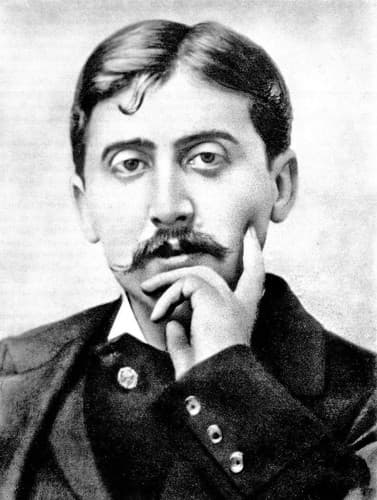
Valentin Louis Georges Eugène Marcel Proust was a French novelist, literary critic, and essayist who wrote the monumental novel In Search of Lost Time, originally in French and published in seven volumes between 1913 and 1927. He is considered by critics and writers to be one of the most influential authors of the 20th century.
Similar books
- Ulysses
James Joyce
3.7 (111k) average on GoodreadsLiterary FictionBoth are monumental works of modernist literature known for their stream-of-consciousness style, deep psychological exploration, and intricate narrative structures.
- To the Lighthouse
Virginia Woolf
3.8 (133k) average on GoodreadsLiterary FictionShares a focus on memory, the passage of time, and the internal lives of characters, using a lyrical and reflective prose style.
- The Magic Mountain
Thomas Mann
4.1 (38k) average on GoodreadsLiterary FictionExplores philosophical themes and the passage of time in a detailed, introspective manner, set within a specific, isolated environment.
- The Old Man and the Sea
Ernest Hemingway
3.8 (831k) average on GoodreadsLiterary FictionA Cuban fisherman's long struggle with a giant marlin becomes a story of endurance and dignity, now retold for young adults with illustrations, phonetic guides, and writing prompts in Traditional Chinese.
- One Hundred Years of Solitude
Gabriel García Márquez
4.1 (753k) average on GoodreadsLiterary FictionThrough the multi-generational story of the Buendía family, a mythical town deals with the repeating patterns of time, love, and solitude, as the extraordinary mixes with the ordinary.
- The Goldfinch
Donna Tartt
3.9 (720k) average on GoodreadsLiterary FictionHaunted by a tragic explosion and clutching a stolen Dutch masterpiece, a young orphan navigates the opulent drawing rooms of New York and the gritty underbelly of the art world, desperately seeking connection and redemption amidst a life spiraling into crime and obsession.




Enjoyed the summary?
A summary gives you the shape of the book. The book itself has the detail, the examples and the voice.
Find In Search of Lost Time on AmazonAs an Amazon Associate, BookBrief earns from qualifying purchases. How we're funded