

Core Idea
- Difficulty
- Medium
- Read it if
- You are fascinated by animal behavior, the history of science, or stories of pioneering women who defied convention to make extraordinary discoveries. It's also for anyone interested in the ethical treatment of animals and the origins of conservation.
- Skip it if
- You prefer highly structured, academic texts over narrative-driven accounts, or if you are not interested in detailed observations of animal life and scientific discovery.
Key Takeaways from In the Shadow of Man
The Power of Patient Observation
Unbiased, long-term observation unlocks groundbreaking scientific discoveries.
Goodall's first years at Gombe involved great patience and a willingness to simply 'be' in the environment, rather than forcing a structured experiment. This approach let her observe chimpanzees in their natural state. This led to discoveries that would have been impossible with a more active method. Her dedication to long-term, non-intrusive observation, often enduring discomfort and isolation, shows how important time and persistence are in ethological research. It challenged scientific ideas that often favored controlled experiments over long, naturalistic study. Goodall proved that sometimes, the best insights come from simply watching and waiting for nature to show its secrets.
“It was a time of intense frustration, but also of intense learning. I learned to wait, to watch, to be patient.”
In the book: Goodall spent months, often daily, observing the chimpanzees from a distance, gradually gaining their trust before they allowed her closer access. Her initial breakthrough came after nearly a year when she observed David Greybeard using a tool.
Try this: Cultivate patience in any research or problem-solving endeavor. Resist the urge for immediate results and allow sufficient time for patterns and natural behaviors to emerge. Embrace a beginner's mind, free from preconceived notions, to truly see what is there.
Related ideas: ethology, long-term-study, unbiased-observation
Challenging Anthropocentric Bias
Chimpanzees exhibit complex behaviors previously thought to be uniquely human.
Goodall's observations went against the scientific idea that only humans used tools and that animals were driven only by instinct. She carefully recorded chimpanzees like David Greybeard modifying grass stems to 'fish' for termites, and later using leaves to soak up water. These observations broke long-held beliefs. This discovery was not just about tool use; it was about the ability for planning, problem-solving, and cultural learning in a non-human species. It made people rethink what 'humanity' means and our place in the animal kingdom. It showed a continuous range of cognitive abilities rather than a clear division, reducing the human-centered view of intelligence.
“It was at this time that I made my most exciting discovery, one that was to shake the very foundations of the scientific community.”
In the book: The seminal observation of David Greybeard stripping leaves from a twig to make a tool for 'fishing' termites from a mound. This was the 'discovery that shook the scientific world' and prompted Louis Leakey's famous quote, 'Now we must redefine man, or redefine tools, or accept chimpanzees as humans.'
Try this: Question deeply ingrained assumptions, especially those that reinforce human exceptionalism. Be open to evidence that challenges established paradigms, as these often lead to the most significant breakthroughs and a more accurate understanding of the world.
Related ideas: tool-use, cognitive-ethology, anthropocentrism
The Richness of Individual Personalities
Animals possess distinct personalities, emotions, and social structures.
Against scientific custom, Goodall named the chimpanzees she studied. She saw their unique personalities, emotional lives, and complex social dynamics. This 'unscientific' approach was important. It allowed her to track individual life histories, observe relationships, and document the full range of chimpanzee emotions – joy, sorrow, fear, jealousy, and compassion. Her detailed accounts of individuals like Flo, Fifi, and Frodo showed family bonds, power struggles, and even helpful behaviors. This proved that chimpanzee societies are more complex and emotionally rich than previously thought. This made her subjects more relatable, building empathy and a deeper understanding of their inner worlds.
“I had been told that it was wrong to give the chimpanzees names. They should be numbered. But I couldn't. Each one was an individual.”
In the book: Goodall's detailed descriptions of individual chimpanzees: Flo, the matriarch, and her family; David Greybeard, the first to trust her; Goliath, the dominant male; and Mike, who rose to alpha status through ingenuity. She documented their distinct behaviors and emotional responses.
Try this: Approach all living beings, human or animal, with an open mind, seeking to understand their individual traits and experiences rather than categorizing them. Recognize that empathy and personal connection can be powerful tools for understanding, even in scientific contexts.
Related ideas: animal-personalities, primate-behavior, empathy-in-science
The Interconnectedness of Life
Understanding one species reveals insights into broader ecological relationships.
Goodall's first focus on chimpanzees grew to include their whole ecosystem. She saw how their diet changed with seasonal fruit, how their movements spread seeds, and how their interactions with other species, like baboons and leopards, shaped the Gombe environment. Her work shows the delicate balance of nature and how the health of one species is connected to the health of the whole. This broad view, from deep experience in the field, shows how important conservation efforts are. These efforts must consider entire ecosystems, not just single species. Removing one part can affect the entire system.
“Every creature, no matter how small, plays a part in the intricate web of life.”
In the book: Her descriptions of chimpanzee diet shifting with the seasons, their interactions with other primates (like olive baboons), and the presence of predators (like leopards and pythons) that influenced chimpanzee behavior and group dynamics. She also documented the impact of human encroachment on the fringes of Gombe.
Try this: Adopt a systems-thinking approach to problem-solving, recognizing that elements are interconnected. When addressing an issue, consider its ripple effects across the entire system rather than focusing solely on isolated components.
Related ideas: ecosystem-balance, conservation-biology, systems-thinking
The Role of Mentorship and Support
Unconventional mentors can unlock extraordinary potential.
Goodall's journey would have been impossible without the support of Dr. Louis Leakey. Despite her lack of formal scientific training, Leakey saw her natural curiosity, patience, and connection with animals. He gave her initial funding and scientific support, protecting her from academic doubt and letting her follow an unconventional research path. This shows the important role of mentors who look beyond traditional qualifications and invest in potential, especially when that potential challenges old ways. Leakey's belief in Goodall showed that passion and dedication can sometimes be more important than degrees in making new discoveries.
“It was Louis Leakey who gave me the chance of a lifetime, a chance that few women, particularly without a university degree, would ever have had.”
In the book: Louis Leakey's decision to send Goodall, a young woman with only a secretarial degree, to Gombe to study chimpanzees, and his subsequent support in helping her secure funding and later pursue a Ph.D. at Cambridge despite her unconventional background.
Try this: Seek out mentors who believe in your potential, even if your path is unconventional. As a mentor, look beyond traditional qualifications and identify raw talent, curiosity, and passion in others, providing them with opportunities and support.
Related ideas: mentorship, scientific-patronage, unconventional-careers
Resilience in the Face of Adversity
Perseverance is essential for overcoming significant challenges in pursuit of a mission.
Goodall faced many physical and emotional challenges in her early years at Gombe: isolation, hard living conditions, dangerous wildlife, and the initial difficulty of getting the chimpanzees used to her. She was often lonely, had malaria, and struggled for funding. But her commitment to understanding the chimpanzees kept her going. This strength shows that important scientific work often requires personal sacrifice and a strong spirit. It shows that true passion can help someone through very difficult times, proving that seeking knowledge takes as much determination as it does intelligence.
“There were days when I felt utterly defeated, when the loneliness and the sheer difficulty of the task seemed overwhelming. But I always went back.”
In the book: Goodall's descriptions of her rudimentary living conditions, her initial struggles to get close to the chimpanzees (who fled from her for months), her battles with illness (malaria), and the constant threat of wild animals like leopards and snakes.
Try this: Develop mental and emotional resilience by focusing on your 'why.' Anticipate and prepare for challenges, understanding that setbacks are part of any significant endeavor. Cultivate a deep sense of purpose to sustain you through difficult times.
Related ideas: resilience, perseverance, field-research-challenges
The Ethical Imperative of Conservation
Direct observation fosters a profound responsibility to protect the studied species.
While 'In the Shadow of Man' mostly focuses on her early research, it subtly prepares for Goodall's later, strong advocacy for chimpanzee conservation. Her deep experience and understanding of individual chimpanzees' lives gave her a strong sense of responsibility for their survival. Seeing their complex social structures and emotional depth made their vulnerability to habitat destruction and poaching very personal. This book suggests that truly understanding a species means also protecting it, especially when human actions threaten it. Her work shows how observation can lead to passionate advocacy.
“We cannot share our world with other creatures unless we are prepared to protect them.”
In the book: Though her full advocacy came later, the book foreshadows this with descriptions of human encroachment on the Gombe boundaries and the growing awareness of the threats to chimpanzee habitats. Her deep emotional connection to the chimpanzees themselves forms the basis of this imperative.
Try this: When studying or interacting with any natural system, recognize the ethical responsibilities that arise. Allow knowledge and empathy to guide actions towards protection and sustainable practices, translating understanding into advocacy when necessary.
Related ideas: conservation-ethics, wildlife-protection, environmental-advocacy
The Value of Intuition in Science
Sometimes, 'unscientific' intuition leads to deeper understanding.
Goodall's success was not just from careful observation; it also came from her intuition and empathy. Her ability to connect with the chimpanzees, understanding their motivations and emotions, allowed her to interpret behaviors in ways a purely objective approach might have missed. While 'intuition' is often dismissed in science, Goodall's story shows that a deep, empathetic connection to one's subjects can provide valuable insights, especially in fields like ethology where understanding subjective experience is important. It suggests that combining careful methods with intuitive understanding can lead to a more complete picture.
“Sometimes I felt I could almost 'think like a chimpanzee.'”
In the book: Her ability to habituate the chimpanzees, often by simply sitting near them, patiently, and without fear, suggesting an intuitive understanding of their psychology. Her 'unscientific' practice of naming them and attributing emotions, which ultimately led to richer data.
Try this: Don't dismiss intuition entirely in your work. While critical thinking and data are paramount, pay attention to 'gut feelings' or insights that arise from deep immersion and empathy, using them as hypotheses to be tested and explored.
Related ideas: scientific-intuition, empathy-in-research, qualitative-data
Redefining the Human-Animal Divide
Chimpanzee behavior blurs the lines between human and animal.
Through her careful observations, Goodall showed that chimpanzees have behaviors once thought to be only human: tool-making, complex social structures, lasting family bonds, warfare, helping others, and even learning behaviors from each other. These discoveries challenged the idea that humans are unique. They suggested a continuous range of abilities rather than a sharp division between humans and other animals. Her work redefined not just chimpanzees, but humanity itself. It made people rethink our place in the natural world and appreciate the intelligence and complexity of non-human life. This change in view has had lasting effects on animal welfare and conservation.
“The more I learned, the more I realized how arbitrary was the line we drew between 'man' and 'beast.'”
In the book: Observations of tool use, hunting, warfare between chimpanzee groups, complex mother-offspring bonds lasting decades, and the transmission of learned behaviors (like specific feeding techniques) across generations.
Try this: Actively challenge preconceived notions about the capabilities and intelligence of non-human animals. Recognize and respect the continuity of life, fostering a more inclusive understanding of consciousness and sentience across species.
Related ideas: human-animal-continuum, animal-cognition, speciesism
The Transformative Power of Direct Experience
Immersion in nature profoundly shapes understanding and purpose.
Goodall's personal change throughout the book is clear. Starting as a young woman who loved animals, her years of direct, solitary experience in the Gombe forest changed her perspective, purpose, and understanding of the world. Constant exposure to nature's beauty and harshness, the close connection with wild chimpanzees, and the challenges she overcame shaped her into the scientist and advocate she became. This shows that deep, firsthand experience, especially in nature, can greatly help personal growth, intellectual development, and finding one's life's purpose. It offers insights that theoretical study alone cannot provide.
“My world, which had once been so small, expanded to embrace the entire Gombe ecosystem, and beyond.”
In the book: Her detailed descriptions of her daily life in the forest, the awe she felt observing nature, and how her understanding of the chimpanzees and herself evolved over time, leading her to dedicate her life to their study and protection.
Try this: Seek out opportunities for deep, immersive experiences, particularly in natural environments. Allow these experiences to challenge your perspectives, foster personal growth, and potentially clarify your life's purpose and contributions.
Related ideas: experiential-learning, personal-transformation, nature-connection
In the Shadow of Man Quotes
“It was a thrilling moment indeed, for I suddenly saw a female chimpanzee with her infant riding on her back.”
“The greatest crime of all is to be boring.”
“Certainly, there is no pleasure in life comparable to that of being a discoverer.”
“The chimpanzees are part of our world, and we must do everything we can to save them.”
“It isn't just a matter of observing, it's a matter of understanding.”
“My own feelings about the chimpanzees were becoming more and more personal.”
“We have a responsibility to be good stewards of the earth.”
“Each individual chimpanzee has his or her own personality, just as we do.”
“It seems to me that the only way to really understand a creature is to live with it, to be part of its world.”
“The more we learn about the world, the more we realize how much we don't know.”
“One of the reasons I wanted to write this book was to share the wonder and excitement of Gombe.”
“The world is full of wonders, and we should never stop trying to understand them.”
“It was a moment of pure magic, a connection across species that transcended language.”
“But it was not until I had spent many hours with the chimpanzees that I began to understand the true complexities of their lives.”
Quiz
10 questions on the main ideas. Each answer comes with a short explanation.
Question 1
Who was the renowned paleoanthropologist who selected Jane Goodall for her groundbreaking study of chimpanzees?
- Dian Fossey
- Louis Leakey
- George Schaller
- Konrad Lorenz
Show answer
B. Louis Leakey The book explicitly states that the legendary Louis Leakey chose Jane Goodall, a young secretarial school graduate, to undertake her landmark study of chimpanzees.
Question 2
What was Jane Goodall's initial academic background when she began her research in Gombe?
- A trained primatologist
- A biology graduate
- A secretarial school graduate
- A veterinary assistant
Show answer
C. A secretarial school graduate The book highlights that Jane Goodall was a young secretarial school graduate when she was chosen by Louis Leakey, emphasizing her non-traditional entry into scientific research.
Question 3
Which specific behavior, observed by Jane Goodall, revolutionized the scientific understanding of chimpanzees and tool use?
- Chimpanzees sharing food with each other
- Chimpanzees using leaves as sponges to drink water
- Chimpanzees modifying grass stems to 'fish' for termites
- Chimpanzees engaging in complex social grooming rituals
Show answer
C. Chimpanzees modifying grass stems to 'fish' for termites One of Goodall's most famous discoveries, detailed in the book, was observing chimpanzees stripping leaves from twigs to create tools for 'fishing' termites out of their mounds. This challenged the then-prevailing scientific view that only humans made and used tools.
Question 4
What was the initial reaction of many scientists to Jane Goodall's early observations and methodology?
- Immediate widespread acceptance and praise for her innovative approach.
- Skepticism, particularly regarding her lack of formal scientific training and her anthropomorphic naming of chimps.
- Indifference, as her findings were not considered significant at the time.
- Encouragement for her to immediately pursue a Ph.D. based on her initial fieldwork.
Show answer
B. Skepticism, particularly regarding her lack of formal scientific training and her anthropomorphic naming of chimps. Goodall faced considerable skepticism from the scientific community, especially due to her lack of formal academic credentials and her practice of naming the chimpanzees, which was seen as anthropomorphic and unscientific at the time. The book describes these early challenges.
Question 5
What is a central theme explored in 'In the Shadow of Man' regarding the relationship between humans and chimpanzees?
- The fundamental biological differences that separate humans from all other primates.
- The importance of chimpanzees as a food source for indigenous populations.
- The close evolutionary and behavioral similarities, blurring the lines previously thought to divide us.
- The unique genetic adaptations that allow chimpanzees to thrive in diverse environments.
Show answer
C. The close evolutionary and behavioral similarities, blurring the lines previously thought to divide us. A core message of the book is Goodall's revelation of the striking similarities between chimpanzees and humans in terms of social structure, emotions, and behaviors, challenging the idea of human uniqueness and highlighting our shared evolutionary heritage.
Question 6
Which of the following describes Jane Goodall's primary research method in Gombe, as detailed in the book?
- Trapping and tagging chimpanzees for GPS tracking.
- Remote observation using hidden cameras and sound recorders.
- Long-term, patient, and immersive direct observation, often alone, to gain trust and acceptance.
- Studying chimpanzees primarily through analysis of their feces and discarded food remains.
Show answer
C. Long-term, patient, and immersive direct observation, often alone, to gain trust and acceptance. The book vividly describes Goodall's commitment to patient, long-term, and solitary direct observation, often spending months without seeing chimps up close, gradually earning their trust and acceptance, which allowed her unprecedented insights.
Question 7
How did Jane Goodall's initial approach to naming the chimpanzees differ from standard scientific practice at the time?
- She used numerical codes exclusively to avoid bias.
- She assigned them Latin scientific names to emphasize their species.
- She gave them individual names based on their personalities and physical traits, which was seen as anthropomorphic.
- She used a system based on their genetic lineage.
Show answer
C. She gave them individual names based on their personalities and physical traits, which was seen as anthropomorphic. Goodall famously named the chimpanzees she studied (e.g., David Greybeard, Fifi, Frodo), a practice that was unconventional and initially criticized by the scientific community for being anthropomorphic. However, it allowed her to track individuals and understand their complex social dynamics, which is a key part of the book.
Question 8
What major shift occurred in the Gombe chimpanzee community during Goodall's long-term study, as documented in the book?
- A sudden mass migration out of the Gombe region due to habitat loss.
- The peaceful integration of two separate chimpanzee communities into one larger group.
- A violent fissioning of the community into two hostile groups, leading to a 'war'.
- The complete eradication of all predators from the chimpanzee habitat.
Show answer
C. A violent fissioning of the community into two hostile groups, leading to a 'war'. The book details the harrowing 'Gombe Chimpanzee War,' where the original community split into two factions (Kasakela and Kahama), leading to a brutal and systematic extermination of the Kahama males by the Kasakela males. This observation profoundly impacted Goodall's understanding of chimpanzee aggression.
Question 9
Stephen Jay Gould's introduction to the paperback edition likely emphasizes what aspect of Jane Goodall's work?
- Her early struggles with funding and logistical challenges in the field.
- The detailed physiological differences between chimpanzees and gorillas.
- The revolutionary impact of her non-traditional scientific approach and discoveries on evolutionary theory and human self-perception.
- The specific dietary habits of the Gombe chimpanzees.
Show answer
C. The revolutionary impact of her non-traditional scientific approach and discoveries on evolutionary theory and human self-perception. Stephen Jay Gould, a prominent evolutionary biologist and science historian, would most likely highlight the profound scientific and philosophical impact of Goodall's discoveries, particularly how her work challenged established views on human uniqueness and contributed to evolutionary understanding, given his own academic focus.
Question 10
Beyond the scientific observations, what personal challenges did Jane Goodall face in the early days of her Gombe research, as implied or described in the book?
- Constant conflict with local government officials over land use permits.
- Severe lack of basic necessities, isolation, and initial difficulty gaining acceptance from the chimpanzees.
- Frequent dangerous encounters with large predators like lions and leopards.
- Difficulty in attracting and retaining scientific assistants to help with data collection.
Show answer
B. Severe lack of basic necessities, isolation, and initial difficulty gaining acceptance from the chimpanzees. The memoir aspect of the book often details Goodall's early struggles, including the extreme isolation, primitive living conditions, the challenge of securing supplies, and the initial, arduous process of habituating the wild chimpanzees to her presence and gaining their trust.
In the Shadow of Man FAQ
What is 'In the Shadow of Man' about?
'In the Shadow of Man' is Jane Goodall's groundbreaking memoir detailing her early years of research on wild chimpanzees in Gombe Stream National Park, Tanzania. It recounts her scientific adventures, the challenges she faced, and the revolutionary discoveries she made about chimpanzee behavior and social structures.
Does Jane Goodall's research in 'In the Shadow of Man' still hold relevance today?
Yes, Goodall's pioneering work described in the book laid the foundation for primatology and continues to be highly relevant. Her observations on tool use, complex social relationships, and individual personalities in chimpanzees revolutionized our understanding of animal behavior and our place in the natural world.
What groundbreaking discoveries did Jane Goodall make about chimpanzees?
Goodall's most significant discoveries included observing chimpanzees making and using tools, demonstrating their capacity for complex problem-solving. She also documented their intricate social hierarchies, long-term family bonds, and behaviors such as warfare and altruism, challenging previous notions about animal intelligence.
How did Jane Goodall begin her chimpanzee study?
Jane Goodall began her study when she was chosen by the renowned anthropologist Louis Leakey, despite her lack of formal scientific training at the time. He recognized her passion and dedication, sending her to Gombe Stream in Tanzania to conduct long-term, direct observations of wild chimpanzees.
What challenges did Jane Goodall face during her research?
Goodall faced numerous challenges, including skepticism from the scientific community due to her unconventional methods and lack of a degree. She also endured difficult living conditions, isolation, and the immense patience required to gain the trust of wild chimpanzees and make her observations.
What is the significance of the title 'In the Shadow of Man'?
The title 'In the Shadow of Man' refers to the close genetic and behavioral similarities between chimpanzees and humans, highlighting how studying our closest living relatives can offer insights into human evolution and behavior. It also subtly suggests humanity's often dominant and impactful presence on the natural world.
How is Jane Goodall's approach different from traditional zoological studies of her time?
Goodall's approach differed significantly by emphasizing long-term, immersive observation and giving individual chimpanzees names rather than numbers, fostering a deeper understanding of their personalities and social dynamics. This contrasted with the more detached, quantitative methods common in zoology at the time, which often overlooked individual variation.
Does 'In the Shadow of Man' include photographs?
Yes, the paperback edition of 'In the Shadow of Man' includes 80 photographs. These images provide a visual chronicle of Goodall's time in Gombe and the chimpanzees she studied, bringing her detailed descriptions to life for the reader.
What can readers learn about conservation from 'In the Shadow of Man'?
While primarily a memoir of discovery, the book implicitly highlights the importance of understanding and protecting species in their natural habitats. Goodall's deep connection and insights into chimpanzee life serve as a powerful testament to the value of wildlife and the urgent need for conservation efforts.
About the author

Jane Goodall is a British primatologist and anthropologist known for her groundbreaking research on wild chimpanzees in Tanzania. Her book "In the Shadow of Man" details her observations and experiences in the field, contributing significantly to the understanding of primate behavior and conservation efforts. Goodall's work has earned her numerous accolades and recognition in the fields of science and environmental activism.
Similar books
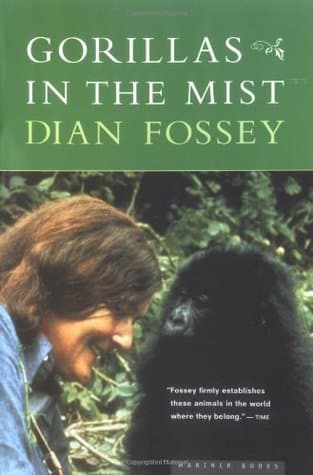
- Gorillas in the Mist
Dian Fossey
4.2 (19k) average on GoodreadsBiographyAnother foundational memoir by a female primatologist detailing long-term, immersive study of great apes in their natural habitat.
- The Diary of a Young Girl
Anne Frank
4.2 (2.7M) average on GoodreadsBiographyDuring the Nazi occupation, a teenage girl's diary, written from a secret annex, shares observations on humanity, hope, and the wait for freedom.
- Eat, Pray, Love
Elizabeth Gilbert
3.6 (1.5M) average on GoodreadsLifestyleA heartbroken writer leaves her conventional life for a year-long global search for pleasure in Italy, spiritual devotion in India, and unexpected love and balance in Bali.
- Night
Elie Wiesel
4.3 (970k) average on GoodreadsBiographyIn the darkness of Auschwitz and Buchenwald, a teenage Elie Wiesel faces the extermination of his family, the loss of his faith, and the lasting scars of humanity's deepest cruelty.
- Steve Jobs
Walter Isaacson
4.1 (957k) average on GoodreadsBusinessSteve Jobs was a visionary who fused creativity and technology to revolutionize six industries and shape our digital world.
- The Glass Castle
Jeannette Walls
4.3 (903k) average on GoodreadsBiographyJeannette Walls's memoir describes her unusual childhood with brilliant, free-spirited parents whose poverty-stricken life shaped her independence and love despite family problems.





Enjoyed the summary?
A summary gives you the shape of the book. The book itself has the detail, the examples and the voice.
Find In the Shadow of Man on AmazonAs an Amazon Associate, BookBrief earns from qualifying purchases. How we're funded