
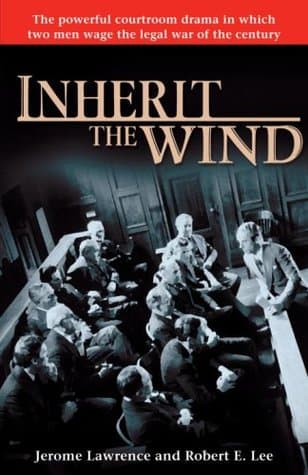
Synopsis
Covers the whole plot, including the ending.
- Difficulty
- Medium
- Pacing
- Moderate
- Mood
- Thought-provoking, Dramatic, Intense, Reflective
- Read it if
- You enjoy thought-provoking courtroom dramas that explore the conflict between faith and reason, and appreciate historical fiction based on significant legal battles.
- Skip it if
- You are looking for fast-paced action or prefer stories with unambiguous heroes and villains, or find extensive philosophical debate in a courtroom setting tedious.
Inherit the Wind Plot Summary
Covers the whole plot, including the ending.
Opening in Hillsboro
The play opens in the small, devout town of Hillsboro, 'Heavenly Hillsboro,' where the community is abuzz with Bertram Cates's impending trial. Sarah Brady, Reverend Brown's daughter and Cates's fiancée, is distressed by the situation. Rachel, Cates's friend, tries to comfort her. The town prepares for the arrival of Matthew Harrison Brady, a renowned prosecutor and fundamentalist, who is coming to lead the prosecution against Cates. The atmosphere is tense, with the townspeople united in their condemnation of Cates and their fervent religious beliefs. Children practice a song, showing the town's conservative values and the pressure Cates faces.
Arrival of Brady and Drummond
Matthew Harrison Brady arrives in Hillsboro to a grand reception, greeted by cheering crowds, a band, and Reverend Brown, who hails him as a champion of their faith. Brady, a charismatic and imposing figure, delivers a rousing speech about defending biblical truth. Shortly after, E.K. Hornbeck, a cynical journalist from Baltimore, arrives, observing the scene with sardonic wit. He announces that the defense has secured Henry Drummond, a brilliant and controversial lawyer, to represent Cates. Drummond's arrival is met with suspicion and hostility, a stark contrast to Brady's reception, immediately establishing the ideological battle ahead.
Jury Selection and Initial Clashes
Jury selection begins, with Drummond immediately facing an uphill battle. The potential jurors are all local Hillsboro residents, deeply religious and openly prejudiced against Cates and the idea of evolution. Drummond attempts to question their impartiality, but Judge Coffey, sympathetic to the prosecution, frequently overrules his objections. Drummond and Brady engage in their first direct confrontations, showing their contrasting legal styles and worldviews. Drummond argues for the right to think and question, while Brady emphasizes faith and tradition. The difficulty in finding an unbiased jury shows the pervasive influence of religious fundamentalism in Hillsboro.
Rachel's Testimony and Reverend Brown's Sermon
Rachel is called to the stand by Brady, who manipulates her into revealing personal conversations with Cates, attempting to paint him as an irreligious and dangerous man. Rachel's testimony is agonizing for her, torn between her love for Cates and her fear of her father, Reverend Brown. Later, Reverend Brown delivers a fervent prayer meeting, condemning Cates and all who support him, even calling for God's wrath upon his own daughter, Rachel, for her wavering faith. This public denunciation disturbs Brady, who recognizes the dangerous extremism of Brown's rhetoric, despite sharing his religious convictions.
Drummond's Failed Attempts to Introduce Scientific Evidence
Drummond attempts to call expert witnesses—scientists and theologians—who could testify about the scientific basis of evolution and the compatibility of faith and reason. However, Judge Coffey consistently rules against allowing their testimony, deeming it irrelevant to the specific charge of violating the state law. The judge's rulings prevent Drummond from presenting a scientific defense, forcing him to shift his strategy. This highlights the limitations placed on intellectual freedom and the judicial system's bias against new ideas in Hillsboro, frustrating Drummond and emphasizing the uphill battle Cates faces.
Brady on the Stand
In a bold and unexpected move, Drummond calls Matthew Harrison Brady to the witness stand as an expert on the Bible. This decision shocks the courtroom and even Brady himself. Drummond begins a meticulous cross-examination, questioning Brady about the literal interpretation of biblical stories, such as the creation account and Noah's Ark. Drummond uses logic and reason to expose inconsistencies and absurdities in a strictly literal interpretation of the Bible, challenging Brady's authority and the foundation of his beliefs. The intensity of the exchange grows, captivating the courtroom.
Brady's Breakdown
As Drummond presses his questions, particularly concerning the duration of a 'day' in Genesis and the concept of free will, Brady becomes increasingly agitated and defensive. His answers grow erratic, and he begins to shout, losing his usual calm demeanor and oratorical prowess. The crowd, initially supportive, starts to waver, witnessing their champion falter under Drummond's intellectual assault. Brady's authority crumbles as he struggles to reconcile literal biblical interpretation with logical inquiry, culminating in a public breakdown that shatters his image of infallibility and reveals the fragility of his convictions.
The Verdict and Sentencing
Despite Drummond's powerful cross-examination of Brady, the jury, having been denied access to scientific evidence, finds Bertram Cates guilty. However, the verdict comes with a surprisingly light sentence: a fine of only one hundred dollars. This lenient punishment, potentially influenced by the public spectacle and Brady's breakdown, is a symbolic victory for Drummond, as it undermines the prosecution's desire for a severe condemnation. The light sentence suggests a crack in the town's monolithic fundamentalism and a recognition, however slight, of the complexities involved.
Brady's Final Moments
After the verdict, Matthew Harrison Brady attempts to deliver a final, impassioned speech to the courtroom and the radio audience, but his voice is weak, and his words lack their former power. He tries to recite a biblical passage, but his energy is depleted, and he collapses, suffering a fatal stroke. His death marks a poignant end to his career and symbolizes the decline of an era of unchallenged fundamentalist authority. The once-mighty orator dies amidst the very people he sought to champion, leaving a void and a sense of disillusionment in Hillsboro.
Aftermath and Reflection
In the aftermath of Brady's death, Drummond, Hornbeck, and Rachel gather in the quiet courtroom. Hornbeck, ever the cynic, mocks Brady's demise, but Drummond defends Brady's humanity, acknowledging his past greatness and the tragedy of his intellectual rigidity. Drummond picks up Brady's Bible and Darwin's 'Origin of Species,' weighing them in his hands, symbolizing the ongoing tension between faith and reason. Rachel, having found her voice and courage, decides to leave Hillsboro with Cates, empowered by the trial's events. The play concludes with Drummond walking out, carrying both books, signifying the necessity of balancing different forms of truth.
Principal Figures
Henry Drummond
Protagonist
A brilliant and unconventional defense attorney championing intellectual freedom.
Henry Drummond is a renowned lawyer, known for his sharp intellect, wit, and unwavering commitment to justice and the right to think. Modeled after Clarence Darrow, he is a secular humanist who believes in challenging dogma and defending individual liberties. He often uses humor and sarcasm to expose hypocrisy, but underneath his tough exterior is a deep respect for humanity and the pursuit of truth. He is an outsider in Hillsboro, facing hostility but never backing down from his principles.
Relationships: Bertram Cates (Defense attorney and client, mentor figure); Matthew Harrison Brady (Opposing counsel, old friends and intellectual rivals); E.K. Hornbeck (Confidante, intellectual ally (though often exasperated by Hornbeck's cynicism))
Matthew Harrison Brady
Antagonist
A charismatic, fundamentalist prosecutor and former presidential candidate.
Matthew Harrison Brady is a celebrated orator and a devout fundamentalist, modeled after William Jennings Bryan. He is deeply respected by the people of Hillsboro and sees himself as a defender of traditional values and biblical truth. Initially presented as an imposing and confident figure, his unwavering belief in literal biblical interpretation ultimately becomes his tragic flaw. He is driven by a desire to preserve what he believes is moral order and protect the innocence of the common man from what he perceives as dangerous, modern ideas.
Relationships: Henry Drummond (Opposing counsel, old friends and intellectual rivals); Reverend Brown (Ally in faith, though Brady sometimes moderates Brown's extremism); The Townspeople of Hillsboro (Adoring supporters and followers)
Bertram Cates
Protagonist
The quiet, principled schoolteacher accused of teaching evolution.
Bertram Cates is a young, earnest high school science teacher in Hillsboro, accused of violating the state law against teaching evolution. He is not a radical firebrand but a thoughtful individual who simply believes in the importance of intellectual inquiry and presenting different ideas to his students. He is initially frightened and overwhelmed by the attention and hostility, but he maintains his conviction. He represents the common man caught in the crossfire of a larger ideological battle, standing up for his principles despite personal cost.
Relationships: Henry Drummond (Client, looks up to Drummond for guidance and defense); Rachel Brown (Fiancée, her support is crucial to him); Reverend Brown (Antagonist, Rachel's father and his accuser)
Rachel Brown
Supporting
Cates's fiancée and Reverend Brown's daughter, torn between love and loyalty.
Rachel Brown is a young schoolteacher, deeply conflicted between her love for Bertram Cates and her loyalty and fear of her domineering father, Reverend Brown. She is initially timid and easily swayed by the strong opinions of Hillsboro. Throughout the trial, she struggles with her own beliefs, caught between the rigid fundamentalism of her upbringing and Cates's more open-minded perspective. Her journey is one of self-discovery, as she grapples with fear, doubt, and ultimately, finds the courage to assert her own convictions.
Relationships: Bertram Cates (Fiancée, deeply loves and supports him); Reverend Brown (Father, fears his condemnation and influence); Henry Drummond (Confides in him, seeks his understanding)
E.K. Hornbeck
Supporting
A cynical, witty journalist covering the trial for a Baltimore newspaper.
E.K. Hornbeck is a highly intelligent, sardonic journalist, modeled after H.L. Mencken. He represents the voice of modern skepticism and intellectualism, often providing biting commentary on the provincialism and religious fervor of Hillsboro. While he supports Drummond's cause, he is also deeply cynical about humanity and the possibility of true progress. He sees the trial as a spectacle and a symbol of the clash between enlightenment and ignorance, using his sharp wit to expose hypocrisy and absurdity. Despite his cynicism, he plays a crucial role in highlighting the intellectual stakes of the trial.
Relationships: Henry Drummond (Intellectual ally, but often clashes with Drummond's idealism); Matthew Harrison Brady (Derides and mocks Brady's fundamentalism); The Townspeople of Hillsboro (Scorns their provincialism and ignorance)
Reverend Jeremiah Brown
Supporting
The zealous, fundamentalist preacher of Hillsboro and Rachel's father.
Reverend Brown is the spiritual leader of Hillsboro, a fervent and dogmatic fundamentalist preacher. He embodies the rigid, uncompromising religious views prevalent in the town. He is a powerful orator who uses fire-and-brimstone sermons to condemn Cates and anyone who questions biblical literalism. His zealotry leads him to publicly denounce his own daughter, Rachel, for her wavering faith, demonstrating the extreme and potentially destructive nature of his unyielding beliefs. He is a formidable figure, representing the forces of unquestioning faith against intellectual inquiry.
Relationships: Rachel Brown (Father, domineering and condemning); Matthew Harrison Brady (Admires and supports Brady, sees him as a religious champion); Bertram Cates (His accuser and target of his condemnation)
Judge Coffey
Supporting
The presiding judge, biased towards the prosecution and local values.
Judge Coffey is the presiding judge in Bertram Cates's trial. He is a product of Hillsboro, sharing the town's conservative values and religious beliefs. His rulings consistently favor the prosecution, often overruling Drummond's attempts to introduce scientific evidence or question the impartiality of the jury. While he tries to maintain an appearance of judicial fairness, his bias is evident, reflecting the community's ingrained prejudice against Cates and modern ideas. He represents the limitations of justice when it is influenced by prevailing social and religious norms.
Relationships: Henry Drummond (Antagonistic, frequently overrules Drummond); Matthew Harrison Brady (Supportive, aligns with Brady's legal strategy); Bertram Cates (Presides over his trial, ultimately finds him guilty)
Themes & Insights
The Conflict Between Faith and Reason
This is the central theme, explored through the clash between Brady's biblical literalism and Drummond's advocacy for scientific inquiry and intellectual freedom. The trial itself is a microcosm of this larger societal debate. Brady believes in absolute, unchanging truth derived from the Bible, while Drummond champions the right to question, to doubt, and to evolve understanding. The play doesn't necessarily condemn faith but critiques blind, dogmatic adherence to it, especially when it stifles intellectual growth. The inability of the court to hear scientific evidence highlights the societal struggle to reconcile these two powerful forces.
“'An idea is a greater monument than a cathedral. And the advance of man's knowledge is a greater miracle than any sticks turned into snakes, or water into wine.'”
Intellectual Freedom vs. Dogma
The play explores the importance of intellectual freedom—the right to think, to question, and to teach ideas that challenge established norms. Bertram Cates is on trial not just for teaching evolution, but for introducing a concept that contradicts Hillsboro's dominant religious dogma. Drummond's defense is about the fundamental right to free thought. The town's hostile reaction to Cates and Drummond, and the court's suppression of scientific testimony, illustrate the dangers of intellectual stagnation and the chilling effect of dogmatic control on education and society.
“'Is it possible that something is holy to the celebrated Mr. Brady that is not holy to the Lord?'”
The Dangers of Extremism and Mob Mentality
The play portrays how easily a community can succumb to extremism and mob mentality, especially under the influence of charismatic leaders like Reverend Brown and Matthew Harrison Brady. The townspeople of Hillsboro, initially devout, quickly turn hostile and judgmental towards Cates and Drummond. Reverend Brown's fiery sermon, where he calls down damnation on his own daughter, exemplifies the destructive potential of unchecked religious fervor. Even Brady, despite his initial moderation, becomes swept up in the emotional intensity, leading to his public breakdown. The play warns against the suppression of individual thought by collective passion.
“'All glitter, no gold. He's a Barnum-and-Bailey booster. A Bible-beating, God-fearing, khaki-colored, old-fashioned, pure-American, unadulterated, hundred-percent, red-white-and-blue-dyed-in-the-wool, all-around patriot!'”
The Role of the Media in Shaping Public Opinion
E.K. Hornbeck, the cynical journalist, serves as a lens through which the audience observes the trial and its impact. His dispatches and commentary show how events are framed and interpreted for a wider public, shaping national opinion. The presence of radio broadcasts also emphasizes the growing power of mass media to disseminate information and influence perceptions, turning a local trial into a national spectacle. Hornbeck's sharp observations often expose the performative aspects of the trial and the underlying motivations of the characters, underscoring the media's capacity to both inform and manipulate.
“'Ladies and gentlemen, I am a newspaperman. I am not a prophet. But I can tell you that the future of this country is in the hands of its children. And the future of its children is in the hands of its teachers.'”
Plot Devices & Literary Techniques
The Scopes Monkey Trial
Historical event serving as the play's direct inspiration and framework.
The actual 1925 Scopes Monkey Trial is the primary historical event upon which 'Inherit the Wind' is based. While fictionalized, the play uses the core elements—a teacher accused of teaching evolution, the clash between two legal giants (Clarence Darrow and William Jennings Bryan), and the intense public debate over science and religion—as its foundational structure. This device grounds the play in a significant moment in American history, giving it immediate relevance and resonance, and allowing it to explore timeless themes through a specific historical context.
Verbal Combat and Rhetoric
The intense courtroom exchanges between Drummond and Brady.
The play heavily relies on the verbal combat and rhetorical prowess of Henry Drummond and Matthew Harrison Brady. Their courtroom exchanges are not merely legal arguments but dramatic duels of wit, logic, and oratorical skill. This device elevates the intellectual debate into high drama, captivating the audience and highlighting the contrasting ideologies. Brady's grand, emotional rhetoric clashes with Drummond's sharp, logical questioning, demonstrating how language and persuasion are used to sway opinion and defend vastly different worldviews. The power of their words drives the play's central conflict.
The Outsider Perspective (Hornbeck)
A cynical journalist's commentary providing critical distance.
E.K. Hornbeck serves as the primary outsider perspective, a cynical and detached observer who comments on the proceedings and the townspeople. His witty, often biting remarks function as a chorus, offering an intellectual critique of the small-town mentality and the fundamentalist fervor. This device provides comic relief while also reinforcing the play's themes of intellectual freedom and the dangers of ignorance. Hornbeck's presence allows the audience to view the events with a degree of critical distance, preventing the play from becoming overly sentimental or didactic.
Symbolism of the Books
Drummond weighing Darwin's 'Origin of Species' and the Bible.
At the play's conclusion, Henry Drummond picks up and weighs Darwin's 'Origin of Species' in one hand and the Bible in the other. This powerful visual symbolizes the central conflict of the play—the tension between scientific inquiry and religious faith. By holding both, Drummond suggests that neither is inherently superior or entirely dismissible, and that perhaps a balance or synthesis between the two is necessary for true understanding. It underscores the play's message that wisdom lies not in choosing one over the other, but in embracing the complexity of both forms of truth.
Inherit the Wind Quotes
“He that troubleth his own house shall inherit the wind: and the fool shall be servant to the wise in heart.”
“All motion is relative. Perhaps it is as well that a man cannot see himself as others see him.”
“The man who has the courage to think is a hero.”
“An idea is a greater monument than a cathedral.”
“I understand what Bert's going through. It's the loneliest feeling in the world—to find yourself standing alone in the middle of a crowd, all pointing their fingers at you.”
“Is it possible that something is holy to the celebrated man, that is not holy to the common man?”
“Truth has meaning only in terms of men's perceptions. And there is no perfection in perception.”
“Conform! Conform! Be like your brother, like your sister, like your father, like your mother! And like the Judge, like the jury—and like me!”
“He that troubleth his own house shall inherit the wind.”
“You see, Colonel, I have the right to think!”
“A man's got a right to think. And my client has a right to think.”
“I'm not trying to destroy anyone's belief in God, but to ask that everyone be allowed to think.”
“The Bible is a book. A good book. But it's not the only book.”
“He who has a thing to sell and goes and whispers in an ass's ear, Is not so apt to get the buyer as he who doth trumpet forth his wares.”
Quiz
10 questions on the plot and the characters. Each answer comes with a short explanation.
Question 1
What is the name of the character accused of teaching evolution in 'Inherit the Wind'?
- Matthew Harrison Brady
- Henry Drummond
- Bertram Cates
- E.K. Hornbeck
Show answer
C. Bertram Cates Bertram Cates is the young schoolteacher on trial for teaching Darwin's theory of evolution.
Question 2
Which real-life legal giant is the character Matthew Harrison Brady based on?
- Clarence Darrow
- William Jennings Bryan
- Andrew Jackson
- Abraham Lincoln
Show answer
B. William Jennings Bryan Matthew Harrison Brady is a fictionalized version of William Jennings Bryan, who prosecuted the Scopes Monkey Trial.
Question 3
What is the primary conflict presented in 'Inherit the Wind'?
- A dispute over land ownership in a small town.
- The conflict between individual intellectual freedom and religious fundamentalism.
- A political struggle for control of the local government.
- A personal rivalry between two prominent legal figures.
Show answer
B. The conflict between individual intellectual freedom and religious fundamentalism. The play deeply explores the tension between the right to think freely and the pressures of dogmatic religious belief.
Question 4
What is the verdict reached by the jury in Bertram Cates's trial?
- Not guilty, and he is acquitted.
- Guilty, and he is sentenced to a substantial fine.
- Guilty, but the judge imposes a minimal fine.
- The jury is hung, resulting in a mistrial.
Show answer
C. Guilty, but the judge imposes a minimal fine. Cates is found guilty, but the judge, recognizing the circus-like nature of the trial, gives him a very light sentence of $100.
Question 5
What significant event causes Brady to collapse and later die?
- He is physically attacked by an angry mob.
- He suffers a heart attack during his closing argument.
- He attempts to deliver a radio address after the verdict, but is ignored and loses his voice.
- He is publicly humiliated by Drummond's cross-examination.
Show answer
C. He attempts to deliver a radio address after the verdict, but is ignored and loses his voice. After the trial, Brady tries to address the crowd via radio, but the crowd disperses, and the radio is turned off. He collapses, feeling abandoned and defeated, and dies shortly after.
Question 6
What is the symbolic significance of Drummond holding both Darwin's 'Origin of Species' and the Bible at the end of the play?
- He is showing his intention to burn both books.
- He believes both books contain equal scientific truth.
- It represents the need for balance and the ability to consider diverse ideas without prejudice.
- He is demonstrating his personal religious conversion.
Show answer
C. It represents the need for balance and the ability to consider diverse ideas without prejudice. Drummond's action symbolizes the importance of open-mindedness and the coexistence of different perspectives, rather than an insistence on absolute truth from a single source.
Question 7
What is the name of the newspaper reporter who provides a cynical, yet insightful, commentary on the trial?
- Meeker
- Reverend Brown
- E.K. Hornbeck
- Sillers
Show answer
C. E.K. Hornbeck E.K. Hornbeck, a character based on H.L. Mencken, is the sharp-witted journalist covering the trial for a Baltimore newspaper.
Question 8
During his cross-examination of Brady, Drummond uses a specific tactic to undermine Brady's literal interpretation of the Bible. What is it?
- He introduces scientific evidence from other cultures.
- He cites passages from the Bible that contradict other passages.
- He brings in expert theological witnesses to dispute Brady.
- He questions Brady's personal faith and moral character.
Show answer
B. He cites passages from the Bible that contradict other passages. Drummond skillfully uses the Bible itself, asking Brady about inconsistencies and metaphorical interpretations (like Jonah and the whale or the creation days), to show that even Brady doesn't interpret everything literally.
Question 9
How does the play portray the townspeople of Hillsboro, particularly in their initial reaction to the trial?
- As largely indifferent and uninvolved.
- As fiercely loyal to Cates and critical of Brady.
- As initially fervent supporters of Brady, easily swayed by emotion and religious zeal.
- As sophisticated and intellectually curious about both sides of the argument.
Show answer
C. As initially fervent supporters of Brady, easily swayed by emotion and religious zeal. The townspeople are depicted as initially enthusiastic, almost fanatical, in their support for Brady and their condemnation of Cates, highlighting the powerful influence of community and religious sentiment.
Question 10
What is the underlying message regarding the nature of truth that 'Inherit the Wind' ultimately conveys?
- Truth is always absolute and divinely revealed.
- Truth is subjective and entirely dependent on individual belief.
- Truth is a dynamic process of questioning, challenging, and seeking knowledge, rather than a static dogma.
- Truth is best determined by popular vote and majority opinion.
Show answer
C. Truth is a dynamic process of questioning, challenging, and seeking knowledge, rather than a static dogma. The play advocates for the ongoing pursuit of knowledge and the right to question, suggesting that truth is not found in blind acceptance but through critical inquiry and intellectual freedom.
Inherit the Wind FAQ
What is the central conflict of 'Inherit the Wind' and who are the main figures involved?
'Inherit the Wind' centers on the conflict between religious fundamentalism and academic freedom, embodied by the trial of Bertram Cates for teaching evolution. The primary legal adversaries are Matthew Harrison Brady, representing the prosecution and a devout creationist, and Henry Drummond, the defense attorney advocating for intellectual liberty and scientific inquiry.
Who is Bertram Cates and what motivates him to break the law?
Bertram Cates is a quiet, unassuming schoolteacher in Hillsboro who deliberately teaches Darwin's theory of evolution to his students, violating a state law that prohibits the teaching of any theory contradicting the biblical account of creation. His motivation stems from a commitment to intellectual honesty and a belief that his students deserve to learn diverse perspectives, even if it means personal sacrifice.
How does the play portray the town of Hillsboro and its initial reaction to the trial?
Hillsboro is depicted as a deeply religious, conservative community, initially united in its condemnation of Cates and fervent support for Matthew Harrison Brady. The townspeople are excited by the national attention and see Brady as a champion of their values, creating a carnival-like atmosphere that underscores their strong convictions and resistance to outside ideas.
What is the significance of Rachel Brown's character in the play?
Rachel Brown is Bertram Cates's girlfriend and the daughter of Reverend Brown. She is torn between her love for Cates and her fear of her father's judgmental authority and the town's condemnation. Her internal struggle represents the conflict faced by individuals caught between rigid dogma and the desire for intellectual freedom and personal loyalty.
What is the eventual outcome of Cates's trial and its broader implications?
Cates is found guilty but receives only a token fine of $100, a verdict that is seen as a moral victory for Drummond and a symbolic defeat for the prosecution's strict interpretation of the law. The trial ultimately exposes the dangers of intellectual intolerance and highlights the importance of open inquiry, even though it doesn't immediately overturn the anti-evolution statute.
How does the relationship between Brady and Drummond evolve throughout the trial, beyond just legal adversaries?
Brady and Drummond share a complex history, having been friends and legal colleagues in the past. Their relationship during the trial is characterized by a mix of professional rivalry, personal respect, and ultimately, profound ideological disagreement. Drummond's cross-examination of Brady exposes the latter's intellectual vulnerabilities, leading to Brady's public humiliation and eventual collapse.
What symbolic role does the character of E.K. Hornbeck play in the narrative?
E.K. Hornbeck, the cynical journalist from the Baltimore Herald, serves as a sharp-witted commentator on the proceedings and the town's provincialism. He represents modern, secular intellectualism and often provides satirical observations that underscore the absurdity and hypocrisy he perceives in Hillsboro, though his own cynicism can be seen as a flaw.
Are there any subtle indications of changing public opinion in Hillsboro as the trial progresses?
Yes, as the trial progresses, subtle shifts in public opinion are hinted at, particularly after Drummond's powerful cross-examination of Brady. The initial fervent support for Brady begins to wane, and the townspeople's discomfort grows as Brady's dogmatic views are exposed. This is visible in the diminishing applause and the uneasy silence that sometimes follows Brady's pronouncements.
What is the significance of the title 'Inherit the Wind,' and to which biblical passage does it refer?
The title 'Inherit the Wind' refers to Proverbs 11:29: 'He that troubleth his own house shall inherit the wind.' This proverb suggests that those who sow discord or rigid intolerance within their own communities will ultimately gain nothing of substance. It subtly critiques the destructive nature of extreme dogmatism and intolerance, especially as embodied by figures like Reverend Brown.
Analyze the psychological impact of the trial on Matthew Harrison Brady.
The trial profoundly impacts Matthew Harrison Brady, leading to his psychological unraveling. Accustomed to being a revered public figure, Brady is unable to cope with the intellectual challenge and public humiliation inflicted by Drummond's cross-examination. His rigid belief system crumbles under scrutiny, culminating in a delusional rant and ultimately, his death from a 'bursting of the magnificent heart,' suggesting a psychological collapse.
How does Rachel Brown's psychological journey reflect the play's themes?
Rachel's psychological journey reflects the struggle between ingrained belief and personal conviction. Initially paralyzed by fear of her father and the community, she gradually finds her voice and courage to stand by Cates, even testifying against him under duress. Her eventual decision to leave Hillsboro with Cates signifies her liberation from psychological oppression and her embrace of independent thought.
Discuss the psychological motivations behind Reverend Brown's zealous fundamentalism.
Reverend Brown's zealous fundamentalism appears to be rooted in a deep-seated need for control and a fear of anything that challenges his literal interpretation of the Bible. His public condemnation of his own daughter, Rachel, demonstrates a rigid adherence to dogma that overrides familial love, suggesting a psychological inability to tolerate dissent or nuance, viewing it as a personal affront to God.
What psychological defense mechanisms does Brady employ when confronted with scientific evidence?
When confronted with scientific evidence, Brady primarily employs denial, rationalization, and appeals to authority (biblical). He dismisses scientific theories he cannot reconcile with scripture, rationalizes discrepancies by asserting faith over reason, and attempts to discredit Drummond by portraying him as an agent of the devil, rather than engaging with the evidence directly.
Is Henry Drummond a purely objective champion of truth, or does he exhibit his own biases?
While Drummond champions intellectual freedom and the right to question, he is not purely objective. He exhibits a strong bias against ignorance and fundamentalism, which sometimes manifests as sarcasm or dismissiveness towards the townspeople's beliefs. However, his core motivation is to protect the freedom of thought, not necessarily to impose his own specific beliefs.
Does the play ultimately condemn faith, or only a particular kind of faith?
The play does not condemn faith itself, but rather a rigid, intolerant, and unthinking form of fundamentalist faith that suppresses intellectual inquiry and individual thought. Drummond explicitly states that 'a man has the right to think,' implying that faith, when balanced with reason and open-mindedness, is not inherently problematic. It critiques dogmatism, not spirituality.
How does 'Inherit the Wind' explore the concept of progress versus tradition?
'Inherit the Wind' deeply explores the tension between progress and tradition by pitting scientific advancement (evolution) against entrenched religious beliefs. The play suggests that while tradition provides comfort and identity, an uncritical adherence to it can stifle intellectual growth and societal progress, advocating for a balance that allows for both heritage and new ideas.
What is the play's stance on the role of the media in shaping public opinion and justice?
The play presents a nuanced view of the media's role. E.K. Hornbeck's reporting from the Baltimore Herald brings national attention and critical perspective, challenging the local narrative. However, it also shows how media can sensationalize events and influence public perception, highlighting both its potential for enlightenment and its capacity for manipulation.
Could Brady be considered a tragic figure in the play?
Yes, Brady can be interpreted as a tragic figure. He is a man of great past achievements and genuine conviction, but his hubris, inability to adapt, and rigid adherence to his beliefs lead to his downfall. His public humiliation and death, brought about by his own intellectual inflexibility, evoke a sense of pity, fulfilling elements of a tragic arc.
What message does the final scene, with Drummond balancing the Bible and Darwin, convey?
The final scene, where Drummond weighs the Bible in one hand and Darwin's 'Origin of Species' in the other, then puts them together and leaves, conveys a powerful message about the potential for coexistence and reconciliation between faith and reason. It suggests that these two domains need not be mutually exclusive and can even inform each other, rather than being perpetually at odds.
About the author

Jerome Lawrence was an American playwright and author known for his contributions to theater and literature. He co-wrote the play "Inherit the Wind," which explores themes of science and religion, and "The Night Thoreau Spent in Jail," a dramatic interpretation of the life of Henry David Thoreau. His works often delve into social issues and individual conscience.
Similar books
- To Kill a Mockingbird
Harper Lee
4.3 (4.5M) average on GoodreadsHistorical FictionExplores social justice, prejudice, and a courageous lawyer in a Southern courtroom setting.
- The Crucible
Arthur Miller
3.6 (323k) average on GoodreadsHistorical FictionA historical play examining mass hysteria, religious fervor, and the persecution of individuals.
- The Great Gatsby
F. Scott Fitzgerald
3.9 (3.8M) average on GoodreadsHistorical FictionIn the opulent Roaring Twenties, a mysterious millionaire's lavish parties hide his desperate, tragic pursuit of a lost love, exposing the emptiness within the American Dream.
- Pride and Prejudice
Jane Austen
4.3 (3M) average on GoodreadsHistorical FictionIn a society focused on status and money, Elizabeth Bennet navigates love and pride, challenging Mr. Darcy and social expectations to find true affection.
- Angels & Demons
Dan Brown
3.9 (2.7M) average on GoodreadsThrillerA Harvard symbologist races through Rome's ancient sites, deciphering cryptic clues to unmask the Illuminati and stop a vengeful plot to destroy the Vatican with a stolen antimatter weapon.
- The Kite Runner
Khaled Hosseini
4.3 (2.4M) average on GoodreadsHistorical FictionIn pre-Taliban Afghanistan, a wealthy boy's betrayal of his servant's son during a kite-running tournament starts a lifelong journey for amends as his country collapses.





Enjoyed the summary?
A summary gives you the shape of the book. The book itself has the detail, the examples and the voice.
Find Inherit the Wind on AmazonAs an Amazon Associate, BookBrief earns from qualifying purchases. How we're funded