
Synopsis
Covers the whole plot, including the ending.
- Difficulty
- Medium
- Pacing
- Moderate
- Mood
- Epic, Evocative, Historical, Reflective, Magical
- Read it if
- You love rich historical tapestries, the magic of storytelling, and immersive journeys through Irish culture and history.
- Skip it if
- You prefer fast-paced plots with clear antagonists or are not interested in a deep dive into Irish folklore and history.
Ireland Plot Summary
Covers the whole plot, including the ending.
The Seanchai's Arrival and Ronan's Enchantment
In the winter of 1951, a Seanchai (storyteller) comes to the farmhouse of nine-year-old Ronan O'Mara in County Wicklow, Ireland. The Seanchai, a man with an ancient craft, tells Ronan and his family stories of Ireland's mythical past for three nights. He tells tales of Fionn Mac Cumhaill, ancient kings like Niall of the Nine Hostages, and the start of Christianity. Ronan, an imaginative boy, is captivated by the storyteller's voice and the scope of his tales. This meeting sparks a deep interest in Ronan, connecting him to his country's history and making him want to understand the Seanchai's craft and the stories.
Banishment and the Inception of the Quest
On the third night, the Seanchai's storytelling becomes controversial. He tells a critical interpretation of historical events and religious figures, especially St. Patrick and the early Christianization of Ireland. Ronan's Catholic parents, particularly his mother, are offended by what they see as disrespect. Despite Ronan's pleas, the Seanchai is banished from their home and leaves in the night. His sudden departure leaves Ronan sad and curious. The boy promises to find the Seanchai again, driven by a desire for the untold stories and to understand the man who brought them to life. This moment starts Ronan's lifelong search.
Early Journeys and the Shadow of History
As Ronan becomes a teenager, his interest in the Seanchai and Ireland's stories grows. He starts traveling to nearby towns and villages, asking about the storyteller. His first attempts are mostly unsuccessful. He meets skepticism, indifference, or vague memories. During these travels, Ronan sees different parts of Irish life and the lasting effects of its history – poverty, the Church's influence, and people's quiet strength. He learns to listen, observe, and put together information. He slowly develops skills like an amateur historian and detective, driven by the elusive Seanchai.
University and Academic Disillusionment
Ronan's intelligence and passion lead him to university, where he studies history, English literature, and folklore. He hopes academic research will answer his questions about the Seanchai and Ireland's history. However, he quickly dislikes the dry, analytical approach of academia. He gains knowledge, but he finds it lacks the spirit of the Seanchai's stories. His professors often dismiss oral traditions and legends, preferring documented facts. This time confirms Ronan's belief that the Seanchai holds a unique, more real way to understand Ireland's soul. It strengthens his commitment to his personal search beyond formal education.
Working Life and Continued Search
After university, Ronan works in broadcasting, first in radio and later in television. This job helps his search. His work takes him across Ireland, letting him interview people, visit remote places, and explore local histories and legends. He uses every chance to ask about the Seanchai, following faint clues and collecting stories. His broadcasting skills, especially listening and connecting with people, are valuable tools. He learns to tell truth from exaggeration and to piece together the Seanchai's fragmented history, slowly forming a picture of the man and his purpose, even as the Seanchai remains hard to find.
Encountering the 'Storyteller's Wife'
During his travels, Ronan meets a woman in County Clare who says she is the Seanchai's wife, Maeve. She is an elderly, wise woman who tells Ronan about the Seanchai's character, his dedication to his art, and his sacrifices for it. Maeve reveals the Seanchai's love for Ireland and its stories, his struggles with poverty, and the misunderstanding he often faced. She explains his way of blending fact with legend to show deeper truths. This meeting is a turning point for Ronan. It makes the legendary figure more human and gives him a better understanding of the Seanchai's mission and the difficulties of keeping an ancient tradition alive in modern Ireland.
The Seanchai's Letters and His Philosophy
Through Maeve and others, Ronan finds letters and journals written by the Seanchai. These writings are valuable. They show the storyteller's research, his thoughts on Irish history, and his ideas. The Seanchai's letters detail his belief that Ireland's true history is not just in facts, but in collective memory, myths, and oral traditions. He explains his controversial interpretations, saying they are needed to challenge simple stories and show the complex realities. These documents give Ronan a deeper understanding of the Seanchai's work, confirming his own thoughts about storytelling's power.
The Troubles and the Enduring Power of Story
Ronan's journey spans decades, including 'The Troubles' in Northern Ireland. He sees how history, myth, and conflicting stories are used in political conflict. This experience strengthens his understanding of the Seanchai's importance: the need for a full understanding of Ireland's past to handle its present. He sees how stories can divide, but also unite and heal. His ongoing search for the Seanchai connects with his desire to understand his country's divisions and the power of narrative in shaping identity.
The Final Clues and the Seanchai's Legacy
As Ronan ages, his search for the Seanchai becomes less about finding the man and more about understanding his legacy. He learns that the Seanchai, after a long life, passed away, having influenced many people like Ronan. Ronan discovers that while the Seanchai is physically gone, his spirit and stories live on through those he touched. He meets people who, inspired by the Seanchai, have taken up parts of his tradition in different ways. Ronan realizes that the Seanchai's goal was not just to tell stories, but to awaken in others a love for Ireland's history and a commitment to its preservation.
Ronan Becomes the Storyteller
By the end of his life, Ronan O'Mara, now a broadcaster and informal historian, realizes he has become a Seanchai. He has spent his life collecting, understanding, and sharing Ireland's stories, both factual and legendary. His journey, which began with a nine-year-old boy's interest, ends with him becoming a conduit for Ireland's narrative. He understands that the Seanchai's gift was not just telling tales, but connecting people to their past, their land, and each other. Ronan's search ends not with a reunion with the Seanchai, but with his own embodiment of the storytelling tradition, ensuring that the saga of his tenacious, troubled, and extraordinary isle continues to be told.
Principal Figures
Ronan O'Mara
Protagonist
A young boy who becomes a lifelong seeker of Ireland's true stories.
Ronan is the central character, whose life is irrevocably shaped by his encounter with the Seanchai at age nine. Initially a curious and imaginative child in rural Wicklow, he develops into a determined and passionate intellectual, driven by an insatiable hunger for Ireland's history and folklore. He pursues his quest through academic study, a career in broadcasting, and countless personal journeys across the island. Ronan is characterized by his deep reverence for oral tradition, his critical mind, and his unwavering dedication to understanding the complex tapestry of his homeland. His journey is one of self-discovery, eventually leading him to embrace his own role as a storyteller and keeper of history.
Relationships: The Seanchai (mentor and object of obsession); Maeve (source of crucial information about the Seanchai); Ronan's Parents (initial guardians, later a source of traditional values he questions)
The Seanchai (Storyteller)
Catalyst/Mentor
The mysterious, itinerant storyteller who ignites Ronan's lifelong quest.
The Seanchai is a figure of immense presence and ancient wisdom, the last practitioner of a venerable oral tradition. He is a master of narrative, capable of weaving together myth, legend, and historical fact into compelling tales that challenge conventional understandings of Ireland's past. Though he is only physically present in Ronan's life for three nights, his influence is profound and lasting. He is portrayed as a man deeply committed to his art, willing to face banishment and misunderstanding for the sake of preserving and interpreting Ireland's true story, even when it is uncomfortable or controversial. He represents the living memory and soul of Ireland.
Relationships: Ronan O'Mara (unwitting mentor and inspiration); Maeve (his devoted wife)
Maeve
Supporting
The Seanchai's wife, who provides Ronan with intimate insights into the storyteller.
Maeve is an elderly, wise woman whom Ronan encounters much later in his quest. She is the Seanchai's devoted wife and a crucial source of information, shedding light on his personal life, his motivations, and the sacrifices he made for his craft. Maeve provides a humanizing perspective on the legendary storyteller, explaining his struggles, his deep love for Ireland, and the profound meaning behind his often controversial narratives. Her accounts help Ronan understand the Seanchai not just as a figure of myth, but as a complex individual, thereby deepening Ronan's appreciation for the storytelling tradition.
Relationships: The Seanchai (his wife and confidante); Ronan O'Mara (source of vital information and connection)
Ronan's Mother
Supporting
A devout Catholic who banishes the Seanchai, representing traditional Irish values.
Ronan's mother is a devout and traditional Irish Catholic woman. Her deep faith and adherence to conventional morality lead her to banish the Seanchai from their home after he tells stories that she perceives as blasphemous or disrespectful to the Church and its saints, particularly St. Patrick. She represents the conservative, deeply religious aspect of Irish society that often struggled with interpretations of history that deviated from established narratives. Her action, though painful for young Ronan, inadvertently sets him on his lifelong quest, demonstrating the tension between traditional belief and critical inquiry.
Relationships: Ronan O'Mara (his mother, whose actions profoundly influence him); The Seanchai (the figure she banishes)
Ronan's Father
Supporting
A pragmatic farmer, less rigid than his wife, but supportive of her decision.
Ronan's father is a practical, hardworking farmer. While perhaps less overtly pious than his wife, he supports her decision to banish the Seanchai, upholding the household's values and avoiding conflict. He embodies a more stoic, grounded aspect of Irish rural life. Though he doesn't fully share his wife's outrage, he respects her convictions and the authority of the Church. His presence provides a stable, if somewhat traditional, home environment for Ronan, offering a contrast to the wild, imaginative world opened up by the Seanchai's tales. He represents the silent agreement with societal norms.
Relationships: Ronan O'Mara (his father); Ronan's Mother (his wife)
Fionn Mac Cumhaill
Mentioned
Legendary hero of Irish mythology, whose tales are central to the Seanchai's repertoire.
Fionn Mac Cumhaill is a legendary hunter-warrior of Irish mythology, leader of the Fianna. While not a physical character in the novel's present-day narrative, his stories are frequently recounted by the Seanchai and become a focal point of Ronan's early fascination. Fionn embodies ancient Irish heroism, wisdom, and connection to the land. The tales of Fionn and the Fianna serve as a gateway for Ronan into the deeper, mythical layers of Irish history, highlighting the Seanchai's ability to bring these ancient figures to life and connect them to contemporary understanding.
Relationships: The Seanchai (subject of his stories); Ronan O'Mara (figure of fascination and study)
St. Patrick
Mentioned
Ireland's patron saint, whose conventional narrative is challenged by the Seanchai.
St. Patrick is Ireland's patron saint, revered for bringing Christianity to the island. In the novel, his traditional, often sanitized, narrative is challenged by the Seanchai's more critical and historically nuanced accounts. The Seanchai suggests that Patrick's mission involved considerable political maneuvering and the suppression of indigenous beliefs, sparking the ire of Ronan's mother. St. Patrick represents the dominant, often unquestioned, historical and religious narrative that Ronan's quest seeks to unravel and understand in its full complexity, exposing the tension between faith and historical revisionism.
Relationships: The Seanchai (subject of controversial reinterpretation); Ronan's Mother (object of her unwavering veneration)
Niall of the Nine Hostages
Mentioned
A powerful High King of Ireland, whose historical and legendary tales are explored.
Niall of the Nine Hostages was a legendary Irish High King of the 5th century, ancestor of the Uí Néill dynasties. His stories, blending historical fact with heroic legend, are among those recounted by the Seanchai. Niall represents the powerful, often brutal, pre-Christian kingship in Ireland, highlighting themes of conquest, lineage, and the formation of early Irish society. The Seanchai's portrayal of Niall helps Ronan understand the deep historical roots of Irish identity and power structures, further illustrating the Seanchai's method of using ancient figures to illuminate enduring national characteristics.
Relationships: The Seanchai (subject of his historical narratives); Ronan O'Mara (figure of historical interest)
Themes & Insights
The Power and Importance of Storytelling
The novel shows storytelling as a way to preserve history, shape identity, and pass on culture. The Seanchai shows how oral narratives capture a nation's essence more than facts. Ronan's search is fueled by these stories, and his broadcasting career lets him continue this tradition. The book argues that stories, even those mixing myth and history, are important for understanding a people's soul and for handling their present and future. They are a nation's living memory.
“'Ireland is not a country, but a story.”
Identity and National Character
The search for identity, personal and national, is central to the novel. Ronan's search to understand the Seanchai connects to his desire to understand what it means to be Irish. The book explores how Ireland's history, its myths, heroes, and struggles have created a national character. Through the Seanchai's tales and Ronan's observations, the novel explores the strength, wit, spirituality, and occasional brutality that define the Irish people. It suggests that understanding national identity means facing the complexities of its past.
“'The stories are in the land, not just in the books. And in the people, if you listen.”
History vs. Myth/Legend
A main theme is the interplay between history and myth and legend. The Seanchai blurs these lines, saying legends often show deeper truths about a culture than historical records. Ronan's early academic disillusionment shows this conflict. He finds formal history lacks the soul of the Seanchai's narratives. The book suggests that both are needed for a full understanding of a nation's past. The 'true' history of Ireland is in combining fact and folklore, allowing a deeper connection to its heritage.
“'History is what happened. Legend is what we make of it. And sometimes, legend tells a truer tale.”
Tradition vs. Modernity
The novel explores the challenge of keeping old traditions alive in a changing world. The Seanchai is shown as the 'last practitioner' of an old art, trying to stay relevant in 20th-century Ireland. His banishment from Ronan's home shows the conflict between oral culture and modern religious and social norms. Ronan's journey, though modern in its methods, comes from respect for this fading tradition. He wants to understand it, and he finds a way to bridge the gap and continue the Seanchai's spirit in a modern context.
“'The old ways die hard, but they die. Unless someone remembers to keep them alive.”
The Search for Truth and Meaning
Ronan's life is a search for truth and meaning, about Ireland's history and his place in it. His search is about reconciling the magical stories of his childhood with Irish life's realities, including poverty, political strife (The Troubles), and religious conservatism. The Seanchai's narratives offer interpretations that challenge simple views, making Ronan think critically and seek deeper understanding. The novel suggests that truth is multifaceted and often found in different perspectives.
“'There are many Irelands, boy, and each one has its own truth. The trick is to see them all.”
Plot Devices & Literary Techniques
The Seanchai as an Archetype
A symbolic figure representing Ireland's collective memory and oral tradition.
The Seanchai functions less as a conventional character and more as an archetypal figure, embodying the ancient spirit of Irish storytelling. He is a living repository of history, myth, and folklore, representing the collective memory of the nation. His elusive nature and profound impact on Ronan highlight his symbolic role as a catalyst for cultural awakening. His stories are not merely entertainment but a sacred trust, passed down through generations, making him a powerful symbol of Ireland's enduring heritage and the wisdom contained within its oral traditions.
The Quest Narrative
Ronan's lifelong journey to find the Seanchai and understand Ireland's true story.
The novel employs a classic quest narrative structure. Ronan's initial encounter with the Seanchai sets him on a lifelong journey (the 'quest') to find the storyteller and, more importantly, to understand the deeper truths of Ireland's history and identity that the Seanchai represents. This quest involves physical travel across Ireland, intellectual exploration through academia and research, and personal growth. The elusive nature of the Seanchai makes the journey itself more significant than the final reunion, symbolizing the continuous search for knowledge and meaning rather than a definitive endpoint.
Framing Device (Childhood Memory)
Ronan's adult narration looking back at the formative childhood encounter.
The novel uses Ronan's childhood memory of the Seanchai's visit as a powerful framing device. The enchantment of those three nights in 1951 serves as the genesis for Ronan's entire life's work. By beginning with this vivid, almost magical, recollection, the author establishes the profound impact of storytelling on a young, impressionable mind. This frame allows the subsequent narrative to unfold as Ronan's retrospective journey, giving weight to his lifelong pursuit and emphasizing the enduring power of that initial, formative experience.
Oral Tradition vs. Written History
A thematic conflict and narrative technique, contrasting spoken tales with academic texts.
This device is both a theme and a narrative technique. The novel constantly contrasts the vibrant, living oral tradition embodied by the Seanchai with the more rigid, often dry, nature of written academic history. Ronan's journey involves navigating both, ultimately synthesizing them. The Seanchai's stories are presented as dynamic, evolving truths, while Ronan's research involves sifting through documented facts. This interplay highlights the different ways history can be understood and preserved, arguing for the validity and richness of both, but particularly emphasizing the soulful connection offered by oral narratives.
The Unreliable Narrator (of History)
Exploring the subjective nature of historical accounts and national myths.
While Ronan himself is a reliable narrator of his own quest, the novel implicitly uses the concept of the 'unreliable narrator' when it comes to historical accounts. The Seanchai's controversial interpretations of figures like St. Patrick challenge the commonly accepted, often simplified, narratives. This device highlights that history is often written by the victors or shaped by dominant ideologies (like the Church). By presenting alternative, more complex versions of historical events and figures, the novel forces the reader, alongside Ronan, to question established 'truths' and recognize the subjective nature of national myths and historical records.
Ireland Quotes
“The past is a foreign country; they do things differently there.”
“Every stone has a story, and every story a stone.”
“The rain fell, as it always did, not as a curse but as a blessing, washing clean the slate of time.”
“He understood then that a man's life was not measured in years, but in the echoes he left behind.”
“The true history of a place is not in its kings and battles, but in the murmur of its people.”
“There's a thin veil between this world and the next, and in Ireland, it's often tattered.”
“A good story, like a good whiskey, improves with age and a bit of embellishment.”
“Sorrow, like joy, was a communal thing here; shared, absorbed, and then, eventually, endured.”
“The land itself felt ancient, sagged with the weight of forgotten centuries.”
“He carried the stories of his ancestors like stones in his pocket, heavy and comforting.”
“To be Irish was to carry a certain melancholy, a beautiful, rain-swept sadness.”
“The silence in the ancient places was not empty, but full of whispers.”
“Life here was a tapestry woven with threads of myth and fact, often indistinguishable.”
“The past wasn't dead; it was merely sleeping, and a good storyteller could wake it.”
Quiz
10 questions on the plot and the characters. Each answer comes with a short explanation.
Question 1
In what season and year does the Seanchai first arrive at Ronan O'Mara's home?
- Summer of 1950
- Autumn of 1951
- Winter of 1951
- Spring of 1952
Show answer
C. Winter of 1951 The story explicitly states the Seanchai arrives in the winter of 1951.
Question 2
What is the traditional role of the 'Seanchai' in Irish culture, as depicted in the book?
- A traveling merchant
- A political agitator
- A traditional storyteller and keeper of tales
- A religious leader or priest
Show answer
C. A traditional storyteller and keeper of tales The Seanchai is described as the last practitioner of an honored, centuries-old tradition of storytelling, captivating audiences with narratives.
Question 3
How many nights does the Seanchai tell stories at Ronan's home before being banished?
- One night
- Two nights
- Three nights
- Four nights
Show answer
C. Three nights The text states the Seanchai enthralls his audience for three evenings running.
Question 4
Why is the Seanchai banished from Ronan's household?
- He stole food from the family.
- He was accused of blasphemy.
- He tried to convince Ronan to leave home.
- His stories were too frightening for the children.
Show answer
B. He was accused of blasphemy. The book explicitly states he is 'banished from the household for blasphemy'.
Question 5
What is Ronan O'Mara's age when the Seanchai first visits his home?
- Seven years old
- Nine years old
- Eleven years old
- Thirteen years old
Show answer
B. Nine years old Ronan O'Mara is introduced as a nine-year-old boy when the Seanchai arrives.
Question 6
What long-term impact do the Seanchai's stories have on young Ronan?
- He decides to become a farmer.
- He becomes afraid of storytellers.
- He is set on a course to pursue the Seanchai and his tales.
- He dedicates himself to religious studies.
Show answer
C. He is set on a course to pursue the Seanchai and his tales. The narrative states that 'these three incomparable nights have changed young Ronan forever, setting him on the course he will follow for years to come -- as he pursues the elusive, itinerant storyteller'.
Question 7
The Seanchai is described as the 'last practitioner' of his tradition. What does this imply about the state of traditional Irish storytelling in the book's setting?
- It is thriving and widely practiced.
- It is a dying art form, with few remaining practitioners.
- It is being revived by modern influences.
- It has been replaced by written history.
Show answer
B. It is a dying art form, with few remaining practitioners. Calling him the 'last practitioner' directly indicates that the tradition is on the verge of extinction, highlighting a theme of fading cultural heritage.
Question 8
What is the ultimate subject of the 'magical tales' the Seanchai tells and Ronan later pursues?
- Fictional adventures from other lands.
- Personal anecdotes of the Seanchai's life.
- The glorious saga of Ireland itself.
- Moral fables for children.
Show answer
C. The glorious saga of Ireland itself. The tales are described as 'no less than the glorious saga of his tenacious, troubled, and extraordinary isle,' meaning Ireland itself.
Question 9
The Seanchai's stories cover a range of subjects. Which of the following is NOT mentioned as a type of narrative he shares?
- Narratives of foolish kings and fabled saints
- Tales of enduring accomplishments and selfless acts
- Detailed prophecies of Ireland's future
- Stories that are part of Ireland's saga
Show answer
C. Detailed prophecies of Ireland's future While he tells tales of kings, saints, accomplishments, and acts, the summary does not mention him delivering detailed prophecies of the future.
Question 10
How does the author use the character of the Seanchai to introduce the historical and cultural scope of the novel?
- By making him a historian who lectures on specific dates and events.
- By having him recount the broad, epic narrative of Ireland's past through his traditional tales.
- By making him a political activist who directly comments on contemporary Irish politics.
- By using him as a guide who takes Ronan on a physical journey through historical sites.
Show answer
B. By having him recount the broad, epic narrative of Ireland's past through his traditional tales. The Seanchai's role is to share the 'glorious saga of his tenacious, troubled, and extraordinary isle' through his narratives, which serve as the vehicle for exploring Ireland's history and culture within the book.
Ireland FAQ
What is 'Ireland' about?
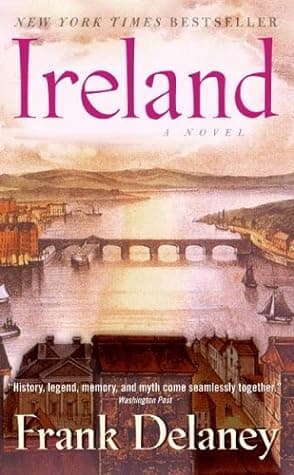
'Ireland' by Frank Delaney follows young Ronan O'Mara's lifelong quest to find the elusive Seanchai, a traditional Irish storyteller who captivated him as a child. After the Seanchai's brief, transformative visit to his home in 1951, Ronan dedicates his life to understanding and preserving the rich, complex history of Ireland through the stories passed down by the last practitioner of this ancient art.
Why should I read 'Ireland'?
You should read 'Ireland' for its immersive journey into Irish history, culture, and folklore, all woven through the captivating narrative of a boy's search for a storyteller. It offers a unique blend of historical fiction and coming-of-age, providing both an education on Ireland's past and an exploration of the power of storytelling itself.
What is the background/setting of 'Ireland'?
The book begins in the Irish countryside in 1951, primarily following Ronan O'Mara's journey through various parts of Ireland over several decades. The setting evolves from post-war rural Ireland to urban centers, encompassing historical events and cultural shifts, always against the backdrop of the country's rich, often turbulent, heritage.
What are the most memorable quotes?
While the book is rich with evocative language, many memorable 'quotes' are actually the poignant, often humorous, short tales and observations shared by the Seanchai or Ronan himself. These often reflect on the resilience of the Irish spirit, the weight of history, and the simple beauty of everyday life, rather than standalone one-liners.
What writing style does the author use?
Frank Delaney employs a lyrical, evocative, and often conversational writing style, mirroring the oral tradition of storytelling central to the book. He seamlessly interweaves historical facts and mythological tales with Ronan's personal narrative, creating a rich tapestry that feels both deeply researched and intimately personal.
What minor details add significant meaning?
The specific tales told by the Seanchai, even those seemingly simple, often contain allegories or historical references that illuminate larger themes about Irish identity, resilience, or past conflicts. For example, a seemingly innocuous story about a foolish king might subtly comment on political leadership in Ireland's history.
What are some subtle foreshadowing moments?
The Seanchai's initial banishment from Ronan's home for 'blasphemy' subtly foreshadows the conflict between ancient traditions and modern religious or societal norms that Ronan will encounter throughout his life. It hints at the challenges and resistance he will face in his quest to preserve the Seanchai's stories.
What unexpected character connections exist?
As Ronan travels and delves deeper into the Seanchai's past and the stories he tells, he often discovers unexpected familial or historical connections between seemingly disparate individuals or events. These connections reinforce the interconnectedness of Irish history and the enduring legacy of the Seanchai's tales.
What are unspoken character motivations?
Ronan's unspoken motivation extends beyond merely finding the Seanchai; it's a deep-seated need to understand his own place in the vast narrative of Ireland. His quest is driven by a desire for identity and belonging, an attempt to anchor himself in the stories of his ancestors in a changing world.
What psychological complexities do characters exhibit?
Ronan exhibits a complex blend of youthful idealism and adult determination, grappling with loneliness and obsession in his pursuit. The Seanchai, though elusive, embodies the psychological weight of being the last of an ancient tradition, carrying the burden of memory and the fear of irrelevance.
What are the major emotional turning points?
The initial encounter with the Seanchai is Ronan's first major emotional turning point, igniting his lifelong quest. Later, moments of near-discovery or profound understanding of a particular story's deeper meaning serve as significant emotional shifts, reinforcing his commitment despite setbacks.
How do relationship dynamics evolve?
The primary relationship dynamic is between Ronan and the absent Seanchai, evolving from a child's awe to an adult's dedicated, almost spiritual, pursuit. Ronan's relationships with others he meets along his journey are often fleeting but instrumental, shaping his understanding of the Seanchai's legacy and the stories he seeks.
Which parts remain ambiguous or open-ended?
The ultimate fate or true identity of the Seanchai often remains ambiguous, blurring the line between historical figure and mythical embodiment of Irish storytelling. The book leaves some questions about whether Ronan ever fully 'catches' the Seanchai in a traditional sense, emphasizing the journey over the destination.
What are controversial scenes or decisions?
The initial banishment of the Seanchai from Ronan's home for 'blasphemy' can be seen as a controversial decision, highlighting the tension between traditional Irish folklore and the strict religious sensibilities of the time. This act sets the entire quest in motion, driven by a perceived injustice.
Ireland ending explained: how it ends & what it means
The ending of 'Ireland' doesn't necessarily provide a definitive, face-to-face reunion with the Seanchai. Instead, Ronan's quest culminates in his deep understanding and embodiment of the Seanchai's role as a keeper of stories. It means that while the individual may disappear, the tradition and the stories themselves endure through those dedicated to preserving them, with Ronan becoming the spiritual successor.
About the author

Frank Delaney was an Irish author known for his fiction, particularly his novel "Ireland," which explores the country's history and culture through a rich narrative. His works often reflect his deep connection to storytelling and the oral tradition, drawing on his background as a broadcaster and writer. Delaney's writing is characterized by its lyrical prose and vivid imagery.
Similar books
- The Mists of Avalon
Marion Zimmer Bradley
4.1 (192k) average on GoodreadsFantasyWeaves myth and history into a rich cultural narrative, focusing on ancient traditions and their clash with new eras.
- Circle of Friends
Maeve Binchy
4.0 (59k) average on GoodreadsHistorical Fiction"Ireland" differs from Binchy's Circle of Friends by focusing on broad historical and mythological narratives rather than intimate, character-driven social realism. While Binchy explores individual lives and relationships within a specific Irish community, Delaney delves into the collective memory and folklore that define the nation.
- Paddy Clarke Ha Ha Ha
Roddy Doyle
3.8 (25k) average on GoodreadsFictionWhile both books utilize a child's perspective, Doyle's Paddy Clarke Ha Ha Ha offers a grittier, more socio-economic and internal look at working-class Irish life. Delaney's "Ireland," in contrast, is more romanticized, mystical, and expansive in its exploration of historical and mythological elements, focusing on the broader cultural identity rather than specific societal realities.
- Eat, Pray, Love
Elizabeth Gilbert
3.6 (1.5M) average on GoodreadsLifestyleA heartbroken writer leaves her conventional life for a year-long global search for pleasure in Italy, spiritual devotion in India, and unexpected love and balance in Bali.
- Wild: From Lost to Found on the Pacific Crest Trail
Cheryl Strayed
4.0 (615k) average on GoodreadsLifestyleAfter losing her mother and her marriage, a young woman impulsively hikes over a thousand miles of the Pacific Crest Trail alone, finding strength and healing in the unforgiving wilderness.
- Into Thin Air: A Personal Account of the Mount Everest Disaster
Jon Krakauer
4.2 (395k) average on GoodreadsLifestyleOn May 10, 1996, ambition and a sudden, violent storm turned Mount Everest into a deadly trap, leaving Jon Krakauer to tell the harrowing story of a disaster that took lives and shattered climbers' dreams.





Enjoyed the summary?
A summary gives you the shape of the book. The book itself has the detail, the examples and the voice.
Find Ireland on AmazonAs an Amazon Associate, BookBrief earns from qualifying purchases. How we're funded