
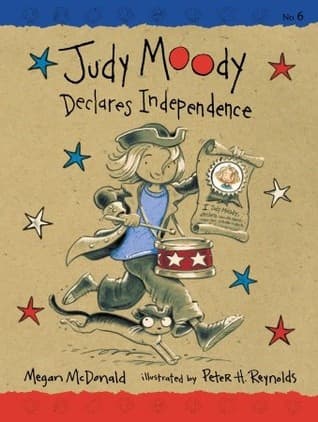
Synopsis
Covers the whole plot, including the ending.
- Difficulty
- Easy
- Pacing
- Fast
- Mood
- Humorous, Lighthearted, Whimsical, Educational
- Read it if
- You enjoy humorous, lighthearted stories about a feisty third-grader navigating family dynamics and personal growth, with a touch of historical inspiration.
- Skip it if
- You prefer complex plots, deep character introspection, or mature themes. This is a children's book through and through.
Judy Moody Declares Independence Plot Summary
Covers the whole plot, including the ending.
A Revolutionary Trip to Boston
Judy Moody and her family, including her parents and younger brother Stink, travel to Boston. Their dad attends a medical conference, but Judy cares more about the historical sights. They visit landmarks like the Old North Church, Faneuil Hall, and the Boston Massacre site. Judy is particularly interested in stories of the American Revolution and the fight for independence. She starts to connect these historical struggles with her own desire for more freedom and fewer rules at home, setting up her 'declaration of independence' when they return.
Meeting Tori and the British Perspective
While visiting the Boston Tea Party ship, Judy Moody meets Tori, a girl from England. They talk, and Judy is surprised by the freedoms Tori has, like her own cell phone, a private bathroom, and a good allowance in pounds. This meeting greatly affects Judy, making her feel that she, as an American, should have even more liberties than a British girl. Tori's perceived independence makes Judy more convinced that she needs to declare her own independence from her parents' rules, like the historical events she is learning about.
The First Draft of Independence
Back home after the Boston trip, Judy Moody is focused on her new understanding of independence. She decides to write her own 'Judy Moody Declaration of Independence.' She lists all her complaints against her parents' rules, such as eating vegetables, sharing a bathroom with Stink, and not having enough allowance. She also includes her demands for more rights and freedoms, like owning a cell phone and having a 'Purse of Happiness.' Her first attempts to gain more independence, such as doing chores, do not quickly get her desired liberties, which frustrates her.
The Boston Tub Party
Feeling that her polite requests for more independence are ignored, Judy Moody decides to increase her protest. Inspired by the Boston Tea Party, she stages her own 'Boston Tub Party' in the bathroom. She gathers all the tea bags she can find and throws them into the bathtub, creating a messy, tea-stained rebellion. This act of defiance does not please her parents. Her dad, especially, is upset by the mess and disrespect, which leads to a stern lecture and Judy being grounded, or having her 'rights' further limited, instead of expanded.
Stink's Alien Discovery
During Judy's independence struggles, her brother Stink becomes sure he found an alien. He finds a strange, squishy, purple blob in the backyard and immediately thinks it is an extraterrestrial. Stink spends his time watching and writing about the 'alien,' even trying to talk to it. This new obsession of Stink's provides a funny side story and temporarily pulls some family attention away from Judy's revolutionary actions, though Judy first dismisses Stink's claims as just a childish fantasy.
The Alien's Escape and Stink's Distress
Stink's 'alien,' which he has been keeping in a container and studying, suddenly disappears. Stink is heartbroken and very upset by the loss of his supposed extraterrestrial friend. He is inconsolable, sure that his alien has either escaped or been taken. This event presents a new challenge for Judy. Despite her first doubts about Stink's alien, she feels sympathy for her brother's real sadness and realizes she needs to help him, momentarily putting her own quest for independence aside to support him.
Judy's Independent Action
Using her revolutionary spirit for a practical purpose, Judy Moody decides to investigate the disappearance of Stink's 'alien.' Instead of protesting, she uses problem-solving skills and independent thinking. She carefully checks the area where Stink kept the creature, looking for clues. She uses her observation skills, like a detective, to figure out what might have happened. This change from rebellious acts to responsible investigation marks a shift in Judy's understanding of what real independence involves.
The Truth Revealed: A Slime Mold
Through her careful investigation, Judy Moody finds that Stink's 'alien' is not an extraterrestrial at all, but a common slime mold. She learns about its features and how it moves, explaining its 'disappearance' and reappearance in different places. She tells Stink what she found, helping him understand that while it wasn't an alien, it was still an interesting natural thing. This resolution not only comforts Stink but also teaches Judy about the value of scientific inquiry and critical thinking, showing her a different kind of independence — intellectual independence.
A New Understanding of Independence
After solving the slime mold mystery and comforting Stink, Judy Moody has an important realization. She understands that real independence is not just about breaking rules or demanding rights; it is about taking responsibility, using her intelligence, and solving problems on her own. Her parents notice her cleverness and resourcefulness in handling Stink's distress, showing her new respect. This experience quietly changes her view, moving her away from purely rebellious acts toward a more mature understanding of what it means to be independent and capable.
Earning Privileges
By showing her ability to think independently and act responsibly in the case of Stink's 'alien,' Judy starts to earn new privileges from her parents. While she doesn't immediately get everything on her original Declaration of Independence, like a cell phone, her parents see her growth and maturity. This means her actions have been more effective than her protests. She learns that independence is a process earned through responsible behavior and proving one's ability, rather than simply being declared. She gains a more balanced understanding of freedom within the family.
Judy Moody Declares Independence Characters
Judy Moody
Protagonist
A third-grader with a strong personality, always in a 'mood,' who seeks more independence.
Judy Moody is a spirited and imaginative third-grader who often expresses herself through her various 'moods.' She is highly observant and easily inspired, as seen by her immediate immersion in Revolutionary War history during her Boston trip. Judy is determined and persistent, qualities that drive her quest for independence at home. While initially prone to dramatic and rebellious acts like the 'Boston Tub Party,' she is also intelligent and capable of critical thinking, which she demonstrates when solving the mystery of Stink's 'alien.' Her journey in this book is about maturing her understanding of what true independence entails.
Relationships: Stink Moody (Younger brother, often annoyed by but ultimately cares for); Mr. Moody (Dad) (Father, often the target of her protests, but also her guide); Mrs. Moody (Mom) (Mother, supportive but firm); Tori (English girl met in Boston, her perceived freedoms inspire Judy)
Stink Moody
Supporting
Judy's younger brother, prone to unusual interests and discoveries.
Stink Moody is Judy's younger brother, known for his unique interests and often being the unwitting catalyst for some of Judy's adventures. In this book, his discovery of what he believes to be an alien becomes a central plot point, diverting Judy's focus and ultimately providing her with an opportunity to demonstrate her own independence through responsibility. Stink is imaginative and sensitive, deeply attached to his 'alien,' which highlights his innocent and curious nature. His distress over its disappearance brings out Judy's more empathetic and problem-solving side.
Relationships: Judy Moody (Older sister, often teases but ultimately supports him); Mr. Moody (Dad) (Father); Mrs. Moody (Mom) (Mother)
Mr. Moody (Dad)
Supporting
Judy and Stink's father, often the voice of authority and reason.
Mr. Moody is the father of Judy and Stink. He is portrayed as a loving but firm parent who sets rules and expects responsibility from his children. He is the one who reads Judy the 'riot act' after her Boston Tub Party, representing the parental authority Judy is rebelling against. However, he is also fair and recognizes Judy's growth when she demonstrates maturity and problem-solving skills in helping Stink. His character provides the necessary opposition for Judy's quest for independence, allowing her to learn the true meaning of freedom within boundaries.
Relationships: Judy Moody (Daughter, often in conflict with her rules); Stink Moody (Son); Mrs. Moody (Mom) (Wife)
Mrs. Moody (Mom)
Supporting
Judy and Stink's mother, supportive and understanding.
Mrs. Moody is the mother of Judy and Stink. She is generally more understanding and patient than Mr. Moody, though still supportive of family rules. She participates in the Boston trip and observes Judy's growing fascination with independence. While she doesn't always condone Judy's rebellious methods, she appreciates Judy's efforts and growth. She often acts as a balance to Mr. Moody's stricter stance, providing a nurturing presence in the family dynamic. She is ultimately proud of Judy's responsible actions regarding Stink's 'alien'.
Relationships: Judy Moody (Daughter); Stink Moody (Son); Mr. Moody (Dad) (Husband)
Tori
Mentioned
An English girl Judy meets in Boston, whose perceived freedoms inspire Judy's quest.
Tori is an English girl whom Judy Moody meets during her family's trip to Boston, specifically on the Boston Tea Party ship. Tori's brief appearance is significant because her casual mentions of having her own cell phone, a private bathroom, and a generous allowance immediately spark Judy's envy and fuel her desire for more personal freedoms. Tori serves as a comparative figure, inadvertently highlighting for Judy the 'liberties' she feels she is missing out on, thus acting as a direct catalyst for Judy's 'Declaration of Independence' at home.
Relationships: Judy Moody (Brief acquaintance, inspires Judy's aspirations for independence)
Toad
Supporting
Judy's pet toad, a silent companion.
Toad is Judy Moody's pet toad. While not a speaking character, Toad is a consistent presence in Judy's life and sometimes serves as an audience for her thoughts and declarations. He represents a small piece of nature and responsibility that Judy already possesses, subtly contrasting with her demands for greater freedoms. Toad's presence adds to the whimsical and childlike atmosphere of the book, and he is a comforting, if inanimate, companion for Judy through her various moods.
Relationships: Judy Moody (Pet owner and companion)
Judy Moody Declares Independence Themes
Independence and Freedom
The main theme is Judy's search for personal independence, like the historical fight for American independence. At first, Judy thinks independence means freedom from rules and getting privileges like a cell phone. Her 'Declaration of Independence' and 'Boston Tub Party' are childish ways she shows this desire. However, the book eventually redefines independence for Judy, showing her that real freedom comes not from rebelling against authority, but from responsibility, self-reliance, and critical thinking, as seen when she solves the mystery of Stink's 'alien.'
“She, Judy Moody, would hereby, this day, make the Judy Moody Declaration of Independence. With alien rights and her own Purse of Happiness and everything.”
Responsibility and Maturity
This theme explores how responsibility is tied to real independence. Judy first seeks independence without accepting the duties that come with it, which leads to frustration. Her attempts to gain freedom through protest and rule-breaking have consequences. Only when she takes responsibility for helping Stink and uses her intelligence to solve a problem does she truly show maturity. This shift earns her respect and, later, more privileges, showing that maturity is needed for earned independence, not just declared freedom.
“Who would guess that a real-life crisis involving her brother, Stink, would finally give Judy a chance to show her courageous quick thinking - -and prove her independence, once and for all?”
Historical Learning and Application
The book blends historical learning into the story. Judy's family trip to Boston and her exposure to the American Revolution directly inspire her personal quest for independence. She compares the colonists' complaints to her own and bases her protests, like the 'Boston Tub Party,' on historical events. This theme shows how historical events, even simplified, can connect with children and provide a way to understand personal struggles and the idea of rights and freedoms in their own lives.
“When Judy meets an English girl named Tori at the Tea Party ship, she is gobsmacked to learn how many liberties her British friend enjoys...”
Sibling Relationships
The relationship between Judy and Stink is an important theme. While they often argue and bother each other, there is an underlying sense of sibling love and loyalty. Judy's initial dismissal of Stink's 'alien' changes to real concern and a wish to help him when he is upset. Her independent problem-solving skills are ultimately used for her brother's benefit, making their bond stronger and showing that even in her search for self-rule, family connections are important. This relationship shows growth in empathy and responsibility.
“Who would guess that a real-life crisis involving her brother, Stink, would finally give Judy a chance to show her courageous quick thinking...”
Plot Devices & Literary Techniques
Historical Allusion/Parallel
Using the American Revolution as a framework for Judy's personal quest.
The entire narrative is framed by Judy's exposure to the American Revolution. Events like the Boston Tea Party and the Declaration of Independence are directly referenced and recreated in Judy's home life (e.g., the 'Boston Tub Party' and her own 'Declaration of Independence'). This device allows young readers to understand complex historical concepts through a relatable, personal lens, and it also provides a humorous contrast between the grand scale of historical events and Judy's childish grievances.
Symbolism of the 'Alien' (Slime Mold)
Represents the mysteries of the unknown and the power of scientific inquiry.
Stink's 'alien,' which is later revealed to be a slime mold, symbolizes several things. Initially, it represents the unknown and the power of imagination (for Stink). For Judy, it becomes an opportunity to apply logical, independent thinking, contrasting with her earlier emotional protests. Its true nature as a slime mold symbolizes the wonders of the natural world and the value of scientific investigation over fantastical assumptions. It's a concrete problem that Judy can solve, demonstrating her growth.
The 'Judy Moody Declaration of Independence'
A literal document outlining Judy's grievances and demands.
This is a key plot device that physically manifests Judy's desires for freedom. It lists her specific 'grievances' against her parents and her demands for new 'rights.' It serves as a humorous and direct articulation of her frustration and aspirations. As the story progresses, the items on her declaration (like a cell phone or a private bathroom) become benchmarks against which her earned privileges are measured, showing her progress from demanding rights to earning them through responsible action.
Character Foil (Tori)
Tori highlights Judy's perceived lack of freedoms, fueling her quest.
Tori, the English girl Judy meets, serves as a character foil. Her casual description of her freedoms (cell phone, private bathroom, allowance) immediately makes Judy feel deprived and ignites her revolutionary spirit. Tori's role isn't to be a developed character but to provide a clear contrast that underscores Judy's initial understanding of independence as the acquisition of privileges. This contrast directly motivates Judy's subsequent actions and her 'Declaration of Independence.'
Judy Moody Declares Independence Quotes
“Judy Moody, super-duper historian, was going to make history come alive!”
“Judy Moody was having a rotten, no-good, very bad, super-boring summer.”
“This was going to be the best Independence Day ever!”
“Judy Moody declared independence from boring.”
“A Declaration of Independence was a very important paper.”
“Freedom was not just for grown-ups.”
“Stink was a walking, talking history book.”
“You can't just declare independence from chores!”
“History was not just about dead people and old papers.”
“This was way better than watching paint dry.”
“Judy Moody was a girl with a plan.”
“Sometimes you just had to make your own fun.”
“The past was full of surprises.”
“Being independent meant making your own choices.”
“It was a summer of declarations.”
Quiz
10 questions on the plot and the characters. Each answer comes with a short explanation.
Question 1
What city does Judy visit that sparks her interest in Revolutionary heroes and independence?
- Philadelphia
- New York City
- Boston
- Washington D.C.
Show answer
C. Boston The book description explicitly states that Judy's visit to Boston is what spurs her interest in Revolutionary heroes and heroines.
Question 2
What is the name of the English girl Judy meets at the Tea Party ship?
- Lucy
- Tori
- Emily
- Sarah
Show answer
B. Tori Judy meets an English girl named Tori at the Tea Party ship, who tells her about the liberties she enjoys.
Question 3
Which of these 'liberties' does Judy learn her English friend enjoys that she does not?
- Her own pet dog
- A private loo
- Unlimited screen time
- Her own car
Show answer
B. A private loo Judy learns that her English friend Tori has a private loo, her own phone, and pounds of allowance, which makes Judy feel she lacks independence.
Question 4
What is the title of the document Judy creates to declare her own independence?
- The Judy Moody Bill of Rights
- The Judy Moody Articles of Confederation
- The Judy Moody Declaration of Independence
- The Judy Moody Constitution
Show answer
C. The Judy Moody Declaration of Independence Inspired by her trip, Judy creates her own 'Judy Moody Declaration of Independence' to outline her desired freedoms.
Question 5
How does Judy initially try to earn more rights after learning about Tori's liberties?
- By staging a protest in her backyard
- By cheerfully doing her chores
- By writing a letter to her parents
- By refusing to eat dinner
Show answer
B. By cheerfully doing her chores After meeting Tori, Judy first attempts to earn more independence by cheerfully doing her chores, but this doesn't yield the results she expects.
Question 6
What event does Judy stage at home that results in her dad 'reading the riot act'?
- A Boston Tub Party
- A kitchen table sit-in
- A silent protest at the dinner table
- A 'no chores' strike
Show answer
A. A Boston Tub Party Judy stages a 'Boston Tub Party' by throwing tea into the bathtub, mimicking the Boston Tea Party, which leads to her dad's stern reaction.
Question 7
What specific item does Judy declare as her 'Purse of Happiness' in her declaration?
- Her backpack
- Her piggy bank
- Her own purse
- Her toy chest
Show answer
C. Her own purse The book description mentions Judy's declaration includes 'her own Purse of Happiness', a direct reference to her personal belongings and desires.
Question 8
The main theme of the book revolves around Judy's quest for what?
- More friends
- Academic success
- Independence
- A new pet
Show answer
C. Independence The book's title and description clearly state Judy's central quest is for 'more independence', inspired by historical events.
Question 9
What ultimately provides Judy with a chance to prove her independence and quick thinking?
- Winning a school competition
- Helping her parents with a difficult task
- A real-life crisis involving her brother, Stink
- Successfully running away from home for a day
Show answer
C. A real-life crisis involving her brother, Stink The description reveals that 'a real-life crisis involving her brother, Stink' gives Judy the opportunity to demonstrate her courage and independence.
Question 10
What kind of 'rights' does Judy include in her declaration, beyond typical human rights?
- Animal rights
- Alien rights
- Robot rights
- Plant rights
Show answer
B. Alien rights Judy's unique declaration includes 'alien rights,' showcasing her imaginative and broad interpretation of independence.
Judy Moody Declares Independence FAQ
What is "Judy Moody Declares Independence" about?
This book follows Judy Moody, a third grader who becomes inspired by the American Revolution after a family trip to Boston. She decides to declare her own independence from her parents, seeking more liberties and privileges like her new British friend, Tori, and stages various 'revolts' to achieve her goals.
Why should I read "Judy Moody Declares Independence"?
You should read this book for its humorous take on a child's desire for independence and its clever integration of historical themes. It's a fun, relatable story for young readers that subtly teaches about the American Revolution while delivering laughs through Judy's antics and her unique perspective.
What is the background/setting of "Judy Moody Declares Independence"?
The story begins with Judy's family visiting historical sites in Boston, including the Boston Tea Party ship and Paul Revere's house, which sparks her interest in the American Revolution. The primary setting then shifts back to her home, where she attempts to apply revolutionary principles to her own life and family dynamics.
What are the most memorable quotes?
While the book is more about narrative and humor than profound quotes, Judy's declaration, 'I, Judy Moody, would hereby, this day, make the Judy Moody Declaration of Independence,' is a central and memorable line. Also, her father's 'reading the riot act' after the Boston Tub Party is a memorable phrase that highlights the clash between Judy's desires and parental authority.
What writing style does the author use?
Megan McDonald employs a lively, engaging, and often humorous writing style, perfect for young readers. She uses simple, direct language interspersed with Judy's distinctive internal monologue and playful exaggerations, making the narrative accessible and entertaining.
What minor details add significant meaning?
The detail of Judy creating her own 'Purse of Happiness' highlights her childlike interpretation of the Declaration of Independence's 'pursuit of happiness.' This small detail beautifully encapsulates her personal, tangible goals for independence, like more allowance or her own private bathroom.
What are some subtle foreshadowing moments?
Early mentions of Stink's clumsiness or his fascination with certain objects, though seemingly minor, subtly foreshadow the eventual crisis involving him. These small character traits are established before they become crucial to the plot's resolution.
What unexpected character connections exist?
The unexpected connection is between Judy and Tori, the English girl she meets. Despite their historical ancestors being on opposing sides of the Revolution, their friendship highlights how individual relationships can transcend historical conflicts, even as Judy uses Tori's 'liberties' as a benchmark for her own independence.
What are unspoken character motivations?
Judy's unspoken motivation is not just about gaining privileges, but also about feeling grown-up and recognized. Her desire for 'independence' stems from a deeper need for autonomy and respect, which she believes comes with more freedom, similar to what she perceives adults and even her British friend enjoy.
What psychological complexities do characters exhibit?
Judy exhibits the psychological complexity of a child grappling with the desire for control versus the reality of parental rules. She struggles with understanding that true independence comes with responsibility, not just rights, and her 'revolts' are a manifestation of this internal conflict.
What are the major emotional turning points?
A major emotional turning point occurs when Judy's 'Boston Tub Party' revolt backfires, leading to her father 'reading the riot act' and her feeling defeated. Another significant turning point is the real-life crisis involving Stink, which shifts Judy's focus from her own desires to helping her brother, demonstrating genuine courage and responsibility.
How do relationship dynamics evolve?
Initially, Judy's relationship with her parents is characterized by a power struggle over rules and privileges. By the end, particularly after the crisis with Stink, the dynamic evolves to one of mutual respect, where Judy earns a degree of independence through responsible action, rather than demanding it through rebellion.
Which parts remain ambiguous or open-ended?
The exact long-term 'independence' Judy gains is left somewhat open-ended. While she proves her quick thinking and responsibility, the narrative doesn't explicitly detail every new privilege she receives, implying that her journey towards full independence is an ongoing process rather than a final destination.
What are controversial scenes or decisions?
Judy's 'Boston Tub Party,' where she throws tea (or rather, bath toys and water) into the bathtub in protest, could be seen as a controversial decision from a parental perspective. It's a defiant act that pushes boundaries, leading to a strong reaction from her father, highlighting the conflict between child rebellion and parental authority.
"Judy Moody Declares Independence" ending explained: how it ends & what it means
The book ends with Judy demonstrating true quick thinking and courage during a real-life emergency involving her brother, Stink. This act of responsibility, rather than her earlier 'revolts,' finally earns her parents' recognition and a degree of the independence she sought. It means that genuine independence is achieved through demonstrating maturity and responsibility, not just demanding rights.
About the author

Megan McDonald is an author known for her children's fiction, particularly the popular Judy Moody series, which includes titles like "Judy Moody Predicts the Future" and "Judy Moody Declares Independence." She also wrote "The Sisters Club" and "Rule of Three," showcasing her ability to engage young readers with relatable characters and humorous storytelling.
Similar books
- Amber Brown Is Not a Crayon
Paula Danziger
3.8 (5k) average on GoodreadsChildren'sExplores the everyday life and feelings of a third-grade girl with humor and authenticity.
- Harry Potter and the Sorcerer's Stone
J.K. Rowling
4.5 (7M) average on GoodreadsFantasyRescued from a miserable life under the stairs, an orphaned boy discovers he's a wizard destined for a magical school, where he uncovers a dangerous secret tied to the dark wizard who murdered his parents.
- The Hobbit, or There and Back Again
J.R.R. Tolkien
4.3 (2.9M) average on GoodreadsFantasyA comfort-loving hobbit named Bilbo Baggins is whisked away by a mischievous wizard and a band of dwarves on an unexpected journey to reclaim stolen treasure from a fearsome dragon, discovering courage and a magical ring along the way.
- Harry Potter and the Goblet of Fire
J.K. Rowling
4.6 (2.6M) average on GoodreadsFantasyA bewildered Harry Potter, underage and thrust into a deadly Triwizard Tournament, must brave dragons, mermaids, and a resurgent dark magic to survive a year that will forever alter the wizarding world.
- Harry Potter and the Order of the Phoenix
J.K. Rowling
4.5 (2.5M) average on GoodreadsFantasyIn a year of oppressive secrets and the threat of Voldemort, Harry Potter and Dumbledore's Army secretly train for war, shown through Jim Kay and Neil Packer's dark illustrations.
- The Lightning Thief
Rick Riordan
4.3 (2M) average on GoodreadsFantasyThrust into a world of mythological monsters and divine treachery, an ordinary boy discovers he's the son of Poseidon and must embark on a perilous quest across modern America to prevent an Olympian war.





Enjoyed the summary?
A summary gives you the shape of the book. The book itself has the detail, the examples and the voice.
Find Judy Moody Declares Independence on AmazonAs an Amazon Associate, BookBrief earns from qualifying purchases. How we're funded