
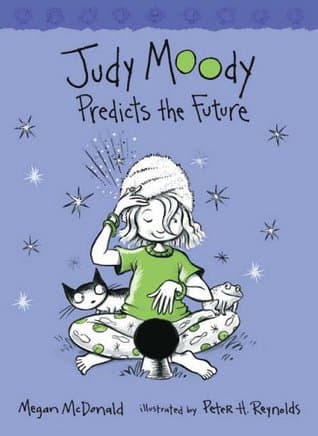
Synopsis
Covers the whole plot, including the ending.
- Difficulty
- Easy
- Pacing
- Fast
- Mood
- Whimsical, Humorous, Lighthearted, Energetic
- Read it if
- You enjoy humorous, relatable stories about a quirky third-grader navigating everyday life with a vivid imagination.
- Skip it if
- You prefer complex plots or stories without a strong focus on a child's internal world.
Judy Moody Predicts the Future Plot Summary
Covers the whole plot, including the ending.
A Mood Ring and a New Hobby
Judy Moody is in a bad mood, specifically a 'stink' mood, when her friend Rocky buys a mood ring from the novelty shop. Judy is curious and buys one too, hoping it will help her understand her changing moods. The ring changes colors, supposedly showing her feelings (blue for calm, black for angry, etc.). Later, at home, Judy is trying to decide what to wear for 'Wacky Wednesday' at school. She puts on her mood ring, and it turns green. Suddenly, she predicts that her brother, Stink, will spill his milk, which he promptly does. This unexpected event makes Judy think: maybe her mood ring isn't just about moods, but about predicting the future. She decides to test this new 'psychic' ability.
Testing Her Powers at School
Judy arrives at school for 'Wacky Wednesday' in mismatched clothes, ready to try her predictive powers. During morning announcements, her mood ring turns green, and she predicts that Ms. Pinky, the principal, will announce a test. To everyone's surprise, Ms. Pinky announces a pop quiz in math. Later, in class, Judy's ring turns yellow, and she predicts that her teacher, Mr. Todd, will show a movie. Again, Mr. Todd announces they will watch a film about the Amazon rainforest. These accurate predictions start to convince her classmates, Rocky and Frank Pearl, that Judy might be psychic. Judy herself starts to believe it too, enjoying the attention and the excitement of her supposed ability.
The Big Test: Predicting the Spelling Bee
The third-grade class is getting ready for a spelling bee. Judy's mood ring turns yellow, and she predicts that Frank Pearl will win. This prediction causes a stir among her classmates, especially Frank, who becomes nervous, and Jessica Finch, who is a strong speller and now feels extra pressure to prove Judy wrong. During the spelling bee, Judy watches Frank closely, trying to make her prediction come true. As the competition goes on, Frank struggles with his words, making it seem unlikely that Judy's prediction will happen. Jessica Finch, as expected, performs well, adding to the tension in the classroom.
Frank's Fumble and Judy's Disappointment
During the spelling bee, Frank Pearl, despite Judy's earlier prediction, mispronounces 'hippopotamus' and is out. Jessica Finch correctly spells 'chimpanzee' and wins the spelling bee, to the class's applause and Judy's disappointment. Her mood ring, which she had been relying on, turns black, showing her anger and frustration. Judy feels like a fraud and is embarrassed that her prediction for Frank did not come true. Her classmates, who had been impressed by her earlier predictions, now look at her with doubt. Judy realizes that her 'psychic' abilities might not be as real as she thought, leading her to question the true power of her mood ring and her own intuition.
A Visit to the Psychic
Feeling bad about her failed spelling bee prediction, Judy decides she needs professional help to understand her powers. With her brother Stink, she visits Madame LaZoom, a local psychic. Madame LaZoom lives in a house filled with crystals, candles, and a crystal ball. Judy asks Madame LaZoom to predict her future, specifically whether she will ever win a spelling bee. Madame LaZoom, however, offers only vague predictions, such as Judy being 'surrounded by friends' and 'finding something lost.' Judy and Stink are not impressed by the experience, as Madame LaZoom's predictions lack the specific, immediate nature of Judy's earlier 'hits.'
The Disappearing Homework
After visiting Madame LaZoom, Judy returns home, still thinking about predictions. She finds that her homework, a drawing of a 'super-duper secret animal,' is missing. Frantically, she searches her room, convinced it's lost forever. Her mood ring turns a frantic red. Suddenly, she has an idea, a strong feeling that her homework is 'under the bed.' She confidently tells Stink her prediction, who is skeptical. They both look under her bed, and to Judy's surprise and relief, her drawing is there, crumpled but found. This unexpected success makes Judy believe again, not necessarily in her mood ring, but in her own inner 'sixth sense.'
The Pet Show Prediction
The local pet show is coming up, and Stink plans to enter his pet, a three-toed sloth named Toady. Judy, feeling her predictive abilities are back after finding her homework, has a strong feeling that Stink and Toady will win the 'Most Unusual Pet' award. She confidently tells Stink her prediction, making him excited and nervous. Jessica Finch is entering her cat, Sir Reginald, and Rocky is entering his dog, Dogzilla. The competition is tough, and Judy watches closely, hoping her prediction will come true. She still wears her mood ring, but her focus has shifted from the ring's colors to her own internal feelings and intuition.
Stink's Victory and Judy's Realization
At the pet show, the judges like Toady the sloth's uniqueness. To Judy's delight and Stink's excitement, Toady wins the 'Most Unusual Pet' award. Judy's prediction has come true! This success, combined with the earlier homework incident, helps Judy understand something important. She realizes that her predictions weren't always tied to her mood ring's colors, but often came from a strong gut feeling or observation. She concludes that her 'psychic' ability is not about the ring itself, but about paying attention, making educated guesses, and sometimes, just having a lucky feeling. She still enjoys her mood ring but no longer relies on it as a magical predictor of the future, instead valuing her own intuition.
Judy Moody Predicts the Future Characters
Judy Moody
Protagonist
A third-grader with a wide range of moods, who believes she gains psychic powers from a mood ring.
Judy Moody is a spirited and imaginative third-grader known for her ever-changing moods. She is curious, a bit dramatic, and often impulsive. When she acquires a mood ring, she becomes convinced she can predict the future, which leads to her making various predictions at school and home. She enjoys being the center of attention and takes her 'psychic' role very seriously, even visiting a real psychic. While initially reliant on the mood ring, she ultimately learns to trust her own intuition and observation skills.
Relationships: Stink Moody (Younger brother, often the subject or witness to her predictions); Rocky (Close friend and classmate); Frank Pearl (Classmate and friend, often subject to Judy's predictions); Jessica Finch (Classmate and academic rival/foil)
Stink Moody
Supporting
Judy's younger brother, who is often the unwitting subject or witness to her 'predictions.'
Stink is Judy's younger brother and a frequent companion in her adventures. He is generally patient with Judy's eccentricities but can also be skeptical and prone to minor accidents, like spilling milk. He is proud of his pet sloth, Toady, and is excited by the prospect of winning the 'Most Unusual Pet' award. Stink often serves as a sounding board for Judy's ideas and is directly impacted by her predictions, whether it's spilling milk or winning a prize.
Relationships: Judy Moody (Older sister, often bossy but caring); Toady (His pet three-toed sloth)
Rocky
Supporting
Judy's best friend and classmate, who is initially impressed by her predictions.
Rocky is one of Judy's closest friends and classmates. He is generally supportive and goes along with Judy's schemes, initially believing in her psychic abilities when her predictions seem to come true. He participates in class activities like 'Wacky Wednesday' and the pet show, where he enters his dog, Dogzilla. Rocky's reactions often mirror the general sentiment of the class, showing excitement or skepticism depending on Judy's success.
Relationships: Judy Moody (Close friend and classmate); Frank Pearl (Classmate)
Frank Pearl
Supporting
Judy's classmate, who becomes nervous after Judy predicts he will win the spelling bee.
Frank Pearl is a classmate and friend of Judy. He is generally quiet and a bit shy. He becomes the focus of one of Judy's most significant predictions when she declares he will win the class spelling bee. This prediction causes him considerable anxiety and pressure, affecting his performance. His failure to win the spelling bee is a pivotal moment in Judy's understanding of her own abilities, highlighting the impact of her predictions on others.
Relationships: Judy Moody (Classmate and friend); Rocky (Classmate)
Jessica Finch
Supporting
A smart and competitive classmate, often a foil to Judy.
Jessica Finch is a diligent and intelligent classmate of Judy. She is a strong speller and a top student, often serving as a friendly rival or foil to Judy. When Judy predicts Frank Pearl will win the spelling bee, Jessica feels extra pressure to prove her own abilities. She ultimately wins the spelling bee, demonstrating her academic prowess and showing Judy that not all predictions come true, especially when based on a whim.
Relationships: Judy Moody (Classmate, friendly rival)
Mr. Todd
Supporting
Judy's third-grade teacher.
Mr. Todd is Judy's third-grade teacher. He is a patient and observant educator who manages his classroom with a calm demeanor. He is unknowingly involved in Judy's predictions when he announces a math quiz and shows a movie, seemingly fulfilling her 'psychic' insights. He facilitates the class spelling bee and the 'Wacky Wednesday' event, providing the structured environment in which Judy's predictions unfold.
Relationships: Judy Moody (Teacher of Judy and her classmates)
Madame LaZoom
Mentioned
A local psychic whom Judy and Stink visit.
Madame LaZoom is a professional psychic who runs a small parlor in town. She has a stereotypical psychic setup with a crystal ball, candles, and an air of mystery. Judy and Stink visit her hoping for specific predictions about their futures, but Madame LaZoom offers only vague and general statements. Her character serves to highlight the difference between genuine, specific predictions (as Judy believes she has) and the often ambiguous nature of professional fortune-telling, ultimately making Judy realize her own 'powers' are more interesting.
Toady
Supporting
Stink's pet three-toed sloth.
Toady is Stink's unique pet, a three-toed sloth. He is slow-moving and unusual, making him a perfect candidate for the 'Most Unusual Pet' award at the pet show. Toady's presence and eventual win at the pet show solidify Judy's final, accurate prediction, bringing the theme of intuition to a satisfying conclusion. Toady's distinctiveness is key to Stink's success and Judy's predictive triumph.
Relationships: Stink Moody (Pet of Stink)
Judy Moody Predicts the Future Themes
Intuition vs. Coincidence
The book explores the line between intuition and coincidence. Judy first thinks her successful predictions are from a magical mood ring, but as the story goes, she learns that some 'predictions' are just lucky guesses or paying attention to small details. Her failed spelling bee prediction for Frank Pearl shows the role of chance, while her successful prediction about her homework and Stink's pet show win show that sometimes, a strong gut feeling or an educated guess can feel like a prediction. Ultimately, Judy learns to trust her own inner sense rather than a magical object.
“It wasn't the ring. It was me!”
Self-Discovery and Belief
Judy's journey is one of self-discovery, as she deals with her belief in her own abilities. First, she believes the mood ring is the source of her 'powers.' However, through successes and failures, she gradually realizes that any 'psychic' ability she has comes from within herself — from her observations, her quick thinking, or her gut feelings. This theme shows the importance of trusting one's own judgment and recognizing one's strengths, rather than relying on external objects or superstitions.
“Maybe she really did have a sixth sense. A Judy sense.”
The Power of Suggestion
The book touches on how predictions and expectations can influence outcomes and perceptions. Judy's predictions, especially about the spelling bee, create pressure and nervousness for Frank Pearl. Her classmates are swayed by her first 'hits,' showing how easily people can be convinced by seemingly supernatural events. This theme shows how belief and suggestion can shape reality, even if the 'predictions' themselves are not truly psychic.
“Frank Pearl looked like he might throw up his lunch. Judy's prediction was making him nervous.”
Childhood Imagination and Play
The story celebrates a child's imagination. Judy's belief in her psychic powers, her dramatic reactions, and her creative problem-solving (like visiting a real psychic) are all typical of childhood play and fantasy. The book embraces the joy and seriousness with which children engage with imaginary scenarios, even as it gently guides Judy towards a more realistic understanding of the world. Her 'Wacky Wednesday' outfit and Stink's unique pet further show the fun and creativity in the children's world.
“A mood ring! It was just what she needed to keep track of her moods. All one hundred and one of them.”
Plot Devices & Literary Techniques
Mood Ring
A novelty item that acts as a catalyst for Judy's belief in her psychic powers.
The mood ring is the central plot device that kickstarts Judy's adventure. Initially, she uses it to track her moods, but after a few coincidental 'predictions,' she attributes psychic powers to it. The changing colors of the ring (green for predicting, black for angry, yellow for happy) become a visual representation of Judy's perceived abilities and her emotional state. The ring serves as a tangible symbol of her belief in magic, which she eventually outgrows as she learns to trust her own intuition.
The 'Prediction' Arc
A narrative structure where Judy makes a series of predictions with varying outcomes.
The story is structured around a series of predictions made by Judy, each with a different result. This arc allows the author to explore the themes of coincidence, intuition, and the power of suggestion. The initial successful predictions build suspense and convince characters (and the reader) of Judy's powers, while the failed spelling bee prediction creates a turning point. The arc culminates in a successful prediction based on intuition, providing a clear resolution to Judy's journey of understanding her 'abilities.'
Foil Characters
Characters who highlight aspects of Judy's personality or challenge her beliefs.
Characters like Jessica Finch and Madame LaZoom serve as foils to Judy. Jessica, with her academic prowess and logical approach, contrasts with Judy's more whimsical and superstitious nature, especially during the spelling bee. Madame LaZoom, a 'professional' psychic who offers vague predictions, highlights the specificity and personal connection Judy feels to her own 'predictions,' making Judy realize her intuition is more valuable than generic fortune-telling. These characters help Judy to better understand herself and the true nature of prediction.
Internal Monologue
Judy's inner thoughts and feelings, revealing her developing understanding.
A significant portion of the story is told through Judy's internal monologue, allowing readers direct access to her thoughts, moods, and evolving beliefs. This device is crucial for understanding her conviction in her psychic powers, her disappointment when predictions fail, and her eventual realization that her 'powers' stem from her own observation and intuition rather than a magical object. It provides insight into her childlike logic and emotional responses, making her journey of self-discovery more personal and relatable.
Judy Moody Predicts the Future Quotes
“I, Judy Moody, will predict the future. I will be a Moody psychic. I will be Judy the Great.”
“What if her fortune-telling abilities were gone? What if they had left her like a runaway dog?”
“Her crystal ball was a super-bouncy, grape-scented, glow-in-the-dark bouncy ball.”
“Stink was a pest, a bother, a little brother who sometimes smelled.”
“It was just a plain, ordinary, run-of-the-mill, nothing-special, boring, ho-hum, yawn-inducing, everyday kind of day.”
“She could see it! She could feel it! She could taste it! Judy Moody had a psychic premonition!”
“The future was not something you could just look up in a book. It was a mystery.”
“Maybe predicting the future was more fun than actually knowing it.”
“She tried to predict what she would have for lunch. She tried to predict what kind of socks she would wear.”
“It was a good thing she was Judy Moody, and not Judy Mopey.”
“Sometimes, even if you try your very hardest, things don't always go the way you predict.”
“She just had to pay attention. Really, really pay attention to everything.”
“Being a kid was hard work, especially when you were trying to predict the future.”
“It was like having a secret power, but without the cape and the flying.”
“Maybe the best predictions are the ones you make happen yourself.”
Quiz
10 questions on the plot and the characters. Each answer comes with a short explanation.
Question 1
What new item does Judy Moody acquire that she believes has special powers?
- A crystal ball
- A mood ring
- A magic eight ball
- A fortune-telling deck of cards
Show answer
B. A mood ring Judy Moody gets a mood ring, which she then believes helps her predict the future, sparking her psychic predictions.
Question 2
What is the primary reason Judy believes her mood ring has special powers?
- It glows in the dark.
- It changes color based on her emotions.
- It was given to her by a mysterious stranger.
- It makes a special sound when she wears it.
Show answer
B. It changes color based on her emotions. Mood rings are designed to change color based on body temperature, which Judy interprets as reflecting her moods and, consequently, her ability to predict events.
Question 3
Which character is often the recipient of Judy's initial predictions, often to their annoyance?
- Her teacher, Mr. Todd
- Her friend Rocky
- Her brother, Stink
- Her friend Frank Pearl
Show answer
C. Her brother, Stink Stink, Judy's younger brother, is frequently the target of her 'predictions' and often finds them bothersome or embarrassing.
Question 4
What kind of predictions does Judy start making after getting her mood ring?
- Predictions about global events and news headlines.
- Predictions about her friends' and family's daily lives and small future events.
- Predictions about which books will be popular at the library.
- Predictions about the weather for the next week.
Show answer
B. Predictions about her friends' and family's daily lives and small future events. Judy's predictions are usually about immediate, personal events concerning those around her, such as what someone will eat or what will happen in class.
Question 5
How do Judy's classmates generally react to her claims of being psychic?
- They completely dismiss her and ignore her predictions.
- They are intrigued and sometimes even believe her, or at least play along.
- They try to prove her wrong at every opportunity.
- They report her to the school principal for disrupting class.
Show answer
B. They are intrigued and sometimes even believe her, or at least play along. While some might be skeptical, many of her classmates are intrigued or amused, and occasionally her predictions seem to come true, further fueling her belief and their curiosity.
Question 6
What is a central theme explored in 'Judy Moody Predicts the Future'?
- The importance of scientific reasoning over superstition.
- The power of imagination and self-belief.
- The dangers of relying on luck rather than hard work.
- The benefits of keeping a diary for self-reflection.
Show answer
B. The power of imagination and self-belief. The book highlights how Judy's belief in her 'powers' (fueled by her imagination and the mood ring) allows her to feel special and affects her interactions, even if the predictions are coincidental.
Question 7
How does Judy's 'psychic' ability affect her own actions and decisions throughout the story?
- She becomes more withdrawn and secretive.
- She uses her 'predictions' to manipulate others for personal gain.
- She becomes more confident and outspoken, often making bold claims.
- She becomes anxious about making wrong predictions.
Show answer
C. She becomes more confident and outspoken, often making bold claims. Her newfound 'ability' makes Judy more assertive and eager to share her thoughts, often leading to humorous and sometimes troublesome situations.
Question 8
What often happens that makes Judy's predictions seem to come true, even if they are just coincidences?
- People around her deliberately make her predictions come true to humor her.
- Judy often predicts things that are highly probable or could easily happen by chance.
- Her mood ring actually emits a signal that influences events.
- She only predicts things she already knows will happen from eavesdropping.
Show answer
B. Judy often predicts things that are highly probable or could easily happen by chance. Many of Judy's 'predictions' are about common occurrences or things that could happen randomly, making it seem like she's psychic when it's often just coincidence.
Question 9
At one point, Judy tries to predict something significant to prove her powers. What kind of event is it?
- The winning lottery numbers.
- Who will win a school talent show.
- What Mr. Todd will wear the next day.
- A surprise pop quiz in class.
Show answer
D. A surprise pop quiz in class. Judy attempts to predict a pop quiz, which causes some humorous tension and shows her desire to validate her perceived psychic abilities.
Question 10
What is the ultimate message or takeaway for young readers regarding Judy's 'predictions'?
- That some people truly have psychic powers.
- That imagination and confidence can make everyday life more exciting, even without actual magic.
- That it's important to trust in mystical objects.
- That being a know-it-all can lead to trouble.
Show answer
B. That imagination and confidence can make everyday life more exciting, even without actual magic. The story subtly teaches that while Judy's predictions aren't real, her belief in them and her imaginative spirit make her experiences more vibrant and engaging, highlighting the fun in imaginative play.
Judy Moody Predicts the Future FAQ
What is Judy Moody Predicts the Future about?
Judy Moody, a third-grader known for her many moods, acquires a mood ring that she believes gives her psychic abilities. She starts making outrageous predictions, from her brother Stink's next move to the outcome of a class spelling bee, leading to humorous chaos and self-discovery.
Why should I read Judy Moody Predicts the Future?
Readers should pick up this book for its humorous take on childhood imagination and the fun of believing in a little magic. It's a lighthearted story that teaches about self-confidence and the difference between coincidence and genuine psychic power, all through the relatable antics of Judy Moody.
What is the background/setting of Judy Moody Predicts the Future?
The story is primarily set in Judy Moody's suburban home and her third-grade classroom. These familiar environments provide the perfect backdrop for Judy's imaginative predictions and the everyday challenges and friendships she navigates, making it very relatable for young readers.
What are the most memorable quotes?
While not heavy on profound quotes, memorable lines often involve Judy's dramatic pronouncements like, 'I predict that something is going to happen to Stink!' or 'My mood ring told me so!' These capture her enthusiastic and often over-the-top personality.
What writing style does Megan McDonald use?
Megan McDonald uses a lively, accessible, and often humorous writing style, perfect for young readers. She incorporates Judy's distinct voice, with plenty of exclamation points and vivid descriptions of her thoughts and moods, making the narrative engaging and easy to follow.
What minor details add significant meaning?
The varying colors of Judy's mood ring, which she interprets with great seriousness, are a key detail. While seemingly trivial, they externalize her internal emotional states and provide a playful framework for her 'predictions,' highlighting how children often assign meaning to simple objects.
What are some subtle foreshadowing moments?
Subtle foreshadowing occurs when Judy's predictions, initially just guesses, coincidentally come true, reinforcing her belief in her powers before she faces a more challenging, unpredictable event. This builds her confidence before her eventual realization about the true nature of her 'psychic' abilities.
What unexpected character connections exist?
There aren't deep, unexpected character connections in this particular installment, as it focuses more on Judy's internal journey. However, the interactions between Judy and her brother Stink, often adversarial but ultimately supportive, highlight a typical sibling bond under unusual circumstances.
What are unspoken character motivations?
Judy's unspoken motivation is a desire for attention and to feel special, which is common for children her age. Her 'psychic' predictions give her a unique identity and a sense of power within her family and classroom, even if it's based on a misunderstanding.
What psychological complexities do characters exhibit?
Judy exhibits the psychological complexity of magical thinking common in childhood, where belief can be very powerful. She genuinely believes in her mood ring's powers, demonstrating how children construct their understanding of the world, often blending reality with imagination.
What are the major emotional turning points?
A major emotional turning point is when Judy's predictions start to fail, particularly concerning the class spelling bee. This forces her to confront the reality that her mood ring might not be truly psychic, leading to disappointment but also a shift towards understanding.
How do relationship dynamics evolve?
The relationship dynamics, especially between Judy and her brother Stink, evolve as Stink initially humors and is annoyed by Judy's predictions but eventually becomes genuinely concerned for her when her 'powers' seem to wane. This shows a subtle strengthening of their sibling bond.
Which parts remain ambiguous or open-ended?
The book leaves it slightly ambiguous whether some of Judy's initial correct predictions were pure coincidence or if there's a touch of 'magic' in the air that Judy simply misinterpreted. It leans into the idea of coincidence but allows for the fun of childhood belief.
What are controversial scenes or decisions?
There are no truly controversial scenes in this children's book. The most 'debatable' aspect might be Judy's insistence on her psychic powers, which some might see as misleading, but it's presented in a way that encourages critical thinking about belief vs. reality.
Judy Moody Predicts the Future ending explained: how it ends & what it means
The book ends with Judy realizing that her mood ring doesn't actually predict the future, but rather reflects her own moods. She learns that while she might not be psychic, she can still make smart guesses and that having a good mood can influence positive outcomes. It's a lesson in self-awareness and the power of positive thinking.
About the author

Megan McDonald is an author known for her children's fiction, particularly the popular Judy Moody series, which includes titles like "Judy Moody Predicts the Future" and "Judy Moody Declares Independence." She also wrote "The Sisters Club" and "Rule of Three," showcasing her ability to engage young readers with relatable characters and humorous storytelling.
Similar books
- Amber Brown Is Not a Crayon
Paula Danziger
3.8 (5k) average on GoodreadsChildren'sFollows the humorous adventures and thoughts of a relatable elementary schooler.
- Ivy and Bean
Annie Barrows
3.9 (14k) average on GoodreadsChildren'sExplores the fun and sometimes mischievous antics of two young friends.
- Harry Potter and the Sorcerer's Stone
J.K. Rowling
4.5 (7M) average on GoodreadsFantasyRescued from a miserable life under the stairs, an orphaned boy discovers he's a wizard destined for a magical school, where he uncovers a dangerous secret tied to the dark wizard who murdered his parents.
- The Hobbit, or There and Back Again
J.R.R. Tolkien
4.3 (2.9M) average on GoodreadsFantasyA comfort-loving hobbit named Bilbo Baggins is whisked away by a mischievous wizard and a band of dwarves on an unexpected journey to reclaim stolen treasure from a fearsome dragon, discovering courage and a magical ring along the way.
- Harry Potter and the Goblet of Fire
J.K. Rowling
4.6 (2.6M) average on GoodreadsFantasyA bewildered Harry Potter, underage and thrust into a deadly Triwizard Tournament, must brave dragons, mermaids, and a resurgent dark magic to survive a year that will forever alter the wizarding world.
- Harry Potter and the Order of the Phoenix
J.K. Rowling
4.5 (2.5M) average on GoodreadsFantasyIn a year of oppressive secrets and the threat of Voldemort, Harry Potter and Dumbledore's Army secretly train for war, shown through Jim Kay and Neil Packer's dark illustrations.




Enjoyed the summary?
A summary gives you the shape of the book. The book itself has the detail, the examples and the voice.
Find Judy Moody Predicts the Future on AmazonAs an Amazon Associate, BookBrief earns from qualifying purchases. How we're funded