
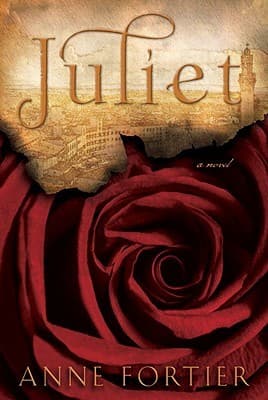
Synopsis
Covers the whole plot, including the ending.
- Difficulty
- Medium
- Pacing
- Moderate
- Mood
- Romantic, Mysterious, Atmospheric, Sweeping
- Read it if
- You love historical mysteries, epic romances, and retellings that delve into the 'true' story behind a classic tale, especially if you enjoy a mix of past and present narratives.
- Skip it if
- You prefer strictly historical accounts without modern-day connections, or if you dislike stories with a strong sense of fated romance and potential melodrama.
Juliet Plot Summary
Covers the whole plot, including the ending.
A Mysterious Inheritance and an Italian Key
Julie Jacobs, a 25-year-old American in Denmark, grieves her Aunt Rose's sudden death. Her twin sister, Janice, inherits most of Rose's estate, but Julie receives only a key and a letter. The letter tells her to go to Siena, Italy, and find a safety deposit box. This key belonged to her mother, Isabella, who died when Julie was a baby. Julie, feeling overlooked by Janice and wanting purpose, decides to follow the instructions, hoping to learn about her family's past and her mother's death. This trip starts her involvement with a very old family story.
Arrival in Siena and the Tolomei Legacy
In Siena, Julie is struck by the city's beauty and history. She uses the key to open a safety deposit box, which holds not treasure, but old documents and a diary. Through these, Julie learns her full name is Giulietta Tolomei, connecting her to the legendary Giulietta of Shakespeare's 'Romeo and Juliet.' She discovers her family, the Tolomei, are one of Siena's oldest and most powerful, involved in a feud with the Salimbeni family, Romeo's descendants. This discovery disturbs Julie, as she realizes her family history is more complex and dramatic than she thought.
Meeting Alessandro and the Salimbeni
While exploring Siena and researching her family, Julie meets Alessandro Baroncini, a charming local. She soon learns Alessandro is a direct descendant of the Salimbeni family, the historical rivals of her Tolomei ancestors. Despite the old animosity, they are drawn to each other, like their famous predecessors. Alessandro, at first cautious, becomes a guide and ally in Julie's search. Together, they begin to piece together the true, often violent, history of Giulietta Tolomei and Romeo Salimbeni, finding that the famous play is a romanticized version of a much darker reality, full of political plots and brutal fights.
Giulietta's Story Unfolds (Past Narrative)
The novel often shifts to Giulietta Tolomei's story in 1340 Siena. After her family is killed by the Salimbeni, young Giulietta is secretly brought to Siena and raised by the Tolomei. She meets the handsome Romeo Salimbeni, and despite their families' deadly feud, they fall in love. Their secret romance grows amidst political unrest, plague, and constant danger. This historical part details their secret meetings, their vows, and desperate attempts to hide their love from their warring families, leading to the tragic events that would inspire Shakespeare.
The Search for the Tolomei Treasure
Julie learns of a 'Tolomei treasure,' supposedly left by the original Giulietta. This treasure is not just gold, but documents and items that could reveal the true history of the feud and perhaps end the ongoing hostilities between the families. Julie, with Alessandro's help, goes on a dangerous hunt through Siena's old churches, catacombs, and hidden paths. Their search is risky, as other descendants from both families, especially those with bad intentions, also want the treasure, believing it holds great power or wealth.
Threats and Ancient Enemies Resurface
As Julie and Alessandro look deeper into the past, they become targets of people who want to keep the secrets of the Tolomei and Salimbeni feud hidden. Mysterious accidents, threats, and direct confrontations suggest the curse of 'A plague on both your houses' might still be active. Julie realizes that the old animosities haven't died, but have simply changed. She suspects some of her own relatives, or those connected to the Salimbeni, are trying to stop her, fearing the truth will disrupt their power or expose their ancestors' crimes. This danger strengthens her bond with Alessandro.
Unveiling the Truth of Giulietta's Fate
The historical chapters reveal what truly happened to Giulietta and Romeo. Unlike Shakespeare's version, their story is more complex and less simply tragic. Giulietta, pregnant with Romeo's child, fakes her death to escape an arranged marriage and the violent feud. Romeo, believing her dead, takes his own life. However, Giulietta survives and dedicates her life to protecting their child and creating a legacy that would one day bring peace. This discovery changes Julie's understanding of her ancestors and their love, adding sacrifice and strength to the legendary tale.
The Betrayal and the Reveal of the 'Romeo'
Julie uncovers a betrayal within her own family. Her aunt, Rose, had tried to protect her, and her twin sister, Janice, has been manipulated by a powerful and dangerous person. This person, who has been planning things behind the scenes, reveals himself to be a direct descendant of the original Romeo and a modern 'Romeo' figure, named Lorenzo. Lorenzo, obsessed with the legacy and the treasure, has used the feud to gain power. He sees Julie as a way to get what he wants, either to claim the treasure or to fulfill a twisted version of the old prophecy.
The Confrontation and the Treasure's True Nature
The story's peak is when Julie confronts Lorenzo, who has captured Janice and plans to use her to force Julie's hand. Alessandro arrives, leading to a tense standoff where the 'treasure' is revealed. It is not gold, but historical documents, letters, and a will from the original Giulietta, meant to reconcile the families and ensure a peaceful future for her descendants. Julie, using her intelligence and what she learned, outwits Lorenzo. The confrontation exposes Lorenzo's evil and leads to his defeat, while also making Julie and Alessandro's bond stronger.
Reconciliation and a New Beginning
With Lorenzo defeated and the truth known, the old feud begins to fade. Julie and Janice reconcile, understanding the pressures and manipulations they both faced. Julie decides to embrace her heritage and the spirit of the original Giulietta, choosing to stay in Siena with Alessandro. She commits to using the unearthed historical documents to tell her ancestors' true story, hoping to bring understanding and peace between the families. She finds love, a sense of belonging, and purpose, finally stepping out of her twin's shadow and making her own way.
Juliet Characters
Julie Jacobs / Giulietta Tolomei
Protagonist
A young American woman who discovers her ancestral connection to Shakespeare's Juliet.
Julie is initially portrayed as somewhat adrift and insecure, living in the shadow of her more charismatic twin sister, Janice. She feels a deep sense of loss from her mother's death and a yearning for identity. Her journey to Siena is born out of curiosity and a desire to understand her past. She is intelligent, resourceful, and possesses a quiet determination. As she uncovers her ancestral history, she grapples with the weight of her name and the ancient feud, gradually finding her voice and strength.
Relationships: Janice Jacobs (Twin sister, initially strained but eventually reconciled); Aunt Rose (Beloved aunt who raised her, posthumously guides her quest); Alessandro Baroncini (Love interest, descendant of Romeo's family, ally); Isabella Tolomei (Deceased mother, whose legacy drives Julie's journey)
Alessandro Baroncini
Supporting / Love Interest
A charming and knowledgeable Sienese man, a descendant of the Salimbeni family.
Alessandro is a descendant of the Salimbeni, the rival family to the Tolomei. He is deeply knowledgeable about Siena's history and its ancient families, initially appearing somewhat enigmatic. He is intelligent, brave, and fiercely loyal, becoming Julie's primary guide and protector in Siena. Despite the centuries-old animosity between their families, he is drawn to Julie and committed to uncovering the truth. He embodies a modern 'Romeo' figure, seeking to break the cycle of hatred.
Relationships: Julie Jacobs (Love interest, ally, and partner in solving the mystery); Lorenzo (Rival, distant relative, antagonist)
Giulietta Tolomei (Historical)
Historical Protagonist / Ancestor
The original Giulietta from 14th-century Siena, whose story inspired the legend.
The historical Giulietta is a strong-willed and passionate young woman living in 14th-century Siena. Orphaned and raised in secret after her family's massacre, she falls deeply in love with Romeo Salimbeni, defying the brutal feud between their families. She is intelligent, brave, and fiercely protective of her unborn child. Her story, filled with sacrifice and resilience, is far more complex than the Shakespearean tragedy, as she fakes her death and dedicates her life to protecting her legacy and seeking peace for her descendants.
Relationships: Romeo Salimbeni (Forbidden lover, father of her child); Lord Tolomei (Her father, whose death fuels the initial feud); The Nurse (Loyal confidante and protector)
Romeo Salimbeni (Historical)
Historical Supporting / Ancestor
The original Romeo, Giulietta's forbidden love interest from the rival Salimbeni family.
The historical Romeo is a passionate and honorable young man from the Salimbeni family. He falls deeply in love with Giulietta Tolomei, defying the violent feud that defines their families. He is depicted as brave and devoted, willing to risk everything for Giulietta. However, his impetuous nature and the extreme circumstances of their time lead to his tragic, self-inflicted death when he believes Giulietta is truly gone. His love for Giulietta is pure, but his actions are ultimately shaped by the harsh realities of medieval Siena.
Relationships: Giulietta Tolomei (Forbidden lover, mother of his child); Lord Salimbeni (His father, who perpetuates the feud)
Janice Jacobs
Supporting
Julie's twin sister, initially perceived as favored but later revealed to be manipulated.
Janice is Julie's twin sister, initially presented as the more confident, successful, and favored sibling, inheriting the bulk of Aunt Rose's estate. She is practical and initially skeptical of Julie's quest. However, it is later revealed that she has been subtly manipulated by Lorenzo, believing she is acting in her family's best interest or for personal gain. She is not inherently malicious but rather a pawn in a larger game, showing vulnerability and ultimately seeking reconciliation with Julie.
Relationships: Julie Jacobs (Twin sister, initially competitive, later supportive); Lorenzo (Manipulator, antagonist)
Aunt Rose
Supporting / Mentioned
Julie's beloved aunt, whose death and cryptic inheritance spark Julie's journey.
Aunt Rose, though deceased at the beginning of the novel, is a pivotal character. She raised Julie and Janice and carefully orchestrated Julie's journey to Siena through her will. Her actions reveal her deep love for Julie and her desire for Julie to uncover her true heritage and break the family curse. She serves as a posthumous guide, her foresight and planning setting in motion the entire plot and providing Julie with the initial clues needed to unravel the mystery.
Relationships: Julie Jacobs (Niece, raised by Rose); Janice Jacobs (Niece, raised by Rose)
Lorenzo
Antagonist
A cunning and ruthless descendant of the Salimbeni, obsessed with power and the ancient feud.
Lorenzo is the primary antagonist, a direct descendant of the original Romeo and a modern-day 'Romeo' figure, albeit a sinister one. He is obsessed with the legend and the perceived power of the 'treasure.' He is manipulative, ruthless, and willing to harm others to achieve his goals, which involve controlling the family legacy and potentially exploiting the ancient feud for his own gain. He uses charm and deception, particularly with Janice, to further his agenda, embodying the lingering darkness of the feud.
Relationships: Julie Jacobs (Rival, target of his schemes); Alessandro Baroncini (Rival, distant relative); Janice Jacobs (Manipulated pawn)
The Nurse (Historical)
Supporting
Giulietta's loyal and wise confidante and protector in 14th-century Siena.
The Nurse is a fiercely loyal and pragmatic woman who serves Giulietta in 14th-century Siena. She acts as Giulietta's confidante, messenger, and protector, helping her navigate the dangerous world of the family feud and her secret romance with Romeo. She is a grounding presence, offering advice and practical assistance, often risking her own safety for Giulietta's well-being. Her unwavering devotion is crucial to Giulietta's survival and the protection of her child.
Relationships: Giulietta Tolomei (Confidante, protector, loyal servant)
Juliet Themes
The Enduring Power of Legacy and Identity
The novel explores how family history, names, and old actions shape a person's identity and future. Julie's journey is about finding her family's past, which is literally in her name, Giulietta. She deals with the weight of her ancestors' choices and the expectations of being a 'Tolomei.' The historical story shows Giulietta Tolomei actively creating a legacy for her child, ensuring her line's survival and a chance for future peace. Both women, centuries apart, are defined by their connection to the legendary story, making them either follow its path or create their own.
“What’s in a name? That which we call a rose by any other name would smell as sweet.”
Love Against All Odds
At its heart, the novel shows how love can overcome social barriers, old feuds, and even time. Both the historical Giulietta and Romeo, and modern Julie and Alessandro, fall in love despite their families' rivalry. Their relationships are dangerous and forbidden, forcing them to make hard choices and face much opposition. The novel suggests that true love, whether it leads to tragedy or a new beginning, can break cycles of hatred and offer hope for peace, even after centuries of animosity.
“A plague o' both your houses! They have made worms' meat of me.”
Reinterpreting History and Truth
A main theme is that history, especially famous stories, can be changed, romanticized, or made up over time. Julie's goal is to find the 'true' story of Giulietta and Romeo, showing that Shakespeare's play, while beautiful, leaves out important details and changes outcomes. The novel highlights how stories are shaped by those who tell them and by political or social reasons. By finding the original documents, Julie reclaims a more complex and empowering truth about her ancestors, showing that history is not fixed but an evolving view of the past.
“The past is a foreign country; they do things differently there.”
The Cycle of Violence and Revenge
The novel clearly shows the destructive nature of family feuds and how hard it is to break cycles of violence and revenge. The Tolomei and Salimbeni families are stuck in a centuries-old conflict, fueled by past killings and betrayals. This animosity continues into the present, seen in threats against Julie and the schemes of characters like Lorenzo. The 'curse' on both houses is not supernatural but a human tendency towards revenge. The goal of both the historical Giulietta and modern Julie is to end this cycle, proving that forgiveness and understanding can overcome deep-seated hatred.
“These violent delights have violent ends And in their triumph die, like fire and powder, Which, as they kiss, consume.”
Sisterhood and Self-Discovery
Julie's initial insecurity comes partly from living in her twin sister Janice's shadow. The novel explores the unique aspects of twin relationships, including competition, perceived favoritism, and the struggle to create individual identities. Julie's trip to Siena is also a journey of self-discovery, allowing her to step out of Janice's shadow and define herself. The eventual reconciliation between the sisters shows their lasting bond despite misunderstandings and outside manipulations, emphasizing that true sisterhood can overcome problems.
“There is no bond on earth like that of a sister.”
Plot Devices & Literary Techniques
Dual Narrative Structure
Alternating chapters between the present-day and 14th-century Siena.
The novel employs a dual narrative, interweaving Julie Jacobs's modern-day quest with the historical account of Giulietta Tolomei in 1340 Siena. This structure allows for a rich exploration of parallels and contrasts between the two time periods, building suspense as Julie uncovers truths that are simultaneously revealed in the past narrative. It deepens the reader's understanding of the historical context and the enduring impact of the feud, while also highlighting how Julie's present actions are influenced by her ancestors' past. This device directly connects the legacy to the present-day mystery.
The Mysterious Inheritance / Scavenger Hunt
A cryptic key and a series of clues lead the protagonist on a quest.
Julie's journey is initiated by a mysterious key and a letter from her deceased Aunt Rose, which leads her to Siena and a safety deposit box. This sets off a classic scavenger hunt narrative, where Julie must decipher clues, explore historical locations, and piece together fragments of information to find the 'treasure' – which turns out to be not material wealth, but historical truth. This device propels the plot forward, creating a sense of adventure and discovery while also immersing the reader in the historical and geographical details of Siena.
The 'Curse' of the Feud
The lingering threat of the ancient family feud and its perceived supernatural influence.
The 'curse' — 'A plague on both your houses!' — serves as a powerful plot device, representing the enduring psychological and physical danger of the ancient Tolomei and Salimbeni feud. While not literally supernatural, the belief in the curse creates a palpable sense of dread and explains the modern-day hostilities and threats against Julie. It motivates characters like Lorenzo and provides a constant source of conflict, emphasizing that historical grievances can continue to haunt and endanger descendants centuries later, until actively broken.
The Reinterpretation of a Classic Tale
Using a famous literary work as a foundation to create a new, historically-grounded narrative.
The novel directly engages with Shakespeare's 'Romeo and Juliet,' using the universally recognized story as its starting point but then subverting and reinterpreting it. This device immediately draws readers in with a familiar premise, only to then reveal a much more complex and historically plausible version of events. By showing how the legend diverged from reality, the author explores themes of truth, myth-making, and the impact of narrative on history, adding depth and intrigue to the well-known tragedy.
Juliet Quotes
“The past is a stubborn thing. It does not easily let go of its secrets.”
“Sometimes, the greatest truths are hidden in the oldest stories.”
“Love, like a dagger, can be both beautiful and deadly.”
“To truly understand the present, one must first confront the ghosts of the past.”
“There are some things that time cannot erase, only bury deeper.”
“Fate, it seems, has a peculiar way of repeating itself.”
“A name, a legend, a curse – sometimes they are all one and the same.”
“The heart, even across centuries, can recognize its own.”
“Siena breathes history, and sometimes, history bites.”
“Not all stories have happy endings, but all endings have a story.”
“The truth is rarely simple, and never without cost.”
“Sometimes, to break a curse, one must first understand its origins.”
“Even the most beautiful roses have thorns, and the sweetest love can draw blood.”
“The past is not dead; it is not even past. It is merely waiting to be rediscovered.”
Quiz
10 questions on the plot and the characters. Each answer comes with a short explanation.
Question 1
What item does Julie Jacobs inherit from her deceased aunt Rose, which initiates her journey to Italy?
- A diary written by her mother
- A large sum of money
- A key to a safety-deposit box in Siena
- A collection of ancient family jewels
Show answer
C. A key to a safety-deposit box in Siena Julie inherits a key that her mother carried, which leads her to a safety-deposit box in Siena, Italy, setting off the main plot.
Question 2
In what city does Julie's ancestor, Giulietta Tolomei, meet Romeo after being smuggled there?
- Verona
- Florence
- Siena
- Venice
Show answer
C. Siena Giulietta was smuggled into Siena, where she met Romeo, contrary to the more commonly known Verona setting of Shakespeare's play.
Question 3
Who is Julie Jacob's twin sister, who inherits the majority of Aunt Rose's estate?
- Giulietta
- Isabella
- Janey
- The provided text does not name Julie's twin sister.
Show answer
D. The provided text does not name Julie's twin sister. The provided synopsis states Julie's 'twin sister' inherited the estate, but does not give her specific name.
Question 4
What is the historical period in which Giulietta Tolomei's story with Romeo unfolds?
- Late 15th Century
- Early 17th Century
- 1340 (Medieval period)
- Mid-19th Century
Show answer
C. 1340 (Medieval period) The synopsis explicitly states, 'In 1340, still reeling from the slaughter of her parents, Giulietta was smuggled into Siena...' placing her story in the medieval period.
Question 5
What famous curse is mentioned as potentially still active and threatening Julie?
- “For never was a story of more woe / Than this of Juliet and her Romeo.”
- “A plague on both your houses!”
- “O, I am slain! If thou be merciful, / Open the tomb, lay me with Juliet.”
- “My only love sprung from my only hate!”
Show answer
B. “A plague on both your houses!” Julie fears that the notorious curse 'A plague on both your houses!' is still at work, suggesting the ancient blood feud continues to affect descendants.
Question 6
What is the primary reason for Giulietta Tolomei being smuggled into Siena?
- To escape an arranged marriage
- To find a hidden family treasure
- After the slaughter of her parents
- To study with a renowned artist
Show answer
C. After the slaughter of her parents The text states Giulietta was 'still reeling from the slaughter of her parents' when she was smuggled into Siena.
Question 7
The novel suggests that the story of Romeo and Giulietta, as recounted by Shakespeare, is a 'pinnacle' of what?
- Medieval Italian history
- Generations of poets and artists inspired by their love
- The genre of historical fiction
- The tradition of tragic opera
Show answer
B. Generations of poets and artists inspired by their love The text states their story 'went on to inspire generations of poets and artists, the story reaching its pinnacle in Shakespeare’s famous tragedy.'
Question 8
What specific danger does Julie face as she delves deeper into the history of Romeo and Giulietta?
- Threats from modern art collectors
- Superstitions, ancient hostilities, and personal vendettas
- Legal challenges from distant relatives
- Natural disasters in the Italian countryside
Show answer
B. Superstitions, ancient hostilities, and personal vendettas The synopsis explicitly mentions 'superstitions, ancient hostilities, and personal vendettas' as dangers surrounding Julie.
Question 9
What is the alleged 'treasure' that Romeo and Giulietta left behind, which Julie gets closer to discovering?
- A collection of love letters
- A hidden will distributing their fortunes
- A secret map to an ancient city
- The synopsis mentions a 'treasure' but does not specify its nature.
Show answer
D. The synopsis mentions a 'treasure' but does not specify its nature. The text states, 'the closer she gets to the treasure they allegedly left behind,' but it does not specify what this treasure actually is.
Question 10
The novel explores the idea that Julie's own fate is 'irrevocably tied' to the star-crossed lovers. What literary device does this suggest about the narrative's structure?
- A purely linear narrative
- A frame story where the past directly influences the present
- An unreliable narrator
- An epistolary novel told through letters
Show answer
B. A frame story where the past directly influences the present The strong connection between past and present, and Julie's fate being tied to her ancestors, indicates a narrative structure where the historical events directly impact and mirror the contemporary storyline, characteristic of a frame story or parallel narrative.
Juliet FAQ
What is the central mystery Julie Jacobs must unravel in Siena?
Julie must uncover the true story of her ancestor Giulietta Tolomei and Romeo, specifically what happened after their supposed deaths and the nature of the treasure they allegedly left behind. This involves deciphering ancient clues and navigating the enduring feuds between their descendants.
How does the legacy of Romeo and Giulietta directly impact Julie's modern-day life?
Julie discovers she is a direct descendant of Giulietta and becomes entangled in the ancient blood feud between the Tolomei and Marescotti families, which still rages in Siena. The 'curse' of the star-crossed lovers seems to follow her, putting her in danger as she seeks the truth and the treasure.
What is the significance of the key Julie receives from her aunt Rose?
The key, carried by Julie's mother on the day she died, is the sole inheritance Julie receives from her aunt. It unlocks a safety-deposit box in Siena, Italy, and serves as the catalyst for Julie's journey into her family's past and the mystery of Romeo and Giulietta.
Who are the primary antagonists Julie encounters in modern Siena?
Julie primarily encounters the powerful and dangerous Marescotti family, descendants of Romeo's historical rivals, who are determined to prevent her from uncovering the truth about their ancestors and claiming the treasure. Their ancient animosity extends to her as a Tolomei descendant.
What is the 'treasure' that Romeo and Giulietta supposedly left behind?
The 'treasure' is not merely material wealth but a collection of historical documents, letters, and artifacts that reveal the true, extended story of Romeo and Giulietta, including their survival and the life they built together beyond Shakespeare's tragic ending. It redefines their legend.
How does the novel reinterpret the fate of Romeo and Giulietta compared to Shakespeare's play?
The novel reveals that Giulietta and Romeo did not die as depicted by Shakespeare. Instead, they survived their initial ordeal in 1340 Siena and went on to live a life together, leaving behind a hidden legacy and descendants, including Julie Jacobs.
What role does the 'curse' play in both historical and modern narratives?
The 'curse' – 'A plague on both your houses!' – manifests as the enduring hostility and violence between the Tolomei and Marescotti families across centuries. In the modern day, it fuels the danger Julie faces, as the descendants continue their vendetta, seeing her as a target.
Are there any clues to the true identities of modern characters being descendants of the historical figures?
Yes, character names often provide direct clues, such as the surname Tolomei for Giulietta's lineage and Marescotti for Romeo's rivals. Additionally, physical descriptions, family traits, and inherited behaviors subtly link modern characters to their historical ancestors, reinforcing the persistent genetic and cultural ties.
How does Julie's initial skepticism about the curse evolve throughout the novel?
Initially, Julie likely dismisses the idea of a centuries-old curse as mere superstition. However, as she faces increasing threats, discovers ancient plots, and witnesses the modern-day animosity of the Marescottis, her skepticism transforms into a genuine fear that the curse is real and targets her.
What psychological impact does discovering her famous ancestry have on Julie?
Discovering her direct lineage to Giulietta profoundly impacts Julie's sense of identity and purpose. It shifts her from a heartbroken young woman to someone with a grand, dangerous destiny, forcing her to confront her own courage and capability in the face of ancient feuds and romantic ideals.
How does the novel explore the theme of inherited trauma through the family feuds?
The novel depicts inherited trauma by showing how the ancient blood feud between the Tolomei and Marescotti families continues to fuel violence, suspicion, and hatred across generations. Modern characters carry the burdens and animosities of their ancestors, perpetuating a cycle of conflict.
What role does the concept of 'fate' play in both Giulietta's and Julie's stories?
Fate is a central theme, with both Giulietta and Julie seemingly predestined for tumultuous love and conflict due to their family lines. However, the novel also explores the characters' agency, suggesting that while fate might set the stage, their choices ultimately determine their individual outcomes, challenging the notion of an unavoidable tragic end.
How does the author use the duality of Siena (ancient vs. modern) to enhance the narrative?
The author uses Siena's timeless quality to blur the lines between past and present, making the ancient feuds feel immediate and alive. The city's historical architecture and traditions serve as a constant backdrop, reminding readers that the events of 1340 are deeply embedded in its very fabric, impacting modern inhabitants.
Is the novel suggesting that true love can defy even the most tragic of literary endings?
Yes, the novel explicitly suggests that true love, as embodied by Giulietta and Romeo, can overcome seemingly insurmountable obstacles, including the tragic ending immortalized by Shakespeare. By giving them a continued life together, the book posits a more enduring and triumphant vision of their romance.
What is the broader message about identity that the novel conveys through Julie's journey?
The novel conveys that identity is deeply intertwined with ancestry and history. Julie's journey shows that understanding one's past, even a legendary one, can profoundly shape one's present and future, forcing a re-evaluation of who one is and what one is capable of achieving.
How does the novel balance the elements of historical fiction, mystery, and romance?
The novel skillfully interweaves historical fiction through Giulietta's 14th-century narrative, providing context for the modern mystery that Julie unravels. The overarching romance, present in both timelines, provides emotional depth and motivation, connecting the past and present through enduring love and conflict.
What is the significance of Julie's twin sister inheriting the estate, while Julie receives only the key?
This inheritance split highlights Julie's unique destiny. While her sister receives material wealth, Julie is given the key to a deeper, more profound legacy – one of identity, history, and adventure. It symbolically separates her from a mundane life and propels her into her true calling, tied to Giulietta.
How does the relationship between Julie and her aunt Rose inform Julie's motivation?
Aunt Rose was like a mother to Julie, and her death leaves Julie heartbroken. The key, Rose's only gift to Julie, becomes a posthumous quest from a beloved figure, driving Julie's determination to honor her aunt's memory by uncovering the secrets the key promises to reveal.
About the author

Anne Fortier is a French author known for her captivating historical fiction novels. Her most notable work, "Juliet," is a bestselling thriller that reimagines Shakespeare's "Romeo and Juliet" in a contemporary setting, weaving together mystery, romance, and family secrets. Fortier's writing is celebrated for its intricate plots and compelling character development.
Similar books
- The Thirteenth Tale
Diane Setterfield
4.0 (272k) average on GoodreadsFantasyFeatures a modern woman unraveling a family mystery rooted in a complex, dramatic past.
- Outlander
Diana Gabaldon
4.2 (824k) average on GoodreadsFantasyWhile fantastical, "Outlander" demonstrates a superior balance between its dual timelines and a much more compelling, deeply developed central romance that effectively drives both historical and contemporary narratives. Fortier's "Juliet" struggles to achieve this same balance, with its modern romance feeling less impactful and its contemporary protagonist less engaging compared to Gabaldon's Claire Randall.
- To Kill a Mockingbird
Harper Lee
4.3 (4.5M) average on GoodreadsHistorical FictionIn the 1930s Jim Crow South, Harper Lee writes about racial injustice, moral growth, and the quiet courage of a lawyer father, Atticus Finch, as seen through his young daughter's eyes.
- The Great Gatsby
F. Scott Fitzgerald
3.9 (3.8M) average on GoodreadsHistorical FictionIn the opulent Roaring Twenties, a mysterious millionaire's lavish parties hide his desperate, tragic pursuit of a lost love, exposing the emptiness within the American Dream.
- Pride and Prejudice
Jane Austen
4.3 (3M) average on GoodreadsHistorical FictionIn a society focused on status and money, Elizabeth Bennet navigates love and pride, challenging Mr. Darcy and social expectations to find true affection.
- Angels & Demons
Dan Brown
3.9 (2.7M) average on GoodreadsThrillerA Harvard symbologist races through Rome's ancient sites, deciphering cryptic clues to unmask the Illuminati and stop a vengeful plot to destroy the Vatican with a stolen antimatter weapon.





Enjoyed the summary?
A summary gives you the shape of the book. The book itself has the detail, the examples and the voice.
Find Juliet on AmazonAs an Amazon Associate, BookBrief earns from qualifying purchases. How we're funded