“J'ai le cœur aussi léger qu'une plume et je le laisse flotter au gré du vent.”
— This quote reflects a feeling of liberation and detachment from worldly concerns.

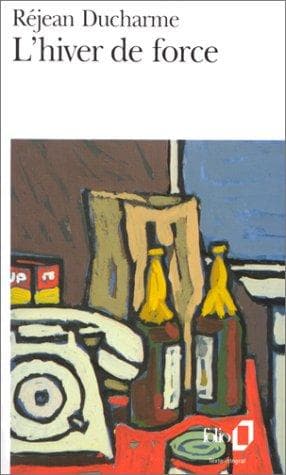
Réjean Ducharme (1985)
Goodreads Rating
3.85/ 5(1,010 reviews)
Genre
General
Summary Read
10 min
Book Length
240 min
Sign in to track this book
In the suffocating grip of a Quebec winter, a young man's obsessive love for a beautiful, elusive woman becomes a desperate battle against his own destructive desires and the stifling expectations of his world.
Ask anything about L'Hiver de force and get instant answers grounded in the summary.
Frédérique and Christiane, two young Québécoises, arrive in New York City without a clear goal, seemingly to escape their routine or find a new way to live. They move into a small, cluttered apartment, which quickly shows their inner disarray. Frédérique, the narrator, is very observant and thoughtful, always analyzing Christiane's actions and their shared situation. Their first days are aimless, filled with odd jobs and the city's overwhelming sensory input. They have playful, often absurd, conversations that show their unique view of the world and their deep, yet complicated, connection. The city itself feels like an almost oppressive force that both excites and isolates them.
Frédérique and Christiane start a strange search for what they call the 'Grand Rien' (the Great Nothing), a philosophical emptiness or ultimate truth they believe hides in New York's chaos. This search appears in their unusual interactions with strangers, their detailed observations of everyday objects, and their philosophical thoughts. They work odd, often demeaning, jobs—from selling souvenirs to working in a bakery—but these are just backdrops to their inner quest. Their conversations are full of wordplay, paradoxes, and a refusal to follow standard logic, all part of their attempt to break down reality and find something real beneath its surface. The city's inhabitants, with their different quirks, become subjects of their detached, yet intense, observation.
Frédérique, as the main narrator, carefully watches and records their daily lives, often adding or inventing details to make the story more engaging. She is fascinated by the small details of their existence, finding deep meaning in the most ordinary objects and events. Her observations are not just descriptions; they are filled with a poetic and often sad feeling. Christiane, in contrast, is more impulsive and action-oriented, though equally prone to strange behavior. Their shared apartment becomes a haven for their imaginative games and intellectual explorations. Frédérique's writing style has long, winding sentences and a stream-of-consciousness flow, showing her inner world and her constant struggle to express the indescribable parts of their experience.
During their stay, Frédérique and Christiane meet many colorful New York characters. These interactions are often brief and shallow, yet they highlight the protagonists' unique view of humanity. They meet a lonely old man who sells hot dogs, a disappointed artist, and various other figures who represent the city's diverse and often isolated population. These encounters rarely lead to deep connections, but instead provide more material for Frédérique's observations and her ongoing analysis of human nature. The protagonists keep an emotional distance from these individuals, preferring to watch them as if they were characters in a play, rather than connecting with them personally.
The relationship between Frédérique and Christiane is central to the novel. It is a complex mix of deep affection, intellectual friendship, and subtle power dynamics. Frédérique often records and interprets Christiane's actions, while Christiane brings a more spontaneous, often chaotic, energy. Their bond has a shared language of inside jokes, philosophical riddles, and a mutual understanding that often excludes the outside world. They are inseparable, yet there are moments of tension and unspoken frustrations, particularly from Frédérique's side, as she struggles with Christiane's seemingly easy existence. Their co-dependency is both a strength and a potential trap, binding them together in their isolated world.
Frédérique and Christiane see their time in New York not just as living, but as an ongoing experiment in existence. They deliberately shed conventional societal expectations, embracing a life of improvisation and philosophical inquiry. Their activities, from their ordinary jobs to their elaborate internal games, are all part of this experiment. They try to break down language, meaning, and reality itself, searching for an authentic way of being. This experimental approach leads them to question everything, including their own identities and the nature of their bond. The city provides a good setting for this experiment, its endless possibilities and absurdities reflecting their own inner states.
Despite their intellectual games and shared world, both Frédérique and Christiane feel deep despair, loneliness, and a sense of meaninglessness at times. The 'Grand Rien' they seek sometimes feels like an oppressive emptiness rather than an enlightening truth. These moments often appear alongside flashes of poetic transcendence, where ordinary sights or sounds suddenly gain deep philosophical significance. Frédérique, in particular, struggles with the weight of existence and the difficulty of expressing her innermost feelings. Their experiences constantly move between the ordinary and the profound, the absurd and the deeply meaningful, reflecting the human condition itself.
Language is a main focus for Frédérique. She constantly dissects words, invents new ones, and plays with grammar, believing that conventional language is not enough to capture the complexity of their experience. Her narration shows this obsession, with its dense, poetic, and often winding sentences. She uses language as a tool to both understand and create their reality, often blurring the lines between objective description and subjective invention. The dialogues between Frédérique and Christiane are full of wordplay, riddles, and linguistic acrobatics, reflecting their shared belief in the transformative power and inherent limits of words.
As the novel continues, time passes, but there is no clear linear progression or external plot development. Their lives in New York seem to loop and repeat, their philosophical quest largely unresolved. This lack of conventional plot shows their deliberate rejection of a goal-oriented existence. The 'winter of force' of the title suggests a period of forced introspection and stillness, a time when external action is suspended in favor of internal exploration. Despite the passage of days and seasons, their fundamental situation and their internal struggles remain largely unchanged, emphasizing the cyclical nature of their search for meaning.
The novel does not offer a clear resolution or ending to Frédérique and Christiane's quest. They remain in New York, still engaged in their philosophical games and observations, their search for the 'Grand Rien' ongoing. The ambiguity of their purpose and their future continues, reflecting the novel's embrace of open-endedness and its rejection of conventional narrative closure. Their unique world, built on shared quirks and intellectual play, goes on. The conclusion reinforces the idea that their lives are an ongoing process of questioning and existing, rather than a journey towards a fixed destination or a single answer.
The Protagonist
Frédérique's arc is less about external change and more about deepening her internal philosophical inquiry, becoming more entrenched in her unique way of perceiving the world and her relationship with Christiane.
The Protagonist
Christiane's arc, like Frédérique's, is less about transformation and more about remaining true to her enigmatic, spontaneous nature, serving as a constant in their shared, unconventional life.
The Supporting
The Hot Dog Vendor experiences no significant arc, serving as a static symbol within the narrative.
The Supporting
New York City remains a constant, dynamic force throughout the narrative, its character unchanged but its impact on the protagonists evolving subtly.
The novel deeply explores the absurdity of human existence and the characters' relentless, often pointless, search for meaning in a seemingly indifferent world. Frédérique and Christiane face the lack of inherent purpose by inventing their own philosophical games and linguistic structures, trying to create meaning where none is obvious. Their quest for the 'Grand Rien' is both a recognition of this absurdity and an attempt to go beyond it, suggesting that meaning might be found in the act of searching or in the subjective creation of reality.
“Nous sommes deux grandes machines à fabriquer du rien, mais ce rien-là est notre tout.”
Language is not just a tool for communication in the novel; it is a main way of building and breaking down reality. Frédérique's narrative is a continuous exploration of language's limits and possibilities, often blurring the lines between description, invention, and philosophical inquiry. The characters play with words, invent new ones, and engage in elaborate linguistic games, suggesting that language can both reveal truth and hide it. This theme shows how our perception of the world is shaped by the words we use, and how manipulating language can lead to new understandings or, conversely, to deeper isolation.
“Les mots sont des pièges. Ils nous font croire que nous comprenons, alors que nous ne faisons qu'effleurer la surface.”
New York City, despite its huge population, is a setting for deep isolation. Frédérique and Christiane, while deeply connected to each other, remain largely separate from the world around them. Their unique philosophical framework and linguistic world create a bubble that both protects and isolates them. The novel explores the paradox of being surrounded by millions yet feeling completely alone, and how intimate relationships can become a refuge against this urban anonymity, while also reinforcing a sense of being 'other' to the mainstream world.
“Nous sommes les deux seules personnes au monde à comprendre le Grand Rien, et c'est ce qui nous rend si terriblement seules.”
The protagonists actively invent themselves, shedding conventional identities and embracing a flexible, experimental sense of self. Their lives in New York are a continuous performance, a deliberate stripping away of societal expectations to discover or create a more authentic being. They question who they are, not just individually, but also in relation to each other, suggesting that identity is not fixed but a constantly evolving story. This theme connects with their use of language, as they use words to define, redefine, and sometimes deliberately hide their own identities.
“Nous ne sommes personne et nous sommes tout le monde. C'est ça, la liberté, non?”
Unfiltered flow of thoughts and feelings from the narrator's mind.
The novel primarily employs a stream-of-consciousness narrative technique, with Frédérique's thoughts, observations, and philosophical digressions flowing in an often unfiltered, non-linear manner. This device allows the reader direct access to her intricate internal world, her musings on language, existence, and her relationship with Christiane. It creates an intimate, subjective experience, reflecting the chaotic yet profoundly thoughtful nature of her mind. The long, complex sentences and associative leaps are characteristic of this style, immersing the reader in the protagonists' unique perception of reality.
Conversations that explore existential and linguistic concepts.
A significant portion of the novel consists of dialogues between Frédérique and Christiane that are less about advancing a plot and more about exploring complex philosophical and linguistic concepts. These conversations are often playful, paradoxical, and filled with wordplay, serving as a central mechanism for the characters to articulate their unique worldview and engage in their search for meaning. This device highlights their intellectual companionship and their shared, unconventional approach to understanding the world, often blurring the lines between serious inquiry and whimsical game.
The city as a metaphor for chaos, anonymity, and possibility.
New York City functions as a powerful symbol throughout the novel. It represents the overwhelming, chaotic, and often indifferent nature of modern existence, providing a vibrant backdrop for the protagonists' internal struggles. Simultaneously, it symbolizes endless possibility, anonymity, and the freedom to reinvent oneself outside conventional societal norms. The city's noise, its diverse inhabitants, and its relentless pace are all imbued with symbolic meaning, reflecting the characters' own internal landscapes and their philosophical quest for the 'Grand Rien' amidst the urban sprawl.
“J'ai le cœur aussi léger qu'une plume et je le laisse flotter au gré du vent.”
— This quote reflects a feeling of liberation and detachment from worldly concerns.
“L'amour est une maladie qui se soigne avec le temps et la distance.”
— A cynical but perhaps realistic view on the nature and healing of love.
“Je suis un homme qui a perdu son ombre, et je vis dans la lumière.”
— Suggests a state of being unbound by conventional identity or past burdens.
“La vie est une comédie écrite par un auteur qui a un très mauvais sens de l'humour.”
— A darkly humorous observation on the absurdity and often tragic nature of existence.
“Je n'ai jamais rien appris de mes succès. Ce sont toujours mes échecs qui m'ont enseigné quelque chose.”
— Highlights the importance of failure as a learning experience.
“Le monde est un théâtre et nous en sommes les acteurs, mais le texte est écrit par un metteur en scène invisible.”
— A metaphorical view of life as a performance with an unknown director.
“Je préfère la solitude à la compagnie des gens qui ne me comprennent pas.”
— Expresses a preference for solitude over superficial or unfulfilling social interactions.
“Le temps est un voleur qui nous dérobe nos souvenirs un à un.”
— A poignant reflection on the erosive power of time on memory.
“J'ai toujours été un étranger dans ce monde, même quand j'en faisais partie.”
— Conveys a deep sense of alienation and not belonging.
“La seule chose qui compte vraiment, c'est d'aimer et d'être aimé.”
— A simple yet profound statement about the ultimate value in life.
“Je suis un rêveur qui a cessé de rêver.”
— Signifies a loss of idealism or hope.
“La vérité est souvent la chose la plus laide que l'on puisse dire.”
— A cynical perspective on the harshness of truth.
“On ne peut pas fuir son passé, on peut seulement apprendre à vivre avec lui.”
— Emphasizes the inescapable nature of one's past and the need for acceptance.
“L'écriture est une façon de mettre de l'ordre dans le chaos de ma pensée.”
— Describes the therapeutic and organizing function of writing.
Ready to see how well you understood this book? Take our interactive quiz with 10 questions.
Support the author — grab the full book.
As an Amazon Associate, BookBrief earns from qualifying purchases, at no extra cost to you. How we're funded.