
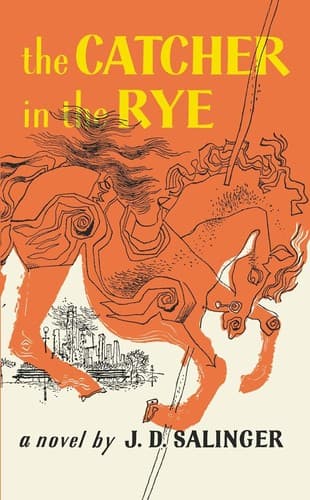
Synopsis
Covers the whole plot, including the ending.
- Difficulty
- Easy
- Pacing
- Moderate
- Mood
- Melancholic, Reflective, Cynical, Angsty
- Read it if
- You're interested in a classic coming-of-age story told from the perspective of a disaffected, opinionated, and deeply introspective teenager.
- Skip it if
- You dislike stream-of-consciousness narration, unreliable narrators, or stories with a cynical and melancholic tone.
The Catcher in the Rye Plot Summary
Covers the whole plot, including the ending.
Leaving Pencey Prep
Holden Caulfield, a sixteen-year-old student, narrates his story from a mental institution. He begins by recounting his dismissal from Pencey Preparatory School in Agerstown, Pennsylvania, because he failed four out of five subjects. On the day of the big football game, Holden is on Thomsen Hill, thinking about his expulsion and feeling alienated from the school's 'phony' spirit. He visits his history teacher, Mr. Spencer, who tries to give him advice, but Holden feels more depressed and misunderstood. After a fight with his roommate, Stradlater, about a date with Jane Gallagher, Holden impulsively leaves Pencey a few days early and takes a train to New York City.
Arrival in New York and Early Encounters
Upon arriving in New York City, Holden checks into the Edmont Hotel. He feels lonely and disconnected. From his hotel window, he sees strange and sexual activities in other rooms, which both fascinate and bother him. He calls Faith Cavendish, a woman he barely knows, to arrange a late-night drink, but she declines. This first experience in the city sets a tone of isolation and his critical view of adult 'phoniness,' as he struggles to find real human connection.
The Lavender Room and Sally Hayes
Holden goes to the Lavender Room, the hotel's nightclub, where he tries to socialize with three older women from Seattle. He dances with them but finds them superficial and only interested in finding a movie star. He lies about his name and age, further isolating himself. The next day, he makes a date with Sally Hayes, a girl he used to date and finds attractive but also 'phony.' This date is an attempt to feel normal, but his underlying cynicism remains strong.
Sunny and Maurice
Back in his hotel room, feeling more depressed, Holden decides to call a prostitute. Maurice, the elevator operator, arranges for Sunny to come to his room. However, when Sunny arrives, Holden only wants to talk, feeling too depressed and uncomfortable for sex. He pays her the agreed-upon five dollars, but Sunny claims he owes her ten. When Holden refuses, Maurice and Sunny return later, and Maurice assaults Holden, taking the extra five dollars. This encounter leaves Holden feeling violated and even more alone.
Date with Sally Hayes
Holden's date with Sally Hayes begins with them seeing a play and then ice skating. During their time together, Holden, desperate for escape and authenticity, suggests they run away to live in a cabin in Massachusetts. Sally, practical, finds his idea absurd and childish, leading to a heated argument. Holden calls her a 'pain in the ass,' and Sally leaves in tears. This failed attempt at connection further strengthens Holden's belief that he cannot find anyone who understands him.
Carl Luce and the Wicker Bar
After the disastrous date with Sally, Holden calls Carl Luce, an older acquaintance from the Whooton School who is now a student at Columbia. They meet at the Wicker Bar, where Holden tries to talk to Carl seriously about sex and relationships. Carl, sophisticated and detached, finds Holden's questions immature and avoids deep discussion, eventually leaving him alone. This encounter reinforces Holden's isolation and his inability to connect with others meaningfully.
Coming Home to Phoebe
Drunk and lonely, Holden decides to go home to see his ten-year-old sister, Phoebe, before completely disappearing. He sneaks into his family's apartment, careful not to wake his parents. Phoebe is happy to see him but quickly realizes he has been expelled from Pencey. She is intelligent and perceptive, challenging Holden's cynicism and expressing disappointment. Their conversation shows Holden's deep affection for her and her role as a symbol of innocence and authenticity in his life.
The Catcher in the Rye Fantasy
During their conversation, Phoebe asks Holden what he wants to do with his life. He tells her about his fantasy of being a 'catcher in the rye'—standing at the edge of a cliff in a rye field, catching children before they fall off. This metaphor shows his desire to protect innocence and prevent children from experiencing the 'phoniness' and disappointment of the adult world. Phoebe points out that the song he misremembers actually says 'If a body meet a body, coming through the rye,' not 'catch a body.' This moment highlights his idealistic, yet flawed, view of the world.
Visit to Mr. Antolini
After leaving home, Holden goes to the apartment of his former English teacher, Mr. Antolini, whom he admires. Mr. Antolini offers him a place to stay and advises him on finding his path in life, stressing the importance of education and curiosity. However, when Holden wakes up to find Mr. Antolini stroking his hair, he misinterprets the gesture as a sexual advance and flees in a panic. This incident further reinforces Holden's distrust of adults and his feeling of being misunderstood, despite Mr. Antolini's likely good intentions.
Phoebe's Suitcase and the Carousel
Holden decides to leave New York for good and live a solitary life out West, planning to say goodbye to Phoebe at her school. However, Phoebe arrives with her packed suitcase, insisting on coming with him. Holden, realizing the absurdity and danger of his plan for her, refuses. To appease her, he takes her to the Central Park carousel. As Phoebe rides, Holden feels a deep sense of happiness and peace, especially when she reaches for the golden ring. This moment is a rare instance of genuine joy and connection for Holden, free from cynicism.
The Rain and the Future
As Phoebe rides the carousel in the pouring rain, Holden sits on a bench, feeling overwhelmed with happiness and warmth. He feels connected to her innocence and the simple joy of the moment, a stark contrast to his earlier despair. This experience seems to be a turning point, where he acknowledges the beauty of preserving innocence rather than trying to literally 'catch' it. The narrative then shifts to the present, revealing that Holden is recounting these events from a psychiatric institution, reflecting on his breakdown and the possibility of a future.
The Catcher in the Rye Characters
Holden Caulfield
Protagonist
A cynical and alienated teenager struggling with the transition to adulthood.
Holden is a sixteen-year-old boy who has been expelled from several prep schools. He views the adult world as 'phony' and corrupt, filled with superficiality and hypocrisy. He is intelligent and sensitive, but deeply pessimistic and struggles with loneliness and depression. He idealizes childhood innocence, particularly his younger sister, Phoebe, and his deceased brother, Allie. His narrative voice is distinctive, filled with slang, digressions, and a constant internal monologue of judgment and self-doubt. He longs for genuine connection but pushes people away.
Relationships: Phoebe Caulfield (Younger sister, symbol of innocence, deep affection and understanding); Allie Caulfield (Deceased younger brother, idealized, source of profound grief); D.B. Caulfield (Older brother, successful writer, Holden views him as a 'sell-out'); Jane Gallagher (Childhood friend, idealized, represents lost innocence); Stradlater (Roommate at Pencey, 'secret slob,' superficial, object of Holden's disdain); Ackley (Neighbor at Pencey, unhygienic, socially awkward, Holden pities him); Sally Hayes (Former girlfriend, attractive but 'phony,' represents conventional society); Mr. Spencer (History teacher at Pencey, well-meaning but ineffective mentor); Mr. Antolini (Former English teacher, intellectual, attempts to guide Holden, misunderstood by him)
Phoebe Caulfield
Supporting
Holden's perceptive and intelligent younger sister, a beacon of innocence.
Phoebe is Holden's ten-year-old sister, who is portrayed as intelligent, intuitive, and remarkably mature for her age. She is one of the few characters Holden genuinely respects and loves, seeing her as pure and uncorrupted by the 'phony' adult world. She challenges Holden's cynicism and sees through his pretenses, yet she also offers him unconditional love and understanding. Her presence often brings out Holden's softer, more vulnerable side, and she represents the innocence he desperately wants to protect.
Relationships: Holden Caulfield (Older brother, deep affection, understanding, and concern for his well-being)
Allie Caulfield
Mentioned
Holden's deceased younger brother, an idealized symbol of innocence and intelligence.
Allie is Holden's younger brother who died of leukemia three years prior to the novel's events. Though deceased, Allie plays a significant role in Holden's psyche. Holden idealizes Allie, remembering him as an intelligent, kind, and genuinely good person who never became 'phony.' Allie's death is a profound source of grief and trauma for Holden, contributing to his depression and his desire to protect innocence. Holden often talks to Allie in his mind and carries Allie's baseball mitt, which has poems written on it, as a tangible reminder.
Relationships: Holden Caulfield (Older brother, idealized, source of profound grief and admiration)
D.B. Caulfield
Supporting
Holden's older brother, a successful but 'phony' Hollywood writer.
D.B. is Holden's older brother, a talented writer who Holden claims 'prostituted' himself by moving to Hollywood to write screenplays. Holden sees D.B.'s success in the film industry as a betrayal of his literary talent and a prime example of the 'phoniness' he despises. Despite his critical view, Holden acknowledges D.B.'s talent and often mentions his writing. D.B. represents the adult world's compromises and the loss of artistic integrity in Holden's eyes, though he is generally kind to Holden.
Relationships: Holden Caulfield (Younger brother, Holden views him as a 'sell-out' but acknowledges his talent)
Jane Gallagher
Mentioned
A childhood friend Holden idealizes, representing purity and uncorrupted innocence.
Jane Gallagher is a girl Holden knew and spent time with during summers. She is never physically present in the novel but is frequently mentioned and remembered by Holden. He idealizes her, recalling her innocent qualities and her vulnerability, particularly her difficult home life. Holden feels a strong protective instinct towards Jane and is deeply disturbed by the thought of her being mistreated by others, such as Stradlater. She represents a lost period of innocence and genuine connection for Holden, untainted by the adult world's 'phoniness.'
Relationships: Holden Caulfield (Childhood friend, idealized, represents lost innocence and vulnerability)
Stradlater
Supporting
Holden's handsome, superficial, and 'secretly slobby' roommate at Pencey.
Stradlater is Holden's roommate at Pencey Prep. He is handsome, popular, and a successful athlete, but Holden views him as superficial and a 'secret slob' because of his poor hygiene habits. Stradlater's date with Jane Gallagher deeply bothers Holden, fueling his protective instincts and his anxiety about Jane's potential loss of innocence. He represents the kind of 'phony' attractiveness and casual disregard for others that Holden despises, leading to a physical confrontation between them.
Relationships: Holden Caulfield (Roommate, strained, characterized by disdain and conflict); Jane Gallagher (Date, cause of Holden's anxiety and anger)
Mr. Spencer
Supporting
Holden's elderly history teacher at Pencey, who tries to offer guidance.
Mr. Spencer is Holden's elderly history teacher at Pencey Prep. He is well-meaning and genuinely concerned for Holden's future, attempting to offer him advice about his academic failures. However, his attempts to connect with Holden only make Holden feel more depressed and alienated, as he finds Mr. Spencer's lectures and advice to be part of the 'phony' adult world. Mr. Spencer's physical frailties and his attempts to 'help' Holden reinforce Holden's sense of being misunderstood by adults.
Relationships: Holden Caulfield (Student, attempts to offer guidance, but fails to connect meaningfully)
Mr. Antolini
Supporting
Holden's former English teacher, an intellectual who offers him shelter and advice.
Mr. Antolini is Holden's former English teacher from the Elkton Hills school, whom Holden respects for his intelligence and open-mindedness. He is an intellectual and a 'liberal' who Holden believes is one of the few adults who isn't a 'phony.' Mr. Antolini offers Holden a place to stay and provides him with advice about finding his path in life, stressing the importance of intellectual curiosity and self-discovery. However, a misunderstanding involving Mr. Antolini stroking Holden's head while he sleeps causes Holden to flee, further cementing his distrust of adults.
Relationships: Holden Caulfield (Former student, attempts to offer guidance and comfort, but is misunderstood)
Sally Hayes
Supporting
An attractive but conventional and 'phony' girl Holden dates.
Sally Hayes is a girl Holden used to date and calls for a date in New York. She is attractive and popular, but Holden ultimately finds her to be superficial, conventional, and 'phony.' Their date culminates in a heated argument when Holden proposes they run away together, highlighting the vast difference between his idealistic, yet impractical, desires and Sally's more grounded, societal expectations. She represents the social norms and superficiality of the adult world that Holden struggles to accept.
Relationships: Holden Caulfield (Former girlfriend, strained, ends in conflict due to differing worldviews)
The Catcher in the Rye Themes
Alienation and Loneliness
Holden's journey includes deep feelings of alienation and loneliness. He constantly calls others 'phonies,' which is a defense mechanism to hide his own inability to connect. He pushes people away, whether his roommate Stradlater, his date Sally Hayes, or his former teacher Mr. Antolini. His internal thoughts are filled with observations of others' superficiality, yet he desperately wants real connection, as seen in his idealization of Phoebe and Allie. His three days in New York are a solitary wandering, marked by failed attempts at intimacy, leaving him more isolated than ever, leading to a mental breakdown.
“I felt so lonesome, all of a sudden. I almost wished I was dead.”
The Phoniness of the Adult World
Holden's main criticism is directed at the 'phoniness' he sees in adults. He sees hypocrisy, superficiality, and artificiality everywhere: in his prep school, in Hollywood (represented by D.B.), in dating rituals (Sally Hayes), and in the behavior of adults he meets. This theme appears in his constant judgments and internal thoughts about others. He wants authenticity and sincerity, which he believes are lost in adulthood. This leads him to reject conventional paths and relationships. This rejection drives his actions and emotional distress.
“Phonies are everywhere. Phonies are my biggest problem.”
The Preservation of Innocence
Holden is obsessed with protecting innocence, especially that of children. His 'catcher in the rye' fantasy—to save children from falling off a cliff—is a strong metaphor for this desire. He is deeply affected by the thought of children losing their purity and encountering the 'phoniness' of the adult world, shown by his distress over Jane Gallagher's potential exploitation by Stradlater, or his desire to erase obscenities from school walls. Phoebe, his younger sister, embodies this innocence for him. His moments of genuine happiness are often tied to her unspoiled joy, especially watching her on the carousel.
“I'd just be the catcher in the rye and all. I know it's crazy, but that's the only thing I'd really like to be.”
Loss and Grief
Holden's deep grief over the death of his younger brother, Allie, is a constant underlying theme. Allie's death three years prior deeply affected Holden, contributing to his depression, his idealization of innocence, and his difficulty coping with loss. He carries Allie's baseball mitt as a cherished item and often thinks of him. The trauma of Allie's death is a major reason for Holden's emotional fragility and his inability to move forward. His breakdown can be seen as an unaddressed result of this profound loss, which has left him feeling adrift and unable to find meaning in a world without Allie.
“He was the most intelligent member in the family. He was also the nicest.”
Plot Devices & Literary Techniques
First-Person Narrator (Unreliable)
Holden's subjective and often biased narration shapes the reader's perception of events.
The entire novel is told through Holden Caulfield's first-person perspective, several months after the events. His voice is distinctive, filled with colloquialisms, digressions, and strong judgments. As an unreliable narrator, Holden's perceptions are filtered through his cynicism, depression, and adolescent angst, meaning the reader must often interpret his observations and draw their own conclusions about the 'truth' of situations and characters. This device allows for an intimate portrayal of his internal world, but also highlights his isolation and skewed worldview.
Symbolism of the Red Hunting Hat
Holden's distinctive hat represents his individuality, insecurity, and desire for protection.
Holden's red hunting hat is a prominent symbol throughout the novel. He wears it backward, a gesture of nonconformity and individuality, often when he feels most vulnerable or when he wants to assert his unique identity. It offers him a sense of comfort and protection, especially when he feels alienated or exposed, such as after his fight with Stradlater or during his solitary wanderings in New York. The hat also symbolizes his connection to childhood and his desire to stand out while simultaneously wanting to disappear.
The 'Catcher in the Rye' Metaphor
Holden's fantasy of saving children symbolizes his desperate desire to protect innocence from the adult world.
The central metaphor of the 'catcher in the rye' represents Holden's core desire to protect children from the corruption and 'phoniness' of the adult world. He envisions himself standing at the edge of a cliff in a rye field, catching children before they fall into the abyss of adulthood. This fantasy highlights his idealistic view of childhood innocence and his desperate, if impractical, longing to preserve it. It also underscores his fear of growing up and facing the complexities and disappointments of adult life, and his inability to cope with loss and change.
Allie's Baseball Mitt
A physical object symbolizing Allie's memory, innocence, and Holden's grief.
Allie's baseball mitt, with poems written all over it in green ink, is a powerful symbol of Allie's unique personality and Holden's profound grief. Holden carries it with him and describes it in detail, revealing his deep affection and idealization of his deceased brother. The mitt represents Allie's innocence, intelligence, and the beauty that Holden sees as lost to the world. It is a tangible link to a past that Holden cherishes and a constant reminder of the trauma of Allie's death, which significantly contributes to Holden's emotional state.
Quiz
10 questions on the plot and the characters. Each answer comes with a short explanation.
Question 1
What is the name of the prep school Holden attends at the beginning of the novel, from which he is expelled?
- Whooton School
- Elkton Hills
- Pencey Prep
- Andover Academy
Show answer
C. Pencey Prep Holden Caulfield is expelled from Pencey Prep at the start of the novel, leading to his journey in New York City.
Question 2
Who is Allie Caulfield?
- Holden's older brother, a successful writer in Hollywood
- Holden's younger sister, whom he deeply loves
- Holden's deceased younger brother, who died of leukemia
- Holden's best friend from elementary school
Show answer
C. Holden's deceased younger brother, who died of leukemia Allie is Holden's younger brother who died of leukemia, and his death profoundly affects Holden, as evidenced by the baseball mitt.
Question 3
What does Holden want to be if he were 'the catcher in the rye'?
- A teacher who guides children in their studies
- Someone who catches children before they fall off a cliff while playing in a field of rye
- A baseball player who catches fly balls in the outfield
- A protector of innocence who preserves their childhood dreams
Show answer
B. Someone who catches children before they fall off a cliff while playing in a field of rye Holden imagines himself as a 'catcher in the rye,' saving children from falling off a cliff, symbolizing his desire to protect childhood innocence from the 'phony' adult world.
Question 4
Which item belonging to Allie does Holden keep with him and frequently reflects upon?
- Allie's favorite book of poems
- Allie's baseball mitt with poems written on it
- Allie's old bicycle
- A drawing Allie made for him
Show answer
B. Allie's baseball mitt with poems written on it Holden cherishes Allie's baseball mitt, which has poems written on it in green ink, and it serves as a powerful symbol of Allie and Holden's grief.
Question 5
What is the name of Holden's younger sister, who is one of the few people he genuinely respects?
- Jane Gallagher
- Phoebe Caulfield
- Sally Hayes
- Sunny
Show answer
B. Phoebe Caulfield Phoebe Caulfield is Holden's younger sister, who represents innocence and understanding to him, and she is one of the few people he can communicate with effectively.
Question 6
Why does Holden get into a physical fight with Stradlater?
- Stradlater borrowed Holden's expensive jacket without asking.
- Stradlater insulted Holden's younger brother, Allie.
- Holden is angry and worried about Stradlater's date with Jane Gallagher.
- Stradlater refused to proofread Holden's English paper.
Show answer
C. Holden is angry and worried about Stradlater's date with Jane Gallagher. Holden is upset and protective of Jane Gallagher, and his anxiety about her date with Stradlater, combined with Stradlater's dismissive attitude, leads to their fight.
Question 7
What specific detail about the ducks in Central Park does Holden obsess over, and what does it symbolize for him?
- He wonders if they migrate south for the winter, symbolizing his desire for escape.
- He wonders where they go when the lagoon freezes, symbolizing his concern for the vulnerable and his own sense of displacement.
- He is fascinated by their ability to fly, symbolizing his longing for freedom.
- He admires their peaceful existence, symbolizing his wish for tranquility.
Show answer
B. He wonders where they go when the lagoon freezes, symbolizing his concern for the vulnerable and his own sense of displacement. Holden repeatedly asks about the ducks in Central Park and where they go when the lagoon freezes. This reflects his preoccupation with the fate of the vulnerable and his own feelings of being lost and without a clear destination.
Question 8
When Holden visits Mr. Antolini, what advice does Antolini give him that Holden initially finds unsettling?
- To embrace the 'phoniness' of the adult world to survive.
- To apply himself in school and find an intellectual pursuit.
- To travel the world and find himself before settling down.
- To seek professional help for his mental health issues.
Show answer
B. To apply himself in school and find an intellectual pursuit. Mr. Antolini advises Holden that 'The mark of the immature man is that he wants to die nobly for a cause, while the mark of the mature man is that he wants to live humbly for one.' He urges Holden to find an intellectual path.
Question 9
What is Holden's primary criticism of movies and actors?
- He finds them too violent and disturbing.
- He believes they are artificial, phony, and lack genuine emotion.
- He thinks they are boring and predictable.
- He dislikes how they portray teenagers inaccurately.
Show answer
B. He believes they are artificial, phony, and lack genuine emotion. Holden frequently expresses his disdain for movies and actors, labeling them as 'phony' because he perceives their emotions and portrayals as insincere and exaggerated.
Question 10
What is the significance of the carousel ride Phoebe takes at the end of the novel?
- It symbolizes Holden's final acceptance of growing up and leaving childhood behind.
- It represents Holden's realization that he cannot prevent children from reaching for the 'gold ring' and that it's okay for them to take risks and grow.
- It highlights Holden's desire to keep Phoebe eternally innocent and safe.
- It shows Phoebe's defiance and rebellion against Holden's wishes.
Show answer
B. It represents Holden's realization that he cannot prevent children from reaching for the 'gold ring' and that it's okay for them to take risks and grow. Watching Phoebe on the carousel, reaching for the gold ring, is a pivotal moment for Holden. He realizes that children need to take risks and experience life, and he can't always be there to 'catch' them, signifying a shift in his perspective on protecting innocence.
The Catcher in the Rye FAQ
What is the central premise of 'The Catcher in the Rye'?
The novel follows Holden Caulfield, a sixteen-year-old boy, as he recounts his experiences after being expelled from Pencey Prep. He spends three days wandering alone in New York City, grappling with feelings of alienation, disillusionment, and a desire to protect childhood innocence from the 'phoniness' of the adult world.
Who is Holden Caulfield and what is his primary struggle?
Holden is the protagonist and narrator, a cynical yet sensitive teenager from New York. His primary struggle is his inability to connect authentically with others and his intense aversion to what he perceives as the superficiality, hypocrisy, and 'phoniness' of adult society, which leads to his deep sense of loneliness and emotional turmoil.
What prompts Holden's departure from Pencey Prep?
Holden is expelled from Pencey Prep due to academic failure, having flunked four out of five subjects. Feeling isolated and disgusted by his classmates and the school environment, he decides to leave early and postpone telling his parents, embarking on an aimless journey through New York City.
Who are some of the key characters Holden interacts with in New York?
In New York, Holden encounters a diverse cast, including his former teacher Mr. Antolini, the prostitute Sunny and her pimp Maurice, two nuns, and his younger sister Phoebe. These interactions highlight his attempts at connection and his recurring disappointments.
What is the significance of the title, 'The Catcher in the Rye'?
The title refers to Holden's fantasy of being a 'catcher in the rye,' standing on a cliff's edge to prevent children from falling off into the abyss. This metaphor symbolizes his desperate desire to protect the innocence of childhood from the corrupting influences of the adult world, particularly embodied by his love for his sister Phoebe.
How does Allie's death impact Holden's psychological state and worldview?
Allie's death from leukemia deeply traumatized Holden, causing him to smash garage windows in grief. This loss profoundly shapes his worldview, contributing to his melancholic outlook, his idealization of childhood innocence, and his fear of change and decay, as Allie represents a perfect, unchanging past.
What is the role of Phoebe in Holden's emotional journey?
Phoebe serves as Holden's emotional anchor and a symbol of the innocence he desperately wants to preserve. Her unwavering love, clear-sightedness, and genuine concern for him are crucial; her plea for him to stay and her simple wisdom ultimately help him confront his emotional breakdown and consider his future.
What is the symbolic meaning of the ducks in Central Park?
The ducks in Central Park symbolize Holden's anxieties about transience, change, and the unknown. He repeatedly wonders where they go in winter, mirroring his own feelings of being lost and uncertain about his future, and his longing for a safe, predictable haven.
How does Holden's red hunting hat function as a symbol?
Holden's red hunting hat is a symbol of his individuality, his desire for uniqueness, and his rebellion against conformity. He wears it backward, signaling his defiance, and it also offers him a sense of comfort and protection, especially when he feels vulnerable or isolated.
What psychological defense mechanisms does Holden frequently employ?
Holden frequently uses denial, projection, and rationalization. He denies his own shortcomings by projecting 'phoniness' onto others, and he rationalizes his destructive behavior by claiming he's trying to protect himself or others from the adult world's perceived corruption.
How does Holden's perception of 'phoniness' reflect his own internal struggles?
Holden's obsession with 'phoniness' is a projection of his own internal conflict and immaturity. He struggles with authenticity himself, often lying or putting on an act, and his intense criticism of others' perceived superficiality is a way to avoid confronting his own anxieties and inability to genuinely connect.
Is Holden suffering from a mental illness, and if so, what might it be?
While the novel doesn't explicitly diagnose him, Holden exhibits symptoms consistent with depression, anxiety, and possibly PTSD from Allie's death. His erratic behavior, suicidal ideation, social withdrawal, and profound sadness suggest a significant mental health crisis, culminating in a nervous breakdown.
How does Holden's narrative voice contribute to his psychological portrayal?
Holden's first-person, stream-of-consciousness narration, filled with slang, digressions, and unfiltered judgments, provides direct access to his troubled mind. It reveals his immaturity, cynicism, sensitivity, and the raw emotional pain he attempts to conceal, making his psychological state palpable to the reader.
Is Holden a reliable narrator?
Holden is largely an unreliable narrator. His subjective biases, emotional immaturity, frequent exaggerations, and tendency to misinterpret situations mean that his account of events and characters is filtered through his own distorted perspective, requiring the reader to critically assess his claims.
Does Holden achieve any personal growth by the end of the novel?
While there isn't a definitive resolution, Holden shows nascent signs of growth. His emotional breakdown and subsequent hospitalization, coupled with his realization that he misses the people he criticized, suggest a potential shift towards self-awareness and a willingness to engage with the world rather than flee from it.
What is the significance of Holden's final statement about not telling anyone anything?
Holden's final statement, 'Don't ever tell anybody anything. If you do, you start missing everybody,' reveals his enduring vulnerability and fear of connection. It suggests that while he's beginning to acknowledge his feelings, he still struggles with opening up and fears the pain that comes with attachment.
How does the novel critique or reflect post-WWII American society?
The novel reflects post-WWII anxieties about conformity, materialism, and the loss of innocence in a rapidly changing America. Holden's disillusionment with adult institutions and his search for authenticity can be seen as a critique of a society he perceives as increasingly superficial and emotionally barren.
Is Holden's journey ultimately hopeful or tragic?
Holden's journey is ambiguous, containing elements of both hope and tragedy. While he experiences profound loneliness and a breakdown, his survival and the implied therapy suggest a potential for recovery. However, the novel ends without a clear resolution, leaving his future uncertain and hinting at ongoing struggles, making it a nuanced mix of both.
About the author

J.D. Salinger was an American author known for his contributions to 20th-century literature. He is most famous for his novel "The Catcher in the Rye," which explores themes of alienation and identity. Other notable works include "Franny and Zooey," "Nine Stories," and "A Perfect Day for Bananafish," all of which reflect his distinctive narrative style and focus on complex characters.
Similar books
- A Separate Peace
John Knowles
3.6 (191k) average on GoodreadsHistorical FictionExplores themes of adolescence, friendship, and loss in a prep school setting.
- The Perks of Being a Wallflower
Stephen Chbosky
4.2 (1.3M) average on GoodreadsPsychologyFeatures an introspective, sensitive protagonist navigating high school, trauma, and mental health.
- To Kill a Mockingbird
Harper Lee
4.3 (4.5M) average on GoodreadsHistorical FictionA classic American novel featuring a child narrator observing the complexities and injustices of the adult world.
- The Adventures of Huckleberry Finn
Mark Twain
3.8 (1.2M) average on GoodreadsHistorical FictionWhile both feature runaway adolescent protagonists, Huckleberry Finn focuses more on physical escape, societal morality, and external conflicts, whereas The Catcher in the Rye delves into internalized psychological struggles and a retreat from perceived hypocrisy.
- Harry Potter and the Sorcerer's Stone
J.K. Rowling
4.5 (7M) average on GoodreadsFantasyRescued from a miserable life under the stairs, an orphaned boy discovers he's a wizard destined for a magical school, where he uncovers a dangerous secret tied to the dark wizard who murdered his parents.
- The Hunger Games
Suzanne Collins
4.3 (6.4M) average on GoodreadsFantasyIn a future where children fight to the death on live television, Katniss Everdeen volunteers for the arena, turning a death sentence into a fight for survival and a spark of rebellion.





Enjoyed the summary?
A summary gives you the shape of the book. The book itself has the detail, the examples and the voice.
Find The Catcher in the Rye on AmazonAs an Amazon Associate, BookBrief earns from qualifying purchases. How we're funded