
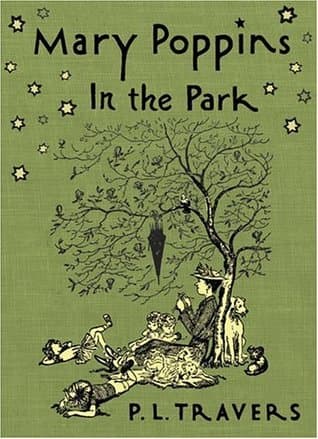
Synopsis
Covers the whole plot, including the ending.
- Difficulty
- Easy
- Pacing
- Moderate
- Mood
- Whimsical, Enchanting, Gentle, Nostalgic
- Read it if
- You love classic children's fantasy with whimsical adventures and a touch of British charm, and enjoy episodic storytelling.
- Skip it if
- You prefer a strong overarching plot or modern fantasy styles, or dislike a nanny character who is often aloof and a bit stern.
Mary Poppins in the Park Plot Summary
Covers the whole plot, including the ending.
A Walk in the Park
The story starts with Mary Poppins taking Jane, Michael, John, and Barbara Banks for a walk in the park on a bright spring afternoon. The children are happy about their outing. As they walk, Mary Poppins, who always seems to know more than she says, points out things that look ordinary but quickly become special. The park, a familiar place, turns into a doorway to magical events under her eye. The children, especially Jane and Michael, always look forward to what wonders Mary Poppins will reveal during their seemingly simple trips. This day is no different, as magic always follows her.
The Goosegirl and the Swineherd
During their walk, Mary Poppins leads the children to a quiet part of the park. There, they meet a beautiful Goosegirl and a sad Swineherd. These are not just people in costumes; they seem to be the actual characters from the fairy tale, with their animals. The Goosegirl is graceful, and the Swineherd talks about wanting the Princess and being unhappy with his life. Mary Poppins talks to them as if it is normal. The children are fascinated and a little confused by seeing storybook characters in their park. This meeting blurs the line between real life and stories for the children.
The Talking Cats of a Distant Planet
On another day, Mary Poppins takes the children to fly kites. Michael's kite flies higher and higher, seeming to pull them, and Mary Poppins, into the sky. They land on a distant planet, home to smart, talking cats. These cats discuss complex ideas with the children about existence, time, and human behavior. Jane and Michael argue with the cats, trying to explain human views, while Mary Poppins watches with a knowing smile. The experience is both confusing and thought-provoking for the children, broadening their understanding of the universe.
Under the Dandelions
One afternoon, while exploring a grassy area, Mary Poppins points out some dandelions. With a simple move, she shows them a hidden, tiny world underneath. Here, small, whimsical people live, doing their daily tasks, which are like human activities but on a tiny scale. The children watch, fascinated, as these dandelion-dwellers work, play, and talk. Mary Poppins explains their customs and conversations. This meeting shows that special life exists in the most unexpected and unnoticed places. It suggests that magic is part of nature, if one only knows how to look.
Shadow Dancing
Mary Poppins's birthday arrives, and it is a unique celebration. Instead of usual gifts and cake, she plans a special event. In the park, as the sun begins to set and cast long shadows, Mary Poppins teaches the children a special dance. As they move, their shadows separate and dance on their own, copying and sometimes adding to their owners' movements. The children are delighted by this playful, airy show. It is a joyful, whimsical celebration of self and light, showing Mary Poppins's ability to turn an ordinary event into a special, personal experience for the Banks children.
The Invisible Man
During another park visit, Mary Poppins and the children sit on a seemingly empty bench. However, Mary Poppins talks lively with an invisible friend, whom she calls 'Mr. Nobody.' The children, at first doubtful, soon notice small signs of his presence—a slight mark on the cushion, a rustle of leaves that seems to answer Mary Poppins's questions. Mr. Nobody is a kind and wise being, offering thoughts and observations. This encounter teaches the children to look past what is visible and trust in the unseen, helping their imagination and openness to mystery.
The Changing Seasons
One afternoon, Mary Poppins decides to show the children the true magic of changing seasons. She leads them to a certain spot in the park. With a simple, focused effort, the scenery around them begins to change. Spring blossoms quickly turn into summer's green, which then changes to autumn's colors, and finally, a soft blanket of winter snow. The children watch this fast cycle of nature in awe. They understand that Mary Poppins is not just observing the seasons, but is, in a subtle way, influencing and revealing their natural magic, making them feel the essence of each season quickly.
The Star-Gazers
Mary Poppins takes the children to the park late one evening for stargazing. Instead of just looking at the stars, she helps them understand and even interact with the constellations. The stars seem to shine brighter, and the children feel a deep connection to the vastness of space. Mary Poppins shares stories and legends of the stars, giving them personality and history. This experience broadens their view, making them feel part of something much bigger than themselves. It creates a sense of wonder and respect for the night sky and its old mysteries.
The Music of the Benches
During another visit, Mary Poppins draws the children's attention to the park benches. She explains that each bench, having seen countless talks and shared moments, holds its own 'music'—a collection of echoes from the past. By listening closely, guided by Mary Poppins, the children start to hear faint tunes and whispers coming from the wood and metal. These are not sounds in the usual sense, but a feeling of the emotions and stories the benches have absorbed over time. It is a lesson in empathy and the hidden history in everyday objects.
The End of the Day
As the day ends, Mary Poppins gathers Jane, Michael, John, and Barbara, and they begin their walk back to Number Seventeen Cherry-Tree Lane. The park, which had been a lively place for their adventures, slowly returns to its more ordinary look. The children are quiet, thinking about the special events they experienced. Mary Poppins, always mysterious, gives no explanation or comfort, simply guiding them home. They are left with vivid, impossible memories that only she seems able to create, showing her unique role in their lives as a bringer of wonder and magic.
Principal Figures
Mary Poppins
Protagonist
The enigmatic and magical nanny of the Banks children.
Mary Poppins is a mysterious, no-nonsense nanny who possesses extraordinary magical abilities. She is prim, proper, and often stern, yet she consistently introduces the Banks children to fantastical worlds and experiences. Her magic is never explicitly explained, but simply 'is,' and she often denies its existence even as she performs it. She views the world with a knowing eye, understanding the hidden wonders that most adults overlook. She is deeply attached to the children, though she expresses it in her own unique, often detached, way.
Relationships: Jane Banks (Nanny-charge, mentor); Michael Banks (Nanny-charge, mentor); John Banks (Nanny-charge); Barbara Banks (Nanny-charge)
Jane Banks
Supporting
The elder Banks child, more sensible and curious.
Jane is the eldest of the Banks children and often the most observant and thoughtful. She is curious and imaginative, but also possesses a streak of practicality that sometimes makes her question the fantastical events orchestrated by Mary Poppins. She grapples with understanding the line between reality and magic, often trying to rationalize the impossible, yet she ultimately embraces the wonder. Jane is protective of her younger siblings and tries to make sense of the world around her, both ordinary and extraordinary.
Relationships: Mary Poppins (Charge-nanny, student); Michael Banks (Sibling); John Banks (Sibling); Barbara Banks (Sibling)
Michael Banks
Supporting
The mischievous and adventurous middle Banks child.
Michael is Jane's younger brother and is often more impulsive and prone to mischief. He is readily accepting of Mary Poppins's magic, often diving into adventures without much hesitation. He has a vivid imagination and a keen sense of wonder. Michael is sometimes stubborn but possesses a good heart. He often asks direct questions about the magic, though Mary Poppins rarely provides straightforward answers. His enthusiasm for the fantastical is infectious and drives many of their adventures.
Relationships: Mary Poppins (Charge-nanny, student); Jane Banks (Sibling); John Banks (Sibling); Barbara Banks (Sibling)
John Banks
Supporting
One of the Banks twins, still very young.
John is one of the youngest Banks children, a twin to Barbara. Still a toddler, his understanding of the world is developing, but he is nonetheless exposed to Mary Poppins's magic. He often observes the fantastical events with wide-eyed wonder, absorbing the experiences on a more instinctual level than his older siblings. His reactions are often simple and pure, reflecting the unfiltered joy and surprise of a very young child encountering the impossible. He is less vocal but deeply engaged in the magical world.
Relationships: Mary Poppins (Charge-nanny); Barbara Banks (Twin sibling); Jane Banks (Older sibling); Michael Banks (Older sibling)
Barbara Banks
Supporting
One of the Banks twins, sharing John's youthful wonder.
Barbara is John's twin sister and shares his innocent perspective on the magical events. Like John, she is too young to fully articulate her experiences but her reactions of delight and awe are clear. She is a gentle and receptive participant in the adventures, often mirroring her twin's responses. Her presence emphasizes the universal appeal of Mary Poppins's magic, touching even the youngest members of the family and instilling a sense of wonder from a very early age, laying the groundwork for a childhood filled with enchantment.
Relationships: Mary Poppins (Charge-nanny); John Banks (Twin sibling); Jane Banks (Older sibling); Michael Banks (Older sibling)
Goosegirl
Mentioned
A character from a fairy tale encountered in the park.
The Goosegirl is a beautiful and serene character from a classic fairy tale, seemingly brought to life in the park. She tends to her geese with a quiet grace, embodying the timeless innocence and simple beauty of her storybook origins. She speaks with a gentle wisdom, her presence adding a layer of enchantment and wonder to the children's outing. Her interaction with Mary Poppins and the children underscores the theme of stories coming to life and the blending of different realities within the park.
Relationships: Swineherd (Fellow fairy tale character, unrequited love interest); Mary Poppins (Acquaintance)
Swineherd
Mentioned
A character from a fairy tale, longing for his princess.
The Swineherd is a melancholic and somewhat frustrated character from a fairy tale, also found residing in the park. He expresses his longing for the Princess and his weariness with his current task of tending pigs, despite his ingenuity with a magical pot. His presence juxtaposes the romantic ideal of fairy tales with the mundane reality of his situation, bringing a touch of bittersweet realism to the magical encounter. He is a reminder that even in enchanted worlds, characters have their own struggles and desires.
Relationships: Goosegirl (Fellow fairy tale character, platonic acquaintance); Mary Poppins (Acquaintance)
Talking Cats
Mentioned
Philosophical felines from a distant planet.
These are highly intelligent and articulate cats encountered on a distant planet after the children's kite-flying adventure. They engage the Banks children in complex, philosophical debates and observations about human nature, the universe, and their own feline existence. They are opinionated, sometimes critical, and always insightful, challenging the children's preconceived notions about intelligence and communication. Their existence broadens the children's understanding of different forms of life and ways of thinking beyond Earth.
Relationships: Mary Poppins (Acquaintances, equals in wisdom); Jane Banks (Debate partners); Michael Banks (Debate partners)
Mr. Nobody
Mentioned
An invisible friend encountered on a park bench.
Mr. Nobody is an invisible, benevolent entity who Mary Poppins converses with on a park bench. Though unseen, his presence is subtly felt, and he is portrayed as kind, wise, and observant. He offers insights and perspectives that enrich the children's understanding of their surroundings and the unseen world. His character encourages the children to engage their imagination and to perceive beyond the obvious, fostering a belief in the existence of things that defy conventional sight.
Relationships: Mary Poppins (Friend, conversational partner); Jane Banks (Unseen acquaintance); Michael Banks (Unseen acquaintance)
Themes & Insights
The Magic of the Everyday
This theme shows how special enchantment can be found in common places, especially the local park. Mary Poppins always reveals hidden wonders in familiar settings, turning a simple walk into a meeting with fairy tale characters (the Goosegirl and Swineherd) or a patch of dandelions into a tiny world. This theme encourages readers to look beyond the surface of daily life and find the magic that exists around them, as Mary Poppins teaches the Banks children.
“Anything can happen if you let it.”
Imagination and Perception
The book strongly highlights the power of imagination and the importance of an open mind. Mary Poppins does not just create magic; she often reveals it, suggesting it was always there, waiting to be seen. The children's ability to talk with cats on a distant planet or hear the 'music' of park benches depends on their willingness to believe and expand their understanding of reality. This theme shows that magic is not only outside, but also within the observer's mind and their ability to feel wonder.
“It is not what you look at that matters, it's what you see.”
The Blurring of Reality and Fantasy
Mary Poppins always blurs the lines between what is real and what is fantasy. Fairy tale characters appear in the park, objects come alive, and the children travel to other planets. Mary Poppins treats these events as completely normal, making the children (and the reader) question what 'reality' means. The book suggests that the difference between the two is fluid and often depends on how one sees things, making the world a more exciting and surprising place where anything is possible.
“The world is full of magic things, patiently waiting for our senses to grow sharper.”
Childhood Wonder and Innocence
The younger Banks children, especially John and Barbara, show pure childhood wonder, accepting the magic without question. Jane and Michael, though older and more doubtful, are always pulled back into this state of awe by Mary Poppins. The book celebrates and protects this childlike ability to believe and be open-minded, suggesting it is a valuable quality that adults often lose. Mary Poppins acts as a guardian of this innocence, making sure the children's early years are full of enchantment and possibility before the 'real' world fully takes over.
“In every job that must be done, there is an element of fun. You find the fun, and snap! The job's a game!”
Plot Devices & Literary Techniques
Magical Realism
Integrating fantastical elements seamlessly into an ordinary setting.
The primary plot device is magical realism, where extraordinary, impossible events occur within a realistic, everyday setting (the park, the Banks's home). Mary Poppins's magic is never questioned or explained by the narrative; it simply exists. This allows the reader to accept the fantastical as part of the normal, creating a sense of wonder and encouraging a suspension of disbelief. The talking cats, dancing shadows, and living fairy tale characters are presented without fanfare, making the magic feel organic to the world.
The Enigmatic Nanny
Mary Poppins's mysterious and unexplained powers.
Mary Poppins herself functions as a key plot device. Her origins, the source of her magic, and her comings and goings are always left unexplained. This enigmatic nature creates a constant sense of wonder and anticipation. Her refusal to acknowledge her own magic or answer direct questions about it forces the children (and the reader) to simply accept the fantastical as it happens, rather than seeking rational explanations. She is a catalyst for adventure, her presence alone sufficient to transform the mundane.
Anthropomorphism
Giving human characteristics or abilities to non-human entities.
Anthropomorphism is used throughout the stories to bring the inanimate and animal world to life. This is evident in the talking cats on a distant planet, the ability to discern the 'music' of park benches, and even the shadows that dance independently. This device allows for deeper philosophical discussions and expands the children's understanding of consciousness and communication beyond human forms, enriching the magical world and emphasizing the interconnectedness of all things.
The Ordinary Gateway
Everyday locations serving as portals to magical realms.
The park itself acts as an 'ordinary gateway.' What appears to be a common public space repeatedly transforms into a portal or setting for extraordinary encounters. A simple walk leads to fairy tale characters, a kite flies to another planet, and dandelions hide miniature civilizations. This device underscores the theme that magic is not distant or hidden, but often lies just beneath the surface of the familiar, accessible through an open mind and, of course, the guidance of Mary Poppins.
Mary Poppins in the Park Quotes
“The wind, as if it had waited for this signal, gave a sudden gust, and for a moment the whole Park seemed to be filled with the sound of a great sigh.”
“For a moment she looked at them, her head a little on one side, as though she were listening to something they could not hear.”
“A world of wonders, thought Jane, if only one knew how to look at it.”
“It was not a thing that could be put into words, but it was there, like the taste of honey or the smell of rain.”
“She never explained anything, and yet everything was always perfectly clear.”
“The world was full of secrets, and some of them were very close at hand.”
“One had to be very careful with wishes; they often came true in the most unexpected ways.”
“For Mary Poppins, the ordinary was merely a disguise for the extraordinary.”
“The Park was not merely a place; it was a living, breathing entity, with its own moods and memories.”
“Even the smallest thing, if looked at in the right way, could hold a universe.”
“She smoothed her gloves, a tiny, almost imperceptible gesture that somehow managed to convey both disapproval and profound understanding.”
“It was impossible to be cross with Mary Poppins for very long, even when she was at her most exasperating.”
“The air itself seemed to hum with a secret, as though it knew something they didn't.”
“All roads, if you waited long enough, led to somewhere interesting.”
Quiz
10 questions on the plot and the characters. Each answer comes with a short explanation.
Question 1
What unique activity do Mary Poppins and the Banks children do with their shadows to celebrate a birthday?
- They paint them with magical colors.
- They teach them to sing and dance.
- They make them disappear for the day.
- They have them deliver birthday presents.
Show answer
B. They teach them to sing and dance. The book describes Mary Poppins and the children celebrating a birthday by dancing with their own shadows, a magical and memorable event.
Question 2
Which specific animal do the Banks children and Mary Poppins argue with on a distant planet?
- Talking dogs
- Talking cats
- Talking birds
- Talking mice
Show answer
B. Talking cats One of the adventures mentioned is arguing with talking cats on a distant planet, highlighting the fantastical elements of the series.
Question 3
Who are the two specific characters from a classic fairy tale that Mary Poppins and the children meet?
- Hansel and Gretel
- The Goosegirl and the Swineherd
- Little Red Riding Hood and the Wolf
- Jack and the Beanstalk giant
Show answer
B. The Goosegirl and the Swineherd The summary explicitly states that they meet the Goosegirl and the Swineherd, characters from a well-known fairy tale.
Question 4
What is the primary role of Mary Poppins at the Banks house?
- A cook
- A tutor
- A nanny
- A housekeeper
Show answer
C. A nanny The description clearly identifies Mary Poppins as 'the world's most beloved nanny,' indicating her role in the Banks household.
Question 5
What is the central theme that Mary Poppins brings to the everyday life at the Banks house?
- Strict discipline and order
- Enchantment and excitement
- Practical life lessons and chores
- Quiet reflection and study
Show answer
B. Enchantment and excitement The text states that Mary Poppins 'brings enchantment and excitement with her everywhere she goes,' defining her primary impact.
Question 6
Where is the specific address of the Banks house where Mary Poppins arrives?
- Number Ten Elm Street
- Number Seventeen Cherry-Tree Lane
- Number Twenty-Two Oak Avenue
- Number Five Willow Walk
Show answer
B. Number Seventeen Cherry-Tree Lane The introduction specifies, 'From the moment Mary Poppins arrives at Number Seventeen Cherry-Tree Lane,' making this a key detail.
Question 7
What specific type of plant are the 'folks' that Mary Poppins and the children make acquaintance with said to live under?
- Mushrooms
- Roses
- Dandelions
- Ferns
Show answer
C. Dandelions The summary mentions they 'make the acquaintance of the folks who live under dandelions,' a specific and whimsical detail.
Question 8
Beyond the immediate adventures, what larger impact does Mary Poppins consistently have on the Banks children's experiences?
- She teaches them advanced academic subjects.
- She helps them develop practical household skills.
- She leads them on one marvelous adventure after another.
- She encourages them to stay indoors and read.
Show answer
C. She leads them on one marvelous adventure after another. The text states, 'Only the incomparable Mary Poppins can lead the Banks children on one marvelous adventure after another,' emphasizing her role as an instigator of constant wonder.
Question 9
How does P.L. Travers's authorship relate to a major motion picture, as mentioned in the description?
- She wrote the screenplay for 'Saving Mr. Banks'.
- She was the subject of the film 'Saving Mr. Banks', which depicted her interactions regarding the Mary Poppins film adaptation.
- She composed the musical score for 'Saving Mr. Banks'.
- She acted in 'Saving Mr. Banks' as a cameo.
Show answer
B. She was the subject of the film 'Saving Mr. Banks', which depicted her interactions regarding the Mary Poppins film adaptation. The description notes P.L. Travers as 'the author featured in the major motion picture, Saving Mr. Banks,' referring to the film about her negotiations with Walt Disney for the movie adaptation.
Question 10
What specific artistic contribution is highlighted as being part of these new editions of the Mary Poppins series?
- New illustrations by a contemporary artist.
- Digitally enhanced photographs of London.
- The charming original cover art by Mary Shepard.
- Interactive augmented reality features.
Show answer
C. The charming original cover art by Mary Shepard. The text specifies that the new editions feature 'the charming original cover art by Mary Shepard,' highlighting the preservation of classic artistic elements.
Mary Poppins in the Park FAQ
What is the central premise of 'Mary Poppins in the Park'?
The book follows Mary Poppins and the Banks children, Jane and Michael, during a series of fantastical adventures in the park. These adventures unfold on a single afternoon, showcasing Mary Poppins' magical abilities and her unique interactions with various mythical and ordinary creatures.
Who are the primary human characters in this installment?
The primary human characters are Mary Poppins, the enigmatic and magical nanny, and the Banks children, Jane and Michael. They are the constant companions throughout the various escapades in the park, witnessing and participating in the extraordinary events.
Can you describe one of the more unusual encounters the children have?
One particularly unusual encounter involves Jane and Michael meeting the Goosegirl and the Swineherd, characters seemingly from a fairytale. They also argue with talking cats on a distant planet, which is accessed through a magical means orchestrated by Mary Poppins.
What role do the talking cats play in the narrative?
The talking cats are encountered on a 'distant planet' and engage Jane and Michael in a philosophical debate. They represent a challenge to the children's preconceived notions and showcase Mary Poppins' ability to transport them to other realms of existence and understanding.
How does the book explore the concept of a 'birthday' in a magical way?
The book features a unique birthday celebration where the children dance with their own shadows. This magical event blurs the line between reality and fantasy, suggesting that even mundane occasions can be imbued with wonder through Mary Poppins' influence.
Is there a connection between the folks under dandelions and any other characters in the Mary Poppins universe?
The folks who live under dandelions are unique to this particular adventure, representing the hidden life and magic within the natural world. While not directly linked to other recurring characters, their existence reinforces the theme of a vibrant, unseen world coexisting with the familiar.
What subtle clues suggest Mary Poppins' true nature or origin in this book?
Mary Poppins' ability to instantly transport the children to distant planets, conjure magical beings, and communicate with animals and inanimate objects subtly hints at her being more than just a nanny. Her profound understanding of the universe and its hidden layers suggests a supernatural or cosmic origin.
Are there any recurring magical items or motifs from previous books in 'Mary Poppins in the Park'?
While the focus is on new adventures, the underlying motif of everyday objects and settings transforming into magical portals or experiences is consistent with the series. Mary Poppins' umbrella and carpet bag, though not always explicitly central, symbolize her power and readiness for enchantment.
How do Jane and Michael's reactions to the fantastical events evolve throughout the story?
Initially, Jane and Michael are often surprised or even a little frightened by the magical occurrences. However, as the afternoon progresses and they encounter more wonders, they gradually become more accepting and even participatory, learning to embrace the extraordinary as part of their reality with Mary Poppins.
What psychological impact does Mary Poppins have on the children?
Mary Poppins' presence subtly broadens the children's perspectives, encouraging imagination, critical thinking (as seen in their debate with the cats), and an appreciation for the unseen. She challenges their assumptions and fosters a sense of wonder, nudging them towards a deeper understanding of the world.
How does the encounter with the Goosegirl and Swineherd reflect on the children's understanding of storytelling?
Meeting the Goosegirl and Swineherd blurs the line between classic fairytales and reality for Jane and Michael. It teaches them that stories can be living, breathing entities, and that the characters they read about might exist in unexpected ways, enriching their imaginative world.
What is the significance of the children dancing with their shadows?
Dancing with their shadows symbolizes an acceptance of their inner selves and perhaps even their darker or less understood aspects. It represents a playful yet profound engagement with identity and the ephemeral nature of self, guided by Mary Poppins' magic.
Is there an overarching moral or lesson P.L. Travers intends to convey in this book?
P.L. Travers often subtly conveys the importance of imagination, the hidden magic in everyday life, and a deeper spiritual understanding. The book encourages readers to look beyond the surface, suggesting that wonder and enchantment are always present if one only knows how to see them.
How does the single-afternoon setting contribute to the book's themes?
Confining all the adventures to a single afternoon intensifies the magical experience, making it feel both fleeting and incredibly dense with wonder. It emphasizes that profound experiences don't require vast amounts of time, only the right perspective and the presence of someone like Mary Poppins.
What does the 'distant planet' symbolize in the context of the children's journey?
The 'distant planet' symbolizes the vastness of existence and the endless possibilities beyond conventional reality. It represents a journey not just through space, but through different modes of thought and perception, challenging the children to expand their understanding of the universe.
How does Mary Poppins' stoic demeanor contrast with the fantastical events around her?
Mary Poppins' unwavering, no-nonsense demeanor provides a grounding contrast to the surrounding fantastical chaos. Her calm acceptance of the extraordinary makes the magic seem more real and integrated into the fabric of existence, rather than a mere spectacle.
Are there any deeper mythological or folkloric inspirations for the characters encountered?
Yes, characters like the Goosegirl and the Swineherd are direct allusions to classic European folklore and fairy tales. P.L. Travers often drew upon such rich mythological sources to imbue her stories with timeless archetypal resonance and a sense of ancient magic.
What is the significance of the park as the primary setting for these adventures?
The park, an ordinary urban space, becoming the gateway to extraordinary realms emphasizes the book's theme that magic can be found in the mundane. It suggests that wonder isn't confined to far-off lands but is accessible in familiar surroundings, if one has the right guide.
About the author

P.L. Travers was an Australian-born author best known for her children's literature, particularly the "Mary Poppins" series. Her notable works include "Mary Poppins" and "Mary Poppins in the Park," which feature the magical nanny and her adventures. Travers' creation of Mary Poppins has had a lasting impact on popular culture and has been adapted into various films and stage productions.
Similar books
- Mary Poppins
P.L. Travers
4.0 (115k) average on GoodreadsFantasyDirectly related, shares characters and whimsical, episodic style.
- Alice's Adventures in Wonderland
Lewis Carroll
4.0 (245k) average on GoodreadsFantasyFeatures a child protagonist entering a series of illogical, fantastical encounters.
- Harry Potter and the Sorcerer's Stone
J.K. Rowling
4.5 (7M) average on GoodreadsFantasyRescued from a miserable life under the stairs, an orphaned boy discovers he's a wizard destined for a magical school, where he uncovers a dangerous secret tied to the dark wizard who murdered his parents.
- The Hunger Games
Suzanne Collins
4.3 (6.4M) average on GoodreadsFantasyIn a future where children fight to the death on live television, Katniss Everdeen volunteers for the arena, turning a death sentence into a fight for survival and a spark of rebellion.
- 1984
George Orwell
4.2 (3.1M) average on GoodreadsPoliticsIn a future where surveillance and thought control are absolute, a man's search for truth clashes with the Party, showing that hope can be a form of rebellion.
- Divergent
Veronica Roth
4.2 (2.9M) average on GoodreadsFantasyIn a society divided by virtues, a sixteen-year-old's difference from the norm starts a rebellion that threatens her world.




Enjoyed the summary?
A summary gives you the shape of the book. The book itself has the detail, the examples and the voice.
Find Mary Poppins in the Park on AmazonAs an Amazon Associate, BookBrief earns from qualifying purchases. How we're funded