

Synopsis
Covers the whole plot, including the ending.
- Difficulty
- Medium
- Pacing
- Moderate
- Mood
- Dark, Intense, Thought-provoking, Empowering
- Read it if
- You enjoy speculative fiction that explores themes of power, control, genetic manipulation, and the struggle for freedom, with a focus on psychic abilities and societal evolution.
- Skip it if
- You prefer lighthearted stories, are uncomfortable with themes of eugenics and psychological manipulation, or dislike morally ambiguous characters.
Mind of My Mind Plot Summary
Covers the whole plot, including the ending.
Doro's Immortality and His Children
Doro is an ancient, immortal entity who has existed for thousands of years by transferring his consciousness from one body to another upon the death of the previous host. He is a 'flesh-eater,' meaning he consumes the life-force of others to sustain himself and facilitate his transfers, though he prefers to do so only when necessary. For millennia, Doro has been manipulating human evolution, breeding specific lines of people to produce powerful psychics, whom he calls his 'children.' He sees himself as a shepherd, guiding humanity towards a new, superior species. He maintains a network of human 'collectors' who identify individuals with latent psychic abilities and bring them to his various compounds for breeding and observation, often with little regard for the individuals' autonomy. His ultimate goal is to create a fully realized psychic race.
Anyanwu's Arrival and Doro's Pursuit
Thousands of years before the main narrative, Doro encounters Anyanwu, a powerful African shapeshifter who is also immortal, able to heal from any injury and change her form at will. Unlike Doro, Anyanwu is connected to life and nature, finding Doro's methods of control and his disregard for individual lives abhorrent. Despite their differences, Doro is fascinated by her unique immortality and believes she can contribute to his breeding program, particularly by bearing children who might inherit both their unique traits. He pursues her relentlessly, eventually coercing her into a partnership and marriage, promising her a life of purpose and a place in his evolving society. Their relationship has much tension, as Anyanwu struggles against Doro's possessiveness and his callousness towards others.
Mary's Awakening and Early Life
Mary is born in a poor, predominantly Black neighborhood in the American South, a direct descendant of Doro's carefully managed bloodlines. She is a 'seed' — a latent psychic with immense potential. Her early life has poverty and a sense of being different, though she doesn't understand why. She experiences strange sensations and an intuitive understanding of people, which she initially dismisses or struggles to interpret. Her family is unaware of her true heritage or the powerful abilities dormant within her. As she grows into adolescence, these latent abilities begin to manifest subtly, causing her confusion and a feeling of alienation from those around her. She wants connection but also fears her own unexplained inner world.
Mary's Introduction to Doro's World
Upon reaching puberty, Mary's psychic abilities fully awaken, a powerful and overwhelming experience. She becomes a 'Patternist,' able to link with and control other psychics, forming a collective mind. This sudden surge of power is disorienting and terrifying, as she inadvertently hurts people with her uncontrolled mental projections. Her awakening immediately draws the attention of Doro, who has been monitoring his breeding lines for such a powerful emergence. He sends his agents to find her and bring her to one of his compounds. Mary is initially resistant and frightened, but Doro, through manipulation and the promise of understanding and control, persuades her to join his community of psychics. She is introduced to a world she never knew existed, filled with others like her, though none as powerful.
Mary's Training and Growing Power
Under Doro's guidance, Mary begins to understand and control her vast psychic abilities. She learns about the 'Pattern,' a collective mental network she can form with other psychics, allowing them to share thoughts, emotions, and even memories. As she practices, her power grows exponentially, and she quickly surpasses all other psychics in Doro's community. She finds herself naturally gravitating towards leadership, though she is still under Doro's strict supervision. Doro is both proud and wary of her rapid development, recognizing her potential but also sensing a nascent challenge to his absolute authority. Mary, for her part, grapples with the ethical implications of her power and Doro's often ruthless methods.
The Pattern's Expansion and Doro's Concerns
Mary begins to actively expand the Pattern, connecting with more psychics, not just those Doro has chosen. She discovers that many latent psychics exist outside Doro's immediate circles and brings them into the collective. This vast, interconnected network gives the psychics a sense of community and shared purpose, creating a collective identity independent of Doro. As the Pattern grows stronger, it also empowers individual psychics, giving them autonomy and strength they lacked before. Doro observes this with growing alarm. He had intended for his psychics to be powerful, but still subservient to him. Mary's Pattern, however, is becoming a self-sustaining entity, a true collective consciousness that could exist without him.
Anyanwu's Perspective and Alliance with Mary
Anyanwu, who has endured centuries of Doro's possessiveness and manipulation, witnesses Mary's rise with hope and trepidation. She sees in Mary a power and a moral compass that could finally challenge Doro's millennia-long reign. Anyanwu has always been repulsed by Doro's cold pragmatism and his treatment of his 'children' as breeding stock. She subtly begins to advise and support Mary, sharing her insights into Doro's character and vulnerabilities. Their alliance is unspoken at first, a mutual understanding that Mary represents the best chance for the psychics to achieve true freedom and self-determination, rather than remaining Doro's genetic experiment.
The Confrontation and Psychic War
As Mary's Pattern solidifies and the psychics gain a collective voice, Mary directly confronts Doro. She demands that he relinquish his absolute control over their lives and allow them to govern themselves. Doro, who has never known any challenge to his authority, refuses. He views the psychics as his property, his creations, and believes they cannot survive without his guidance. This ideological clash escalates into a psychic war. Doro, with his personal power and experience, tries to dismantle the Pattern and reassert his dominance. Mary, backed by the collective power of the Pattern and Anyanwu's subtle support, fights back, using the shared strength of her people against him. The battle is cataclysmic, causing widespread physical and mental devastation.
Doro's Defeat and the New World
The psychic battle reaches a climax, with Mary, as the nexus of the Pattern, facing Doro directly. The collective will and power of the Pattern prove too much for Doro, despite his individual strength. He is overwhelmed, his mind shattered and reformed by the collective consciousness of the Pattern. He is not destroyed, but he is fundamentally changed, forced to experience the pain and suffering he has inflicted over the millennia. Mary, demonstrating her power and a desire for a new future, does not kill him. Instead, she integrates him into the Pattern, forcing him to become a part of the collective rather than its sole master. This act establishes the psychics' autonomy and Mary's leadership. Anyanwu, witnessing Doro's defeat, finally feels peace and vindication.
The Birth of the Patternists
With Doro integrated and his absolute rule ended, the psychics, now calling themselves Patternists, begin to forge their own destiny under Mary's guidance. They establish communities where they can live openly and safely, free from Doro's manipulative breeding programs. The Pattern continues to grow, evolving into a complex, self-aware collective consciousness. Mary, while leading, ensures that individual autonomy within the Pattern is respected. Doro, now a part of the Pattern, is forced to witness and participate in the growth of the species he created but could not control. The novel concludes with the Patternists stepping into a new era, having achieved self-determination and beginning the journey of building a new psychic civilization, laying the groundwork for future generations and the world of the Patternist series.
Principal Figures
Doro
Antagonist/Creator
Ancient, immortal entity who breeds humans for psychic abilities, seeking to create a master race.
Doro is an ancient, parasitic immortal who survives by possessing new human bodies, consuming the life-force of others in the process. For 4,000 years, he has meticulously managed human breeding lines across continents, aiming to cultivate a race of powerful psychics. He is intelligent, manipulative, and utterly ruthless, viewing his 'children' as experiments and tools rather than individuals. He cares for the species he is creating but has little empathy for the suffering of individuals. His ultimate goal is to create a superior psychic race that can survive and thrive, but always under his absolute control. He represents a kind of detached, paternalistic god figure.
Relationships: Mary (Creator/creation, then antagonist/protagonist in a power struggle); Anyanwu (Husband/wife, captor/captive, manipulative partner); Patternists (Master/servant, breeder/stock)
Mary
Protagonist
Powerful latent psychic who awakens to become the nexus of the Pattern and leader of the Patternists.
Mary is a young Black woman born in poverty, unknowingly a product of Doro's breeding program. She possesses an unprecedented level of latent psychic power, which fully awakens at puberty, allowing her to link with and control other psychics to form a collective consciousness, the 'Pattern.' Initially overwhelmed and fearful of her abilities, she quickly learns to master them. Mary is compassionate, fiercely independent, and possesses a strong moral compass that clashes with Doro's utilitarianism. She becomes the reluctant leader of the nascent psychic species, fighting for their freedom and self-determination against Doro's tyranny.
Relationships: Doro (Creation/creator, then challenger/opponent); Anyanwu (Ally, mentor, friend); Patternists (Leader, nexus, protector)
Anyanwu
Supporting
An ancient, immortal African shapeshifter, Doro's mate, who mentors Mary.
Anyanwu is an ancient, powerful immortal from Africa, a shapeshifter capable of healing from any injury and changing her physical form at will. She is deeply connected to life, nature, and empathy, making her a stark contrast to Doro's cold, calculating nature. Doro forcibly takes her as his mate and partner in his breeding experiments, drawn by her unique immortality. She endures centuries of his possessiveness and cruelty, always yearning for true freedom and respect. She sees Mary as the potential liberator of Doro's 'children' and becomes a crucial, if subtle, ally and mentor to Mary, sharing her wisdom and understanding of Doro.
Relationships: Doro (Wife/husband, captive/captor, reluctant partner); Mary (Mentor, ally, friend)
Emma
Supporting
A powerful psychic and one of Doro's oldest 'children,' initially loyal to him.
Emma is one of Doro's oldest and most powerful psychic 'children,' having been part of his communities for a long time. She is fiercely loyal to Doro, having known no other life or authority, and initially views Mary with suspicion and jealousy. She is a strong telepath and telekinetic, accustomed to Doro's hierarchical system. As Mary's Pattern grows, Emma struggles with her ingrained loyalty to Doro versus the undeniable power and promise of the new collective. Her arc reflects the internal conflict of many psychics caught between the old order and the new.
Relationships: Doro (Loyal subordinate, 'child'); Mary (Rival, then fellow Patternist)
Karl
Supporting
A psychic who becomes one of Mary's early connections in the Pattern.
Karl is one of the psychics Mary connects with early in her awakening. He is a relatively stable and well-adjusted psychic within Doro's community, offering a more grounded perspective than some of the others. He is a telepath, and his connection with Mary helps her understand the potential and implications of the Pattern. He represents the ordinary psychics who are given a voice and agency through Mary's leadership, moving from being Doro's subjects to self-determining members of the Patternist species.
Relationships: Mary (Early Pattern connection, follower); Doro (Subject)
Sarah
Supporting
Mary's younger sister, who initially struggles to understand Mary's changes.
Sarah is Mary's younger sister, who, unlike Mary, does not possess psychic abilities. She represents the 'normal' human world that Mary comes from. Sarah struggles to understand the profound changes in Mary after her awakening and her departure into Doro's world. Her perspective highlights the vast gulf between ordinary humanity and the emerging psychic species. While not a central figure in the psychic conflict, her presence grounds Mary's early experiences in a relatable human context and shows the impact of Mary's transformation on her family.
Relationships: Mary (Sister)
The Collectors
Mentioned/Supporting
Human agents who identify and bring latent psychics to Doro.
The Collectors are ordinary humans, or sometimes less powerful psychics, who work for Doro. Their role is to identify individuals with latent psychic abilities, often children or adolescents, and bring them to Doro's various compounds for breeding and integration into his communities. They operate in secrecy, often using manipulation or coercion, and are largely unaware of the full scope of Doro's plans. They represent the human infrastructure Doro uses to maintain his ancient breeding program, acting as his eyes and hands in the wider world.
Relationships: Doro (Servants, agents)
The Patternists (as a collective)
Supporting/Collective Protagonist
The emerging psychic species, united by Mary's Pattern.
The Patternists are the collective of psychics, Doro's 'children,' who are brought together and unified by Mary's immense power. Initially a disparate group of individuals with varying abilities and levels of control, they become a true collective consciousness through the Pattern. They represent the future of humanity, a new species capable of immense mental feats, shared consciousness, and self-governance. Their collective strength allows them to overcome Doro's individual power and establish their autonomy, embodying the theme of collective empowerment.
Relationships: Mary (Collective led by her); Doro (Formerly his subjects, then his conquerors)
Themes & Insights
Identity and Self-Determination
The central struggle of the novel is about the right of Doro's 'children' to define themselves and their future, rather than being extensions of his will. Mary's journey is one of self-discovery, embracing her power, and then using it to forge a collective identity for the psychics. The Pattern's formation is an act of collective self-determination, as the psychics choose to govern themselves and evolve on their own terms, breaking free from Doro's control and his definition of their purpose. This theme shows the importance of agency and freedom for a nascent species.
“He had made them, but he hadn't made them his. Not in the way that mattered.”
Power and Control vs. Empathy and Connection
The novel contrasts Doro's exercise of power—cold, manipulative, and focused on control and breeding—with Mary's approach, which emphasizes empathy, connection, and collective well-being. Doro treats individuals as means to an end, sacrificing personal autonomy for the perceived good of the species. Mary, however, builds the Pattern on shared understanding and mutual support, valuing individual lives while fostering collective strength. Anyanwu, with her empathy, is a moral counterpoint to Doro, showing the destructive nature of unchecked power without compassion. The Pattern's ultimate victory suggests that true strength is in connected empathy, not solitary control.
“He was a shepherd, but a shepherd who sometimes ate his flock.”
Evolution and the Creation of a New Species
At its heart, the book explores the deliberate and accidental evolution of a new human species: the Patternists. Doro initiates this process through selective breeding over thousands of years, acting as a god-like figure. However, the actual evolution of the species' collective consciousness, the Pattern, is an emergent property that surpasses Doro's original intent. Mary's role is not just to lead, but to facilitate this evolutionary leap, guiding the psychics from disparate individuals to a unified, self-aware entity. The novel questions the ethics of guided evolution and celebrates the resilience of life to forge its own path, even beyond its creator's design.
“You are my children. I made you. I will guide you.”
The Nature of Immortality
The novel presents two distinct forms of immortality through Doro and Anyanwu, exploring their psychological and moral implications. Doro's immortality, based on body-hopping and life-force consumption, leads to detachment, isolation, and a utilitarian view of human life. He becomes a 'flesh-eater,' perpetuating a cycle of death to sustain himself. Anyanwu's immortality, through shapeshifting and natural healing, connects her to life and the earth, making her more empathetic but also susceptible to Doro's control. Their contrasting experiences show how the nature of one's immortality can shape one's ethics and worldview, and the potential for both wisdom and cruelty over millennia.
“He had lived too long to care about individual lives, only the species.”
Family and Legacy
The concept of family is central, though twisted by Doro's breeding program. He sees the psychics as his 'children' and his family, but his relationship with them is one of ownership and control, not nurturing. Mary's emergence creates a new kind of family—a psychic collective, the Pattern—where bonds are forged through shared consciousness and mutual respect. The novel examines the legacy of a creator, Doro, whose 'children' ultimately surpass and redefine his original vision, creating a legacy of their own that is both a continuation and a rejection of his initial designs. It questions what it truly means to be a parent and what responsibilities come with creation.
“They were his. His children. His creations. But they were also hers.”
Plot Devices & Literary Techniques
The Pattern
A collective psychic consciousness that unifies the Patternists.
The Pattern is the central plot device and a unique psychic phenomenon. It is a vast, interconnected mental network formed by psychics, initially facilitated and later led by Mary. It allows for shared thoughts, emotions, and experiences, creating a collective consciousness. The Pattern serves as the primary source of power for the psychics, enabling them to resist and ultimately defeat Doro. It represents the evolution of the species, a form of collective intelligence and a symbol of their unity and self-determination. Its formation and growth drive the narrative conflict and signify the birth of a new era for the psychic species.
Doro's Breeding Program
The millennia-long, selective breeding of humans to cultivate psychic abilities.
Doro's breeding program is the foundational plot device that sets the entire narrative in motion. For thousands of years, Doro has systematically manipulated human reproduction, selecting individuals with latent psychic traits and orchestrating their unions to produce increasingly powerful psychic offspring. This program explains the existence of the psychics and their varied abilities. It also establishes Doro's role as a controlling, god-like figure and highlights the ethical dilemmas inherent in his quest for a 'master race,' as he treats humans as mere genetic material. The program's ultimate outcome, Mary and the Pattern, ironically defies Doro's absolute control.
Immortality (Doro's and Anyanwu's)
Contrasting forms of eternal life that shape character motivations and the world.
The distinct forms of immortality possessed by Doro and Anyanwu serve as crucial plot devices. Doro's body-hopping, life-force-consuming immortality enables his millennia-long breeding program and fuels his detached, utilitarian worldview. It explains his ancient knowledge and his ability to survive. Anyanwu's shapeshifting and regenerative immortality provide her with a unique perspective, a deep connection to life, and a means to escape Doro's physical control, though not his emotional manipulation. Their contrasting immortal natures underscore the novel's themes of power, empathy, and the long-term psychological effects of eternal life, driving their conflict and their interactions with the mortal psychics.
Psychic Abilities (Telepathy, Telekinesis, etc.)
The diverse mental powers that define the emerging species and fuel the conflict.
The various psychic abilities possessed by Doro, Mary, and the other psychics are fundamental plot devices. These powers, including telepathy, telekinesis, precognition, and the ability to link minds, are the very essence of the new species Doro is trying to create. They are the source of both their strength and their vulnerability. The manifestation, control, and collective use of these abilities drive the plot, particularly during the psychic war between Mary and Doro. The specific nature of these powers—especially Mary's unique ability to form and lead the Pattern—determines the course of the conflict and the ultimate triumph of the Patternists.
Mind of My Mind Quotes
“The price of being unique is loneliness.”
“Change is a good thing. Change is a necessary thing. And sometimes, change is the only thing.”
“You can't solve all the world's problems. You can only solve the ones you're given.”
“Power corrupts, and absolute power corrupts absolutely. But powerlessness also corrupts.”
“To be human is to be flawed. To be human is to be capable of great good and great evil.”
“The greatest prison is a mind closed to new possibilities.”
“Fear is a tool. It can be used to control, or it can be used to motivate.”
“You don't have to like someone to understand them. Sometimes, understanding is more important.”
“Every choice has consequences. Some are small, some are vast, but none are truly insignificant.”
“The past is never truly gone. It shapes the present, and it will shape the future.”
“Sometimes, the only way to save yourself is to let go of what you think you are.”
“There are things in the world that cannot be explained, only experienced.”
“To truly live is to embrace the chaos, to find your own order within it.”
“We are all connected, whether we want to be or not. That is both our strength and our vulnerability.”
Quiz
10 questions on the plot and the characters. Each answer comes with a short explanation.
Question 1
Who is the immortal character responsible for seeding the master race?
- Mary
- Doro
- Anyanwu
- Emma
Show answer
B. Doro Doro is the ancient, immortal being who has been breeding humans for thousands of years to develop a telepathic master race.
Question 2
What is the primary ability of the 'master race' Doro is trying to create?
- Super strength
- Immortality
- Telepathy
- Shape-shifting
Show answer
C. Telepathy The 'master race' Doro is cultivating are known as 'Patternists' and possess powerful telepathic abilities.
Question 3
What is the name of the young ghetto telepath who challenges Doro?
- Emma
- Mary
- Helen
- Sarah
Show answer
B. Mary Mary is the young telepath who awakens her powers and challenges Doro's dominion over the Patternists.
Question 4
How does Doro typically 'live' and sustain himself?
- By absorbing life force from plants
- By consuming other humans' bodies
- By transferring his consciousness into new bodies upon the death of the old
- Through a complex system of advanced technology
Show answer
C. By transferring his consciousness into new bodies upon the death of the old Doro is a body-jumper, possessing new human bodies when his current one dies, allowing him to maintain his immortality.
Question 5
What significant event marks Mary's transition from an ordinary telepath to a powerful leader?
- She discovers an ancient artifact that amplifies her powers.
- She forms a telepathic 'Pattern' with other sensitives, linking their minds.
- She undergoes a genetic modification procedure.
- She is trained by an ancient telepathic master.
Show answer
B. She forms a telepathic 'Pattern' with other sensitives, linking their minds. Mary's unique ability to create and lead the 'Pattern' – a linked network of telepathic minds – is what makes her a formidable force against Doro.
Question 6
What is Doro's ultimate goal for the telepaths he breeds?
- To create a peaceful, harmonious society for them.
- To serve as his personal army against other immortal beings.
- To understand and control their abilities for his own survival and purpose.
- To help them integrate seamlessly into human society.
Show answer
C. To understand and control their abilities for his own survival and purpose. Doro views the telepaths as his creations, meant to serve his needs and provide him with companionship and a form of 'family' that can withstand his constant body-jumping.
Question 7
What is the primary conflict between Mary and Doro?
- A dispute over territory and resources.
- Mary's desire for the telepaths to be free from Doro's control and exploitation.
- A battle over who possesses the most powerful individual telepathic abilities.
- Doro's attempt to eliminate all telepaths.
Show answer
B. Mary's desire for the telepaths to be free from Doro's control and exploitation. The core conflict revolves around Mary's fight for the autonomy and freedom of her people, the Patternists, from Doro's centuries-long manipulation and control as their 'creator'.
Question 8
What is the nature of Doro's 'breeding stock'?
- Genetically engineered animals.
- Humans specifically chosen for their genetic potential to produce telepathic children.
- Clones of powerful telepaths.
- Other immortal beings.
Show answer
B. Humans specifically chosen for their genetic potential to produce telepathic children. Doro meticulously selects and manipulates human families, often from downtrodden communities, to interbreed and produce children with the desired telepathic abilities.
Question 9
How does Mary's 'Pattern' differ fundamentally from Doro's method of control?
- The Pattern only includes women, while Doro controls men.
- The Pattern is a consensual, interconnected network, while Doro's control is hierarchical and coercive.
- The Pattern uses technology, Doro uses pure psychic power.
- The Pattern seeks to destroy all non-telepaths, Doro aims to integrate them.
Show answer
B. The Pattern is a consensual, interconnected network, while Doro's control is hierarchical and coercive. Mary's Pattern represents a democratic, shared consciousness where individuals contribute willingly, contrasting sharply with Doro's authoritarian, exploitative, and often violent control over his 'children'.
Question 10
What is the ultimate outcome of the psychic battle between Mary and Doro?
- Mary completely destroys Doro, ending his existence.
- Doro defeats Mary and reasserts absolute control over the Patternists.
- They reach a tense stalemate, with Mary gaining significant autonomy for the Patternists but Doro still existing.
- They merge their consciousnesses into a single, supreme being.
Show answer
C. They reach a tense stalemate, with Mary gaining significant autonomy for the Patternists but Doro still existing. The conclusion of 'Mind of My Mind' sees Mary establish the Pattern as a powerful, independent entity, forcing Doro into a new, more constrained relationship with his creations, rather than outright victory or defeat for either.
Mind of My Mind FAQ
What is 'Mind of My Mind' about?
'Mind of My Mind' tells the story of Mary, a young black woman living in a 1970s Los Angeles ghetto, who suddenly awakens to immense telepathic power. She discovers she is part of a new race, the Patternists, seeded by an ancient immortal named Doro. Mary must then challenge Doro's millennia-long control over his psychic offspring, fighting for the freedom and self-determination of her burgeoning people against his tyrannical, often violent, rule.
Why should I read 'Mind of My Mind'?
You should read 'Mind of My Mind' for its groundbreaking exploration of power dynamics, race, and the birth of a new species through a telepathic lens. Octavia E. Butler crafts a raw, visceral narrative that delves into the complexities of leadership, the cost of freedom, and the struggle for identity against overwhelming patriarchal control. It's a foundational work in speculative fiction that challenges conventional notions of humanity and community.
What is the background/setting of 'Mind of My Mind'?
The story is primarily set in 1970s Los Angeles, particularly focusing on the urban ghetto environment where Mary lives. This mundane, contemporary setting sharply contrasts with the extraordinary, evolving psychic abilities of the Patternists, highlighting the racial and social tensions that underpin Doro's breeding experiments and Mary's struggle for liberation. The backdrop grounds the fantastical elements in a recognizable, often harsh, reality.
What are the most memorable quotes?
One memorable quote is Doro's chilling assertion, 'I own you,' which encapsulates his ancient, possessive relationship with his offspring. Another is Mary's defiant internal thought, 'He was not God. He was a man. A terrible, powerful, old man, but only a man,' marking her realization of his vulnerability. These quotes highlight the core conflict of ownership versus freedom.
What writing style does the author use?
Octavia E. Butler employs a sparse, direct, and often brutal prose style that doesn't shy away from depicting violence, trauma, and complex emotional states. Her writing is characterized by its unflinching realism, even when dealing with fantastical elements, and a deep psychological insight into her characters. She uses vivid, sensory details to immerse the reader in both the physical and psychic worlds.
What minor details add significant meaning?
The detail of Doro's constant need to 'jump' bodies, essentially killing his hosts, underscores his parasitic nature and the profound ethical dilemma he represents. Similarly, the initial descriptions of Mary's 'headaches' before her awakening subtly hint at the immense power she is struggling to contain. These details establish the stakes and Doro's true horror.
What are some subtle foreshadowing moments?
Early in the novel, Mary's inexplicable ability to soothe animals and her intense sensitivity to others' emotions subtly foreshadow her latent psychic abilities and her eventual role as a Patternist leader. Doro's seemingly random interest in her and his casual observations about her 'potential' also hint at her destined power, long before she fully awakens.
What unexpected character connections exist?
The most unexpected connection is that many of the telepaths Mary encounters, including her own family, are Doro's direct or indirect descendants, making them all part of a vast, interconnected, yet often unknown, psychic family. This revelation creates a complex web of loyalty and betrayal, as individuals must choose between their creator and their emerging community.
What are unspoken character motivations?
Doro's unspoken motivation, beyond simply perpetuating his species, is a profound loneliness and a desire for control born from millennia of isolation and the trauma of his own origins. Mary, on the other hand, is driven not just by a desire for freedom, but by a deep-seated empathy and a need to protect others from the suffering she has experienced and witnessed, even if it means immense personal sacrifice.
What psychological complexities do characters exhibit?
Mary exhibits the complexity of a reluctant leader burdened by immense power and responsibility, struggling with the moral compromises necessary for survival and liberation. Doro, despite his villainy, shows a twisted form of paternal affection and a deep-seated fear of obsolescence, making him more than a one-dimensional antagonist. The Patternists grapple with identity, loyalty, and the fear of their own power.
What are the major emotional turning points?
A major emotional turning point is Mary's first full 'Patterning' experience, where she connects with other telepaths, feeling their joy and pain, solidifying her understanding of her people. Another is her confrontation with Doro after he kills her loved ones, which transforms her fear into resolute defiance and a commitment to fighting him. These moments catalyze her leadership.
How do relationship dynamics evolve?
The central relationship dynamic between Mary and Doro evolves from a creator-creation dynamic, where Doro sees Mary as property, to an adversarial one where Mary becomes his direct challenger. Her relationships with other Patternists evolve from tentative connections to a deep, communal bond, forming the foundation of the Pattern. Even Doro's relationships with his older children are fraught with resentment and fear, showing a cyclical pattern of abuse.
Which parts remain ambiguous or open-ended?
While Mary's victory over Doro is clear, the long-term future of the Patternists and the precise nature of their societal evolution remain open-ended. The novel concludes with the foundation of their new way of life but leaves the challenges of building a truly equitable and sustainable society to the reader's imagination. The full extent of Doro's ancient history and his own species' origins are also left somewhat vague.
What are controversial scenes or decisions?
Doro's practice of forced breeding and his casual violence against his own offspring, including Mary's family members, are highly controversial and disturbing. Mary's decision to use her psychic power to 'kill' Doro, effectively ending his millennia-long life, is also a controversial act, despite its necessity for liberation, raising ethical questions about the use of extreme power even for righteous causes.
'Mind of My Mind' ending explained: how it ends & what it means
The novel ends with Mary, now the 'mother' of the Pattern, successfully defeating Doro in a climactic psychic battle, effectively killing him by forcing his consciousness into a permanent, agonizing state of being 'Patterned' by all his descendants. This victory signifies the liberation of the Patternists from Doro's tyrannical control and the establishment of a new, interconnected community based on mutual understanding and shared consciousness, ushering in a new era for their species.
About the author
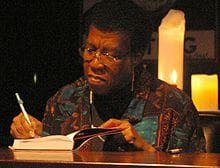
Octavia E. Butler was an American science fiction writer known for her exploration of complex themes such as race, gender, and identity. Her notable works include "Kindred," a time-travel narrative addressing slavery, and the "Patternist" series, which begins with "Mind of My Mind." Other significant titles in her catalog include "Parable of the Talents," "Wild Seed," "Adulthood Rites," and "Bloodchild and Other Stories."
Similar books
- Wild Seed
Octavia E. Butler
4.2 (18k) average on GoodreadsFantasyExplores the earlier relationship between Doro and Anyanwu, providing origin context for the characters.
- The Dispossessed
Ursula K. Le Guin
4.2 (88k) average on GoodreadsPoliticsDeals with societal structures, freedom versus control, and philosophical conflicts within a speculative setting.
- Dragonflight
Anne McCaffrey
4.1 (126k) average on GoodreadsFantasyBoth feature strong female protagonists and unique bonds (telepathic dragons vs. psionic humans). However, Butler delves far deeper into the psychological and ethical complexities of creation, control, and the responsibilities of power, offering a more critical social commentary than McCaffrey's more adventure-oriented narrative.
- Harry Potter and the Sorcerer's Stone
J.K. Rowling
4.5 (7M) average on GoodreadsFantasyRescued from a miserable life under the stairs, an orphaned boy discovers he's a wizard destined for a magical school, where he uncovers a dangerous secret tied to the dark wizard who murdered his parents.
- The Hunger Games
Suzanne Collins
4.3 (6.4M) average on GoodreadsFantasyIn a future where children fight to the death on live television, Katniss Everdeen volunteers for the arena, turning a death sentence into a fight for survival and a spark of rebellion.
- 1984
George Orwell
4.2 (3.1M) average on GoodreadsPoliticsIn a future where surveillance and thought control are absolute, a man's search for truth clashes with the Party, showing that hope can be a form of rebellion.





Enjoyed the summary?
A summary gives you the shape of the book. The book itself has the detail, the examples and the voice.
Find Mind of My Mind on AmazonAs an Amazon Associate, BookBrief earns from qualifying purchases. How we're funded