
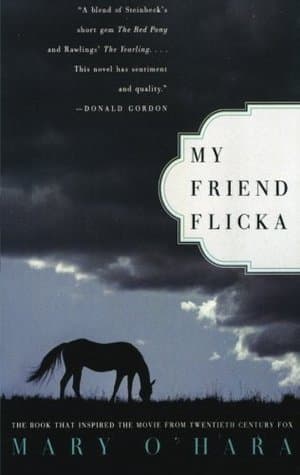
Synopsis
Covers the whole plot, including the ending.
- Difficulty
- Easy
- Pacing
- Moderate
- Mood
- Heartwarming, Evocative, Bittersweet, Hopeful
- Read it if
- You enjoy classic coming-of-age stories about a boy and his animal, set against the backdrop of the American West.
- Skip it if
- You prefer fast-paced plots or stories without animal suffering.
My Friend Flicka Plot Summary
Covers the whole plot, including the ending.
The Report Card and the Offer
Ten-year-old Ken McLaughlin, the younger son of Rob and Nell McLaughlin, returns to the Goose Bar Ranch in Wyoming with a bad report card, meaning he failed a grade. His father, Rob, a strict but fair man, is disappointed by Ken's lack of focus and daydreaming. Rob decides Ken will work on the ranch for the summer, hoping hard work will teach him discipline. As a reward, Rob promises Ken he can choose any colt from the spring foals, a big privilege that excites Ken, despite his initial dread of the summer's work.
Choosing Flicka
When it's time to choose, Ken is drawn to a wild chestnut filly, whose family line includes a legendary, untamable stallion called The Albino. Nell, Ken's mother, sees a similar wild and independent spirit in the filly and Ken. Rob, however, opposes the choice, saying the filly, whom Ken names Flicka (Swedish for 'little girl'), is too wild and will only cause trouble. Despite Rob's doubts, Nell convinces him to let Ken keep Flicka, believing it might be good for Ken to have such a challenging project.
Initial Attempts and Frustration
Ken's attempts to tame Flicka are frustrating. Flicka is incredibly wild, resisting all efforts to halter or handle her. She repeatedly escapes her enclosure, often hurting herself by running into fences or barbed wire. Rob's patience wears thin as Ken's project becomes a problem, needing extra work and vet care. Ken, despite loving Flicka, feels despair and inadequacy, believing he cannot connect with the spirited horse.
Flicka's First Serious Injury
One day, Flicka makes a violent escape, crashing through a fence and badly cutting her leg. The wound is deep and gets infected, causing a high fever. The ranch hands and Rob believe Flicka cannot be saved and suggest putting her down to end her suffering. Ken is heartbroken and refuses, pleading with his father to give Flicka a chance. Nell supports Ken, and together they try to nurse Flicka back to health, but her condition worsens, and she becomes weaker and confused.
The Canyon Incident
Despite their efforts, Flicka's fever continues, and she eventually runs away into a dangerous, rocky canyon known for its difficult terrain and wild animals. Ken, upset, goes against his father's orders and searches for her alone. He searches tirelessly, driven by a deep bond he feels for the filly. After a dangerous search, he finds Flicka, weak and near death, trapped in a narrow crevice. Ken spends the night with her, comforting her and protecting her from predators, showing deep dedication.
Rob's Change of Heart
The next morning, Rob, who has been searching for Ken, finds him in the canyon with Flicka. Seeing his son's tired but determined face, and the gentle way Ken cares for the dying filly, Rob has a change of heart. He realizes the depth of Ken's love and their bond. Rob, for the first time, truly understands what Flicka means to Ken and decides to do everything to save the filly, knowing that saving Flicka is also saving a part of Ken.
The Battle for Flicka's Life
Rob, Ken, and the ranch hands work hard to bring Flicka back to the ranch. Her condition is critical, and she gets a severe infection, falling into a coma. Dr. Hicks, the local vet, is called, but has little hope. Nell takes charge of Flicka's care, giving medicine and keeping her warm, while Ken stays by her side constantly, talking to her and wanting her to live. The whole family works together, putting aside past frustrations and doubts, hoping for a miracle.
Flicka's Recovery and the Bond
Against all odds, Flicka slowly begins to recover. Her fever breaks, and she gradually regains strength. Her wildness is still there, but it is now softened by a growing trust in Ken. She starts to respond to his voice and touch, letting him approach without fear. The experience creates an unbreakable bond between Ken and Flicka. Ken has matured greatly through the ordeal, showing responsibility, perseverance, and a deep, unwavering love, earning his father's respect and admiration.
The Challenge of the Wild Stallion
As Flicka recovers, her wild instincts are reawakened by The Albino, the legendary white stallion and her father, who sometimes appears on the ranch lands. Flicka is drawn to him, her wild blood calling her back to the freedom of the open range. Ken fears losing her, understanding that her wild nature is a part of her. This creates a new challenge: how to balance Flicka's wild spirit with her growing connection to him and ranch life.
A Moment of Connection
At a key moment, Flicka stands at the fence between the ranch and the open plains, torn between The Albino's call and Ken's gentle presence. Ken approaches her slowly, not trying to force her, but simply offering his presence. After an internal struggle, Flicka turns from the wild stallion and lets Ken approach and touch her. This act shows her choice to stay with Ken, not out of submission, but from a unique bond of trust and affection. Ken has truly earned her friendship.
Ken's Growth and Acceptance
By the end of the summer, Ken is changed. He is no longer the daydreaming, irresponsible child who failed school. The challenges and successes with Flicka have matured him, giving him purpose and self-worth. His relationship with his father, Rob, has also changed. Rob now sees and respects Ken's inner strength and his ability for love and dedication. While Flicka remains spirited, she is no longer untamable, and her wildness is now a beautiful part of her character, reflecting Ken's own journey of self-discovery and acceptance.
My Friend Flicka Characters
Ken McLaughlin
Protagonist
A dreamy, sensitive boy who struggles with responsibility and finds his purpose through a wild horse.
Ken is a ten-year-old boy who often gets lost in his own thoughts and dreams, leading to academic struggles and a perceived lack of responsibility by his stern father, Rob. He is sensitive, imaginative, and possesses a deep, intuitive understanding of animals. His initial struggles with Flicka reflect his own internal battle with discipline and finding his place. He is deeply devoted and capable of great empathy, especially towards the wild filly.
Relationships: Rob McLaughlin (Son, initially strained due to Ken's perceived irresponsibility, later grows into mutual respect.); Nell McLaughlin (Son, Nell is a supportive and understanding mother who often mediates between Ken and Rob.); Flicka (Owner and friend, sharing a profound and challenging bond of love and mutual growth.)
Rob McLaughlin
Supporting/Antagonist (initially)
The stern, practical ranch owner who values hard work and discipline.
Rob is the hardworking owner of the Goose Bar Ranch and Ken's father. He is a man of the land, practical, demanding, and often appears stern, especially with Ken, whom he struggles to understand. He believes in the importance of discipline, responsibility, and tangible results. While he loves his family, his gruff exterior and focus on ranch operations sometimes make him seem unsympathetic to Ken's more sensitive nature. He initially views Flicka as a nuisance and a bad choice.
Relationships: Ken McLaughlin (Father, initially critical and demanding, later becomes understanding and proud.); Nell McLaughlin (Husband, Nell often softens Rob's rigid views and helps him understand Ken.); Gus (Ranch foreman, a loyal and experienced employee.)
Nell McLaughlin
Supporting
Ken's understanding and supportive mother, who champions his unique spirit.
Nell is Ken's mother and Rob's wife. She is a compassionate, intuitive, and wise woman who understands Ken's dreamy nature better than Rob. She often acts as a mediator between her husband and son, advocating for Ken and his chosen filly. Nell has a deep connection to nature and a strong belief in the power of love and understanding over harsh discipline. She is the one who encourages Rob to let Ken keep Flicka, seeing the potential for growth in both the boy and the horse.
Relationships: Ken McLaughlin (Mother, deeply supportive and understanding.); Rob McLaughlin (Wife, provides emotional balance and insight to her more pragmatic husband.)
Flicka
Supporting
A wild, untamed chestnut filly whose spirit mirrors Ken's own.
Flicka is a beautiful chestnut filly, chosen by Ken from the spring foals. She is exceptionally wild, spirited, and fiercely independent, inheriting these traits from her sire, The Albino, a legendary wild stallion. Her untamable nature initially causes significant trouble and frustration for the McLaughlins, particularly Rob. Flicka represents the untamed spirit of the wild, and her journey towards accepting Ken's presence without losing her essence is central to the story. She is a catalyst for Ken's growth.
Relationships: Ken McLaughlin (Her chosen human companion, sharing a deep and challenging bond of trust and affection.); The Albino (Her sire, representing her wild heritage and the call of freedom.)
Gus
Supporting
The loyal and experienced ranch foreman at Goose Bar Ranch.
Gus is the long-serving foreman of the Goose Bar Ranch. He is a steady, reliable, and knowledgeable cowboy, deeply committed to the ranch and the McLaughlin family. While he initially shares Rob's practical concerns about Flicka's wildness, he is ultimately kind-hearted and assists in the efforts to save the filly. He provides a grounded presence and a contrast to Ken's more emotional nature, but also demonstrates a quiet understanding of the boy's devotion.
Relationships: Rob McLaughlin (Ranch foreman, loyal employee and friend.); Ken McLaughlin (Adult figure who assists Ken and offers practical advice.)
Howard McLaughlin
Supporting
Ken's older brother, who is more practical and responsible.
Howard is Ken's older brother, a capable and responsible young man who is much more aligned with his father's practical nature. He is a good rider and ranch hand, often serving as a foil to Ken's dreamy and less disciplined tendencies. While he sometimes teases Ken, he also cares for his younger brother and is part of the family unit, though his role is less central than Ken's.
Relationships: Ken McLaughlin (Older brother, sometimes teasing but ultimately supportive.); Rob McLaughlin (Son, shares his father's practical disposition.)
The Albino
Mentioned
A legendary wild white stallion, Flicka's sire, symbolizing untamed freedom.
The Albino is a magnificent, untamed white stallion, a mythical figure on the plains who is known for his intelligence and elusiveness. He is Flicka's sire and represents the ultimate symbol of wild, unfettered freedom. His occasional appearances on the ranch lands serve as a constant reminder of Flicka's wild heritage and the strong pull of the natural world. He is a force of nature, embodying the spirit that Ken must learn to understand and respect in Flicka.
Relationships: Flicka (Sire, representing her wild ancestry and instincts.)
My Friend Flicka Themes
The Call of the Wild vs. Domestication
This theme explores the tension between wild nature and the human desire to control it. Flicka embodies the untamed spirit, always resisting efforts to be broken, while Ken represents the human desire for connection. The story suggests that true connection comes from understanding and respecting a spirit, not breaking it. This is clear in Flicka's escapes and her choice between The Albino and Ken, ultimately choosing Ken on her own terms, without losing her wildness.
“She was not a horse, but a spirit. Wild. Untamable. And Ken, in his heart, knew it was not his job to break her, but to understand her.”
Responsibility and Maturity
Ken's journey is about growing up and learning responsibility. His school failure and his father's decision to make him work on the ranch start this theme. The challenge of caring for Flicka, especially when she is sick, forces Ken to move past daydreaming and make difficult decisions and consistent effort. He learns that loving Flicka requires dedication, sacrifice, and perseverance, changing him from an irresponsible boy into a mature young man capable of deep commitment. His actions, like staying with Flicka in the canyon, show his new sense of duty.
“It was no longer a game, no longer a dream. It was life and death, and he was responsible.”
The Power of Unconditional Love and Empathy
The story shows how love and empathy can bridge differences and encourage growth. Ken's unwavering love for Flicka, even when she is wild, hurt, or seemingly beyond help, helps her recover and strengthens their bond. Nell also shows this theme, consistently being empathetic towards Ken and Flicka, and advocating for understanding over harshness. Rob's change of heart, seeing Ken's devotion in the canyon, shows how even practical people can be moved by genuine, empathetic connection, leading to healing and deeper relationships.
“He knew then that love was not about possessing, but about understanding, and letting be.”
Father-Son Relationships
The complex relationship between Ken and Rob is a central theme. Initially, their dynamic is strained by Rob's strictness and Ken's perceived irresponsibility. Rob struggles to understand his dreamy son, often showing disappointment. However, as Ken shows dedication and courage in saving Flicka, Rob gradually sees and respects his son's inner strength. The shared experience with Flicka builds a bridge, allowing them to form a deeper connection based on mutual respect and understanding, moving past their initial misunderstandings.
“Rob looked at his son, truly looked at him, and saw not a boy, but a man in the making, forged by love and suffering.”
Plot Devices & Literary Techniques
The Wild Horse as a Mirror
Flicka's wildness and journey reflect Ken's own internal struggles and growth.
Flicka serves as a powerful symbolic mirror for Ken. Her untamed spirit, resistance to control, and eventual connection with Ken without losing her essence reflect Ken's own struggle to find his place, tame his daydreaming nature, and ultimately find self-acceptance. Flicka's physical injuries and recovery parallel Ken's emotional wounds and his journey to maturity. The wildness in Flicka is the same spirit that Nell recognizes in Ken, suggesting that both must be understood and nurtured, not broken.
The Canyon as a Crucible
A dangerous, isolated setting where Ken's dedication is tested and his bond with Flicka is forged.
The canyon where Flicka flees and Ken finds her serves as a crucible, a place of severe test and transformation. It is a dangerous, wild environment that strips away the comforts of the ranch and forces Ken to confront his deepest fears and demonstrate his unwavering commitment to Flicka. His solitary vigil with the dying filly in the harsh wilderness solidifies his bond with her and marks a crucial turning point in his character development, proving his courage and dedication to himself and, eventually, to his father.
The Report Card
An initial inciting incident that sets Ken's summer journey in motion.
Ken's failing report card is the initial catalyst for the entire plot. It highlights his perceived irresponsibility and his father's frustration, leading directly to Rob's decision to make Ken work on the ranch and offering him a colt. Without this inciting incident, Ken would not have been given the opportunity to choose Flicka, and his transformative summer would not have occurred. It establishes the conflict and the need for Ken's personal growth from the very beginning of the story.
The Albino
A recurring symbol of untamed freedom and Flicka's wild heritage.
The Albino, Flicka's legendary wild sire, serves as a powerful symbol throughout the narrative. He represents the ultimate untamed spirit of the wilderness and the strong genetic pull that Flicka feels towards freedom. His occasional appearances on the ranch lands act as a constant reminder of Flicka's wild instincts and the internal struggle she faces between her heritage and her growing bond with Ken. He embodies the 'wild' aspect of the 'wild vs. domestication' theme.
My Friend Flicka Quotes
“The wind was a friend, the sun a companion, the trees were his brothers, and the horses his kin.”
“It was not enough to be good. He had to be good for something.”
“A wild thing, he thought, belonged to no one. It was free.”
“He didn't want a horse to ride. He wanted a horse to love.”
“She was beautiful and wild and untamed, like a dream.”
“The ranch was not merely a place; it was a way of life, hard and demanding, but also deeply rewarding.”
“Sometimes you have to let go of what you want to get what you need.”
“A boy and his horse. It was an old story, but always new.”
“He understood then that loving something meant accepting it, flaws and all.”
“The wilderness was not empty; it was full of life, and full of lessons.”
“To truly know a horse, you had to speak its language, not just with your voice, but with your heart.”
“Hope was a thing with feathers, but sometimes it had hooves.”
“He knew what it was to fight for something you believed in, even when everyone else told you it was foolish.”
“The wind could carry secrets, and the earth could hold them.”
Quiz
10 questions on the plot and the characters. Each answer comes with a short explanation.
Question 1
What is the primary reason Ken's father, Rob, decides to give Ken a horse of his own?
- Ken had been asking for a horse for many years.
- Ken received a very good report card.
- Rob hopes that having a horse will teach Ken responsibility and focus.
- Nell, Ken's mother, convinced Rob to give Ken a horse.
Show answer
C. Rob hopes that having a horse will teach Ken responsibility and focus. Rob gives Ken a horse after his poor report card, hoping it will instill responsibility and help Ken focus, as he's often lost in daydreams.
Question 2
What kind of horse does Ken specifically choose to be his own, much to his father's initial disapproval?
- A gentle, broken-in mare.
- A strong, mature gelding.
- A wild, spirited chestnut filly.
- A young, calm colt.
Show answer
C. A wild, spirited chestnut filly. Ken chooses the wild, untamed chestnut filly, Flicka, despite his father's concerns about her difficult nature.
Question 3
What does 'Flicka' mean in Swedish, and why is this significant to the horse's character?
- 'Friend,' symbolizing the bond Ken eventually forms with her.
- 'Little girl,' reflecting her youthful, spirited nature.
- 'Wild one,' representing her untamed spirit.
- 'Swift,' referring to her speed.
Show answer
B. 'Little girl,' reflecting her youthful, spirited nature. Nell tells Ken that 'Flicka' means 'little girl' in Swedish, which fittingly describes the young, often temperamental, and free-spirited filly.
Question 4
What is Ken's initial, major challenge in trying to 'tame' Flicka?
- He can't catch her in the pasture.
- She repeatedly escapes her enclosure.
- She refuses to eat any food he offers.
- She bites and kicks him constantly.
Show answer
B. She repeatedly escapes her enclosure. Flicka's wild nature is evident in her repeated escapes from her corral and even the barn, which frustrates Rob and worries Nell.
Question 5
What significant illness does Flicka contract that puts her life in jeopardy?
- A broken leg from an escape attempt.
- A severe case of colic.
- Glanders, a highly contagious horse disease.
- Lockjaw (tetanus), from a wound.
Show answer
D. Lockjaw (tetanus), from a wound. Flicka gets lockjaw (tetanus) from a cut on her leg, leading to a long and harrowing period where Ken desperately tries to save her.
Question 6
How does Ken demonstrate his growing responsibility and commitment during Flicka's illness?
- He works extra chores to earn money for her medicine.
- He stays by her side day and night, sacrificing sleep and meals.
- He studies veterinary books to find a cure himself.
- He argues with his father about the best course of treatment.
Show answer
B. He stays by her side day and night, sacrificing sleep and meals. Ken's devotion to Flicka is shown through his unwavering vigil, staying by her side constantly, feeding her by hand, and battling exhaustion to care for her.
Question 7
What is Rob's initial reaction when he believes Flicka is dying and suggests putting her down?
- He is relieved, as he never wanted Ken to have such a wild horse.
- He shows deep empathy for Ken's distress and immediately changes his mind.
- He views it as a practical, necessary decision for the ranch, despite Ken's pleas.
- He blames Ken for not taking better care of the filly.
Show answer
C. He views it as a practical, necessary decision for the ranch, despite Ken's pleas. Rob, ever the pragmatic rancher, initially sees Flicka's suffering as a drain on resources and suggests putting her down, prioritizing the ranch's practicalities over Ken's emotional attachment.
Question 8
Which character consistently supports Ken's connection with Flicka, often mediating between Ken and Rob?
- Gus, one of the ranch hands.
- Howard, Ken's older brother.
- Nell, Ken's mother.
- Missy, another horse on the ranch.
Show answer
C. Nell, Ken's mother. Nell, Ken's mother, is consistently understanding and supportive of Ken, often interceding with Rob on Ken's behalf regarding Flicka.
Question 9
What is the ultimate outcome of Flicka's illness and Ken's care?
- Flicka sadly succumbs to her illness despite Ken's efforts.
- Flicka recovers completely and becomes a gentle, obedient horse.
- Flicka makes a miraculous recovery, and her bond with Ken is solidified.
- Rob sells Flicka once she recovers, as she is still too wild.
Show answer
C. Flicka makes a miraculous recovery, and her bond with Ken is solidified. Against all odds, Flicka recovers, and her near-death experience, coupled with Ken's unwavering care, cements an unbreakable bond between them.
Question 10
By the end of the story, how has Ken's relationship with his father, Rob, evolved?
- It remains strained, as Rob still sees Ken as irresponsible.
- Rob gains a deeper understanding and respect for Ken's character and capabilities.
- Ken becomes completely independent of his father's opinions.
- They agree to disagree about how to raise and train horses.
Show answer
B. Rob gains a deeper understanding and respect for Ken's character and capabilities. Through witnessing Ken's devotion and maturity in caring for Flicka, Rob develops a new respect and understanding for his son, recognizing his strength of character.
My Friend Flicka FAQ
What is the central conflict Ken McLaughlin faces at the beginning of the story?
Ken's primary conflict is his academic failure and his father Rob's disappointment. He receives a terrible report card, forcing him to repeat a grade, which underscores his perceived irresponsibility and dreaminess in his father's eyes, further straining their relationship.
Who is Flicka and what is her initial significance to Ken?
Flicka is a wild, untamed chestnut filly that Ken chooses from the new foals. She represents a chance for Ken to prove his responsibility and maturity to his father, Rob, who initially doubts Ken's ability to handle such a spirited animal.
Describe the relationship between Ken and his father, Rob, throughout the book.
Their relationship is initially strained, marked by Rob's sternness and Ken's perceived failures. Rob struggles to understand Ken's sensitive nature, often resorting to harsh discipline, but over time, their shared experience with Flicka gradually fosters a deeper understanding and respect.
How does Ken's mother, Nell, contribute to his development and well-being?
Nell acts as a crucial emotional buffer and advocate for Ken, often mediating between him and Rob. She understands Ken's sensitive and imaginative nature, offering him unconditional love, comfort, and quiet support, which helps him navigate his challenges.
What is the climax of Flicka's illness and how does it impact Ken?
Flicka contracts a serious illness, believed to be sleeping sickness, and Rob decides to shoot her to end her suffering. Ken's desperate efforts to save her, including staying with her overnight in the storm, showcase his profound love and determination, ultimately leading to her miraculous recovery.
Are there any subtle hints about Ken's future beyond the scope of this book?
The book hints at Ken's growing maturity and his deepening connection to the ranch life and horses. While not explicitly stating his future, his journey with Flicka suggests he will continue to develop a strong bond with animals and perhaps find his place within the ranching world, overcoming his earlier academic struggles.
What is the significance of the wildness of the horses, particularly Flicka, in relation to Ken's own character?
The wildness of the horses mirrors Ken's own untamed spirit and dreaminess, which initially cause him trouble. Flicka's resistance to domestication reflects Ken's struggle to conform to his father's expectations, and their eventual bond signifies Ken's ability to find a balance between his inner world and the demands of reality.
Beyond Flicka, what other animals play a notable, if minor, role in the story?
Gus, the ranch hand, has a significant bond with the horses and often offers Ken practical advice and quiet support. Other horses on the ranch, like Banner, are mentioned and contribute to the overall atmosphere of ranch life, showcasing the diverse personalities of the herd.
How does Ken's initial dreaminess and lack of focus evolve throughout the story?
Ken's dreaminess gradually transforms into focused determination, particularly when it comes to Flicka. His love and responsibility for the filly provide a tangible outlet for his imaginative energy, teaching him the practical consequences of his actions and fostering a new sense of purpose.
Analyze Rob McLaughlin's parenting style and its impact on Ken's self-esteem.
Rob's parenting is characterized by sternness, high expectations, and a belief in tough love, often leading to Ken feeling inadequate and misunderstood. While Rob intends to instill discipline, his approach frequently damages Ken's self-esteem and creates a barrier in their communication, making Ken feel like a constant disappointment.
How does the author use the natural environment of the Wyoming ranch to reflect Ken's inner state?
The vast, wild landscapes of the Wyoming ranch often mirror Ken's internal world of dreams and untamed emotions. The challenging weather, the freedom of the open range, and the raw beauty of nature reflect Ken's struggles, resilience, and eventual growth, connecting his personal journey to the rugged environment.
What role does empathy play in Ken's development and his relationship with Flicka?
Empathy is central to Ken's development; his deep understanding and feeling for Flicka's wild spirit and suffering allow him to connect with her in a way others cannot. This empathy teaches him patience, compassion, and responsibility, ultimately fostering a unique and powerful bond with the filly.
Is Flicka truly 'tamed' by the end of the book, or does her wild spirit remain?
Flicka is not fully 'tamed' in the traditional sense; rather, she chooses to bond with Ken, retaining her inherent wild spirit. Her willingness to approach Ken and allow him to touch her signifies a mutual trust and understanding, not a complete submission, suggesting her wildness is respected and integrated into their relationship.
Could Ken's 'dreaminess' be interpreted as a form of neurodivergence, given the historical context?
While the term 'neurodivergence' wasn't used in the book's era, Ken's characteristics—difficulty with traditional schooling, intense focus on specific interests, and a rich inner world—could be reinterpreted through a modern lens as traits aligning with conditions like ADHD or high sensitivity. This offers a nuanced understanding of his challenges beyond simple 'irresponsibility.'
What is the ultimate message about masculinity conveyed through Rob and Ken's evolving relationship?
The book challenges traditional notions of masculinity, showing Rob's gradual shift from a stoic, results-oriented father to one who values emotional connection and understanding. Ken's journey demonstrates that strength can also lie in sensitivity, empathy, and a deep bond with nature, redefining what it means to be a man on the ranch.
How does the concept of 'responsibility' evolve for Ken throughout the story?
Initially, responsibility is a burden Ken struggles with, often associated with chores and academic expectations he fails to meet. However, through his devotion to Flicka, it transforms into a deeply personal commitment driven by love and empathy, teaching him self-discipline and purpose without external pressure.
To what extent does the book romanticize the challenges of ranch life?
While the book highlights the beauty and freedom of ranch life, it also realistically portrays its harsh realities, including financial struggles, dangerous animals, severe weather, and the constant threat of illness to livestock. It balances the romantic ideal with the gritty, demanding nature of the work.
Similar books
- The Yearling
Marjorie Kinnan Rawlings
4.0 (26k) average on GoodreadsChildren'sA classic story of a boy growing up in a rural setting and his deep bond with a wild animal, facing hardship and emotional growth.
- Black Beauty
Anna Sewell
4.0 (239k) average on GoodreadsChildren'sFocuses on the life and experiences of a horse, exploring themes of animal welfare, compassion, and human-animal relationships.
- The Call of the Wild
Jack London
3.9 (341k) average on GoodreadsChildren'sWhile both explore the wildness of nature and animal instincts, O'Hara focuses more on the human-animal bond and the psychological development of a young protagonist, offering a more hopeful and intimate narrative compared to London's grittier, Darwinian approach.
- Harry Potter and the Sorcerer's Stone
J.K. Rowling
4.5 (7M) average on GoodreadsFantasyRescued from a miserable life under the stairs, an orphaned boy discovers he's a wizard destined for a magical school, where he uncovers a dangerous secret tied to the dark wizard who murdered his parents.
- The Hobbit, or There and Back Again
J.R.R. Tolkien
4.3 (2.9M) average on GoodreadsFantasyA comfort-loving hobbit named Bilbo Baggins is whisked away by a mischievous wizard and a band of dwarves on an unexpected journey to reclaim stolen treasure from a fearsome dragon, discovering courage and a magical ring along the way.
- Harry Potter and the Goblet of Fire
J.K. Rowling
4.6 (2.6M) average on GoodreadsFantasyA bewildered Harry Potter, underage and thrust into a deadly Triwizard Tournament, must brave dragons, mermaids, and a resurgent dark magic to survive a year that will forever alter the wizarding world.




Enjoyed the summary?
A summary gives you the shape of the book. The book itself has the detail, the examples and the voice.
Find My Friend Flicka on AmazonAs an Amazon Associate, BookBrief earns from qualifying purchases. How we're funded