
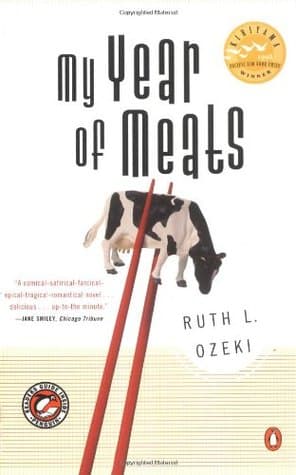
Synopsis
Covers the whole plot, including the ending.
- Difficulty
- Medium
- Pacing
- Moderate
- Mood
- Thought-provoking, Eye-opening, Empowering, Challenging
- Read it if
- You enjoy cross-cultural narratives, feminist themes, and explorations of food politics and media manipulation.
- Skip it if
- You prefer lighthearted reads without social commentary or find discussions of industrial agriculture and reproductive health unappealing.
My Year of Meats Plot Summary
Covers the whole plot, including the ending.
Jane Lands the 'My American Wife!' Gig
Jane Takagi-Little, a Japanese-American filmmaker in New York, struggles to find meaningful work. She gets a job with a Japanese production company. The show, 'My American Wife!', is sponsored by BEEF-EX, an American meat-exporting company. Its goal is to promote American meat to Japanese housewives. Jane travels across America, filming segments with 'typical' American wives who cook meat dishes for their families. She approaches the project with cynicism and a desire to find authentic stories, despite the show's commercial agenda. Her initial experiences involve meeting diverse women, whose unique quirks and family dynamics often clash with the idealized image BEEF-EX wants to project.
Akiko's Silent Suffering
Meanwhile, in Japan, Akiko Ueno, a young housewife, watches 'My American Wife!'. Akiko is trapped in a stifling marriage to John Ueno, a salaryman who controls her life, including her diet and access to the outside world. He insists she eat meat for fertility, the very product Jane promotes. Akiko is infertile, a source of shame and pressure in her marriage, leading to inadequacy and isolation. She finds solace watching the American wives on screen, even as her husband's erratic and abusive behavior escalates.
Jane Discovers the DES Connection
As Jane continues filming, she notices a pattern among some of the women she interviews: a history of infertility, miscarriages, or health issues. Her research, initially for the show, leads her to discover Diethylstilbestrol (DES), a synthetic estrogen hormone once used in livestock feed to promote growth, especially in beef. DES was later found to be a carcinogen and reproductive disruptor, linked to health problems in women exposed in utero, including cervical cancer and infertility. This discovery disturbs Jane, as it contradicts the wholesome image BEEF-EX wants to project and connects to the health struggles she observes.
Subverting the Message
With knowledge of DES, Jane subtly changes the show's intended message. While still delivering content that outwardly promotes American meat, she creatively edits segments to highlight the unspoken struggles of the American wives. She focuses on their resilience, hidden anxieties, and sometimes unhealthy aspects of their lives, rather than just their cooking. She uses visual cues, juxtaposition, and chosen soundbites to hint at the underlying issues of industrial agriculture and its impact on women's bodies. Her goal is to create a more authentic, subversive narrative that resonates with the real experiences of women, in America and Japan.
Akiko's Awakening and Artistic Expression
Watching Jane's nuanced episodes of 'My American Wife!', Akiko sees reflections of her own suppressed life and desires. Jane's subtle messages resonate with her. Akiko, once an art student, secretly starts drawing again, using the American wives as inspiration, but transforming them into powerful, often grotesque, figures that express her inner turmoil and rebellion. Her art becomes a form of release and a way to process her experiences. This creative outlet gives her strength to confront John, leading to a dramatic escalation in their marital conflict and her decision to seek freedom.
The Network's Backlash and Jane's Stand
Jane's subtle changes do not go unnoticed. Network executives, especially from BEEF-EX, question the tone and content of certain episodes. They demand more straightforward, positive portrayals of American meat and family life. Jane faces pressure to conform to the original propaganda-driven agenda. This puts her in a difficult position, forcing her to choose between her journalistic integrity and her job security. She must decide how far she will go to expose the truth, even if it risks her career and the show itself. Her moral compass guides her to continue her resistance.
Akiko's Escape and New Life
After a violent confrontation with John, Akiko finds the courage to leave her abusive marriage. She flees her home and seeks refuge, initially feeling lost and isolated. She eventually connects with a community of women who have also experienced abuse or societal marginalization. These women provide her with support, understanding, and a sense of belonging she has never known. Akiko begins to heal, finding her voice and rebuilding her life. Her artistic talents blossom in this supportive environment, as she continues to draw and process her past experiences, transforming them into expressions of resilience and liberation.
The Birth of the 'Meat Mothers'
As Jane's investigation into DES deepens, she learns about a community of women called the 'Meat Mothers.' These are women directly exposed to DES, either through their mothers' prenatal use of the drug or through contaminated meat, who have suffered severe reproductive health issues, including infertility, miscarriages, and cancer. Jane seeks them out, recognizing their stories as crucial to her broader narrative. Interviewing the 'Meat Mothers' provides Jane with personal accounts that strengthen her resolve to expose the truth, giving a human face to the scientific data she has uncovered.
Jane's Final Broadcast and Its Aftermath
In a climactic act of defiance, Jane produces a final, unedited episode of 'My American Wife!' that directly addresses the dangers of DES, featuring testimonies from the 'Meat Mothers' and scientific evidence. This episode challenges BEEF-EX and the network's censorship. The broadcast causes a sensation, shocking viewers and creating a major public outcry. As a result, the show is immediately canceled, and Jane faces professional repercussions and legal threats. However, her actions also spark a wider conversation about corporate accountability, food safety, and women's health, fulfilling her deeper journalistic purpose.
Akiko's Art and Jane's New Path
Years later, Akiko is a successful artist, her drawings gaining recognition for their raw honesty and feminist themes. She exhibits her work, which often depicts the female body and challenges traditional notions of beauty and motherhood, earning her a new sense of identity and purpose. Jane, having faced the fallout from her final broadcast, continues independent documentary filmmaking, though with a more cautious approach. She reflects on the impact her work had, not just on public discourse, but also on individual lives, especially Akiko's. The two women, though never meeting, have influenced each other's journeys, united by a shared narrative of resilience and truth-telling.
My Year of Meats Characters
Jane Takagi-Little
Protagonist
A Japanese-American documentary filmmaker who uncovers the truth behind the meat industry.
Jane is a sharp, independent, and ethically driven filmmaker with a dry wit and a deep sense of social justice. Raised by a single mother, she navigates her bicultural identity, often feeling like an outsider in both American and Japanese contexts. She starts her job on 'My American Wife!' with a cynical view but quickly becomes invested in uncovering the hidden truths behind the show's facade. Her intelligence and investigative instincts drive her to delve into the dark side of industrial agriculture and its impact on women's health.
Relationships: Akiko Ueno (Unseen connection through the TV show; Jane's work inspires Akiko); Her Mother (Supportive but distant; Jane's mother's past health issues subtly influence her investigation); Staff at BEEF-EX/Network (Antagonistic; they represent the corporate interests Jane opposes)
Akiko Ueno
Co-protagonist
A Japanese housewife oppressed by her husband and societal expectations, who finds liberation through art.
Akiko is initially a timid, submissive, and deeply unhappy young woman, trapped in an abusive marriage and burdened by the shame of infertility. She is intelligent and artistic but has suppressed her true self under the weight of her husband's control and traditional Japanese gender roles. Watching 'My American Wife!' becomes her window to the outside world and a catalyst for her awakening. Her journey is one of profound psychological and emotional liberation, fueled by her burgeoning artistic expression.
Relationships: John Ueno (Abusive husband; relationship of control and fear); Jane Takagi-Little (Unseen inspiration; Jane's show empowers Akiko); The 'Meat Mothers' (Symbolic connection through shared experiences of reproductive issues)
John Ueno
Antagonist
Akiko's controlling and abusive husband.
John is a traditional Japanese salaryman who embodies patriarchal control and emotional abuse. He is obsessed with maintaining appearances, particularly his wife's fertility and their social standing. He is rigid, demanding, and prone to violent outbursts when Akiko deviates from his expectations. His character represents the oppressive societal forces and gender roles that Akiko struggles against, and his actions are a primary catalyst for her eventual rebellion and escape.
Relationships: Akiko Ueno (Abusive husband-wife relationship)
The 'Meat Mothers'
Supporting
A group of American women suffering health issues due to DES exposure.
These women represent the human cost of industrial agriculture and corporate negligence. They are victims of Diethylstilbestrol (DES) exposure, either directly or through their mothers, leading to a range of reproductive health problems, including infertility, miscarriages, and cancer. Their collective stories provide Jane with crucial, heartbreaking evidence for her documentary, giving a face to the scientific data and exposing the profound, intergenerational impact of the hormone. They symbolize resilience and the fight for justice.
Relationships: Jane Takagi-Little (Sources of information and inspiration for Jane's exposé); Akiko Ueno (Symbolic connection through shared experiences of reproductive issues)
Lester
Supporting
Jane's eccentric and supportive cameraman.
Lester is Jane's loyal and quirky cameraman. He is a free spirit, often providing comic relief and philosophical musings. He is initially unaware of Jane's deeper agenda but becomes a silent accomplice and a sounding board for her ethical dilemmas. His presence offers Jane a sense of camaraderie and support in her often-solitary quest for truth, and he helps her execute her subversive filming and editing techniques.
Relationships: Jane Takagi-Little (Professional colleague and trusted friend)
BEEF-EX Executives
Antagonist
The corporate sponsors of 'My American Wife!' who prioritize profit over health.
These unnamed executives represent the powerful, faceless corporate interests driving the show's propaganda. They are primarily concerned with promoting American meat sales and protecting their company's image and profits, regardless of ethical considerations or public health. They embody the capitalist greed and lack of accountability that Jane is fighting against. They are the direct opposition to Jane's journalistic integrity, constantly trying to control the narrative and suppress any negative information.
Relationships: Jane Takagi-Little (Adversarial; they attempt to control her and her work)
The American Wives (e.g., Barb, Marilyn, etc.)
Supporting
The various women filmed for 'My American Wife!', representing diverse American lives.
These women are a diverse group from different backgrounds and regions across America. They are initially presented as idealized figures for the Japanese audience, showcasing wholesome American family life and meat-centric cooking. However, through Jane's lens, their individual stories reveal deeper complexities, including personal struggles, health issues, and often subtle unhappiness, which resonate with Akiko. Some of them unknowingly provide clues about the DES issue through their health histories or family anecdotes.
Relationships: Jane Takagi-Little (Subjects of her documentary, some unknowingly providing crucial insights); Akiko Ueno (Figures of both fascination and identification for Akiko)
Dr. Ueno (John's Father)
Mentioned
John's deceased father, a respected doctor whose legacy influences Akiko's situation.
Dr. Ueno is John's father, a respected physician in Japan. Although deceased, his legacy heavily influences John's behavior, particularly his obsession with Akiko's fertility and his desire to maintain a perfect family image. Dr. Ueno's medical background also subtly links to the themes of medicine, science, and the body that run through the novel, providing a contrast to the industrial and often unethical medical practices Jane uncovers.
Relationships: John Ueno (Father-son relationship, influencing John's values and behavior); Akiko Ueno (Her husband's father; his legacy contributes to her oppression)
My Year of Meats Themes
The Politics of Food and the Body
The novel explores how food, especially meat, connects with power, gender, and health. The industrial meat complex, BEEF-EX, prioritizes profit over public health, using hormones like DES that harm women's reproductive systems. This theme appears in Jane's investigation into DES and the 'Meat Mothers,' exposing the dangerous consequences of unchecked corporate agriculture. Akiko's forced meat consumption by John to 'cure' her infertility further shows how food becomes a tool of control and a symbol of societal pressures on women's bodies.
“What does it mean to be a woman whose body is not her own?”
Feminism and Female Empowerment
'My Year of Meats' is a feminist narrative. It shows women, American and Japanese, struggling against patriarchal control, societal expectations, and corporate exploitation. Jane's journey is one of professional and ethical empowerment, as she uses her craft to expose injustice. Akiko's transformation from a submissive, abused wife to a liberated artist is a central arc of female empowerment, showing women's strength to reclaim their bodies, voices, and creative spirits. The solidarity among the 'Meat Mothers' and Akiko's new community of women highlights the strength in collective female experience and resistance.
“She was making herself, making herself up again, from scratch.”
Media and Truth
The novel examines media's role in shaping perception and spreading propaganda. 'My American Wife!' is initially a tool for corporate marketing, presenting an idealized, often false, image of American life and food. Jane struggles to subvert this corporate agenda and use the same medium to expose uncomfortable truths. Her subtle editing, and eventually her direct exposé, shows media's power to either hide or reveal. The novel questions who controls the narrative and how audiences, like Akiko, interpret and are affected by what they see on screen, highlighting media's potential for both manipulation and liberation.
“Truth, like beauty, is in the eye of the beholder. Or, in this case, the editor.”
Cross-Cultural Understanding and Misunderstanding
The narrative explores cultural exchange between Japan and America. The Japanese show 'My American Wife!' tries to translate American culture for a Japanese audience, often leading to stereotypes and misunderstandings. Jane, as a Japanese-American, navigates this cultural divide, understanding both perspectives but also feeling alienated by both. The novel shows how cultural products can be both a bridge and a barrier, revealing shared human experiences while also exposing cultural differences, especially concerning gender roles, family dynamics, and societal pressures around fertility and consumption.
“It was a strange thing, this show, a mirror reflecting back what each culture wanted to see in the other.”
Motherhood and Infertility
Motherhood, its expectations, and the pain of infertility are central to the novel. Akiko's inability to conceive causes shame and fuels her husband's abuse, reflecting intense societal pressure on women to bear children. The 'Meat Mothers' show how corporate negligence can take away the possibility of motherhood from women, or lead to tragic miscarriages. Jane's own background, raised by a single mother, adds another dimension to this theme. The novel challenges conventional notions of motherhood, suggesting that nurturing and creativity can take many forms beyond biological reproduction, as seen in Akiko's artistic 'births' and Jane's commitment to truth.
“To be a woman in Japan and not a mother was to be incomplete, a broken vessel.”
Plot Devices & Literary Techniques
Parallel Narratives
Two distinct storylines of Jane and Akiko unfolding simultaneously.
The novel employs a dual narrative structure, alternating between Jane Takagi-Little's experiences filming 'My American Wife!' in the U.S. and Akiko Ueno's life as a viewer of the show in Japan. These parallel stories, though initially separate, are intrinsically linked by the television program. Jane's actions and creative choices directly influence Akiko's perceptions and eventual liberation, creating a powerful sense of unseen connection and demonstrating the far-reaching impact of media and shared female experiences across cultures. This device allows for a comprehensive exploration of the novel's themes from both sides of the Pacific.
Metafiction/Show-within-a-Show
The fictional TV show 'My American Wife!' serves as a central element of the plot.
The television show 'My American Wife!' is not just a backdrop but an active character and plot device. It is the vehicle through which Jane conducts her investigation and subversion, and it is the catalyst for Akiko's awakening. The show itself evolves, reflecting Jane's growing ethical dilemma and her attempts to infuse truth into propaganda. This metafictional element allows the author to critique media's role in shaping reality, cultural stereotypes, and corporate influence, while also demonstrating how individuals can reclaim and subvert dominant narratives within a seemingly controlled environment.
The DES Hormone
A real-world hormone used in livestock, serving as a central symbol and plot driver.
Diethylstilbestrol (DES), a real-world synthetic estrogen used in animal feed, functions as a powerful symbol and a crucial plot driver. It represents the hidden dangers of industrial agriculture, corporate greed, and the devastating impact of unregulated chemicals on women's bodies. Jane's discovery of DES is the turning point in her narrative, propelling her investigation and transforming her role from producer to whistleblower. For Akiko and the 'Meat Mothers,' DES symbolizes the silent suffering and reproductive trauma inflicted upon women, linking their individual stories to a larger systemic problem and giving a concrete focus to the novel's themes of health, fertility, and exploitation.
Akiko's Drawings/Art
Akiko's artistic creations serve as a non-verbal form of expression and rebellion.
Akiko's drawings, initially hidden and private, become a profound plot device for her character development and a powerful form of non-verbal communication. They symbolize her suppressed creativity, her inner turmoil, and her burgeoning rebellion against her husband and societal expectations. As she watches 'My American Wife!', her drawings evolve from mere copies into increasingly grotesque and expressive interpretations of the American wives, reflecting her own psychological journey and growing empowerment. Her art ultimately provides her with a means of escape, a new identity, and a platform for her voice, embodying the theme of artistic liberation.
My Year of Meats Quotes
“Meat is the way to a man's heart. And to a woman's. And to a child's.”
“Sometimes it's hard to tell the difference between the story and the truth.”
“The camera lies. It always lies. But it tells the truth too.”
“Being a woman is a political act.”
“What does it mean to be a good mother? Is it to protect your child from everything, or to teach them to protect themselves?”
“Everyone has a secret, a story they don't want to tell.”
“Food is love. Food is comfort. Food is culture. Food is everything.”
“The world is full of stories, and sometimes they find you.”
“There are some things you can't unsee, some things that change you forever.”
“Silence can be a weapon, or it can be a shield.”
“We are all made of stories, and we tell them to ourselves and to each other to make sense of who we are.”
“Sometimes the most radical thing you can do is just be yourself.”
“The past is never really past; it just keeps circling back.”
“To truly see someone, you have to look beyond what they show you.”
Quiz
10 questions on the plot and the characters. Each answer comes with a short explanation.
Question 1
What is the name of the Japanese television show that Jane Takagi-Little produces?
- Meat Lovers' Paradise
- My American Wife!
- Taste of America
- The Global Kitchen
Show answer
B. My American Wife! Jane's job is producing the Japanese television show 'My American Wife!', which features American wives cooking meat dishes.
Question 2
What specific type of hormone does Jane uncover as being dangerous and affecting the women in her show?
- Estrogen
- Testosterone
- Diethylstilbestrol (DES)
- Progesterone
Show answer
C. Diethylstilbestrol (DES) Jane's investigation reveals the dangerous hormone Diethylstilbestrol (DES) and its impact on the women featured in the show, particularly concerning fertility.
Question 3
What is Akiko Ueno's primary struggle in her personal life at the beginning of the novel?
- Finding a fulfilling career outside the home
- Coping with a serious illness
- Escaping her overbearing and abusive husband
- Dealing with financial difficulties
Show answer
C. Escaping her overbearing and abusive husband Akiko Ueno is portrayed as a beleaguered Japanese housewife struggling to escape her overbearing husband, a key aspect of her storyline.
Question 4
What is the main reason Jane begins to subtly alter the content of the 'My American Wife!' episodes?
- To increase viewership by making the show more dramatic
- To subtly expose the truths she uncovers about the meat industry and fertility
- To fulfill a personal artistic vision for the show
- To appeal to a younger demographic in Japan
Show answer
B. To subtly expose the truths she uncovers about the meat industry and fertility Jane begins to manipulate the show's content to subtly communicate the unsavory truths she discovers about industrial agriculture and its impact on women's bodies.
Question 5
The novel draws a parallel between the treatment of animals in industrial agriculture and what other societal issue?
- The rise of global capitalism
- The objectification and control of women's bodies and fertility
- The decline of traditional family values
- The impact of technology on human relationships
Show answer
B. The objectification and control of women's bodies and fertility A central theme of the book is the parallel drawn between the industrial treatment of animals and the societal control and objectification of women's bodies, especially concerning fertility and motherhood.
Question 6
What is the significance of the 'meat' in the title 'My Year of Meats' beyond its literal meaning?
- It symbolizes the prosperity of the American economy.
- It represents the physical bodies and experiences of the women, both animal and human.
- It refers to the financial profits generated by the meat export business.
- It is a metaphor for the strength and resilience of the characters.
Show answer
B. It represents the physical bodies and experiences of the women, both animal and human. The 'meat' in the title extends beyond its literal meaning to symbolize the physical bodies, fertility, and the often-controlled experiences of both the animals and the women in the narrative.
Question 7
How does Akiko Ueno typically communicate her internal world and resistance?
- Through direct confrontation with her husband.
- By secretly writing a diary or journal.
- Through her art, specifically painting and drawing.
- By confiding in her close friends and family.
Show answer
C. Through her art, specifically painting and drawing. Akiko expresses her inner turmoil and resistance primarily through her artistic creations, especially her paintings and drawings, which often depict her experiences and desires.
Question 8
What is the ultimate fate of Akiko Ueno's husband, Kenzo?
- He reconciles with Akiko and changes his behavior.
- He leaves Akiko and moves abroad.
- He is arrested for his abusive actions.
- He dies, allowing Akiko to find freedom.
Show answer
D. He dies, allowing Akiko to find freedom. Kenzo's death is a pivotal event that ultimately frees Akiko from his control and allows her to pursue her own life and desires.
Question 9
What American state is frequently highlighted in the 'My American Wife!' show as a source of the featured meats and wives?
- California
- Texas
- Nebraska
- Florida
Show answer
C. Nebraska Nebraska is frequently mentioned in the show as a key location, representing the heartland of American meat production and the origin of many of the 'American wives'.
Question 10
How do Jane Takagi-Little and Akiko Ueno ultimately connect in the novel?
- They meet in person at an international conference.
- Akiko writes to Jane after seeing her subtle messages in the show.
- Jane travels to Japan specifically to find Akiko.
- They are introduced by a mutual friend.
Show answer
B. Akiko writes to Jane after seeing her subtle messages in the show. Akiko, as a viewer of 'My American Wife!', recognizes the subtle messages Jane embeds in the show and reaches out to her, forming a crucial connection between the two women.
My Year of Meats FAQ
What is the central premise of 'My Year of Meats'?
The novel follows Jane Takagi-Little, a Japanese-American filmmaker producing a Japanese TV show called 'My American Wife!', sponsored by a meat-exporting company. She aims to portray American wives preparing meat dishes, but subtly uses the show to expose the dark side of industrial agriculture and its impact on women's bodies, particularly through the use of DES.
Who is Akiko Ueno and how does her story intertwine with Jane's?
Akiko Ueno is a Japanese housewife who watches Jane's show, 'My American Wife!'. Inspired by the show's subtle messages and the recipes, she begins to assert her independence from her abusive, infertile husband, John. Her personal journey of rebellion and eventual escape is deeply influenced by Jane's filmmaking, demonstrating the show's unexpected impact.
What role does the hormone DES play in the novel's plot?
DES (diethylstilbestrol) is a synthetic estrogen used to fatten cattle, which also affected human fertility and caused birth defects and cancer in 'DES daughters' and sons. Jane's discovery of its widespread use in American meat and its impact on women, including her own mother, becomes a driving force behind her desire to expose corporate malfeasance through her television show.
How does the novel explore themes of fertility and motherhood?
Fertility and motherhood are central, examined through Jane's struggle with her own infertility and her mother's history as a DES daughter, and through Akiko's desire for a child despite her husband's infertility and abuse. The narrative contrasts natural fertility with the artificial manipulation of animal reproduction and the devastating effects of chemicals like DES on human reproductive health.
What is the significance of the title, 'My Year of Meats'?
The title refers to Jane's year-long project producing the TV show 'My American Wife!', which focuses on different meat dishes each week. It also alludes to the pervasive presence of meat and its associated industries in American culture, and symbolically, the 'meat' of the issues—fertility, corporate greed, and women's bodies—that Jane uncovers.
Are there any subtle clues about Jane's own health issues related to DES?
Yes, Jane's struggle with infertility and her mother's past health problems are subtly linked to DES exposure. While not explicitly stated as a direct cause for Jane until later revelations, her personal history mirrors the broader health crisis she investigates, suggesting a familial legacy of DES-related issues.
How does the novel use the concept of 'television' as a narrative device?
Television serves as both a medium for corporate propaganda and a tool for subversive storytelling. Jane manipulates the seemingly innocuous cooking show format to embed critical messages about agribusiness and women's health, demonstrating how popular media can be reappropriated to challenge dominant narratives and empower viewers like Akiko.
What is the symbolic meaning behind the different American wives featured in Jane's show?
Each 'American Wife' represents a different facet of American womanhood and consumerism, from the seemingly perfect housewife to the more unconventional. Jane deliberately chooses diverse women, some of whom subtly defy the show's intended message, allowing her to explore various experiences and subtly critique idealized notions of domesticity and meat consumption.
How does Jane's bicultural identity influence her perspective and actions?
Jane's bicultural identity as Japanese-American provides her with a unique lens through which to observe and critique both cultures. She understands the expectations of the Japanese audience for the TV show while also being deeply aware of the American industrial practices she is exposing, allowing her to bridge and challenge both worlds effectively.
Analyze Akiko's psychological journey from submission to liberation.
Akiko's journey is one of profound psychological transformation, moving from a state of extreme repression and self-blame under her husband John's control to a gradual awakening of self-worth and agency. Inspired by the subtle messages of empowerment in Jane's show, she finds the courage to defy her husband, pursue her own desires, and ultimately escape her abusive situation, culminating in her pregnancy and new life.
How does the novel portray the psychological effects of corporate greed on individuals?
The novel illustrates how corporate greed, specifically in the meat industry, has far-reaching psychological consequences. It creates a culture of denial and secrecy, impacting public health and forcing individuals like Jane to confront difficult truths, while also contributing to the emotional and physical suffering of those affected by products like DES.
Discuss the 'gaze' in the novel, particularly how women are viewed and view themselves.
The novel critically examines the male gaze, especially through John Ueno's oppressive control over Akiko and the idealized, often superficial portrayal of women in advertising and media. However, it also highlights the empowering 'female gaze' through Jane's filmmaking, which reclaims the narrative and allows women like Akiko to see themselves, and each other, in new, liberated ways.
Is 'My Year of Meats' ultimately an optimistic or pessimistic novel?
While exposing grim realities of industrial agriculture and abuse, the novel ultimately leans towards optimism. It celebrates resilience, the power of individual agency, and the potential for connection and change. The positive outcomes for Akiko and Jane, despite their struggles, suggest a hopeful outlook on overcoming systemic and personal challenges.
How does the novel challenge traditional notions of 'family' and 'motherhood'?
The novel expands traditional definitions by showcasing diverse family structures and paths to motherhood. Jane's journey through infertility and eventual adoption, and Akiko's choice to leave an abusive marriage to create a new family for herself and her unborn child, challenge conventional expectations and highlight the strength found in unconventional bonds and choices.
What is the significance of the novel's ending, particularly the convergence of Jane and Akiko's stories?
The ending signifies a powerful culmination of their parallel journeys, bringing Jane and Akiko together through a shared understanding and mutual support. Akiko's pregnancy and Jane's adoption represent new beginnings and the successful subversion of the destructive forces they fought against, symbolizing hope, healing, and the creation of new, healthier families.
How does the book function as a critique of consumer culture?
The novel critiques consumer culture by exposing the hidden costs and ethical dilemmas behind readily available products, particularly meat. It highlights how advertising and media manipulate desires, while simultaneously obscuring the environmental, health, and social impacts of industrial production, urging readers to look beyond the superficial.
What is the ethical responsibility of a filmmaker or artist, according to the novel?
The novel suggests that artists and filmmakers have a profound ethical responsibility to speak truth to power, even when constrained by corporate interests. Jane's ingenious subversion of her show demonstrates that art can be a powerful tool for social commentary and activism, capable of inspiring change and exposing injustice, even subtly.
How does the novel use humor to address serious topics?
Ruth Ozeki employs a distinctive blend of humor, often ironic or dark, to tackle grave subjects like corporate malpractice, domestic abuse, and infertility. This humor serves to make the difficult themes more accessible, to highlight absurdities, and to provide moments of levity that prevent the narrative from becoming overly didactic or despairing, engaging the reader more deeply.
About the author

Ruth Ozeki is a Japanese-American author known for her fiction that often explores themes of identity, culture, and the intersection of personal and societal issues. Her notable work, "My Year of Meats," examines the meat industry and its impact on culture and relationships. Ozeki has received recognition for her writing, including the PEN/Faulkner Award for Fiction.
Similar books
- The Jungle
Upton Sinclair
3.8 (129k) average on GoodreadsPoliticsExposes the dark underbelly of an industry (meatpacking) and its impact on society.
- The Handmaid's Tale
Margaret Atwood
4.1 (1.5M) average on GoodreadsFantasyExplores themes of female subjugation, reproductive rights, and societal control.
- The Omnivore's Dilemma: A Natural History of Four Meals
Michael Pollan
4.2 (182k) average on GoodreadsPoliticsInvestigates the origins and ethics of modern food production, particularly meat.
- The Vegetarian
Han Kang
3.6 (93k) average on GoodreadsLiterary FictionBoth novels feature protagonists who undergo radical transformations in their relationship with meat, leading to profound personal and social consequences. However, Kang's 'The Vegetarian' is a much darker, more surreal, and allegorical exploration of female subjugation and rebellion, with the protagonist's refusal of meat driven by a disturbing dream and leading to a complete withdrawal from society. Ozeki's novel, while critical, maintains a more grounded, activist, and ultimately hopeful tone, with characters actively engaging with and subverting oppressive systems rather than retreating from them. Ozeki's critique is also more explicitly tied to corporate and media structures.
- The Old Man and the Sea
Ernest Hemingway
3.8 (831k) average on GoodreadsLiterary FictionA Cuban fisherman's long struggle with a giant marlin becomes a story of endurance and dignity, now retold for young adults with illustrations, phonetic guides, and writing prompts in Traditional Chinese.
- One Hundred Years of Solitude
Gabriel García Márquez
4.1 (753k) average on GoodreadsLiterary FictionThrough the multi-generational story of the Buendía family, a mythical town deals with the repeating patterns of time, love, and solitude, as the extraordinary mixes with the ordinary.




Enjoyed the summary?
A summary gives you the shape of the book. The book itself has the detail, the examples and the voice.
Find My Year of Meats on AmazonAs an Amazon Associate, BookBrief earns from qualifying purchases. How we're funded