
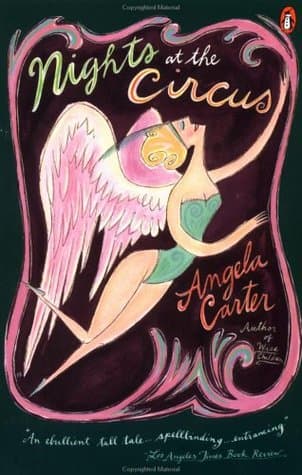
Synopsis
Covers the whole plot, including the ending.
- Difficulty
- Medium
- Pacing
- Variable
- Mood
- Whimsical, Magical, Feminist, Darkly Humorous, Philosophical
- Read it if
- You enjoy magical realism, feminist themes, and rich, evocative prose set in a fantastical historical circus.
- Skip it if
- You prefer straightforward narratives, realistic fiction, or are put off by grotesque imagery and philosophical digressions.
Nights at the Circus Plot Summary
Covers the whole plot, including the ending.
The Interview with Fevvers
American journalist Jack Walser arrives at the London dressing room of Sophie Fevvers, the famous aerialiste, known for her magnificent wings. He is there to interview her for a sensational scoop, determined to uncover whether her wings are real or an elaborate hoax. Fevvers, a flamboyant character, recounts a fantastical version of her origins, claiming she was hatched from an egg and raised in a brothel run by the formidable Lizzie. Walser, initially skeptical, finds himself increasingly captivated by Fevvers's charisma and her incredible, often contradictory, tales. He struggles to discern fact from fiction, as Fevvers's narrative intertwines the mundane with the miraculous, constantly challenging his journalistic objectivity.
Fevvers's Childhood in Mrs. Schreck's Brothel
Fevvers details her childhood in Mrs. Schreck's 'Museum of Womanhood,' a high-class brothel and exhibition space that catered to gentlemen with unusual tastes. Raised by Lizzie, a former prostitute and current manager, Fevvers was initially an exhibit herself, a 'winged human' displayed behind glass. She describes an unconventional upbringing surrounded by various women, each with their own stories and skills. It was here that she developed her theatrical flair and learned to navigate a world that simultaneously exploited and celebrated her uniqueness. This period shaped her resilient and self-possessed character, teaching her to control her own narrative and use her perceived abnormalities to her advantage.
The Circus Joins the Train
Having failed to get a definitive answer about Fevvers's wings, and increasingly smitten, Jack Walser decides to join Colonel Kearney's circus as a clown, hoping to get closer to Fevvers and uncover the truth. The entire troupe embarks on a long, arduous train journey from London to St. Petersburg. Walser, under the tutelage of Buffo the clown, struggles to adapt to circus life and the eccentricities of his fellow performers. The train itself becomes a microcosm of the circus world, filled with a diverse cast of characters: strongmen, trapeze artists, animal trainers, and the philosophical Princess of Abyssinia. This journey marks Walser's complete immersion into the fantastical realm of the circus, leaving his conventional journalistic life behind.
St. Petersburg and the Grand Duke
The circus arrives in St. Petersburg, where their performances captivate the Russian aristocracy. Fevvers, as the star attraction, becomes the object of obsession for the Grand Duke, a figure of immense power and depravity. He invites Fevvers and other circus members to his palace, a place of lavish excess and dangerous games. Fevvers, accompanied by Lizzie, navigates the Grand Duke's predatory advances with cunning and wit, protecting herself and her companions. Walser, still struggling with his clown role, observes the dangerous allure of the aristocracy and the resilience of the performers in the face of exploitation, further deepening his understanding of Fevvers's strength and vulnerability.
The Siberian Wilderness
As the circus travels deeper into Siberia, the train mysteriously derails, stranding the entire troupe in the vast, frozen wilderness. This event marks a significant shift in the narrative, moving from the urban spectacle to a primal, mystical setting. The performers are forced to contend with the brutal elements, dwindling supplies, and the psychological strain of isolation. The accident also brings to the forefront the underlying tensions and relationships within the circus family. Walser, still clumsy as a clown, finds himself increasingly reliant on the practical skills and resilience of his fellow performers, as the boundaries between reality and the fantastical continue to blur in the desolate landscape.
The Women's Commune
Following the train derailment, a group of female performers, led by Lizzie and including Fevvers, separates from the main troupe. They stumble upon a hidden, ancient commune populated entirely by women, deep within the Siberian forest. This commune, a matriarchal society, offers a stark contrast to the patriarchal world they've known, providing a temporary sanctuary and a different perspective on female power and autonomy. The women of the commune practice their own rituals and live in harmony with nature, representing an alternative vision of womanhood. Fevvers and Lizzie find a sense of belonging and understanding among these women, solidifying their bond and their belief in female strength and independence.
Walser's Amnesia and Shamanic Journey
During the chaos of the derailment and the subsequent struggle for survival, Jack Walser suffers a head injury that results in amnesia. Stripped of his identity as a journalist and his preconceived notions, he wanders the Siberian landscape. He is eventually taken in by a group of shamans, who guide him through a series of rituals and a spiritual transformation. Walser, no longer bound by his past, begins to experience the world through a more intuitive and mystical lens, shedding his Western rationalism. This journey mirrors his earlier immersion into the circus, but on a deeper, more existential level, preparing him for a new understanding of Fevvers and her magical reality.
The Tiger and the Human Beast
Amidst the Siberian chaos, the circus's tigers escape their cages, adding another layer of danger to the stranded troupe. Simultaneously, the 'human beast' – a performer who embodies primal savagery – becomes increasingly prominent. This character, who has a complex relationship with the tigers, blurs the lines between human and animal, performance and reality. The escaped tigers symbolize the untamed forces of nature and the dangerous elements of the circus itself. Their presence highlights the fragility of civilization and the power of the wild, mirroring the internal struggles and animalistic urges within the human characters, particularly Walser's own transformation.
Fevvers's Rescue and Reunion
As Walser, now a transformed figure with a more primal understanding of the world, wanders through the Siberian snow, Fevvers, guided by her unique abilities and the wisdom of the women's commune, sets out to find him. Using her powerful wings, she soars above the desolate landscape, eventually locating the amnesiac Walser. Her flight is a powerful display of her true nature, a culmination of the questions Walser had sought to answer. Their reunion is not merely a physical one but a meeting of two transformed individuals. Walser, having shed his skepticism, is now ready to accept Fevvers for who she is, wings and all, marking a profound shift in their relationship and his perception of reality.
The End of the Circus, The Beginning of a New Age
The surviving members of Colonel Kearney's circus, battered but not broken, begin to regroup after the Siberian ordeal. The traditional structure of the circus has been shattered, but a new, more empowered dynamic emerges, particularly among the women. Fevvers and Lizzie, now more confident in their own strength and agency, lead the way. The novel concludes with a sense of hopeful anticipation for a new era, one where women like Fevvers can truly fly, free from the constraints of patriarchal expectations and societal definitions. The circus, in its dissolution, becomes a metaphor for the dismantling of old orders and the birth of a more liberated future.
Nights at the Circus Characters
Sophie Fevvers
Protagonist
The winged aerialiste, a flamboyant and enigmatic star of the circus.
Fevvers is a magnificent, larger-than-life woman, reputedly half-swan, hatched from an egg, and possessing real wings. She is the star attraction of Colonel Kearney's circus, celebrated for her aerial acts and her captivating persona. Fevvers is witty, resilient, and fiercely independent, using her perceived abnormality to her advantage. She spins elaborate tales about her past, blurring the lines between truth and fiction, constantly challenging those who try to define her. Her strength lies in her self-possession and her ability to embrace her unique identity.
Relationships: Lizzie (Adoptive mother, companion, and protector); Jack Walser (Love interest, initially skeptical journalist, later devoted partner)
Jack Walser
Protagonist
An American journalist on a quest to uncover the truth about Fevvers's wings.
Walser is initially a pragmatic, somewhat cynical American journalist, determined to get the 'scoop of a lifetime' by exposing Fevvers as a fraud. He represents the rational, Western male perspective, seeking to categorize and explain the inexplicable. As he becomes immersed in the circus world and falls in love with Fevvers, his skepticism gradually erodes. He is transformed by his experiences, particularly his amnesia and shamanic journey in Siberia, shedding his old identity to embrace a more intuitive and accepting worldview.
Relationships: Sophie Fevvers (Object of his journalistic investigation and later his profound love interest); Buffo the Clown (Mentor in clowning, though often a harsh one)
Lizzie
Supporting
Fevvers's adoptive mother, protector, and shrewd manager.
Lizzie is a formidable, pragmatic, and fiercely loyal woman who has been Fevvers's constant companion and guardian since childhood. A former prostitute and manager of Mrs. Schreck's brothel, she possesses a keen understanding of the world's harsh realities and a sharp wit. Lizzie acts as Fevvers's confidante, manager, and protector, grounding the more fantastical Fevvers with her down-to-earth wisdom and practical skills. She is a symbol of female resilience and solidarity, always putting Fevvers's well-being first and challenging patriarchal assumptions.
Relationships: Sophie Fevvers (Adoptive mother and lifelong companion); Colonel Kearney (Professional relationship, often adversarial in negotiations)
Colonel Kearney
Supporting
The ambitious and often ruthless ringmaster and owner of the circus.
Colonel Kearney is the entrepreneurial and somewhat tyrannical owner of the circus, driven by a desire for fame and fortune. He views his performers as assets, particularly Fevvers, and is constantly seeking new ways to exploit their talents for profit. While he provides a framework for the circus, he often lacks genuine empathy for his troupe, seeing them primarily as a means to an end. He represents the commercial and patriarchal forces at play, trying to control and profit from the extraordinary.
Relationships: Sophie Fevvers (Employer-employee, but Fevvers often defies his control); Lizzie (Business associate, often clashing over Fevvers's welfare)
Buffo the Clown
Supporting
The lead clown, a master of his craft but prone to melancholy and cruelty.
Buffo is the principal clown of Colonel Kearney's circus and Walser's reluctant mentor in the art of clowning. He is a complex character, capable of both brilliant comedic performance and profound despair. Buffo embodies the darker, more melancholic aspects of circus life, the sadness hidden beneath the painted smile. He is a tragic figure, haunted by past traumas and prone to acts of cruelty, particularly towards Walser. His character explores the fine line between comedy and tragedy, and the masks people wear, both literally and figuratively.
Relationships: Jack Walser (Mentor-student, but also a source of torment for Walser); Mignon (Complex and abusive relationship)
Mignon
Supporting
A beautiful but vulnerable trapeze artist, often a victim of abuse.
Mignon is a delicate and beautiful trapeze artist, often depicted as a victim of circumstance and abuse, particularly from her husband, the strongman. She is initially portrayed as fragile and passive, but her experiences in the circus and the camaraderie with other women gradually awaken a latent strength. Her story highlights the vulnerability of women in a patriarchal world and their capacity for resilience and solidarity when supported by others. She finds solace and strength in her relationships with other female performers.
Relationships: The Strongman (Abusive husband); Princess of Abyssinia (Friend and confidante)
The Princess of Abyssinia
Supporting
A philosophical and insightful tiger trainer.
The Princess of Abyssinia is a wise and enigmatic figure, a tiger trainer with a deep connection to the animals. She is a woman of quiet strength and profound insight, often offering philosophical observations on life, fate, and the nature of humanity. Her character represents a connection to ancient wisdom and a more mystical understanding of the world, contrasting with Walser's initial rationalism. She serves as a mentor and confidante to Mignon and provides a moral compass for the circus troupe.
Relationships: Mignon (Friend and protector); The Tigers (Deep, almost spiritual bond)
The Grand Duke
Antagonist
A decadent and predatory Russian aristocrat obsessed with Fevvers.
The Grand Duke is a powerful and depraved Russian aristocrat who becomes obsessed with Fevvers during the circus's St. Petersburg engagement. He embodies the corrupting influence of unchecked power and the patriarchal desire to possess and control women. His palace is a place of lavish excess and dangerous games, where he attempts to ensnare Fevvers. He represents the forces that seek to exploit and diminish Fevvers's unique spirit, viewing her as an object of desire rather than a sentient being.
Relationships: Sophie Fevvers (Obsessive admirer and would-be captor)
Nights at the Circus Themes
Identity and Transformation
The novel explores the fluidity of identity, challenging fixed notions of self. Fevvers's ambiguous origins—is she swan or woman, real or fake?—are central to this theme. Walser's journey of self-discovery, from skeptical journalist to amnesiac shaman-in-training, exemplifies radical transformation. The circus itself is a place where performers adopt new personas, blurring the lines between their true selves and their acts. This theme is most evident in Walser's Siberian experience, where he sheds his old identity and embraces a new, more intuitive way of being, mirroring Fevvers's own embrace of her unique nature.
“'Is she fact or is she fiction?'”
Feminism and Female Empowerment
Angela Carter subverts traditional patriarchal narratives by centering powerful, unconventional female characters. Fevvers, with her magnificent wings, is a symbol of female liberation and defiance against societal expectations. Lizzie represents shrewd female wisdom and unwavering loyalty, while the women's commune in Siberia offers a vision of matriarchal autonomy. The novel critiques the male gaze and the commodification of women, portraying female solidarity as a source of strength and resistance. The ending, with Fevvers truly taking flight and the women embarking on a new journey, signifies a triumphant assertion of female agency.
“'Every woman a bird!'”
Reality vs. Illusion
The circus thrives on illusion, and the novel constantly blurs the lines between what is real and what is staged. Fevvers's wings are the ultimate mystery, forcing characters and readers alike to question their perceptions of reality. Walser's initial journalistic quest is to uncover the 'truth,' but he gradually learns that truth itself can be multifaceted and subjective. The fantastical elements, from talking tigers to shamanic rituals, challenge a purely rational worldview, suggesting that magic and myth hold their own form of truth, especially in the context of human experience and belief. This is especially poignant when Walser, after his amnesia, no longer seeks to 'expose' Fevvers, but simply to accept her reality.
“'She was a grand illusion, and it was his business to penetrate her, to find the truth behind the paint and feathers.'”
The Nature of Performance
The entire novel is a celebration and deconstruction of performance. The circus is a world where identities are performed, stories are enacted, and reality is shaped by the spectacle. Fevvers is a master performer, using her acts to control her narrative and captivate her audience. Walser, by joining the circus as a clown, becomes a performer himself, experiencing the transformative power of embodying a role. The novel suggests that performance is not just about entertainment, but about creating meaning, challenging perceptions, and even shaping one's own destiny. The performers, despite their hardships, find their authentic selves within their acts.
“'The circus is the only true theatre, the theatre of life itself.'”
Plot Devices & Literary Techniques
The Frame Narrative
The story begins and ends with Jack Walser's journalistic inquiry into Fevvers.
The novel employs a frame narrative, starting with Jack Walser's interview of Fevvers in London and culminating in their reunion. This structure allows the fantastical tales of Fevvers's past to be embedded within Walser's more grounded, if increasingly surreal, present. It also establishes Walser's initial skepticism as a point of entry for the reader, guiding them through the unfolding wonders and challenges to their own perceptions of reality. The frame ultimately closes with a transformed Walser, reflecting the profound impact of Fevvers and the circus on his worldview.
Magical Realism
The blending of realistic settings and characters with fantastical elements.
Magical realism is a pervasive device, seamlessly integrating the miraculous into the mundane. Fevvers's wings, her alleged birth from an egg, and the talking tigers exist alongside detailed descriptions of turn-of-the-century London and Siberian landscapes. This blending creates a world where the extraordinary is accepted, or at least grappled with, as part of everyday life. It challenges the reader's rational expectations, inviting them to suspend disbelief and engage with the story on a deeper, more symbolic level, where the 'impossible' holds profound truths about human experience and the power of imagination.
The Journey (Physical and Spiritual)
The circus's physical journey across Europe and Siberia parallels the characters' internal transformations.
The literal journey of Colonel Kearney's circus from London to St. Petersburg and into the Siberian wilderness serves as a powerful metaphor for the characters' internal, spiritual journeys. As the physical landscape changes from urban spectacle to desolate wild, the characters undergo profound transformations. Walser's journey is the most explicit, leading to amnesia and a shamanic awakening. This device emphasizes that true change often requires stepping outside of one's comfort zone and confronting the unknown, both externally and within oneself, allowing for new perspectives and self-discovery.
Foreshadowing and Prophecy
Hints and predictions of future events, particularly regarding Fevvers's destiny and a new age for women.
The novel uses subtle and overt foreshadowing, often through Fevvers's own pronouncements and the mystical elements of the story. Fevvers frequently speaks of her destiny to 'fly' and herald a new age, setting up expectations for her ultimate liberation. The Princess of Abyssinia and the Siberian shamans also offer prophetic insights. This device builds suspense and imbues the narrative with a sense of inevitability regarding Fevvers's triumph and the broader theme of female empowerment. It suggests a preordained trajectory for the characters and the world they inhabit, hinting at a future where the miraculous becomes manifest.
Nights at the Circus Quotes
“She was an invention of the age, a wonder. She was a goddess on the flying trapeze.”
“To be the object of desire is to be a slave, and the highest freedom is to be the one who desires.”
“We are all of us, in a sense, made of stories.”
“She was a bird; she was a woman; she was a bird-woman.”
“What a perilous thing it is to be a woman, to be a show.”
“The greatest trick the devil ever pulled was convincing the world he didn't exist. The greatest trick the circus ever pulled was convincing the world it did.”
“Every metamorphosis is a kind of death.”
“She was an artificial pearl, but nevertheless a pearl.”
“Reality is a convention, and the only reality is what you perceive.”
“The world is a stage, and we are merely players.”
“He knew, with a sudden, chilling certainty, that he had fallen in love with a myth.”
“The true nature of things is not always what it seems.”
“Nothing is real unless it is dreamed.”
“To be a freak is to be an exception, to be unique.”
Quiz
10 questions on the plot and the characters. Each answer comes with a short explanation.
Question 1
Which city does Jack Walser first encounter Sophie Fevvers and begin his interview?
- St. Petersburg
- London
- Paris
- Siberia
Show answer
B. London Jack Walser's initial interview with Sophie Fevvers takes place in her dressing room in London, where he first hears her extraordinary life story.
Question 2
What is the most distinguishing physical characteristic of Sophie Fevvers that makes her a sensation?
- Her incredible strength
- Her luminous blue eyes
- Her wings
- Her exceptionally long hair
Show answer
C. Her wings Sophie Fevvers is famous for her 'wings', which she claims are real, making her part-swan and the 'toast of Europe's capitals'.
Question 3
What is Jack Walser's profession when he first meets Fevvers?
- A circus performer
- A painter
- A journalist
- A theatrical agent
Show answer
C. A journalist Jack Walser is an American journalist on a quest to uncover the truth behind Fevvers' identity, hoping for the 'scoop of a lifetime'.
Question 4
Who is Lizzie, and what is her relationship to Fevvers?
- Fevvers' rival performer
- Fevvers' manager
- Fevvers' adoptive mother and constant companion
- Fevvers' childhood friend
Show answer
C. Fevvers' adoptive mother and constant companion Lizzie is Fevvers' loyal and pragmatic adoptive mother, who has been with her since childhood and acts as her protector and confidante.
Question 5
What is the name of the circus Fevvers performs in, led by Colonel Kearney?
- The Grand Imperial Circus
- Colonel Kearney's Circus
- The Wonders of the World Circus
- The Celestial Circus
Show answer
B. Colonel Kearney's Circus Fevvers is the star of 'Colonel Kearney's circus,' which embarks on a magical tour across Europe and into Siberia.
Question 6
What is the primary thematic concern explored through Fevvers' character and her ambiguous nature?
- The corruption of political power
- The nature of truth, illusion, and female identity/empowerment
- The perils of technological advancement
- The decline of the British Empire
Show answer
B. The nature of truth, illusion, and female identity/empowerment Fevvers' character, with her ambiguous wings, constantly raises questions about what is real versus what is performance, and challenges traditional notions of female identity and agency.
Question 7
In St. Petersburg, what surprising role does Walser take on within the circus?
- A lion tamer
- A clown
- A strongman
- A trapeze artist
Show answer
B. A clown After being 'dazzled by his love for her, and desperate for the scoop,' Walser joins the circus and eventually becomes a clown, losing his memory in the process.
Question 8
What significant event occurs to Walser during the journey through Siberia, leading to a temporary loss of his identity?
- He is captured by a group of bandits.
- He falls from a train and suffers amnesia.
- He is hypnotized by a shaman.
- He is mistaken for a local and forced to work.
Show answer
B. He falls from a train and suffers amnesia. During the journey through Siberia, Walser falls from the train and experiences amnesia, becoming a 'holy fool' and further blurring the lines between reality and performance.
Question 9
Which historical figure is mentioned as having painted Sophie Fevvers?
- Claude Monet
- Vincent van Gogh
- Henri de Toulouse-Lautrec
- Edgar Degas
Show answer
C. Henri de Toulouse-Lautrec The novel explicitly states that Fevvers was 'painted by Toulouse-Lautrec,' integrating her into a rich historical and artistic context.
Question 10
What is the ultimate 'truth' regarding Fevvers' wings that the novel suggests by its conclusion?
- They are proven to be an elaborate hoax using mechanical devices.
- They are definitively proven to be natural and biological.
- Their reality remains ambiguous, suggesting that belief and perception are as significant as objective fact.
- They are revealed to be a magical gift from a mythical creature.
Show answer
C. Their reality remains ambiguous, suggesting that belief and perception are as significant as objective fact. Angela Carter consistently maintains ambiguity regarding the true nature of Fevvers' wings, never definitively confirming if they are real or fake. This reinforces the novel's themes of illusion, the power of storytelling, and the subjective nature of truth.
Nights at the Circus FAQ
What is the central mystery surrounding Sophie Fevvers that Jack Walser is trying to uncover?
Jack Walser's primary quest is to determine if Sophie Fevvers's magnificent wings are genuine biological appendages or an elaborate, masterful hoax. This question drives him to join Colonel Kearney's circus, hoping to find definitive proof during their tour across Europe and into Siberia.
Who is Colonel Kearney and what is his role in the circus and Fevvers's life?
Colonel Kearney is the flamboyant and somewhat eccentric American owner of the circus that Fevvers headlines. He is not only her employer but also her manager and a significant figure in her public presentation, often exaggerating her legend and actively participating in maintaining the mystique around her identity.
What kind of journey does the circus undertake, and through which specific locations?
The circus embarks on a grand, fantastical tour starting in turn-of-the-century London. Their journey then takes them eastward to the decadent imperial city of St. Petersburg, Russia, and finally deep into the desolate, mystical landscapes of Siberia, where much of the book's climax unfolds.
How does Jack Walser initially attempt to get close to Fevvers and what challenges does he face?
Walser first tries to interview Fevvers in her dressing room, where she tells him her elaborate life story, blurring fact and fiction. He struggles to get a straightforward answer, constantly being drawn into her theatrical persona and the incredible narratives she weaves, which only deepens his confusion and fascination.
Besides Fevvers and Walser, who are some of the other notable characters in the circus troupe?
The circus is populated by a vibrant cast including the strongman Samson, the trapeze artist Mignon, the philosophical clown Buffo, and the wise ape-man, the Professor. Each character contributes to the circus's unique atmosphere and often plays a role in Walser's unfolding understanding of Fevvers and the world.
What is the significance of the 'Philosopher's Egg' and how does it relate to Fevvers's origin story?
The 'Philosopher's Egg' is the brothel where Fevvers claims to have been raised by its madam, Lizzie, and a community of women. It's presented as a sanctuary where she was nurtured and her unique existence accepted, forming a crucial part of the myth she constructs about her past and identity.
Are there any subtle clues throughout the narrative that hint at the true nature of Fevvers's wings, before the ultimate revelation?
Carter often uses ambiguous descriptions, focusing on Fevvers's powerful presence and the wonder she inspires rather than explicit anatomical details. The narrative frequently emphasizes the 'miracle' of her flight and her ability to captivate, making the question of her wings' authenticity less about biological fact and more about belief and performance.
How does the character of Lizzie, Fevvers's 'foster mother,' influence Fevvers's worldview and independence?
Lizzie, an ex-suffragette and madam of the brothel, instills in Fevvers a strong sense of female autonomy, resilience, and an understanding of the power of performance and self-creation. She encourages Fevvers to embrace her uniqueness and use it to defy societal expectations and limitations imposed on women.
What is the implied fate of the men who attempt to 'unmask' or exploit Fevvers, and what does this suggest?
Several men who try to possess, expose, or harm Fevvers meet unfortunate ends, often through mysterious or seemingly accidental circumstances within the magical realism of the novel. This suggests a protective, almost supernatural aura around Fevvers and reinforces her status as an untameable, powerful female figure who subverts patriarchal control.
How does Jack Walser's initial journalistic cynicism evolve throughout his journey with the circus?
Walser begins as a detached observer, seeking only a factual 'scoop,' but as he becomes immersed in the circus's world and falls in love with Fevvers, his cynicism erodes. He starts to embrace the magic, the subjective truth, and the emotional reality of the experiences, transforming from a mere reporter into a participant and believer.
Analyze the psychological impact of Fevvers's constant performance and the blurring of her public and private selves.
Fevvers lives in a state of perpetual performance, where her identity is inextricably linked to her act. This blurring of public and private self allows her immense freedom and power, but it also creates a psychological barrier, making it difficult for others, including Walser, to access a 'true' unmasked self, if such a thing even exists for her.
How does the novel explore themes of gender identity and female empowerment through Fevvers's character?
Fevvers challenges traditional gender roles by embodying both masculine strength and feminine allure, defying categorization. Her wings symbolize freedom from societal constraints, and her refusal to be defined by men or conventional expectations makes her a powerful icon of female agency and self-definition in a patriarchal world.
Discuss the psychological significance of the Siberian wilderness as a setting for the climax of the novel.
Siberia represents a primal, untamed landscape, stripping away the artifice of civilization and the circus. It forces characters, especially Walser, to confront their deepest fears and desires, leading to a psychological reckoning where the boundaries of reality and fantasy dissolve, culminating in a transformative experience.
To what extent is 'Nights at the Circus' a feminist novel, and what aspects support this interpretation?
The novel is strongly interpreted as feminist, celebrating female strength, autonomy, and sisterhood. Fevvers, Lizzie, and the women of the Philosopher's Egg defy patriarchal norms, reclaim their bodies, and use performance and myth-making as tools for liberation, challenging conventional notions of femininity and power.
How does the novel use magical realism to blur the lines between reality and illusion, and what is its effect on the reader?
Angela Carter masterfully weaves fantastical elements into a historical setting, presenting Fevvers's wings and other surreal events as natural occurrences within the world of the story. This blurring challenges the reader's perception of truth, encouraging an embrace of wonder and the idea that subjective reality and belief can be as potent as objective fact.
Is Fevvers's ultimate 'truth' about her wings ever definitively revealed, or is it left open to interpretation?
The novel cleverly maintains ambiguity about the biological authenticity of Fevvers's wings. While there are moments that suggest their reality, the emphasis is less on scientific proof and more on the power of belief, performance, and the myth she embodies. The 'truth' becomes less about fact and more about the narrative's magical, transformative power.
What is the symbolic meaning of Fevvers's flight, beyond mere physical movement?
Fevvers's flight symbolizes freedom, transcendence, and liberation from earthly constraints and patriarchal expectations. It represents her ultimate independence, her ability to defy gravity and societal norms, and her aspiration to a higher, self-defined existence, making her a powerful emblem of female aspiration.
How does the ending of the novel resolve the relationship between Fevvers and Walser, and what does it signify?
The ending sees Walser, transformed by his journey and love for Fevvers, fully embracing her world and her truth, even if it remains fantastical. Their final union in the Siberian wilderness signifies his acceptance of the miraculous and his commitment to a life beyond conventional reality, suggesting a partnership founded on shared wonder and belief.
What role does humor and satire play in 'Nights at the Circus'?
Angela Carter employs a rich vein of humor and satire, often through Fevvers's witty dialogue, the absurd situations the circus finds itself in, and the exaggerated characters. This lightens the narrative, allows for social commentary on gender roles and patriarchal society, and adds to the novel's carnivalesque, playful atmosphere.
About the author

Angela Olive Pearce, who published under the name Angela Carter, was an English novelist, short story writer, poet, and journalist, known for her feminist, magical realism, and picaresque works. She is best known for her book The Bloody Chamber, which was published in 1979. In 2008, The Times ranked Carter tenth in their list of "The 50 greatest British writers since 1945". In 2012, Nights at the Circus was selected as the best ever winner of the James Tait Black Memorial Prize.
Similar books
- The Master And Margarita
Mikhail Bulgakov
4.3 (243k) average on GoodreadsFantasyShares a blend of satire, fantasy, and philosophical depth with a touch of the absurd.
- Circe
Madeline Miller
4.3 (343k) average on GoodreadsFantasyFocuses on a powerful, unconventional female protagonist in a mythic setting, exploring themes of identity and power.
- Beloved
Toni Morrison
3.9 (325k) average on GoodreadsLiterary FictionBoth Nights at the Circus and Toni Morrison's Beloved (1987) are seminal works of magical realism that explore profound trauma and the resilience of marginalized figures. However, their historical contexts and primary concerns differ significantly. Beloved is deeply rooted in the historical trauma of slavery in America, using the supernatural to explore the haunting legacy of the past and the psychological scars of oppression. Nights, while set in a historical period, uses its fantasy elements to critique broader patriarchal systems and celebrate female liberation through performance and self-invention. Morrison's prose is often more elegiac and grounded in a specific cultural memory, while Carter's is more flamboyant and fantastical, aiming for a broader, more universal commentary on gender and power.
- Harry Potter and the Sorcerer's Stone
J.K. Rowling
4.5 (7M) average on GoodreadsFantasyRescued from a miserable life under the stairs, an orphaned boy discovers he's a wizard destined for a magical school, where he uncovers a dangerous secret tied to the dark wizard who murdered his parents.
- The Hunger Games
Suzanne Collins
4.3 (6.4M) average on GoodreadsFantasyIn a future where children fight to the death on live television, Katniss Everdeen volunteers for the arena, turning a death sentence into a fight for survival and a spark of rebellion.
- 1984
George Orwell
4.2 (3.1M) average on GoodreadsPoliticsIn a future where surveillance and thought control are absolute, a man's search for truth clashes with the Party, showing that hope can be a form of rebellion.





Enjoyed the summary?
A summary gives you the shape of the book. The book itself has the detail, the examples and the voice.
Find Nights at the Circus on AmazonAs an Amazon Associate, BookBrief earns from qualifying purchases. How we're funded