
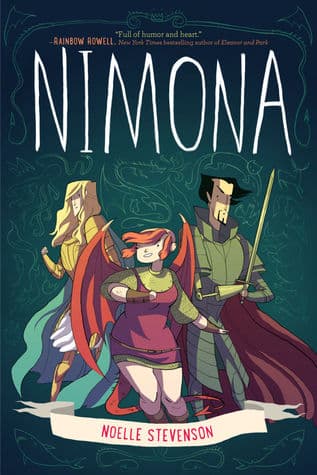
Synopsis
Covers the whole plot, including the ending.
- Difficulty
- Easy
- Pacing
- Fast
- Mood
- Humorous, Heartwarming, Action-packed, Dark, Bittersweet
- Read it if
- You love subversive fantasy, morally grey characters, and stories about found family. Perfect for fans of animated shows like 'She-Ra and the Princesses of Power' or 'The Owl House'.
- Skip it if
- You prefer traditional hero-villain narratives, or dislike stories with dark themes and tragic elements.
Nimona Plot Summary
Covers the whole plot, including the ending.
A New Sidekick Joins Blackheart's Lair
The story begins with Nimona, a shapeshifter, arriving at Lord Blackheart's lair and declaring herself his new sidekick. Blackheart, a disgraced villain with a prosthetic arm, prefers a more calculated approach to villainy. Nimona shows her powers by transforming into a shark and then a dragon. Despite Blackheart's concerns about her chaotic nature, he accepts her, seeing her abilities as useful to expose the corrupt Institution of Law Enforcement and Heroics, especially his former friend and rival, Sir Ambrosius Goldenloin.
Early Shenanigans and a Failed Heist
Nimona's first mission with Blackheart is to steal a dragon from the Institution. Blackheart plans a careful infiltration, but Nimona, in her typical way, crashes through a wall as a monstrous beast, causing panic. She corners the dragon but befriends it instead of stealing it, to Blackheart's frustration. The mission fails, but Nimona's destructive display makes Blackheart seem like a strong villain, though one with an unpredictable associate. Goldenloin and the Institution are confused by the chaos, unable to figure out Blackheart's goals.
Uncovering Institution Secrets
Blackheart and Nimona investigate the Institution, suspecting corruption. They find a hidden lab and discover that the Institution, led by the Director, is experimenting with a dangerous substance, seemingly for a weapon. This confirms Blackheart's suspicions about the Institution's nature, changing their mission from simple villainy to exposing a threat. Nimona becomes interested in the glowing, volatile substance and the Institution's activities.
The Director's Deception and Goldenloin's Dilemma
The Director of the Institution, who seems kind, secretly manipulates Goldenloin. She gives him false information about Blackheart and portrays Nimona as a monster. Goldenloin is torn between his loyalty to the Institution and his friendship with Blackheart. He questions the Director's aggressive tactics and the purpose of the experiments. Blackheart tries to tell Goldenloin about the Institution's corruption, but Goldenloin's pride and the Director's influence make him disbelieve his former friend.
Nimona's Past and Uncontrollable Power
As the conflict grows, Nimona's shapeshifting becomes more erratic when she is distressed or injured. She sometimes turns into a more primal, monstrous form, frightening Blackheart and suggesting an older origin. Nimona shares parts of a traumatic past, mentioning experiments and feeling like a monster. Blackheart worries about her and her power, realizing she is more than a sidekick; she is a being with immense, destructive capabilities and a mysterious history.
The Goldenloin Rescue and a Fleeting Alliance
The Institution's experimental weapon, powered by the volatile substance, activates and goes out of control, endangering Goldenloin and the city. Blackheart and Nimona, despite their villainous appearance, intervene. Nimona, showing great power, confronts the weapon while Blackheart tries to disable it. They save Goldenloin, who sees the weapon's destructive potential and Blackheart's concern for safety. This creates a temporary alliance between Blackheart and Goldenloin, as they realize the Director is the real threat.
The Director's True Nature Revealed
After the weapon's activation, Blackheart, Goldenloin, and Nimona confront the Director. The Director is a brilliant but ruthless scientist who, years ago, experimented on Nimona. She created her shapeshifting abilities or tried to control them. The Director sees Nimona as her property and a tool. She also reveals she caused the incident that cost Blackheart his arm and knighthood, framing him to further her agenda. This revelation destroys Goldenloin's remaining loyalty to the Institution.
Nimona's Sacrifice and Disappearance
With the Director's true nature revealed and her weapon threatening the city, Nimona makes a decision. Using her full, monstrous power, she confronts the Director, becoming a colossal, destructive force. In a final battle, Nimona sacrifices herself, consuming the Director and the weapon in an explosion, preventing further destruction. The city is saved, but Nimona vanishes, leaving Blackheart and Goldenloin unsure of her fate.
Aftermath and a Glimmer of Hope
After this, Blackheart and Goldenloin reconcile. They understand each other and the extent of the Institution's corruption. Blackheart works to rebuild and do good, no longer playing a villain. He mourns Nimona, but one day, he receives a small note with a drawing of a shark, suggesting Nimona might be alive. This message gives Blackheart hope that his sidekick may return, perhaps having found peace or control over her abilities.
Nimona Characters
Nimona
Protagonist
Impulsive shapeshifter and Lord Blackheart's chaotic sidekick
Nimona is a powerful, unpredictable shapeshifter with a knack for mischief and a deep-seated desire for belonging. She presents herself as a villainess but often acts with a surprising sense of justice and loyalty. Her powers are vast, allowing her to transform into any creature, but they are also tied to her emotions and can become uncontrollable. Beneath her boisterous exterior lies a vulnerable past, having been experimented on by the Director, which fuels her distrust of authority and her connection to Blackheart. She struggles with her identity, often feeling like a 'monster,' but finds acceptance and a form of family with Blackheart.
Relationships: Lord Ballister Blackheart (mentor/father figure, boss, friend); Sir Ambrosius Goldenloin (initial enemy, reluctant ally); The Director (creator/abuser, archnemesis)
Lord Ballister Blackheart
Protagonist
Disgraced scientist and an ethical supervillain
Lord Ballister Blackheart is a brilliant but disgraced scientist, marked by a prosthetic arm and a reputation as a villain. He operates by a strict code of ethics, preferring strategic villainy over senseless destruction. His primary motivation is to expose the corruption of the Institution of Law Enforcement and Heroics, which he believes framed him and caused his disfigurement. Initially wary of Nimona's chaotic nature, he gradually becomes a protective, almost fatherly figure to her, valuing her more than his own reputation. He is driven by a desire for truth and justice, even if it means being perceived as the bad guy.
Relationships: Nimona (sidekick, surrogate daughter, loyal friend); Sir Ambrosius Goldenloin (former best friend, rival, eventual ally); The Director (archenemy, responsible for his disfigurement)
Sir Ambrosius Goldenloin
Supporting
The Institution's golden boy and Blackheart's former best friend
Sir Ambrosius Goldenloin is the poster boy for the Institution of Law Enforcement and Heroics, a seemingly perfect knight with a dashing appearance and a strong sense of duty. He was once Blackheart's best friend and rival. Despite his loyalty to the Institution, he harbors lingering guilt and affection for Blackheart, which constantly puts him at odds with the Director's agenda. He struggles with the moral ambiguities of his role, eventually realizing the Institution's corruption and the Director's manipulative nature. Goldenloin is fundamentally good-hearted but initially blinded by his loyalty and the Institution's propaganda.
Relationships: Lord Ballister Blackheart (former best friend, rival, eventual ally); Nimona (initial enemy, reluctant ally); The Director (superior, manipulator)
The Director
Antagonist
The manipulative head of the Institution and Nimona's creator
The Director is the seemingly benevolent but ultimately sinister head of the Institution of Law Enforcement and Heroics. She is a brilliant and ruthless scientist who secretly conducts unethical experiments, including the creation or manipulation of Nimona's powers. She is a master manipulator, using propaganda and misinformation to maintain control and project an image of heroism while pursuing her own power-hungry agenda. Her past actions include framing Blackheart and attempting to weaponize Nimona. She views people as tools and sees her scientific pursuits as justified by the greater good, even if they cause immense harm.
Relationships: Nimona (creator/abuser, subject of experimentation); Lord Ballister Blackheart (archenemy, victim of her machinations); Sir Ambrosius Goldenloin (subordinate, manipulated pawn)
The Dragon
Supporting
A captive creature befriended by Nimona
The Dragon is a large, powerful creature held captive by the Institution for unknown purposes. It is initially a target for Blackheart and Nimona's villainous schemes but is quickly befriended by Nimona, who recognizes its plight. The Dragon serves as a symbol of the Institution's control over nature and its willingness to exploit powerful beings. Its interaction with Nimona highlights Nimona's empathy and her connection to other 'monstrous' beings, suggesting a shared experience of being misunderstood or caged.
Relationships: Nimona (friend, liberator); The Institution (captor)
Dr. Meredith Blitzmeyer
Mentioned
A brilliant scientist and Blackheart's former colleague
Dr. Meredith Blitzmeyer is a scientist who appears in flashbacks and is mentioned by Blackheart. She was a colleague of Blackheart and Goldenloin at the Institution. Her research and inventions were often overshadowed or co-opted by the Director's agenda. She represents the potential for good science within the Institution, and her work is sometimes referenced by Blackheart when he needs to understand the Institution's technology. She is a background character whose past association with Blackheart helps to flesh out his history and the ethical dilemmas within the scientific community.
Relationships: Lord Ballister Blackheart (former colleague); Sir Ambrosius Goldenloin (former colleague)
Nimona Themes
Identity and Self-Acceptance
Nimona's journey involves her struggle with her identity as a shapeshifter. She often feels like a 'monster' because of her past and uncontrollable powers. Blackheart helps her accept herself, showing her that her abilities are not a curse. This theme also appears through Blackheart's identity as a 'villain' who is more heroic than the supposed heroes. The story questions societal labels and encourages characters to define themselves, not by what others think.
“I'm not a girl. I'm a monster.”
Corruption of Authority and Heroism
The book changes traditional hero/villain ideas by showing the 'heroic' Institution of Law Enforcement and Heroics as a corrupt organization. The Director, who seems to represent justice, is the real antagonist. She conducts unethical experiments and spreads propaganda. Blackheart, the 'villain,' wants justice and to expose the Institution's lies. This theme criticizes unchecked power and the danger of blindly trusting authority. It suggests true heroism is moral action, regardless of public image.
“There's a monster in this city, Goldenloin. And it's not me.”
Found Family and Belonging
Nimona, an outcast with a traumatic past, finds belonging and family with Lord Blackheart. Despite initial awkwardness, Blackheart becomes a protective, fatherly figure who accepts Nimona, monstrous forms and all. Their bond is built on trust and understanding, giving Nimona the stability she needs. This theme shows that family is not always blood, but shared experiences, loyalty, and love. It provides a safe place for outsiders.
“You're not a monster, Nimona. You're just... you.”
The Nature of Good and Evil
The graphic novel blurs the lines between good and evil. Blackheart, called a villain, follows a strict moral code and seeks to expose injustice. Goldenloin, a hero, initially participates in the Institution's corruption. Nimona, with her destructive powers, struggles with her capacity for both chaos and compassion. The story argues that 'good' and 'evil' are not fixed qualities but are defined by actions and intentions. It asks readers to look beyond labels and judge characters by their moral choices.
“Sometimes the good guys are the bad guys.”
Plot Devices & Literary Techniques
Shapeshifting
Nimona's primary power and a symbol of her identity
Nimona's ability to shapeshift into any creature serves as a central plot device. It is both her greatest asset, allowing her to cause chaos and aid Blackheart, and a source of her internal conflict, as she struggles to control it and fears her 'monstrous' forms. The erratic nature of her transformations often propels the plot forward by creating unforeseen challenges and revealing more about her mysterious origins and emotional state. It also visually represents her struggle with identity and belonging.
The Prosthetic Arm
Blackheart's physical scar and a symbol of his past trauma
Lord Blackheart's prosthetic arm is a constant visual reminder of his past and the incident that cost him his knighthood and damaged his friendship with Goldenloin. It symbolizes the injustice he suffered at the hands of the Institution and fuels his desire for revenge and truth. The arm is not just a physical limitation but a psychological burden, representing his loss and the unfair branding as a villain. Its presence underscores the deep-seated conflict between him and the Institution.
The Institution of Law Enforcement and Heroics
The corrupt authority figure and source of conflict
The Institution acts as the primary antagonist in the story, despite its heroic facade. It is a plot device that represents oppressive authority, corruption, and the manipulation of public perception. Its experiments and secrets drive much of Blackheart and Nimona's actions, and its eventual exposure and downfall form the climax of the narrative. The Institution's existence creates the central conflict, forcing characters to question what it means to be a hero or villain in a world where truth is obscured.
Flashbacks and Backstory Reveals
Unveiling character motivations and the world's history
The narrative strategically uses flashbacks and gradual reveals of character backstories, particularly for Blackheart and Nimona. These insights into their pasts—Blackheart's disfigurement, his friendship with Goldenloin, and Nimona's experimentation—serve to explain their motivations, deepen their characterization, and provide crucial context for the ongoing conflict. These reveals often occur at pivotal moments, shifting reader perception and building empathy for the characters, while also exposing the true villainy of the Director.
Nimona Quotes
“I'm not a hero. I'm a villain.”
“The Institution isn't good. It's just powerful.”
“You can't just go around killing people!”
“I'm a shark. I'm a monster. I'm a villain. That's what I do.”
“Sometimes the bad guys are the only ones who see what's really going on.”
“You don't have to be what they say you are.”
“I'm not a sidekick. I'm a force of nature.”
“The world isn't black and white. It's a lot of gray.”
“I don't want to be a monster anymore.”
“Heroes are just villains who won.”
“You can't save everyone. Sometimes you just have to save yourself.”
“I'm not afraid of you. I'm afraid for you.”
“Change is the only constant. Might as well make it work for you.”
Quiz
10 questions on the plot and the characters. Each answer comes with a short explanation.
Question 1
What is Nimona's primary ability that makes her valuable to Lord Blackheart?
- Teleportation
- Shapeshifting
- Invisibility
- Mind control
Show answer
B. Shapeshifting Nimona is introduced as an impulsive young shapeshifter, which is her defining power throughout the book. This ability allows her to transform into various forms, including animals and mythical creatures, making her a formidable sidekick for Blackheart's villainous schemes.
Question 2
What organization does Sir Ambrosius Goldenloin work for, which Nimona and Blackheart aim to expose?
- The Royal Guard
- The Institution of Law Enforcement and Heroics
- The Knights of the Round Table
- The Science Guild
Show answer
B. The Institution of Law Enforcement and Heroics Sir Ambrosius Goldenloin is part of the Institution of Law Enforcement and Heroics, the establishment that Blackheart and Nimona target to reveal as corrupt and not the heroes they claim to be, a central conflict in the plot.
Question 3
What event from the past caused the rift between Lord Blackheart and Sir Goldenloin?
- A disagreement over a treasure map
- Blackheart being framed for a crime
- Goldenloin cutting off Blackheart's arm during a joust
- A love triangle involving a princess
Show answer
C. Goldenloin cutting off Blackheart's arm during a joust During a jousting match, Goldenloin accidentally severed Blackheart's arm, which led to Blackheart being branded a villain and expelled from the Institution, fueling his vendetta and the story's central tension.
Question 4
Why does Nimona initially seek out Lord Blackheart to be his sidekick?
- She admires his reputation as a fearsome villain
- She wants to help him get revenge on Goldenloin
- She believes he can help her control her powers
- She is bored and looking for excitement and purpose
Show answer
D. She is bored and looking for excitement and purpose Nimona is portrayed as impulsive and seeking adventure; she approaches Blackheart out of a desire for mischief and to escape her mundane life, not initially out of deep personal motives like revenge.
Question 5
What key discovery does Blackheart make about the Institution's experiments that escalates the conflict?
- They are creating clones of heroes
- They are using illegal magic to enhance their knights
- They are conducting dangerous experiments with jaderoot
- They are secretly allied with dragons
Show answer
C. They are conducting dangerous experiments with jaderoot Blackheart uncovers that the Institution is experimenting with jaderoot, a substance that can nullify magical abilities, which ties into the themes of science vs. magic and institutional corruption.
Question 6
How does Nimona's past as a shapeshifter relate to the kingdom's history and fears?
- She was a legendary hero who was forgotten
- She is revealed to be a dragon from ancient folklore
- She was created by the Institution as a weapon
- She is a descendant of the royal family
Show answer
B. She is revealed to be a dragon from ancient folklore Nimona's true nature is linked to dragons from the kingdom's past, which are feared and hunted, adding depth to her character and the theme of otherness versus acceptance.
Question 7
What role does science play in the world of 'Nimona', as contrasted with magic?
- Science is purely for entertainment and has no real power
- Science is used to suppress and control magical beings like Nimona
- Science and magic are seamlessly integrated with no conflict
- Science is only practiced by villains like Blackheart
Show answer
B. Science is used to suppress and control magical beings like Nimona The Institution employs science, such as jaderoot experiments, to counteract and dominate magical forces, highlighting a central theme of control and the clash between tradition and progress.
Question 8
In the climax, what sacrifice does Nimona make to protect the kingdom from destruction?
- She gives up her shapeshifting powers permanently
- She allows herself to be captured by the Institution
- She transforms into a massive dragon to absorb an explosion
- She betrays Blackheart to save Goldenloin
Show answer
C. She transforms into a massive dragon to absorb an explosion Nimona uses her full shapeshifting ability to become a dragon and contain a catastrophic explosion, showcasing her growth from a mischievous sidekick to a selfless protector, a key plot twist.
Question 9
How does the relationship between Blackheart and Goldenloin evolve by the end of the story?
- They become bitter enemies with no reconciliation
- Goldenloin admits his guilt and they work together to reform the Institution
- Blackheart forgives Goldenloin but they go their separate ways
- Goldenloin takes over as the new villain
Show answer
B. Goldenloin admits his guilt and they work together to reform the Institution After the climax, Goldenloin acknowledges his role in Blackheart's downfall and collaborates with him to dismantle the corrupt Institution, reflecting themes of redemption and challenging binary notions of hero and villain.
Question 10
What does Nimona's character arc primarily symbolize in terms of the book's themes?
- The inevitability of destiny and fate
- The dangers of unchecked scientific progress
- The complexity of identity and the rejection of societal labels
- The superiority of magic over technology
Show answer
C. The complexity of identity and the rejection of societal labels Nimona's journey from a chaotic shapeshifter to a heroic figure challenges rigid categories of good vs. evil and monster vs. human, emphasizing themes of self-acceptance and the fluidity of identity in a judgmental society.
Nimona FAQ
What is 'Nimona' about?
'Nimona' follows the story of Nimona, a shapeshifting girl who becomes the sidekick to Lord Ballister Blackheart, a self-proclaimed villain with a grudge against the Institution of Law Enforcement and Heroics. Together, they aim to expose the corruption of the kingdom's supposed heroes, led by Sir Ambrosius Goldenloin, but their plans spiral into a deeper conflict involving Nimona's mysterious powers and past.
Why should I read 'Nimona'?
You should read 'Nimona' for its witty subversion of fantasy and superhero tropes, dynamic characters like the chaotic Nimona and morally gray Ballister, and its exploration of themes like identity, corruption, and redemption. The graphic novel's vibrant art, humor, and emotional depth make it a standout in young adult fantasy.
What is the background/setting of 'Nimona'?
The story is set in a medieval-inspired fantasy kingdom that blends traditional elements like knights and dragons with futuristic science and technology. The Institution of Law Enforcement and Heroics serves as the governing authority, creating a backdrop where heroes and villains are not as clear-cut as they seem.
What are the most memorable quotes from 'Nimona'?
Memorable quotes include Nimona's line, 'I'm not a sidekick, I'm a villain!', highlighting her defiance, and Ballister's reflection, 'Sometimes the villain is the one who knows the hero best,' underscoring the story's moral ambiguity. Another key quote is Nimona's admission, 'I don't know what I am,' which ties into her identity struggles.
What writing style does Noelle Stevenson use in 'Nimona'?
Noelle Stevenson employs a sharp, irreverent writing style with deadpan humor and fast-paced dialogue, balancing action with emotional moments. The graphic novel format allows visual storytelling to complement the text, using expressive art to convey character emotions and plot twists effectively.
What minor details add significant meaning in 'Nimona'?
Minor details like the recurring motif of dragons, which symbolize Nimona's untamed nature and the kingdom's fears, add depth. The use of scientific experiments by the Institution hints at hidden corruption, while small visual cues, such as Ballister's mechanical arm, reflect his past trauma and resilience.
What are some subtle foreshadowing moments in 'Nimona'?
Foreshadowing includes early hints of Nimona's destructive potential, like her casual shapeshifting into dangerous forms, and Ballister's growing unease about her past. The Institution's secretive actions, such as covering up incidents, subtly foreshadow their role in the larger conspiracy against Nimona.
What unexpected character connections exist in 'Nimona'?
Unexpected connections include the revealed history between Ballister and Ambrosius, who were once close friends before a betrayal, and Nimona's link to ancient magical forces that the Institution has been suppressing. These ties complicate alliances and drive the plot's emotional conflicts.
What are unspoken character motivations in 'Nimona'?
Ballister's motivation is not just revenge but a desire for justice and to expose the Institution's hypocrisy, driven by his own victimization. Nimona seeks acceptance and a place to belong, masking her loneliness with bravado. Ambrosius is motivated by guilt and a need to uphold his heroic image, despite knowing the truth.
What psychological complexities do characters exhibit in 'Nimona'?
Nimona exhibits complexity through her struggle with identity and fear of her own power, often using humor as a defense mechanism. Ballister grapples with morality, torn between his villainous persona and protective instincts toward Nimona. Ambrosius shows internal conflict between duty and personal loyalty, highlighting the gray areas of heroism.
What are the major emotional turning points in 'Nimona'?
Major emotional turning points include Ballister discovering Nimona's tragic past and her connection to ancient magic, which deepens their bond. The confrontation where Nimona loses control and nearly destroys everything forces characters to reevaluate their roles. The climax involving Ballister's choice to protect Nimona over defeating the Institution is a key moment of redemption.
How do relationship dynamics evolve in 'Nimona'?
The relationship between Nimona and Ballister evolves from a pragmatic alliance to a father-daughter-like bond, with Ballister becoming her protector. Ballister and Ambrosius's dynamic shifts from bitter enemies to tentative reconciliation as secrets are uncovered. Nimona's interactions with others reveal her gradual trust and vulnerability.
Which parts of 'Nimona' remain ambiguous or open-ended?
Ambiguous elements include the full extent of Nimona's origins and the true nature of her shapeshifting powers, which are hinted to be ancient and mystical. The fate of the Institution after the climax is left somewhat open, suggesting ongoing change rather than a complete resolution.
What are controversial scenes or decisions in 'Nimona'?
Controversial scenes include Nimona's violent outbursts that challenge her sympathetic portrayal, and Ballister's initial willingness to use her as a weapon despite his growing care. The Institution's morally questionable experiments and cover-ups spark debate about authority and ethics in the story.
'Nimona' ending explained: how it ends & what it means
The ending sees Nimona sacrificing herself to stop the Institution's destruction, but she is implied to survive in a reformed state, with Ballister and Ambrosius working to rebuild the kingdom. This conclusion emphasizes themes of redemption, the complexity of good vs. evil, and the idea that identity can be reshaped through love and acceptance.
About the author
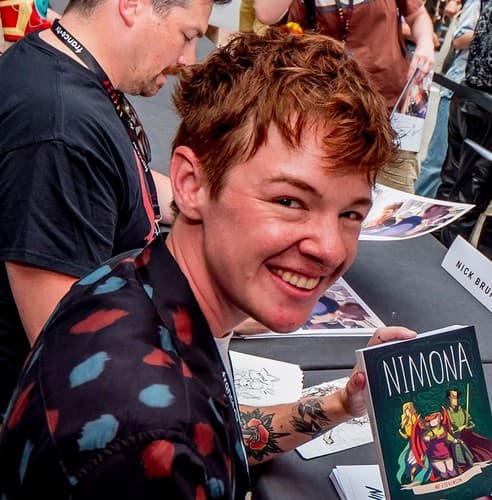
Noelle Stevenson is an American author and illustrator known for her work in graphic novels and comics. She is best known for "Nimona," a graphic novel that blends fantasy and humor, which has received significant recognition and was adapted into an animated film. Stevenson's storytelling often features themes of identity and friendship.
Similar books
- Alanna: The First Adventure
Tamora Pierce
4.2 (116k) average on GoodreadsFantasyNimona challenges traditional gender roles and heroism more radically. While Pierce's Alanna was groundbreaking for a female knight, Nimona deconstructs the very concept of heroism and villainy, and explicitly includes LGBTQ+ representation, which is absent in Alanna.
- Harry Potter and the Sorcerer's Stone
J.K. Rowling
4.5 (7M) average on GoodreadsFantasyRescued from a miserable life under the stairs, an orphaned boy discovers he's a wizard destined for a magical school, where he uncovers a dangerous secret tied to the dark wizard who murdered his parents.
- The Hunger Games
Suzanne Collins
4.3 (6.4M) average on GoodreadsFantasyIn a future where children fight to the death on live television, Katniss Everdeen volunteers for the arena, turning a death sentence into a fight for survival and a spark of rebellion.
- 1984
George Orwell
4.2 (3.1M) average on GoodreadsPoliticsIn a future where surveillance and thought control are absolute, a man's search for truth clashes with the Party, showing that hope can be a form of rebellion.
- Divergent
Veronica Roth
4.2 (2.9M) average on GoodreadsFantasyIn a society divided by virtues, a sixteen-year-old's difference from the norm starts a rebellion that threatens her world.
- The Hobbit, or There and Back Again
J.R.R. Tolkien
4.3 (2.9M) average on GoodreadsFantasyA comfort-loving hobbit named Bilbo Baggins is whisked away by a mischievous wizard and a band of dwarves on an unexpected journey to reclaim stolen treasure from a fearsome dragon, discovering courage and a magical ring along the way.





Enjoyed the summary?
A summary gives you the shape of the book. The book itself has the detail, the examples and the voice.
Find Nimona on AmazonAs an Amazon Associate, BookBrief earns from qualifying purchases. How we're funded