
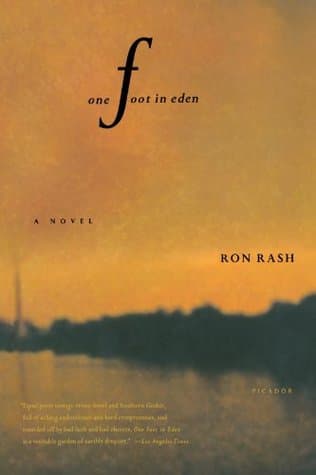
Synopsis
Covers the whole plot, including the ending.
- Difficulty
- Medium
- Pacing
- Moderate
- Mood
- Atmospheric, Bleak, Suspenseful, Reflective, Tragic
- Read it if
- You appreciate sparse, evocative prose, multi-perspective narratives, and a deep dive into the moral complexities of a desperate rural community.
- Skip it if
- You prefer fast-paced thrillers with clear-cut heroes and villains, or shy away from bleak, character-driven stories.
One Foot in Eden Plot Summary
Covers the whole plot, including the ending.
The Disappearance of Holland Winchester
Sheriff Will Alexander, in the summer of 1952 in Oconee County, South Carolina, learns from Deputy Bobby Burnette that Holland Winchester, a known moonshiner and troublemaker, is missing. Bobby and other locals suspect foul play, given Holland's violent reputation and many enemies. Will, quiet and observant, begins his investigation at Holland's cabin, finding signs of a struggle but no body. The lack of a corpse and witnesses makes the case difficult, creating a tense atmosphere in the small, insular community where everyone knows everyone's business but few speak openly.
Billy Holcombe's Confession
Billy Holcombe, a struggling farmer, returns home to his wife, Amy, and their young son, Isaac. Distraught and dirty, Billy confesses to Amy that he killed Holland Winchester. He explains how Holland had been harassing them, stealing their corn, and making advances toward Amy. The confession reveals a desperate act, born from a desire to protect his family and their meager living. Amy, shocked but loyal, agrees to help Billy hide the crime, knowing the severe consequences if the truth comes out. This moment solidifies their desperate bond and begins their shared secret.
The Search for the Body
Sheriff Alexander continues his investigation, questioning various townsfolk and moonshiners who knew Holland. He visits the Holcombe farm, noticing Billy's nervousness and Amy's calm, almost defiant, presence. The Sheriff's intuition tells him something is wrong, but he has no concrete evidence. The community offers little useful information, either from ignorance, fear of Holland's associates, or a desire to protect their own. The search extends to the surrounding woods and rivers, but the rugged land yields no clues to Holland's location.
Isaac's Perspective and the Secret
Isaac, Billy and Amy's son, is a quiet, observant boy. He overhears his parents' hushed conversations and senses the change in their home after Holland's disappearance. He sees the fear and determination in his mother's eyes and his father's burden. Though he doesn't fully understand the murder details, he grasps the secret's seriousness. He becomes a silent witness to their complicity, his innocent perspective highlighting the moral complexities of their actions. Isaac's internal struggle with the unspoken truth adds poignant tension, showing the crime's impact on the most vulnerable.
Amy's Determination and Protection
Amy Holcombe, determined to protect her husband and son, plans the concealment of Holland's murder. She meticulously cleans the scene, disposes of evidence, and coaches Billy on what to say if questioned. Her strength and resourcefulness are formidable, contrasting with Billy's more fractured state. She understands the harsh realities of their isolated existence and the unforgiving nature of justice in their community. Amy's actions, while morally complex, stem from fierce love and a primal instinct for survival, making her a compelling character whose choices drive much of the plot.
Deputy Burnette's Suspicions
Deputy Bobby Burnette, more impulsive than Sheriff Alexander, begins to suspect Billy and Amy Holcombe. He notices inconsistencies in their stories and senses tension from their farm. Bobby's past experiences and knowledge of local feuds lead him to believe Billy is capable of the deed. He shares his theories with Sheriff Alexander, urging a more aggressive approach. While Will appreciates Bobby's zeal, he prefers to gather undeniable proof rather than act on speculation, creating a dynamic of contrasting investigative styles between the two lawmen.
The Drought and Growing Pressure
A severe drought affects Oconee County, making life harder for the struggling farmers, including the Holcombes. The parched land and wilting crops reflect Billy and Amy's internal struggles and growing desperation. The environmental hardship adds pressure, intensifying the fear that their secret might be uncovered. The drought also forces people to interact more, as they seek water and assistance, increasing the chances of someone noticing something amiss. Nature itself seems to work against them, reflecting the harsh, unforgiving nature of their lives and the moral desert they find themselves in.
A Clue in the River
During one of his patrols, Sheriff Alexander finds a small, unusual item in the local river, a piece of clothing or personal effect he recognizes as possibly belonging to Holland Winchester. While not definitive proof, this discovery strengthens his resolve and narrows his search area, bringing him closer to the truth. The river, a silent witness to many secrets, slowly begins to reveal its hidden information. This small clue, though seemingly insignificant, reignites the investigation and adds urgency to the Sheriff's pursuit of justice, moving the story toward its climax.
The Confession to Sheriff Alexander
Overwhelmed by guilt, fear, and Sheriff Alexander's investigation, Billy Holcombe finally confesses to killing Holland Winchester. The confession comes after a tense interrogation, where Sheriff Alexander, through calm but persistent questioning, breaks through Billy's facade. Billy recounts the details of the confrontation, the fight, and the desperate act that led to Holland's death. This moment releases the immense burden Billy has carried, but it also signals the dismantling of his life and the consequences for his family, particularly Amy.
Amy's Complicity and Sacrifice
Following Billy's confession, Amy Holcombe's deep involvement in hiding the crime becomes clear. Her loyalty and determination to protect her family are fully understood. Faced with the inevitable, Amy makes a sacrifice, taking full blame for the murder and claiming she acted alone to save Billy from the gallows. This act, born of a powerful love, shows her strength and the desperate measures she will take. Her sacrifice reshapes the story, revealing her character's depths and the devastating impact of their choices on their lives and their son's future.
The Aftermath and Justice
After the confessions, the community of Oconee County faces the truth behind Holland Winchester's disappearance. Sheriff Alexander, having solved the case, now oversees the legal proceedings. Amy is arrested, and Billy, though spared the murder charge, lives with the weight of his wife's sacrifice and his own guilt. The justice system processes the crime, but the emotional and social repercussions for the Holcombes and the community are far more complex and lasting. The ending offers a somber reflection on justice, love, and the harsh realities of mountain life.
Principal Figures
Sheriff Will Alexander
Protagonist
The quiet, methodical sheriff investigating Holland Winchester's disappearance.
Will Alexander is the seasoned sheriff of Oconee County, a man of few words but keen observation. He embodies a quiet, almost stoic wisdom, deeply rooted in the land and its people. Unlike his deputy, he prefers patience and methodical investigation over impulsive action. Will is driven by a deep sense of justice and a desire to maintain order in his community, even when faced with the moral ambiguities of human nature. He understands the nuances of mountain life, where loyalty and desperation often intertwine, making his pursuit of truth both challenging and empathetic.
Relationships: Deputy Bobby Burnette (mentor/mentee, professional partner); Billy Holcombe (investigator/suspect); Amy Holcombe (investigator/suspect)
Amy Holcombe
Protagonist/Supporting
Billy's fiercely protective and resourceful wife, a key figure in the cover-up.
Amy Holcombe is a woman of immense inner strength and unwavering loyalty. Beautiful and resilient, she is the backbone of her family, fiercely devoted to her husband, Billy, and their son, Isaac. When faced with the murder of Holland Winchester, she becomes the architect of its concealment, her intelligence and resourcefulness shining through in her desperate attempts to protect her loved ones. Her actions, while morally questionable, are driven by a powerful, primal love and a deep understanding of the harsh realities of their isolated existence. She carries the weight of their secret with a stoicism that belies her inner turmoil.
Relationships: Billy Holcombe (husband/wife, co-conspirators); Isaac Holcombe (mother/son); Holland Winchester (victim's target of harassment)
Billy Holcombe
Protagonist/Supporting
A struggling farmer who commits murder out of desperation.
Billy Holcombe is a hardworking but desperate farmer, struggling to provide for his family in the unforgiving Appalachian landscape. He is less resilient than Amy, prone to fits of temper and burdened by guilt after killing Holland Winchester. His act is one of desperation, a reaction to Holland's relentless harassment and threats to his family and livelihood. Billy is haunted by his actions, his conscience a constant tormentor. He relies heavily on Amy's strength and resolve to navigate the cover-up, revealing his vulnerability and the immense pressure he's under. His internal struggle drives much of the narrative's tension.
Relationships: Amy Holcombe (husband/wife, co-conspirators); Isaac Holcombe (father/son); Holland Winchester (victim of his crime)
Isaac Holcombe
Supporting
Billy and Amy's observant young son, a silent witness to their secret.
Isaac Holcombe is the innocent son of Billy and Amy, a quiet and perceptive boy who senses the profound shift in his parents' lives after Holland Winchester's disappearance. Though he doesn't fully comprehend the details of the murder, he understands the gravity of the secret and the fear that permeates their home. His perspective offers a poignant counterpoint to the adult struggles, highlighting the innocence lost and the long-term impact of the crime on the next generation. Isaac's silent observations underscore the theme of inherited burdens and the way secrets can shape a child's world.
Relationships: Billy Holcombe (father/son); Amy Holcombe (mother/son)
Holland Winchester
Antagonist/Mentioned
The local troublemaker whose murder sets the plot in motion.
Holland Winchester is the catalyst for the novel's events, a notorious moonshiner and all-around menace in Oconee County. Even in death, his presence looms large over the community. He is depicted as a man without scruples, known for his violence, thievery, and harassment of local women, particularly Amy Holcombe. His reputation ensures that many people have a motive for his disappearance, complicating Sheriff Alexander's investigation. Holland represents the darker, lawless element of the Appalachian mountains, a force that pushes ordinary people like Billy Holcombe to desperate acts.
Relationships: Billy Holcombe (antagonist/victimizer); Amy Holcombe (harasser); Sheriff Will Alexander (victim of a crime he investigates)
Deputy Bobby Burnette
Supporting
Sheriff Alexander's younger, more impulsive deputy.
Deputy Bobby Burnette is Sheriff Alexander's eager and somewhat impetuous second-in-command. He is more direct and less nuanced than Will, often jumping to conclusions and advocating for swifter, more aggressive action in the investigation. Bobby's past experiences and knowledge of local feuds make him quick to suspect foul play. While he respects Sheriff Alexander, he sometimes chafes under Will's patient approach. His character provides a contrast to the Sheriff's steady demeanor, highlighting different approaches to law enforcement in a close-knit, rural community.
Relationships: Sheriff Will Alexander (subordinate/superior, professional partner)
Themes & Insights
Justice and Morality
The novel explores justice, questioning whether legal justice always matches moral justice. Billy's murder, though illegal, is shown as a desperate act to protect his family from Holland Winchester. Amy's sacrifice to save Billy further complicates this theme, showing a moral conviction rooted in love and loyalty, even if it defies the law. Sheriff Alexander's patient investigation seeks truth, acknowledging the harsh realities and moral compromises of mountain life, rather than simply applying the law. The ending prompts the reader to consider the true meaning of justice in such a nuanced context.
“A man will do what he has to do to protect his own.”
Love and Sacrifice
The power of love and sacrifice is central to the story. Amy Holcombe's actions stem from her love for Billy and Isaac, leading her to plan the cover-up and eventually take the blame for the murder. Her sacrifice shows her devotion, highlighting how love can compel individuals to extraordinary, often morally complex, acts. Billy's initial act also comes from a desire to protect his family, showing a desperate form of love. The novel demonstrates how love, in its most intense forms, can lead to both great strength and immense suffering.
“She loved him enough to bear his sin.”
The Burden of Secrets and Guilt
The Holcombes' secret deeply affects their lives and relationships. Billy is consumed by guilt and fear, his peace shattered. Amy, though resilient, carries the burden of orchestrating the cover-up and the constant threat of discovery. Even young Isaac, innocent of the crime, is affected by the unspoken tension and fear within his family, showing how secrets can affect generations. The novel vividly portrays the psychological toll of living with a hidden truth, showing how it isolates individuals and distorts their sense of self and connections to the community.
“The secret was a third person in their house, silent but always present.”
Man vs. Nature/Environment
The harsh Appalachian landscape plays a significant role, shaping the characters' lives and influencing the plot. The struggle for survival on their farm, made worse by a severe drought, highlights the desperation driving Billy's actions. The rugged mountains and winding rivers also provide the setting for the crime and its concealment, making the investigation challenging. Nature is not just a backdrop but an active force, mirroring the characters' internal struggles and constantly reminding them of their precarious existence. The land dictates their lives, choices, and ultimately, their fate.
“The land took what it wanted, and sometimes, it took more than just a living.”
Community and Isolation
The novel explores the dual nature of community in a rural, isolated setting. While Oconee County's close-knit nature means everyone knows everyone, it also fosters a culture of silence and protection, hindering Sheriff Alexander's investigation. The Holcombes, despite living within this community, become isolated by their secret, unable to share their burden. This theme highlights the paradox of rural life: a sense of belonging coexists with profound individual isolation, especially when secrets and crimes are involved. The community's unspoken role or ignorance shapes the narrative, revealing the complex social fabric of the mountains.
“In these mountains, folks knew things without being told, and kept quiet when they did.”
Plot Devices & Literary Techniques
Multiple Perspectives
The story is told through the alternating viewpoints of key characters.
The novel employs a rotating narrative perspective, allowing the reader to experience the story through the eyes of Sheriff Alexander, Billy Holcombe, Amy Holcombe, Deputy Burnette, and young Isaac. This device provides a rich, multifaceted understanding of the events, revealing the inner thoughts, motivations, and emotional struggles of each character. It builds suspense by showing how different individuals perceive the same events and how their secrets and suspicions intertwine, deepening the moral complexities and allowing for a comprehensive exploration of the themes of justice, love, and guilt.
Foreshadowing
Subtle hints and clues throughout the narrative suggest future events.
Foreshadowing is used effectively to build tension and anticipation. Early descriptions of Holland Winchester's violent nature and the resentment he garners from the community hint at his eventual demise. Similarly, the initial interactions between Sheriff Alexander and the Holcombes, with their nervous demeanors and evasive answers, subtly suggest their involvement. These subtle clues create a sense of impending revelation, allowing the reader to piece together the truth alongside the Sheriff, making the eventual confessions feel both inevitable and impactful, rather than sudden.
The Unseen Body
The absence of Holland Winchester's body drives the initial mystery.
The fact that Holland Winchester's body is missing is a central plot device. This absence creates the initial mystery and complicates Sheriff Alexander's investigation, making it difficult to prove a murder has even occurred, let alone identify a culprit. It forces the characters to grapple with an unseen crime, amplifying the psychological tension for both the investigators and the perpetrators. The search for the body becomes a symbolic quest for truth and justice, and its eventual discovery, or the confession without it, serves as a significant turning point in the narrative.
The Isolated Setting
The remote Appalachian mountains influence character actions and plot progression.
The isolated, rugged setting of Oconee County, South Carolina, is more than just a backdrop; it's a character in itself. This isolation fosters a close-knit, self-reliant community where external law often holds less sway than local customs and loyalties. It provides a perfect environment for secrets to be kept and for desperate acts to occur with little outside interference. The harshness of the land also contributes to the characters' struggles and their desperate choices, underscoring the theme of man versus nature and the unique moral landscape shaped by geographic remoteness.
One Foot in Eden Quotes
“The river kept its secrets well, deep and cold, carving its way through the mountains.”
“There were things you did not speak of, even to your wife, things that festered in the dark.”
“A man could lose himself in these mountains, and sometimes, that was exactly what he wanted.”
“Grief, like a shadow, always found its way back, no matter how far you ran.”
“Justice, in these parts, was often a thing bought with blood or silence.”
“The past was not dead; it was merely sleeping, waiting for a chance to rise again.”
“Some wounds never healed, just scabbed over, waiting for a pick or a fall.”
“Fear was a cold hand on the back of your neck, even when the sun shone bright.”
“There was a harsh beauty to the land, a beauty that demanded a price.”
“A lie, once told, had a way of growing, twisting itself around the truth until no one knew which was which.”
“The silence could be louder than any scream, especially when it held so much unsaid.”
“Hope was a dangerous thing, a flickering candle in a strong wind.”
“Every man carried his own particular hell, and some carried it better than others.”
“The mountains remembered, even when the people tried to forget.”
Quiz
10 questions on the plot and the characters. Each answer comes with a short explanation.
Question 1
Which character is the sheriff investigating Holland Winchester's disappearance?
- Billy Holcombe
- Isaac Alexander
- Will Alexander
- Amos Alexander
Show answer
C. Will Alexander Will Alexander is explicitly identified as the sheriff in the book's description, and he is the one investigating Holland Winchester's murder.
Question 2
What is the primary conflict Will Alexander faces regarding Holland Winchester?
- He knows Holland is alive but has fled the county.
- He suspects Holland faked his own death for insurance money.
- He knows Holland was murdered but can't find the body or a witness.
- He believes Holland committed suicide but lacks definitive proof.
Show answer
C. He knows Holland was murdered but can't find the body or a witness. The book description states, 'Will Alexander... knows that the local thug Holland Winchester has been murdered. The only thing is the sheriff can find neither the body nor someone to attest to the killing.'
Question 3
Through how many different character voices is the story 'elementally told'?
- Three
- Four
- Five
- Six
Show answer
C. Five The description lists five voices: 'the sheriff, a local farmer, his beautiful wife, their son, and the sheriff's deputy.'
Question 4
What is the geographical setting for 'One Foot in Eden'?
- Rural Mississippi Delta
- Southern Appalachia
- Coastal Georgia
- Central Florida swamps
Show answer
B. Southern Appalachia The book is set in 'a small town in southern Appalachia,' as stated in the synopsis.
Question 5
Which of the following literary genres is NOT explicitly mentioned in the description for 'One Foot in Eden'?
- Thriller
- Romance
- Historical Fiction
- Mystery
Show answer
B. Romance The provided genres are Literary Fiction, Thriller, Historical Fiction, and Mystery. Romance is not listed.
Question 6
What specific characteristic is Holland Winchester known for in the local community?
- He is a respected businessman.
- He is the local preacher.
- He is referred to as 'the local thug'.
- He is a reclusive artist.
Show answer
C. He is referred to as 'the local thug'. The description clearly identifies Holland Winchester as 'the local thug,' indicating his reputation.
Question 7
The narrative structure of 'One Foot in Eden' is described as being told 'elementally' through multiple voices. What does this suggest about the storytelling approach?
- The story relies heavily on complex, unreliable narrators.
- The narrative is straightforward and focuses on fundamental human experiences and perspectives.
- The plot is told in reverse chronological order, revealing elements slowly.
- The author uses a single, omniscient narrator with occasional character interjections.
Show answer
B. The narrative is straightforward and focuses on fundamental human experiences and perspectives. The phrase 'Simply, almost elementally told through the voices' suggests a direct, fundamental approach to storytelling, focusing on core experiences and perspectives without unnecessary complexity.
Question 8
The phrase 'signals the bellwether arrival of one the most mature and distinctive voices in southern literature' implies what about Ron Rash's standing as an author at the time of this book's publication?
- He was already a well-established and celebrated author in southern literature.
- This book marked his significant emergence as a notable and promising new voice.
- The book was a controversial work that challenged traditional southern literary norms.
- It was a commercial success but critically panned by southern literary critics.
Show answer
B. This book marked his significant emergence as a notable and promising new voice. A 'bellwether arrival' signifies an important and pioneering event, suggesting that this book marked Ron Rash's significant emergence or recognition as a distinctive voice in southern literature, rather than him being already well-established.
Question 9
What specific challenge does the sheriff face that elevates the mystery and difficulty of his investigation?
- He is new to the town and doesn't know the local customs.
- The local community is actively obstructing his investigation.
- He cannot find Holland Winchester's body nor anyone to confirm the killing.
- The crime scene was destroyed by a natural disaster before he arrived.
Show answer
C. He cannot find Holland Winchester's body nor anyone to confirm the killing. The core of the mystery, as stated, is that the sheriff 'can find neither the body nor someone to attest to the killing,' making his investigation uniquely challenging.
Question 10
Given the description, what is a likely thematic element explored in 'One Foot in Eden'?
- The escapist fantasies of urban dwellers moving to the countryside.
- The complex interplay of justice, community secrets, and moral ambiguity in a rural setting.
- The celebration of technological advancement in isolated communities.
- The challenges of intergenerational conflict in a wealthy family.
Show answer
B. The complex interplay of justice, community secrets, and moral ambiguity in a rural setting. The elements of a murder investigation without a body or witness, set in a small Appalachian town, told through multiple local voices, strongly suggest themes of hidden truths, community dynamics, and the blurred lines of right and wrong in a specific cultural context.
One Foot in Eden FAQ
What is the central mystery driving the plot of 'One Foot in Eden'?
The central mystery revolves around the disappearance and presumed murder of Holland Winchester, a local troublemaker. Sheriff Will Alexander is tasked with investigating, but the lack of a body and the silence of the community make it difficult to determine what truly happened and who might be responsible.
Who are the primary narrators in the novel, and how do their perspectives contribute to the story?
The story is told through multiple first-person perspectives, including Sheriff Will Alexander, the farmer Billy Holcombe, his wife Amy, their son Isaac, and Deputy Bobby Burns. Each narrator offers a limited, subjective view of the events surrounding Holland Winchester's disappearance, gradually revealing pieces of the truth and building a complex portrait of the community.
What is the significance of the novel's Appalachian setting in the 1950s?
The Appalachian setting in the 1950s is crucial, highlighting the isolation, poverty, and strong community ties that shape the characters' lives and moral choices. The impending construction of the dam, which will flood the valley, adds a sense of impending loss and desperation, influencing the characters' actions and their relationship with the land.
How does the relationship between Billy and Amy Holcombe evolve throughout the narrative?
Billy and Amy's relationship is central, initially strained by their financial struggles and Amy's past with Holland Winchester. The events surrounding Holland's death force them to confront their secrets and loyalties, ultimately deepening their bond as they make difficult choices to protect their family and their future.
What role does Sheriff Will Alexander play in the community beyond investigating the murder?
Sheriff Will Alexander is not just an investigator; he acts as the moral compass and a protector of his community, even when that means bending the rules. He understands the complexities of his neighbors' lives and often prioritizes maintaining order and protecting innocents over strict adherence to the law, particularly in the isolated Eden Valley.
What hints are dropped early on about Holland Winchester's true nature and his history with Amy?
Early narratives subtly suggest Holland Winchester's predatory nature and his past entanglement with Amy. Billy's resentment and Amy's unease whenever Holland is mentioned, along with the community's general dislike for him, hint at a history of exploitation and conflict that predates his disappearance.
Is there a symbolic significance to the impending dam construction and the flooding of the valley?
Yes, the dam symbolizes an irreversible change and the destruction of a traditional way of life. It represents the loss of Eden Valley, forcing characters to confront their pasts and make desperate choices before their world is literally submerged, reflecting the moral ambiguities and consequences of their actions.
How does Isaac's perspective, as a child, subtly reveal truths that adults might overlook or suppress?
Isaac's innocent and observant perspective often picks up on adult tensions and unspoken truths without fully understanding their implications. His descriptions of his parents' moods or the way adults interact with Holland Winchester provide unvarnished details that, when pieced together, corroborate other narrators' accounts or reveal hidden anxieties.
What is the implied fate of Holland Winchester, and how is it connected to the Holcombe family?
It is strongly implied that Holland Winchester was killed by Billy Holcombe in an act of self-defense or protection for Amy, following Holland's assault on her. His body is then hidden, likely with Amy's assistance, to protect Billy from legal repercussions and preserve their family.
How does the novel explore the psychology of guilt and complicity among its characters?
The novel delves into how guilt manifests differently in Billy, Amy, and Sheriff Alexander. Billy carries the direct guilt of the act, Amy the complicity of concealment, and the Sheriff the burden of knowing the truth but choosing to protect his community. Each grapples with their conscience and the consequences of their choices, revealing the complex nature of morality.
Discuss Amy Holcombe's internal conflict between loyalty to her husband and her own past traumas.
Amy struggles with the trauma of her past with Holland Winchester and her deep loyalty to Billy, who she knows acted to protect her. Her internal conflict involves suppressing her own pain and fear while actively participating in the cover-up, demonstrating her strength and determination to preserve her family, even at great personal cost.
How does Sheriff Alexander's moral compass operate in a way that sometimes contradicts the letter of the law?
Sheriff Alexander's moral compass is guided by a deep understanding of his community's needs and the harsh realities of their lives. He often prioritizes justice in a broader sense—protecting the innocent and maintaining peace—over strict legal enforcement, especially when he believes the law would inflict greater harm or injustice on deserving individuals like the Holcombes.
What psychological impact does the secret of Holland's disappearance have on Billy and Amy's relationship?
The shared secret of Holland's disappearance and presumed death binds Billy and Amy together in a profound and complex way. While it initially creates immense tension and fear, it ultimately solidifies their bond, forcing them to rely completely on each other and deepening their understanding of their mutual commitment and sacrifices.
Is 'One Foot in Eden' more of a crime novel or a character study, and why?
'One Foot in Eden' transcends a simple crime novel, functioning more as a profound character study. While a murder mystery drives the plot, the novel's core lies in exploring the motivations, moral dilemmas, and psychological states of the characters, examining how their choices are shaped by their environment and relationships rather than just solving a 'whodunit'.
What does the title 'One Foot in Eden' signify in the context of the novel's themes?
The title 'One Foot in Eden' suggests a precarious balance between paradise and expulsion, innocence and corruption. It reflects the characters' connection to the beautiful, yet soon-to-be-lost, Eden Valley, and their struggle to maintain a semblance of goodness or peace amidst hardship, violence, and moral compromise.
How does the novel challenge traditional notions of justice and law enforcement?
The novel challenges traditional notions of justice by presenting a situation where the 'right' thing to do, from a community and moral standpoint, might involve subverting the law. Sheriff Alexander's actions demonstrate that true justice in a complex world isn't always black and white, and that compassion and understanding can sometimes outweigh legal rectitude.
Can the ending be considered a triumph for the Holcombe family, despite their actions?
The ending can be seen as a qualified triumph for the Holcombe family. While they escape legal repercussions and secure their future, it comes at a significant moral cost and with the lifelong burden of their secret. Their survival and ability to start anew in a different place represent a victory, but it's tinged with the lingering shadows of their past actions.
What is the ultimate message about the nature of truth in 'One Foot in Eden'?
The novel suggests that truth is often subjective, fragmented, and deeply intertwined with individual perspectives and protective instincts. The full 'truth' of Holland Winchester's death is never explicitly stated by a single narrator, highlighting how personal narratives, self-preservation, and communal silence can obscure or reshape reality, making objective truth elusive.
About the author

Ron Rash is an American author known for his fiction that often explores themes of the Appalachian region. His notable works include "Serena," a novel about ambition and destruction in the early 20th century, "One Foot in Eden," which delves into the complexities of rural life, and "The World Made Straight," a story of redemption and the impact of the past.
Similar books
- Sons and Lovers
David Herbert Lawrence
Explores complex family dynamics and the harsh realities of rural life with a literary focus.
- Winter's Bone
Daniel Woodrell
3.9 (29k) average on GoodreadsLiterary FictionFeatures a strong female protagonist in a desolate Ozark setting, confronting poverty and crime.
- The Glass Castle
Jeannette Walls
4.3 (903k) average on GoodreadsBiographyOffers a raw, intimate look at survival and family secrets in an impoverished American landscape.
- Serena
Ron Rash
3.5 (34k) average on GoodreadsLiterary FictionRash's own "Serena" also explores themes of environmental exploitation, power, and moral decay in historical Appalachia. Both novels feature characters driven to extreme acts by their circumstances and desires. However, "Serena" is arguably more epic in scope, focusing on a ruthless timber baroness and her husband's empire, and has a more pronounced villainous figure in Serena herself. "One Foot in Eden," while equally dark, is more intimate, focusing on a single family's desperate act and its immediate consequences, making it a more contained and character-driven mystery compared to the broader historical drama of "Serena." The narrative focus in "Serena" is often on the macro-level impact of industry, while "One Foot in Eden" delves into the micro-level human cost of desperation.
- The Old Man and the Sea
Ernest Hemingway
3.8 (831k) average on GoodreadsLiterary FictionA Cuban fisherman's long struggle with a giant marlin becomes a story of endurance and dignity, now retold for young adults with illustrations, phonetic guides, and writing prompts in Traditional Chinese.
- One Hundred Years of Solitude
Gabriel García Márquez
4.1 (753k) average on GoodreadsLiterary FictionThrough the multi-generational story of the Buendía family, a mythical town deals with the repeating patterns of time, love, and solitude, as the extraordinary mixes with the ordinary.




Enjoyed the summary?
A summary gives you the shape of the book. The book itself has the detail, the examples and the voice.
Find One Foot in Eden on AmazonAs an Amazon Associate, BookBrief earns from qualifying purchases. How we're funded