BookBrief
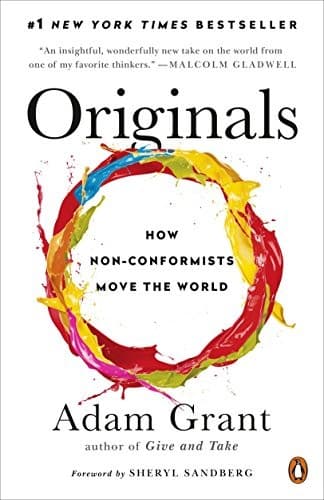
Originals: How Non-Conformists Move the World cover

Originals: How Non-Conformists Move the World Summary

Adam Grant (2017)

Get the book

Goodreads Rating

3.95/ 5(58,965 reviews)

Genre

General

Summary Read

15 min

Book Length

5 hours

By BookBrief EditorialLast updated August 30, 2026verifiedReviewed by BookBrief Editorial

Track Your Reading

Sign in to track this book

My Notes

Only visible to you
Adam Grant argues that the most impactful people aren't necessarily the first to act, but those who champion the ideas others initially reject.

Core Idea

Adam Grant's "Originals" explores the surprising habits and strategies of people who successfully challenge the status quo and introduce novel ideas that move the world forward. Grant argues that originality isn't an innate trait but a choice and a process, demystifying the path to innovation. He reveals that originals often doubt themselves, procrastinate, and even have many bad ideas before hitting on a good one, challenging common misconceptions about genius and risk-taking. The book provides actionable insights for individuals and organizations to foster and harness originality, emphasizing the importance of speaking up, building strong alliances, and carefully managing risk.
Reading time
5 hours
Difficulty
Medium
✓ Read this if...
You want to understand the psychology behind successful innovation, learn how to cultivate originality in yourself and others, or are looking for practical strategies to challenge the status quo effectively without being reckless.
✗ Skip this if...
You are looking for a purely historical account of famous innovators, or prefer a highly theoretical academic text over one rich with anecdotes and practical advice.

Chat with this book

Ask anything about Originals: How Non-Conformists Move the World and get instant answers grounded in the summary.

Key Takeaways from Originals

1

The Strategic Procrastinator

Originals don't rush; they strategically delay to incubate ideas.

Quote

When you put a task away, you give yourself the opportunity to engage in divergent thinking.

Grant challenges the idea that procrastination is always bad. He argues that a moderate amount of it can help creativity and originality. By delaying a task, people let their minds explore more possibilities, leading to new solutions. This 'incubation period' allows the subconscious to work on a problem, often resulting in sudden insights or a better approach. The point is not to procrastinate forever, but to use the delay for thought and exploration, not avoidance. This idea is helpful for anyone feeling pressured to deliver fast res...

Supporting evidence

Grant cites a study where participants who procrastinated moderately on a task generated 28% more creative ideas than those who started immediately. He also references Leonardo da Vinci's habit of taking years to complete paintings, often stepping away for extended periods.

Apply this

When faced with a complex problem, resist the urge to immediately jump to a solution. Instead, outline the problem, brainstorm initial ideas, and then step away for a period to allow for incubation. Return to the problem with fresh eyes and a more diverse set of potential solutions.


incubation-perioddivergent-thinkingcreative-process
2

The Power of Voicing Imperfect Ideas

Sharing early, unpolished ideas fosters collaboration and refinement.

Quote

The greatest originals are the ones who are willing to share their rough drafts and imperfect ideas.

Many aspiring creators fear sharing ideas before they are perfect, thinking it makes them look bad. Grant argues that this perfectionism stops innovation. He shows that sharing early, even flawed, ideas can be very helpful. This invites feedback, different viewpoints, and group refinement, which leads to a stronger final product. It also shows openness and humility, creating a more inclusive and innovative setting. This is different from just 'throwing out' ideas; it's about asking for feedback to improve, recognizing that group intel...

Supporting evidence

Grant recounts the story of Warby Parker's founders, who initially presented their business idea in a rough, incomplete state to their professor, receiving critical feedback that helped them refine their model significantly. He also discusses Pixar's 'Braintrust' meetings, where directors present early cuts of films for brutal, yet constructive, criticism.

Apply this

When developing a new idea or project, identify trusted colleagues or mentors and share your work-in-progress with them. Explicitly ask for critical feedback and be open to incorporating their insights, even if they challenge your initial assumptions. View early sharing as a strength, not a weakness.

constructive-criticismcollaborationidea-incubation
3

Vulnerability as a Catalyst for Change

Frame your original ideas by highlighting risks and limitations to build trust.

Quote

When you want to influence people, don't focus on trumpeting your strengths. Focus on revealing your weaknesses.

This is one of the book's strongest ideas, surprising yet very effective. Grant argues that when presenting an original idea, especially one that challenges the norm, it is more convincing to start with its potential downsides or weaknesses rather than only its strengths. This 'vulnerability approach' disarms your audience, showing honesty, self-awareness, and a balanced view. By acknowledging potential problems, you build trust and credibility, making your audience more open to the benefits you present afterward. It changes the dynam...

Supporting evidence

Grant cites a study where venture capitalists were more likely to invest in entrepreneurs who acknowledged risks and challenges in their pitches, compared to those who presented only upsides. He also references JFK's 1962 speech announcing the goal of landing a man on the moon, where he explicitly mentioned the immense difficulties and costs involved, yet still inspired the nation.

Apply this

When advocating for an original idea, begin by acknowledging its potential challenges, risks, or limitations. Frame these as opportunities for further consideration or collaborative problem-solving, then pivot to the compelling benefits and how those challenges might be mitigated. This builds immediate rapport and credibility.

persuasioncredibilityinfluence
4

The Myth of the Risk-Taking Maverick

Originals are often risk-averse in one area to take bigger risks in another.

Quote

The greatest originals are not necessarily risk takers in every domain; they are risk mitigators in most domains, which gives them the security to take risks in one or two significant areas.

Grant debunks the romanticized image of originals as reckless daredevils. Instead, he shows that many highly original people are quite risk-averse in their personal lives and financial decisions. They often keep a steady 'day job' or secure their finances before pursuing their groundbreaking ideas. This careful approach provides a safety net, reducing the pressure and fear of failure linked to their more radical projects. By minimizing risk in one area, they free up mental and emotional resources to take bigger, more impactful risks i...

Supporting evidence

Grant highlights that many successful entrepreneurs, like Phil Knight of Nike, maintained their full-time jobs for years while building their companies on the side. He also points to the fact that most Nobel Prize winners have full-time academic positions, providing a stable foundation for their research.

Apply this

If you have a bold, original idea, consider how you can build a safety net around it. This might mean maintaining your current employment, saving a financial buffer, or securing support systems before fully committing to the venture. This strategic stability allows for more fearless experimentation.

risk-managemententrepreneurshipinnovation-strategy
5

The Power of Groupthink's Antidote

Fostering psychological safety and dissenting voices prevents groupthink.

Quote

The most effective way to prevent groupthink is to create a culture of psychological safety, where people feel comfortable challenging the status quo.

Grant highlights the danger of groupthink, where a desire for conformity stops critical evaluation and original thought within teams. He argues that the solution is psychological safety—an environment where people feel safe to express different opinions, ask questions, and challenge assumptions without fear of punishment or embarrassment. Leaders are key in establishing this safety by actively seeking diverse perspectives, showing intellectual humility, and rewarding constructive criticism. This is not about constant disagreement, but...

Supporting evidence

Grant references Amy Edmondson's research on psychological safety in healthcare teams, showing that teams with higher psychological safety reported more errors, not because they made more, but because they felt safer admitting them, leading to better learning and performance. He also discusses how Google's Project Aristotle identified psychological safety as the most important factor for team effectiveness.

Apply this

As a leader or team member, actively invite dissenting opinions. Frame discussions as problem-solving sessions rather than consensus-seeking missions. Reward individuals who challenge the status quo respectfully and demonstrate that their input is valued, even if it's not ultimately adopted.

psychological-safetygroupthinkdissentteam-dynamics
6

The Art of Constructive Destructive Criticism

Effective feedback focuses on the task, not the person, and offers solutions.

Quote

The most effective critics are those who are not just destructive, but constructively destructive. They tear down an idea in a way that helps you build it back up better.

This takeaway looks at how to give feedback that helps originality rather than stifling it. Grant distinguishes between destructive criticism (which attacks the person or offers no way forward) and 'constructively destructive' criticism. The latter focuses only on the idea or product, identifies specific flaws, and, importantly, offers concrete suggestions for improvement or alternative approaches. This type of feedback helps creators refine their vision without feeling personally attacked or discouraged. It requires both empathy and ...

Supporting evidence

Grant discusses the impact of early critics on the careers of artists and entrepreneurs, highlighting how those who received specific, actionable feedback were more likely to succeed than those who received only vague praise or harsh personal attacks. He uses the example of a film director receiving feedback on a script, where specific suggestions for plot holes or character development are far more useful than a general 'it's bad'.

Apply this

When giving feedback, focus on the specific elements of the idea or work, rather than the individual. Clearly articulate what isn't working and, whenever possible, suggest alternative solutions or areas for improvement. Frame your feedback as a desire to help the idea reach its full potential.

feedbackcritiquementorshipcreative-development
7

Quantity Breeds Quality

Generating a high volume of ideas increases the likelihood of an original breakthrough.

Quote

The greatest originals are not the ones who produce the most ideas, but the ones who produce the most original ideas. But to produce the most original ideas, they often have to produce the most ideas, period.

Grant challenges the idea that originality is about waiting for a single, perfect 'aha!' moment. Instead, he shows that producing a lot of ideas is common among highly original thinkers. The more ideas one generates, the higher the chance of finding a truly new and impactful one. This is not about lowering standards, but about understanding that most initial ideas, even from brilliant minds, are average. Generating many ideas allows for exploration, iteration, and eventually filtering to find the best ones. This insight offers a pract...

Supporting evidence

Grant cites a study of classical composers, showing that the most prolific composers (like Bach and Mozart) also produced the most widely performed masterpieces. Similarly, he notes that Thomas Edison generated thousands of patents, most of which were minor, but a few were revolutionary. Shakespeare's extensive body of work is another example.

Apply this

When brainstorming or developing new concepts, set a goal for quantity rather than immediate perfection. Generate as many ideas as possible, no matter how wild or impractical they seem initially. Only after a significant volume has been produced, begin the process of evaluation and refinement.

ideationbrainstormingcreativityinnovation
8

The Weak-Tie Advantage

Diverse, casual connections are crucial for exposing us to novel ideas and opportunities.

Quote

Our weak ties are our most potent source of new ideas.

While close friends and family provide emotional support, Grant argues that 'weak ties'—acquaintances, colleagues in different departments, people we meet occasionally—are more valuable for fostering originality. Close ties often expose us to similar information, as our inner circles tend to share perspectives and knowledge. Weak ties, however, act as bridges to entirely different networks, exposing us to new ideas, diverse information, and unexpected opportunities that we would not find within our immediate social bubble. This is imp...

Supporting evidence

Grant references Mark Granovetter's famous 'strength of weak ties' theory, which demonstrated that individuals are more likely to find jobs through acquaintances than close friends. He applies this to idea generation, showing how diverse weak ties expose people to unique perspectives and information not available within their inner circle.

Apply this

Actively seek out opportunities to connect with people outside your immediate professional or social circle. Attend conferences, join cross-functional teams, or engage in online communities related to different fields. Prioritize these 'weak tie' interactions as sources of novel insights and potential collaborations.

networkingsocial-capitaldiversity-of-thoughtinformation-flow
9

Challenging the 'First-Mover Advantage'

Pioneers face higher risks; 'second movers' often have a strategic edge.

Quote

First movers are often the ones who make all the mistakes, allowing later entrants to learn from their errors.

Grant directly challenges the belief that being the 'first mover' in an industry or with an idea guarantees success. He presents evidence that pioneers often bear the cost of market education, technological development, and regulatory hurdles, making them more likely to fail. Instead, 'second movers' or 'fast followers' can observe the pioneers' mistakes, learn from their failures, and then enter the market with a refined, better product or business model, often at a lower cost and with less risk. This argument has limitations in rapi...

Supporting evidence

Grant highlights examples like Facebook (not the first social network, but learned from MySpace's errors), Google (not the first search engine, but vastly superior to AltaVista and Yahoo!), and Apple's iPhone (not the first smartphone, but perfected the user experience). These companies observed the pioneers and improved upon their designs.

Apply this

When considering an original idea, research existing attempts in similar areas. Analyze why they succeeded or failed. Instead of rushing to be first, consider how you can learn from existing efforts and enter the market with a more robust, refined, or strategically differentiated offering.

competitive-advantagemarket-strategyinnovation-timingfast-follower
10

The Unsung Heroes of Originality

Originality isn't just about generating ideas, but championing them effectively.

Quote

Being original is not just about coming up with a new idea. It's about having the courage to speak up for it, and the skill to get others to listen.

This final takeaway brings together many of Grant's earlier points, showing that true originality goes beyond just having ideas. It includes the courage to voice unconventional thoughts, the resilience to handle skepticism, and the strategic skill to persuade others to accept new concepts. Many brilliant ideas fail because their creators lack the conviction or communication skills to champion them effectively. Grant emphasizes the importance of developing persuasive communication, building alliances, and understanding how to present i...

Supporting evidence

Grant discusses the importance of 'venturing' an idea – speaking up and advocating for it. He highlights the story of the employees at a major retail chain who championed the idea of online sales despite initial resistance from management, eventually proving its worth. He also references Martin Luther King Jr.'s ability to articulate a vision and mobilize millions.

Apply this

Beyond generating ideas, actively cultivate your ability to articulate and advocate for them. Practice persuasive communication, learn to anticipate and address objections, and seek out allies who can help champion your cause. Remember that an idea's impact is often tied to its champion's effectiveness.

advocacypersuasionleadershipcourage

Originals Quotes

Originals are not great because they are the first to light the fire, but because they are the last to let it go out.

Grant's definition of originality, emphasizing persistence.

We tend to think of risk-takers as people who are reckless and don't care about the consequences. But the most successful risk-takers are the ones who are the most careful.

Discussing the nature of risk-taking among successful originals.

The most effective way to be creative is to have a lot of ideas, and then to be very critical of them.

On the process of idea generation and refinement.

When you're facing a difficult decision, it's often better to trust your gut than to overthink it.

Advice on decision-making, highlighting intuition.

The biggest barrier to creativity is not a lack of ideas, but a fear of failure.

Identifying fear of failure as a primary obstacle to originality.

Embrace doubt. Doubt is not the enemy of progress, but its engine.

Encouraging a healthy relationship with doubt in the pursuit of originality.

The greatest danger in life is not taking any risk.

A concise statement on the importance of taking risks.

We can be more original when we have a greater tolerance for risk.

Connecting tolerance for risk with the capacity for originality.

Procrastination can be a good thing. It allows you to think about your ideas more deeply and to come up with better solutions.

Re-framing procrastination as a potentially beneficial tool for originals.

The opposite of courage in our society is not cowardice, it is conformity.

Defining conformity as the true antithesis of courage in the context of originality.

We are more likely to take risks when we have a strong sense of purpose.

Linking purpose with the willingness to take risks.

The most successful people are not the ones who never fail, but the ones who learn from their failures.

Emphasizing learning from failure as a hallmark of successful originals.

We should be willing to challenge the status quo and to question assumptions.

Advocating for challenging established norms and beliefs.

If you want to be original, you have to be willing to be wrong.

Highlighting the necessity of accepting potential errors to achieve originality.

Quiz

Test Your Knowledge

Ready to see how well you understood this book? Take our interactive quiz with 10 questions.

10
Questions
~5
Minutes
?
Best Score

Originals FAQ

Originals: How Non-Conformists Move the World by Adam Grant explores the characteristics and strategies of people who drive creativity and change. It delves into how non-conformists generate novel ideas, challenge the status quo, and bring about significant progress in various fields.

About the author

Adam Grant is an organizational psychologist and a professor at the University of Pennsylvania's Wharton School. He is a New York Times bestselling author known for his work on motivation, generosity, and the psychology of giving.

Enjoyed the summary?

Support the author — grab the full book.

As an Amazon Associate, BookBrief earns from qualifying purchases, at no extra cost to you. How we're funded.

Get the book