
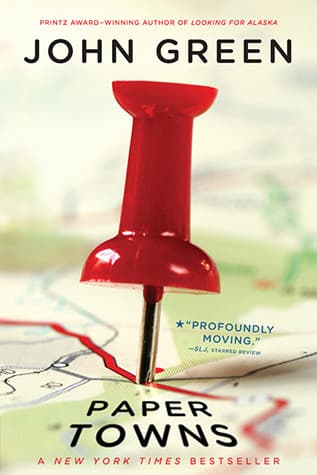
Synopsis
Covers the whole plot, including the ending.
- Difficulty
- Easy
- Pacing
- Moderate
- Mood
- Reflective, Witty, Bittersweet, Thought-provoking
- Read it if
- You enjoy coming-of-age stories with a mystery element and philosophical undertones about identity.
- Skip it if
- You prefer a straightforward romance or a fast-paced, action-driven mystery.
Paper Towns Plot Summary
Covers the whole plot, including the ending.
The Return of Margo Roth Spiegelman
One night, a few weeks before high school graduation, Quentin 'Q' Jacobsen is surprised when Margo Roth Spiegelman, his childhood friend and longtime crush, climbs through his bedroom window. Dressed in black, Margo asks Q for help with an elaborate, spontaneous revenge mission. Their targets include Margo's cheating boyfriend, Jase Worthington, and her fair-weather friends, Lacey Pemberton and Becca Arrington. They egg houses, saran-wrap Jase's car, and move a large plastic fish into Becca's room. Q is excited by the adventure and the unexpected closeness to Margo, a girl he has admired from afar for years. This night is a significant change from Q's otherwise ordinary, predictable life.
Margo's Disappearance
The morning after their adventurous night, Q arrives at school expecting to see Margo. However, she is gone. Her parents, used to her occasional disappearances, are not overly concerned at first, believing she will return. Q, however, feels uneasy and responsible, especially given their recent shared experience. He starts to worry when Margo misses more and more days of school, and her parents eventually file a missing person report. Q is left wondering why she left and if their night together meant anything to her.
The First Clues: Woody Guthrie and a Poster
Q, needing to understand Margo's disappearance, starts looking for clues. He finds two important items: a poster of Woody Guthrie's 'This Machine Kills Fascists' on Margo's bedroom wall, and a copy of Walt Whitman's 'Leaves of Grass' with specific passages highlighted. These clues are for him, as Margo's family and the police do not recognize their meaning. Q asks his best friends, Ben Starling and Radar, to help him decipher Margo's messages. They begin to realize that Margo's disappearance might be more intentional and complex than a simple runaway.
The Abandoned Mini-Mall
Following the clues from 'Leaves of Grass,' Q, Ben, and Radar find an abandoned mini-mall, which Margo had used as a hideout. Inside, they find evidence of Margo's recent presence: a mattress, some discarded food, and a notebook with Margo's thoughts and drawings. The most important find is a map of the area with certain points circled, specifically focusing on a place called 'Agloe, New York,' a paper town. This discovery confirms Q's belief that Margo intended for him to find her and that her leaving was a deliberate act, not an impulsive one.
Paper Towns and Agloe
The idea of 'paper towns' becomes central to the mystery. Q and his friends learn that these are fictitious places added to maps by cartographers to catch copyright infringers. Agloe, New York, is one such paper town, which, due to its inclusion on a map, actually attracted a general store and a few residents, briefly becoming a real place before fading away. Q deduces that Margo, feeling like a 'paper girl' living in a 'paper town' (Orlando), might have gone to Agloe as a symbolic act of escape or self-discovery. This provides a concrete destination for their search.
The Road Trip to Agloe
With graduation approaching and only a few days left before Q and his friends are set to leave for college, they receive a final, urgent clue from Radar's Omni-vision computer: a message posted on a geocaching website that seems to indicate Margo is in Agloe, and she plans to leave soon. Convinced this is their last chance, Q, Ben, Radar, and Lacey Pemberton (who feels guilty about her previous judgment of Margo), pile into Radar's minivan. They embark on a frantic, 19-hour road trip from Florida to upstate New York, determined to find Margo before it is too late.
Arrival in Agloe
After a grueling, non-stop drive, the group finally arrives in Agloe, New York. The 'town' is nothing more than a dilapidated barn and a few scattered trees. Inside the barn, they find Margo. However, she is not the vibrant, adventurous girl Q remembers. She is disheveled, somewhat withdrawn, and clearly annoyed by their sudden appearance. Margo explains that she never intended for them to find her and that the clues were merely breadcrumbs for Q to understand her perspective, not to follow her physically. This encounter shatters Q's romanticized image of her.
The Confrontation and Realization
Q confronts Margo, expressing his frustration and hurt at her apparent indifference to their efforts and her lack of concern for the worry she caused. Margo, in turn, criticizes Q for projecting his own fantasies onto her, for seeing her as a 'miracle' rather than a complex, flawed individual. She explains her need to escape the 'paper' existence she felt trapped in, a life where everyone saw her as a two-dimensional character. This difficult conversation forces Q to realize that his perception of Margo was entirely his own creation, and the real Margo is far more complicated and independent than he ever imagined.
Margo's Future and Q's Acceptance
After the initial tension, Margo explains her plans to continue her travels, living on her own terms and writing about her experiences. She emphasizes that she needs to discover who she truly is, away from the expectations of others. While Q is disappointed that Margo will not be returning to Orlando with them, he begins to understand and respect her decision. He realizes that loving someone means accepting them for who they are, not who you want them to be. The friends share a final, poignant moment with Margo before she sets off on her own again, and they begin their journey back to Florida.
Returning Home and Moving On
Q, Ben, and Radar return to Orlando, missing their high school graduation but having gained a significant experience. The road trip and the encounter with Margo have deeply impacted Q, helping him to mature and gain a new perspective on life, friendship, and love. He no longer idealizes Margo but sees her as a real person. He cherishes the memories of their adventure and the bond it formed with his friends. The experience ultimately prepares him to embrace his own future, less focused on Margo and more on his own path and the genuine connections he has.
Paper Towns Characters
Quentin 'Q' Jacobsen
Protagonist
A cautious, intelligent high school senior obsessed with Margo Roth Spiegelman.
Q is a studious, somewhat nerdy, and risk-averse high school student on the cusp of graduation. He has a deep, long-standing infatuation with his neighbor, Margo Roth Spiegelman, whom he idealizes as a magnificent, enigmatic figure. Q is driven by a desire for order and understanding, which fuels his quest to find Margo and decipher her clues. He is loyal to his friends, Ben and Radar, and often acts as the group's intellectual leader.
Relationships: Margo Roth Spiegelman (Childhood friend, unrequited crush, object of his quest); Ben Starling (Best friend, comedic relief); Marcus 'Radar' Lincoln (Best friend, voice of reason, tech expert); Lacey Pemberton (Margo's friend, initially estranged, later joins the quest)
Margo Roth Spiegelman
Catalyst/Mystery
The enigmatic, adventurous girl who disappears, leaving clues for Q.
Margo is presented as a legend in her high school, known for her spontaneous adventures, rebellious spirit, and captivating beauty. Beneath this adventurous exterior, Margo feels deeply misunderstood and trapped by the two-dimensional image others have of her. She seeks authenticity and a life free from the expectations of her Orlando community. Her disappearance is an act of self-discovery and a rejection of her 'paper girl' persona.
Relationships: Quentin 'Q' Jacobsen (Childhood friend, accidental recipient of her escape plan); Jase Worthington (Ex-boyfriend, target of her revenge); Lacey Pemberton (Friend, later reconnects with Margo); Becca Arrington (Friend, target of her revenge)
Ben Starling
Supporting
Q's best friend, known for his crude humor and desire for a girlfriend.
Ben is Q's goofy and often crude best friend, providing much of the comic relief. He is obsessed with finding a girlfriend, particularly Lacey Pemberton, and frequently makes inappropriate jokes. Despite his immaturity, Ben is fiercely loyal to Q and Radar and is willing to go to great lengths to help his friends, even embarking on a cross-country road trip. He represents the more impulsive and less analytical side of the trio.
Relationships: Quentin 'Q' Jacobsen (Best friend); Marcus 'Radar' Lincoln (Best friend); Lacey Pemberton (Love interest, later girlfriend)
Marcus 'Radar' Lincoln
Supporting
Q's other best friend, a logical and intelligent tech expert.
Radar is the most grounded and intelligent of Q's friends, often serving as the voice of reason. He is a skilled computer whiz and the son of the world's largest collection of black Santas. Radar is pragmatic, responsible, and provides the logistical and technological support for Q's quest. He is in a stable relationship with Angela and often offers a more balanced perspective than Q or Ben.
Relationships: Quentin 'Q' Jacobsen (Best friend); Ben Starling (Best friend); Angela (Girlfriend)
Lacey Pemberton
Supporting
Margo's best friend, initially perceived as superficial, but proves to be caring.
Lacey is initially presented as one of Margo's popular, somewhat superficial friends, targeted by Margo's revenge. However, after Margo's disappearance, Lacey reveals a deeper, more caring side, expressing genuine concern for Margo's well-being. She feels hurt and confused by Margo's actions and later joins Q and his friends on the road trip, proving her loyalty and challenging Q's initial judgments.
Relationships: Margo Roth Spiegelman (Best friend); Ben Starling (Love interest, later girlfriend)
Angela
Supporting
Radar's girlfriend, who offers a calm and supportive presence.
Angela is Radar's steady and understanding girlfriend. She is supportive of Radar and his friends, even when their antics are unconventional. Her presence provides a contrast to the romantic dramas and obsessions of the other characters, representing a stable and healthy relationship. She is intelligent and perceptive, offering a quiet strength to the group.
Relationships: Marcus 'Radar' Lincoln (Girlfriend)
Jase Worthington
Mentioned
Margo's popular, cheating boyfriend.
Jase is Margo's ex-boyfriend, a popular and athletic student who cheated on Margo, prompting her elaborate revenge scheme. He represents the superficiality and betrayal that Margo feels in her life. His character is primarily seen through Margo's and Q's perceptions, serving as an initial antagonist and a catalyst for Margo's actions.
Relationships: Margo Roth Spiegelman (Ex-boyfriend)
Mr. and Mrs. Spiegelman
Supporting
Margo's parents, who are accustomed to her disappearances.
Margo's parents are portrayed as somewhat detached and resigned to Margo's unpredictable behavior. They are initially unconcerned by her disappearance, having dealt with it multiple times before. Their complacency highlights Margo's feeling of being misunderstood and overlooked, even by her own family. They represent the adult world's failure to truly connect with Margo.
Relationships: Margo Roth Spiegelman (Parents)
Paper Towns Themes
The Illusion of Perception
This theme explores how individuals create idealized versions of others, failing to see their true, complex selves. Q's entire quest is driven by his romanticized image of Margo as a 'miracle' and an 'adventure.' He projects his desires and fantasies onto her, only to discover in Agloe that the real Margo is a flawed, independent person who resents being seen as a two-dimensional character. The novel uses the metaphor of 'paper towns' and 'paper girls' to show how people can be simplified by others' perceptions, highlighting the dangers of idealization and the importance of seeing others for who they truly are, not who you want them to be. This is clearly shown when Q finally finds Margo and she criticizes him for expecting her to be the person he imagined.
“What a treacherous thing to believe that a person is more than a person.”
The Search for Identity and Authenticity
Margo's disappearance is an act of self-discovery. She feels stifled by the expectations and superficiality of her life in Orlando, seeing herself as a 'paper girl' in a 'paper town.' Her journey to Agloe and beyond is an attempt to shed these imposed identities and find her authentic self, away from others' judgments. Q, too, goes on a journey of self-discovery, learning to define himself independently of Margo. He initially seeks to 'find Margo' but ultimately finds a more mature understanding of himself and his place in the world, accepting that identity is fluid and personal.
“I’m not a miracle. I’m not a fantasy. I’m a human being. Just so you know.”
The Nature of Friendship and Loyalty
Beyond the central mystery of Margo, the novel shows the lasting bonds of friendship between Q, Ben, and Radar. Their loyalty to Q and to each other is strong, as they drop everything to help him search for Margo, even embarking on an impulsive, cross-country road trip. Their banter, shared experiences, and mutual support form the emotional core of the story. The addition of Lacey to their group further explores the complexities of friendship, showing how perceived rivalries can become genuine concern and camaraderie. The journey strengthens their bonds, proving that true friendship involves supporting each other through absurd and challenging times.
“It is so hard to leave—until you leave. And then it is the easiest goddamned thing in the world.”
The Transition from Adolescence to Adulthood
Set against the backdrop of high school graduation, the novel explores the anxieties and excitement of transitioning into adulthood. The characters are on the edge of major life changes – college, new responsibilities, and defining their future. Margo's dramatic escape is an extreme example of this desire for independence and self-definition. Q's journey, while initially focused on Margo, ultimately becomes about his own growth, his understanding of the world, and his readiness to face the future without clinging to past ideals. The road trip itself is a rite of passage, forcing the characters to confront their limitations and embrace uncertainty as they move forward.
“The town was paper, but the memories were not.”
Plot Devices & Literary Techniques
The Missing Person Mystery
Margo's disappearance drives the entire plot.
Margo's vanishing act serves as the central enigma that propels the narrative. It provides the initial hook, drawing Q and the reader into a quest for answers. The mystery isn't just about 'where' Margo went, but 'why,' leading to deeper explorations of her character and Q's perceptions. This device creates suspense, builds anticipation, and provides a clear objective for the protagonist, ensuring continuous engagement.
Clues and Scavenger Hunt
A series of cryptic messages left by Margo for Q.
Margo deliberately leaves a trail of clues, including highlighted passages in 'Leaves of Grass,' a Woody Guthrie poster, and notes in an abandoned mini-mall. This scavenger hunt structure allows Q to actively participate in solving the mystery, providing a sense of agency and discovery. It also serves as a narrative tool to reveal Margo's internal world and intellectual interests, slowly peeling back layers of her persona for Q and the reader.
'Paper Towns' Metaphor
Fictitious map entries symbolizing superficiality.
The concept of 'paper towns' (fictional places on maps) and its extension to 'paper people' is a central metaphor. It represents the idea of superficiality, fabricated identities, and the feeling of being two-dimensional or misunderstood. Margo feels like a 'paper girl' living in a 'paper town' (Orlando), prompting her escape to Agloe, a real-life former paper town. This device deepens the thematic exploration of perception versus reality and the search for authenticity.
The Road Trip
A journey that serves as a physical and emotional transformation.
The cross-country road trip undertaken by Q and his friends is a classic literary device. It physically moves the characters from their familiar environment, symbolizing their transition from adolescence to adulthood. The shared experience on the road strengthens their bonds, forces them to confront challenges, and allows for deep conversations and character development outside the constraints of their everyday lives. It culminates in the climactic confrontation with Margo, marking the end of Q's idealized quest.
Paper Towns Quotes
“Margo always loved mysteries. And in everything she did, she became a mystery.”
“It is so hard to leave—until you leave. And then it is the easiest goddamned thing in the world.”
“What a treacherous thing to believe that a person is more than a person.”
“You are not a bad person for wanting the one thing you want more than anything else.”
“The town was a paper town, and the people were paper people. I could never live in a paper town.”
“That's always been the problem with you, Margo. You don't think anything's going to happen to you.”
“You can't just be a person. You have to be a person who matters.”
“The miracle is not that we are here, but that we are here together.”
“I’m not a human being, I’m a human doing.”
“The way I figure it, everyone gets a miracle. My miracle was Margo Roth Spiegelman.”
“I will never be able to figure out how Margo got from where she was to where she is.”
“She was not a miracle. She was not an adventure. She was not a prize. She was a girl.”
“You have to get lost before you can be found.”
“The rules of the game are: you find the clues, you solve the puzzle, you get the girl.”
Quiz
10 questions on the plot and the characters. Each answer comes with a short explanation.
Question 1
What is the primary reason Margo Roth Spiegelman initially enlists Quentin Jacobsen's help for an all-night adventure?
- To confess her feelings for him.
- To commit acts of revenge against people she feels have wronged her.
- To explore abandoned places in Orlando.
- To help her move out of her house without her parents knowing.
Show answer
B. To commit acts of revenge against people she feels have wronged her. Margo's initial adventure with Q is a 'revenge mission' against her cheating boyfriend, Jase, and her fair-weather friends.
Question 2
What is the first significant clue Quentin finds that indicates Margo's disappearance is more than just a typical runaway act?
- A note left on his pillow.
- A copy of Walt Whitman's 'Leaves of Grass' with highlighted passages.
- A coded message on her bedroom wall.
- A map with a specific location circled.
Show answer
B. A copy of Walt Whitman's 'Leaves of Grass' with highlighted passages. One of the first and most crucial clues Q finds is a copy of 'Leaves of Grass' in Margo's room, which contains highlighted lines pointing to her potential location and mindset.
Question 3
What is the 'paper town' concept that Margo discusses, and how does it relate to her view of Orlando?
- It refers to towns that exist only on maps but not in reality, and Margo sees Orlando as a vibrant, real place.
- It refers to towns that are so generic and fake that they might as well be made of paper, and Margo sees Orlando in this way.
- It refers to towns built quickly out of cheap materials, and Margo believes Orlando is poorly constructed.
- It refers to towns that are only for tourists, and Margo hates the tourist traps in Orlando.
Show answer
B. It refers to towns that are so generic and fake that they might as well be made of paper, and Margo sees Orlando in this way. Margo describes 'paper towns' as places that are so bland, artificial, and devoid of real substance that they feel like they're merely drawn on paper. She applies this concept to her perception of Orlando, feeling trapped by its superficiality.
Question 4
Which specific location do Quentin and his friends drive to during their road trip, believing it to be Margo's final destination?
- A deserted amusement park in Florida.
- A remote cabin in the Appalachian Mountains.
- An abandoned mini-mall in Agloe, New York.
- A beach house on the Outer Banks of North Carolina.
Show answer
C. An abandoned mini-mall in Agloe, New York. Following the clues, Q and his friends embark on a road trip to Agloe, New York, a 'paper town' that was once a copyright trap on maps, where they believe Margo is hiding out in an abandoned mini-mall.
Question 5
What is Quentin's biggest realization about Margo when he finally confronts her in Agloe?
- That she intentionally wanted to hurt him by leaving.
- That she is not the idealized, perfect person he imagined her to be, but a complex individual.
- That she has fallen in love with someone else.
- That she had planned to return to Orlando all along.
Show answer
B. That she is not the idealized, perfect person he imagined her to be, but a complex individual. Q's ultimate confrontation with Margo reveals that his perception of her was an idealized fantasy. He learns that she is a real person with flaws and desires, not the 'miracle' he built her up to be in his mind.
Question 6
What role does the character Ben Starling play in Quentin's search for Margo?
- He is Quentin's rival for Margo's affection.
- He provides essential financial support for the road trip.
- He is one of Quentin's best friends and an enthusiastic, albeit sometimes distracting, companion on the journey.
- He is the one who initially finds the most crucial clue to Margo's whereabouts.
Show answer
C. He is one of Quentin's best friends and an enthusiastic, albeit sometimes distracting, companion on the journey. Ben is one of Quentin's two best friends and accompanies him on the road trip to find Margo, providing comic relief and unwavering support, even if his motivations sometimes lean towards wanting to go to prom.
Question 7
Margo leaves a cryptic message on a specific type of animal poster in her room. What animal is featured on these posters?
- Cats
- Dogs
- Woody Guthries
- Black Santas
Show answer
D. Black Santas Margo leaves a message for Q on the back of a Black Santa poster in her room, which is one of the early, perplexing clues.
Question 8
The theme of 'seeing people as maps' versus 'seeing people as people' is central to the novel. How does Quentin's journey with Margo illustrate this theme?
- Q initially sees Margo as a flat, two-dimensional character (a 'map') of his desires, but through his search, he learns to appreciate her three-dimensional complexity as a real person.
- Q always saw Margo as a complex person, but Margo only saw him as a map to escape her life.
- The theme is about literal maps and how they can mislead people, which is why Margo ends up in a 'paper town'.
- It suggests that people are constantly changing, making it impossible to ever truly know them.
Show answer
A. Q initially sees Margo as a flat, two-dimensional character (a 'map') of his desires, but through his search, he learns to appreciate her three-dimensional complexity as a real person. Q spends most of the book projecting his idealized image onto Margo, seeing her as a 'map' of adventure and mystery. His journey forces him to confront the reality that she is a complex, flawed 'person' with her own motivations, separate from his perceptions.
Question 9
Before her disappearance, Margo tells Quentin that she believes that 'all the strings inside him are snapping.' What does she mean by this metaphor?
- She thinks Quentin is about to have a mental breakdown.
- She feels like she is losing her connection to the world and the people around her, becoming detached and unreal.
- She is referring to the strings of a guitar, indicating her desire to become a musician.
- She is describing her physical health deteriorating.
Show answer
B. She feels like she is losing her connection to the world and the people around her, becoming detached and unreal. The 'strings' metaphor represents Margo's feeling of being disconnected and unreal, as if the connections that hold her together and link her to others are breaking. This is a key insight into her internal struggles and her reason for leaving.
Question 10
What is the significance of the poem 'Song of Myself' by Walt Whitman in Margo's clues?
- It directly states her exact location.
- It is a poem about finding love, which is what Margo hopes to do.
- Its themes of self-discovery, individuality, and the vastness of the world resonate with Margo's journey and provide contextual clues.
- It is a poem Margo wrote herself, hinting at her artistic aspirations.
Show answer
C. Its themes of self-discovery, individuality, and the vastness of the world resonate with Margo's journey and provide contextual clues. Margo highlights passages in 'Song of Myself' which reflect her desire for self-discovery, her feeling of being a 'paper girl' in a 'paper town,' and her need to explore her own identity. It doesn't give a literal location but provides insight into her mindset and motivations.
Paper Towns FAQ
What is the core mystery Quentin Jacobsen tries to solve in 'Paper Towns'?
Quentin's core mystery is the disappearance of Margo Roth Spiegelman. After an adventurous night of revenge with her, Margo vanishes, leaving behind a series of cryptic clues that Quentin believes are specifically for him to follow and find her.
Describe the 'ingenious campaign of revenge' Margo and Quentin undertake.
Margo and Quentin's revenge campaign involves a series of elaborate pranks targeting people who have wronged Margo. This includes saran-wrapping a car, removing a door, filling a room with fish, and leaving a dead fish in the bed of her cheating boyfriend, Jase.
Who are Quentin's closest friends, and how do they assist him?
Quentin's closest friends are Ben Starling and Radar. Ben, often focused on finding a prom date, and Radar, a meticulous and intelligent individual, both help Quentin decode Margo's clues, provide transportation, and offer moral support throughout his search.
What is a 'paper town' in the context of the book?
A 'paper town' refers to a fake subdivision or a phantom settlement that exists only on maps. In the book, the term also symbolizes the superficiality and artificiality Margo perceives in her suburban Orlando life and the people around her, particularly the idealized versions people create of others.
Where does Quentin ultimately find Margo, and what state is she in?
Quentin eventually finds Margo in Agloe, New York, a 'paper town' on a map. She is living in an abandoned barn, having intentionally run away to escape what she felt was a fake and unfulfilling life, rather than being in distress or needing rescue.
What is the significance of the Whitman poem 'Song of Myself' in Margo's clues?
The Whitman poem 'Song of Myself' is a crucial part of Margo's clues, particularly the lines 'I too am not a bit tamed, I too am untranslatable, I sound my barbaric yawp over the roofs of the world.' It reflects Margo's desire for freedom, individuality, and her rejection of societal expectations, guiding Quentin to understand her true motivations for leaving.
How does the abandoned mini-mall relate to Margo's perspective on her life?
The abandoned mini-mall, a place Margo frequently visited, symbolizes the decay and emptiness she sees in her suburban existence. It's a place of forgotten dreams and failed ventures, mirroring her feeling that her own life in Orlando is equally unfulfilling and destined for obsolescence.
What detail about Margo's family life contributes to her desire to escape?
Margo's family life is depicted as somewhat detached and superficial; her parents don't seem to truly understand or connect with her. This lack of genuine connection and their tendency to focus on appearances rather than her emotional well-being contributes significantly to her feeling misunderstood and her eventual decision to run away.
What is the 'Black Santa' joke, and how does it reveal Margo's character?
The 'Black Santa' joke involves Margo leaving a black Santa Claus figurine in people's houses. This prank reveals Margo's mischievous, unconventional, and slightly rebellious nature, showing her inclination to subvert expectations and leave her unique mark in unexpected ways.
How does Quentin's perception of Margo evolve throughout his search?
Initially, Quentin idealizes Margo as a mysterious, adventurous goddess. As he follows her clues, he gradually realizes that his idealized version is a 'paper Margo,' and he begins to understand her as a complex, flawed individual with her own struggles and desires, rather than just an object of his affection.
Discuss Margo's 'manic pixie dream girl' archetype and how the book subverts it.
Margo initially appears as a 'manic pixie dream girl' who exists primarily to inspire Quentin. However, the book subverts this by revealing that Margo has her own agency, motivations, and internal struggles entirely separate from Quentin's narrative, ultimately rejecting his attempt to define her solely through his gaze.
What psychological need does Quentin's relentless pursuit of Margo fulfill for him?
Quentin's relentless pursuit of Margo fulfills his need for adventure, a break from his mundane life, and a sense of purpose. It also allows him to confront his own idealized perceptions and mature by understanding that people are complex and cannot be fully known or 'solved.'
How does the concept of empathy play a role in Quentin's journey?
Empathy is crucial as Quentin attempts to 'get inside Margo's head' to understand her clues and motivations. His journey forces him to try and see the world from her perspective, ultimately leading to a deeper, more nuanced understanding of her struggles and desires, rather than just projecting his own feelings onto her.
Is the ending of 'Paper Towns' a happy one for Quentin and Margo? Why or why not?
The ending is not a traditionally happy romantic ending for Quentin and Margo, as they do not end up together. Instead, it's a resolution focused on self-discovery and acceptance. Quentin finds peace in understanding Margo's need for independence, and Margo maintains her freedom, making it a mature and realistic conclusion about respecting individual paths.
What is the ultimate message of the book regarding knowing other people?
The ultimate message is that it's impossible to truly know another person completely, as everyone is a complex individual with their own internal world. The book suggests that attempting to understand others involves recognizing their autonomy and accepting that our perceptions are often incomplete or idealized 'paper' versions of them.
Could Margo's actions be considered selfish, or are they justified?
Margo's actions could be seen as selfish by those she leaves behind, particularly her parents and Quentin, due to the distress her disappearance causes. However, from her perspective, they are justified as a necessary act of self-preservation and a quest for authenticity, rejecting a life she found suffocating and fake.
How does the road trip with Quentin's friends contribute to his personal growth?
The road trip provides Quentin with a shared adventure, strengthening his bonds with Ben and Radar. It forces him out of his comfort zone, tests his resolve, and ultimately helps him realize the value of present experiences and true friendship over a singular, idealized pursuit, fostering significant personal growth.
What does the final conversation between Quentin and Margo reveal about their future relationship?
The final conversation reveals that while there's a deep understanding and mutual respect, a romantic future together is unlikely. Margo emphasizes her need for freedom and her journey of self-discovery, and Quentin accepts this, signifying a shift from romantic pursuit to a more mature, platonic appreciation of each other's paths.
What is the significance of Margo's decision to travel alone after meeting Quentin in Agloe?
Margo's decision to travel alone after Agloe is highly significant as it reaffirms her independence and commitment to her own journey of self-discovery. It demonstrates that her escape was not a plea for rescue but a deliberate choice to forge her own path, free from others' expectations or narratives, including Quentin's.
About the author

John Michael Green is an American author, YouTuber, podcaster, and philanthropist. His books have more than 50 million copies in print worldwide, including The Fault in Our Stars (2012), which is one of the best-selling books of all time. Green's rapid rise to fame and idiosyncratic voice are credited with creating a major shift in the young adult fiction market. Green is also well known for his work in online video, most notably his YouTube ventures with his brother Hank Green.
Similar books
- Looking for Alaska
John Green
4.0 (1.1M) average on GoodreadsMysteryExplores themes of identity, first love, and the search for meaning in a similar YA voice.
- Eleanor & Park
Rainbow Rowell
4.0 (860k) average on GoodreadsYoung AdultFeatures complex teenage characters and a poignant, realistic portrayal of young love and self-discovery.
- The Perks of Being a Wallflower
Stephen Chbosky
4.2 (1.3M) average on GoodreadsPsychologyA coming-of-age story about an introspective protagonist navigating high school, friendship, and self-acceptance.
- It's Kind of a Funny Story
Ned Vizzini
4.1 (211k) average on GoodreadsPsychologyBoth books feature a protagonist undergoing a significant personal journey. However, Vizzini's novel focuses on mental health and recovery within a clinical setting, whereas Paper Towns uses a physical road trip and mystery framework to explore philosophical themes of perception and idealization, with less emphasis on clinical psychological issues.
- We Were Liars
E. Lockhart
3.8 (465k) average on GoodreadsThrillerBoth are YA mysteries involving secrets and a quest for truth. We Were Liars builds to a dramatic, shocking twist that recontextualizes the entire narrative. Paper Towns, in contrast, gradually dismantles the initial mystery, revealing that the 'truth' is less about a hidden event and more about the flawed perceptions of the protagonist, making its resolution more existential than plot-driven.
- Angels & Demons
Dan Brown
3.9 (2.7M) average on GoodreadsThrillerA Harvard symbologist races through Rome's ancient sites, deciphering cryptic clues to unmask the Illuminati and stop a vengeful plot to destroy the Vatican with a stolen antimatter weapon.





Enjoyed the summary?
A summary gives you the shape of the book. The book itself has the detail, the examples and the voice.
Find Paper Towns on AmazonAs an Amazon Associate, BookBrief earns from qualifying purchases. How we're funded