
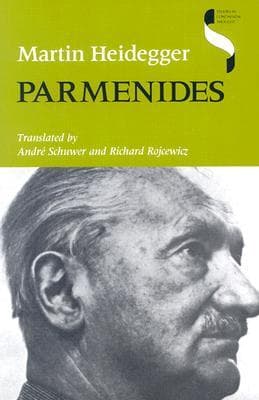
Core Idea
- Difficulty
- Hard
- Read it if
- You are a serious student of Heidegger, ancient Greek philosophy, or the history of metaphysics, and are prepared for a deep, challenging dive into the origins of Western thought and the concept of truth.
- Skip it if
- You are looking for an introductory text on philosophy, a light read, or a straightforward historical account of Parmenides' philosophy without extensive Heideggerian interpretation.
Key Takeaways from Parmenides
Aletheia: The Unconcealed Essence of Truth
Truth as unconcealment, not correctness of assertion.
Heidegger redefines truth, moving away from its usual definition as agreement between intellect and thing. For ancient Greeks, especially Parmenides, truth (aletheia) was not about a statement's accuracy but about an event: the 'unconcealing' of what is. It is a dynamic process where being emerges from hiddenness. This early understanding stresses the fight against concealment (lethe), where 'untruth' is not just falsehood but the state of being hidden or forgotten. This active revealing was central to how Greeks experienced reality, different from later philosophy that reduced truth to a feature of statements.
“The Greeks do not call truth aletheia because it is correctness of assertion, but rather assertion can be correct only because its essence is determined by unconcealment.”
In the book: Heidegger's extensive etymological analysis of 'aletheia,' breaking down the word into 'a-' (privative alpha, indicating negation) and '-letheia' (from 'lethe,' meaning oblivion or concealment).
Try this: When evaluating information, instead of merely checking for factual accuracy, consider what aspects are being revealed and what remains concealed. Engage with ideas not just to confirm their correctness, but to participate in their unfolding and disclosure.
Related ideas: aletheia, lethe, unconcealment
The Latinization of Truth: From Unconcealment to Correctness
How Roman translation shifted truth's meaning and Western thought.
Heidegger argues that translating 'aletheia' into the Latin 'veritas' changed the Western understanding of truth. 'Veritas' implies correctness, reliability, and the 'rightness' of a judgment, moving away from the Greek sense of active unconcealment. This 'Latinization' was more than a language change; it set a new metaphysical framework where truth became a feature of statements or propositions, not an event of being. This shift, Heidegger claims, led to the dominance of logic, epistemology, and the subject-object split, hiding the original Greek experience of truth as a dynamic revelation.
“The Latin word veritas, which translates the Greek aletheia, is not an equivalent translation; rather, it already represents a decisive transformation of the essence of truth.”
In the book: Heidegger's detailed comparison of the etymological roots and conceptual implications of 'aletheia' (unconcealment, coming-to-light) versus 'veritas' (verum, 'that which is correct or real').
Try this: Be critically aware of how language shapes understanding. When engaging with foundational concepts, investigate their etymological history to uncover layers of meaning that might have been lost or altered through translation and historical usage. Question assumptions embedded in common terms.
Related ideas: veritas, latinization, correspondence-theory-of-truth
Parmenides' Didactic Poem: A Path to Being
The poem as a guide to the primordial experience of Being.
Heidegger sees Parmenides' poem 'On Nature' as a direct unveiling of Being itself, not just a philosophical text. He argues that the poem's structure, especially the Goddess's revelation of two paths (the Way of Truth and the Way of Seeming), shows unconcealment happening. The 'Way of Truth' is where Being 'is' and non-Being 'is not,' highlighting Being's undivided, unchanging, and complete nature. This is not an abstract logical idea but a basic experience of what truly appears. The poem leads the reader into this initial encounter, challenging daily distractions of 'seeming' and opinion to grasp Being's lasting presence.
“The poem of Parmenides is not a 'doctrine' in the modern sense, but a showing, a pointing, a bringing-to-light of that which is to be thought.”
In the book: Heidegger's close reading and extensive commentary on fragments of Parmenides' poem, especially the proem where the youth is led by the Daughters of the Sun to the Goddess, and the Goddess's pronouncements on 'What is' and 'What is not.'
Try this: Approach foundational texts not just as sources of information, but as experiences designed to transform your understanding. Pay attention to the structure, imagery, and rhetorical devices, as they might be integral to the 'showing' of a concept, rather than just its explanation.
Related ideas: parmenides-poem, way-of-truth, being
The Decadence of Untruth: From Lethē to Falsity
Untruth as concealment, not mere error.
Just as truth is unconcealment (aletheia), Heidegger argues that early untruth is not error in judgment, but concealment (lethe). This original untruth is a part of Being itself; Being always appears from and withdraws into concealment. It is a dynamic interaction. However, with truth's Latinization, untruth also became merely 'falsity' (falsum), the incorrectness of an assertion. This change reduces untruth from a deep existential state of hiddenness to a logical or epistemic error, further hiding the rich Greek understanding of how things appear and disappear. This reduction affects how we understand knowledge, error, and human understanding's limits.
“Untruth is not primarily the incorrectness of a judgment, but rather the concealment of being, the withdrawal into oblivion.”
In the book: Heidegger's analysis of 'lethe' not as a lack of truth, but as an active process of forgetting or hiding, which is always at play in the event of unconcealment. He contrasts this with the later 'falsum' as a property of propositions.
Try this: When encountering 'false' or 'misleading' information, consider not just its inaccuracy but what it conceals or distracts from. Recognize that some truths are inherently elusive or only partially revealed, and this concealment is part of their nature, not merely a human failing.
Related ideas: lethe, falsity, concealment
The Greek-Roman Divide: Two Ways of Being
A fundamental ontological difference shaping Western civilization.
Heidegger proposes a deep difference between Greek and Roman ways of being, arguing it is more significant than cultural variations. The Greeks, especially early on, had a more original relationship to Being as unconcealment (aletheia), experiencing the world as a dynamic happening of revealing. The Romans, in contrast, developed a more practical, instrumental, and legalistic relationship to the world, emphasizing order, governance, and the 'correctness' of things (veritas). This difference is deeply embedded in their languages, institutions, and entire understanding of reality, affecting everything from philosophy to architecture. Heidegger sees the Roman influence as a key step in the West's departure from its Greek beginnings.
“The contrast between the Greek and the Roman is not a mere cultural difference, but concerns a fundamental difference in their relation to Being, in their understanding of truth.”
In the book: Heidegger's repeated comparisons of Greek concepts and words (e.g., 'aletheia,' 'phusis') with their Roman counterparts (e.g., 'veritas,' 'natura'), highlighting the semantic and ontological shifts.
Try this: When studying historical or cultural phenomena, look beyond superficial similarities to identify fundamental differences in how different civilizations conceive of reality, truth, and human existence. This can reveal deeper layers of influence and divergence.
Related ideas: greek-thought, roman-thought, ontology
Language as the House of Being
The power of original language to reveal or conceal truth.
Heidegger's statement, 'Language is the house of Being,' is central to his analysis in 'Parmenides.' He argues that language is not just a communication tool or a system of signs, but the way Being reveals itself to humans. A language's specific structure and origins, especially ancient Greek, can either keep an early understanding of Being (like 'aletheia') or distort it (like 'veritas'). The shift from Greek to Latin, then, was not a neutral translation but a basic re-housing of Being, with major effects for Western thought. To understand truth, one must pay attention to the language in which it is first spoken, aiming to recover its original terms' lost meanings.
“Language is the house of Being. In its home man dwells. Those who think and those who create with words are the guardians of this home.”
In the book: The entire book is an extended exercise in linguistic analysis, dissecting Greek words like 'aletheia,' 'lethe,' 'phusis,' and 'logos' to uncover their original, often forgotten, meanings and their implications for understanding Being.
Try this: Cultivate a deep appreciation for language, particularly the etymology and historical context of key terms in any field of study. Recognize that translations are interpretations, and engaging with original texts in their original languages (or with careful scholarly translations) can unlock deeper insights.
Related ideas: language-of-being, etymology, linguistic-turn
The Beginning of Western Metaphysics
Parmenides as a pivotal, yet misunderstood, figure.
Heidegger presents Parmenides not just as an early philosopher, but as a foundational figure whose insights into Being and non-Being deeply shaped, then were later obscured by, Western metaphysics. While often seen through a logical lens, Heidegger insists Parmenides' 'is' is not just a word in a sentence but an assertion of Being's pure presence and unconcealedness. The later philosophical tradition, starting with Plato and Aristotle, began to interpret Parmenides' Being through ideas like substance, form, and actuality, starting the 'forgetting of Being' (Seinsvergessenheit) that ends in modern technology and nihilism. Heidegger's 'Parmenides' tries to recover this lost beginning.
“Parmenides stands at the very beginning of Western thinking, not as a mere precursor, but as the one who first explicitly thought the essence of Being and truth.”
In the book: Heidegger's critique of traditional interpretations of Parmenides, which often reduce his propositions to abstract logical principles rather than ontological insights into the nature of Being.
Try this: When studying the history of philosophy, resist the urge to view early thinkers solely through the lens of later developments. Strive to understand their concepts within their own unique context, recognizing that later interpretations might have inadvertently distorted original meanings.
Related ideas: forgetting-of-being, western-metaphysics, presocratics
The 'Out of Joint' World: A Critique of Modernity
The contemporary world's crisis stems from the forgetting of Being.
Heidegger’s lecture on Parmenides, given during World War II, is not just an academic work but a critique of the modern world, which he called 'out of joint.' This disjointedness comes from the West's 'forgetting of Being' (Seinsvergessenheit), a historical process started by truth's Latinization and the later dominance of technology, calculative thinking, and subjectivism. Reducing truth to correctness and the world to objects for human control leads to a sense of homelessness, meaninglessness, and a basic separation from reality's core. Heidegger saw his work as an attempt to re-awaken questioning of Being, a necessary step to address modernity's spiritual and existential crisis.
“The time is out of joint. O cursed spite, that ever I was born to set it right! (Hamlet, often cited by Heidegger to describe his contemporary world)”
In the book: Heidegger's direct references to his contemporary situation throughout the lectures, framing the philosophical discussion within the context of a world in crisis and searching for a new beginning.
Try this: Reflect on how modern society's emphasis on efficiency, quantification, and technological control might inadvertently obscure deeper questions about meaning, purpose, and the nature of reality. Seek out experiences and practices that foster a more contemplative, open relationship with the world.
Related ideas: seinsvergessenheit, nihilism, critique-of-technology
The Primacy of the Question of Being
Philosophy's true task is to re-awaken the question of Being.
For Heidegger, philosophy's main job is not to solve problems or build systems, but to awaken and maintain the 'question of Being.' He argues that this basic question, which inspired early Greek thought, has been forgotten throughout Western metaphysics. Instead, philosophy has focused on questions about beings (entities) rather than Being itself—its meaning, its essence, its unconcealment. By carefully returning to Parmenides, Heidegger aims to show how this question was originally asked and experienced, challenging modern philosophy to reclaim its deepest inquiry. This re-awakening is essential for overcoming the 'forgetting of Being' and addressing the modern age's spiritual emptiness.
“The question of Being, which once moved the Greeks, has today fallen into oblivion. Yet it is the fundamental question of philosophy.”
In the book: The entire structure of the lecture course, which is less about presenting a fixed doctrine and more about leading the audience into a rigorous, questioning engagement with Parmenides' text and the concept of Being.
Try this: Instead of seeking definitive answers, cultivate a practice of deep, persistent questioning, especially regarding foundational concepts. Allow yourself to dwell in the discomfort of uncertainty when exploring fundamental truths, as this can be a more fruitful path to understanding than premature closure.
Related ideas: question-of-being, fundamental-ontology, philosophical-inquiry
Parmenides Quotes
“The beginning remains the greatest. What is great, however, is not what has been completed, but what is just beginning.”
“Being and thinking are the same.”
“The truth of being is not something to be possessed, but something that possesses man.”
“Parmenides is for us the thinker who, in the very beginning, thought being as being.”
“The way of truth is a way that leads through unconcealment.”
“Language is the house of Being.”
“The unconcealment of being is not a human achievement; it is an event.”
“What is, is. What is not, is not. This is the simple, yet fundamental, insight.”
“Thinking is the essence of man, not as a faculty among others, but as the relation to Being itself.”
“The oblivion of Being is the fundamental event of Western history.”
“The word 'is' names Being. It is not a mere copula, but the fundamental word.”
“Philosophy is not a theoretical discipline, but a fundamental event of human existence.”
“The 'what' of a thing can never be separated from the 'that it is'.”
“The path of inquiry is not a human choice, but a destiny.”
Quiz
10 questions on the main ideas. Each answer comes with a short explanation.
Question 1
According to Heidegger in 'Parmenides', what is the central theme of his interpretation of Parmenides' 'didactic poem'?
- The problem of universals and particulars
- The question of truth and its primordial understanding
- The ethical implications of being and non-being
- The historical development of pre-Socratic metaphysics
Show answer
B. The question of truth and its primordial understanding The text explicitly states that 'The central theme is the question of truth and the primordial understanding of truth to be found in Parmenides' 'didactic poem.''
Question 2
What significant contrast does Heidegger highlight in 'Parmenides' that is reflected in language?
- The contrast between Eastern and Western philosophical traditions
- The contrast between rationalism and empiricism
- The contrast between Greek and Roman thought
- The contrast between ancient and modern scientific inquiry
Show answer
C. The contrast between Greek and Roman thought Heidegger 'highlights the contrast between Greek and Roman thought and the reflection of that contrast in language,' according to the description.
Question 3
Heidegger argues that the decline in the primordial understanding of truth began in which period?
- The pre-Socratic era itself
- Later Greek philosophy
- The early Roman Empire
- The medieval scholastic period
Show answer
B. Later Greek philosophy The text states that Heidegger 'analyzes the decline in the primordial understanding of truth...that began in later Greek philosophy.'
Question 4
Heidegger's 'Parmenides' is described as a 'major contribution' to his provocative dialogue with which group of philosophers?
- The German Idealists
- The Scholastics
- The pre-Socratics
- The British Empiricists
Show answer
C. The pre-Socratics The book description notes it as 'A major contribution to Heidegger's provocative dialogue with the pre-Socratics.'
Question 5
What does Heidegger identify as a primary cause for the continued decline of the primordial understanding of truth down to the present day?
- The rise of scientific rationalism
- The Latinization of the West
- The dominance of Christian theology
- The advent of technological modernity
Show answer
B. The Latinization of the West Heidegger argues the decline continues 'by virtue of the Latinization of the West, down to the present day.'
Question 6
Beyond an interpretation of Greek philosophy, what else does 'Parmenides' offer, especially given the historical context of its delivery?
- A defense of contemporary political ideologies
- A detailed historical account of ancient Rome
- A strident critique of the contemporary world
- A blueprint for a new philosophical system
Show answer
C. A strident critique of the contemporary world The description states, 'Beyond an interpretation of Greek philosophy, Parmenides...offers a strident critique of the contemporary world.'
Question 7
In 'Parmenides', Heidegger attacks some of the most firmly established conceptions of Greek thinking and of the Greek world. What does this suggest about his approach to ancient philosophy?
- He aims to reinforce traditional scholarly views without deviation.
- He seeks to provide a conventional, historically accurate overview.
- He engages in a critical re-evaluation that challenges accepted interpretations.
- He primarily focuses on cataloging existing interpretations rather than creating new ones.
Show answer
C. He engages in a critical re-evaluation that challenges accepted interpretations. The phrase 'attacks some of the most firmly established conceptions' indicates a critical and revisionist approach, challenging accepted interpretations rather than merely presenting them.
Question 8
Heidegger's analysis in 'Parmenides' includes the decline in the primordial understanding of both truth and, just as importantly, what other concept?
- Beauty
- Goodness
- Untruth
- Justice
Show answer
C. Untruth The text explicitly mentions 'the decline in the primordial understanding of truth--and, just as importantly, of untruth.'
Question 9
What specific historical context is provided for the delivery of Heidegger's 'Parmenides' lectures and his critique of the contemporary world?
- The post-World War I disillusionment in Germany
- The period of the Cold War and the atomic age
- 1942-1943, a time Heidegger described as 'out of joint'
- The student protests and cultural revolutions of the late 1960s
Show answer
C. 1942-1943, a time Heidegger described as 'out of joint' The description states the lectures were 'delivered...in 1942-1943...during a time that Heidegger described as 'out of joint.''
Question 10
Given Heidegger's focus on the 'primordial understanding of truth' and its decline due to Latinization, what is a likely implication for how he views language in philosophical inquiry?
- Language is a transparent medium that merely reflects pre-existing ideas.
- The specific historical and linguistic forms of expression are crucial to understanding philosophical concepts.
- Universal logical structures of language transcend cultural and historical contexts.
- Philosophical truth can only be accessed through mathematical or symbolic logic, not natural language.
Show answer
B. The specific historical and linguistic forms of expression are crucial to understanding philosophical concepts. Heidegger's emphasis on the 'contrast between Greek and Roman thought and the reflection of that contrast in language,' and the 'decline...by virtue of the Latinization of the West,' strongly suggests that for him, language is not a neutral vessel but profoundly shapes and reflects philosophical understanding, making its specific historical forms crucial.
Parmenides FAQ
What is the central theme of Heidegger's 'Parmenides'?
The central theme is the question of truth and the primordial understanding of truth as presented in Parmenides' didactic poem. Heidegger explores how this original conception of truth, and untruth, has declined over time.
Does Heidegger's 'Parmenides' offer a traditional interpretation of ancient Greek philosophy?
No, Heidegger's 'Parmenides' presents a highly original and often provocative interpretation of ancient Greek philosophy. It directly challenges many firmly established conceptions of Greek thinking and the Greek world.
What is the significance of the contrast between Greek and Roman thought in the book?
Heidegger highlights the profound contrast between Greek and Roman thought, arguing that this difference is reflected in their respective languages. He traces the decline of the primordial understanding of truth to the 'Latinization of the West' that began with Roman influence.
What does Heidegger mean by the 'decline in the primordial understanding of truth'?
Heidegger argues that the original, more profound understanding of truth and untruth, evident in early Greek thought like Parmenides', began to erode with later Greek philosophy. This decline was further entrenched by the Latinization of Western thought, leading to a diminished contemporary grasp of truth.
How does Heidegger's 'Parmenides' differ from other interpretations of Parmenides' work?
Heidegger's interpretation is unique in its focus on the 'primordial understanding of truth' and its critique of the Western philosophical tradition through the lens of Parmenides. Unlike many commentaries, it uses Parmenides as a springboard for a broader critique of metaphysical decline.
What is the role of language in Heidegger's analysis of truth?
Language plays a crucial role as Heidegger analyzes how the contrast between Greek and Roman thought is reflected in their respective languages. He suggests that linguistic shifts contributed to the decline in the primordial understanding of truth.
Does 'Parmenides' offer insights into Heidegger's broader philosophical project?
Yes, 'Parmenides' is a major contribution to Heidegger's ongoing dialogue with the pre-Socratics and provides significant insights into his critique of Western metaphysics. It reflects his persistent concern with the question of Being and truth.
How does this book relate to Heidegger's critique of the contemporary world?
Beyond a philosophical interpretation, 'Parmenides' offers a strident critique of the contemporary world, which Heidegger described as 'out of joint.' He connects the decline of truth to the modern condition, making the book relevant to understanding his broader cultural criticisms.
Is 'Parmenides' an accessible read for those new to Heidegger?
As a lecture course from Heidegger's Collected Works, 'Parmenides' can be challenging for newcomers due to its dense philosophical argumentation and specific terminology. Prior familiarity with Heidegger's thought or ancient Greek philosophy would be beneficial.
About the author
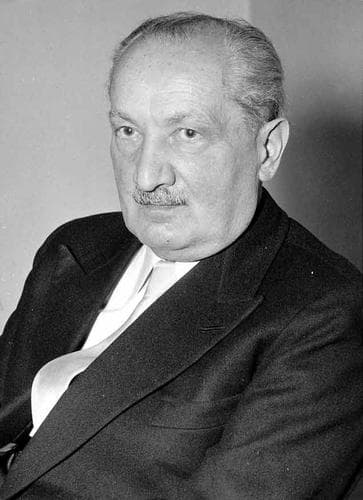
Martin Heidegger was a German philosopher known for his contributions to existentialism and phenomenology. His notable works include "Being and Time," which explores the nature of being, and "Parmenides," which examines the relationship between thought and being. Heidegger's ideas have significantly influenced 20th-century philosophy and continue to be studied today.
Similar books
- Being and Time
Martin Heidegger
4.0 (20k) average on GoodreadsPsychologyExplores the fundamental question of Being and the nature of truth, providing the broader context for 'Parmenides'.
- Brave New World
Aldous Huxley
4.0 (1.4M) average on GoodreadsFantasyIn a future where happiness comes from chemicals and individuality is gone, one man's desire for real experience threatens the calm, controlled society.
- Life of Pi
Yann Martel
3.9 (1.3M) average on GoodreadsFantasyStranded in the vast Pacific, a young Indian boy forms an unlikely bond with a Bengal tiger, questioning belief and survival.
- The Picture of Dorian Gray
Oscar Wilde
4.1 (966k) average on GoodreadsFantasyA beautiful young man's soul decays within a cursed portrait, mirroring the grotesque cost of his hedonistic pursuit of eternal youth and illicit pleasure.
- Tuesdays with Morrie
Mitch Albom
4.1 (782k) average on GoodreadsBiographyA dying professor's weekly lessons from his bedside change a former student, giving him ideas on life, love, and letting go.
- The Tipping Point: How Little Things Can Make a Big Difference
Malcolm Gladwell
4.0 (690k) average on GoodreadsBusinessMalcolm Gladwell explains how small, targeted actions can start widespread changes in trends, behaviors, and ideas.





Enjoyed the summary?
A summary gives you the shape of the book. The book itself has the detail, the examples and the voice.
Find Parmenides on AmazonAs an Amazon Associate, BookBrief earns from qualifying purchases. How we're funded