
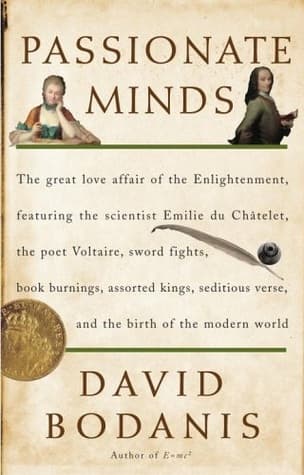
Core Idea
- Difficulty
- Medium
- Read it if
- You are fascinated by the untold stories of intellectual collaboration, want to understand the true origins of Enlightenment thought beyond popular figures, or are interested in the lives of brilliant women who defied societal norms to pursue science and philosophy.
- Skip it if
- You prefer a straightforward, chronological biography of a single individual, or are not interested in the detailed interplay between personal relationships and intellectual development in historical context.
Key Takeaways from Passionate Minds
The Enlightenment's Unsung Architect
Émilie du Châtelet's pivotal role in popularizing Newton and foreshadowing Einstein.
Émilie du Châtelet was more than Voltaire's lover; she was an important intellectual whose work helped shape the Enlightenment and modern science. At a time when women were often denied education, her intelligence allowed her to understand complex scientific theories and to translate and popularize Newton's Principia Mathematica for a French audience. Her work included critical notes and an early understanding of kinetic energy that helped form the concept behind Einstein's E=mc². Her intellectual rigor challenged the norms of her time, showing that genius is not limited by gender.
“Why did you only reach me so late?”
In the book: Du Châtelet's translation and commentary on Newton's *Principia Mathematica*, which included her unique insights into kinetic energy (proportional to velocity squared), a concept that was not widely accepted at the time but later proved correct.
Try this: Recognize and actively seek out the 'hidden figures' in historical narratives, especially those whose contributions were minimized due to societal biases. Support and amplify contemporary voices from underrepresented groups in STEM and academia.
Related ideas: enlightenment-figures, women-in-science, history-of-physics
Love as an Intellectual Catalyst
The passionate and tumultuous relationship between Voltaire and du Châtelet fueled their intellectual output.
The fifteen-year relationship between Voltaire and Émilie du Châtelet was a mix of passion, intellectual teamwork, and personal drama. Their connection created a strong intellectual synergy. At Cirey, their château, they made a place for scientific experiments and philosophical discussions, attracting leading thinkers. Their shared pursuit of knowledge, along with a willingness to challenge societal and personal limits, allowed them to push intellectual boundaries. This shows how deep emotional bonds, when combined with shared purpose and mutual respect for intellect, can drive creativity and new ideas.
“Their time together was filled with far more than reading and intellectual conversation. There were frantic gallopings across France, sword fights... and intense affairs that bent but did not break their bond.”
In the book: Their joint transformation of Cirey into a scientific and philosophical hub, where they conducted experiments and developed radical ideas, as well as their mutual support during periods of exile and persecution.
Try this: Seek out relationships, both platonic and romantic, that foster intellectual growth and provide a safe space for challenging ideas. Prioritize environments where curiosity and critical thinking are celebrated and encouraged.
Related ideas: intellectual-collaboration, romantic-partnerships, enlightenment-era
The Perilous Pursuit of Truth
Challenging authority during the Enlightenment came with severe personal and political risks.
The Enlightenment was a difficult fight against established power. Voltaire and du Châtelet often faced trouble for their ideas about monarchy, church, and state. The burning of Voltaire's books and their narrow escapes from royal agents show the real dangers of free thought in 18th-century France. This constant threat highlights the bravery needed to support new ideas and the personal sacrifices made by those who questioned the existing order. Their story reminds us that intellectual freedom is often hard-won and requires strong conviction against censorship.
“A deadly burning of Voltaire’s books by the public executioner at the base of the grand stairwell of the Palais de Justice in Paris.”
In the book: Voltaire's multiple exiles, the public burning of his writings, and the constant surveillance and threats from agents of the king, which often forced him and du Châtelet to flee or operate covertly.
Try this: Understand that progress often involves challenging comfortable norms and powerful institutions. Be prepared for resistance when advocating for change and support those who speak truth to power, even when it's unpopular.
Related ideas: censorship, freedom-of-thought, age-of-reason, political-persecution
Mathematics as Liberation
Du Châtelet used her mathematical prowess to assert independence and navigate societal constraints.
For Émilie du Châtelet, mathematics was more than a study; it was a way to gain personal power and overcome the limits placed on women. Her ability to use mathematical principles went beyond theoretical physics to practical uses, such as her success at royal gambling tables. This gave her financial independence, rare for women then, and showed her sharp, practical mind. Her mathematical skills allowed her to engage with the world on her own terms, proving that intellectual abilities could lead to power and freedom, even in a restrictive society. It was a quiet rebellion through superior intellect.
“Emilie put her mathematical acumen to lucrative use at the royal gambling tables.”
In the book: Her successful application of mathematical probability at gambling tables, which provided her with significant financial resources and autonomy.
Try this: Cultivate practical skills and knowledge that can provide independence and leverage, especially in areas where traditional power structures might limit options. Recognize that 'soft' skills can be just as empowering as 'hard' skills.
Related ideas: financial-independence, women-in-math, problem-solving
The Private Sphere as a Crucible of Ideas
Isolated châteaux and private salons were vital for fostering radical thought.
In an era of strict censorship, private places like Cirey became important havens for intellectual freedom. Voltaire and du Châtelet's decision to rebuild and move to a rural château was a strategic move to create a 'think tank' away from the monarchy and the Church. These informal salons and private laboratories allowed for uncensored discussion, experimentation, and the development of ideas that would have been suppressed publicly. This shows how private, collaborative spaces are important for developing new ideas, especially when public discussion is restricted.
“Together the two lovers rebuilt a dilapidated and isolated rural chateau at Cirey where they conducted scientific experiments, entertained many of the leading thinkers...”
In the book: The transformation of Cirey into a hub for scientific experiments and philosophical discussions, attracting figures like Maupertuis and others, allowing them to work and publish controversial material.
Try this: Create or seek out 'safe spaces' for open dialogue and experimentation, whether in professional, academic, or personal contexts. Value privacy and intellectual freedom as essential components for innovation.
Related ideas: intellectual-salons, safe-spaces, innovation-hubs, private-sphere
Beyond the 'Great Man' Narrative
The book re-evaluates history to give du Châtelet her rightful place alongside Voltaire.
Historically, many accounts of the Enlightenment have focused mainly on men, often putting women in secondary roles. 'Passionate Minds' challenges this 'great man' view of history by highlighting Émilie du Châtelet's independent intellectual work. It shows that her work was not just an extension of Voltaire's but a distinct and equally important force in shaping scientific and philosophical thought. This re-evaluation is important for a more accurate and complete understanding of history, reminding us to question whose stories are told and whose are left out, and to find and share the voices that have been marginalized.
“Passionate Minds at last does justice to the supremely unconventional life and remarkable achievements of Emilie du Châtelet.”
In the book: The book's detailed exploration of du Châtelet's original scientific work, particularly her insights into kinetic energy and her independent translation and commentary on Newton, rather than merely focusing on her relationship with Voltaire.
Try this: Actively deconstruct historical narratives, seeking out diverse perspectives and challenging dominant interpretations. Advocate for inclusive storytelling that recognizes contributions from all individuals, regardless of gender or background.
Related ideas: revisionist-history, gender-bias, historical-narratives, feminist-history
The Fluidity of Love and Intellect
Their unconventional relationship demonstrated that deep bonds can endure shifting personal dynamics.
Voltaire and du Châtelet's relationship went against common expectations, marked by periods of personal passion, intellectual collaboration, and even affairs. Yet, through all these changes, their basic bond of mutual respect and intellectual friendship lasted. This suggests that deep connections, especially those based on shared intellectual pursuits, can withstand personal complexities and changing emotions. It questions strict ideas of romantic fidelity, suggesting that the strongest partnerships might adapt and prioritize a deeper, shared purpose over conventional expectations, allowing for individual growth without breaking the core connection.
“Intense affairs that bent but did not break their bond.”
In the book: The narrative details their individual affairs and personal struggles, yet consistently shows them returning to Cirey and to each other for intellectual support and companionship, maintaining their collaborative projects.
Try this: Consider the multifaceted nature of relationships and the various forms 'love' and 'partnership' can take. Prioritize shared values and intellectual connection over superficial expectations in long-term bonds.
Related ideas: unconventional-relationships, intellectual-intimacy, relationship-dynamics, emotional-resilience
Science as a Revolutionary Force
Scientific inquiry was intrinsically linked to broader challenges against established power.
For Voltaire and du Châtelet, scientific inquiry was not a neutral activity; it was deeply linked to their broader philosophical and political challenges to the old order. Their experiments on fire and light, their acceptance of Newtonian physics, and their discussions on the nature of reality directly influenced their views on government, human rights, and religious freedom. By seeking empirical truth and logical reasoning in the natural world, they implicitly questioned the authority of divine right and unquestioned dogma. This shows that scientific progress can be a strong force for social and political change, pushing societies to re-evaluate basic beliefs and structures.
“They developed radical ideas about the monarchy, the nature of free will, the subordination of women, and the separation of church and state.”
In the book: Their work on fire and light, and du Châtelet's popularization of Newton, directly contrasted with the prevailing Aristotelian and church-sanctioned views, thereby providing an intellectual basis for questioning traditional authority.
Try this: Recognize the political and social implications of scientific discovery and technological advancement. Understand that scientific literacy is crucial for informed citizenship and challenging misinformation.
Related ideas: science-and-politics, enlightenment-philosophy, scientific-revolution, reason-vs-dogma
Passionate Minds Quotes
“The price of seeking to better oneself is that one has to accept that one's previous self was not as good.”
“Science is a way of thinking much more than it is a body of knowledge.”
“The greatest enemy of knowledge is not ignorance, it is the illusion of knowledge.”
“To understand is to perceive patterns, to see connections, to grasp the underlying structure.”
“Ideas are not born in a vacuum; they are products of their time, their culture, and the minds that conceive them.”
“The most beautiful thing we can experience is the mysterious. It is the source of all true art and science.”
“Doubt is not a pleasant condition, but certainty is an absurd one.”
“True genius often lies not in having new ideas, but in seeing old problems in a new light.”
“The universe is not only stranger than we imagine, it is stranger than we can imagine.”
“Every great advance in science has issued from a new audacity of imagination.”
“The history of science is the history of the gradual discovery of the fact that the world is not as it seems.”
“It is not enough to have a good mind; the main thing is to use it well.”
“The greatest minds are those who can see the familiar with unfamiliar eyes.”
“To be truly free, one must be free to think, to question, and to challenge.”
Quiz
10 questions on the main ideas. Each answer comes with a short explanation.
Question 1
Which specific concept, later central to Einstein's E=mc², did Emilie du Châtelet's work directly contribute to?
- The constant 'c' for the speed of light
- The equivalence of mass and energy
- The 'squared' part of the equation
- The concept of relative motion
Show answer
C. The 'squared' part of the equation The book explicitly states that Emilie du Châtelet worked out the concepts that would lead directly to the 'squared' part of Einstein’s revolutionary equation: E=mc2.
Question 2
What was the primary purpose of Voltaire and Emilie du Châtelet's chateau at Cirey?
- To host elaborate social gatherings for the French aristocracy
- To serve as a military outpost during a period of conflict
- To conduct scientific experiments and develop radical new ideas
- To hide from agents of the king after Voltaire's books were burned
Show answer
C. To conduct scientific experiments and develop radical new ideas At Cirey, they 'conducted scientific experiments, entertained many of the leading thinkers of the burgeoning scientific revolution, and developed radical ideas.'
Question 3
What was Emilie du Châtelet's significant contribution to the popularization of scientific ideas?
- She invented new scientific instruments that made experiments more accessible.
- She popularized Newton's arcane ideas, making them understandable to a wider audience.
- She founded the first scientific academy open to women in France.
- She discovered a new element, revolutionizing chemistry.
Show answer
B. She popularized Newton's arcane ideas, making them understandable to a wider audience. The text states she 'would one day popularize Newton’s arcane ideas and pave the way for Einstein’s theories.'
Question 4
What specific event highlighted the danger Voltaire faced from the authorities?
- His arrest and imprisonment in the Bastille for sedition.
- A public executioner burning his books at the Palais de Justice.
- A duel with a royal guard that he narrowly survived.
- Being forced into exile in England for several years.
Show answer
B. A public executioner burning his books at the Palais de Justice. The book details 'a deadly burning of Voltaire’s books by the public executioner at the base of the grand stairwell of the Palais de Justice in Paris.'
Question 5
Beyond intellectual pursuits, what other activities characterized Voltaire and Emilie du Châtelet's time together?
- Extensive travel to the New World for exploration.
- Organizing peasant revolts against the monarchy.
- Gallopings across France, sword fights, and gambling.
- Founding a new religious order based on scientific principles.
Show answer
C. Gallopings across France, sword fights, and gambling. Their time together included 'frantic gallopings across France, sword fights in front of besieged German fortresses, and forays to the royal gambling tables.'
Question 6
What does the book suggest about Emilie du Châtelet's role in the Enlightenment?
- She was primarily a muse and patron for Voltaire's intellectual endeavors.
- She was a key intellectual figure who developed radical ideas and paved the way for future scientific breakthroughs.
- Her contributions were limited to her social connections and influence at court.
- She was a skilled politician who navigated complex court intrigues to protect Voltaire.
Show answer
B. She was a key intellectual figure who developed radical ideas and paved the way for future scientific breakthroughs. The text highlights her 'unusual brilliance,' her role in popularizing Newton, developing 'radical ideas,' and 'working out the concepts that would lead directly to the “squared” part of Einstein’s revolutionary equation.'
Question 7
What was the societal context regarding women's education during Emilie du Châtelet's time?
- Women had equal access to serious schooling as men, especially in aristocratic circles.
- Women were rarely permitted any serious schooling.
- Only women from the lower classes were denied serious schooling.
- Serious schooling for women was encouraged, but only in domestic sciences.
Show answer
B. Women were rarely permitted any serious schooling. The text explicitly states, 'In an era when women were rarely permitted any serious schooling.'
Question 8
How does the book characterize Voltaire's emotional state within the relationship?
- As a detached intellectual primarily interested in Emilie's scientific mind.
- As a vulnerable romantic, despite his public persona.
- As a domineering figure who controlled Emilie's intellectual pursuits.
- As indifferent to the emotional aspects of their bond, focusing only on shared work.
Show answer
B. As a vulnerable romantic, despite his public persona. The book mentions its 'riveting portrait of Voltaire as a vulnerable romantic.'
Question 9
Which of the following was NOT a radical idea developed by Voltaire and Emilie du Châtelet at Cirey?
- The nature of free will
- The subordination of women
- The divine right of kings
- The separation of church and state
Show answer
C. The divine right of kings They developed 'radical ideas about the monarchy, the nature of free will, the subordination of women, and the separation of church and state.' The divine right of kings would be an opposing, traditional view, not a radical idea they supported.
Question 10
What is the primary source material mentioned as the basis for 'Passionate Minds'?
- Only Voltaire's published philosophical treatises.
- A rich array of personal letters, writings from houseguests, scientists, and police reports.
- Mainly Emilie du Châtelet's scientific journals and experimental notes.
- Oral histories passed down through their aristocratic families.
Show answer
B. A rich array of personal letters, writings from houseguests, scientists, and police reports. The book is 'Based on a rich array of personal letters, as well as writings from houseguests, neighbors, scientists, and even police reports.'
Passionate Minds FAQ
What is 'Passionate Minds' about?
'Passionate Minds' tells the story of the tumultuous fifteen-year love affair between the philosopher Voltaire and the brilliant scientist Emilie du Châtelet in 18th-century France. Through their relationship, the book explores the birth of the Enlightenment, their scientific experiments, and their radical ideas that challenged the social order of the time.
Who was Emilie du Châtelet and why is she important?
Emilie du Châtelet was a brilliant aristocrat, mathematician, and physicist who, despite being a woman in an era when serious schooling for women was rare, popularized Newton's ideas and conducted groundbreaking scientific work. Her contributions, particularly in understanding kinetic energy, directly paved the way for the 'squared' part of Einstein's E=mc2 equation.
Does 'Passionate Minds' only focus on the intellectual aspects of Voltaire and Du Châtelet's lives?
No, while it delves into their intellectual contributions and radical ideas, 'Passionate Minds' also vividly portrays the dramatic and adventurous side of their lives. It includes stories of frantic gallopings, sword fights, court intrigues, narrow escapes, and intense personal affairs, offering a panoramic and intimate view of their world.
How did Emilie du Châtelet contribute to Einstein's theories?
Emilie du Châtelet's work on kinetic energy, specifically her understanding that energy is proportional to mass times velocity squared (mv²), was a crucial precursor. This insight into the nature of energy directly informed the 'squared' component of Einstein's revolutionary E=mc² equation, making her a foundational figure in modern physics.
How does 'Passionate Minds' differ from other biographies of Voltaire?
'Passionate Minds' distinguishes itself by giving equal, if not more, prominence to Emilie du Châtelet, moving beyond traditional narratives that often sideline her contributions. It presents Voltaire as a vulnerable romantic and fully explores their intertwined lives and intellectual partnership, offering a more balanced and comprehensive perspective.
What kind of primary sources did David Bodanis use for this book?
David Bodanis drew upon a rich array of primary sources including personal letters between Voltaire and Du Châtelet, writings from their houseguests and neighbors, scientific papers, and even police reports from the era. This extensive research allows for both the panoramic sweep and intimate feeling of the narrative.
What social and political ideas did Voltaire and Emilie du Châtelet develop?
Together at Cirey, they developed radical ideas about the monarchy, the nature of free will, the subordination of women, and the crucial separation of church and state. Their intellectual partnership challenged the prevailing social and political norms of 18th-century Europe, contributing significantly to Enlightenment thought.
Does the book explore the challenges women faced during the Enlightenment?
Yes, 'Passionate Minds' highlights the significant challenges Emilie du Châtelet faced as a woman pursuing serious intellectual and scientific endeavors in an era when such opportunities were rarely afforded to women. Her story provides crucial insight into women's lives and the limitations they encountered at the time of the Enlightenment.
What is the significance of the chateau at Cirey in their story?
The dilapidated rural chateau at Cirey became the intellectual and emotional heart of Voltaire and Emilie du Châtelet's relationship. It was here they conducted scientific experiments, entertained leading thinkers, and developed their radical ideas, serving as a sanctuary and a hub for the burgeoning scientific revolution.
About the author

David Bodanis is a bestselling author of popular science books, including the critically acclaimed 'E=mc²: A Biography of the World's Most Famous Equation' and 'Passionate Minds: The Great Love Affair of Science.' His work is known for making complex scientific concepts accessible and engaging for a general audience.
Similar books
- The Diary of a Young Girl
Anne Frank
4.2 (2.7M) average on GoodreadsBiographyDuring the Nazi occupation, a teenage girl's diary, written from a secret annex, shares observations on humanity, hope, and the wait for freedom.
- Eat, Pray, Love
Elizabeth Gilbert
3.6 (1.5M) average on GoodreadsLifestyleA heartbroken writer leaves her conventional life for a year-long global search for pleasure in Italy, spiritual devotion in India, and unexpected love and balance in Bali.
- Night
Elie Wiesel
4.3 (970k) average on GoodreadsBiographyIn the darkness of Auschwitz and Buchenwald, a teenage Elie Wiesel faces the extermination of his family, the loss of his faith, and the lasting scars of humanity's deepest cruelty.
- Steve Jobs
Walter Isaacson
4.1 (957k) average on GoodreadsBusinessSteve Jobs was a visionary who fused creativity and technology to revolutionize six industries and shape our digital world.
- The Glass Castle
Jeannette Walls
4.3 (903k) average on GoodreadsBiographyJeannette Walls's memoir describes her unusual childhood with brilliant, free-spirited parents whose poverty-stricken life shaped her independence and love despite family problems.
- Bossypants
Tina Fey
4.0 (848k) average on GoodreadsBiographyFrom a 'vicious nerd' with stress dreams to the comedic force behind Liz Lemon and 'Weekend Update,' Tina Fey chronicles her journey to proving that 'you're no one until someone calls you bossy.'






Enjoyed the summary?
A summary gives you the shape of the book. The book itself has the detail, the examples and the voice.
Find Passionate Minds on AmazonAs an Amazon Associate, BookBrief earns from qualifying purchases. How we're funded