
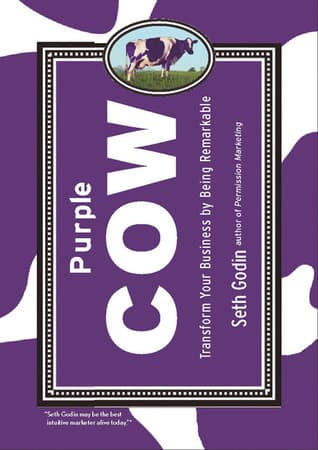
Core Idea
- Difficulty
- Easy
- Read it if
- you're an entrepreneur, marketer, product developer, or business leader looking for strategies to differentiate your offerings and achieve breakout success in a crowded market.
- Skip it if
- you prefer traditional marketing approaches and are unwilling to challenge the status quo of product design and business strategy.
Key Takeaways from Purple Cow
The Death of the S-Curve
Marketing as we know it has fundamentally changed, rendering traditional advertising ineffective for new products.
Godin argues that the traditional product life cycle, an S-curve of adoption, has become much shorter and flatter. With endless choices and divided attention, 'early adopters' already have many options, and the 'early majority' are too busy for average products. The sheer volume of marketing messages has made consumers ignore anything not truly unique. This means a product has almost no chance to gain traction through standard marketing. Companies that rely on the old method – develop, advertise, distribute – will likely fail, seeing less return on their marketing investments. The focus must change from broad appeal to specific groups, from shouting to quiet influence.
“The old marketing model, where you build a safe, average product and then use mass advertising to tell everyone about it, is broken.”
In the book: Godin frequently references the declining efficacy of TV advertising and the rise of consumer skepticism towards traditional brands, implying that the cost-per-impression for effective marketing has skyrocketed, making it unsustainable for average products.
Try this: Businesses must stop trying to appeal to 'everyone' and instead identify and target the 'innovators' and 'early adopters' who are actively seeking new solutions and are willing to spread the word. This involves understanding their specific pain points and desires, rather than generic market segments.
Related ideas: mass-market-failure, idea-virus, attention-economy
The Purple Cow Imperative
To succeed in today's market, products and services must be inherently remarkable, standing out like a purple cow in a field of ordinary ones.
This is the book's main idea and central comparison. Godin says that 'safe is risky' and 'average is dead.' In a world full of competent but uninteresting products, the only way to get attention and grow is to be truly unique. A 'Purple Cow' isn't about small improvements; it's about making a product or service so distinct, compelling, and unexpected that people have to talk about it. This 'uniqueness' is the new form of advertising. It takes courage to go against norms, innovate beyond what customers expect, and accept the risk of failure that comes with pushing boundaries. The purple cow is the product itself, not the advertising.
“The Purple Cow is that something in a product or service that makes it remarkable, worth talking about, worth noticing. It's not about being weird for weird's sake; it's about being different in a way that truly matters to your target audience.”
In the book: Godin cites examples like Starbucks (remarkable coffee experience), JetBlue (remarkable airline experience), and Apple (remarkable design and user experience) as companies that built their success on remarkable offerings rather than just advertising.
Try this: Instead of asking 'How can we advertise this product?', ask 'How can we make this product so remarkable that it advertises itself?' This involves re-evaluating product design, features, pricing, and service delivery through the lens of 'what would make someone say WOW?'
Related ideas: remarkability, differentiation, viral-marketing
Design Thinking for Remarkability
Remarkable products are not accidents; they are the result of intentional design and continuous innovation.
Godin stresses that creating a Purple Cow is an ongoing effort, not a one-time event. It requires constant testing, observation, and a willingness to change. Companies must build a culture that accepts risk and questions the usual way of doing things. This means truly understanding a specific, underserved group and creating solutions that genuinely surprise and please them. It's about finding the 'edges' of the market – the small groups, the underserved, the early adopters – and serving them very well. The design process should not aim for widespread appeal but for strong, even passionate, appeal to a select few, knowing their excitement will drive broader adoption.
“The job of marketing is not to create a product for everybody, but to create a product for somebody, and then tell that story to the right people.”
In the book: Godin points to how companies like Google consistently innovate and release new, often experimental, products (even if some fail) as a way to stay remarkable and maintain their edge.
Try this: Implement a 'remarkability audit' for existing products and services. Encourage teams to brainstorm 'purple cow' features for future offerings, focusing on how to differentiate rather than just improve. Embrace agile development to quickly test and refine new, remarkable ideas.
Related ideas: innovation, niche-marketing, product-design
The Role of the 'Sneezers'
Identifying and empowering early adopters to spread the word is crucial for product success.
In the Purple Cow idea, traditional advertising is replaced by 'sneezers' – influential early adopters who are eager to find and share unique products. These are passionate, well-connected, and trusted people within their communities. Godin argues that marketing efforts should mainly target these sneezers, giving them reasons and tools to promote the product. This means creating a product that is naturally shareable and then actively working with these influencers, listening to their feedback, and enabling them to spread the 'idea virus.' A unique product's success depends on how strongly it connects with this first group, making them willing, enthusiastic marketers.
“The sneezers are the people who are infected by an idea, and then spread that idea to everyone they come into contact with.”
In the book: The success of early social networks and viral campaigns, where adoption was driven by peer-to-peer recommendation rather than traditional advertising, exemplifies the power of 'sneezers.'
Try this: For every new product, identify who the potential 'sneezers' are. How can the product be designed to appeal specifically to them? How can they be engaged and incentivized (not necessarily financially) to talk about the product? This might involve exclusive access, early previews, or community-building efforts.
Related ideas: influencer-marketing, word-of-mouth, early-adopters
Marketing as a Product Feature
Marketing isn't an afterthought; it's an intrinsic part of the product itself, designed to facilitate remarkability and spread.
This idea challenges the usual separation of product development and marketing. Godin suggests that the most effective marketing is built into the product itself. This means designing features that are naturally shareable, creating experiences that encourage conversation, and developing products that solve problems in such a unique way that they demand attention. For example, a product might have a 'viral loop' in its setup process, or its user interface might be so pleasing that users want to show it off. The goal is to make the product itself the most powerful marketing tool, reducing the need for expensive, outside advertising. This complete approach ensures that the 'purple cow' is an actual quality of the offering, not just a marketing slogan.
“Don't think of marketing as something you do after the product is built. Think of marketing as something you build into the product.”
In the book: Hotmail's famous 'Get your free email at Hotmail' signature appended to every outgoing email is a classic example of marketing built directly into the product's usage.
Try this: During product design sprints, include marketing strategists to ensure that 'remarkability' and 'shareability' are core considerations. Ask: 'How does this feature encourage users to talk about it?' or 'What aspect of this product is inherently designed to spread?'
Related ideas: viral-loops, product-led-growth, embedded-marketing
The Perils of Average
Playing it safe and striving for broad appeal leads to invisibility and ultimately, failure.
Godin strongly states that in today's crowded market, 'average' means 'invisible.' Companies that try to please everyone end up pleasing no one in particular. This often leads to products that are good but bland, lacking any distinct quality that would make them noticeable or worth discussing. Aiming for average often comes from fear – fear of losing a market segment, fear of failure, fear of standing out. However, this fear-driven approach guarantees mediocrity and eventual irrelevance. The book criticizes corporate cultures that prioritize small improvements and market research that only confirms existing trends, instead of encouraging bold, disruptive innovation.
“The greatest danger in the world is not taking a risk, but in being boring.”
In the book: Godin often contrasts the success of disruptive companies with the slow decline of established brands that clung to traditional, 'safe' product development and marketing strategies.
Try this: Challenge internal assumptions about 'market share' and 'broad appeal.' Encourage teams to embrace projects that might initially seem niche or even 'crazy,' as these are often the ideas with the most purple cow potential. Actively identify and eliminate 'average' aspects of products and services.
Related ideas: mediocrity, risk-aversion, market-saturation
Embrace the Edges
Innovation and remarkability are found by focusing on the extremes of the market, not the middle.
Instead of chasing the mainstream, Godin advises companies to look for the 'edges' of the market – the early adopters, the niche communities, the extreme users, the underserved groups. These people are actively looking for new solutions, are more accepting of flaws, and are most likely to become enthusiastic supporters. By designing for these extreme users, companies can discover truly innovative features and methods that might later appeal to a wider audience. The 'middle' of the market is already full and resistant to new ideas. The edges, however, are good for trying new things and finding the 'sneezers' who will eventually spread the idea to the mainstream.
“If you're going to build a remarkable product, you have to find the edges. The edges are where the action is.”
In the book: Godin might point to how specialized software or niche sporting equipment often gains intense loyalty from a small group before wider adoption, proving the power of 'the edges.'
Try this: Conduct market research not just on the average customer, but specifically on the most demanding, unconventional, or passionate users. What are their unmet needs? How can a product be designed to delight them specifically, even if it alienates others?
Related ideas: niche-markets, early-adopters, extreme-users
The Iterative Nature of Remarkability
Remarkability is not a destination but a continuous journey of improvement and differentiation.
This argument recognizes that uniqueness doesn't last. What is unique today will be common tomorrow as competitors copy successful innovations. Therefore, companies cannot stop innovating after creating one Purple Cow; they must constantly strive to innovate, differentiate, and find new ways to stand out. This requires a continuous commitment to creativity, a willingness to question past successes, and a culture that encourages constant reinvention. The 'Purple Cow' idea is not about a single product launch but about embedding a philosophy of constant, brave differentiation throughout the organization's entire product development and marketing process. This is a subtle but important point of the book: it suggests a continuous effort to stay unique.
“The thing about Purple Cows is that they don't last forever. You have to keep making them.”
In the book: The tech industry, with its rapid cycles of innovation and obsolescence, serves as a prime example of the need for continuous remarkability. Companies like Netflix constantly evolve their offerings to stay ahead.
Try this: Establish a regular 'remarkability review' process for all products and services. Allocate resources specifically for R&D aimed at creating the 'next Purple Cow' rather than just improving existing offerings. Foster a culture where employees are empowered to suggest and pursue truly novel ideas.
Related ideas: continuous-innovation, differentiation-strategy, market-evolution
Challenging the Status Quo
Creating a Purple Cow demands a fundamental shift in organizational mindset and a rejection of traditional business norms.
Godin argues that the biggest barrier to creating Purple Cows is often internal – the established corporate culture, fear of failure, slow bureaucracy, and a reliance on old measurements. Organizations must actively remove these barriers and create an environment where risk-taking, creativity, and unconventional thinking are valued. This means giving employees at all levels the power to challenge existing processes, encouraging experiments, and being comfortable with the idea that not every bold idea will succeed. The book implicitly criticizes 'safe' corporate structures that stifle innovation and promote conformity, arguing that true marketing leadership now comes from the courage to be different, not just efficient.
“The greatest enemy of remarkability is the status quo.”
In the book: Godin often uses the contrast between nimble startups and slow-moving incumbents to highlight how organizational structure and culture directly impact a company's ability to be remarkable.
Try this: Leaders should actively champion projects that challenge existing norms and protect teams working on unconventional ideas. Create 'safe spaces' for experimentation and allow for 'smart failures' as learning opportunities. Re-evaluate performance metrics to reward innovation and risk-taking, not just adherence to established procedures.
Related ideas: organizational-change, corporate-culture, disruption
The Power of Story and Emotion
Remarkable products don't just solve problems; they evoke emotion and create compelling narratives.
While Godin doesn't explicitly use the term 'storytelling' as much as later marketers, the core of the Purple Cow is closely tied to emotional connection and narrative. A truly unique product isn't just better functionally; it connects with consumers on a deeper level, tapping into their hopes, values, or even their desire for social connection. The 'uniqueness' itself creates a story that people want to share – a story about innovation, convenience, or joy. This emotional connection turns a casual user into a 'sneezer,' someone who feels driven to share their experience. The Purple Cow provides not just a product, but a talking point, a way to show identity, or a solution that feels deeply personal and worth supporting.
“People don't buy what you do; they buy why you do it. And what you do simply proves what you believe.”
In the book: Godin's examples, like Starbucks creating a 'third place' experience, or JetBlue making flying 'fun' again, highlight the emotional and experiential aspects that make products remarkable beyond their basic utility.
Try this: Beyond features and benefits, explore the emotional impact and narrative potential of your product. What story does it tell? What emotion does it evoke? How can the product experience be designed to create a memorable, shareable narrative for the user?
Related ideas: emotional-marketing, brand-narrative, experiential-marketing
Purple Cow Quotes
“The new product, the new service, the new marketing idea is a Purple Cow. It's something remarkable.”
“Marketing is no longer about the stuff that you make, but about the stories you tell.”
“The opposite of remarkable is very common.”
“If you're not making something remarkable, you're not making something that matters.”
“The riskiest thing you can do is to be safe.”
“The old way of doing things, the safe way, is no longer safe.”
“The Purple Cow is not about a specific product, it's about a mindset.”
“Don't try to appeal to everyone. Instead, focus on a niche and make them love you.”
“The best marketing is the marketing that doesn't feel like marketing.”
“The goal is to create something so remarkable that people can't help but talk about it.”
“Marketing is the art of finding and telling an interesting story.”
“The world is full of boring things. Your job is to make something that isn't.”
“The Purple Cow is the result of seeking out and exploiting a hidden opportunity.”
“The only way to get ahead is to be remarkable.”
Quiz
10 questions on the main ideas. Each answer comes with a short explanation.
Question 1
What is the central metaphor Seth Godin uses to describe a successful product or service in the book 'Purple Cow'?
- A Blue Ocean
- A Purple Cow
- A Golden Goose
- A Red Herring
Show answer
B. A Purple Cow Godin uses the 'Purple Cow' as a metaphor for something remarkable, unusual, and worth noticing in a crowded marketplace. Just as a purple cow would stand out in a field of ordinary cows, a remarkable product or service stands out.
Question 2
According to 'Purple Cow', what is the primary reason why many traditional marketing strategies are becoming less effective?
- Consumers have less disposable income.
- The internet has created too much competition.
- Consumers are overwhelmed with choices and ignore average products.
- Government regulations have increased.
Show answer
C. Consumers are overwhelmed with choices and ignore average products. Godin argues that consumers are bombarded with marketing messages and have learned to ignore anything that isn't exceptionally interesting or valuable. Average products, advertised through traditional means, simply get lost in the noise.
Question 3
What does Seth Godin mean by 'The Death of the Marketing Department'?
- Marketing departments are being replaced by AI.
- Marketing is no longer a separate function but integrated into product development.
- Marketing budgets are being cut drastically.
- Marketing is becoming obsolete due to social media.
Show answer
B. Marketing is no longer a separate function but integrated into product development. Godin suggests that the traditional model of a separate marketing department creating messages for products is outdated. Instead, the 'marketing' should be inherent in the product itself, making it remarkable and worth talking about from its inception.
Question 4
In 'Purple Cow', what is the concept of 'ideavirus'?
- A virus that spreads through online advertising.
- A marketing campaign that goes viral unintentionally.
- An idea that spreads rapidly and infects the market.
- A failed marketing strategy.
Show answer
C. An idea that spreads rapidly and infects the market. An 'ideavirus' is a potent idea that spreads organically from person to person, much like a virus. The goal is to create an 'ideavirus' that becomes a self-sustaining phenomenon.
Question 5
What does Godin advise businesses to do instead of targeting the masses with average products?
- Focus on creating niche products for specific segments.
- Invest heavily in traditional advertising.
- Develop remarkable products that appeal to early adopters and innovators.
- Lower prices to attract more customers.
Show answer
C. Develop remarkable products that appeal to early adopters and innovators. Godin advocates for creating products and services that are inherently interesting and remarkable, targeting those who are most likely to embrace novelty (early adopters and innovators). These individuals will then spread the word, creating a buzz.
Question 6
The book 'Purple Cow' emphasizes the importance of 'being remarkable'. What does 'remarkable' mean in this context?
- Being the most expensive option.
- Being extremely popular.
- Being worth talking about.
- Being the first to market.
Show answer
C. Being worth talking about. 'Remarkable' in Godin's terminology means something that stands out, is unusual, and prompts people to remark upon it, to talk about it, and to share it. It's about being different and interesting.
Question 7
According to 'Purple Cow', what is the risk of creating a product that is 'safe' and not remarkable?
- It might be too expensive to produce.
- It will likely be ignored and fail.
- It will require significant advertising.
- Competitors will quickly copy it.
Show answer
B. It will likely be ignored and fail. A 'safe' product, one that is not remarkable, is unlikely to capture attention in a crowded market. It will blend in, fail to generate word-of-mouth, and ultimately be unsuccessful.
Question 8
What does Seth Godin suggest is the 'new P' of marketing, supplementing or replacing the traditional ones (Product, Price, Place, Promotion)?
- Perception
- Purpose
- Purple
- Remarkable
Show answer
D. Remarkable While not explicitly stated as a 'P', Godin's entire thesis revolves around making the product itself remarkable. This inherent remarkability replaces the need for extensive promotion of average products.
Question 9
The book argues that 'being invisible is a choice'. What does this statement imply?
- Businesses can choose to avoid marketing.
- Businesses can choose to be average and thus unnoticed.
- Businesses can choose to operate in secret.
- Businesses can choose to be completely offline.
Show answer
B. Businesses can choose to be average and thus unnoticed. If a business chooses to create an average, unremarkable product or service, it is effectively choosing to be invisible in a market saturated with options. It's a passive choice that leads to lack of recognition and success.
Question 10
What is the primary audience Seth Godin suggests businesses should target with their remarkable ideas?
- The majority of consumers.
- The 'late majority' of consumers.
- The 'early adopters' and 'innovators'.
- Consumers who are price-sensitive.
Show answer
C. The 'early adopters' and 'innovators'. Godin advocates focusing on the 'early adopters' and 'innovators' – those who are eager to try new things. These individuals are more likely to embrace and spread word about remarkable products, creating a ripple effect.
Purple Cow FAQ
What is the main idea of Seth Godin's Purple Cow?
The core concept of Purple Cow is that in today's crowded marketplace, traditional marketing is no longer effective. To succeed, businesses must create products or services that are so remarkable, so unique, and so interesting that they stand out like a purple cow in a field of brown ones.
Why is it called 'Purple Cow'?
Seth Godin uses the 'purple cow' as a metaphor for something truly exceptional and attention-grabbing. If you were driving through a field and saw only brown cows, you'd ignore them. But if you saw a purple cow, you'd stop, stare, and tell everyone about it. This is the kind of marketing impact businesses should aim for.
Who is the target audience for Purple Cow?
Purple Cow is aimed at entrepreneurs, marketers, product developers, and anyone involved in creating or selling a product or service. It's for those who want to break through the noise and make their offerings truly stand out.
How does Purple Cow differ from traditional marketing?
Traditional marketing relies on mass advertising and reaching a broad audience. Purple Cow argues that this approach is becoming obsolete. Instead, it advocates for creating remarkable products that inherently generate word-of-mouth marketing and attract a dedicated audience through their sheer uniqueness.
What does Seth Godin mean by 'being remarkable'?
Being remarkable means creating something worth talking about. It's not just about being different; it's about being significantly better, more innovative, or more engaging than the competition in a way that naturally sparks curiosity and discussion.
Can I apply Purple Cow principles to any business?
Yes, the principles of Purple Cow can be applied to virtually any business, regardless of size or industry. The key is to identify opportunities to innovate and create a product or service that is genuinely remarkable and appeals to a specific niche or audience.
What are some examples of 'Purple Cows'?
Examples include early Apple products like the iPod, the unique marketing of Dollar Shave Club, or the distinctive design and user experience of Airbnb. These companies succeeded by offering something consumers genuinely found remarkable and worth discussing.
How can I start creating my own 'Purple Cow'?
Start by questioning assumptions about your product or service and your market. Look for gaps, unmet needs, or opportunities to inject extreme innovation. Focus on creating something that excites you and that you believe your target audience will find extraordinary.
Is Purple Cow about being controversial?
Not necessarily. While controversy can sometimes make something remarkable, the core idea is about creating genuine value and innovation that captures attention. It's about being outstanding, not just provocative for the sake of it.
What is the risk of *not* creating a Purple Cow?
The risk of not creating a Purple Cow is becoming invisible in a crowded marketplace. Without a remarkable product or service, your marketing efforts will be drowned out, and you'll struggle to attract and retain customers, eventually leading to stagnation or failure.
About the author

Seth Godin is an American author and entrepreneur known for his insights on marketing and leadership. His notable works include "Linchpin: Are You Indispensable?", "Tribes: We Need You to Lead Us", "The Dip: A Little Book That Teaches You When to Quit (and When to Stick)", "Poke the Box", and "The Icarus Deception: How High Will You Fly?". Godin's writing often focuses on the importance of creativity and innovation in business.
Similar books
- Start with Why: How Great Leaders Inspire Everyone to Take Action
Simon Sinek
4.1 (122k) average on GoodreadsBusinessBoth emphasize the importance of differentiation and purpose from the core of a business, not just its marketing.
- The Diary of a Young Girl
Anne Frank
4.2 (2.7M) average on GoodreadsBiographyDuring the Nazi occupation, a teenage girl's diary, written from a secret annex, shares observations on humanity, hope, and the wait for freedom.
- Twisted 1. Twisted love
Ana Huang
3.7 (1.7M) average on GoodreadsA quiet billionaire with a difficult past finds his guarded heart opening to the woman he must protect, but their growing passion uncovers dangerous secrets and a shared, traumatic history.
- Eat, Pray, Love
Elizabeth Gilbert
3.6 (1.5M) average on GoodreadsLifestyleA heartbroken writer leaves her conventional life for a year-long global search for pleasure in Italy, spiritual devotion in India, and unexpected love and balance in Bali.
- Night
Elie Wiesel
4.3 (970k) average on GoodreadsBiographyIn the darkness of Auschwitz and Buchenwald, a teenage Elie Wiesel faces the extermination of his family, the loss of his faith, and the lasting scars of humanity's deepest cruelty.
- Steve Jobs
Walter Isaacson
4.1 (957k) average on GoodreadsBusinessSteve Jobs was a visionary who fused creativity and technology to revolutionize six industries and shape our digital world.






Enjoyed the summary?
A summary gives you the shape of the book. The book itself has the detail, the examples and the voice.
Find Purple Cow on AmazonAs an Amazon Associate, BookBrief earns from qualifying purchases. How we're funded