
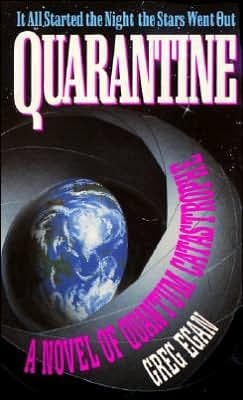
Synopsis
Covers the whole plot, including the ending.
- Difficulty
- Hard
- Pacing
- Moderate
- Mood
- Philosophical, Mysterious, Thought-provoking, Introspective
- Read it if
- You enjoy mind-bending science fiction that explores the nature of reality, consciousness, and the unknown.
- Skip it if
- You prefer straightforward narratives without complex philosophical and scientific concepts.
Quarantine Plot Summary
Covers the whole plot, including the ending.
The Arrival of the Bubble
On November 15, 2034, an inexplicable, opaque gray barrier materializes around the solar system, quarantining Earth and its immediate celestial bodies from the rest of the universe. This event, dubbed 'The Bubble,' causes widespread global panic, societal breakdown, and the rise of new religions and cults. Humanity grapples with the sudden loss of space travel, communication with probes, and any hope of extraterrestrial contact. Governments struggle to maintain order as the implications of this isolation sink in, leading to mass hysteria, riots, and a profound shift in human perception of existence. The scientific community is baffled, unable to penetrate or explain the Bubble's composition or origin.
Nick Stavrianos and the Impossible Case
Years after the Bubble's arrival, Nick Stavrianos, a bio-enhanced private investigator operating in a world still reeling from the event, is hired by an anonymous client. His mission: find a young woman named Laura, who mysteriously disappeared from a high-security mental institution. The perplexing detail is that Laura did not escape conventionally; security footage indicates she simply walked through solid walls. Nick, with his own neural implants and enhanced perception, finds the premise unsettling but intriguing, recognizing the potential for technology or phenomena far beyond current understanding, especially in a world where the impossible has already occurred with the Bubble.
Investigating Laura's Past
Nick begins his investigation by examining Laura's medical records and interviewing staff at the institution. He learns that Laura suffered from a rare neurological condition that caused her to perceive reality differently, often experiencing vivid hallucinations and a distorted sense of self. She was also part of a fringe group known as the 'Bubbleheads,' individuals who believe the Bubble is a divine or evolutionary catalyst, and who engage in practices aimed at transcending conventional reality. Nick suspects Laura's condition, amplified by her involvement with the Bubbleheads, might be key to understanding her impossible disappearance, pushing the boundaries of what he believes is possible.
The Transcendent Experience
Following leads, Nick infiltrates a gathering of Bubbleheads. He observes their rituals, which involve sensory deprivation, hypnotic suggestion, and the use of specialized neural interface devices designed to 'tune in' to the Bubble's perceived frequencies. During one such session, Nick, using his own implants, experiences a profound shift in perception. He witnesses reality fragmenting, seeing multiple possibilities and alternative pathways, hinting at a non-linear existence. This experience is disorienting but also provides a glimpse into the mental state that might allow someone like Laura to 'walk through walls,' suggesting a manipulation of perceived reality rather than physical matter.
The Nature of the Bubble
Through his investigations and discussions with various fringe scientists and Bubblehead theorists, Nick learns about a radical hypothesis: the Bubble is not an impenetrable wall, but a filter or a 'quarantine' system. This theory posits that the universe beyond Earth is teeming with entities or phenomena that are dangerous or incomprehensible to baseline human consciousness. The Bubble, therefore, acts as a protective shield, allowing humanity to evolve or adapt before encountering these external realities. This reinterpretation challenges the prevailing fear and despair, suggesting a benevolent, albeit alien, intervention.
Laura's Unique Ability
Nick eventually connects Laura's neurological condition with the Bubblehead theories. He deduces that Laura's brain, through a combination of her innate disorder and the Bubblehead practices, developed the ability to perceive and navigate 'alternate timelines' or 'probabilistic realities' that exist concurrently with the perceived physical world. Her 'walking through walls' was not a physical act of teleportation, but her shifting her consciousness and, consequently, her perceived physical presence, into a reality where the wall was not an obstruction, or where she occupied a different quantum state. This explains her seeming violation of physical laws.
The Client's Agenda
As Nick pieces together the puzzle, he grows suspicious of his anonymous client. The client's questions and demands shift from merely locating Laura to understanding the mechanics of her unique ability. Nick realizes the client is not interested in Laura's well-being but in exploiting her gift for their own purposes, potentially to breach the Bubble or gain an advantage in the quarantined world. This revelation adds a layer of ethical complexity to his mission, forcing him to reconsider his loyalties and the potential consequences of sharing his findings.
Confrontation and Choice
Nick confronts his client, who is revealed to be a shadowy corporation or government entity seeking to weaponize or control the power of 'reality-shifting.' He learns they want to use Laura as a test subject to develop technology that could potentially allow others to replicate her abilities, with unknown and potentially catastrophic consequences for the stability of their quarantined world. Nick is faced with a moral dilemma: hand over Laura, who is now a key to understanding the Bubble and potentially breaking its hold, or protect her and the dangerous knowledge she represents from those who would misuse it.
Laura's Resolution
Nick eventually finds Laura, who, through her experiences, has gained control and understanding over her abilities. She is no longer just a patient but a pioneer of a new mode of existence. She explains to Nick that the 'walls' are not as absolute as they seem, and the Bubble itself might be a construct of perception as much as physical reality. Laura, having transcended conventional limitations, chooses to remain in a state of flux, navigating the probabilistic realities, effectively becoming unreachable to those who would exploit her. She embraces her unique existence within the confines of the Bubble.
Nick's Transformation and the Enduring Mystery
Nick's encounter with Laura and the Bubbleheads fundamentally alters his perception of reality. He realizes the universe is far more complex and fluid than he previously imagined, and the Bubble might not be a prison but an evolutionary crucible. Though Laura remains beyond reach, Nick carries the knowledge of her abilities and the implications for humanity's future. The Bubble remains, but its meaning has shifted for him. He continues his work as a PI, but now with an understanding that the boundaries of existence, both physical and conceptual, are far more permeable than most people dare to believe, leaving the true nature of the Bubble an enduring mystery.
Quarantine Characters
Nick Stavrianos
Protagonist
A bio-enhanced private investigator seeking a missing girl.
Nick is a cynical, pragmatic private investigator in a post-Bubble world. He is bio-enhanced with neural implants that aid his investigative work, giving him an edge in a society grappling with technological advancements and societal decay. Initially a man of logic and concrete evidence, he is forced to confront the limits of his understanding when faced with the impossible. His primary motivation is solving cases, but this particular one challenges his fundamental beliefs about reality and existence.
Relationships: Laura (His missing person case; eventually, a catalyst for his philosophical transformation.); Anonymous Client (His employer; a shadowy entity with a manipulative agenda.)
Laura
Central Figure
A young woman with a rare neurological condition who can 'walk through walls'.
Laura is initially presented as a patient in a mental institution, suffering from a severe neurological disorder that causes her to perceive reality in a fragmented, non-linear way. Her condition, combined with her involvement with the Bubbleheads, allows her to develop an extraordinary ability to shift her consciousness between probabilistic realities, making her seem to violate physical laws. She is a symbol of humanity's potential for adaptation and a living embodiment of the new realities brought forth by the Bubble.
Relationships: Nick Stavrianos (The investigator tasked with finding her; she eventually becomes his guide to a new understanding of reality.); Bubbleheads (A community that provided a framework for understanding and developing her abilities.)
The Anonymous Client
Antagonist/Supporting
A shadowy entity seeking to exploit Laura's abilities.
The client who hires Nick remains largely anonymous throughout much of the story, representing a larger, unseen force – likely a corporation or government agency. Their motivation is driven by a desire to understand, control, and ultimately weaponize or exploit Laura's unique ability to navigate alternate realities. They embody the human tendency to seek power and control, even over phenomena that are poorly understood, and serve as a foil to Nick's evolving ethical considerations.
Relationships: Nick Stavrianos (His employer; their goals diverge as Nick uncovers the truth.); Laura (The target of their research and exploitation.)
The Bubbleheads
Supporting/Mentioned
A fringe group believing the Bubble is a catalyst for human evolution.
The Bubbleheads are a diverse community of individuals who interpret the arrival of the Bubble not as a catastrophe, but as a transformative event. They engage in practices, often involving sensory manipulation and neural interfaces, to 'tune in' to the Bubble's perceived frequencies and unlock new modes of perception. They represent a spiritual and philosophical response to the crisis, offering an alternative framework for understanding reality that directly influences Laura's development and Nick's investigation.
Relationships: Laura (She was a member, and their practices helped awaken her abilities.); Nick Stavrianos (They provide him with crucial insights and experiences during his investigation.)
Dr. Aris Thorne
Supporting/Mentioned
A scientist specializing in consciousness and quantum mechanics.
Dr. Aris Thorne is a brilliant but eccentric scientist whose theories about the nature of consciousness and the possibility of parallel realities were largely dismissed before the Bubble. After the Bubble's appearance and Laura's disappearance, his work gains new, terrifying relevance. He provides Nick with some of the more abstract and theoretical explanations for Laura's abilities and the Bubble's potential nature, pushing Nick's understanding beyond conventional physics. He represents the intellectual frontier pushing against the limits of known science.
Relationships: Nick Stavrianos (An informant and intellectual guide for Nick.)
The Bubble
Antagonist/Plot Device
The mysterious, impenetrable barrier around the solar system.
The Bubble is the central inciting incident and a pervasive, existential presence in the novel. It is an inexplicable, opaque gray shield that isolates Earth, cutting off humanity from the universe. Its nature and purpose are unknown, leading to widespread despair, scientific bewilderment, and the rise of new belief systems. It acts as both a physical barrier and a philosophical challenge, forcing humanity to redefine its place in the cosmos and its understanding of reality.
Relationships: Humanity (An isolating force that profoundly alters human society and perception.); Laura (Her abilities are intrinsically linked to its existence and potential purpose.)
Quarantine Themes
The Nature of Reality and Perception
The novel explores how reality is not a fixed, objective construct but can be influenced by perception and consciousness. Laura's ability to 'walk through walls' is not a violation of physics but a shift in her perceived reality, demonstrating that what we consider solid and unyielding might be fluid. The Bubble itself, initially seen as an absolute barrier, is later theorized to be a filter or even a perceptual construct. This theme challenges the reader to question their own understanding of existence, as seen when Nick experiences the fragmented realities during the Bubblehead rituals, blurring the lines between hallucination and alternative truth.
“The universe isn't what it is, it's what you perceive it to be. And sometimes, if you're lucky, or cursed, your perception can change what it is.”
Humanity's Response to Crisis and Isolation
The arrival of the Bubble plunges humanity into an unprecedented crisis of isolation, leading to diverse and often extreme reactions. Society fragments, with some succumbing to despair and chaos (riots, cults), while others seek new forms of understanding and transcendence (the Bubbleheads). This theme examines the resilience and fragility of human civilization when confronted with an existential threat that defies scientific explanation. It highlights how humans search for meaning, whether through religion, science, or radical new philosophies, when their established worldview is shattered, as evidenced by the widespread societal upheaval and the desperate search for answers.
“The stars were gone. And with them, our future. Or so we thought. But some saw it as a beginning, not an end.”
The Ethics of Knowledge and Power
The narrative explores the moral implications of acquiring and wielding extraordinary knowledge, particularly concerning Laura's unique abilities. Nick's anonymous client represents the dangerous side of this pursuit: a desire to exploit Laura for strategic advantage or control, without regard for her well-being or the potential societal repercussions. This theme forces Nick to confront ethical dilemmas, questioning whether certain knowledge should be contained or shared, and highlighting the line between scientific advancement and unchecked ambition. The potential for misusing Laura's power to breach the Bubble or manipulate reality raises questions about humanity's readiness for such capabilities.
“Some truths are too dangerous to be known, especially when power-hungry men are listening.”
Evolution and Adaptation
The Bubble, whether an intentional quarantine or a natural phenomenon, acts as a catalyst for human evolution and adaptation. Laura's neurological condition, previously seen as a disorder, becomes an evolutionary advantage, allowing her to perceive and navigate realities beyond baseline human experience. The Bubbleheads, through their practices, actively try to adapt to the new reality. This theme suggests that humanity, when faced with extreme environmental pressures, has the capacity to develop entirely new faculties, blurring the lines between disability and superpower, and hinting at a future where consciousness itself might be the next frontier of evolution within the confines of the Bubble.
“Perhaps the Bubble isn't a prison, but a crucible. A place where we learn to see with new eyes, or perish.”
Plot Devices & Literary Techniques
The Unreliable Narrator (Perception)
The narrative challenges the reader's and protagonist's understanding of objective reality.
While Nick is a reliable narrator in terms of recounting his actions, the novel employs an unreliable narrator aspect through the lens of perception. As Nick delves into Laura's abilities and the Bubbleheads' theories, his own understanding of reality becomes fluid and subjective. The reader, like Nick, is forced to question what is objectively 'real' versus what is perceived, especially during Nick's own altered sensory experiences. This device directly supports the theme of the nature of reality, making the reader experience the confusion and re-evaluation alongside the protagonist.
The MacGuffin (Laura's Ability)
Laura's unique ability drives the plot, but its true significance lies in its philosophical implications.
Laura's ability to 'walk through walls' initially serves as a classic MacGuffin: an enigmatic object or ability that drives the plot forward, prompting Nick's investigation. However, as the story progresses, her ability transcends mere plot device status. Its true significance lies not just in solving the mystery of her disappearance, but in its profound philosophical implications for understanding reality, consciousness, and the Bubble itself. It becomes a key to unlocking deeper themes about human potential and the universe's true nature, rather than just a simple quest object.
Existential Dread
The pervasive feeling of isolation and meaninglessness due to the Bubble.
The constant presence of the Bubble instills a deep sense of existential dread throughout the narrative. Humanity is cut off from the universe, leading to questions of purpose, meaning, and the future of the species. This dread permeates the characters' lives, influencing societal structures, the rise of new religions, and individual psychological states. It's a pervasive atmosphere that underscores the stakes of Nick's investigation and the profound impact of the Bubble, making the characters' struggles not just personal but cosmic in scope.
Bio-enhancements and Neural Implants
Technology that blurs the line between human and machine, enhancing perception.
Nick's own bio-enhancements and neural implants serve as a crucial plot device, allowing him to interact with the Bubblehead technology and experience altered states of perception directly. This technology not only gives him an edge as an investigator but also makes him susceptible to the very shifts in reality that Laura experiences. It acts as a bridge between conventional human perception and the potential for enhanced or altered consciousness, directly facilitating his understanding of Laura's abilities and the nature of the Bubble, blurring the lines between natural and artificial perception.
Quarantine Quotes
“The universe is not obliged to make sense to us.”
“Every act of observation changes the observed.”
“Ignorance is not the absence of knowledge, but the refusal to know.”
“Memory is not a recording, but a reconstruction.”
“The only constant is change, and the only certainty is uncertainty.”
“We are all prisoners of our own perceptions.”
“To understand is to simplify, and to simplify is to distort.”
“Truth is not a destination, but a journey.”
“The greatest freedom is the freedom from illusion.”
“Every choice we make creates a different universe.”
“Fear is the mind-killer. Fear is the little-death that brings total obliteration.”
“The boundaries of our world are only the boundaries of our imagination.”
“What we call reality is merely a consensus of shared hallucinations.”
“There is no 'outside' to the universe; only different perspectives within it.”
Quiz
10 questions on the plot and the characters. Each answer comes with a short explanation.
Question 1
What significant event occurred on November 15, 2034, that drastically changed humanity's perception of the universe?
- A global war broke out, leading to widespread chaos.
- An impenetrable gray shield enveloped the solar system.
- Humanity made first contact with an alien civilization.
- A new energy source was discovered, solving all global crises.
Show answer
B. An impenetrable gray shield enveloped the solar system. The book opens with the description of the gray shield appearing on November 15, 2034, isolating the solar system from the rest of the universe.
Question 2
What is the profession of the protagonist, Nick Stavrianos?
- A government scientist researching the shield.
- A religious leader interpreting the shield's meaning.
- A bio-enhanced Private Investigator.
- A historian documenting the societal changes.
Show answer
C. A bio-enhanced Private Investigator. Nick Stavrianos is explicitly described as a 'bio-enhanced PI' (Private Investigator) in the book's synopsis.
Question 3
What is the initial effect of the gray shield on human society, as described in the book's premise?
- Mass migration to other planets.
- Widespread scientific collaboration and progress.
- Riots, new religions, and extreme behaviors like dancing in the streets and leaping off skyscrapers.
- A sudden end to all forms of conflict and crime.
Show answer
C. Riots, new religions, and extreme behaviors like dancing in the streets and leaping off skyscrapers. The synopsis mentions that the shield 'causes riots and religions. It has people dancing in the streets and leaping off skyscrapers,' indicating a profound and often chaotic societal impact.
Question 4
What is unique about Laura's disappearance from the mental institution that prompts Nick's investigation?
- She was abducted by an unknown organization.
- She left a cryptic message predicting her return.
- She walked directly through the walls of the institution.
- She escaped using a previously unknown tunnel system.
Show answer
C. She walked directly through the walls of the institution. Nick takes on the job to find Laura, who 'disappeared from a mental institution by the most direct possible method -- walking through the walls.'
Question 5
How do some people interpret the gray shield's appearance?
- As a sign of alien invasion.
- As revenge of an insane God, justice, or protection.
- As a natural, albeit rare, cosmic phenomenon.
- As a global experiment conducted by a secret society.
Show answer
B. As revenge of an insane God, justice, or protection. The text states, 'Some see the bubble as the revenge of an insane God. Some see it as justice. Some even see it as protection,' highlighting the varied interpretations.
Question 6
What is the primary implication of the gray shield's presence for humanity's relationship with the 'universe'?
- It facilitates faster-than-light travel to distant galaxies.
- It means the universe and Earth are now permanently separated.
- It opens a portal to parallel dimensions.
- It allows for direct communication with extraterrestrial life.
Show answer
B. It means the universe and Earth are now permanently separated. The synopsis explicitly states, 'But one thing is for certain -- now there is the universe, and the earth. And never the twain shall meet.'
Question 7
What type of client hires Nick Stavrianos to find Laura?
- A government agency concerned about her abilities.
- Laura's worried family members.
- An anonymous client.
- The mental institution seeking her return.
Show answer
C. An anonymous client. Nick takes on a job 'for an anonymous client' to find Laura.
Question 8
Considering the 'bio-enhanced' aspect of Nick Stavrianos, what might be a key characteristic of the world within the Quarantine?
- A world where natural human abilities are universally declining.
- A world where advanced biological modifications are common or possible.
- A world where technology is strictly forbidden due to the shield.
- A world where only spiritual enlightenment is pursued.
Show answer
B. A world where advanced biological modifications are common or possible. The term 'bio-enhanced PI' suggests that biological modifications or augmentations are a part of this future society, indicating an advanced or altered state of human biology.
Question 9
Given the description of the shield and its effects, what philosophical question is implicitly raised about human existence?
- The feasibility of interstellar colonization.
- The definition of reality and humanity's place within a confined universe.
- The ethics of artificial intelligence development.
- The economic impact of resource scarcity.
Show answer
B. The definition of reality and humanity's place within a confined universe. The shield's sudden appearance and isolation of Earth forces humanity to confront a new reality, questioning their place and purpose when the vastness of the universe is suddenly cut off, leading to existential and philosophical crises.
Question 10
What does the phrase 'never the twain shall meet' imply about the gray shield's nature, prior to Nick's investigation?
- That the shield is a temporary phenomenon.
- That the shield is an absolute and permanent barrier between Earth and the rest of the universe.
- That the shield allows for one-way communication only.
- That the shield is permeable to certain forms of energy.
Show answer
B. That the shield is an absolute and permanent barrier between Earth and the rest of the universe. The phrase 'never the twain shall meet' strongly suggests an absolute and unbreachable separation between Earth and the universe, reinforcing the idea of the shield's impenetrable nature until Laura's mysterious abilities challenge this assumption.
Quarantine FAQ
What is the central inciting incident that sets the stage for the book 'Quarantine'?
The core event is the sudden appearance of an impenetrable gray shield around the entire solar system on November 15, 2034. This 'bubble' isolates Earth completely from the rest of the universe, leading to widespread societal upheaval and diverse human reactions, from religious fervor to despair.
Who is Nick Stavrianos, and what is his profession in 'Quarantine'?
Nick Stavrianos is a bio-enhanced private investigator. He possesses advanced sensory and cognitive abilities due to his enhancements, which make him uniquely suited to investigate unusual occurrences in a world grappling with the implications of the solar system's encapsulation.
What is the initial mystery Nick Stavrianos is tasked with solving?
Nick is hired by an anonymous client to locate a girl named Laura. Laura reportedly vanished from a mental institution by physically walking through its walls, a seemingly impossible feat that immediately challenges the known laws of physics and the nature of reality within the bubble.
How do different segments of society react to the 'bubble's' appearance?
Reactions are highly polarized: some interpret it as divine punishment or a manifestation of God's will, leading to new religions and widespread street dancing. Others see it as a form of protection or a cosmic joke, causing mass suicides, riots, and a general breakdown of established social order.
What kind of technological advancements exist in the world of 'Quarantine' prior to the bubble's arrival?
The setting features significant bio-enhancement technology, as evidenced by Nick Stavrianos's own modifications. This suggests a society that has pushed the boundaries of human physiology and perception, making the sudden, inexplicable nature of the bubble even more disruptive to their understanding of the universe.
What is the significance of Laura's ability to walk through walls?
Laura's ability is a key 'hidden detail' that hints at a fundamental shift in the laws of physics or perception within the bubble. It suggests that the isolation isn't just physical but potentially alters the very fabric of reality, allowing for previously impossible phenomena and challenging scientific understanding.
Are there any clues early on that suggest the bubble might not be a purely external, physical barrier?
While the bubble appears as an 'impenetrable gray shield,' the immediate and extreme psychological reactions it provokes – from mass euphoria to despair – along with the later emergence of abilities like Laura's, subtly imply it might affect consciousness or perception as much as physical space. The term 'quarantine' itself suggests a deliberate, perhaps internal, process.
Does the book ever explain the origin or purpose of the 'bubble'?
The book delves into theories and interpretations rather than offering a definitive, universally accepted explanation. While characters like Nick investigate the anomalies, the ultimate nature of the bubble—whether it's alien, divine, or a manifestation of collective human consciousness—remains a central mystery and point of philosophical debate.
How does the 'bubble' impact individual identity and free will?
The bubble profoundly challenges individual identity by stripping away external context and forcing an internal focus. For many, the loss of the universe outside leads to an existential crisis, where previous life goals and meanings become irrelevant, forcing a re-evaluation of self and purpose within the new, confined reality.
What psychological coping mechanisms are explored in response to the isolation?
The book showcases a spectrum of coping mechanisms: some individuals embrace spiritual or religious fanaticism, finding new meaning in the 'divine' intervention. Others succumb to nihilism, leading to self-destructive behaviors like leaping off skyscrapers. Still others, like Nick, attempt to impose order through rational investigation.
How does Nick Stavrianos's bio-enhancement affect his psychological resilience or vulnerability to the bubble's effects?
Nick's enhancements grant him a degree of detachment and enhanced analytical capabilities, which might make him more resistant to the immediate emotional contagion affecting others. However, his heightened perception could also make him more acutely aware of the existential implications, potentially leading to a unique form of psychological burden.
Is there a psychological explanation for the sudden onset of riots and dancing in the streets?
The sudden, extreme reactions reflect a collective psychological break from normalcy. The 'bubble' acts as a massive stressor, releasing pent-up societal anxieties and hopes. For some, it's a liberation from mundane existence (dancing); for others, it's a catalyst for despair and chaos (riots), as old rules lose meaning.
Does 'Quarantine' lean towards a scientific or spiritual explanation for the bubble's existence?
'Quarantine' deliberately blurs the lines, presenting both scientific inquiry through Nick's investigation and profound spiritual/religious interpretations from the general populace. It encourages readers to ponder the limits of each framework, suggesting that the truth might lie in a synthesis or an entirely new paradigm.
What philosophical questions does the book raise about reality and perception?
The book challenges the nature of objective reality by introducing phenomena like walking through walls. It asks: Is reality fixed, or is it influenced by collective consciousness, individual perception, or a hidden layer of existence? The isolation forces a re-evaluation of what is 'real' when external verification is impossible.
Could the 'bubble' be interpreted as a metaphor for a personal or societal crisis?
Yes, the 'bubble' can be interpreted as a powerful metaphor for various forms of isolation or crisis—be it a personal mental breakdown, a society facing an existential threat, or humanity confronting its own limitations. It forces introspection and a re-evaluation of priorities when external distractions are removed.
How does the book explore the concept of human connection in an isolated world?
In the confined world, human connection takes on heightened importance and new forms. While some connections fracture under the stress, others deepen as people seek solace, meaning, or shared understanding. The common predicament of isolation paradoxically creates a powerful, albeit often chaotic, sense of shared humanity.
Is the ending of 'Quarantine' definitive, or does it leave room for ambiguity and further thought?
Greg Egan's works often conclude with thought-provoking ambiguity rather than neat resolutions, and 'Quarantine' is no exception. While Nick's investigation may uncover significant revelations about Laura and the nature of the bubble, the ultimate meaning and future implications are likely left open for the reader to ponder, consistent with its philosophical depth.
What role does the 'mental institution' play in the narrative, beyond just Laura's disappearance?
The mental institution serves as a symbolic space where the boundaries of sanity and reality are already blurred. It highlights that those labeled 'mad' might possess unique insights or vulnerabilities to the bubble's effects, potentially making them pioneers in understanding the new reality, rather than just patients.
Similar books
- Permutation City
Greg Egan
4.1 (8k) average on GoodreadsFantasyExplores complex ideas about consciousness, reality, and identity within a hard sci-fi framework.
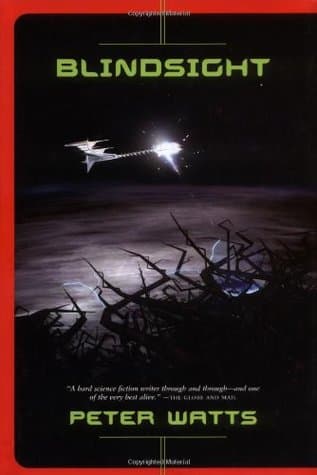
- Blindsight
Peter Watts
4.0 (27k) average on GoodreadsFantasyFeatures a mysterious, world-altering event and delves into philosophical questions about consciousness and perception.
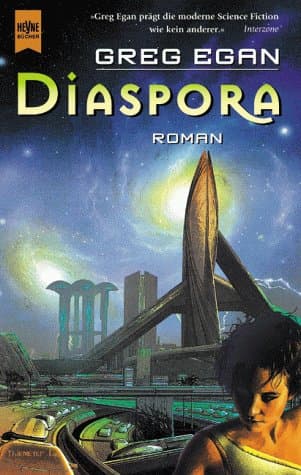
- Diaspora
Greg Egan
4.1 (7k) average on GoodreadsScience FictionKnown for its rigorous exploration of advanced scientific concepts and the nature of existence.
- Stories of Your Life and Others
Ted Chiang
4.2 (66k) average on GoodreadsFantasyChiang's work also explores the impact of alien phenomena on human perception and language but tends to be more character-focused and emotionally resonant, making his complex ideas more accessible. Egan prioritizes the scientific mechanics and their direct implications on reality itself, often at the expense of deep emotional exploration.
- The Old Man and the Sea
Ernest Hemingway
3.8 (831k) average on GoodreadsLiterary FictionA Cuban fisherman's long struggle with a giant marlin becomes a story of endurance and dignity, now retold for young adults with illustrations, phonetic guides, and writing prompts in Traditional Chinese.
- One Hundred Years of Solitude
Gabriel García Márquez
4.1 (753k) average on GoodreadsLiterary FictionThrough the multi-generational story of the Buendía family, a mythical town deals with the repeating patterns of time, love, and solitude, as the extraordinary mixes with the ordinary.


Enjoyed the summary?
A summary gives you the shape of the book. The book itself has the detail, the examples and the voice.
Find Quarantine on AmazonAs an Amazon Associate, BookBrief earns from qualifying purchases. How we're funded