
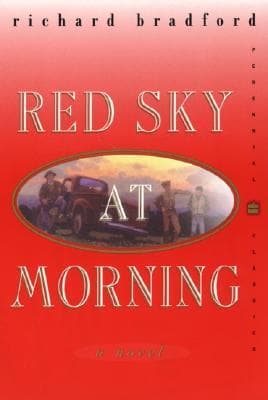
Synopsis
Covers the whole plot, including the ending.
- Difficulty
- Easy
- Pacing
- Moderate
- Mood
- Nostalgic, Poignant, Resilient, Humorous
- Read it if
- You enjoy coming-of-age stories set against the backdrop of WWII, focusing on character development and the challenges of adolescence.
- Skip it if
- You prefer fast-paced action or high-stakes war narratives; this is a quieter, more introspective story.
Red Sky at Morning Plot Summary
Covers the whole plot, including the ending.
The Departure from Mobile
The story begins with seventeen-year-old Joshua 'Josh' Phipps and his mother, Mary, leaving their comfortable home in Mobile, Alabama. Josh's father, Frank Phipps, an architect, decides to enlist in the Navy after the attack on Pearl Harbor. Josh is initially resentful and confused by this decision. Frank believes it is his duty to serve, leaving his family behind. They move to Fairhope, a smaller, more rural town on Mobile Bay, where they will live in the family's old, somewhat run-down summer house. This sudden change takes Josh away from his familiar life, friends, and the girl he liked, moving him into an unfamiliar place and a more modest life with his mother.
Settling into Fairhope
When they arrive in Fairhope, Josh finds a town very different from Mobile. Their summer house, 'The Pillars,' needs repairs, and the general atmosphere is simple and rustic, a strong contrast to his previous life. He quickly meets several of the town's unique characters. There is Steenie, a smart, independent girl who works at the local library and becomes important in his new life. He also meets 'Jimbob' Buel, a loud and somewhat rough local boy who at first does not get along with Josh. Fairhope's slower pace and close community are a culture shock for Josh, who feels out of place and misses his old life and his father's return.
First Encounters and Misunderstandings
Josh's first interactions in Fairhope are full of misunderstandings. He tries to impress Steenie with his city sophistication, but she sees through it immediately. His first major conflict is with Jimbob Buel, who questions Josh's perceived arrogance. A fight happens, showing Josh's inexperience with rough rural life. Despite their initial dislike, this fight leads to a gradual respect and eventual friendship between Josh and Jimbob. Josh also starts working at the local general store. This job further involves him in Fairhope's daily life and social scene, making him let go of some of his old ideas.
The Weight of Responsibility
With his father away, Josh feels more responsible for his mother and himself. Money is tighter than they are used to, and Josh's earnings from the general store become important. He also takes on the role of 'man of the house,' which means dealing with household repairs and other practical matters he had never thought about before. His mother, Mary, supports him but also struggles with her own worries about Frank's safety and adjusting to their new life. This time forces Josh to grow up quickly, moving past his sheltered pre-war adolescence and facing the realities of adult life and the sacrifices war demands.
Developing Relationships
As summer goes on, Josh's friendships with Steenie and Jimbob change significantly. Steenie, with her intelligence, independence, and strong sense of self, challenges Josh's assumptions and broadens his perspective. She introduces him to books and ideas, and their talks become a source of intellectual stimulation and emotional connection. Jimbob, despite his tough exterior, proves to be a loyal friend and teaches Josh about practical rural life. He shows Josh about fishing, hunting, and the unspoken rules of their community. These friendships help Josh connect his past life in Mobile with his present in Fairhope, showing him the value of different people and experiences.
News from the War Front
Letters from Frank Phipps arrive regularly, sharing details of his life in the Navy. While these letters offer some comfort to Mary and Josh, they also show the growing distance, both physical and emotional, between Frank and his family. Josh notices a change in his father's tone, a new seriousness shaped by his experiences. The letters serve as a constant reminder of the war overseas and the uncertainty of their situation. For Josh, the letters confirm that his father is no longer just the architect he knew, but a man deeply changed by the global conflict, adding another layer to Josh's own growth.
The Hurricane Threat
A major hurricane threatens the Gulf Coast, bringing urgency and fear to Fairhope. This natural disaster tests Josh and the community. He works with Jimbob and other townspeople to secure homes and prepare for the storm. During the hurricane, Josh shows courage and resourcefulness he did not know he had, helping his mother and others. The shared experience of facing the storm strengthens his bond with Fairhope residents and reinforces his growing sense of belonging. It is a moment where his city upbringing gives way to a practical, resilient spirit.
Tragedy and Resilience
Amidst the ongoing war and his personal adjustments, Josh experiences a significant personal loss that affects him deeply. This event, which could be the death of a minor character or a serious injury, makes him confront how fragile life is and the reality of grief. While specific details are not given, this tragedy helps him grow emotionally. It shows how loss was common during wartime, even in a seemingly peaceful town, and deepens Josh's understanding of human suffering. He learns to rely on his friends and community for support, realizing the strength found in shared sorrow.
A Visit from Frank
Frank Phipps finally returns home on leave, a moment Josh and Mary have looked forward to. However, the reunion is not entirely as expected. Frank is a changed man, hardened by his Navy experiences. He is quieter, more distant, and the easygoing father Josh remembered seems to have been replaced by someone more serious and tired. Josh, too, has matured, and the dynamic between father and son has shifted. There is a subtle tension as both try to reconnect after their separate wartime experiences. This visit highlights the lasting impact of the war on individuals and families.
A Difficult Farewell
Frank's leave ends, and he must return to duty. This second farewell is different from the first. Josh now understands his father's deep sacrifices and immense courage. While there is still sadness, there is also a deeper respect and a more mature understanding between them. Josh has accepted his father's decision and the reality of their separation. He is no longer just a boy resenting his father's absence, but a young man who has taken on his own responsibilities and found his place in the world, even without his father. The red sky at morning, a symbol of warning and beauty, reflects the complex feelings of this moment.
Embracing Fairhope
By the end of the summer, Josh is fully part of the Fairhope community. He has found true friends in Steenie and Jimbob, a sense of purpose in his work, and a new appreciation for the town's simple, honest life. He no longer feels like an outsider but a contributing member. He understands the value of community, strength, and the quiet dignity of everyday life. While the war continues, Josh has found a way to grow personally amidst global conflict. He looks forward to his future, whether it involves college or other plans, with confidence gained from his experiences in Fairhope.
Principal Figures
Joshua 'Josh' Phipps
Protagonist
A seventeen-year-old boy forced to mature quickly during wartime.
Josh is initially a somewhat sheltered and self-absorbed teenager from Mobile, accustomed to a comfortable life. He resents his father's enlistment and the subsequent move to Fairhope, feeling uprooted and out of place. He is intelligent but lacks practical experience and a deeper understanding of the world beyond his social circle. Throughout the story, he grapples with feelings of inadequacy, the burden of responsibility, and the search for his own identity amidst the chaos of war.
Relationships: Frank Phipps (Father-son, initially strained by Frank's enlistment, evolving to mutual respect.); Mary Phipps (Mother-son, supportive but both grappling with their new circumstances.); Steenie (Close friend and intellectual confidante, a potential romantic interest.); Jimbob Buel (Initially antagonistic, evolving into a loyal and practical friendship.)
Frank Phipps
Supporting
Josh's father, an architect who enlists in the Navy, symbolizing the war's impact.
Frank is a successful architect and a loving father, but his decision to enlist in the Navy after Pearl Harbor is a pivotal moment that reshapes his family's life. He represents the call to duty and patriotism that many men felt during WWII. Although largely absent from the physical narrative, his presence is felt through his letters and his eventual brief return. He is a man who makes a difficult choice for his country, a choice that profoundly impacts his family and changes him.
Relationships: Joshua 'Josh' Phipps (Father-son, initially strained by Frank's enlistment, evolving to mutual respect.); Mary Phipps (Husband-wife, their relationship is tested by separation and the war's stresses.)
Mary Phipps
Supporting
Josh's mother, who navigates the challenges of wartime and raising a son alone.
Mary Phipps is Josh's mother, forced to leave her comfortable life in Mobile and adapt to a simpler existence in Fairhope. She is resilient and supportive, though she experiences her own anxieties and struggles with her husband's absence and the financial strain. She represents the strength and adaptability of women on the home front during the war, managing a household and raising her son while dealing with the constant worry for her husband.
Relationships: Joshua 'Josh' Phipps (Mother-son, supportive but both grappling with their new circumstances.); Frank Phipps (Husband-wife, their relationship is tested by separation and the war's stresses.)
Steenie
Supporting
An intelligent, independent local girl who becomes Josh's close friend and confidante.
Steenie is a bright, free-spirited girl who works at the Fairhope library. She is intelligent, observant, and possesses a strong sense of self and integrity. Unlike many of the more provincial characters, she has a broader perspective, often challenging Josh's preconceived notions and encouraging his intellectual and emotional growth. She is a source of wisdom and companionship for Josh, helping him to see the value in different ways of life and to develop a deeper understanding of himself and the world.
Relationships: Joshua 'Josh' Phipps (Close friend and intellectual confidante, a potential romantic interest.)
Jimbob Buel
Supporting
A rough-around-the-edges local boy who becomes Josh's loyal friend.
Jimbob is a boisterous, somewhat unrefined local boy from Fairhope. Initially antagonistic towards Josh, viewing him as an arrogant city kid, Jimbob eventually becomes one of Josh's closest friends. He is practical, loyal, and knowledgeable about the ways of rural life, teaching Josh valuable skills and helping him navigate the social dynamics of Fairhope. Jimbob represents the unvarnished honesty and resilience of the local community, and his friendship helps Josh to shed his snobbery and appreciate different kinds of people.
Relationships: Joshua 'Josh' Phipps (Initially antagonistic, evolving into a loyal and practical friendship.)
Mr. C.D. Buel
Supporting
Jimbob's father and a prominent, respected member of the Fairhope community.
Mr. Buel is Jimbob's father and a significant figure in Fairhope. He embodies the community's values of hard work, honesty, and self-reliance. He is a man of few words but strong character, respected by his neighbors. He provides a paternal figure for Josh in his father's absence, offering guidance and a sense of stable authority. His presence reinforces the themes of community and the quiet dignity of rural life.
Relationships: Jimbob Buel (Father-son, a relationship built on respect and shared values.); Joshua 'Josh' Phipps (Mentor figure, a source of quiet wisdom.)
Mrs. Buel
Supporting
Jimbob's mother, a kind and nurturing woman.
Mrs. Buel is Jimbob's mother, a warm and hospitable woman who welcomes Josh into their home. She represents the nurturing and communal spirit of Fairhope, often providing food and comfort. Her kindness helps to make Josh feel more at home in the unfamiliar town, acting as a maternal figure when his own mother is preoccupied with wartime anxieties. She is a symbol of the simple, enduring goodness found in the community.
Relationships: Jimbob Buel (Mother-son, a loving and supportive relationship.); Joshua 'Josh' Phipps (Nurturing figure, offering comfort and hospitality.)
Mr. Ransome
Supporting
The owner of the general store where Josh works.
Mr. Ransome is the proprietor of the local general store in Fairhope, where Josh gets his first job. He is a fair but firm employer, representing the local business community. His store serves as a hub of activity and information in the small town, and working there exposes Josh to the daily lives and interactions of the Fairhope residents. Mr. Ransome teaches Josh the value of hard work and responsibility, contributing to his maturation.
Relationships: Joshua 'Josh' Phipps (Employer-employee, a mentor in practical work ethics.)
Themes & Insights
Coming of Age and Maturation
The novel's main theme is Josh's journey from a privileged, somewhat naive city boy to a responsible, understanding young man. His father's enlistment forces him into an unfamiliar place where he must take on adult duties, earn money, and handle complex social interactions. Scenes like his first fight with Jimbob, his job at the general store, and his efforts during the hurricane all contribute to his quick growth, removing his youthful illusions and building a stronger character. He learns to value different things and to find his own place.
“He had left Mobile a boy, resentful and confused. He was leaving Fairhope a young man, still confused, perhaps, but with a new sense of purpose and belonging.”
The Impact of War on the Home Front
While the war is fought overseas, its effects are deeply felt by those at home. Frank Phipps's enlistment starts the entire story, moving his family and forcing them into a new, more difficult life. Constant worry for Frank's safety, financial stress, and a general feeling of uncertainty fill the story. The war changes people, as seen in Frank's return, and reshapes communities, as Fairhope comes together. It shows the sacrifices made by families, not just soldiers, and how global conflict reaches even the most remote parts of life.
“The war was a distant thunder, but its echoes reached even to Fairhope, shaking their lives and reshaping their futures.”
Community and Belonging
At first, Josh feels like an outsider in Fairhope, missing his old life. However, through shared experiences, challenges, and forming real friendships, he slowly accepts the close-knit community. The townspeople, despite their unique qualities, show strength, loyalty, and strong mutual support, especially during the hurricane. This theme highlights the importance of human connection and how finding one's place in a community can provide stability and meaning, even in chaotic times. His friendships with Steenie and Jimbob are key to his integration.
“He realized then that belonging wasn't about where you were born, but where you found the people who saw you, truly saw you.”
Loss and Resilience
The novel explores different kinds of loss: the loss of a comfortable past, the absence of a father, and potentially the loss of life. Josh experiences the grief of separation and the anxiety of the unknown. However, alongside loss, the theme of strength stands out. Characters adapt to new situations, face hardships like the hurricane with courage, and find strength in each other. Josh's ability to cope with his father's changed demeanor and his own personal losses shows his growing resilience, highlighting people's ability to endure and find hope even in difficult times.
“The world might be tearing itself apart, but here, in this small corner, life found a way to mend and grow.”
Plot Devices & Literary Techniques
Setting as a Character
Fairhope, Alabama, acts as a crucible for Josh's transformation.
The small, rural town of Fairhope is more than just a backdrop; it functions almost as a character itself. Its rustic simplicity, close-knit community, and natural environment (especially Mobile Bay and the threat of hurricanes) provide the stark contrast to Josh's previous urban life. The town's unique rhythms, its eccentric inhabitants, and the demands of its way of life force Josh out of his comfort zone and into a process of self-discovery. Without Fairhope, Josh's maturation would not be as profound or as challenging.
Letters from the Front
Correspondence from Frank Phipps bridges the physical distance and reveals war's impact.
Frank Phipps's letters from the Navy serve as a crucial plot device. They are the primary link between the family and the war front, keeping Frank's presence alive in the narrative despite his physical absence. These letters provide updates, offer reassurance, but also subtly reveal the changes happening within Frank due to his experiences. They intensify the family's anxieties and provide a tangible reminder of the war's ongoing impact, fueling Josh's internal conflict and his desire for his father's return, while also foreshadowing Frank's eventual transformation.
The Hurricane
A natural disaster serves as a powerful test and catalyst for community bonding.
The hurricane that threatens Fairhope is a significant plot device, acting as an external conflict that mirrors and intensifies the internal struggles of the characters. It forces Josh to confront real danger, demanding resourcefulness and courage he didn't know he possessed. More importantly, it brings the entire community together, dissolving social barriers and fostering a strong sense of unity and mutual reliance. The shared experience of weathering the storm accelerates Josh's integration into Fairhope and solidifies his bonds with its residents, proving his worth not as an outsider, but as a member of the community.
Red Sky at Morning Quotes
“Red sky at morning, sailors take warning. Red sky at night, sailors delight.”
“I was seventeen years old, and already I had experienced the loss of my father, the upheaval of my home, and the bewildering beauty of a woman much older than myself.”
“The thing about women, I was beginning to learn, was that they were never simple. They were like a good book, full of twists and turns and unexpected chapters.”
“It was a summer of learning, of growing, of making mistakes and trying to understand the world.”
“Corrales was a place where time moved differently, slower, like the dust motes dancing in the sunbeams.”
“My father always said that a man's character was forged in adversity, and I was certainly getting my share of forging.”
“There's a certain kind of loneliness that comes from being in a new place, even if it's beautiful.”
“Sometimes the most important lessons aren't taught in school, but in the quiet moments of life.”
“You can't go back, not really. But you can carry what you learned with you.”
“The desert had a way of stripping things down to their essentials, showing you what was truly important.”
“It wasn't just about surviving; it was about living, truly living, for the first time.”
“Some truths are like wild horses; they can't be tamed, only respected from a distance.”
“The past is a story we tell ourselves, but the future is a story we write.”
“New Mexico was a land of harsh beauty, where life and death danced a constant, intricate ballet.”
Quiz
10 questions on the plot and the characters. Each answer comes with a short explanation.
Question 1
Why does Frank Arnold's family move from Mobile, Alabama, to Sagamore, Vermont, at the beginning of the novel?
- Frank's father is reassigned for his military service.
- They want to escape the summer heat of Alabama.
- Frank's mother inherited a house in Vermont.
- Frank's father got a new job in a factory there.
Show answer
A. Frank's father is reassigned for his military service. Frank's father, a Naval Reserve officer, is called to active duty during World War II, necessitating the family's move to Sagamore, Vermont.
Question 2
What is the name of the eccentric, older woman who owns the house the Arnolds rent in Sagamore?
- Mrs. Parker
- Miss Jane
- Miss Emily
- Miss Agnes
Show answer
D. Miss Agnes The house the Arnolds rent belongs to the quirky and memorable Miss Agnes, who has many unique rules and habits.
Question 3
What is the primary theme explored through Frank's experiences in Sagamore, particularly concerning his relationship with his father?
- The importance of conformity and fitting in.
- The challenges of wartime rationing.
- The transition from childhood innocence to a more mature understanding of life and responsibility.
- The pursuit of wealth and social status.
Show answer
C. The transition from childhood innocence to a more mature understanding of life and responsibility. The novel is a classic coming-of-age story, focusing on Frank's journey from naive youth to a more mature understanding of the world, his family, and himself, especially in the context of his father's absence and the war.
Question 4
What kind of 'job' does Frank get involved with that leads to some humorous and challenging situations, often involving transportation?
- Delivering newspapers on a bicycle.
- Working at a local general store.
- Driving a jitney cab for the local townspeople.
- Helping on a farm during harvest season.
Show answer
C. Driving a jitney cab for the local townspeople. Frank takes on the role of a jitney driver, using his family's car to transport various colorful characters around Sagamore, which provides much of the novel's humor and plot development.
Question 5
Which character represents a stark contrast to the more traditional values of Sagamore and often provides Frank with a different perspective on life?
- Miss Agnes
- Myrtle
- Mr. Wilson, the school principal
- His mother, Mary Arnold
Show answer
B. Myrtle Myrtle, a worldly and cynical local girl, offers Frank a contrasting view of life, love, and human nature compared to the more sheltered environment he's used to.
Question 6
What specific detail about Frank's father's letters home becomes a source of both comfort and later, a crucial plot point?
- He always includes a drawing for Frank.
- He often includes money for the family.
- He consistently uses a specific, reassuring phrase, 'Red sky at morning, sailors take warning.'
- He meticulously recounts his daily activities and ship's location.
Show answer
D. He meticulously recounts his daily activities and ship's location. Frank's father, in his letters, includes detailed descriptions of his activities and precise locations, which later become significant when his mother believes he's been lost at sea.
Question 7
The title 'Red Sky at Morning' refers to a well-known nautical proverb. How does this proverb metaphorically relate to the novel's overarching themes?
- It symbolizes the calm before a storm, reflecting the pre-war innocence of Frank's life.
- It suggests impending trouble or difficulty, foreshadowing the challenges Frank and his family face during wartime.
- It represents the beauty of nature in Vermont, contrasting with the ugliness of war.
- It signifies the dawn of a new era, full of hope and opportunity after the war.
Show answer
B. It suggests impending trouble or difficulty, foreshadowing the challenges Frank and his family face during wartime. The proverb 'Red sky at morning, sailors take warning' aptly foreshadows the difficulties and uncertainties that Frank and his family experience during wartime, as well as Frank's own coming-of-age struggles.
Question 8
What significant misunderstanding or misinterpretation occurs regarding Frank's father's status during the war?
- His mother believes he has deserted the Navy.
- A telegram mistakenly reports him as a prisoner of war.
- Due to a clerical error and lack of communication, his mother is led to believe he is dead.
- Frank's father deliberately sends misleading letters to protect his family.
Show answer
C. Due to a clerical error and lack of communication, his mother is led to believe he is dead. A central conflict arises when Frank's mother receives a telegram, combined with the lack of further correspondence, leading her to believe that Frank's father has been killed in action, which is later revealed to be an error.
Question 9
How does Frank's relationship with his father evolve by the end of the novel, particularly after the resolution of the wartime misunderstanding?
- It becomes more distant as Frank asserts his independence.
- Frank rejects his father's values and chooses a different path.
- Frank gains a deeper appreciation and understanding of his father, moving from a boy's admiration to a young man's respect.
- Their relationship remains unchanged, as if the war never happened.
Show answer
C. Frank gains a deeper appreciation and understanding of his father, moving from a boy's admiration to a young man's respect. By the novel's conclusion, Frank has matured significantly and developed a more profound and adult understanding of his father, recognizing his strengths and the sacrifices he made, moving beyond simple childhood idealization.
Question 10
What is the ultimate 'value in life that counts' that Frank seems to learn and embody by the end of his time in Sagamore?
- The importance of wealth and financial security.
- The pursuit of fame and recognition.
- Resilience, integrity, and the enduring strength of family and community bonds.
- The necessity of strictly adhering to societal rules and expectations.
Show answer
C. Resilience, integrity, and the enduring strength of family and community bonds. Frank's journey through the challenges of wartime, the absence of his father, and the eccentricities of Sagamore teaches him the vital importance of resilience, personal integrity, and the deep, often unconventional, connections within family and community.
Red Sky at Morning FAQ
What is the central premise of 'Red Sky at Morning' and who is its protagonist?
'Red Sky at Morning' centers on Josh Tigue, a young man from Mobile, Alabama, whose privileged life is upended when his father, Frank Tigue, enlists in the Navy during World War II. Josh is sent to live with his eccentric maternal grandparents, Steenie and G.P., in a small, isolated New Mexico town called Agua Dulce, marking a drastic cultural and environmental shift for him.
How does Josh's relationship with his parents evolve throughout the story, particularly in light of his father's service?
Josh's relationship with his father, Frank, becomes more complex as Frank goes to war; Josh initially resents being sent away but later comes to understand his father's sacrifice. His relationship with his mother, Ann, is more distant, as she remains in Mobile, but through letters and his experiences, Josh gains a new appreciation for the stability and love his family represents, despite their physical separation.
Who are Steenie and G.P., and what role do they play in Josh's coming-of-age?
Steenie and G.P. are Josh's highly unconventional maternal grandparents in Agua Dulce. Steenie is a flamboyant and theatrical woman who runs a boarding house, while G.P. is a quiet, philosophical man who teaches Josh about the beauty and harshness of the New Mexico landscape. They provide Josh with a non-traditional education in resilience, self-reliance, and finding joy in simple pleasures, profoundly shaping his worldview.
What significant challenges does Josh face in adapting to life in Agua Dulce?
Josh faces significant culture shock, moving from urban Mobile to the rural, arid environment of Agua Dulce. He struggles with the lack of modern conveniences, the slow pace of life, and the eccentricities of the town's inhabitants, including his grandparents. He also has to learn to navigate the local social dynamics and find his place among new peers, often feeling like an outsider.
What is the meaning behind the title 'Red Sky at Morning'?
The title 'Red Sky at Morning' refers to the old sailor's adage, 'Red sky at morning, sailors take warning,' which traditionally signifies impending bad weather or trouble. In the context of the book, it symbolizes the uncertain and tumultuous period of World War II and the personal upheaval Josh experiences, hinting at the challenges and changes he must navigate during his coming-of-age.
Are there any subtle foreshadowing elements regarding Frank Tigue's fate or the war's impact?
Yes, there are subtle hints throughout the narrative, particularly in the anxious tone of letters from Frank and Ann, and the general atmosphere of uncertainty surrounding the war. The title itself, 'Red Sky at Morning,' serves as a broader metaphorical foreshadowing of the difficult times ahead, both globally and for Josh's family, implying that not everything will end happily or simply.
What is the significance of the specific New Mexico setting, Agua Dulce, beyond just being a backdrop?
Agua Dulce (Sweet Water) is significant as a symbol of contrast and unexpected richness. Despite its initial desolation to Josh, it becomes a place of profound growth and beauty, reflecting the idea that value can be found in unexpected places. The stark landscape and unique community force Josh to shed his preconceived notions and discover inner strengths he didn't know he possessed, making the setting an active character in his development.
How do the various letters exchanged between Josh and his parents reveal unspoken emotions or character traits?
The letters are crucial for revealing unspoken anxieties, hopes, and the emotional distance imposed by war. Frank's letters often try to maintain a brave front, but subtle phrases betray his fears and the realities of war. Ann's letters reflect her efforts to maintain normalcy and her longing for her family, while Josh's replies gradually show his increasing maturity and understanding of their sacrifices, bridging emotional gaps through the written word.
What role do the secondary characters, like the other boarders or townspeople, play in Josh's psychological development?
The secondary characters, such as the colorful boarders at Steenie's house and the idiosyncratic townspeople of Agua Dulce, expose Josh to a wider spectrum of human experience and eccentricities. They challenge his youthful judgments, teach him tolerance, and provide a sense of community that differs vastly from his previous life, helping him develop empathy, adaptability, and a more nuanced understanding of people.
How does Josh's initial resentment towards his father's decision transform into understanding or even admiration?
Josh's initial resentment stems from feeling abandoned and uprooted. However, as he matures and experiences the hardships of wartime life indirectly, he begins to grasp the gravity of his father's sacrifice. Through letters, news of the war, and his own struggles, he develops a deeper understanding of duty and patriotism, transforming his resentment into a profound respect and love for Frank's courage.
Discuss the psychological impact of living in a constant state of uncertainty due to the war, as experienced by Josh.
Living under the shadow of World War II creates a pervasive sense of uncertainty for Josh, manifesting as underlying anxiety about his father's safety and the future. This forces him to confront existential questions and accelerates his maturity. He learns to cope with the unknown, finding solace in the present moment and the routines of Agua Dulce, which builds his emotional resilience.
In what ways does Steenie's flamboyant personality serve as a psychological coping mechanism or a philosophical statement?
Steenie's flamboyant personality can be interpreted as both a psychological coping mechanism against the harsh realities of life and war, and a philosophical statement about embracing joy and individuality. Her theatricality and zest for life provide a vibrant contrast to the potential dreariness of their circumstances, offering Josh a model of resilience through self-expression and an affirmation of life's richness despite adversity.
Is 'Red Sky at Morning' primarily a war story, a coming-of-age narrative, or something else entirely?
'Red Sky at Morning' is predominantly a coming-of-age narrative, with World War II serving as a crucial catalyst and backdrop for Josh's personal transformation. While the war's impact is central to the plot, the story's core focuses on Josh's internal growth, his adaptation to a new environment, and his discovery of self and values, rather than detailing battlefield events.
How does the book explore the theme of 'home' and what it truly means?
The book deeply explores the theme of 'home' by showing Josh's journey from a physical home in Mobile to finding a new sense of belonging in Agua Dulce. It suggests that home is not merely a place but a feeling of connection, love, and acceptance, found in relationships and the lessons learned. Josh ultimately discovers that home can be portable, residing within oneself and the people one cherishes.
What is the enduring message or moral lesson 'Red Sky at Morning' conveys about life's values?
The enduring message of 'Red Sky at Morning' is that true values lie in resilience, adaptability, love for family, and finding beauty and joy in unexpected places, especially during times of hardship. It teaches that material comforts are secondary to human connection, integrity, and the strength of the human spirit to endure and grow through adversity.
How does G.P.'s quiet wisdom contrast with Steenie's exuberance, and what combined impact do they have on Josh?
G.P.'s quiet, observant wisdom offers a grounding counterpoint to Steenie's boisterous exuberance. While Steenie teaches Josh about embracing life's vibrancy and finding joy, G.P. imparts lessons on nature's cycles, patience, and silent contemplation. Together, they provide Josh with a balanced education in both the active engagement with life and the reflective appreciation of it, shaping a well-rounded perspective.
Could the ending be interpreted as ambiguous or definitive regarding Josh's future outlook?
The ending, while poignant, offers a definitive sense of Josh's growth and resilience, rather than ambiguity. While his future path is not explicitly detailed, his journey through hardship and his acquired wisdom suggest a strong, adaptable young man capable of navigating life's challenges. It implies a hopeful, albeit realistic, outlook on his ability to face whatever comes next, armed with the lessons from Agua Dulce.
What literary devices are most prominent in conveying the novel's themes?
The novel prominently uses vivid imagery to depict the New Mexico landscape and character eccentricities, creating a strong sense of place and personality. Symbolism is key, with Agua Dulce itself symbolizing unexpected richness and the title 'Red Sky at Morning' foreshadowing change. Humor and irony are also employed to lighten the darker themes and underscore human resilience, while epistolary elements (letters) drive emotional development.
Similar books
- To Kill a Mockingbird
Harper Lee
4.3 (4.5M) average on GoodreadsHistorical FictionSouthern setting, coming-of-age themes, and a focus on community and moral development.
- A Separate Peace
John Knowles
3.6 (191k) average on GoodreadsHistorical FictionExplores male friendship and the loss of innocence during wartime, though in a different setting.
- The Giver
Lois Lowry
4.1 (1.8M) average on GoodreadsFantasyWhile dystopian, 'The Giver' offers a more profound and subtle exploration of societal structures and individual agency, themes present but less deeply excavated in 'Red Sky at Morning'. Lowry's narrative depth and thematic complexity set a high bar for YA literature.
- Out of the Dust
Karen Hesse
3.8 (69k) average on GoodreadsChildren's'Out of the Dust' provides a more visceral, poetic, and internal account of hardship and resilience. Hesse's protagonist's inner world is arguably more deeply explored, offering a richer emotional landscape compared to the more externalized focus of Bradford's narrative.
- The Great Gatsby
F. Scott Fitzgerald
3.9 (3.8M) average on GoodreadsHistorical FictionIn the opulent Roaring Twenties, a mysterious millionaire's lavish parties hide his desperate, tragic pursuit of a lost love, exposing the emptiness within the American Dream.
- Pride and Prejudice
Jane Austen
4.3 (3M) average on GoodreadsHistorical FictionIn a society focused on status and money, Elizabeth Bennet navigates love and pride, challenging Mr. Darcy and social expectations to find true affection.





Enjoyed the summary?
A summary gives you the shape of the book. The book itself has the detail, the examples and the voice.
Find Red Sky at Morning on AmazonAs an Amazon Associate, BookBrief earns from qualifying purchases. How we're funded