
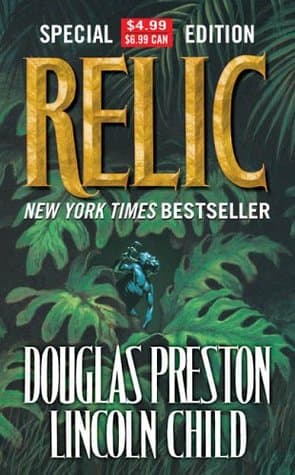
Synopsis
Covers the whole plot, including the ending.
- Difficulty
- Medium
- Pacing
- Fast
- Mood
- Suspenseful, Terrifying, Intense, Atmospheric
- Read it if
- You enjoy fast-paced creature features, scientific thrillers, and claustrophobic horror set in unique locations.
- Skip it if
- You dislike gore, creature violence, or stories with a strong focus on scientific investigation.
Relic Plot Summary
Covers the whole plot, including the ending.
The Brazilian Expedition and Its Aftermath
The novel begins with Dr. John Whitney's Iquitos expedition to the Amazon basin. After finding a lost tribe and their terrifying god, the expedition is wiped out, except for Whitney, who ships a crate of specimens to the New York Museum of Natural History before dying mysteriously on the way. Soon after, brutal murders start inside the museum. Security guards are found decapitated or dismembered, with their hypothalami removed. Lieutenant Vincent D'Agosta of the NYPD takes the case, at first believing a human serial killer is responsible, despite the extreme violence of the attacks.
Margo Green's Research and the Kothoga Legend
Margo Green, a bright evolutionary biology graduate student at the museum, gets involved in the investigation. She studies botanical specimens from Whitney's expedition. Among them, she finds unusual plant matter and ancient artifacts that suggest a creature called the 'Kothoga' – a mythical beast worshipped by the Zenzera tribe. Her mentor, Dr. Frock, initially dismisses her ideas, but Margo's scientific curiosity and D'Agosta's frustration with the lack of human suspects lead them to consider a non-human killer.
The Museum Lock-down and the Beast's Presence
Despite the rising death count and D'Agosta's warnings, the museum director, Dr. Cuthbert, insists on holding the 'Superstition' exhibition gala, fearing financial ruin. He orders a complete lockdown of the museum for the event, sealing all exits. This traps hundreds of high-society guests, museum staff, and police inside with the unseen killer. Margo, D'Agosta, and curator Dr. Frock realize how serious their situation is as the creature's presence becomes clear within the museum's halls and ventilation systems.
The Gala Massacre
During the crowded gala, the Kothoga appears, attacking guests in the exhibit halls. Panic breaks out as the creature, a large, reptilian-like beast with sharp claws and teeth, kills people. D'Agosta and his officers try to contain the creature and protect survivors, but the Kothoga's speed, strength, and knowledge of the museum's hidden passages make it nearly unstoppable. The gala turns into a scene of carnage and desperate escape.
Margo's Breakthrough: The Hypothalamus Connection
Amid the chaos, Margo continues her research, analyzing plant samples and the Kothoga's biology. She discovers that the Kothoga needs the hypothalamus gland from its victims, not for food, but because it contains a specific hormone that counters a metabolic problem caused by the plants Whitney brought back. She realizes the Kothoga is not a mythical beast but a mutated creature, likely a human transformed by a parasitic fungus or virus from the Amazonian plants and Whitney's experimental drug, which he took for his own illness.
The Sewer System and the Creature's Lair
As the Kothoga continues its rampage, a group of survivors, including Margo, D'Agosta, and museum employee George Moriarty, must go into the museum's vast, dark sewer system to escape the beast and find a way out. They navigate dangerous tunnels and find more gruesome evidence of the Kothoga's presence. Deep within the sewers, they discover the Kothoga's lair – a nest filled with bones and, chillingly, the remains of Dr. John Whitney, confirming his mutation into the creature they are fighting.
Confrontation in the Exhibition Hall
Margo realizes that the Kothoga, as a mutated form of Dr. Whitney, still has some of his human instincts and knowledge of the museum. They decide to lure the creature into the 'Superstition' exhibit hall, specifically the section about the Kothoga legend. Their plan involves using the exhibition's setup and the creature's own biology against it. They prepare a trap, hoping to exploit its sensitivity to cold or its need for the hypothalamic hormone, while D'Agosta coordinates with the remaining police officers.
The Final Showdown and the Fire
The final fight happens in the exhibition hall. Margo and D'Agosta manage to lure the Kothoga into the trap. They use the museum's fire suppression system, dousing the creature and the exhibit in water. Margo, remembering Whitney's notes, realizes that the creature's vulnerability to cold and its mutated, plant-like biology makes it vulnerable to fire. D'Agosta, with a brave police officer, ignites the water-soaked exhibit, engulfing the Kothoga in flames. The creature shrieks as it burns, seemingly destroyed.
Aftermath and Lingering Doubts
With the Kothoga seemingly defeated, the few remaining survivors, including Margo, D'Agosta, and Moriarty, emerge from the burning museum. The city is in shock, and the museum is a smoldering ruin. While the official story is that a deranged human serial killer was responsible and died in the fire, Margo and D'Agosta know the truth. The experience leaves them scarred, and Margo grapples with the scientific and ethical issues of Whitney's transformation. The novel ends with a sense of unease, suggesting that while this creature is gone, the line between science and myth has blurred, and such horrors could still exist.
Principal Figures
Margo Green
Protagonist
A brilliant and determined evolutionary biologist graduate student.
Margo is an intelligent and scientifically-minded graduate student at the New York Museum of Natural History, specializing in evolutionary biology. She is driven by a deep curiosity and a rigorous approach to scientific inquiry, often challenging established norms. Despite her academic background, she demonstrates remarkable courage and resourcefulness in the face of extreme danger, applying her scientific knowledge to understand and combat the Kothoga. She is initially underestimated by some male colleagues but proves to be indispensable.
Relationships: Dr. Frock (Mentor and colleague); Lieutenant Vincent D'Agosta (Reluctant ally and developing mutual respect); Dr. John Whitney (Object of study and ultimate antagonist (as the Kothoga))
Lieutenant Vincent D'Agosta
Protagonist
A pragmatic and initially skeptical NYPD detective.
D'Agosta is an experienced and cynical NYPD homicide detective, initially dismissive of any non-human explanation for the murders. He is a pragmatic man, grounded in logic and police procedure, but he is also open-minded enough to eventually consider Margo's unconventional theories when the evidence defies normal explanation. He is brave and protective, taking charge of the human survivors and coordinating efforts against the creature. He is burdened by the bureaucracy and skepticism of his superiors.
Relationships: Margo Green (Reluctant ally and developing mutual respect); Captain Waxman (Superior, often dismissive of D'Agosta's concerns); Police Officers (Commander of his squad)
Dr. Frock
Supporting
Margo's wise but physically disabled mentor.
Dr. Frock is an older, wheelchair-bound evolutionary biologist and Margo Green's mentor. He is highly intelligent and initially skeptical of Margo's more outlandish theories, preferring established scientific explanations. However, he is genuinely supportive of Margo and ultimately becomes convinced by her evidence, using his vast knowledge to help piece together the Kothoga's origins. His physical limitations highlight his intellectual strength and courage.
Relationships: Margo Green (Mentor and close colleague); Dr. John Whitney (Former colleague and object of his scientific curiosity)
Dr. John Whitney
Antagonist
The ill-fated ethnobotanist who becomes the Kothoga.
Dr. Whitney is an ethnobotanist who led the doomed expedition to the Amazon. He is driven by scientific ambition and a desire to cure a rare illness he suffers from. His pursuit of a unique plant, 'folia horripilans,' leads to his exposure to a parasitic fungus and an experimental drug, ultimately transforming him into the monstrous Kothoga. Though he appears briefly in flashbacks and in his mutated form, his actions are the catalyst for the entire plot.
Relationships: Margo Green (Indirectly, the subject of her research); Dr. Frock (Former colleague)
Dr. Cuthbert
Antagonist
The museum director, prioritizing profit over safety.
Dr. Cuthbert is the ambitious and financially-motivated director of the New York Museum of Natural History. He is obsessed with the success of the 'Superstition' exhibition and the museum's public image, constantly downplaying the danger posed by the murders. His arrogance and refusal to cancel the gala directly lead to the massive loss of life. He represents institutional hubris and a disregard for human life in the pursuit of prestige and profit.
Relationships: Margo Green (Superior, dismissive of her concerns); Lieutenant Vincent D'Agosta (Antagonistic, hindering the investigation)
George Moriarty
Supporting
A pragmatic and resourceful museum security guard.
Moriarty is a veteran museum security guard who knows the museum's layout intimately, especially its hidden passages and ventilation systems. He is initially skeptical of the 'monster' theories but quickly adapts to the terrifying reality. He is brave, loyal, and resourceful, proving invaluable to Margo and D'Agosta in navigating the museum's labyrinthine corridors during the lockdown. He represents the common man caught in extraordinary circumstances.
Relationships: Margo Green (Ally and guide); Lieutenant Vincent D'Agosta (Ally and fellow survivor)
Captain Waxman
Supporting
D'Agosta's skeptical and bureaucratic superior.
Captain Waxman is D'Agosta's superior officer in the NYPD. He is highly concerned with public perception and political repercussions, often prioritizing order and official narratives over D'Agosta's more outlandish theories about the killer. He represents the institutional resistance to accepting anything outside the realm of conventional explanation, hindering D'Agosta's investigation and adding to the pressure on him.
Relationships: Lieutenant Vincent D'Agosta (Superior, often in conflict)
The Kothoga
Antagonist
A mutated, reptilian-like creature hunting in the museum.
The Kothoga is the primary antagonist, a terrifying, genetically altered beast that was once Dr. John Whitney. It is highly intelligent, incredibly strong, fast, and possesses an acute sense of smell. Its physical description is reptilian, with sharp claws, teeth, and glowing red eyes. It hunts specifically for the hypothalamus gland, driven by a metabolic imperative caused by its mutation. The creature embodies the horror of science gone wrong and the blurring of myth and reality.
Relationships: Margo Green (Prey and intellectual adversary); Lieutenant Vincent D'Agosta (Prey and physical adversary)
Themes & Insights
The Peril of Unchecked Scientific Ambition
The novel shows the dangers that come when scientific curiosity and ambition override ethics and caution. Dr. John Whitney's search for a rare plant and a cure for his illness, along with his experimental drug use, leads directly to his transformation into the Kothoga. The creature itself is a grotesque example of scientific ambition gone wrong. The museum's early dismissal of Margo's scientific theories also shows how established institutions can fail to see new threats or unusual truths.
“Science is a two-edged sword. It can cut away the darkness, or it can cut us to ribbons.”
The Collision of Science and Superstition (Myth)
At the core of 'Relic' is the conflict between scientific explanation and ancient myths. The Kothoga, first seen as a mythical beast, is later revealed as a biological mutation linked to ancient tribal stories and modern science. Margo's initial struggle to convince others of a non-human killer, and the 'Superstition' exhibit, set the scene for this clash. The book suggests that what is dismissed as myth sometimes contains a truth that science can explain, or even create.
“There are more things in heaven and earth, Horatio, / Than are dreamt of in your philosophy.”
Institutional Blindness and Bureaucracy
The novel criticizes institutional failures, especially through Dr. Cuthbert and Captain Waxman. Cuthbert's focus on the museum's image and money leads him to ignore clear warnings and endanger hundreds of lives by refusing to cancel the gala. Waxman's strict adherence to police procedure and doubt about anything unusual hinders D'Agosta's investigation. This theme shows how rigid structures and self-interest can prevent effective action in a crisis, leading to disaster.
“The museum was a fortress of bureaucracy, and truth was often the first casualty.”
Survival and Adaptation
The characters' fight for survival against the Kothoga shows their ability to adapt under extreme pressure. Margo uses her scientific knowledge to understand the creature and plan, while D'Agosta adjusts his police tactics to fight a non-human enemy. The survivors navigating the dark, dangerous museum, especially the sewer system, demonstrate human resilience and resourcefulness. The Kothoga itself is an example of biological adaptation, mutated to survive in its new environment, though through horrific means.
“In the face of pure, primal terror, all pretenses fell away. Only the will to live remained.”
Plot Devices & Literary Techniques
The Locked-Room Mystery
The museum acts as an enclosed, inescapable setting for the murders.
The New York Museum of Natural History, particularly during the gala lockdown, functions as a classic locked-room setting. With all exits sealed, the characters are trapped inside with the killer, intensifying the suspense and limiting escape options. This device forces the protagonists to confront the threat directly within a confined space, heightening the claustrophobic terror and emphasizing the internal nature of the threat, as the Kothoga knows the museum's secrets.
The Red Herring
Initial evidence points to a human serial killer, diverting investigation.
Early in the investigation, the police, particularly D'Agosta, are led to believe a human serial killer is responsible for the murders. The surgical precision of the hypothalamus removal, coupled with the museum's labyrinthine structure, initially suggests a human with specialized knowledge. This misdirection serves to heighten the reveal of the Kothoga as a non-human entity and underscores the limitations of conventional investigative methods when faced with an unconventional threat.
The MacGuffin (The Folia Horripilans)
The rare Amazonian plant, the catalyst for Whitney's transformation.
The 'folia horripilans' is the rare Amazonian plant that Dr. Whitney sought, ultimately leading to his mutation. While not directly pursued by the main characters, its properties and the parasitic fungus it carries are the central catalyst for the entire plot. It drives Whitney's initial expedition and provides Margo with the crucial scientific clues to understand the Kothoga's biology and its need for the hypothalamus, making it an essential, though indirect, driving force of the narrative.
The Unreliable Environment
The familiar museum transforms into a dangerous, disorienting labyrinth.
The New York Museum of Natural History, a place of learning and public access, becomes an 'unreliable environment.' Its vast, dark halls, secret passages, ventilation shafts, and especially the flooded sewer system, transform from familiar spaces into disorienting and deadly traps. The museum's grandeur and complexity, initially a source of wonder, become a source of terror, as the Kothoga uses its intimate knowledge of these spaces to hunt its prey, making escape and navigation extremely perilous for the human characters.
Relic Quotes
“It was a thing of impossible beauty and terrifying power, a perfect killing machine forged in a million years of evolution.”
“The greatest treasures are often found in the darkest places.”
“Fear is a powerful motivator. It can make you do things you never thought possible.”
“Sometimes, the only way to understand something truly alien is to become a little alien yourself.”
“The museum was a tomb, and they were the unsuspecting sacrifices.”
“There are things in this world that defy all logic, all reason. And sometimes, those are the things that are most real.”
“The human mind, when confronted with the truly horrific, often chooses to disbelieve.”
“Every object tells a story, if you know how to listen.”
“Chaos is just order waiting to be understood.”
“The past is never truly dead; it waits, sometimes for centuries, to reach out and touch the present.”
“Science is not about proving what we already know, but about discovering what we don't.”
“In the darkness, every shadow holds a potential predator.”
“The world is full of wonders, both beautiful and terrible, and it is our job to understand them all.”
“Sometimes, the greatest monsters are the ones we create ourselves.”
Quiz
10 questions on the plot and the characters. Each answer comes with a short explanation.
Question 1
What is the name of the museum where the murders are taking place?
- Metropolitan Museum of Art
- American Museum of Natural History
- Museum of Modern Art
- Smithsonian National Museum of Natural History
Show answer
B. American Museum of Natural History The book explicitly states the murders occur at the New York Museum of Natural History, which is based on the real-life American Museum of Natural History.
Question 2
Who is the primary museum researcher tasked with investigating the killings?
- Dr. Frock
- Lieutenant D'Agosta
- Margo Green
- Dr. Cuthbert
Show answer
C. Margo Green Margo Green is introduced as the museum researcher who takes on the role of investigating the mysterious murders.
Question 3
What kind of creature is ultimately revealed to be responsible for the murders?
- A mutated rat
- A prehistoric reptilian creature (Kothoga)
- An escaped zoo animal
- A serial killer in a monster costume
Show answer
B. A prehistoric reptilian creature (Kothoga) The killer is revealed to be a Kothoga, a prehistoric creature brought back from the Amazon.
Question 4
What is the primary motivation for the museum directors to continue with the exhibition despite the murders?
- To not cause panic among the public
- To secure significant financial donations and prestige
- They believe the murders are unrelated to the museum
- To prove the museum's security is impenetrable
Show answer
B. To secure significant financial donations and prestige The museum directors are primarily concerned with the financial success and public relations of the exhibition, downplaying the murders to ensure its opening.
Question 5
Which specific exhibit is central to the museum's grand opening?
- The Hall of Gems and Minerals
- A new dinosaur exhibit
- The 'Superstition' exhibit, featuring artifacts from the Amazon
- An ancient Egyptian mummy collection
Show answer
C. The 'Superstition' exhibit, featuring artifacts from the Amazon The 'Superstition' exhibit, which includes artifacts brought back from the Amazon, is the focus of the grand opening and is linked to the creature.
Question 6
What unique dietary requirement does the creature responsible for the killings have that links it to the Amazonian expedition?
- It requires a specific type of rare orchid found only in the Amazon.
- It needs a steady diet of raw human flesh to survive.
- It has an addiction to a specific brain chemical (hypothalamic enzyme) found in humans.
- It can only consume the blood of animals native to its original habitat.
Show answer
C. It has an addiction to a specific brain chemical (hypothalamic enzyme) found in humans. Margo Green and Dr. Frock discover that the Kothoga's attacks are driven by its need for a specific hypothalamic enzyme found in the human brain, which it developed a dependency on due to a plant it consumed in the Amazon.
Question 7
Who is the detective from the NYPD assigned to the museum murder case?
- Captain Delaney
- Lieutenant Vincent D'Agosta
- Sergeant O'Shaughnessy
- Detective Glinn
Show answer
B. Lieutenant Vincent D'Agosta Lieutenant Vincent D'Agosta is the skeptical but ultimately helpful detective from the NYPD who investigates the murders.
Question 8
What is the significance of the plant 'Mbwun' to the creature and its origins?
- It is the plant the Kothoga uses to build its nest.
- It is a hallucinogenic plant that tribal shamans used to communicate with the Kothoga.
- The Kothoga consumed it in the Amazon, causing its mutation and its dependency on human brain chemicals.
- It is a rare carnivorous plant that attracts the Kothoga to the museum.
Show answer
C. The Kothoga consumed it in the Amazon, causing its mutation and its dependency on human brain chemicals. The 'Mbwun' plant, consumed by the Kothoga in its natural habitat, caused a mutation that led to its need for the specific human brain enzyme, thereby linking its origin to its current predatory behavior.
Question 9
Which character initially dismisses the idea of a non-human killer and insists on finding a human perpetrator?
- Margo Green
- Dr. Frock
- Lieutenant Vincent D'Agosta
- Dr. Cuthbert
Show answer
C. Lieutenant Vincent D'Agosta Lieutenant D'Agosta, as a pragmatic police detective, initially believes the killer must be human and struggles to accept the scientific explanations for a monstrous perpetrator.
Question 10
What method is ultimately used to try and trap or kill the creature in the museum's sub-basements?
- Setting a series of animal traps with bait.
- Flooding the sub-basements with water.
- Using explosives to collapse tunnels and seal it in.
- Luring it into a cage with a live human decoy.
Show answer
C. Using explosives to collapse tunnels and seal it in. A significant part of the climax involves the characters, particularly Margo and D'Agosta, using explosives in the museum's infrastructure to try and trap or destroy the Kothoga.
Relic FAQ
What is the central premise of 'Relic' and what drives the initial conflict?
The central premise of 'Relic' revolves around a series of brutal murders occurring within the New York Museum of Natural History, just days before a major exhibition opens. The initial conflict is driven by the fact that the killer appears to be non-human, while the museum's administration, led by Director Frock, insists on proceeding with the exhibition and suppressing information about the deaths, creating a desperate race against time for Margo Green to uncover the truth.
Who are the primary protagonists investigating the murders?
The primary protagonists investigating the murders are Margo Green, a brilliant evolutionary biologist and museum researcher, and Lieutenant Vincent D'Agosta, a seasoned NYPD homicide detective. They are later joined by Dr. Gregory Kawakita, a geneticist, and eventually by journalist Bill Smithback, who initially seeks a sensational story but becomes entangled in the mystery.
What is the significance of the Mbwun idol and the expedition to Brazil?
The Mbwun idol is a key artifact brought back from a fateful expedition to Brazil by Dr. John Whitney, which also included the plant samples that Margo Green is studying. The idol, along with the crates of plants, is intrinsically linked to the creature responsible for the murders, as it represents the very being that Whitney encountered and brought back to the museum.
What is the 'Kothoga' and what is its connection to Dr. Whitney?
The 'Kothoga' is the colloquial name given to the creature responsible for the murders, a monstrous, bipedal beast with powerful claws and an insatiable hunger. It is revealed to be Dr. John Whitney himself, transformed by a fungal parasite he ingested from the Mbwun plant during his expedition to the Amazon, which radically altered his physiology and drove him to violence.
How does the museum's 'Superstition' exhibition play into the plot?
The 'Superstition' exhibition is the grand event that the museum is preparing for, and its opening night serves as the climax of the novel. The irony lies in the fact that while the exhibition explores ancient beliefs and fears, a very real, ancient, and monstrous 'superstition' is loose within the museum, turning the celebratory event into a hunting ground for the Kothoga.
What is the specific biological mechanism that transforms Dr. Whitney into the Kothoga?
Dr. Whitney is transformed by a parasitic fungus, derived from the Mbwun plant, that he ingested in the Amazon. This fungus acts as a powerful mutagen, rapidly altering his genetic structure and physiology. It causes his body to grow larger, his teeth and claws to develop, and his brain to regress, fundamentally reshaping him into the predatory Kothoga.
What is the significance of the hypothalamus and its role in the Kothoga's behavior?
The hypothalamus plays a crucial role in the Kothoga's behavior because the parasitic fungus specifically targets and inflames this part of the brain. This explains the creature's heightened aggression, insatiable hunger, and loss of higher cognitive functions, essentially reducing Whitney to a primal, instinct-driven predator. Margo uses this knowledge to understand and predict its actions.
How do the 'crypts' beneath the museum serve as a critical setting for the climax?
The 'crypts' are the labyrinthine, forgotten tunnels and sub-basements beneath the museum, filled with discarded exhibits and historical artifacts. They serve as the Kothoga's primary lair and hunting ground, providing it with ample hiding places and an escape route. The final confrontation during the 'Superstition' exhibition takes place within these dark, confined spaces, heightening the tension and danger.
What is the symbolic significance of the Kothoga's preference for spinal fluid?
The Kothoga's preference for spinal fluid is not just a gruesome detail but has symbolic significance. It suggests a desire for the essence of intellect and life, perhaps hinting at the creature's own lost humanity and intelligence. Biologically, it's also explained as a necessary nutrient for the parasitic fungus that sustains the Kothoga, making it a critical aspect of its predatory behavior.
How does Margo Green's scientific background influence her approach to the mystery?
Margo Green's background as an evolutionary biologist allows her to approach the mystery with a scientific and rational mindset, rather than immediately resorting to supernatural explanations. She focuses on analyzing biological samples, understanding the creature's physiology and behavior through an ecological lens, which ultimately leads her to identify the parasitic fungus and the true nature of the Kothoga.
Discuss Lieutenant D'Agosta's internal conflict and his evolving perception of the case.
Lieutenant D'Agosta initially struggles with the bizarre nature of the murders, trying to fit them into conventional criminal profiles. His internal conflict arises from the mounting evidence that defies human explanation. As he witnesses the creature's brutality and the museum's cover-up, his perception evolves from skepticism to a reluctant acceptance of the extraordinary, forcing him to adapt his investigative methods.
How does the novel explore themes of scientific hubris through Dr. Whitney's actions?
The novel explores scientific hubris through Dr. Whitney's actions, as his ambition to discover a new species in the Amazon leads him to disregard caution and ingest an unknown plant. His desire for groundbreaking discovery overrides his scientific prudence, resulting in his horrific transformation and the unleashing of a monster. This highlights the dangers of unchecked scientific curiosity and the potential for unintended, catastrophic consequences.
What role does fear play in the various characters' decision-making throughout the story?
Fear plays a significant role, driving many characters' decisions. The museum directors' fear of scandal and financial loss leads them to cover up the murders. The public's fear escalates as the body count rises. Margo and D'Agosta's fear is a constant companion, but it also sharpens their resolve and instincts, pushing them to confront the monster and the conspiracy despite the overwhelming danger.
Is the Kothoga presented as purely evil, or is there a tragic element to its existence?
While the Kothoga commits horrific acts, there is a tragic element to its existence. It is not inherently evil but rather a victim of a parasitic transformation, a mutated Dr. Whitney whose consciousness has been largely erased. The creature acts out of primal instinct driven by the fungus, making it a tragic figure enslaved by a biological imperative rather than a being of malicious intent.
How does the novel critique institutional bureaucracy and the pursuit of profit over safety?
The novel strongly critiques institutional bureaucracy and the pursuit of profit over safety through the actions of the museum's board and Director Frock. Their obsession with the 'Superstition' exhibition's success and the associated revenue leads them to actively suppress information about the murders, endangering hundreds of lives. This highlights how systemic interests can override ethical responsibilities and public safety.
What is the broader message of 'Relic' regarding humanity's interaction with the natural world?
'Relic' delivers a broader message about humanity's often disrespectful and exploitative interaction with the natural world. Dr. Whitney's ill-fated expedition and his casual ingestion of an unknown plant symbolize a failure to respect the inherent dangers and complexities of nature. The Kothoga's emergence can be seen as nature's violent retribution for human intrusion and disregard.
Could the Kothoga's transformation be interpreted as a metaphor for the 'monsters' within human nature?
Yes, the Kothoga's transformation can be interpreted as a metaphor for the 'monsters' within human nature, particularly unchecked ambition and the destructive potential that lies beneath a civilized facade. Dr. Whitney's desire for fame and discovery leads to his physical and mental regression into a primal beast, suggesting that even humanity's most advanced minds can harbor destructive, animalistic impulses when driven by selfish desires.
What is the ultimate fate of the Kothoga, and what does it signify?
The Kothoga is ultimately destroyed during the climax of the 'Superstition' exhibition, though the exact method is often gruesome and hard-won. Its demise signifies the triumph of human ingenuity and cooperation over a monstrous threat, but also leaves a lingering question about the true cost of scientific exploration and the lasting impact of tampering with unknown biological forces. It is a hard-won victory that emphasizes the fragility of human control.
About the author

Douglas Preston is a prolific author known for his suspenseful thrillers, often co-authored with Lincoln Child. Their collaborative works, including the popular Pendergast series featuring novels like 'Relic' and 'Blue Labyrinth,' have achieved international bestseller status. Preston also co-authored the non-fiction bestseller 'The Monster of Florence,' showcasing his versatility in both fictional and true crime narratives.
Similar books
- Jurassic Park
Michael Crichton
4.0 (803k) average on GoodreadsThrillerFeatures scientific horror, creature-on-the-loose thrills, and a focus on biological explanation.
- Sphere
Michael Crichton
3.8 (167k) average on GoodreadsThrillerInvolves scientists investigating a mysterious, dangerous entity in a confined, isolated setting.
- Harry Potter and the Sorcerer's Stone
J.K. Rowling
4.5 (7M) average on GoodreadsFantasyRescued from a miserable life under the stairs, an orphaned boy discovers he's a wizard destined for a magical school, where he uncovers a dangerous secret tied to the dark wizard who murdered his parents.
- The Hunger Games
Suzanne Collins
4.3 (6.4M) average on GoodreadsFantasyIn a future where children fight to the death on live television, Katniss Everdeen volunteers for the arena, turning a death sentence into a fight for survival and a spark of rebellion.
- 1984
George Orwell
4.2 (3.1M) average on GoodreadsPoliticsIn a future where surveillance and thought control are absolute, a man's search for truth clashes with the Party, showing that hope can be a form of rebellion.
- Divergent
Veronica Roth
4.2 (2.9M) average on GoodreadsFantasyIn a society divided by virtues, a sixteen-year-old's difference from the norm starts a rebellion that threatens her world.





Enjoyed the summary?
A summary gives you the shape of the book. The book itself has the detail, the examples and the voice.
Find Relic on AmazonAs an Amazon Associate, BookBrief earns from qualifying purchases. How we're funded