
Core Idea
- Difficulty
- Easy
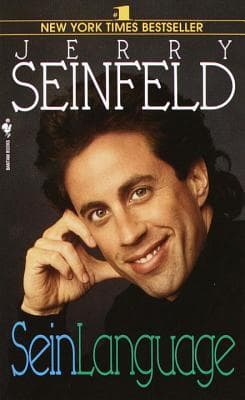
Key Takeaways from SeinLanguage
The Absurdity of the Mundane
Seinfeld elevates everyday observations into comedic gold by highlighting their inherent illogicality.
Seinfeld's most powerful idea, and the basis of his comedy, is that ordinary life, when looked at closely, is completely ridiculous. He breaks down common social customs, shopping habits, and personal quirks with great care, showing the irrationality we often accept. From the difficulties of returning clothes to the strange psychology of gift-giving, Seinfeld's humor focuses not on big statements but on carefully detailing the small, shared absurdities that connect us. This approach works because it confirms our own unspoken frustrations and observations, making us feel less alone in finding the world a bit strange. His skill is making us laugh at what we thought was normal.
“Why do we always buy something just to get rid of it?”
In the book: His extensive bits on airplane etiquette, the nuances of dating, or the futility of small talk, all meticulously break down the unspoken rules and illogical actions embedded in these situations.
Try this: Cultivate a 'Seinfeldian' perspective by consciously questioning the 'why' behind everyday actions and social conventions. Look for the illogical in the routine.
The Pain of the Social Contract
Many everyday interactions are an unspoken agreement to tolerate mild annoyance for the sake of civility.
This book, like Seinfeld's stand-up, consistently points out the unspoken difficulties of social interaction. We constantly navigate polite fictions, forced smiles, and unnecessary sharing. Seinfeld clearly expresses the quiet annoyance of enduring conversations about topics we don't care about, the pressure to pretend interest, and the subtle power dynamics in even casual meetings. This view is strong because it acknowledges the collective performance we all put on to maintain social harmony, often at the cost of genuine connection or personal comfort. It is a funny complaint about the energy spent just 'being social.'
“People love to tell you what they don't have to tell you.”
In the book: His commentary on the obligatory nature of small talk, the forced politeness with strangers, or the awkwardness of gift receipt exchanges.
Try this: Recognize when you're performing social niceties versus genuinely connecting. Practice setting gentle boundaries in conversations that drain you.
The Tyranny of Choice and Consumerism
Modern life is often complicated by an overwhelming abundance of options and the relentless pursuit of 'stuff.'
Seinfeld often makes fun of modern consumer culture's excesses and the problem of having too many choices. He highlights the absurdity of having too many brands of cereal, the detailed customs around buying and returning items, and the dissatisfaction that often follows a purchase. This idea is especially relevant today, where we are constantly offered many options. Seinfeld shows how this abundance, instead of making our lives simpler, often adds new levels of decision fatigue and buyer's regret. His observations critique our materialistic tendencies and the unfulfilled promises of advertising, making us question the true value of our possessions and choices.
“The more choices you have, the less you want any of them.”
In the book: His routines on shopping for mundane items like coffee makers or clothes, and the overwhelming array of options available in supermarkets.
Try this: Practice conscious consumption. Before buying, ask if it truly simplifies your life or adds another layer of complexity. Embrace minimalism where possible.
The Unspoken Rules of Relationship Dynamics
Romantic relationships are a complex dance of subtle power plays, misunderstandings, and unspoken expectations.
Seinfeld dedicates much of his humor to examining dating and relationships, focusing on the often-irrational behaviors and unspoken rules that guide them. From the initial awkwardness of a first date to the small arguments in long-term partnerships, he reveals the funny side of human connection. He points out gender differences in communication, the subtle tests we put on partners, and the constant negotiation needed to keep harmony. This view is sharp because it goes beyond romantic ideals to the messy, human reality of sharing a life with another person, confirming the frustrations and confusing moments many experience in their own relationships.
“A relationship is like a small business. You're constantly negotiating.”
In the book: His bits on 'making out,' the challenges of breaking up, or the differing expectations men and women have in dating scenarios.
Try this: Approach relationship challenges with a sense of humor and curiosity. Instead of frustration, try to observe the 'game' being played, and communicate expectations more clearly.
Childhood as a Foreign Country
Adults often forget the unique logic and intense experiences of being a child.
Seinfeld often revisits his childhood, not with nostalgia, but with a critical eye, analyzing the strange logic and intense emotions of youth. He points out how adults often dismiss children's worries as unimportant, yet from a child's perspective, everything is bigger and very significant. His observations about the arbitrary rules set by parents, the strange power dynamics in school, and the unique anxieties of growing up offer a funny link between the adult and child worlds. This theme is insightful because it encourages adults to remember and perhaps understand the distinct reality of childhood, rather than just applying adult understanding to it, showing the humor in both perspectives.
“Children are like a small, highly sophisticated, emotional terrorist organization.”
In the book: His stories about his parents' peculiar rules, the social hierarchies of elementary school, or the intense emotional reactions to seemingly small events as a child.
Try this: When interacting with children, try to see the world from their perspective, acknowledging their unique concerns and the logic that governs their experiences.
The Unreliability of Memory and Perception
Our memories are flawed, and our perceptions are constantly shaped by our current state.
Seinfeld's humor often touches on the subjective and unreliable nature of memory and perception. He shows how we selectively remember events, often adding to or forgetting details, and how our interpretation of situations can differ greatly from others involved. This theme is subtly powerful because it supports much of his observational comedy—the idea that what one person finds normal, another finds completely baffling. His jokes about forgetting why you entered a room or misinterpreting a social cue speak to the universal experience of our minds playing tricks on us, and the humor in those mental lapses. This is a strong insight into the human condition, even if presented through comedy.
“Memory is a wonderful thing, if you don't have to deal with the past.”
In the book: His anecdotes about forgetting everyday items, misremembering past conversations, or the differing accounts of shared experiences among friends.
Try this: Be mindful that your perception is not always reality. Practice active listening and consider alternative viewpoints, accepting that memory is fallible for everyone.
The Frustration of Bureaucracy and Systems
Man-made systems often create unnecessary hurdles and illogical processes.
Seinfeld often targets the absurdities of institutional systems, from government agencies to customer service departments. He expresses the shared frustration of navigating inefficient processes, filling out redundant forms, and dealing with indifferent staff. His humor in this area works because it taps into a universal annoyance with systems that seem designed to complicate rather than simplify. Whether it is the DMV, the post office, or an airline, Seinfeld identifies the inherent illogicality and lack of common sense that often fills these interactions, providing a comedic release for anyone who has felt powerless against the system. This is one of the book's more broadly applicable insights.
“The government is just a group of people who are trying to get out of doing anything.”
In the book: His routines on the DMV, customer service calls, or the convoluted processes of air travel and baggage claim.
Try this: When encountering bureaucratic hurdles, try to maintain a sense of humor. Document frustrating processes and advocate for simpler systems where possible.
The Art of the 'Nothing' Observation
Profound comedy can be found in dissecting the most seemingly insignificant details.
This is perhaps Seinfeld's defining comedic technique and a central idea of the book: that the best source for humor is not in grand statements or political satire, but in the careful examination of the unimportant. He shows that by focusing intensely on a seemingly trivial detail—a Raisinette, a specific gesture, a phrase—one can uncover layers of absurdity and shared human experience. This is the book's strongest insight into the craft of comedy itself, revealing that 'nothing' can actually be 'everything' if observed with enough precision and wit. It challenges the idea that comedy needs a 'big' topic, proving that the universal lies in the specific, however small.
“What is the deal with airline food?”
In the book: His famous bits on airline food, the mechanics of shaking hands, or the specific oddities of movie theater etiquette.
Try this: Practice mindful observation in your daily life. Look for the unusual or illogical in small, overlooked details. This can spark creativity and new perspectives.
The Perpetual Search for Comfort
Much of human behavior is driven by an underlying desire for ease and convenience, often leading to ironic complications.
Seinfeld often explores the human desire for comfort and convenience, and the ironic ways this pursuit can lead to greater discomfort or absurdity. From the detailed routines of getting ready for bed to the constant adjustments we make to our environment (thermostats, car seats), he highlights our relentless, often unconscious, drive for an ideal state of ease. This insight is especially sharp because it exposes the often-unacknowledged effort involved in 'being comfortable,' and how this pursuit can become a source of its own anxieties and minor struggles. He shows us that even when seeking relaxation, we are often just creating new problems to solve.
“Why do we feel the need to always be comfortable, even when it makes us uncomfortable?”
In the book: His observations on sleeping positions, the quest for the perfect temperature, or the elaborate routines people undertake for personal grooming and hygiene.
Try this: Become aware of your own comfort-seeking behaviors. Question if your pursuit of ease is genuinely simplifying your life or adding unnecessary complexity.
The Fragility of Adulting
Despite outward appearances, most adults are still figuring things out, often clumsily.
A recurring idea in Seinfeld's observations is that 'adulting' is a continuous performance, and that beneath the appearance of responsibility, most people are still navigating life with varying degrees of skill and confusion. He makes fun of the arbitrary signs of adulthood (power suits, mortgages, 'serious' conversations) and reveals the underlying immaturity or uncertainty that often remains. This perspective is comforting and relatable, as it normalizes the feeling that we are all just improvising. It is a gentle critique of the pressure to appear fully formed, and a humorous acknowledgment that growth is an ongoing, often awkward, process, even for grown-ups. The book subtly argues that adulthood is less about mastery and more about managing continuous minor crises.
“I think the only thing that makes us truly mature is when we realize how immature we actually are.”
In the book: His bits on the awkwardness of formal attire, the struggles with home maintenance, or the often-childish arguments that arise between adults.
Try this: Embrace vulnerability and self-compassion. Recognize that it's okay not to have all the answers, and that continuous learning and adaptation are part of being an adult.
Quiz
10 questions on the main ideas. Each answer comes with a short explanation.
Question 1
What is the title of Jerry Seinfeld's book?
- Seinfeld's World
- SeinLanguage
- The Bookstore
- My Life in Comedy
Show answer
B. SeinLanguage The book is explicitly titled 'SeinLanguage' in the provided text.
Question 2
According to the text, what kind of ritual did the Emmy Award-winning television show become for over 33 million viewers?
- A Saturday morning cartoon viewing
- A Sunday afternoon sports event
- A Thursday night ritual
- A Monday morning news update
Show answer
C. A Thursday night ritual The text states, 'For more than 33 million viewers, the Emmy Award-winning television show has become a Thursday night ritual.'
Question 3
In 'SeinLanguage', what is one of the topics Jerry Seinfeld's views cover, as mentioned in the text?
- Advanced calculus
- Gardening techniques
- Raisinettes
- Quantum physics
Show answer
C. Raisinettes The text lists 'Raisinettes' as one of the topics Jerry Seinfeld's views cover in his book.
Question 4
The book 'SeinLanguage' is described as a #1 New York Times bestseller. What does this indicate about its popularity?
- It was critically acclaimed by a small group of reviewers.
- It had very limited distribution.
- It was one of the most popular books sold during its time on the list.
- It was primarily sold in academic institutions.
Show answer
C. It was one of the most popular books sold during its time on the list. Being a #1 New York Times bestseller signifies that the book was among the top-selling books in the country during the period it was listed.
Question 5
Besides relationships and cop shows, which of the following is *also* mentioned as a topic covered in 'SeinLanguage'?
- Ancient Roman history
- Childhood
- The stock market
- Classical music
Show answer
B. Childhood The text states that Seinfeld's views range from 'childhood to cop shows'.
Question 6
What is the primary genre classification for the book 'SeinLanguage' provided in the text?
- Science Fiction
- Mystery
- Biography, Memoir
- Cookbook
Show answer
C. Biography, Memoir The text explicitly states the genres as 'Biography, Memoir'.
Question 7
The text mentions that the show 'has ended'. What does this imply about the current status of the television series?
- It is still airing new episodes.
- It has been cancelled and will not return.
- It has concluded its original run.
- It is currently in its final season.
Show answer
C. It has concluded its original run. The phrase 'the show has ended' directly indicates that the television series is no longer producing new episodes.
Question 8
The text calls 'SeinLanguage' a 'must-have book for all fans--and who isn't a fan?'. What does this rhetorical question suggest?
- That very few people are fans of Seinfeld.
- That the author doubts the book's appeal.
- That the author believes Seinfeld has a very wide and popular following.
- That the book is only for a niche audience.
Show answer
C. That the author believes Seinfeld has a very wide and popular following. The rhetorical question 'and who isn't a fan?' implies that the author assumes almost everyone is a fan of Seinfeld, thus making the book a must-have for a broad audience.
Question 9
What is the implication of stating that Jerry Seinfeld's 'distinct brand of humor can still be yours' even though the show has ended?
- His humor is now outdated and inaccessible.
- His comedic style is preserved and available through his book.
- His humor was only relevant during the show's broadcast.
- His humor requires visual performance to be appreciated.
Show answer
B. His comedic style is preserved and available through his book. The statement suggests that the essence of his humor, as experienced on the show, is captured and made accessible to readers through the book 'SeinLanguage'.
Question 10
The text mentions that 'SeinLanguage' remains available in both paperback and hardcover. What does this suggest about the publisher's strategy or the book's market life?
- The book is no longer being printed.
- The publisher is testing different formats for a new release.
- The book has had sustained sales and appeal across different physical formats.
- Only the hardcover version was a bestseller.
Show answer
C. The book has had sustained sales and appeal across different physical formats. The continued availability in both paperback and hardcover indicates that the book has maintained enough demand to warrant production in multiple physical formats, suggesting a long and successful market presence.
SeinLanguage FAQ
What is SeinLanguage about?
SeinLanguage is a collection of essays where Jerry Seinfeld shares his unique comedic observations on everyday life. He covers a wide range of topics, from childhood memories and relationships to pop culture and his experiences as a comedian.
Who is the author of SeinLanguage?
SeinLanguage is written by Jerry Seinfeld, the acclaimed comedian and co-creator of the iconic television show "Seinfeld."
Is SeinLanguage a novel or a collection of essays?
SeinLanguage is a collection of humorous essays, not a fictional novel. It reflects Jerry Seinfeld's stand-up comedy style and his personal thoughts on various subjects.
What kind of humor can I expect in SeinLanguage?
You can expect Jerry Seinfeld's signature observational humor. He takes mundane, everyday situations and finds the absurdity and humor in them, often with a dry and witty delivery.
What are some of the topics covered in SeinLanguage?
The book covers a diverse array of topics including childhood, relationships, parents, television, food, and the absurdities of modern life. Nothing is too small or insignificant for Seinfeld's comedic analysis.
Who would enjoy reading SeinLanguage?
Fans of Jerry Seinfeld's comedy, the "Seinfeld" TV show, and observational humor will thoroughly enjoy this book. It's a great read for anyone who appreciates a witty take on everyday life.
Is SeinLanguage similar to the "Seinfeld" TV show?
While it shares Jerry Seinfeld's comedic voice and observational style, SeinLanguage is a written collection of essays. It offers his personal reflections on topics, whereas the TV show is a narrative sitcom.
Where does Jerry Seinfeld draw inspiration for SeinLanguage?
Seinfeld draws inspiration from his own life experiences, observations of people, and the common quirks and absurdities found in everyday situations. He turns these ordinary moments into comedic gold.
Is SeinLanguage a biography or memoir?
While it contains personal anecdotes and reflections, SeinLanguage is primarily a collection of humorous essays rather than a formal biography or memoir. It offers glimpses into his perspective and humor style.
About the author

Jerry Seinfeld is an American comedian, actor, and writer, best known for his role in the television series "Seinfeld." His book "SeinLanguage" explores the nuances of everyday life through humor and observational comedy. Seinfeld's work has significantly influenced the comedy genre and remains popular in contemporary culture.
Similar books
- Born a Crime: Stories From a South African Childhood
Trevor Noah
4.5 (389k) average on GoodreadsBiographyWhile both "SeinLanguage" and "Born a Crime" are memoirs by comedians, their approaches are vastly different. Noah's book is a rich, chronological narrative detailing his extraordinary upbringing in apartheid and post-apartheid South Africa, filled with profound personal stories, emotional depth, and a strong sense of character development. Seinfeld's book, conversely, eschews narrative for thematic observations. Noah uses humor to illuminate a specific, often painful, personal and historical context, whereas Seinfeld's humor is largely universal and detached from personal history, focusing on the 'what' rather not the 'who' or 'why' of his life experiences. Noah offers a journey; Seinfeld offers a series of comedic destinations.
- Me Talk Pretty One Day
David Sedaris
4.0 (618k) average on GoodreadsBiographyDavid Sedaris's "Me Talk Pretty One Day" shares Seinfeld's comedic sensibility in dissecting the absurdities of daily life, particularly social interactions and cultural misunderstandings. Both authors excel at observational humor and crafting highly polished, self-contained essays. However, Sedaris's work often delves deeper into self-deprecation and vulnerability, frequently involving his family and personal experiences in a more direct and often exaggerated narrative fashion. While Seinfeld's observations feel like universal truths presented by an impartial, witty commentator, Sedaris often positions himself as the bewildered, slightly neurotic protagonist of his own comedic misadventures, offering a more intimate and character-driven humorous perspective. Seinfeld aims for shared recognition; Sedaris aims for shared, often uncomfortable, laughter at his own expense.
- The Diary of a Young Girl
Anne Frank
4.2 (2.7M) average on GoodreadsBiographyDuring the Nazi occupation, a teenage girl's diary, written from a secret annex, shares observations on humanity, hope, and the wait for freedom.
- Eat, Pray, Love
Elizabeth Gilbert
3.6 (1.5M) average on GoodreadsLifestyleA heartbroken writer leaves her conventional life for a year-long global search for pleasure in Italy, spiritual devotion in India, and unexpected love and balance in Bali.
- Night
Elie Wiesel
4.3 (970k) average on GoodreadsBiographyIn the darkness of Auschwitz and Buchenwald, a teenage Elie Wiesel faces the extermination of his family, the loss of his faith, and the lasting scars of humanity's deepest cruelty.
- Steve Jobs
Walter Isaacson
4.1 (957k) average on GoodreadsBusinessSteve Jobs was a visionary who fused creativity and technology to revolutionize six industries and shape our digital world.





Enjoyed the summary?
A summary gives you the shape of the book. The book itself has the detail, the examples and the voice.
Find SeinLanguage on AmazonAs an Amazon Associate, BookBrief earns from qualifying purchases. How we're funded