
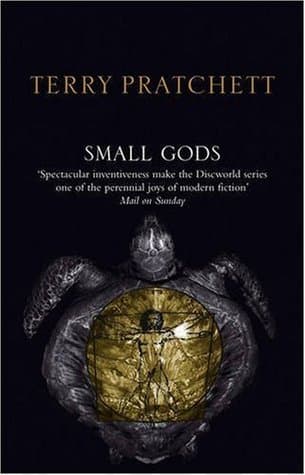
Synopsis
Covers the whole plot, including the ending.
- Difficulty
- Medium
- Pacing
- Moderate
- Mood
- Satirical, Philosophical, Humorous, Thought-provoking, Witty
- Read it if
- You enjoy satirical fantasy that cleverly dissects themes of religion, power, and belief with humor and philosophical depth.
- Skip it if
- You prefer straightforward epic fantasy without much social commentary or find religious satire unappealing.
Small Gods Plot Summary
Covers the whole plot, including the ending.
The Desert and the Tortoise
In the desert kingdom of Omnia, ruled by the tyrannical Exquisitor Vorbis and the Omnian church, the simple, uneducated novice Brutha tends to the temple's melon patch. Brutha has a photographic memory for scriptures but often questions the church's dogma. One sweltering day, while searching for water, Brutha finds a small tortoise. To his astonishment, the tortoise speaks, identifying itself as the Great God Om, the very deity the Omnian church worships. Om, now reduced to this humble form, reveals that his power has waned because no one truly believes in him anymore; they only fear the church. He desperately needs Brutha's help to restore his former glory.
A God's Decline
Om, the tortoise, explains to a bewildered Brutha that the Omnian church, through centuries of rigid dogma and brutal inquisitions, has choked off true faith. People no longer believe in Om out of devotion, but out of terror of the Quisition and its tortures. This fear-based 'belief' offers Om no spiritual sustenance, causing him to shrink from a mighty god into a mere reptile. He recounts his past grandeur, his thunderous voice, and his legion of prophets, all now just fading memories. Om sees Brutha as his last hope, the only person left in Omnia who genuinely believes in him, even if that belief is still somewhat naive.
The Journey to Ephebe
Exquisitor Vorbis, a shrewd and ruthless leader, decides to send an envoy to Ephebe, a more liberal, philosophical city-state, to demand tribute and assert Omnian dominance. He chooses Brutha, viewing him as a simpleton who will be easily controlled, and forces him to take a giant, ornate, but empty, tortoise shell as a gift, symbolizing Om. Unbeknownst to Vorbis, the real Om is hidden inside the shell with Brutha. Their journey across the desert is full of danger and philosophical debates, as Om tries to explain the true nature of divinity and belief to Brutha, while Brutha struggles to reconcile Om's humble form with the church's teachings.
Ephebe's Philosophers
Upon arriving in Ephebe, Brutha and Om experience a stark contrast to Omnian rigidity. Ephebe is a hub of philosophy, science, and diverse religious practices, where gods are numerous and often discussed with academic detachment. Brutha is overwhelmed by the libraries and the free exchange of ideas, while Om is both fascinated and frustrated by the Ephebians' intellectual approach to divinity. They meet various philosophers, including Urn, a cynical scholar, and the blind librarian, Dios, who possesses vast historical knowledge. Brutha's simple faith and photographic memory of scriptures, however, prove useful in philosophical debates, earning him unexpected respect.
The Seeds of War
Exquisitor Vorbis, impatient with Brutha's progress, arrives in Ephebe with Omnian soldiers, including the fearsome Sergeant Simony. Vorbis's true intention is not diplomacy, but conquest. He publicly humiliates Brutha, who is forced to carry the enormous tortoise shell, and demands Ephebe surrender to Omnian rule and adopt the worship of Om. The Ephebians, proud of their independence and intellectual freedom, refuse. Vorbis uses this refusal as a pretext for war, positioning his army for an imminent invasion, believing that Om desires the spread of his faith through force.
The Oracle and the Prophecy
Seeking guidance amidst the escalating tensions, Brutha, accompanied by Om, visits the Oracle of Ephebe. The Oracle, a cryptic figure, delivers a prophecy that speaks of a 'chosen one' who will save Om, and refers to a time when Om's voice will be heard again. The prophecy also hints at the true nature of belief and the dangers of a god's dependence on human worship. Brutha struggles to interpret the prophecy, but Om realizes its implications for his own existence and the future of his faith. The encounter further solidifies Om's realization that his salvation lies not in conquest, but in a return to genuine, heartfelt belief.
Escape and Revelation
As war looms, Brutha and Om manage to escape Ephebe, aided by some sympathetic Ephebians. They journey back towards Omnia, but take a detour through ancient, forgotten ruins. Here, Om reveals more of his past, including details about a previous prophet, a man named Cenobi, who had a true, personal relationship with him before the church's rise to power. Om also confesses his own past mistakes, admitting that he once enjoyed the fear he inspired and allowed his followers to commit atrocities in his name. This self-reflection marks a turning point for the god, as he begins to understand the destructive nature of his former glory.
The Battle of the Desert
The Omnian army, under Vorbis's command, launches a brutal assault on Ephebe. The Ephebians, though outmatched in military might, fight bravely, using their ingenuity and understanding of the terrain. Brutha, carrying the empty tortoise shell, is caught in the thick of the battle, witnessing the horrific consequences of religious zealotry and war. Om, inside the shell, experiences the battle firsthand, feeling the fear and faith of the soldiers, and the terrible cost of his 'glory'. The battle is fierce, with heavy casualties on both sides, and it becomes clear that Vorbis's ambition knows no bounds.
Brutha's Stand
In the chaos of battle, Brutha, guided by Om, makes a desperate stand. He confronts Exquisitor Vorbis, challenging his perversion of Om's teachings and his tyrannical rule. Brutha, using his incredible memory, recites scripture and argues for a compassionate, loving god, directly contradicting Vorbis's doctrine of fear and conquest. Vorbis, enraged, tries to silence Brutha, but Brutha's unwavering conviction, fueled by his true belief in Om, gives him unexpected strength. Om, witnessing Brutha's courage, begins to feel a surge of true belief, a power he has not felt in centuries.
The Miracle of the Desert
As the battle rages, Brutha, with Om's guidance, performs a seemingly impossible feat. He uses his knowledge of the desert and his innate goodness to bring water to the dying soldiers, both Omnian and Ephebian, in a moment of compassion. This act of selfless love, a true miracle born of genuine faith, causes Om to manifest his power. The desert itself seems to respond, providing aid. This event, witnessed by both armies, shatters the fanaticism of many Omnian soldiers and exposes Vorbis's cruelty. Om's power is significantly restored, not through fear, but through Brutha's pure belief and action.
The Trial of the Afterlife
In a surreal sequence, Vorbis and Brutha both die in the aftermath of the battle and find themselves in the afterlife. Vorbis, confident in his righteousness, expects a glorious reward, but is instead confronted by many gods, including a now fully restored Om. Brutha, humble and apologetic, faces judgment for his actions. Om, no longer a tortoise, but a magnificent bull, acts as Brutha's advocate, arguing for the purity of his belief and condemning Vorbis's manipulation of faith. The gods of the afterlife ultimately judge Vorbis for his cruelty and Brutha for his goodness, highlighting the true nature of divine justice.
The Prophet and the Shepherd
After his experience in the afterlife, Brutha returns to the mortal world, now recognized as the Eighth Prophet of Om. With Om's renewed presence and Brutha's gentle guidance, the Omnian church undergoes a radical transformation. The Quisition is disbanded, torture is abolished, and the focus shifts from fear and conquest to compassion, education, and genuine faith. Brutha, despite his newfound status, remains humble, preferring to tend his melon patch and guide his flock with kindness rather than dogma. Om, now a powerful but benevolent deity, continues to exist, his power sustained by the true belief of his followers, a belief fostered by Brutha's gentle leadership.
Small Gods Characters
Brutha
Protagonist
A humble, uneducated novice with an eidetic memory and pure faith.
Brutha is a young, simple-minded novice in the Omnian church, often underestimated due to his meek demeanor. Despite his lack of formal education, he possesses an eidetic memory, allowing him to recall every word of scripture, though he struggles with the deeper, often contradictory, interpretations. His defining characteristic is his unwavering, innocent faith in Om, uncorrupted by the church's dogma of fear and control. He is compassionate, empathetic, and possesses a quiet courage that emerges when he stands up for what he believes is right. He is initially naive but grows through his experiences with Om and the wider world.
Relationships: Om (His god and companion; he is Om's last true believer.); Vorbis (His tyrannical superior and ideological antagonist.)
Om
Deuteragonist/God
The Great God Om, reduced to a tortoise, learning the true meaning of divinity.
Om is the Great God of Omnia, worshipped by millions, yet ironically reduced to the form of a small, talking tortoise. His divine power has waned because the Omnian church has replaced true belief with fear and rigid dogma. Initially arrogant, self-serving, and prone to divine temper tantrums, Om is forced to confront the consequences of his past actions and the destructive nature of a faith built on fear. Through his journey with Brutha, he learns humility, compassion, and the true source of a god's power: genuine, heartfelt belief and love from his followers, rather than blind obedience.
Relationships: Brutha (His only true believer and eventual prophet; his salvation.); Vorbis (The leader of the church that inadvertently starved him of true belief.)
Exquisitor Vorbis
Antagonist
The ruthless and calculating leader of the Omnian Quisition.
Exquisitor Vorbis is the cold, calculating, and utterly ruthless leader of the Omnian Quisition. He embodies the worst aspects of religious fanaticism: absolute certainty, unwavering cruelty, and a complete lack of empathy. He believes that the ends justify the means, and that the Omnian church's dominance, achieved through torture and war, is the only way to serve Om. Vorbis sees people as tools or obstacles, and views faith as a means of control. He is intellectually brilliant but morally bankrupt, utterly convinced of his own righteousness, even in the face of his god's true desires.
Relationships: Brutha (He views Brutha as a simpleton to be exploited, but Brutha ultimately undermines his authority.); Om (He believes he serves Om, but his actions inadvertently weaken and nearly destroy his god.)
Sergeant Simony
Supporting
A loyal but increasingly conflicted Omnian soldier.
Sergeant Simony is a hardened Omnian soldier, a product of the Quisition's brutal training. He is fiercely loyal to Vorbis and the church, initially unquestioning in his duty to enforce Omnian law and spread its faith by force. However, as he witnesses Brutha's compassion, Om's true nature, and the horrors of Vorbis's campaign, Simony begins to experience doubt and a growing moral conflict. He is a man caught between his ingrained obedience and a dawning sense of justice and humanity, representing the potential for redemption even within a rigid system.
Relationships: Vorbis (His commanding officer, whom he initially serves without question.); Brutha (He is initially dismissive of Brutha but comes to respect his moral conviction.)
Didactylos
Supporting
An Ephebian philosopher and inventor.
Didactylos is a prominent Ephebian philosopher and inventor, known for his eccentricities and his commitment to free thought. He represents the intellectual curiosity and open-mindedness of Ephebe, a stark contrast to Omnian dogma. He is a proponent of reason and scientific inquiry, often challenging established beliefs with logical arguments and practical experiments. Didactylos is friendly and inquisitive, engaging Brutha in philosophical debates and helping him understand the Ephebian way of life. He is a symbol of the enlightenment and intellectual freedom that Omnia seeks to suppress.
Relationships: Brutha (He engages Brutha in philosophical discussions, challenging his worldview.)
Urn
Supporting
A cynical Ephebian philosopher.
Urn is another Ephebian philosopher, characterized by his cynical and often pessimistic outlook. He is a keen observer of human nature and politics, frequently pointing out the flaws and absurdities in both. While he values intellectual freedom, he often expresses a weary resignation about the inevitability of human folly and conflict. Urn's cynicism provides a counterpoint to Didactylos's more optimistic view of reason, but he ultimately stands with Ephebe against Omnian aggression. He offers a grounded, often humorous, perspective on the events unfolding.
Relationships: Brutha (He engages Brutha in philosophical discussions, often with a cynical edge.)
Dios
Supporting
The ancient, blind librarian of Ephebe.
Dios is the ancient, blind librarian of Ephebe, a repository of vast historical knowledge. Despite his physical blindness, he possesses profound insight into history, philosophy, and the nature of belief. He provides Brutha with crucial information about ancient religions and the cyclical nature of gods and their worshippers, often speaking in riddles or parables. Dios represents the enduring power of knowledge and the wisdom that comes from a long perspective. His presence underscores the value of recorded history and the dangers of suppressing information, a key difference between Ephebe and Omnia.
Relationships: Brutha (He provides Brutha with historical context and philosophical insights.)
The Oracle of Ephebe
Mentioned
A cryptic figure who delivers prophecies.
The Oracle of Ephebe is a mysterious figure, a conduit for cryptic prophecies that often require careful interpretation. She represents the more mystical and intuitive side of Ephebian spirituality, contrasting with the philosophers' reliance on pure reason. Her pronouncements, while vague, often contain deep truths about the nature of gods, belief, and destiny, guiding Brutha and Om towards a greater understanding of their purpose. She embodies the ancient, often ambiguous, wisdom that transcends simple logic.
Relationships: Brutha (She delivers a prophecy to Brutha concerning Om's fate and his role.)
Small Gods Themes
The Nature of Belief and Divinity
The novel explores the relationship between gods and their worshippers. It states that a god's power is not inherent but directly proportional to the genuine belief of its followers. Om, reduced to a tortoise, shows this, having been starved of true faith by the Omnian church's fear-based dogma. The Ephebians, with their many minor gods, show a different, less intense form of belief. Brutha's pure, unquestioning faith, despite the church's perversion, is what ultimately sustains and restores Om. The book argues that true belief is an act of love and trust, not fear or blind obedience, and that gods are, in essence, a reflection of their worshippers.
“A god needs a worshipper. Just one. But a real one. That’s the difference. You don’t get what you want, you get what you get.”
Religious Fanaticism vs. True Faith
Pratchett contrasts the rigid, brutal fanaticism of the Omnian church with the concept of true, personal faith. Exquisitor Vorbis and the Quisition embody the dangers of institutionalized religion when it prioritizes power, control, and dogma over compassion and genuine spirituality. Their actions, including torture and conquest, are carried out in Om's name but contradict the god's true desires, ultimately weakening him. Brutha, on the other hand, represents uncorrupted faith—a simple, compassionate belief that sees the good in people and acts with kindness. The novel argues that true faith should lead to empathy and understanding, not violence and intolerance, and that strict adherence to doctrine can kill the very spirit it claims to serve.
“Just because you can't explain it, doesn't mean it's a miracle.”
The Corrupting Influence of Power
The narrative shows how power, especially religious power, can corrupt both institutions and individuals. The Omnian church, initially founded on genuine belief, transformed into a totalitarian regime under the guise of serving Om. Exquisitor Vorbis is the epitome of this corruption, wielding immense power through fear and torture, believing himself to be an instrument of divine will. Even Om himself, in his earlier, more powerful incarnations, admits to enjoying the fear he inspired, showing that power can corrupt even a god. The book suggests that unchecked power, regardless of its source, leads to tyranny and the perversion of original ideals, highlighting the constant need for humility and accountability.
“A man who knows he is right because the Voices inside his head tell him so is a madman. A man who knows he is right because Om tells him so is a prophet. The difference is a long, thin, bloody line.”
The Value of Knowledge and Free Thought
The contrast between Omnia and Ephebe highlights the importance of knowledge, reason, and free thought. Omnia suppresses education, burns books, and punishes any deviation from its rigid dogma, fearing that independent thought will undermine its authority. Ephebe, conversely, is a hub of philosophy, science, and diverse ideas, where debate and inquiry are encouraged. Brutha's journey exposes him to the liberating power of knowledge and the dangers of ignorance. The novel champions intellectual freedom, suggesting that progress and true understanding can only flourish where ideas can be openly explored and challenged, rather than dictated by authority.
“The only thing that burns in hell is the part of you that won't let go of your life: your memories, your attachments. They burn them all away. But they're not punishing you, they're freeing you.”
Plot Devices & Literary Techniques
The Talking Tortoise (Om)
The literal embodiment of a god's diminished power.
The transformation of the mighty Great God Om into a small, talking tortoise is the central plot device. It visually and metaphorically represents his loss of power due to the Omnian church's perversion of true belief. This humble form forces Om to experience the world from a mortal perspective, stripping him of his divine arrogance and compelling him to learn humility and the true meaning of faith. It also serves as a source of dramatic irony and humor, as the all-powerful deity is dependent on a simple novice.
Brutha's Eidetic Memory
A miraculous recall of scripture that challenges institutional dogma.
Brutha's perfect, photographic memory of every word of Omnian scripture is a key device. It allows him to quote chapter and verse to challenge Vorbis's interpretations and expose the church's deviations from its own sacred texts. This ability makes him both invaluable to Om (who needs someone to remember his true words) and a dangerous anomaly to the Quisition, who rely on controlling information. It highlights the idea that the 'spirit' of the law can be lost even when the 'letter' is preserved, and that true understanding goes beyond mere recitation.
The Journey to Ephebe
A physical and philosophical journey to a contrasting culture.
The journey to Ephebe acts as a classic 'fish out of water' narrative, exposing Brutha and Om to a world entirely different from rigid Omnia. It serves as a crucible for Brutha's character development, introducing him to free thought, diverse philosophies, and alternative ways of life. For Om, it's a sobering encounter with intellectual detachment from divinity. The contrasting societies allow Pratchett to satirize religious extremism and champion intellectual freedom, providing the necessary external conflict and internal reflection for the protagonists.
The Quisition
A fanatical religious police force that enforces dogma through terror.
The Quisition, the Omnian church's secret police and torture arm, is a primary plot device representing the dangers of religious extremism and institutionalized terror. It is the mechanism by which Vorbis maintains control and suppresses dissent, directly contributing to Om's weakening by replacing true faith with fear. Its actions drive much of the initial conflict and Brutha's moral awakening. The Quisition acts as a constant threat, illustrating the brutal consequences of a society where dogma is enforced through violence, and freedom of thought is brutally suppressed.
Small Gods Quotes
“The Turtle Moves.”
“It is a brave man who is not afraid to look the Devil in the face and tell him he is a fool.”
“Gods don't need to be true. They only need to be believed.”
“A man is not a man until he is a man of his word.”
“The opposite of a profound truth may be another profound truth.”
“People think that it's the right thing to do to make the world a better place. But the world is not a place. It's a process.”
“Ignorance is not bliss. Ignorance is ignorance.”
“If you don't know where you're going, any road will take you there.”
“The trouble with having an open mind, of course, is that people will insist on coming along and trying to put things in it.”
“There are no atheists in foxholes, but there are a lot of them in the officer's mess.”
“It's a strange thing, but when you are dreading something, and would give anything to postpone it, then you suddenly find that you have a tremendous desire to get it over with.”
“He didn't want to be a hero. He just wanted to be a man.”
“Wisdom is knowing when to stay silent.”
“The universe is not obliged to make sense to you.”
Quiz
10 questions on the plot and the characters. Each answer comes with a short explanation.
Question 1
What animal form does the god Om take for the majority of the novel?
- A raven
- A snake
- A tortoise
- A beetle
Show answer
C. A tortoise Om, once a mighty god, finds himself reduced to the form of a small tortoise due to the dwindling belief in him.
Question 2
What is the name of the main protagonist, the only true believer left in Om?
- Brutha
- Urn
- Didactylos
- Vorbis
Show answer
A. Brutha Brutha is the humble novice who, despite his simple nature, becomes the last and most important believer in Om.
Question 3
What is the primary method the Omnian church uses to spread its faith and influence?
- Peaceful missionary work and charitable acts
- Military conquest and forced conversion
- Grand spectacles and divine interventions
- Scholarly debates and philosophical arguments
Show answer
B. Military conquest and forced conversion The Omnian church, under the Exquisitor Vorbis, is known for its aggressive military expansion and conversion by the sword.
Question 4
What unique ability does Brutha possess that makes him crucial to Om's survival and resurgence?
- He can speak directly to all animals.
- He has a perfect, eidetic memory.
- He can foresee future events with accuracy.
- He can perform minor miracles.
Show answer
B. He has a perfect, eidetic memory. Brutha's perfect memory allows him to recall every word of scripture and every detail of his life, making him a unique vessel for Om's truth.
Question 5
Which character serves as the ruthless and manipulative head of the Omnian church for much of the novel?
- Didactylos
- Vorbis
- Cutwell
- Deacon Crophopper
Show answer
B. Vorbis Exquisitor Vorbis is the cold, calculating leader of the Omnian church, responsible for its brutal expansion and the suppression of dissent.
Question 6
What is the primary philosophical conflict explored in 'Small Gods' regarding the nature of divinity?
- Whether gods are inherently good or evil.
- Whether gods create belief, or belief creates gods.
- The conflict between monotheism and polytheism.
- The role of free will versus divine predestination.
Show answer
B. Whether gods create belief, or belief creates gods. The novel directly tackles the idea that gods on the Discworld derive their power and even their existence from the belief of their followers.
Question 7
What is the name of the desert where Brutha and Om undertake their journey to the neighboring nation of Ephebe?
- The Dry Reach
- The Klatchian Desert
- The Great Nef
- The Sunken Lands
Show answer
C. The Great Nef Brutha and Om traverse the treacherous Great Nef desert as part of their diplomatic mission to Ephebe.
Question 8
What is the 'Quisition' within the Omnian church?
- The council of senior priests who advise the Exquisitor.
- The elite military guard responsible for protecting the Citadel.
- The investigative and punitive arm of the church, akin to an inquisition.
- The theological college where new priests are trained.
Show answer
C. The investigative and punitive arm of the church, akin to an inquisition. The Quisition is the feared secret police and judicial system of the Omnian church, known for its brutal methods of extracting confessions and punishing heretics.
Question 9
What happens to Vorbis after his death?
- He is immediately reincarnated as a worm, as per Om's judgment.
- He becomes a minor god of bureaucracy and order in the afterlife, trapped in an endless desert.
- He is condemned to an eternal torment in the deepest pits of hell.
- He simply ceases to exist, his soul dissipating into nothingness.
Show answer
B. He becomes a minor god of bureaucracy and order in the afterlife, trapped in an endless desert. Upon his death, Vorbis finds himself in an afterlife shaped by his own beliefs and actions, wandering an endless desert, forever counting grains of sand, a 'small god' of his own making.
Question 10
What fundamental change does Om undergo as a result of his experience as a tortoise and his interactions with Brutha?
- He decides to abandon his godhood entirely and live as a mortal.
- He learns the true meaning of compassion and humility, becoming a god who genuinely cares for his believers.
- He becomes even more vengeful and tyrannical, seeking to punish those who abandoned him.
- He merges with all other gods, becoming a singular, universal deity.
Show answer
B. He learns the true meaning of compassion and humility, becoming a god who genuinely cares for his believers. Om's time as a tortoise and his reliance on Brutha forces him to understand the true nature of belief and the suffering of his followers, transforming him from a distant, demanding deity into one who truly cares.
Small Gods FAQ
What is the central premise of 'Small Gods'?
'Small Gods' explores the nature of belief and the relationship between gods and their worshippers on the Discworld. It posits that gods' power directly correlates with the number and fervor of their believers, leading to a deity, Om, being reduced to a tortoise due to a decline in genuine faith among his followers.
Who is Brutha and what is his significance to Om?
Brutha is a simple, uneducated novice in the Church of Omnia who possesses an eidetic memory and, crucially, is the only person who genuinely believes in Om, not just the Church's dogma. He becomes Om's sole true prophet and the instrument through which Om seeks to regain his power and influence.
Who is Vorbis and what role does he play in the Omnian Empire?
Vorbis is the highly intelligent, ruthless, and manipulative de facto leader of the Omnian Empire, the Exquisitor. He uses the Church's power to control the populace through fear, torture, and strict dogma, believing that faith is best enforced through absolute obedience and the suppression of independent thought.
What is the role of the Quisition in the Omnian Empire?
The Quisition is the brutal enforcement arm of the Omnian Church, responsible for maintaining doctrinal purity and punishing heretics. Led by Vorbis, it employs torture, censorship, and public executions to instill fear and ensure absolute conformity to the Church's teachings, effectively stifling any dissent.
What happens to Om at the beginning of the story?
At the beginning of the story, Om, once a powerful god, finds himself incarnated as a small, physically vulnerable tortoise. This demotion is a direct consequence of his worshippers' faith becoming superficial and institutionalized, rather than genuine and heartfelt, leaving him with little power.
How does the 'ephebe' concept relate to the gods and their power?
The 'ephebe' concept, though not explicitly named as such, refers to the idea that a god's power is directly proportional to the number and quality of their worshippers. When faith becomes mere habit or ritual, the god weakens, as seen with Om's transformation into a tortoise, demonstrating the fragile nature of divine power.
What is the significance of the desert in 'Small Gods'?
The desert represents a place of stark reality and spiritual testing, contrasting sharply with the artificiality of the Omnian Church. It's where Brutha and Om experience profound revelations, confront their true natures, and where Om directly interacts with other, often forgotten, 'small gods' who derive power from specific, localized beliefs.
Are there other gods besides Om explicitly mentioned or implied in the story?
Yes, several 'small gods' are encountered in the desert, such as the god of the small dry places, the god of the forgotten things, and the god of the empty spaces. These minor deities derive their limited power from very specific, often overlooked, aspects of belief, highlighting the diverse pantheon of the Discworld.
What does Vorbis's character reveal about the nature of fanaticism?
Vorbis embodies the dangers of fanaticism, showing how a belief system, even one purportedly divine, can be twisted to justify immense cruelty and control. His conviction in his own righteousness, combined with a complete lack of empathy, illustrates how absolute power and dogmatic certainty can corrupt individuals and institutions.
How does Brutha's simple faith contrast with the institutionalized religion of Omnia?
Brutha's faith is characterized by genuine belief, compassion, and a personal connection to his god, contrasting sharply with the Omnian Church's rigid dogma, fear-mongering, and focus on power. His innocence and directness challenge the hypocrisy and corruption that have overtaken the established religion, demonstrating true piety.
What psychological impact does the Quisition have on the people of Omnia?
The Quisition's pervasive surveillance, torture, and public executions create a climate of intense fear and paranoia among the Omnian populace. This psychological manipulation suppresses individuality, critical thinking, and genuine expression, forcing outward conformity while stifling inner dissent and fostering a deeply traumatized society.
How does the book explore the relationship between belief and truth?
'Small Gods' suggests that belief can shape truth, especially concerning the gods, whose existence and power are directly contingent on their worshippers' faith. It also highlights how institutionalized belief can distort objective truth, as seen in the Church's fabrication of history and suppression of knowledge, creating a dangerous disconnect.
Is 'Small Gods' a critique of organized religion, or simply specific abuses of it?
While 'Small Gods' sharply critiques the abuses of organized religion, particularly the Omnian Church's fanaticism and cruelty under Vorbis, it also champions genuine faith and spirituality through Brutha's character. It suggests that the problem lies not with belief itself, but with the human tendency to institutionalize, control, and corrupt it for power.
What is the ultimate fate of Om and the Omnian Empire?
Om eventually regains his full godhood, not through conquest or fear, but through Brutha's genuine faith and the subsequent reformation of the Omnian Church. The Empire transforms from a tyrannical, expansionist power into a more tolerant and enlightened society, embracing knowledge and genuine spiritual inquiry.
How does the ending of 'Small Gods' redefine what it means to be a god?
The ending redefines godhood by asserting that true divine power comes from genuine, heartfelt belief and a god's capacity for empathy and wisdom, rather than fear or blind obedience. Om's transformation from a vengeful deity to a more benevolent, understanding god highlights that a god's nature is shaped by their worshippers.
What is the significance of Brutha's memory and his role as a chronicler?
Brutha's eidetic memory is crucial because it allows him to retain true history and Om's original teachings, undistorted by the Church's revisions. As a chronicler, he ensures that the true narrative survives, challenging the fabricated history of the Quisition and serving as a living archive of genuine faith and events.
How does the concept of 'miracles' evolve throughout the story?
Initially, miracles are presented as grand, supernatural displays, but the story redefines them as subtle interventions and the profound impact of genuine belief and compassion. Om's 'miracles' become less about overt divine power and more about inspiring change, revealing truth, and fostering genuine human connection.
What philosophical questions does the book raise about free will versus divine intervention?
The book debates whether gods dictate human actions or if humans shape their gods. Om's initial powerlessness and reliance on Brutha suggest that divine intervention is limited without human agency and belief, while the reformed Omnia highlights how human free will, guided by principles, can lead to a more enlightened path.
About the author
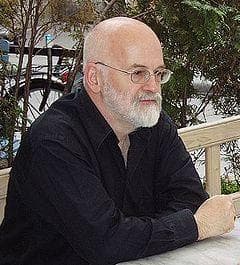
Sir Terence David John Pratchett was an English humorist, satirist, and author of fantasy novels, especially comical works. He is best known for his Discworld series of 41 novels.
Similar books
- The Hitchhiker's Guide to the Galaxy
Douglas Adams
4.2 (1.4M) average on GoodreadsFantasyFeatures absurd humor, philosophical musings, and a unique, satirical perspective on existence and institutions.
- Jonathan Livingston Seagull
Richard Bach
3.8 (202k) average on GoodreadsFantasyExplores themes of spirituality, self-discovery, and challenging tradition, albeit in a more allegorical and less satirical style.
- American Gods
Neil Gaiman
4.1 (758k) average on GoodreadsFantasyWhile both Small Gods and Gaiman's American Gods (2001) explore the relationship between gods and human belief, their approaches differ significantly. Pratchett focuses on the decline of a god and the internal corruption of a single, dominant religion, using satire to critique dogma. Gaiman, conversely, examines the clash of old world gods (sustained by immigrant beliefs) with new American deities (born from technology and media), exploring the nature of belief in a pluralistic, modern society. Pratchett's tone is largely comedic and philosophical, whereas Gaiman's is darker, more mythological, and often violent, delving into the raw power dynamics of belief systems. Pratchett's critique is more focused on institutional hypocrisy, while Gaiman explores the very fabric of how belief shapes reality and identity.
- Harry Potter and the Sorcerer's Stone
J.K. Rowling
4.5 (7M) average on GoodreadsFantasyRescued from a miserable life under the stairs, an orphaned boy discovers he's a wizard destined for a magical school, where he uncovers a dangerous secret tied to the dark wizard who murdered his parents.
- The Hunger Games
Suzanne Collins
4.3 (6.4M) average on GoodreadsFantasyIn a future where children fight to the death on live television, Katniss Everdeen volunteers for the arena, turning a death sentence into a fight for survival and a spark of rebellion.
- 1984
George Orwell
4.2 (3.1M) average on GoodreadsPoliticsIn a future where surveillance and thought control are absolute, a man's search for truth clashes with the Party, showing that hope can be a form of rebellion.






Enjoyed the summary?
A summary gives you the shape of the book. The book itself has the detail, the examples and the voice.
Find Small Gods on AmazonAs an Amazon Associate, BookBrief earns from qualifying purchases. How we're funded