
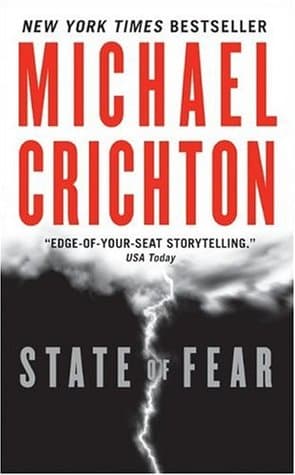
Synopsis
Covers the whole plot, including the ending.
- Difficulty
- Medium
- Pacing
- Fast
- Mood
- Suspenseful, Provocative, Action-packed, Analytical
- Read it if
- You enjoy fast-paced, globe-trotting thrillers with a strong scientific bent and a controversial take on environmental issues.
- Skip it if
- You prefer character-driven stories over plot-driven ones, or you are sensitive to politically charged narratives about climate change.
State of Fear Plot Summary
Covers the whole plot, including the ending.
The Paris Incident and First Contact
The novel begins with the mysterious death of Dr. Kenner, a French physicist, in Paris after a visit from Sarah Jones. At the same time, George Morton, a wealthy philanthropist, involves his nephew, Peter Evans, a lawyer, in a strange request: to represent Morton's girlfriend, Jennifer Haynes, in a lawsuit against the National Environmental Resource Fund (NERF). Peter is hesitant but agrees, unaware of the larger conspiracy he is entering. Morton, a vocal skeptic of environmental warnings, secretly funds a group planning to stage a series of catastrophic 'natural' disasters to highlight the 'state of fear' he believes environmentalists create.
Icelandic Avalanche and the Rescue
Peter Evans, along with Sarah Jones, who is an agent for Morton's group, travels to Iceland to get a package. They are caught in a sudden, large avalanche, created by Morton's operatives using advanced technology. Peter survives and, despite his injuries, helps Sarah. John Kenner, a climatologist and the deceased physicist's brother, and Sanjong Thapa, a Nepalese guide, rescue them. Kenner, suspicious of the unusual weather, begins investigating the incident, unknowingly following Morton's operations.
The California Tsunami Plot
The story moves to California, where Morton's operatives, led by Dr. Norman Hoffman, prepare to trigger a massive tsunami off Santa Monica. Their plan involves using a submersible to detonate explosives along a fault line. Peter, Sarah, Kenner, and Thapa, having just escaped another attack in Arizona where Morton's group tried to create a superstorm, race to expose and stop this plot. Peter starts to understand the true nature of Morton's organization and its global reach.
Antarctic Glacier Collapse
After the California incident, the team tracks Morton's next target to Antarctica. His operatives try to trigger a massive glacier collapse, aiming to create a dramatic image of climate change's supposed effects. Peter, Sarah, Kenner, and Thapa infiltrate the remote research station and confront Morton's men. They disrupt the operation, but not before experiencing the terrifying power of the man-made disaster. During this confrontation, Morton's intense beliefs and his willingness to sacrifice lives for his 'message' become clear.
Solomon Islands Cyclone and the Cavitation Device
The climax of Morton's global plan unfolds in the Solomon Islands, where his group intends to unleash a super-cyclone using an advanced cavitation device. This device, bought through illegal channels, can create immense destructive power. Peter, Sarah, Kenner, and Thapa, now fully aware of the scale and danger of Morton's operations, meet on the remote island. They face Morton's armed operatives and the immediate threat of the catastrophic storm. The team must disable the device and end Morton's terror.
Confrontation and Resolution
In a confrontation on the Solomon Islands, Peter, Sarah, Kenner, and Thapa battle Morton's forces. Peter tries to reason with Morton, but the philanthropist remains firm in his belief. Morton is killed, either by his own device or in the chaos. The cavitation device is destroyed, and the super-cyclone is averted, though the region still experiences significant natural weather. The world largely remains unaware of Morton's plans, and the heroes are left to deal with what they witnessed.
The Intelligence Agent's Perspective
Throughout the story, an intelligence agent in Tokyo, initially confused by unrelated global events, tries to connect the dots. This subplot provides an outside view of the seemingly random disasters and hints at the underlying conspiracy. The agent's investigations, separate from Peter's direct involvement, gradually align with the events, showing the global impact of Morton's actions and the difficulty of distinguishing natural phenomena from deliberate acts of terror.
The Nature of Fear
The novel explores the theme of 'state of fear,' examining how environmental alarmism can be exploited. Morton's agenda is based on the idea that people are easily swayed by fear, especially when shown dramatic, undeniable evidence of catastrophe. The book looks at the psychological and societal impact of constant warnings about impending doom, suggesting such fear can control public opinion and drive specific political and economic agendas. The heroes, by stopping Morton, are not just preventing physical disasters but also challenging the manipulation of truth.
Unmasking the Collaborators
As Peter and his allies progress, they uncover the network of individuals and organizations working with George Morton. This includes his direct operatives like Dr. Norman Hoffman and Sarah Jones (who eventually defects), as well as financiers, scientists, and intelligence assets who aid his schemes. The revelation of this network shows the insidious nature of the conspiracy, demonstrating how powerful individuals can use resources and expertise to pursue radical agendas, blurring the lines between legitimate research and dangerous manipulation.
The Aftermath and Lingering Questions
After Morton's defeat, Peter Evans and his companions reflect on their experience. While immediate threats are gone, questions about environmental alarmism, scientific integrity, and the manipulation of public fear remain largely unanswered in public discussion. The heroes have saved lives and exposed a dangerous conspiracy, but the ideological battle over climate change and the 'state of fear' it creates continues, suggesting that Morton's extreme actions touched a deeper societal vulnerability.
Principal Figures
Peter Evans
Protagonist
A Los Angeles lawyer unwittingly drawn into a global conspiracy.
Peter Evans is a sharp, initially somewhat detached, Los Angeles lawyer who finds himself representing George Morton's girlfriend, Jennifer Haynes. He begins as a skeptic, focused on legal details, but is quickly thrust into a world of global intrigue and danger. Through his harrowing experiences, he transforms from an ordinary professional into an active participant in uncovering and stopping a dangerous plot. His legal mind proves useful in analyzing the evidence and understanding the motivations behind the conspiracy.
Relationships: George Morton (Client's associate, later primary antagonist); Sarah Jones (Initial adversary, later ally and romantic interest); John Kenner (Ally and scientific expert); Sanjong Thapa (Ally and survival expert)
George Morton
Antagonist
A wealthy, charismatic philanthropist orchestrating global eco-terrorism.
George Morton is a billionaire philanthropist who outwardly funds environmental causes but secretly believes that environmental alarmism is a dangerous, fear-mongering tactic. He masterminds a series of elaborate, technologically advanced 'natural' disasters to expose what he perceives as the manipulative 'state of fear' created by environmental groups. Morton is highly intelligent, charismatic, and utterly convinced of the righteousness of his radical methods, willing to sacrifice lives to prove his point. He is the ideological core of the conspiracy.
Relationships: Peter Evans (Employer/target); Jennifer Haynes (Girlfriend/pawn); Sarah Jones (Operative/manipulated agent); Dr. Norman Hoffman (Chief operative)
Sarah Jones
Supporting
A mysterious operative who eventually switches allegiance.
Sarah Jones is initially introduced as an enigmatic and beautiful woman working for George Morton's organization. She is highly skilled, resourceful, and capable of both espionage and combat. As she spends more time with Peter Evans and witnesses the extreme violence and disregard for human life perpetuated by Morton, her conscience begins to stir. She ultimately defects from Morton's group, becoming a crucial ally to Peter, Kenner, and Thapa, using her inside knowledge to help them thwart the remaining plots.
Relationships: Peter Evans (Initial adversary, later ally and romantic interest); George Morton (Employer); John Kenner (Ally); Sanjong Thapa (Ally)
John Kenner
Supporting
A dedicated climatologist seeking the truth behind unusual weather events.
John Kenner is a highly intelligent and principled climatologist, whose brother's mysterious death in Paris sparks his personal investigation into abnormal weather phenomena. He is a rational, scientifically-minded individual who initially believes in anthropogenic climate change but is open to examining anomalies. His expertise is crucial in understanding the technological manipulations behind Morton's engineered disasters. He provides the scientific counterpoint to Morton's ideological fervor, grounding the narrative in data and observation.
Relationships: Peter Evans (Ally); Sarah Jones (Ally); Sanjong Thapa (Ally); Dr. Kenner (brother) (Deceased brother, motivating force)
Sanjong Thapa
Supporting
A skilled Nepalese guide and survival expert.
Sanjong Thapa is a calm, highly capable Nepalese guide who initially assists Kenner and later becomes an invaluable member of the team. He possesses exceptional survival skills, knowledge of diverse terrains, and a pragmatic approach to dangerous situations. Thapa often provides a grounded, spiritual perspective amidst the high-tech chaos, offering wisdom and a sense of calm. His unwavering loyalty and practical expertise are vital for the team's survival in the extreme environments they encounter.
Relationships: Peter Evans (Ally); Sarah Jones (Ally); John Kenner (Ally)
Dr. Norman Hoffman
Supporting
A ruthless scientist and chief operative for George Morton.
Dr. Norman Hoffman is one of George Morton's primary scientific and operational leaders. He is a cold, calculating individual who designs and executes many of the engineered disasters. Hoffman is fanatically loyal to Morton's vision and shows no compunction about causing widespread destruction or loss of life to achieve their goals. He represents the technical and ruthless arm of Morton's conspiracy, embodying the dangerous potential of scientific knowledge when divorced from ethical considerations.
Relationships: George Morton (Employer/collaborator); Sarah Jones (Fellow operative)
Jennifer Haynes
Mentioned
George Morton's girlfriend, whose legal case initiates Peter's involvement.
Jennifer Haynes is George Morton's girlfriend, whose seemingly innocuous lawsuit against an environmental group is the initial hook that draws Peter Evans into Morton's orbit. She is largely unaware of the extent of Morton's nefarious activities, serving primarily as a pawn in his elaborate scheme to ensnare Peter. Her role highlights the manipulative nature of Morton, who uses personal connections to advance his larger agenda without their full knowledge.
Relationships: George Morton (Boyfriend); Peter Evans (Lawyer)
The Intelligence Agent (Tokyo)
Mentioned
An unnamed agent trying to connect disparate global events.
This character represents an external perspective on the unfolding events, an intelligence agent in Tokyo who is trying to make sense of seemingly unrelated global incidents – the physicist's death, unusual weather, strange purchases. The agent's fragmented investigations provide a sense of the conspiracy's global reach and the difficulty for even intelligence agencies to grasp the full picture. This character serves to broaden the scope of the narrative beyond the immediate protagonists.
Themes & Insights
The Manipulation of Fear
This is the novel's main theme. Crichton explores how fear, especially about environmental catastrophe, can be manufactured and used for political or ideological goals. George Morton's entire plan relies on creating dramatic, terrifying 'natural' disasters to highlight the 'state of fear' he believes environmentalists exploit. The novel questions the motives behind alarmist rhetoric and suggests that public anxiety can be a powerful, dangerous tool. For example, the staged avalanche in Iceland or the planned tsunami in California are designed not just to kill, but to shock and manipulate public perception, creating a demand for specific actions.
“The greatest challenge facing mankind is the challenge of distinguishing reality from fantasy, truth from propaganda.”
Scientific Integrity vs. Ideology
The novel examines the role of science in public discussion, particularly regarding climate change. It highlights the conflict between objective scientific inquiry and ideologically driven stories. John Kenner represents the search for truth through data, while George Morton twists scientific principles and technology to create false evidence supporting his anti-environmentalist views. The book suggests that science can be misused to create a 'state of fear' or to discredit legitimate concerns, depending on the agenda of those funding or interpreting research. The descriptions of Morton's advanced methods (e.g., cavitation devices, weather manipulation) show how powerful scientific tools can be weaponized.
“Nobody wanted to hear about science. Everybody wanted to hear about the end of the world.”
The Nature of Truth and Perception
Crichton explores how truth is made and understood in a media-saturated world. The novel argues that dramatic images and sensational reports can override complex scientific realities, leading to a warped public understanding. Morton's plan is to create visually shocking events that become undeniable 'proof' of environmental catastrophe, regardless of their true origin. The plot forces characters like Peter Evans to question everything they thought they knew, challenging them to tell real threats from expertly crafted illusions. This theme is clear in the global media's reaction to the staged disasters, which often uncritically reports the 'natural' explanation.
“The media is not interested in the truth, only in what is new and sensational.”
Technological Hubris and Its Dangers
The novel shows that advanced technology is a double-edged sword. While science offers solutions and understanding, it also provides the means for destruction and manipulation. Morton's group uses advanced technology — from cavitation devices to sophisticated weather manipulation systems — to orchestrate their 'natural' disasters. This demonstrates a form of technological arrogance, where the belief in human ability to control or simulate natural forces leads to catastrophic outcomes. The dangers are not just in the technology itself, but in the hands of individuals who use it without ethical restraint, seeking to impose their will on the world.
“Every technology, no matter how benign, can be used for destruction.”
Plot Devices & Literary Techniques
MacGuffin (Jennifer Haynes' Lawsuit)
An initial, seemingly minor legal case that draws the protagonist into the main plot.
Jennifer Haynes' lawsuit against the National Environmental Resource Fund serves as the initial MacGuffin. It is a seemingly mundane legal issue that George Morton uses to ensnare Peter Evans. The lawsuit itself is not the core of the plot, but rather a catalyst that introduces Peter to Morton's world and sets him on the path to uncovering the larger conspiracy. As Peter delves deeper, the lawsuit becomes irrelevant, superseded by the global stakes of Morton's plans.
Red Herring (Initial Environmental Alarmism)
The initial focus on environmental alarmism as the primary threat, diverting from the true antagonist.
The novel initially presents environmental alarmism as a major concern, with George Morton vocally criticizing what he sees as exaggerated claims. This serves as a red herring, making the reader question the validity of environmental science. However, the true threat emerges not from the environmental movement itself, but from Morton's extreme reaction to it – his decision to stage catastrophic events. This device is used to challenge reader assumptions and highlight the complexity of the debate, before revealing the genuine, human-driven danger.
Ticking Clock
A recurring element of impending disaster that creates constant tension.
The 'ticking clock' is a pervasive plot device throughout the novel. From the impending avalanche in Iceland to the planned tsunami in California, the glacier collapse in Antarctica, and finally the super-cyclone in the Solomon Islands, the protagonists are constantly racing against time to prevent catastrophic, man-made disasters. This device generates relentless suspense and urgency, driving the narrative forward and forcing the characters into high-stakes, immediate action to save lives and stop Morton's schemes before they reach their devastating conclusions.
Expert Exposition
The use of expert characters to explain complex scientific or technical concepts.
Crichton frequently uses characters like John Kenner and, to a lesser extent, Sarah Jones and even George Morton himself, to provide detailed explanations of scientific principles, technological capabilities, and environmental data. This device allows the author to integrate complex scientific and technical information into the narrative in an accessible way, grounding the thrilling plot in a veneer of scientific realism. It also serves to educate the reader on the specific mechanisms behind the engineered disasters, making the threats more tangible and believable.
State of Fear Quotes
“There are some people who are so much in love with the idea of a problem that they don't want to solve it.”
“The greatest challenge facing mankind is the challenge of distinguishing reality from fantasy, truth from propaganda.”
“Nobody believes a weather report. Everybody believes a climate report.”
“The planet is fine. The people are fucked.”
“It is an article of faith with many people that the environment is always being destroyed, that things are always getting worse.”
“Consensus is what happens when people decide they’re too lazy to think anymore.”
“In the information age, the only way to retain information is to be skeptical of it.”
“There is no such thing as a global temperature. There is only temperature, at a given place and a given time.”
“If you want to control people, you have to control their perceptions.”
“The whole point of science is to question authority, to question dogma, to question received wisdom.”
“Fear sells. Fear gets attention. Fear gets action.”
“We are getting to the point where the environment is a religion, and to question it is heresy.”
“What is the true cost of an environmental policy? Not just the money, but the human cost.”
“It's never a single cause. It's always a constellation of causes.”
Quiz
10 questions on the plot and the characters. Each answer comes with a short explanation.
Question 1
What is the primary goal of the eco-terrorist organization, ERM, in 'State of Fear'?
- To assassinate world leaders who deny climate change.
- To destabilize the global economy through environmental sabotage.
- To create catastrophic 'natural' disasters to shock humanity into environmental action.
- To fund scientific research into renewable energy sources.
Show answer
C. To create catastrophic 'natural' disasters to shock humanity into environmental action. The Environmental Resource Management (ERM) group, led by Kenner, orchestrates a series of 'natural' disasters to generate public fear and force action on climate change.
Question 2
What is the name of the eccentric millionaire who initially funds environmental causes but later becomes a target of ERM?
- John Kenner
- George Morton
- Peter Evans
- Nicholas Drake
Show answer
B. George Morton George Morton is the wealthy philanthropist who initially supports environmental groups, only to discover their true, violent intentions and become a target.
Question 3
Which scientific phenomenon is NOT a method used by ERM to create their manufactured disasters?
- Tsunami generation using underwater cavitation devices.
- Triggering avalanches using seismic devices.
- Creating hurricanes by seeding clouds with silver iodide.
- Inducing lightning strikes using high-altitude drones.
Show answer
C. Creating hurricanes by seeding clouds with silver iodide. While ERM uses various sophisticated technologies, the novel does not depict them creating hurricanes by cloud seeding. They focus on tsunamis, avalanches, and lightning strikes, among other methods.
Question 4
Who is the protagonist, a lawyer who initially represents George Morton and gets drawn into the conspiracy?
- Sarah Jones
- John Kenner
- Peter Evans
- Jennifer Haines
Show answer
C. Peter Evans Peter Evans is the lawyer who finds himself entangled in the dangerous plot after his client, George Morton, disappears and is targeted by the eco-terrorists.
Question 5
What is the significance of the 'State of Fear' concept as presented in the novel?
- It refers to the natural fear humans have of environmental disasters.
- It describes a psychological condition induced by living in polluted environments.
- It represents the deliberate manipulation of public anxiety to achieve political or ideological goals.
- It signifies the global scientific consensus on climate change.
Show answer
C. It represents the deliberate manipulation of public anxiety to achieve political or ideological goals. The title 'State of Fear' directly reflects the novel's central theme: the idea that fear, particularly regarding environmental issues, can be manufactured and exploited to control public opinion and drive specific agendas.
Question 6
What is the role of the character John Kenner in the narrative?
- He is a leading climatologist who debunks the eco-terrorist claims.
- He is a former CIA agent and counter-terrorism expert who helps Peter Evans uncover the plot.
- He is the mastermind behind the ERM organization.
- He is a journalist investigating the mysterious deaths linked to environmental groups.
Show answer
B. He is a former CIA agent and counter-terrorism expert who helps Peter Evans uncover the plot. John Kenner is a mysterious and highly capable counter-terrorism expert, implied to be former intelligence, who guides Peter Evans and Sarah Jones through the dangerous plot, revealing the true nature of ERM.
Question 7
Which real-world scientific concept is heavily discussed and critically examined in 'State of Fear' in relation to climate change?
- Plate tectonics and volcanic activity.
- Chaos theory and the unpredictability of weather patterns.
- Quantum mechanics and subatomic particle interactions.
- Genetic engineering and its impact on biodiversity.
Show answer
B. Chaos theory and the unpredictability of weather patterns. The novel frequently references chaos theory, particularly the 'butterfly effect,' to emphasize the complexity and inherent unpredictability of climate systems, challenging the idea of simple cause-and-effect in environmental predictions.
Question 8
What is the ultimate fate of Nicholas Drake, one of the key figures in the ERM organization?
- He is arrested and put on trial for eco-terrorism.
- He escapes justice and continues his operations in secret.
- He is killed during a violent confrontation in Antarctica.
- He reforms and becomes an environmental advocate.
Show answer
C. He is killed during a violent confrontation in Antarctica. Nicholas Drake, a prominent and fanatical member of ERM, meets his end during the chaotic events at the Antarctic base, dying in a violent confrontation.
Question 9
Which geographical location is NOT featured as a primary setting for one of ERM's planned disasters or a chase sequence?
- The glaciers of Iceland.
- The Amazon rainforest.
- The volcanoes of Antarctica.
- The jungles of the Solomon Islands.
Show answer
B. The Amazon rainforest. While the novel spans many global locations, the Amazon rainforest is not a primary setting for the ERM operations or a significant chase sequence. The plot takes characters to Iceland, Antarctica, the Solomon Islands, and other diverse locales.
Question 10
The novel heavily implies that public perception of environmental issues is often driven by what, rather than purely objective scientific data?
- Economic recessions.
- Media sensationalism and political agendas.
- Religious prophecies.
- Advances in space exploration.
Show answer
B. Media sensationalism and political agendas. A core theme of 'State of Fear' is the critique of how environmental narratives are shaped. The novel suggests that media sensationalism, political maneuvering, and the exploitation of fear often overshadow objective scientific interpretation in public discourse.
State of Fear FAQ
What is the central premise of 'State of Fear' regarding environmentalism?
The novel posits that radical environmental groups, specifically the National Environmental Resource Fund (NERF) led by Richard Sanjong, are orchestrating elaborate 'natural' disasters to create a false sense of climate crisis. Their goal is to manipulate public opinion and secure more funding and political influence for their extremist agenda, rather than genuinely protect the environment.
Who are the main protagonists trying to uncover the conspiracy?
The primary protagonists are Peter Evans, a lawyer for George Morton, who becomes entangled after Morton's suspicious death; Sarah Jones, Morton's assistant; and Kenner, a mysterious MIT-trained expert in 'extreme events' who guides them through the various disaster scenarios. They are later joined by John Marshall, an intelligence agent, and Jennifer Haines, a TV reporter.
What kind of 'natural' disasters do the antagonists attempt to engineer?
The conspirators attempt to create a variety of disasters, including tsunamis in the Solomon Islands and Los Angeles using cavitation devices, an artificial blizzard in Arizona by seeding clouds, and a catastrophic ice cave collapse in Iceland using explosives. They also manipulate a lightning strike in a French laboratory.
Who is Richard Sanjong and what is his motivation?
Richard Sanjong is the charismatic and ruthless leader of the National Environmental Resource Fund (NERF) and the mastermind behind the eco-terrorism plot. His motivation stems from a deeply cynical view of humanity and a belief that extreme measures are necessary to force people to acknowledge environmental threats, even if those threats are fabricated or exaggerated.
How does George Morton's death serve as a catalyst for the plot?
George Morton, a wealthy philanthropist and critic of radical environmentalism, is apparently killed in a suspicious 'accident' orchestrated by Sanjong's group. His death draws his lawyer Peter Evans into the investigation, as Evans inherits Morton's research and becomes a target, forcing him to confront the conspiracy.
What is the significance of the cavitation technology used in the novel?
The cavitation technology, specifically the 'acoustic projectors,' is a crucial hidden detail, as it's the primary means by which Sanjong's group attempts to generate artificial tsunamis. This technology, purchased from a Malaysian manufacturer, allows them to create underwater pressure waves powerful enough to mimic natural seismic events.
How does the 'butterfly effect' or chaos theory play a subtle role in the narrative?
While not explicitly named, the unpredictable nature of weather systems and the difficulty of precisely controlling large-scale events, even with advanced technology, subtly underpins the plot. The conspirators' plans often encounter unforeseen complications or fail to achieve their exact intended magnitude, highlighting the inherent chaos in natural systems.
What is the true identity and background of Kenner, the enigmatic guide?
Kenner is revealed to be an operative from a clandestine government agency or private organization specializing in 'extreme events,' possibly with ties to intelligence. His extensive knowledge of disaster scenarios, survival skills, and access to resources suggest a background in military or special operations, making him more than just a scientific expert.
What is the psychological impact of constant exposure to fabricated threats on the protagonists?
The protagonists, especially Peter Evans, experience significant psychological distress, fear, and paranoia as they are relentlessly pursued and subjected to life-threatening 'natural' disasters. This constant state of fear, mirroring the book's title, highlights how manufactured crises can erode trust and create widespread anxiety, even when the threats are artificial.
How does Sanjong manipulate the 'state of fear' in the public?
Sanjong manipulates public fear by staging dramatic, seemingly natural disasters and then leveraging media coverage to amplify the perception of an escalating climate crisis. He then uses this heightened public anxiety to push for his organization's policy agendas and secure more donations, convincing people that only his group can provide solutions.
What psychological traits define Richard Sanjong as the antagonist?
Sanjong exhibits traits of megalomania, extreme cynicism, and a messianic complex, believing he alone understands the 'truth' and has the right to manipulate humanity for its own good. He lacks empathy, views people as gullible and irrational, and is willing to commit mass murder to achieve his ideological goals, seeing himself as a necessary evil.
How does the novel explore the concept of confirmation bias in relation to environmental beliefs?
The novel subtly suggests that individuals, including scientists and the public, are susceptible to confirmation bias, readily accepting information that aligns with their pre-existing beliefs about climate change. This makes them vulnerable to Sanjong's manipulations, as they are more likely to interpret his engineered events as evidence of an accelerating environmental crisis.
Is 'State of Fear' primarily an anti-environmentalist novel, or is its message more nuanced?
While often criticized as anti-environmentalist due to its portrayal of extremist groups, the novel's message is arguably more nuanced. It critiques radical environmentalism and the manipulation of science for political ends, but it doesn't deny climate change itself. Instead, it warns against fear-mongering and the dangers of uncritical acceptance of information, regardless of the source.
What is Crichton's stance on the scientific consensus regarding climate change, as presented in the book?
Crichton, through his characters and extensive footnotes, challenges the idea of a monolithic scientific consensus on climate change, presenting data and arguments that question specific predictions and methodologies. He emphasizes the complexity of climate science and warns against politicizing scientific research, advocating for skepticism and open debate rather than dogmatic acceptance.
How does the novel use its thriller elements to convey its thematic arguments?
The novel uses its fast-paced thriller elements – exotic locations, constant danger, and intricate plots – to keep readers engaged while subtly introducing its thematic arguments through character dialogues, Kenner's explanations, and extensive footnotes. The high-stakes pursuit makes the reader personally experience the 'state of fear' that the antagonists aim to instill in the wider public.
What is the significance of the extensive footnotes in the novel?
The footnotes are a distinctive feature, providing real-world data, scientific studies, and historical context to support the novel's arguments about climate science and environmentalism. They serve to ground the fictional narrative in what Crichton presents as factual information, encouraging readers to critically evaluate the claims made both within and outside the book.
Does the ending offer a clear resolution or leave room for continued debate?
While the immediate threat from Sanjong and his group is neutralized, the ending doesn't offer a definitive resolution to the broader debate about climate change or the dangers of fear-mongering. It concludes with the protagonists having survived and exposed the conspiracy, but the underlying societal vulnerabilities to manipulation and the complexities of environmental issues remain unresolved, leaving room for continued thought and discussion.
About the author
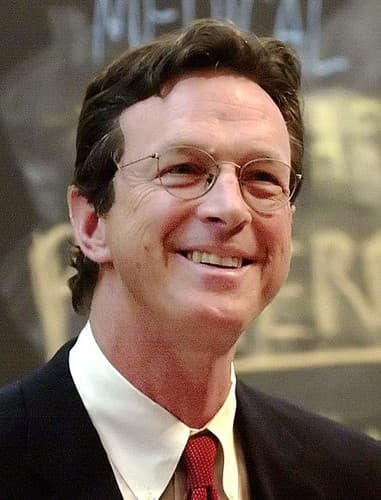
Michael Crichton was an American author and filmmaker known for his contributions to the science fiction genre. His notable works include Jurassic Park, The Andromeda Strain, Timeline, Sphere, Congo, and State of Fear, many of which explore themes of technology and its impact on society. Crichton's writing often blends scientific concepts with thrilling narratives, making him a significant figure in contemporary literature.
Similar books
- Jurassic Park
Michael Crichton
4.0 (803k) average on GoodreadsThrillerShares Crichton's signature blend of science, adventure, and ethical dilemmas.
- The Da Vinci Code
Dan Brown
3.9 (1.9M) average on GoodreadsThrillerFeatures a similar globe-trotting chase, intricate conspiracy, and race against time.
- Prey
Michael Crichton
3.8 (9k) average on GoodreadsThrillerAnother Crichton technothriller exploring the dangers of unchecked scientific advancement.
- The Road
Cormac McCarthy
4.0 (716k) average on GoodreadsScience FictionWhile both State of Fear and The Road depict environmental catastrophe, their approaches are fundamentally different. The Road presents a post-apocalyptic world ravaged by an unspecified environmental disaster, using it as a stark backdrop for a deeply human story of survival, love, and morality. McCarthy does not delve into the 'why' of the catastrophe but instead focuses on its devastating 'what.' In contrast, Crichton's State of Fear is intensely focused on the 'why,' specifically arguing that the fear of environmental catastrophe is manufactured. The Road explores the emotional and existential impact of environmental collapse on individuals, whereas State of Fear critiques the scientific and political mechanisms behind environmental alarmism. McCarthy's work is a literary exploration of human resilience in the face of irreversible loss; Crichton's is a scientific and political thriller challenging established environmental narratives.
- Flight Behavior
Barbara Kingsolver
3.8 (83k) average on GoodreadsLiterary FictionBarbara Kingsolver's Flight Behavior (2012) also tackles the theme of climate change but from a vastly different perspective. Kingsolver approaches the topic through the eyes of a working-class woman in rural Appalachia who observes a seemingly miraculous phenomenon (monarch butterflies wintering in an unusual location) that scientists later attribute to climate change. Kingsolver's novel explores the socio-economic and cultural divides in understanding climate science, portraying the skepticism and challenges faced by those in economically vulnerable communities, as well as the scientists trying to communicate their findings. Unlike Crichton, who critiques the scientific consensus from an external, often dismissive, standpoint, Kingsolver humanizes the debate, showing the complexities of belief, denial, and the personal impact of environmental shifts. Flight Behavior integrates the science organically into the narrative, focusing on character and community response, while State of Fear frequently interrupts its narrative for explicit scientific (or anti-scientific) exposition.
- 1984
George Orwell
4.2 (3.1M) average on GoodreadsPoliticsIn a future where surveillance and thought control are absolute, a man's search for truth clashes with the Party, showing that hope can be a form of rebellion.






Enjoyed the summary?
A summary gives you the shape of the book. The book itself has the detail, the examples and the voice.
Find State of Fear on AmazonAs an Amazon Associate, BookBrief earns from qualifying purchases. How we're funded