
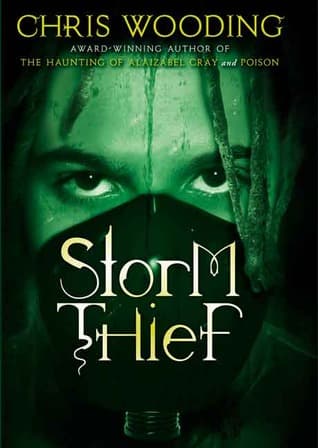
Synopsis
Covers the whole plot, including the ending.
- Difficulty
- Medium
- Pacing
- Fast
- Mood
- Dark, Atmospheric, Mysterious, Thrilling, Desperate
- Read it if
- You enjoy dark, atmospheric YA fantasy/sci-fi with unique world-building, high stakes, and a sense of mystery.
- Skip it if
- You prefer lighthearted stories, clear-cut magic systems, or straightforward resolutions.
Storm Thief Plot Summary
Covers the whole plot, including the ending.
The Rooftop Chase and the Storm's Arrival
The story starts with Rail, a skilled parkour artist and thief, trying to steal something valuable from a high-rise in Orokos. Agents from the Protectorate, the city's police, chase him. Rail's partner, Moa, can sense probability storms and guides him through the city via a comm-link. As they barely escape, a large 'reality storm' gathers over Orokos. These storms change reality randomly, altering buildings, objects, and people, making escape risky and adding danger to their flight from the Protectorate.
The Discovery of the Map and the Automaton
During their escape, Rail and Moa hide in a forgotten, storm-damaged part of the city. There, they find a hidden room with an ancient map etched on a strange metal surface. Next to the map, they discover a dormant automaton, a machine of unknown origin. Moa, using her abilities, accidentally turns on the automaton, which calls itself a 'geas' – a guardian of the map. The automaton, though unclear at first, says the map holds a secret vital to Orokos, hinting at a power beyond the city's walls.
Vago's Investigation and the Protectorate's Interest
Chief Vago, the head of the Protectorate Secret Police, wants to control Orokos and use the probability storms. He learns about the artifact Rail and Moa stole, and more importantly, about the ancient automaton being activated. Vago has old knowledge and believes the automaton and map are linked to the storms' true nature and a power that could reshape Orokos. He sends his best agents, the 'Storm Wardens,' to find Rail and Moa, not just for the theft, but for the information they have.
The Geas's Guidance and the City's Secrets
The automaton, which Rail and Moa name Geas, explains that the map is a schematic of Orokos, showing its forgotten systems and the storms' true source. Geas reveals that Orokos is an ancient, self-sustaining machine built for a forgotten purpose, and the storms are a sign of its failing functions. Geas guides them through dangerous, storm-hit parts of the city, explaining the map's symbols and hinting at a 'heart' of Orokos that must be reached to understand and possibly control the storms.
Encounters with the Storm Wardens
As Rail, Moa, and Geas go deeper into Orokos, they often fight Chief Vago's Storm Wardens. These trained agents have special gear to navigate and even partly control the probability storms. The fights are brutal, making Rail use all his parkour skills and Moa push her storm-sensing abilities. During one fight, Geas shows it can defend itself, making it even more important for the trio's survival and mission. The chase gets more intense, showing Vago will do anything to get the map and Geas.
The Unveiling of Moa's Origin
Through Geas's explanations and her own growing sensitivity to the storms, Moa starts to understand her unique nature. She finds out she isn't just sensing the storms but is connected to them, a product of Orokos's original design, or perhaps a change caused by long exposure to storm energy. This explains her abilities and her deep connection to the city's pulse. It also suggests her role in controlling or understanding the storms is far greater than she or Rail imagined, making her a key part of the puzzle.
The Descent into the Under-City
Following the map, Rail, Moa, and Geas go into the 'Under-City,' a vast network of ancient machines and forgotten structures beneath Orokos. This area is even more unpredictable, with reality storms creating strange, distorted landscapes and dangerous pockets of altered physics. Here, they face not only the Storm Wardens but also mutated creatures and environmental dangers from centuries of storm activity. The Under-City shows the true, vast scale of Orokos as an engineered structure, far beyond what its surface inhabitants understand.
Vago's Pursuit and the Heart of Orokos
Chief Vago, using his old knowledge and technology, tracks Rail, Moa, and Geas to the heart of the Under-City. He believes this is where Orokos's ultimate power lies, the key to controlling or using the probability storms. The race becomes a desperate struggle as the trio, guided by Geas, navigates the final, most dangerous parts of the city's core. They realize Vago plans to take this power for himself, no matter the cost, possibly dooming Orokos to a more chaotic future.
The Confrontation and the Truth Revealed
At the heart of Orokos, inside a large, storm-generating chamber, Rail, Moa, and Geas finally confront Chief Vago and his remaining Storm Wardens. Here, Geas fully activates the core, revealing Orokos's true nature: it is a giant, self-repairing terraforming machine, built by an ancient civilization to stabilize an unstable planet. The probability storms are its erratic attempts to fix itself, and Orokos is not a city on an island, but the island itself. Moa's unique abilities are shown to be a direct result of her being a 'key' or interface to Orokos's systems, able to connect with and potentially control its functions.
The Climax: Control or Destruction
A fierce battle breaks out between Rail, Moa, and Vago. Vago tries to take control of the core, thinking he can weaponize the storms. Moa, guided by Geas, realizes she can either stabilize Orokos, ending the storms and letting the city heal, or let it continue its chaotic, self-destructive cycle. Rail fights to protect Moa, while Geas provides vital information and defense. Orokos's fate hangs in the balance as Moa makes a critical decision, understanding the huge responsibility that comes with her connection to the ancient machine.
The Resolution and Orokos's Future
Moa, using her connection, interfaces with Orokos's core, stabilizing its erratic functions. The probability storms start to lessen, and the city slowly begins to form a more stable structure. Vago is defeated, his plans for control stopped. While things aren't immediately 'normal,' the constant reality shifts are gone. Rail and Moa, with Geas, emerge from the Under-City into a changed Orokos, one with the potential for growth and a future free from the chaos that defined its past. The exact nature of this new Orokos, and their place in it, remains to be seen.
Storm Thief Characters
Rail
Protagonist
A skilled, agile thief and parkour artist.
Rail is a young, resourceful, and highly agile thief who navigates the treacherous, ever-changing city of Orokos with exceptional skill. He is quick-witted and pragmatic, often relying on his physical prowess and ability to adapt to chaotic situations. Despite his thieving background, he possesses a strong moral compass, particularly when it comes to protecting Moa, whom he views as his younger sister or closest companion. His primary motivation is survival and ensuring Moa's safety in a dangerous world.
Relationships: Moa (Protective, brotherly bond; close companion and partner in crime.); Geas (Initially distrustful, but grows to respect and rely on the automaton's knowledge.)
Moa
Protagonist
A mysterious girl with a unique connection to the probability storms.
Moa is a quiet, observant girl with an extraordinary, almost supernatural sensitivity to the probability storms that plague Orokos. She can 'feel' the storms approaching, sense their intensity, and even, to some extent, intuit the shifts in reality they cause. Her origins are mysterious, hinted at being intrinsically linked to Orokos itself. She is emotionally intelligent and often the more intuitive of the duo, providing a crucial counterpoint to Rail's more physical approach. Her main drive is to understand her own nature and the storms.
Relationships: Rail (Close, trusting bond; relies on him for protection and practical guidance.); Geas (Deep, intuitive connection; understands the automaton's cryptic messages more easily.)
Geas
Supporting
An ancient, sentient automaton guardian of the map and Orokos's secrets.
Geas is a complex, ancient automaton, awakened by Moa. It is the guardian of the map that holds the secrets of Orokos. Geas speaks in a cryptic, formal manner, often providing information in riddles or partial truths, designed to guide rather than simply inform. Its physical form is resilient and capable of defense, but its true power lies in its vast knowledge of Orokos's history, function, and purpose. It acts as a mentor and guide for Rail and Moa, slowly revealing the truth about their world.
Relationships: Rail (Teacher/student dynamic; provides vital information and guidance.); Moa (Recognizes Moa's unique connection and guides her towards her destiny.)
Chief Vago
Antagonist
The ruthless and ambitious head of the Protectorate Secret Police.
Chief Vago is the primary antagonist, a cunning and ruthless leader obsessed with power and control. He commands the Protectorate Secret Police and seeks to understand and harness the probability storms for his own ends, believing he can bring order to Orokos by force. Vago is intelligent, manipulative, and possesses a hidden knowledge of Orokos's past, which he uses to his advantage. His ambition blinds him to the potential destruction his plans could unleash, making him a dangerous and formidable foe.
Relationships: Rail (Adversarial; views Rail as a nuisance and an obstacle to his plans.); Moa (Views Moa as a tool to be exploited for her connection to Orokos.)
Storm Wardens
Supporting
Elite agents of the Protectorate Secret Police, specialized in storm navigation.
The Storm Wardens are Chief Vago's elite special forces, trained and equipped to operate within the probability storms. They are highly disciplined, formidable combatants, often serving as Vago's primary means of pursuit and enforcement. They represent the oppressive arm of the Protectorate, embodying its control and willingness to use force. While not individually developed, their collective presence provides a constant, physical threat to Rail, Moa, and Geas.
Relationships: Chief Vago (Loyal, obedient subordinates, executing his commands.)
The Architect/Ancient Civilization
Mentioned
The creators of Orokos, a long-vanished advanced civilization.
The Architect (or the ancient civilization it represents) is the mysterious, long-vanished entity responsible for constructing Orokos. Their motivations and ultimate fate are unknown, but their legacy is the city itself – a colossal, intricate machine designed to terraform or stabilize a planet. Their advanced technology and foresight are evident in Orokos's complex systems and the existence of automatons like Geas. They serve as the unseen hand that shaped the world of the story, with their intentions slowly being uncovered.
Relationships: Orokos (Creator/creation relationship; responsible for the city's existence and purpose.)
Storm Thief Themes
The Nature of Reality and Perception
The probability storms constantly change Orokos's physical reality, making characters question what is real. This appears most clearly in the shifting cityscapes, where buildings change and objects appear or disappear. Moa's ability to 'feel' these shifts shows a deeper, intuitive understanding of reality. The book explores how people adapt to, or are driven mad by, this fluid reality, and its impact on their identity and place in the world. The discovery that Orokos itself is a machine built to change reality further highlights this theme.
“Reality was a fluid thing in Orokos, a canvas constantly being repainted by the whims of the storms.”
Control vs. Chaos
This theme is central to the conflict between Chief Vago and the heroes. Vago wants complete control, seeking to use the chaotic probability storms for his own oppressive rule. Rail and Moa, at first, deal with the chaos out of necessity, but their journey leads them to understand Orokos's deeper systems. The ending involves finding a balance, not by removing the storms, but by bringing Orokos's core systems into a stable state, suggesting that true order comes from understanding and harmony rather than force.
“Order was a lie. The city breathed chaos, and only by dancing with it could you survive.”
Identity and Belonging
Moa's journey of self-discovery is a key part of this theme. She feels different, an outsider, until she finds her true connection to Orokos and her role as a 'key' to its systems. Rail, a street thief, struggles to find his place in a society that rejects him, but finds purpose and belonging through his bond with Moa and their shared goal. The citizens of Orokos, living in a city that constantly redefines itself, also deal with their collective identity, questioning what it means to be an 'Orokosian' when their world is so unstable.
“She was a part of Orokos, not merely living within it, but woven into its very fabric, a piece of the great machine.”
The Legacy of the Past
Orokos is a city built on forgotten history and old technology. The discovery of the map and the activation of Geas slowly reveal the city's true purpose and origin, showing it as a huge, ancient machine. The past, though buried and changed by centuries of storms, greatly affects the present. Characters like Vago try to use this legacy, while Rail and Moa aim to understand and fix it. The story emphasizes that ignoring or misunderstanding the past can lead to destruction, while understanding it offers the chance for a better future.
“The city was a testament to a wisdom long lost, a whisper from a time when gods walked the earth, or at least, men who built like them.”
Plot Devices & Literary Techniques
Probability Storms
Unpredictable reality-altering weather phenomena.
The probability storms are the central environmental and narrative device. They are unpredictable, localized weather events that physically rearrange reality, altering landscapes, buildings, and even living beings. They serve as both a constant threat and a catalyst for plot progression, forcing characters to adapt, creating new obstacles, and revealing hidden areas. Their erratic nature emphasizes the chaotic setting of Orokos and drives the characters' quest to understand and ultimately control them.
The Ancient Map
A schematic of Orokos, revealing its true nature and hidden pathways.
The ancient map, discovered by Rail and Moa, is not a conventional geographical map but a complex schematic of Orokos's internal workings. It acts as a guide, leading the protagonists through the forgotten layers of the city and revealing the true nature of its core systems. The map is often cryptic, requiring interpretation by Geas, which enhances the sense of mystery and discovery. It is the key to unlocking Orokos's secrets and the primary object of desire for both the heroes and the antagonist.
The Automaton (Geas)
A sentient mechanical guardian and source of ancient knowledge.
Geas, the ancient automaton, functions as a living archive and guide. Its role is to provide exposition, interpret the map, and reveal crucial information about Orokos and the storms. Its cryptic manner of speaking adds to the sense of mystery and forces the characters (and the reader) to piece together the larger puzzle. Geas also serves as a protector, using its ancient mechanisms to defend the protagonists, and ultimately facilitates Moa's connection to the city's core.
Moa's Storm Sensitivity
A unique, intuitive ability to perceive and connect with the probability storms.
Moa's inherent sensitivity to the probability storms serves as a crucial plot device, driving her character arc and enabling key discoveries. This ability allows her to warn Rail of approaching storms, navigate treacherous shifting landscapes, and eventually, to directly interface with Orokos's core. It establishes her as a unique individual, intrinsically linked to the city's fate, and provides a 'magical' element within the science-fantasy setting, making her the ultimate key to resolving the city's chaos.
Storm Thief Quotes
“The wind was a living thing in the city of Orokos, a constant, whispering presence that shaped the very stones.”
“Even a thief can have a code, and Talon's was simple: don't get caught.”
“A storm was coming, not just of weather, but of fate.”
“The city was built on lies and powered by forgotten magic.”
“Sometimes the greatest treasures are not things you can hold in your hand.”
“Fear was a cold companion, but it could also be a motivator.”
“The wind whispers secrets if you know how to listen.”
“No one is truly free when their life is dictated by the whims of others.”
“The past is a heavy cloak, but you can choose to shed it.”
“Survival was a constant negotiation with the impossible.”
“Magic wasn't just about power; it was about understanding, about connection.”
“Even in the darkest places, a flicker of hope can ignite a fire.”
“The world doesn't care about your intentions, only your actions.”
“Sometimes the only way to save something is to let it go.”
Quiz
10 questions on the plot and the characters. Each answer comes with a short explanation.
Question 1
What natural phenomenon regularly afflicts the city of Orokos, re-ordering reality wherever it strikes?
- Temporal rifts
- Probability storms
- Reality quakes
- Chaos winds
Show answer
B. Probability storms The city of Orokos is described as being 'lashed by probability storms that re-order the world wherever they strike.'
Question 2
What object do three of Orokos's denizens discover that holds the key to the city's secret?
- An ancient artifact
- A forgotten diary
- A map
- A decoded message
Show answer
C. A map The synopsis explicitly states, 'Then three of its denizens discover a map that holds the key to the secret at the heart of Orokos.'
Question 3
Which organization's Chief is mentioned as being interested in obtaining the power related to Orokos's secret?
- The City Council
- The Protectorate Secret Police
- The Storm Wardens
- The Guild of Cartographers
Show answer
B. The Protectorate Secret Police The synopsis mentions, 'But there are others, such as the Chief of the Protectorate Secret Police who would do anything to get their hands on that power.'
Question 4
How long has the city of Orokos stood, according to the provided information?
- A few centuries
- So long that history has forgotten it
- Since the last great storm
- Approximately a millennium
Show answer
B. So long that history has forgotten it The text states, 'It has stood for so long that history has forgotten it.'
Question 5
What is the primary characteristic of Orokos's citizens regarding the world beyond its walls?
- They actively explore beyond the walls.
- They are forbidden from discussing what lies beyond.
- They no longer question what exists beyond its walls.
- They believe nothing exists beyond its walls.
Show answer
C. They no longer question what exists beyond its walls. The description states that Orokos's citizens 'no longer question what exists beyond its walls.'
Question 6
What is the geographical feature upon which the city of Orokos is built?
- A vast desert expanse
- A mountainous plateau
- A rocky island
- A dense forest clearing
Show answer
C. A rocky island The text describes Orokos: 'It covers every inch of the rocky island that it dominates.'
Question 7
The description implies a theme of forgotten history and isolation. Which phrase best supports this?
- A darkly thrilling new novel
- It has stood for so long that history has forgotten it, and its citizens no longer question what exists beyond its walls.
- about a civilization plagued by chaos and reality-rearranging storms.
- But there are others, such as the Chief of the Protectorate Secret Police who would do anything to get their hands on that power...
Show answer
B. It has stood for so long that history has forgotten it, and its citizens no longer question what exists beyond its walls. The phrase directly states that 'history has forgotten it' and citizens 'no longer question what exists beyond its walls,' highlighting themes of forgotten past and isolation.
Question 8
Given the nature of the probability storms, what might be a common challenge for the inhabitants of Orokos in their daily lives?
- Predicting the weather for farming cycles.
- Maintaining a stable and consistent reality or environment.
- Dealing with frequent alien invasions.
- Surviving extreme temperature fluctuations.
Show answer
B. Maintaining a stable and consistent reality or environment. Probability storms 're-order the world wherever they strike,' implying that a stable reality is constantly under threat, making consistency a major challenge.
Question 9
What is the implied consequence of the city covering 'every inch of the rocky island that it dominates'?
- The city has vast, open green spaces within its walls.
- The city is likely densely populated and possibly claustrophobic.
- The city has an abundance of natural resources.
- The city is easily defensible from all sides.
Show answer
B. The city is likely densely populated and possibly claustrophobic. If the city covers every inch of a rocky island, it suggests a lack of undeveloped space, leading to density and potentially a cramped, claustrophobic environment.
Question 10
The discovery of the map and the interest of the Secret Police Chief suggest what overarching narrative conflict?
- A struggle against an external invading force.
- A race to uncover and control a powerful secret, potentially involving internal strife.
- A quest to escape the city and find a new home.
- A scientific endeavor to understand and control the probability storms.
Show answer
B. A race to uncover and control a powerful secret, potentially involving internal strife. The map holds 'the key to the secret,' and the Secret Police Chief 'would do anything to get their hands on that power,' clearly setting up a conflict over the discovery and control of this significant secret.
Storm Thief FAQ
What is the central premise of 'Storm Thief' and where is it set?
'Storm Thief' is set in the ancient, isolated city of Orokos, a place constantly reshaped by unpredictable 'probability storms.' These storms literally alter reality, creating new buildings, destroying old ones, and changing the very fabric of existence. The story follows three protagonists who stumble upon a secret that could explain or even control these phenomena.
Who are the three main protagonists and what are their initial roles?
The three main protagonists are Rail, a street-smart thief; Moa, a girl with a mysterious past and an affinity for the city's strange mechanisms; and Vago, a Protectorate agent who becomes disillusioned with his superiors. They are brought together by circumstance, initially distrustful of each other but forced to cooperate to survive and uncover the truth.
What are 'probability storms' and how do they impact life in Orokos?
Probability storms are reality-altering phenomena that strike Orokos without warning, rearranging physical structures, creating new items, or even changing memories for those caught within them. They make life unpredictable and dangerous, forcing citizens to adapt to constant change and preventing any stable societal structure from forming beyond the immediate present.
What is the 'map' that the protagonists discover, and why is it so important?
The 'map' is not a traditional geographical representation but rather a complex, multi-layered schematic that reveals the true nature of Orokos as a giant, ancient machine. It holds the key to understanding how the city functions, how the probability storms are generated, and potentially how to control or stop them, making it an object of immense power and desire.
Who is the primary antagonist and what are their motivations?
The primary antagonist is the Chief of the Protectorate Secret Police, a ruthless and ambitious figure who seeks to seize control of Orokos's underlying power for his own ends. He views the probability storms as a resource to be harnessed and manipulated, rather than a force to be understood or stopped, believing it will grant him ultimate authority.
What is the true nature of Orokos, revealed later in the book?
Orokos is not a natural city but a vast, ancient, self-repairing machine designed by an unknown, advanced civilization. The probability storms are a byproduct of its internal processes, constantly reconfiguring its structure and perhaps even maintaining its long-term function or purpose, which remains shrouded in mystery.
What is the significance of Moa's unique abilities or connection to the city?
Moa possesses an innate, almost subconscious connection to Orokos's mechanical workings, allowing her to sense the city's 'moods' and sometimes even manipulate its smaller mechanisms. This ability hints at her origins or a deeper purpose tied to the city's design, suggesting she might be an integral part of its functionality or a product of its unique environment.
Are there any clues about the civilization that built Orokos, or their ultimate fate?
The book offers tantalizing but vague clues about the original builders, implying they were a highly advanced, possibly extra-dimensional civilization. Their ultimate fate is left ambiguous, suggesting they either abandoned Orokos, perished, or ascended to another plane of existence, leaving their incredible technology behind as a self-sustaining enigma.
How does the constant change inflicted by probability storms affect the mental state and identity of Orokos's inhabitants?
The constant, unpredictable change fosters a profound sense of impermanence and detachment among Orokos's citizens. Memories can be altered, relationships fractured, and the very concept of a stable identity challenged, leading to a focus on immediate survival and a reluctance to form deep, lasting connections.
Discuss Rail's character arc, specifically how his thieving nature evolves throughout the story.
Rail begins as a self-interested survivor, using his thieving skills purely for personal gain in a chaotic world. As he becomes entangled with Moa and Vago, his motivations shift from pure acquisition to protection and a desire for a stable future. He learns to use his cunning not just for stealing, but for problem-solving and outwitting powerful adversaries.
How does Vago's loyalty to the Protectorate change, and what triggers this shift?
Vago initially embodies the Protectorate's rigid order, but his loyalty erodes as he witnesses the Chief's ruthless ambition and disregard for human life in pursuit of power. The discovery of the Chief's willingness to sacrifice citizens and manipulate the city's core functions for personal gain forces Vago to question his allegiances and ultimately rebel.
What psychological impact does living in a city without a past or a certain future have on children like Moa?
Children like Moa, growing up in Orokos, lack a stable framework for understanding history or a predictable future. This can foster adaptability and resilience, but also a potential lack of long-term planning, a heightened sense of immediate danger, and a unique, almost instinctual understanding of the city's chaotic rhythms.
Is Orokos inherently malevolent, or is it merely a machine operating without intent?
Orokos is best interpreted as a complex machine operating without inherent malevolence. The probability storms, while destructive and chaotic, are likely a byproduct of its self-maintenance or an intended function, rather than a deliberate act of cruelty. The city simply 'is,' and its impact is determined by those who try to understand or control it.
What is the philosophical implication of a city where reality itself is fluid and constantly re-written?
The fluidity of reality in Orokos challenges fundamental notions of truth, memory, and personal identity. It suggests that what we perceive as stable reality is often arbitrary and can be reshaped, forcing characters and readers to confront the fragility of their understanding of the world and themselves.
Could the probability storms be seen as a metaphor for societal change or political upheaval?
Yes, the probability storms can be interpreted as a powerful metaphor for societal change, political upheaval, or even the unpredictable forces of nature. They represent the constant, often chaotic, forces that reshape civilizations, making long-term planning difficult and forcing inhabitants to adapt to new realities beyond their control.
What does the ending suggest about the future of Orokos and its inhabitants?
The ending suggests a tentative, uncertain future for Orokos. While the immediate threat posed by the Chief is dealt with, the fundamental nature of the city as a self-altering machine remains. The protagonists gain a deeper understanding, but the city's true purpose and the complete cessation of its storms are left open, hinting at ongoing challenges and mysteries.
How does the book explore the themes of control versus chaos?
The book profoundly explores the tension between control and chaos. The probability storms represent pure chaos, while the Protectorate attempts to impose order through force and surveillance. The protagonists' journey seeks a balance, aiming not to eliminate chaos entirely, but to understand and perhaps guide it, suggesting that true wisdom lies in adaptation rather than absolute domination.
What is the significance of the 'heart' of Orokos that the map leads to?
The 'heart' of Orokos is not a metaphorical center but a literal, complex core mechanism deep within the city, responsible for generating and regulating the probability storms. It is the control nexus of the entire machine-city, holding immense power and representing the ultimate prize for those who seek to master Orokos.
About the author

Chris Wooding is a prolific British author known for his engaging young adult fantasy and adventure novels. His notable works include the "Tales of the Ketty Jay" series, beginning with "Retribution," the "Mortal Engines"-esque "Storm Thief," and the dark fantasy "The Haunting of Alaizabel Cray." Wooding's writing is characterized by its fast-paced plots, vivid world-building, and compelling characters, earning him a dedicated readership.
Similar books
- Leviathan
Scott Westerfeld
4.0 (15k) average on GoodreadsLiterary FictionCombines steampunk elements with a young adult adventure in a war-torn world.
- Harry Potter and the Sorcerer's Stone
J.K. Rowling
4.5 (7M) average on GoodreadsFantasyRescued from a miserable life under the stairs, an orphaned boy discovers he's a wizard destined for a magical school, where he uncovers a dangerous secret tied to the dark wizard who murdered his parents.
- The Hunger Games
Suzanne Collins
4.3 (6.4M) average on GoodreadsFantasyIn a future where children fight to the death on live television, Katniss Everdeen volunteers for the arena, turning a death sentence into a fight for survival and a spark of rebellion.
- 1984
George Orwell
4.2 (3.1M) average on GoodreadsPoliticsIn a future where surveillance and thought control are absolute, a man's search for truth clashes with the Party, showing that hope can be a form of rebellion.
- Divergent
Veronica Roth
4.2 (2.9M) average on GoodreadsFantasyIn a society divided by virtues, a sixteen-year-old's difference from the norm starts a rebellion that threatens her world.
- The Hobbit, or There and Back Again
J.R.R. Tolkien
4.3 (2.9M) average on GoodreadsFantasyA comfort-loving hobbit named Bilbo Baggins is whisked away by a mischievous wizard and a band of dwarves on an unexpected journey to reclaim stolen treasure from a fearsome dragon, discovering courage and a magical ring along the way.





Enjoyed the summary?
A summary gives you the shape of the book. The book itself has the detail, the examples and the voice.
Find Storm Thief on AmazonAs an Amazon Associate, BookBrief earns from qualifying purchases. How we're funded