
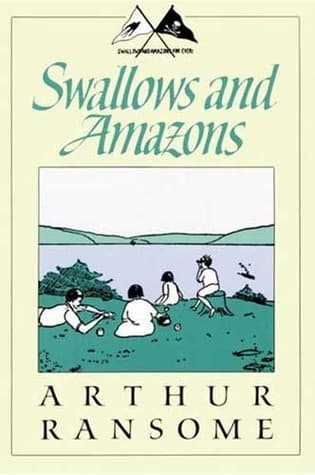
Synopsis
Covers the whole plot, including the ending.
- Difficulty
- Easy
- Pacing
- Moderate
- Mood
- Nostalgic, Adventurous, Idyllic, Wholesome
- Read it if
- You love classic children's adventure stories, tales of self-sufficient kids exploring nature, or nostalgic stories about imaginative play and friendship.
- Skip it if
- You prefer fast-paced, high-stakes plots, or stories with complex adult themes and modern sensibilities.
Swallows and Amazons Plot Summary
Covers the whole plot, including the ending.
Departure for the Lake and Wild Cat Island
The four Walker children—John, Susan, Titty, and Roger—travel by train from London to the Lake District for their summer holiday. Their father, a naval officer, is away at sea, but he has let them camp on an island in the lake. They must send a telegram saying 'BETTER DROWNED THAN DUFFERS IF NOT DUFFERS WON'T DROWN'. When they arrive, they meet their mother and baby sister, Vicky, at the farm. They prepare their dinghy, 'Swallow', for its first trip, stocking it with supplies. John, as captain, feels responsible, while Susan, as mate, keeps things organized. Titty is the able seaman, and young Roger is the ship's boy. They are excited to sail for Wild Cat Island.
Establishing Camp and First Encounters
The Swallows sail to Wild Cat Island, a small, wooded island in the middle of the lake. They set up their camp carefully, pitching their tent, building a fireplace, and organizing their food. John, as captain, teaches them sailing moves and camp skills. While exploring, they see another boat, a dinghy named 'Amazon', with two girls. These girls, Nancy and Peggy Blackett, live on a nearby farm and call themselves pirates. They first see the Swallows as intruders in their area. A tense moment leads to a challenge for control of the lake, setting up their future interactions and adventures.
The Declaration of War and Naval Maneuvers
After their first meeting, the Amazons, Nancy and Peggy Blackett, leave a message on Wild Cat Island declaring war on the Swallows. The Swallows, led by Captain John, accept the challenge. The war rules are simple: capture the other side's boat. Both sides scout the area, mapping the lake and planning. The Swallows practice sailing and rowing, developing ways to get away and chase. They learn to use the wind and the lake's shape to their advantage. The Amazons, with their knowledge of the local water and pirate spirit, are tough opponents, making the lake a lively place for their imaginative games.
The Capture of the Amazon and its Aftermath
During a naval battle, the Swallows outmaneuver the Amazons and capture their boat, 'Amazon'. This win is a big moment for the Swallows, especially John, who feels proud. The Amazons, though initially upset, admit defeat. After the capture, they call a truce, and the two crews start talking more. They share stories, compare sailing experiences, and find they respect each other's skills and love for adventure. This shared event changes their relationship from rivalry to a growing friendship, preparing them for future teamwork.
Exploring the Mainland and the Amazon's Uncle
With the truce, the Swallows and Amazons decide to explore the mainland together. They go into the woods, finding hidden paths and imagining new adventures. During their exploration, they meet the Amazons' uncle, Captain Flint, a quiet and gruff man who lives in a houseboat called 'The Houseboat'. Captain Flint at first seems scary. The children call him after the pirate in 'Treasure Island'. He likes his privacy and often seems annoyed by the children, but there are hints of kindness. The children, especially Titty, are interested in him and his mysterious ways, adding intrigue to their summer.
The Search for Treasure and Captain Flint's Secret
Inspired by their pirate games, the children decide to go on a treasure hunt. They make their own maps and clues, leading them on an exciting search across the island and parts of the mainland. While hunting for treasure, they find Captain Flint's secret project: he is writing a book about his travels. This discovery makes Captain Flint more human to the children, changing him from just an intimidating figure to someone with his own creative pursuits. The children, especially Titty, feel a connection to his writing, and a new understanding starts to grow between them and the quiet adult, bridging the gap between their imaginative world and his reality.
The Night Expedition and the Farm Raid
Wanting fresh milk for their tea, the Swallows, led by John, go on a night trip. They row 'Swallow' to the mainland under cover of darkness, using moonlight to navigate. The excitement of the secret mission, the quiet paddling, and the risk of being caught make their adventure greater. They get the milk, paying for it and leaving a note. This trip shows their self-reliance and cleverness, adding more excitement to their summer camping and proving they can be independent adventurers.
The Storm and Shared Shelter
A storm suddenly hits the lake, catching the Swallows unprepared in their camp on Wild Cat Island. The tent struggles against the wind and rain, threatening to collapse. Because of the bad weather, they have to leave their tent and find better shelter. Captain Flint, despite being gruff, offers them a place in his houseboat. Sharing the experience of riding out the storm together in the houseboat further breaks down barriers between the children and the quiet adult. It creates a feeling of friendship and mutual reliance, showing Captain Flint's kindness.
The Fleet's Regatta and the Final Feast
As their holiday nears its end, the Swallows and Amazons decide to hold a regatta, inviting Captain Flint to join. They organize races and sailing challenges, showing their skills and competitive spirit. The regatta is a happy celebration of their summer adventures and new friendship. It ends with a feast on the mainland, with both families there, including the Swallows' mother and Captain Flint (who is the Amazons' uncle and a friend of the Swallows' parents). The feast is a warm gathering, full of laughter, stories, and shared memories. It marks the good end of their summer of exploration and friendship.
The Return Home and Promises of Future Adventures
With the summer holiday over, the Swallows reluctantly pack up their camp on Wild Cat Island. They carefully take down their tent, gather their things, and make sure to leave the island as clean as they found it. Their last trip across the lake in 'Swallow' feels a bit sad, but also satisfying from a successful adventure. They return to the farm, where they meet their mother again, sharing stories of what they did. As they get ready to leave the Lake District, there is a quiet promise of future summers and more sailing adventures, strengthening the friendships made and memories created as independent navigators and explorers.
Principal Figures
John Walker
Protagonist
The eldest Walker child and captain of the 'Swallow'
John is the responsible and serious eldest of the Walker children, taking his role as captain of the 'Swallow' very seriously. He strives to emulate his naval officer father, meticulously planning voyages, drilling his crew, and making tactical decisions during their 'wars'. He is often concerned with rules and proper procedure, sometimes to the frustration of his siblings, but his leadership is essential for the success and safety of their adventures. He feels the weight of responsibility for his younger siblings.
Relationships: Susan Walker (Younger sister, first mate); Titty Walker (Younger sister, able seaman); Roger Walker (Youngest brother, ship's boy); Nancy Blackett (Rival turned friend, fellow captain); Peggy Blackett (Rival turned friend)
Susan Walker
Supporting
The second eldest Walker child and first mate of the 'Swallow'
Susan is the practical and nurturing second eldest, acting as the 'first mate' of the 'Swallow'. She is responsible for the domestic aspects of their camp life, ensuring meals are prepared, the tent is tidy, and everyone is comfortable. Susan often worries about safety and cleanliness, balancing John's adventurous spirit with a grounding sense of reality. Her organizational skills and care for her siblings are crucial to the smooth running of their expedition, making her the heart of the Swallows' camp.
Relationships: John Walker (Older brother, captain); Titty Walker (Younger sister); Roger Walker (Youngest brother)
Titty Walker
Protagonist
The imaginative third Walker child and able seaman of the 'Swallow'
Titty is the most imaginative and curious of the Swallows, often lost in her own world of make-believe and adventure. As the 'able seaman', she is quick to embrace new ideas and explore the unknown, whether it's imagining herself as a solitary explorer, a native inhabitant, or a spy. Her keen observation skills and independent spirit lead to many discoveries, including Captain Flint's secret. Titty's perspective often drives the narrative's sense of wonder and possibility.
Relationships: John Walker (Older brother); Susan Walker (Older sister); Roger Walker (Younger brother); Captain Flint (Object of fascination and later, a friend)
Roger Walker
Supporting
The youngest Walker child and ship's boy of the 'Swallow'
Roger is the youngest of the Swallows, serving as the 'ship's boy'. Despite his youth, he is eager to contribute and prove himself, often asking questions and diligently following orders. He is characterized by his love for food and his straightforward observations. Roger's innocence and enthusiasm provide moments of humor and remind the older children of the simple joys of their adventure. He is fiercely loyal to his siblings and determined to participate fully in their games.
Relationships: John Walker (Older brother, captain); Susan Walker (Older sister); Titty Walker (Older sister)
Nancy Blackett
Protagonist
Captain of the 'Amazon' and leader of the Amazon pirates
Nancy, whose real name is Ruth, is the fiery and adventurous leader of the Amazon pirates. She is bold, daring, and fiercely independent, with a strong sense of honor and a love for imaginative play. Nancy is a skilled sailor and a natural leader, constantly inventing new games and challenges. Her initial rivalry with the Swallows quickly turns into a deep friendship, as she recognizes their shared spirit of adventure. She is determined to live up to her pirate persona.
Relationships: Peggy Blackett (Younger sister, first mate); John Walker (Rival turned friend, fellow captain); Captain Flint (Uncle)
Peggy Blackett
Supporting
First mate of the 'Amazon' and Nancy's younger sister
Peggy, whose real name is Margaret, is Nancy's younger sister and the first mate of the 'Amazon'. She is more cautious and less boisterous than Nancy, often acting as a grounding influence. Peggy is loyal and a good follower, though she can be prone to homesickness or anxiety. She is a capable sailor in her own right and fully committed to their pirate games, even if she sometimes needs encouragement from Nancy. Her gentler nature provides a contrast to Nancy's exuberance.
Relationships: Nancy Blackett (Older sister, captain); Captain Flint (Uncle)
Captain Flint
Supporting
The Amazons' reclusive uncle, nicknamed after a pirate
Captain Flint, whose real name is James Turner, is the Blackett children's uncle and a reclusive, gruff man who lives on a houseboat. The children nickname him 'Captain Flint' after the pirate in 'Treasure Island' due to his intimidating demeanor and his initial desire for solitude. He is a writer, secretly working on a book about his travels. Despite his initial gruffness, he has a kind heart, eventually warming to the children and even offering them shelter during a storm, revealing a deeper care beneath his solitary exterior.
Relationships: Nancy Blackett (Niece); Peggy Blackett (Niece); Titty Walker (Object of fascination for Titty)
Mrs. Walker
Supporting
The mother of the Swallows
Mrs. Walker is the understanding and trusting mother of the Walker children. She allows her children significant freedom and independence, trusting them to manage their own adventures while ensuring their safety. She communicates with them via telegram and visits them, always supportive of their imaginative play and self-reliance. Her presence provides a secure base from which the children can launch their expeditions, representing a balance between parental care and the children's desire for freedom.
Relationships: John Walker (Son); Susan Walker (Daughter); Titty Walker (Daughter); Roger Walker (Son)
Themes & Insights
Childhood Imagination and Play
The main idea is about how children's imagination can turn ordinary places into great adventures. The lake becomes a vast ocean, Wild Cat Island a remote land, and other children become pirate rivals. Titty's vivid imagination and the detailed 'wars' and treasure hunts planned by both groups show this. Their ability to create entire worlds through play helps them learn skills, build relationships, and feel free.
“Better drowned than duffers if not duffers won't drown.”
Independence and Self-Reliance
The children's summer holiday shows their growing independence. With their parents' permission, they set up their own camp, manage their food, navigate the lake, and solve problems without adults. John's role as captain, Susan's managing the household, and everyone's efforts to 'raid' the farm for milk all show they can take care of themselves and make their own choices. This independence comes from their parents' trust, letting them truly own their adventures.
“'We're not going to have any grown-ups bothering us this time,' said John.”
The Natural World as a Playground
The Lake District is an active background for the children's adventures. The lake's winds, islands, and shores guide their sailing, create challenges, and offer chances to explore. The children learn to read the weather, navigate by landmarks, and respect nature's power, as seen during the storm. This idea highlights the value of outdoor play and learning from direct interaction with the environment.
“The lake was their ocean, Wild Cat Island their desert island, and the Amazon their pirate ship.”
Friendship and Rivalry
The first meeting between the Swallows and Amazons is marked by rivalry and a declaration of war, fueled by competition and claims over the lake. But through shared experiences, respect for sailing skills, and a love for adventure, this rivalry grows into a strong friendship. The change from enemies to allies, ending with the joint regatta and feast, shows how shared experiences and understanding can overcome initial differences and form lasting bonds.
“Peace at last! And now for a proper feast.”
Leadership and Responsibility
The book explores different parts of leadership through John as captain of the Swallows and Nancy as captain of the Amazons. John deals with the responsibility for his crew's safety and the strategic choices for their 'war'. Nancy shows bold action and smart thinking. Both learn to lead their teams well, assign tasks, and consider their crew's welfare. This idea points out the difficulties and rewards of being in charge and making decisions.
“'A captain must always be ready for anything,' said John.”
Plot Devices & Literary Techniques
The Telegram
A symbolic permission slip for adventure
The telegram from the Walker children's father, with its iconic message 'BETTER DROWNED THAN DUFFERS IF NOT DUFFERS WON'T DROWN', serves as a pivotal plot device. It acts as both a literal permission slip for their island camping adventure and a symbolic endorsement of their independence and daring. It sets the tone for the entire summer, emphasizing that risk and adventure are encouraged, provided they are undertaken with competence and responsibility, giving the children a sense of sanctioned freedom.
The Boats ('Swallow' and 'Amazon')
Vehicles for adventure and symbols of identity
The two dinghies, 'Swallow' and 'Amazon', are central to the narrative. They are not merely modes of transport but extensions of the children's identities and the primary arenas for their adventures. 'Swallow' represents the Walker children's self-reliance and the spirit of exploration, while 'Amazon' embodies the Blackett girls' fierce independence and pirate persona. The boats facilitate the 'war', races, and journeys, making the lake their personal playground and solidifying their roles as sailors and adventurers.
Wild Cat Island
The isolated setting for their independent kingdom
Wild Cat Island is more than just a location; it's the children's private kingdom, a symbol of their independence and the canvas for their imaginative play. Its isolation allows them to create their own rules and govern themselves without adult interference. The island provides a base for their expeditions, a place for their camp, and a strategic point for their 'battles'. It embodies the freedom and self-sufficiency that are core to their summer experience, becoming a character in itself.
The 'War' and Truce
A narrative structure for character development and relationship building
The 'war' between the Swallows and Amazons, complete with declarations, strategies, and battles, functions as a structured narrative device. It provides a clear conflict and a framework for the children to develop sailing skills, strategic thinking, and leadership. The subsequent truce is equally important, allowing the initial rivalry to evolve into friendship, demonstrating how shared experiences and mutual respect can bridge differences. This arc of conflict-to-collaboration is central to the plot and character development.
Swallows and Amazons Quotes
“Better drowned than duffers if not duffers won't drown.”
“Let's be explorers and discover things.”
“Pirates don't have mothers.”
“It's not what you look like, it's what you do that counts.”
“We'll have to make our own laws.”
“The best way of learning to swim is to be thrown into the water.”
“A ship is all right as long as you can keep her afloat.”
“We're not playing at being pirates, we are pirates.”
“It's no good having adventures unless you can talk about them afterwards.”
“You can't be a proper pirate without a parrot.”
“The lake is ours.”
“We must always be ready for the unexpected.”
“There's nothing like a good map.”
“Better to ask forgiveness than permission.”
Quiz
10 questions on the plot and the characters. Each answer comes with a short explanation.
Question 1
What is the name of the island where the Walker children camp during their summer holiday?
- Treasure Island
- Wild Cat Island
- Pirate Island
- Swallow Island
Show answer
B. Wild Cat Island The Walker children receive permission from their father to camp on Wild Cat Island, which becomes the central location for their adventures in the book.
Question 2
Which two Walker children are the main sailors of the boat Swallow?
- John and Susan
- Titty and Roger
- Nancy and Peggy
- John and Titty
Show answer
A. John and Susan John is the captain and Susan is the mate of the Swallow, with John primarily handling sailing while Susan manages provisions and camp duties.
Question 3
What do the Walker children name their camp on Wild Cat Island?
- Swallow Camp
- Amazon Camp
- Darien
- Wild Cat Camp
Show answer
C. Darien The children name their camp 'Darien' after the line in Keats' poem 'On First Looking into Chapman's Homer,' reflecting their imaginative and literary sensibilities.
Question 4
Why do Nancy and Peggy Blackett call themselves 'Amazon pirates'?
- Because they are from South America
- Because they admire Greek mythology
- Because their boat is named Amazon
- Because they are fierce warriors
Show answer
C. Because their boat is named Amazon Nancy and Peggy's sailing dinghy is named Amazon, which inspires their pirate personas as the 'Amazon pirates,' leading to their rivalry and eventual friendship with the Swallows.
Question 5
What important message do the Walker children receive from their father that allows their adventure to begin?
- A letter giving permission to camp on the island
- A telegram sending money for supplies
- A phone call warning of bad weather
- A map showing hidden treasure
Show answer
A. A letter giving permission to camp on the island Their father, who is away with the navy, sends a telegram with the message 'BETTER DROWNED THAN DUFFERS IF NOT DUFFERS WON'T DROWN,' granting permission for them to sail and camp independently.
Question 6
Which character is mistakenly thought to be a pirate by the Walker children early in the story?
- Captain Flint
- Mr. Jackson
- Uncle Jim
- The charcoal-burners
Show answer
A. Captain Flint Captain Flint, who is actually Nancy and Peggy's uncle Jim, is initially suspected by the Walkers of being a pirate due to his mysterious behavior and houseboat.
Question 7
What major conflict arises between the Swallows and Amazons that leads to their 'war'?
- A dispute over fishing rights
- The Amazons capturing the Swallow
- A theft of food supplies
- An argument about sailing rules
Show answer
B. The Amazons capturing the Swallow The Amazons capture the Swallow and take its flag, which the Swallows view as an act of piracy, sparking a playful but intense rivalry that escalates into their 'war.'
Question 8
How do the children ultimately resolve their conflict with Captain Flint?
- By returning a stolen treasure chest
- By apologizing for trespassing
- By helping him repair his boat
- By involving their parents
Show answer
A. By returning a stolen treasure chest The children find and return Captain Flint's missing treasure chest, which contains his manuscript, mending their relationship and leading to a celebratory feast.
Question 9
Which theme is most prominently explored through the children's imaginative play and adventures?
- The dangers of childhood
- The importance of family loyalty
- The value of independence and resourcefulness
- The conflict between nature and civilization
Show answer
C. The value of independence and resourcefulness The book emphasizes how the children, through self-reliance, creativity, and cooperation, navigate challenges and learn practical skills, highlighting themes of independence and resourcefulness.
Question 10
What practical skill do the Walker children demonstrate by using semaphore signals?
- Cooking over a campfire
- Navigating without a compass
- Communicating over distances
- Building shelters
Show answer
C. Communicating over distances The children use semaphore flags to send messages between their camp and the mainland, showcasing their ingenuity and adherence to naval traditions learned from their father.
Swallows and Amazons FAQ
What is 'Swallows and Amazons' about?
The book follows the Walker children—John, Susan, Titty, and Roger—who are allowed to camp alone on an island in the Lake District during their summer holiday. They sail their dinghy Swallow, explore Wild Cat Island, and engage in imaginative adventures with the Blackett sisters, Nancy and Peggy, who sail the Amazon, leading to a friendly rivalry and eventual alliance.
Why should I read 'Swallows and Amazons'?
It's a timeless celebration of childhood independence, imagination, and outdoor adventure, offering a charming escape into a world where children solve problems, navigate friendships, and explore nature with minimal adult intervention. The book's detailed sailing and camping lore, combined with its wholesome spirit, appeals to both young readers and nostalgic adults.
What is the background/setting of 'Swallows and Amazons'?
Set in the Lake District of England during the 1930s, the story unfolds around a fictional lake (based on Coniston Water) where the Walker children's mother rents a farmhouse. The rural, idyllic setting includes islands, hills, and shores that serve as the backdrop for their sailing and camping adventures.
What are the most memorable quotes?
Notable quotes include 'Better drowned than duffers if not duffers won't drown,' which the children use as a motto to emphasize competence and bravery, and Nancy Blackett's declaration, 'We're pirates, not explorers,' highlighting the imaginative play that drives the story.
What writing style does the author use?
Arthur Ransome employs a straightforward, descriptive prose that vividly details sailing techniques, camping logistics, and natural surroundings, blending realism with a child's perspective to make the adventures feel authentic and immersive without overly sentimentalizing them.
What minor details add significant meaning?
Small details like Titty's renaming of landmarks (e.g., calling the island 'Wild Cat Island') and the children's meticulous logging of their voyages in a ship's logbook emphasize their deep immersion in imaginative play, turning ordinary activities into grand adventures.
What are some subtle foreshadowing moments?
Early mentions of the 'pirate' Uncle Jim (Captain Flint) and the mysterious houseboat hint at later conflicts, such as the theft of his trunk, which becomes a central plot point driving the alliance between the Swallows and Amazons.
What unexpected character connections exist?
The connection between the Blackett sisters' Uncle Jim and the Walker children's mother, who is an old friend, is revealed later, explaining why the adults allow the children's adventures and adding a layer of trust and shared history to the families' interactions.
What are unspoken character motivations?
Nancy Blackett's fierce desire to be seen as a capable 'pirate' rather than a conventional girl drives her competitive spirit, while John Walker's unspoken need to prove his responsibility as the eldest influences his cautious leadership and decision-making throughout the adventures.
What psychological complexities do characters exhibit?
Titty's vivid imagination borders on escapism, allowing her to see magic in ordinary events, whereas Roger's youthful impulsiveness contrasts with Susan's practical, motherly tendencies, showcasing a range of childhood personalities and coping mechanisms in a group dynamic.
What are the major emotional turning points?
Key moments include the Swallows and Amazons' initial hostile encounter turning into a truce after realizing their shared love of adventure, and the collective effort to recover Captain Flint's stolen trunk, which solidifies their friendship and mutual respect.
How do relationship dynamics evolve?
The relationship shifts from rivalry to collaboration as the children move from competing over the island to working together against a common 'enemy' (the thieves), with Nancy's dominant personality gradually accepting John's leadership, fostering a balanced partnership.
Which parts remain ambiguous or open-ended?
The exact identity and motives of the thieves who steal Captain Flint's trunk are left vague, focusing more on the children's response than on adult criminality, and the future of the children's adventures beyond the summer is hinted at but not resolved, inviting reader imagination.
What are controversial scenes or decisions?
Some modern readers debate the permissiveness of the parents allowing young children to camp and sail unsupervised, viewing it as either dangerously negligent or an ideal of childhood freedom, reflecting changing societal norms around safety and independence.
'Swallows and Amazons' ending explained: how it ends & what it means
The story concludes with the children successfully recovering Captain Flint's trunk, earning his gratitude, and celebrating with a joint feast. This ending symbolizes the triumph of teamwork and imagination, reinforcing themes of friendship and the value of self-reliant adventure in shaping childhood.
About the author

Arthur Ransome was an English author best known for "Swallows and Amazons," a series of children's books chronicling the adventures of children sailing and camping. His vivid descriptions of outdoor life and self-reliance resonated with readers, making the series a classic of children's literature. Ransome's own love for sailing and the outdoors heavily influenced his writing.
Similar books
- The Secret Garden
Frances Hodgson Burnett
4.1 (891k) average on GoodreadsFantasyWhile both books feature children discovering independence and the restorative power of nature, The Secret Garden (1911) focuses more on psychological transformation and emotional healing through a magical, hidden space, rather than the practical, skill-based adventures of Swallows and Amazons. Burnett's protagonists are initially more troubled and isolated, whereas Ransome's children are already well-adjusted and thrive on collaborative exploration. The adult world, though often distant in both, plays a more explicit role in the children's initial circumstances and eventual well-being in Burnett's work.
- Treasure Island
Robert Louis Stevenson
Treasure Island (1883) is a quintessential adventure novel, but it differs significantly from Swallows and Amazons in its scale, stakes, and the nature of its antagonists. Stevenson's work features genuine danger, mutiny, and the pursuit of real treasure, with adult villains posing existential threats. Ransome's 'adventures' are largely imaginative play, with 'enemies' being other children or the challenges of nature itself, devoid of actual malice. While both celebrate youthful daring, Treasure Island is a more traditional quest narrative with life-or-death consequences, whereas Ransome grounds his story in the realistic, albeit idealized, world of childhood make-believe, as noted by researchers like M.O. Grenby in his analysis of children's adventure fiction.
- Harry Potter and the Sorcerer's Stone
J.K. Rowling
4.5 (7M) average on GoodreadsFantasyRescued from a miserable life under the stairs, an orphaned boy discovers he's a wizard destined for a magical school, where he uncovers a dangerous secret tied to the dark wizard who murdered his parents.
- The Hobbit, or There and Back Again
J.R.R. Tolkien
4.3 (2.9M) average on GoodreadsFantasyA comfort-loving hobbit named Bilbo Baggins is whisked away by a mischievous wizard and a band of dwarves on an unexpected journey to reclaim stolen treasure from a fearsome dragon, discovering courage and a magical ring along the way.
- Harry Potter and the Goblet of Fire
J.K. Rowling
4.6 (2.6M) average on GoodreadsFantasyA bewildered Harry Potter, underage and thrust into a deadly Triwizard Tournament, must brave dragons, mermaids, and a resurgent dark magic to survive a year that will forever alter the wizarding world.
- Harry Potter and the Order of the Phoenix
J.K. Rowling
4.5 (2.5M) average on GoodreadsFantasyIn a year of oppressive secrets and the threat of Voldemort, Harry Potter and Dumbledore's Army secretly train for war, shown through Jim Kay and Neil Packer's dark illustrations.





Enjoyed the summary?
A summary gives you the shape of the book. The book itself has the detail, the examples and the voice.
Find Swallows and Amazons on AmazonAs an Amazon Associate, BookBrief earns from qualifying purchases. How we're funded