
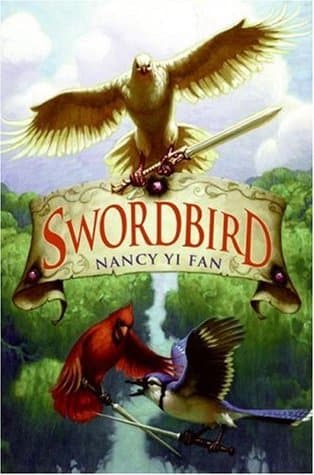
Synopsis
Covers the whole plot, including the ending.
- Difficulty
- Easy
- Pacing
- Moderate
- Mood
- Adventurous, Hopeful, Inspirational, Whimsical
- Read it if
- You enjoy classic good-vs-evil fantasy stories with animal characters and a clear moral message.
- Skip it if
- You prefer complex narratives, morally grey characters, or mature themes.
Swordbird Plot Summary
Covers the whole plot, including the ending.
The Seeds of Conflict
In Stone-Run Forest, the blue jays, led by Miltin, and the cardinals, led by Frightful, face a severe food shortage. The acorn supply has shrunk, and the birds grow desperate. Miltin, a cautious leader, tries to keep peace, but Frightful, afraid for his flock, becomes more aggressive. Young birds, like the blue jay Arlo and the cardinal Daresh, see the growing anger, their own friendship strained by hunger and mistrust. Elders recall old legends of a savior, Swordbird, but many think it is just a myth.
Malak's Manipulation
A hawk named Malak, with his bat henchmen Snitch and Grunch, arrives in Stone-Run Forest. Malak immediately sees how vulnerable the jays and cardinals are. He offers a solution: if they gather food for him, he will protect them and share his own supplies. Unknown to the birds, Malak plans to enslave them, making them work to expand his power. He uses their fears and anger, subtly increasing their conflict to stop them from uniting against him.
The Enslavement of the Birds
As food becomes scarcer, Miltin and Frightful, out of desperation for their flocks, agree to Malak's terms. The blue jays and cardinals work side-by-side, but without unity. Malak's bats, Snitch and Grunch, oversee them, driving them to gather food and build defenses for the hawk. The birds receive small rations, barely enough to live, and any protest leads to harsh punishment. Arlo and Daresh, seeing their enslavement, begin to understand Malak's evil and their dire situation.
A Glimmer of Hope: The Legend of Swordbird
Working under Malak, Arlo and Daresh find an old, hidden chamber in the forest. Inside, they see carvings and scrolls about Swordbird, a powerful bird-warrior, son of the Great Spirit, destined to defeat evil and bring peace. The legend describes Swordbird with a magical sword and the power to unite all birds. This discovery gives the two young birds hope, making them believe the myth is real and Swordbird could save them from Malak. They decide to secretly search for this legendary figure.
The Journey to Find Swordbird
With new hope, Arlo and Daresh escape the work camps despite the dangers and Malak's watchful bats. They journey through the forest, following clues from the ancient chamber. Their path is difficult, with dangerous terrain, predators, and the constant threat of Malak's patrols. Their friendship grows as they rely on each other's courage, showing that unity between their species is possible even in the darkest times. They face their fears, determined to find Swordbird.
Encountering the Wise Owl
During their quest, Arlo and Daresh meet Barnaby, an ancient, wise owl living in a secluded part of the forest. Barnaby is at first doubtful but, seeing their sincerity and the seriousness of their situation, shares his knowledge. He confirms Swordbird's existence, saying the legend is true, and gives them directions and warnings about trials ahead. Barnaby also teaches them about courage, unity, and belief, strengthening the young birds' resolve for their search.
The Appearance of Swordbird
Following Barnaby's advice, Arlo and Daresh reach a sacred, hidden grove. There, with a bright glow, Swordbird appears. He is a majestic, powerful bird, radiating calm strength and wisdom, carrying a shining, legendary sword. His presence is impressive, removing any remaining doubts the young birds had. Arlo and Daresh explain the terrible situation in Stone-Run Forest, detailing Malak's tyranny and their people's suffering. Swordbird listens, his eyes showing deep understanding and a quiet resolve to help. He accepts his destiny and agrees to return with them to confront Malak.
Return to Stone-Run Forest
Swordbird, with Arlo and Daresh, returns to Stone-Run Forest. His arrival creates hope and disbelief among the enslaved blue jays and cardinals, who had given up under Malak. Many hesitate to believe the legend, but Swordbird's calm authority and Arlo and Daresh's earnest stories begin to convince them. He speaks of unity, courage, and the strength within each bird, urging them to rise against their oppressor. He challenges their despair, reminding them of their dignity and the power they have when united, preparing them for the fight with Malak.
The Confrontation with Malak
Swordbird confronts Malak directly. The hawk, confident in his power and the birds' submission, at first scoffs at Swordbird, calling him a myth. But as Swordbird shows his strong resolve and the legendary power of his sword, Malak's arrogance fades. A fierce battle starts, showing Swordbird's agility, strength, and skill. The enslaved birds, seeing their champion's bravery, are inspired to join the fight, overcoming their fear and turning against Malak's bat henchmen, Snitch and Grunch, and even against Malak himself, united for their freedom.
Malak's Defeat and the Restoration of Peace
In a final struggle, Swordbird defeats Malak. The hawk's power is broken, and his bat henchmen flee. With Malak's defeat, the blue jays and cardinals are free. Swordbird, with Arlo and Daresh, guides the birds in rebuilding their community, stressing cooperation and understanding. He helps them restore the forest's balance, ensuring food and harmony. The old animosity between the blue jays and cardinals disappears, replaced by respect and friendship, beginning an era of peace and prosperity for Stone-Run Forest.
Principal Figures
Swordbird
Protagonist
The legendary bird-warrior destined to save Stone-Run Forest.
Swordbird is a majestic and powerful bird, the son of the Great Spirit, embodying wisdom, courage, and justice. He wields a magical sword and possesses an innate ability to inspire hope and unity. He is not driven by personal glory but by a profound sense of duty to protect the innocent and restore balance to the natural world. His calm demeanor belies immense strength, and he acts as a beacon of light against the darkness of Malak's tyranny. He is the ultimate symbol of good, bringing an end to oppression and fostering peace.
Relationships: Arlo (His first believers and allies); Daresh (His first believers and allies); Malak (His primary antagonist)
Arlo
Supporting
A brave and curious young blue jay who believes in the legend of Swordbird.
Arlo is a young, inquisitive blue jay with a strong sense of justice and an unwavering belief in the good. Despite his youth, he possesses remarkable courage and a keen observational mind. He is deeply affected by the suffering of his community under Malak's rule and is one of the first to actively seek a solution beyond mere survival. His friendship with Daresh transcends species boundaries, highlighting the potential for unity. Arlo's determination and hope are crucial in sparking the quest to find Swordbird, making him a catalyst for change.
Relationships: Daresh (Best friend and fellow quest-seeker); Miltin (His leader/elder); Swordbird (His hero and ally)
Daresh
Supporting
A loyal and resourceful young cardinal, Arlo's steadfast friend.
Daresh is a young cardinal, initially wary due to the conflict between his species and the blue jays, but his loyalty to Arlo and his inherent goodness shine through. He is resourceful and practical, often providing a grounded perspective to Arlo's more idealistic nature. Daresh shares Arlo's burden of witnessing Malak's cruelty and joins him on the perilous journey to find Swordbird. His courage grows throughout the adventure, and he becomes a symbol of reconciliation between the cardinal and blue jay communities, demonstrating that unity is possible despite past animosities.
Relationships: Arlo (Best friend and fellow quest-seeker); Frightful (His leader/elder); Swordbird (His hero and ally)
Malak
Antagonist
A tyrannical hawk who enslaves the birds of Stone-Run Forest.
Malak is a cunning, cruel, and power-hungry hawk. He preys on the fear and desperation of the blue jays and cardinals, exploiting their food shortage and existing animosity to establish himself as their absolute ruler. He delights in their suffering and uses intimidation and manipulation to maintain control. Malak represents pure evil and tyranny, caring only for his own power and comfort. He is a formidable foe, whose defeat is essential for the restoration of peace and freedom in Stone-Run Forest. His actions drive the entire conflict of the story.
Relationships: Snitch (His bat henchman); Grunch (His bat henchman); Swordbird (His primary adversary)
Miltin
Supporting
The wise but struggling leader of the blue jays.
Miltin is the elder leader of the blue jay flock. He is depicted as wise, cautious, and deeply concerned for the welfare of his birds. Initially, he tries to maintain peace amidst the food shortage but is eventually forced to make difficult decisions, including accepting Malak's 'protection' out of desperation. He represents the well-intentioned but overwhelmed leadership that falls prey to Malak's schemes. Miltin struggles with the burden of his responsibility and the despair of his flock, but he never loses his innate sense of morality and eventually rallies against Malak.
Relationships: Arlo (A young member of his flock); Frightful (Leader of the rival cardinal flock); Swordbird (The savior he eventually trusts)
Frightful
Supporting
The fearful and aggressive leader of the cardinals.
Frightful is the leader of the cardinal flock, characterized by his fear-driven aggression and protectiveness towards his own. The food shortage makes him increasingly paranoid and hostile towards the blue jays, making him susceptible to Malak's divisive tactics. While his intentions are to protect his flock, his methods often exacerbate the conflict. He is proud and stubborn, but ultimately, the harsh reality of Malak's enslavement forces him to confront his biases and eventually unite with the blue jays in the face of a greater evil.
Relationships: Daresh (A young member of his flock); Miltin (Leader of the rival blue jay flock); Malak (The enslaver of his flock)
Snitch
Supporting
One of Malak's menacing bat henchmen.
Snitch is one of Malak's two bat henchmen, acting as overseers and enforcers of Malak's will. He is depicted as cruel, cunning, and completely loyal to Malak, driven by fear and the promise of power. Snitch and Grunch are responsible for monitoring the enslaved birds, driving them to work, and punishing any insubordination. They are extensions of Malak's tyranny, embodying the oppressive force that keeps the birds in line. Their presence instills fear and reinforces Malak's absolute control over Stone-Run Forest.
Relationships: Malak (His master); Grunch (His fellow henchman)
Grunch
Supporting
One of Malak's menacing bat henchmen.
Grunch is the other bat henchman of Malak, similar in nature to Snitch. He is equally cruel and menacing, working in tandem with Snitch to enforce Malak's rule over the enslaved birds. Grunch helps to create an atmosphere of fear and despair, ensuring that the blue jays and cardinals remain subjugated. He is a symbol of the oppressive regime, highlighting the constant threat and lack of freedom under Malak's control. Like Snitch, he is motivated by fear of Malak and the small amount of power he gains from his position.
Relationships: Malak (His master); Snitch (His fellow henchman)
Barnaby
Supporting
A wise, ancient owl who guides Arlo and Daresh.
Barnaby is an ancient and sagacious owl who possesses deep knowledge of Stone-Run Forest's history and legends. He lives a solitary life but acts as a guardian of ancient wisdom. When Arlo and Daresh seek him out, he initially tests their resolve but ultimately provides crucial guidance and confirmation about the legend of Swordbird. Barnaby represents the enduring wisdom of the natural world and the importance of preserving history and hope. His counsel empowers the young birds to continue their quest, providing them with the necessary direction and encouragement.
Relationships: Arlo (Recipient of his wisdom); Daresh (Recipient of his wisdom)
Themes & Insights
Hope vs. Despair
The main conflict is between the despair Malak's tyranny causes and the hope the Swordbird legend offers. The blue jays and cardinals first fall into despair due to food shortages and Malak's rule, feeling hopeless. However, Arlo and Daresh's discovery of the Swordbird legend reignites hope, showing that even in dark times, belief in a better future can lead to action. This theme is clear as the enslaved birds find new courage when Swordbird arrives, turning their despair into a collective will to fight for freedom.
“Perhaps the greatest power of all is hope, for it is hope that gives us the strength to fight, even when all seems lost.”
Unity and Reconciliation
A core theme is that unity and reconciliation are needed to defeat a common enemy. The blue jays and cardinals are initially divided by an old rivalry and suspicion, made worse by food shortages. Malak uses this division to enslave them more easily. The journey of Arlo and Daresh, a blue jay and a cardinal, as they form a deep friendship, shows that their species can overcome differences. Their eventual unity, inspired by Swordbird, is what allows them to defeat Malak, proving that a shared purpose can bridge deep divides.
“Together, you are strong. Divided, you are merely prey.”
The Power of Belief
The story highlights the power of belief, especially in legends and the potential for heroism. For many birds, Swordbird is just a myth. But Arlo and Daresh's strong belief in the legend drives them to seek him, making a myth real. This belief spreads, eventually inspiring the whole forest to fight Malak. It shows how faith in something greater, whether a legend or an ideal, can empower people and communities to do amazing things and overcome huge obstacles.
“A legend is only a story until someone believes it enough to make it real.”
Good vs. Evil
The basic struggle between good and evil is the story's foundation. Malak is pure evil: cruel, manipulative, and seeking to dominate for his own gain. Swordbird, in contrast, represents ultimate good, fighting for freedom, justice, and peace. The story clearly separates these forces, showing the destructive nature of unchecked power and the healing power of compassion and heroism. The conflict is not just physical but also moral, as the birds must choose between giving in to evil or fighting for what is right.
“Evil thrives in silence. It is only when voices rise in defiance that its power begins to crumble.”
Courage and Resourcefulness
Courage and resourcefulness are central themes, especially through Arlo and Daresh. These two young birds, despite their size and inexperience, show great courage by defying Malak and going on a dangerous quest. Their resourcefulness is clear in how they handle challenges, solve clues, and overcome obstacles to find Swordbird. Their bravery inspires others and shows that heroism is not only for the strong, but for anyone willing to stand up for what is right, even against great odds.
“Courage is not the absence of fear, but the triumph over it.”
Plot Devices & Literary Techniques
The MacGuffin (Swordbird Legend)
The legend of Swordbird drives the protagonists' quest.
The legend of Swordbird serves as a classic MacGuffin, initially a seemingly mythical object of desire that propels the plot forward. While Swordbird himself is a character, his legendary status and the quest to find him function as the primary objective for Arlo and Daresh. The legend is what gives them hope and a concrete goal to work towards, ultimately leading to the hero's manifestation. Its existence motivates the young birds and gives the enslaved birds something to believe in, even if they're initially skeptical, making it crucial for the story's progression.
The Mentor Figure
The wise owl Barnaby provides crucial guidance to the young heroes.
Barnaby, the ancient and wise owl, fulfills the role of the mentor figure. He possesses ancient knowledge about the legend of Swordbird and the history of Stone-Run Forest. His wisdom is crucial for Arlo and Daresh, as he confirms Swordbird's existence, provides essential directions, and offers moral support and encouragement. The mentor figure's role is to equip the protagonists with the knowledge and confidence needed to face their challenges, and Barnaby effectively does this, guiding them on their perilous journey and preparing them for the ultimate confrontation.
The Symbol of Unity (Arlo and Daresh's Friendship)
The friendship between a blue jay and a cardinal foreshadows inter-species harmony.
The friendship between Arlo, a blue jay, and Daresh, a cardinal, serves as a powerful symbol of unity. In a forest divided by long-standing animosity between their species, their bond demonstrates that cooperation and mutual respect are possible. Their shared quest solidifies their friendship, which then becomes a living example for their respective flocks. This device highlights the theme of reconciliation and shows, on a personal level, how historical prejudices can be overcome, paving the way for the larger unity needed to defeat Malak and restore peace to the entire forest.
The Tyrannical Oppressor
Malak, the hawk, serves as the clear embodiment of evil and oppression.
Malak functions as the archetypal tyrannical oppressor. He is introduced as an external threat who exploits existing vulnerabilities (food shortage, inter-species conflict) to gain absolute power. His methods are cruel, manipulative, and driven by self-interest, making him a clear antagonist against whom the forces of good must unite. This device creates immediate conflict and provides a concrete evil for the protagonists to fight against, galvanizing the birds of Stone-Run Forest into action and highlighting the stakes of their struggle for freedom and survival.
Swordbird Quotes
“Only true courage can defeat the darkness within.”
“The greatest battles are not always fought with claws and teeth, but with wit and heart.”
“A leader's strength is not measured by his might, but by the loyalty and love of those who follow him.”
“Hope is a tiny seed, but it can grow into the tallest tree.”
“Even the smallest creature can cast a giant shadow.”
“Fear is a cage, but courage is the key.”
“The past holds lessons, but the future holds destiny.”
“True friendship is a wing that helps you fly even when you think you can't.”
“To protect what you love, sometimes you must become what you fear.”
“The world is full of wonders, if only you open your eyes to see them.”
“Darkness cannot drive out darkness; only light can do that.”
“Every feather has a purpose, every life has a story.”
“Sometimes, the quietest voices hold the loudest truths.”
“A kingdom is not just land and sky, but the hearts of its inhabitants.”
Quiz
10 questions on the plot and the characters. Each answer comes with a short explanation.
Question 1
Which two bird species are primarily at war in Stone-Run Forest at the beginning of the story?
- Robins and Sparrows
- Blue Jays and Cardinals
- Owls and Hawks
- Finches and Woodpeckers
Show answer
B. Blue Jays and Cardinals The book explicitly states that the blue jays and cardinals of Stone-Run Forest have turned against each other.
Question 2
Who is the main antagonist stirring up conflict between the bird species?
- Malkin, the hawk
- Fleder, the bat
- Terin, the squirrel
- Malden, the mouse
Show answer
D. Malden, the mouse Malden, the power-hungry mouse, manipulates the birds and instigates the war for his own gain.
Question 3
What is Swordbird's connection to the Great Spirit?
- He is the Great Spirit's prophet.
- He is the Great Spirit's son.
- He is a disciple of the Great Spirit.
- He is the Great Spirit's chosen messenger.
Show answer
B. He is the Great Spirit's son. According to the legend, Swordbird is described as the 'son of the Great Spirit'.
Question 4
Which character initially doubts the existence of Swordbird?
- Malkin
- Arin
- Malden
- Fleder
Show answer
C. Malden Malden, the villain, actively dismisses Swordbird as a myth to further his own agenda and prevent peace.
Question 5
What is the primary theme explored through the conflict between the blue jays and cardinals?
- The importance of individual strength.
- The dangers of misinformation and prejudice.
- The inevitability of conflict in nature.
- The power of magic over reason.
Show answer
B. The dangers of misinformation and prejudice. Malden's manipulation thrives on spreading lies and mistrust between the bird species, highlighting the theme of how misinformation can lead to conflict.
Question 6
What special item does Swordbird possess or is associated with that helps him restore peace?
- A magical feather
- A glowing staff
- A shining sword
- A powerful song
Show answer
C. A shining sword His name, 'Swordbird', directly refers to the sword he wields, which is a key tool in his quest for peace and justice.
Question 7
Which character acts as a mentor or guide to the younger birds seeking Swordbird's help?
- Malden
- Fleder
- Malkin
- Terin
Show answer
B. Fleder Fleder, the bat, despite initial apprehension, becomes a crucial ally and guide for the young birds searching for Swordbird.
Question 8
What specific act does Malden commit to escalate the war and further his control?
- He steals food from both bird camps.
- He captures and imprisons key bird leaders.
- He sets fire to parts of Stone-Run Forest.
- He poisons the main water source.
Show answer
B. He captures and imprisons key bird leaders. Malden's strategy involves capturing the leaders of both the blue jays and cardinals to consolidate his power and prevent any attempts at peace talks.
Question 9
What is the ultimate fate of Malden at the end of the story?
- He escapes and vows revenge.
- He is forgiven and joins the birds.
- He is defeated and brought to justice.
- He disappears without a trace.
Show answer
C. He is defeated and brought to justice. Swordbird, with the help of the united birds, defeats Malden, bringing his reign of terror to an end and restoring peace.
Question 10
What characteristic is most emphasized as crucial for the birds to overcome Malden's influence and achieve peace?
- Superior aerial combat skills.
- The ability to fly faster than Malden.
- Unity and belief in each other.
- A deeper understanding of forest magic.
Show answer
C. Unity and belief in each other. The story strongly emphasizes that only through overcoming their divisions and working together can the birds defeat Malden and restore harmony to the forest, representing the power of unity.
Swordbird FAQ
What is the central conflict driving the plot in 'Swordbird'?
The central conflict in 'Swordbird' is the escalating war between the blue jays and the cardinals of Stone-Run Forest. This conflict is fueled by fear, misunderstanding, and the manipulative influence of the tyrannical hawk, Malau, who profits from their discord.
Who are the main protagonists working to restore peace?
The main protagonists are the young blue jay, Miri, and the young cardinal, Arfa. Despite their species' animosity, they form an unlikely alliance after Miri saves Arfa, and together they seek to find the legendary Swordbird to bring peace.
Who is Malau, and what role does he play in the forest's troubles?
Malau is the cunning and powerful hawk who rules Stone-Run Forest with an iron claw. He instigates and perpetuates the war between the blue jays and cardinals, exploiting their fear and distrust to maintain his power and ensure a steady supply of tribute.
What is the legend of Swordbird, and why is it significant?
The legend of Swordbird describes him as the son of the Great Spirit, destined to appear and conquer evil, restoring peace to the land. This legend gives hope to the oppressed birds and becomes the driving force behind Miri and Arfa's quest, representing their belief in a greater power for good.
How do Miri and Arfa first meet and overcome their initial prejudice?
Miri and Arfa first meet when Miri, a blue jay, finds Arfa, a cardinal, injured and vulnerable. Despite their species' war, Miri's inherent compassion leads her to help Arfa, slowly building trust and demonstrating that their shared desire for peace transcends tribal loyalty.
What is the significance of the 'Great Spirit' in the birds' belief system?
The 'Great Spirit' represents a benevolent, guiding force in the birds' world, a higher power that is believed to watch over them and, crucially, to have sent Swordbird. This belief provides comfort and hope in times of despair, reinforcing the idea of a cosmic order.
Are there any subtle hints about Swordbird's true nature or identity before his arrival?
Yes, there are subtle hints, particularly through the ancient prophecies and the unwavering faith of certain characters like the elder birds. The legend is consistently presented as a genuine, albeit ancient, truth, rather than just a fanciful tale, suggesting its eventual realization.
How does Malau's palace reflect his character and power?
Malau's palace, built from the bones and feathers of his enemies and adorned with stolen treasures, serves as a stark physical manifestation of his cruelty, dominance, and the fear he instills. It is a fortress of oppression, symbolizing his tyrannical rule over the forest.
What role do the smaller, often overlooked forest creatures play in aiding Miri and Arfa?
The smaller creatures, like the mice and chipmunks, often provide crucial assistance to Miri and Arfa by sharing vital information, creating diversions, or helping them navigate dangerous areas. Their collective actions demonstrate the power of unity and cooperation against a larger foe.
How does fear manipulate the birds, and how do Miri and Arfa overcome it?
Fear, primarily instilled by Malau, manipulates the birds by making them distrust each other and accept their subjugation. Miri and Arfa overcome this by choosing courage, empathy, and hope, demonstrating that shared purpose and compassion can break through the cycle of fear and prejudice.
Analyze the psychological impact of Malau's propaganda on the blue jays and cardinals.
Malau's propaganda fosters deep-seated prejudice and hatred, making each bird species view the other as an inherent enemy. This psychological conditioning blinds them to their common oppressor and prevents them from forming alliances, ensuring Malau's continued control.
How do Miri and Arfa's individual character arcs demonstrate growth beyond their initial circumstances?
Miri, initially a compassionate but perhaps naive blue jay, grows into a determined leader, while Arfa, a cardinal, overcomes his species' ingrained animosity to trust and fight alongside Miri. Both learn to prioritize peace and justice over tribal loyalty, demonstrating profound moral courage.
What psychological elements make Malau such an effective villain?
Malau's effectiveness as a villain stems from his cunning manipulation, his ability to exploit existing prejudices, and his sheer ruthlessness. He embodies pure self-interest and a desire for power, making him a clear and tangible threat that preys on the psychological weaknesses of others.
Is Swordbird a literal figure, or could he be interpreted as a symbol of collective hope and courage?
While Swordbird appears as a literal, powerful figure in the narrative, he can also be interpreted symbolically as the embodiment of collective hope, courage, and the inherent goodness within the birds. His arrival coincides with the birds' readiness to fight for themselves, suggesting a dual interpretation.
How does the book's resolution challenge or affirm the idea of peace through force versus peace through understanding?
The book's resolution suggests a blend: peace is ultimately secured by Swordbird's decisive defeat of Malau (force), but it is enabled by Miri and Arfa's efforts to foster understanding and unity among the birds. True, lasting peace requires both the removal of tyranny and the cultivation of empathy.
What message about prejudice and unity does 'Swordbird' convey, particularly for its young audience?
'Swordbird' conveys a powerful message that prejudice is learned and destructive, often manipulated by those seeking power. It emphasizes that unity, empathy, and courage to stand up for what's right, regardless of differences, are essential to overcoming conflict and achieving peace.
Could Malau's tyranny be a metaphor for real-world political or social oppression?
Yes, Malau's tyranny can be seen as a metaphor for real-world political or social oppression, where leaders exploit divisions, instill fear, and control resources to maintain power. The birds' struggle reflects the universal fight against injustice and for freedom.
How does the book's ending suggest the ongoing nature of maintaining peace, rather than a definitive 'happily ever after'?
While Malau is defeated and peace is restored, the ending subtly implies that maintaining peace requires continued vigilance and cooperation, rather than being a one-time event. The lessons learned about unity and understanding will need to be actively practiced by the birds for lasting harmony.
Similar books
- Watership Down
Richard Adams
4.1 (434k) average on GoodreadsFantasyFeatures animal protagonists on an epic journey with themes of survival and community.
- The Tale of Despereaux
Kate DiCamillo
4.0 (162k) average on GoodreadsFantasyA children's fantasy about a brave mouse, emphasizing courage and the power of hope.
- Redwall
Brian Jacques
4.1 (105k) average on GoodreadsFantasy"Swordbird" lacks the intricate world-building, diverse cast of characters, and detailed societal structures present in Jacques' Redwall series. Jacques creates a much richer, more immersive world with deep historical and cultural elements for his anthropomorphic animals, whereas "Swordbird" is simpler in its depiction.
- Harry Potter and the Sorcerer's Stone
J.K. Rowling
4.5 (7M) average on GoodreadsFantasyRescued from a miserable life under the stairs, an orphaned boy discovers he's a wizard destined for a magical school, where he uncovers a dangerous secret tied to the dark wizard who murdered his parents.
- The Hunger Games
Suzanne Collins
4.3 (6.4M) average on GoodreadsFantasyIn a future where children fight to the death on live television, Katniss Everdeen volunteers for the arena, turning a death sentence into a fight for survival and a spark of rebellion.
- 1984
George Orwell
4.2 (3.1M) average on GoodreadsPoliticsIn a future where surveillance and thought control are absolute, a man's search for truth clashes with the Party, showing that hope can be a form of rebellion.



Enjoyed the summary?
A summary gives you the shape of the book. The book itself has the detail, the examples and the voice.
Find Swordbird on AmazonAs an Amazon Associate, BookBrief earns from qualifying purchases. How we're funded