BookBrief
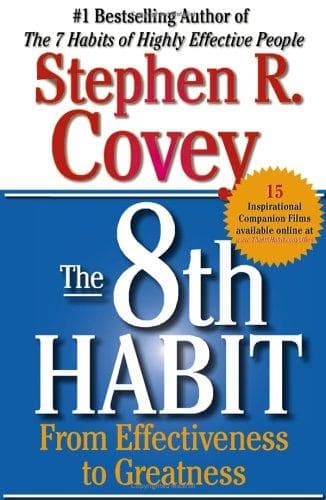
The 8th Habit cover

The 8th Habit Summary

Stephen R. Covey (2004)

Get the book

Goodreads Rating

4.04/ 5(23,906 reviews)

Genre

General

Summary Read

13 min

Book Length

6-8 hours

By BookBrief EditorialLast updated August 30, 2026verifiedReviewed by BookBrief Editorial

Track Your Reading

Sign in to track this book

My Notes

Only visible to you
Stephen Covey shows how to find your unique voice and inspire others by blending your talents, needs, conscience, and passions.

Core Idea

Stephen Covey's "The 8th Habit" argues that in the modern, knowledge-worker age, merely being effective (as outlined in "The 7 Habits of Highly Effective People") is no longer sufficient. To thrive and make a significant contribution, individuals and organizations must move beyond effectiveness to find their unique voice and inspire others to find theirs. This '8th Habit' is about unleashing human potential by moving from effectiveness to greatness, which is defined as finding your voice and helping others find theirs, thereby contributing meaningfully to the world. Covey posits that finding your voice involves identifying your unique talent, passion, and conscience. Once found, the challenge is to then help others discover their own voices, fostering a culture of leadership and contribution within families, organizations, and communities. This habit is presented as a natural evolution and an essential next step for individuals and organizations seeking to achieve profound impact and relevance in an increasingly complex and interconnected world.
Reading time
6-8 hours
Difficulty
Medium
✓ Read this if...
you've mastered the 7 Habits and are looking for the next level of personal and organizational leadership, want to understand how to move from effectiveness to greatness, or are interested in empowering others and fostering a culture of leadership.
✗ Skip this if...
you haven't read or grasped the concepts of "The 7 Habits of Highly Effective People," are looking for a quick fix to productivity issues, or prefer a less philosophical approach to self-improvement and leadership.

Chat with this book

Ask anything about The 8th Habit and get instant answers grounded in the summary.

Key Takeaways from The 8th Habit

1

Finding Your Voice

Beyond effectiveness to significance: the ultimate human need.

Quote

The 8th Habit is about finding your voice and inspiring others to find theirs.

Covey states that the first seven habits moved people from dependence to independence and then interdependence. The 8th Habit—finding your voice—addresses the human need for significance. He argues that in the modern "Knowledge Worker Age," old management styles are not enough. People want purpose and meaningful contributions, not just efficiency. Voice, in Covey's view, is where talent (what you do well), passion (what you love), need (what the world requires), and conscience (what you feel is right) meet. This combination is key for...

Supporting evidence

Covey references numerous surveys indicating widespread disengagement in the workplace, suggesting that a lack of 'voice' is a significant contributing factor to low morale and productivity.

Apply this

Individuals can create a 'Voice Compass' by journaling about their unique talents, deepest passions, perceived needs of their environment, and their inner moral compass to identify their personal voice. Leaders can foster environments where employees feel safe and encouraged to express their voice.


knowledge-worker-agesignificancepersonal-voicetalent-passion-need-conscience
2

The Whole Person Paradigm

Engaging the body, mind, heart, and spirit for holistic contribution.

Quote

When you treat people as whole people, they respond as whole people.

Covey expands his earlier view of human nature with the "Whole Person Paradigm." This means effective leadership and personal contribution need all four parts: body (economic/physical), mind (development/learning), heart (relationships/social), and spirit (meaning/purpose). He believes most organizations only use the body and mind, ignoring the heart and spirit. This leads to disengagement and poor performance. By recognizing and supporting all four parts, people can bring their full selves to work, and organizations can unlock great ...

Supporting evidence

Covey cites examples of companies that have successfully integrated employee well-being, learning opportunities, strong team cultures, and a clear sense of mission to achieve superior results.

Apply this

Leaders should design roles and environments that offer opportunities for physical well-being, continuous learning, meaningful relationships, and a connection to a larger purpose. Individuals should consciously seek balance across these four dimensions in their own lives.

whole-person-paradigmholistic-developmentbody-mind-heart-spiritemployee-engagement
3

From Management to Leadership

Shifting focus from controlling outcomes to inspiring potential.

Quote

Management works in the system; leadership works on the system.

Covey clearly separates management from leadership. He argues that the industrial age needed management—controlling, organizing, and maximizing efficiency. But the knowledge worker age needs leadership—releasing potential, inspiring vision, and empowering people. He thinks many organizations are "over-managed and under-led," which results in compliance instead of commitment. True leadership, for Covey, means igniting people's inner drive by helping them connect their personal voice to the organization's shared voice. This change is vi...

Supporting evidence

Covey contrasts the hierarchical, command-and-control structures of industrial-era companies with the more agile, empowering models seen in successful knowledge-based organizations.

Apply this

Leaders should delegate authority, foster a culture of trust, provide clear vision, and focus on developing people rather than just directing tasks. Managers should learn to transition from 'boss' to 'enabler.'

leadership-vs-managementempowermentvisionary-leadershipknowledge-economy
4

The Age of the Knowledge Worker

Capitalizing on human intelligence, creativity, and self-direction.

Quote

The greatest waste in organizations is the waste of human potential.

Covey stresses that we have moved past the Agricultural and Industrial Ages into the "Knowledge Worker Age." Here, the main assets are human intellect, creativity, and initiative, not land or machines. This basic shift means organizations must be structured and led in new ways. He argues that traditional, top-down, command-and-control models are not only inefficient but also harm knowledge workers, who thrive on autonomy, mastery, and purpose. The book's strength is showing how this new age requires a "principle-centered" leadership a...

Supporting evidence

Covey refers to Peter Drucker's foundational work on the knowledge worker and highlights the rise of industries where intellectual capital far outweighs physical capital.

Apply this

Organizations must create cultures that foster innovation, continuous learning, and self-management. Leaders should act as facilitators and coaches, removing obstacles and providing resources rather than dictating every step.

knowledge-workerintellectual-capitalautonomy-mastery-purposeorganizational-design
5

The Execution Gap

Bridging the chasm between strategy and results through alignment.

Quote

The greatest problem in organizations today is the execution gap.

Covey points to the "execution gap" as a major problem for most organizations: they cannot turn good strategies into real results. He blames this gap on unclear goals, poor alignment between individual and organizational objectives, not enough accountability, and failing to communicate priorities effectively. The 8th Habit offers a way to close this gap by making sure every person's voice and contribution match the overall mission. This involves setting clear goals, regular accountability, and understanding how individual efforts cont...

Supporting evidence

Covey cites studies showing that a large percentage of employees do not understand their organization's top goals or how their work contributes to them, directly impacting execution.

Apply this

Leaders should ensure crystal-clear strategic objectives, involve employees in the goal-setting process, establish robust accountability systems, and regularly communicate progress and impact.

execution-gapstrategic-alignmentaccountabilitygoal-setting
6

The Four Disciplines of Execution (4DX)

A practical framework for achieving wildly important goals.

Quote

Focus on the wildly important, act on the lead measures, keep a compelling scoreboard, and create a cadence of accountability.

Though not fully developed in "The 8th Habit," Covey introduces the "Four Disciplines of Execution" (4DX) as a powerful method to bridge the execution gap; this later became a separate book. The 4DX are: 1. Focus on the Wildly Important Goal (WIG), 2. Act on the Lead Measures (actions that predict success and can be influenced), 3. Keep a Compelling Scoreboard, and 4. Create a Cadence of Accountability. This system gives teams a structured, actionable way to achieve their most important goals despite daily distractions. It is a practi...

Supporting evidence

Covey provides numerous case studies of organizations, from government agencies to corporations, that have dramatically improved their results by implementing 4DX.

Apply this

Teams should identify one or two WIGs, define specific lead measures, track progress publicly on a scoreboard, and hold weekly 4DX meetings to review commitments and solve problems.

four-disciplines-of-executionwildly-important-goalslead-measurescadence-of-accountability
7

Inspiring Others to Find Their Voice

The ultimate test of leadership and the path to exponential growth.

Quote

True leadership is about empowering others to find their voice, not just following yours.

Covey states that the highest form of leadership is not about having followers, but about creating more leaders. The second half of the 8th Habit heavily focuses on the leader's role in inspiring others to find their own voice. This means modeling principles, building trust, clarifying purpose, aligning systems, and releasing talent. When leaders truly empower individuals to use their unique talents and passions for a shared vision, the organization grows exponentially. This idea is a strong restatement of servant leadership, emphasiz...

Supporting evidence

Covey shares stories of leaders who have successfully transformed cultures by fostering environments of trust and empowerment, leading to increased innovation and employee retention.

Apply this

Leaders should actively listen to their team members, delegate meaningful responsibilities, provide opportunities for growth and development, and celebrate individual contributions to the collective mission.

servant-leadershipempowermentcollective-voicetalent-development
8

The Trust Dividend

High trust cultures enable speed, innovation, and engagement.

Quote

Trust is the highest form of human motivation. It brings out the very best in people.

Covey consistently stresses that trust is the basis for all effective relationships and, therefore, for finding and releasing voice. He argues that high-trust environments reduce problems, speed up decisions, encourage open communication, and promote new ideas. In contrast, low-trust cultures lead to micromanagement, bureaucracy, and disengagement, ultimately hindering efforts to empower individuals or achieve significant results. The "Trust Dividend" refers to the real benefits—both financial and cultural—that come to organizations a...

Supporting evidence

Covey draws on his earlier work and observations that organizations with high levels of trust consistently outperform those with low trust in terms of productivity, innovation, and employee satisfaction.

Apply this

Leaders must model trustworthiness through integrity, competence, and consistent behavior. They should create systems that reward transparency and accountability, and actively work to resolve conflicts and build rapport within teams.

organizational-trusttrust-dividendintegrity-competencepsychological-safety
9

The Path of Principle-Centered Leadership

Guiding decisions by universal, timeless laws for sustained success.

Quote

Principles are like lighthouses. They are natural laws that cannot be broken.

Covey repeats his core belief in "principle-centered leadership." He argues that lasting success, for both individuals and organizations, comes from following universal, timeless principles (e.g., fairness, integrity, service, human dignity). He contrasts this with "personality ethics" or "expediency ethics," which focus on quick fixes or manipulation. While this idea is a cornerstone of his earlier works, in "The 8th Habit," it is presented as the essential moral guide for handling the complexities of the knowledge worker age and for...

Supporting evidence

Covey frequently cites historical examples and enduring successful organizations that have demonstrated long-term growth and resilience due to their adherence to fundamental principles.

Apply this

Individuals and organizations should identify and commit to a set of core principles that guide their decisions and actions. Leaders must consistently model these principles, even when it's difficult or unpopular.

principle-centered-leadershipuniversal-principlestimeless-lawsethical-leadership
10

From Pain to Purpose

Leveraging personal challenges to discover and unleash your voice.

Quote

Your greatest pain can be your greatest blessing; it can be the very thing that helps you find your voice.

A less emphasized but important part of the 8th Habit is that personal struggles, setbacks, and even "pain" can strongly help people discover their true voice and purpose. Covey suggests these challenging experiences often show what truly matters, refine talents, ignite passions, and deepen conscience. By reflecting on and learning from difficulties, individuals can gain clarity about their unique contribution and develop the resilience needed to act on their voice. This takeaway adds a deeply personal and transformative dimension to ...

Supporting evidence

Covey shares anecdotes of individuals who, after experiencing significant personal or professional crises, emerged with a clearer sense of purpose and a stronger commitment to their unique calling.

Apply this

Individuals should practice self-reflection and journaling to understand the lessons embedded in their challenges. Instead of avoiding pain, view it as an opportunity for growth and a potential guide to discovering deeper meaning and purpose in life and work.

personal-transformationresiliencepurpose-discoverygrowth-mindset

The 8th Habit Quotes

The key is not to try to be the best, but to try to be the best you can be.

Covey emphasizes personal growth and striving for one's own potential rather than external comparison.

The 8th Habit is about finding your voice and inspiring others to find theirs.

This defines the core concept of the 8th Habit, focusing on leadership and empowerment.

We are not to be measured by the number of our successes, but by the number of times we have picked ourselves up after a fall.

Covey highlights the importance of resilience and perseverance in the face of adversity.

The key to effective leadership is not to be a hero, but to be a servant.

This quote reflects Covey's emphasis on servant leadership and humility.

The greatest single cause of failure in the business world today is the inability to manage oneself.

Covey points to self-management as a critical skill for professional success.

Most people don't listen with the intent to understand; they listen with the intent to reply.

This is a famous quote from Covey, emphasizing the importance of empathetic listening.

Your personal compass, your conscience, is the ultimate arbiter of your choices.

Covey stresses the role of inner moral guidance in decision-making.

The principle of fairness, of justice, of integrity, is the bedrock upon which all lasting relationships and organizations are built.

This highlights the foundational importance of ethical principles.

The most important thing in your life is not what happens to you, but how you respond to what happens to you.

Covey emphasizes personal agency and the power of our response to circumstances.

The challenge of leadership is to operate on the principle of the law of the harvest: you reap what you sow.

This connects leadership effectiveness to consistent application of principles and long-term consequences.

The essence of the 8th Habit is to tap into the unique genius and passion that is within each person.

This further elaborates on the core idea of unlocking individual potential and purpose.

The greatest danger in times of turbulence is not the turbulence; it is to act with yesterday's logic.

Covey cautions against outdated thinking in a rapidly changing world.

When you seek to understand, you build trust. When you build trust, you create a powerful foundation for communication and influence.

This explains the ripple effect of understanding in interpersonal dynamics.

The 8th Habit is about going beyond effectiveness to significance.

This positions the 8th Habit as a higher level of achievement than mere effectiveness.

Quiz

Test Your Knowledge

Ready to see how well you understood this book? Take our interactive quiz with 10 questions.

10
Questions
~5
Minutes
?
Best Score

The 8th Habit FAQ

The 8th Habit by Stephen Covey introduces the concept of finding your 'voice' by identifying the intersection of your talent, need, conscience, and passion. It emphasizes moving beyond effectiveness to significance, inspiring yourself and others to contribute their unique capabilities.

About the author

Stephen R. Covey

Stephen R. Covey was an American author and educator known for his work in personal development and leadership. He is best known for "The 7 Habits of Highly Effective People: Powerful Lessons in Personal Change," which outlines principles for personal and professional effectiveness, and "First Things First," which focuses on time management and prioritization. Covey's writings have had a significant impact on the field of self-help and organizational leadership.

Enjoyed the summary?

Support the author — grab the full book.

As an Amazon Associate, BookBrief earns from qualifying purchases, at no extra cost to you. How we're funded.

Get the book