
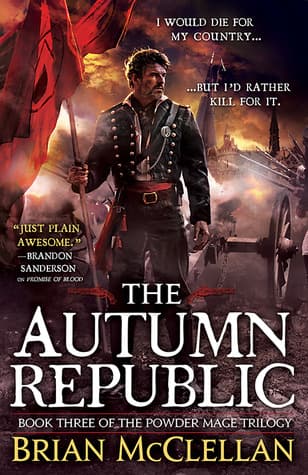
Synopsis
Covers the whole plot, including the ending.
- Difficulty
- Medium
- Pacing
- Fast
- Mood
- Epic, Intense, Action-packed, Desperate, Triumphant
- Read it if
- You enjoy epic military fantasy with complex characters, gunpowder magic, political intrigue, and high stakes, and have read the previous books in the Powder Mage series.
- Skip it if
- You haven't read 'Promise of Blood' or 'The Crimson Campaign' (this is the final book and requires prior knowledge), or dislike grim, action-heavy fantasy.
The Autumn Republic Plot Summary
Covers the whole plot, including the ending.
The Fall of Adro and Tamas's Return
Field Marshal Tamas returns to Adro after his campaign in the south, only to find that the Kez have invaded and taken Adopest, the capital. The city is under siege, and his army is in disarray. He learns that his son, Taniel Two-shot, vanished during the Kez attack. Tamas immediately assesses the situation, seeing that the Adran army is broken and without morale, with many officers captured, killed, or having switched sides. He gathers his remaining loyal forces, including the powder mage Vlora, and plans to retake the city and rescue any survivors, all while dealing with the shock of Adro's defeat.
Adamat's Desperate Search and the Mutiny
Inspector Adamat, his son Juste still missing and thought kidnapped by the Dynize, gets caught in a dangerous mutiny among the Adran forces outside Adopest. General Courts, a bitter and self-serving officer, manipulates Adamat by offering information about Juste's location if Adamat helps in a coup against loyalist commanders. Adamat, desperate to save his son, agrees to Courts's demands, using his skills to expose loyalist officers, weakening Tamas's possible allies. This puts Adamat in a moral bind, forcing him to betray his country for a small chance to save his family, showing more of Adro's chaos and division.
Taniel's Survival and the Godstone
Taniel Two-shot, having lived through the Kez invasion of Adopest and thought dead, is badly wounded and hiding in the occupied city. He is hunted by both Kez forces and local groups. During his escape, he finds the last Godstone, a powerful item needed to defeat Kresimir. Taniel, despite his injuries and constant danger, takes on the job of protecting the Godstone, understanding its great importance. He struggles with his personal problems and the loss of loved ones, but his resolve to guard this object drives him to survive and fight for Adro's future, making him a key person in the coming conflict.
The Dynize Threat and Kresimir's Plan
The Dynize forces, who first seemed allied with some Adran groups, show their true, dark intentions. It becomes clear that their leader is the god Kresimir, returned to the world and wanting to rule again. Kresimir plans not just to conquer Adro but to use the remaining Godstones to gain ultimate power and reshape reality. His methods are brutal, involving controlling and manipulating people. The Dynize, under Kresimir's direct influence, show terrifying magic, posing a threat not only to Adro but to all nations. This discovery changes the conflict from a war to a struggle for humanity's fate against a vengeful god.
Vlora's Leadership and the Northern Front
Vlora, a strong powder mage and Tamas's former student, takes on an important leadership role in the northern areas. She gathers scattered Adran forces, including mercenaries and loyal soldiers, forming a key resistance movement. Vlora shows great tactical skill and determination, fighting Kez forces and stopping their advance. She also begins to understand the deeper threat from the Dynize and Kresimir, seeing the need for a united front. Her actions in the north are vital for delaying the enemy and giving Tamas time, proving her growth as a commander and her dedication to Adro's survival, despite her complex relationship with Tamas and Taniel.
Tamas's Counter-Offensive and the Siege of Adopest
Field Marshal Tamas, with his remaining loyal army and help from Vlora's northern forces, starts a dangerous counter-attack to reclaim Adopest from the Kez and Dynize. He uses bold plans, drawing on his knowledge of the city's defenses and terrain. The siege is brutal, with intense street fighting and many casualties. Tamas relies heavily on his remaining officers and powder mages. His personal leadership and strategic ability are fully tested as he handles the complex city warfare, always aiming to find Taniel and face the true enemy, Kresimir, whose presence is increasingly felt throughout the city.
Adamat's Redemption and Juste's Fate
Inspector Adamat, after securing his son Juste's release from the Dynize, ultimately betrays General Courts, refusing to fully join the mutiny. He finds that Courts was only a pawn in Kresimir's larger plan, and Juste's kidnapping was set up to manipulate Adamat and further destabilize Adro. Adamat confronts the Dynize responsible for Juste's abduction, learning more about Kresimir's powers and goals. His focus shifts from personal revenge to protecting his son and helping Tamas, understanding the true size of the threat. This moment marks Adamat's personal return to honor, as he recommits to Adro's cause, bringing important information to Tamas about Kresimir's plans and the Dynize's weaknesses.
The Reunions and the Godstone's Power
Amid the chaos of retaking Adopest, Tamas and Taniel finally meet again. Their reunion is full of emotion, relief, and the shared burden of war. Taniel reveals the last Godstone, explaining its unique powers and how it can be used against Kresimir. The Godstone, which takes in and boosts powder mage power, becomes the main focus of their plan. Taniel, with his stronger powder mage abilities and connection to the Godstone, is a key player in the final fight. This reunion strengthens the father-son bond and sets the stage for the big battle against Kresimir, with the Godstone as their ultimate weapon.
The Battle for the Soul of Adro
The combined Adran forces, including Tamas's army, Vlora's resistance, and loyal elements, gather for the final, desperate battle against Kresimir and his Dynize army in Adopest. The fight is huge, with powder mages, flintlocks, and divine powers clashing across the city. Kresimir uses his full power, appearing as a terrifying, god-like being. The Adran soldiers fight with new resolve, driven by a wish to reclaim their capital and protect their nation from divine rule. Many are lost on both sides, and Adro's fate hangs in the balance as the war reaches its most destructive point.
The Confrontation with Kresimir
In the final fight, Taniel Two-shot, using the great power from the last Godstone, faces Kresimir directly. The Godstone, an old relic, lets Taniel take in and control divine energy, using Kresimir's own power against him. The battle is a clash of giants, with Taniel pushing his powder mage abilities to their limit. Kresimir, at first sure of his divine power, is shocked by Taniel's strength. The struggle is not just physical but also a battle of wills, as Taniel fights to protect humanity's freedom from divine interference. This duel's outcome will decide Adro's future and the very nature of gods in the world.
Tamas's Sacrifice and Kresimir's Defeat
During the intense battle against Kresimir, Field Marshal Tamas makes a sad sacrifice. Realizing that Taniel needs an opening to land the final blow with the Godstone, Tamas puts himself in danger, drawing Kresimir's attention and taking a critical hit. This selfless act creates the chance Taniel needs. Powered by the Godstone and his father's sacrifice, Taniel launches a devastating attack that defeats Kresimir, stripping him of his power and sending him from the mortal world. The victory comes at a terrible personal cost, leaving Taniel and the remaining Adrans to deal with their hard-won freedom.
The Aftermath and the New Republic
With Kresimir defeated and the immediate danger gone, Adro begins the hard process of rebuilding. The capital is ruined, and the nation is tired from years of war. Kresimir's defeat marks a new time where the gods are either dead or much weaker, leaving humanity to make its own way. The surviving leaders, including Taniel, Vlora, and Adamat, work to create a new political system, moving towards a more democratic republic. However, the scars of war, the loss of life, and the ongoing political instability mean that Adro's future, though free from divine rule, will still be hard, needing continued watchfulness and cooperation from its people.
The Autumn Republic Characters
Field Marshal Tamas
Protagonist
The brilliant but weary commander leading Adro's fight for survival.
Tamas is the renowned and pragmatic Field Marshal of Adro, a legendary powder mage and military strategist. He is a man burdened by the weight of leadership, having orchestrated the overthrow of the monarchy and now fighting to save the republic he helped create. He is fiercely devoted to his country and his son, Taniel, though their relationship is often strained. Tamas is a master of tactics, capable of making ruthless decisions for the greater good, but he is also deeply affected by the losses he endures.
Relationships: Taniel Two-shot (Son, often estranged but deeply loved); Vlora (Former protégé, trusted commander, complicated relationship); Adamat (Loyal investigator, confidant); Kresimir (Arch-nemesis, divine antagonist)
Taniel Two-shot
Protagonist
A gifted but troubled powder mage, destined to confront a god.
Taniel is Tamas's son, an exceptionally talented powder mage and a legendary marksman. He is often reckless and struggles with addiction and the trauma of war, particularly the loss of his beloved Ka-poel. Despite his flaws, Taniel possesses an unwavering moral compass and a deep sense of loyalty to those he cares about. He has a unique connection to the Godstones, which sets him apart and ultimately makes him Adro's greatest hope against Kresimir.
Relationships: Tamas (Father, complicated and often strained but ultimately loving); Vlora (Former lover, fellow powder mage, close friend); Ka-poel (Deceased lover, his guiding light and source of grief); Kresimir (Divine antagonist, his ultimate opponent)
Vlora
Supporting
A fierce and independent powder mage, emerging as a critical military leader.
Vlora is a powerful powder mage, once Tamas's protégé and Taniel's former lover. She is fiercely independent, pragmatic, and highly skilled in combat and strategy. Vlora often struggles with her loyalties, having temporarily sided with the Dynize, but her core desire is always to protect Adro and its people. She demonstrates immense resilience and leadership throughout the war, proving herself to be an indispensable commander and a formidable force on the battlefield.
Relationships: Tamas (Mentor, commander, complex relationship); Taniel Two-shot (Former lover, close friend, fellow powder mage); Olem (Loyal bodyguard, friend)
Adamat
Supporting
A former police inspector, drawn into the war by a desperate search for his son.
Adamat is a brilliant and meticulous former police inspector, now serving Tamas. He is a family man, driven by his love for his wife and children, especially his kidnapped son, Juste. Adamat is not a fighter, but his intelligence, deductive reasoning, and moral compass make him invaluable. He is forced into morally compromising situations due to his son's abduction, highlighting the personal tolls of war, but ultimately seeks redemption and justice.
Relationships: Tamas (Employer, confidant); Juste (Son, kidnapped, the focus of Adamat's desperation); General Courts (Manipulative antagonist, coercer)
Kresimir
Antagonist
A vengeful and ambitious god seeking to re-establish his dominion over humanity.
Kresimir is the primary antagonist, a powerful and ancient god who has returned to the mortal realm. He is arrogant, cruel, and views humanity as mere pawns in his grand design to reshape the world according to his will. Kresimir manipulates nations and individuals, using the Dynize as his primary instruments. His ultimate goal is to consolidate all divine power and rule unchallenged, seeing himself as the rightful master of creation. He is a formidable foe, possessing immense magical and physical power.
Relationships: Tamas (Mortal enemy, leader of the resistance); Taniel Two-shot (His ultimate opponent, the wielder of the Godstone); Dynize (His loyal, fanatical followers and instruments)
General Courts
Supporting
A treacherous Adran general who seeks to usurp power amidst the chaos.
General Courts is a opportunistic and ambitious Adran general who exploits the chaos of the Kez invasion to stage a mutiny against Tamas's loyalists. He is cunning and manipulative, using Adamat's desperation to find Juste as leverage. Courts embodies the internal divisions and betrayals that plague Adro during the war, prioritizing his personal power over the nation's survival. He is ultimately revealed to be a pawn of Kresimir, highlighting the god's far-reaching influence.
Relationships: Adamat (His coerced agent, manipulator); Tamas (Rival, target of his mutiny); Kresimir (Unwitting pawn)
Olem
Supporting
Vlora's loyal and steadfast bodyguard.
Olem is a quiet, stoic, and fiercely loyal bodyguard to Vlora. He is a skilled warrior and a constant presence by her side, offering unwavering support and protection. Olem's calm demeanor and reliability provide a stable anchor for Vlora amidst the chaos of war. He is not a powder mage but is highly effective in combat, always putting Vlora's safety above his own. His presence underscores Vlora's leadership and the trust she inspires in her followers.
Relationships: Vlora (His charge, close friend, and commander)
Juste
Supporting
Adamat's kidnapped son, a key to Kresimir's manipulation.
Juste is Adamat's young son, whose kidnapping forms a central personal motivation for Adamat. He is innocent and vulnerable, representing the civilian toll of the war and the lengths to which Kresimir will go to manipulate his enemies. His abduction is a critical plot point, driving Adamat's actions and ultimately revealing more about Kresimir's insidious methods.
Relationships: Adamat (Father, his rescuer)
The Autumn Republic Themes
The Burden of Leadership and Sacrifice
The novel shows the great personal and moral costs of leadership, especially through Tamas and Taniel. Tamas constantly makes difficult choices, giving up personal happiness and even his life for Adro's good. Taniel, despite his own struggles, takes on the burden of facing Kresimir, understanding that his power comes with huge responsibility. Vlora also shows this, stepping into a leadership role despite her past conflicts. Tamas's ultimate sacrifice highlights that true leadership often demands the highest price, a theme made clear in the final fight with Kresimir.
“A leader must be willing to sacrifice everything, even himself, for his people. That is the price of command.”
Humanity's Resilience Against Divine Power
A main theme is humanity's ability to resist and overcome oppressive divine powers. Kresimir represents the worst kind of tyranny, a god who sees people as mere tools. Yet, through the cleverness, bravery, and shared will of characters like Tamas, Taniel, Vlora, and Adamat, humanity proves it can challenge and defeat a god. The Godstones, though divine, become tools for human empowerment, showing humanity's ability to use even divine power for its own survival. This theme ends with Taniel's final fight with Kresimir, asserting humanity's right to decide its own future.
“We are not pawns, god. We are Adro. And we will not break.”
The Scars of War and Personal Redemption
The novel looks at the lasting emotional and physical scars left by long conflicts. Characters like Taniel struggle with grief, addiction, and trauma from past battles and losses, especially Ka-poel's death. Adamat's story is a touching look at personal redemption, as he is forced to make morally unclear choices to save his son but finally regains his integrity by helping Adro. Even Tamas carries the weight of past decisions and losses. The war not only changes the political world but also deeply affects the inner lives of its survivors, showing that victory does not erase deep wounds.
“War takes everything, even the parts of you you didn't know you had. And it leaves you with nothing but the ghosts.”
The Nature of Power and Authority
The book examines different kinds of power: military, political, and divine. Tamas uses military authority with great strategy, while Kresimir shows absolute divine power. The story questions the rightfulness of both, especially when power becomes cruel or corrupt, as seen with General Courts's mutiny. The change from monarchy to republic, and the eventual defeat of a god, points to a shift towards a more human-focused government. The Godstones represent a unique source of power that people can use, blurring the lines between divine and ordinary, and suggesting that true authority should come from the people's will, not from birth or divine right.
“Power is not given, it is taken. And once taken, it must be earned, every single day.”
Plot Devices & Literary Techniques
Godstones
Ancient artifacts capable of absorbing and amplifying divine and powder mage energy.
The Godstones are ancient, powerful artifacts that serve as a central plot device. They are remnants of a past age, capable of absorbing and channeling both divine power and the energy of powder mages. The last remaining Godstone becomes the key to defeating Kresimir, as it allows Taniel to effectively fight a god. Their existence raises questions about the nature of gods and magic, and their manipulation by mortals demonstrates humanity's potential to transcend its limitations. They are crucial for both Kresimir's plan to regain full power and Adro's ability to counter him.
The Kidnapping of Juste
Adamat's son's abduction, used as leverage to manipulate a key character.
The kidnapping of Adamat's son, Juste, serves as a powerful personal motivator and a crucial plot device to drive Adamat's actions. It forces Adamat into morally compromising alliances with General Courts and the Dynize, creating internal conflict and revealing the extent of Kresimir's manipulative tactics. This personal tragedy humanizes the broader conflict and highlights the devastating impact of war on innocent civilians, while also providing Adamat with crucial intelligence and a path to redemption when he ultimately chooses Adro over personal gain.
Internal Mutiny and Divided Loyalties
The fracturing of Adran forces due to ambition and manipulation.
The internal mutiny orchestrated by General Courts, and the divided loyalties within the Adran army, serve as a significant plot device to increase the stakes and complexity of the conflict. It weakens Adro's defense against the external threat of the Kez and the Dynize, forcing Tamas to fight on multiple fronts. This device highlights the fragility of leadership and the human element of ambition and opportunism even in the face of existential threats. It also provides Adamat's arc with a moral dilemma, making his eventual choice to betray Courts more impactful.
The Dynize as Kresimir's Instruments
A fanatical, magically potent army serving a resurrected god.
The Dynize are a foreign army, initially appearing as another invading force, but they are revealed to be the fanatical instruments of the resurrected god Kresimir. Their unique magical abilities and unwavering devotion to Kresimir make them a formidable and terrifying enemy. They serve as a plot device to escalate the threat from a conventional war to a divine conflict, demonstrating Kresimir's power and reach. Their presence forces the Adrans to confront not just military might, but also divine magic and absolute faith, requiring new strategies and a deeper understanding of the supernatural.
The Autumn Republic Quotes
“There are no easy answers. Only easier ones.”
“The greatest trick the Devil ever pulled was convincing the world he didn't exist. The greatest trick the gods ever pulled was convincing the world they did.”
“Power is a strange thing. It corrupts, but it also reveals. It shows you who you really are.”
“War is a beast that feeds on human lives, and it doesn't care whose side you're on.”
“Sometimes the hardest thing to do is to forgive yourself.”
“Hope is a dangerous thing. It can keep you alive, but it can also make you do stupid things.”
“A leader must be willing to make the difficult choices, even when they are unpopular.”
“The past is a stubborn thing. It never truly lets go.”
“Even the mightiest empires crumble. It's not a matter of if, but when.”
“Sometimes, the only way to save something is to let it go.”
“True strength isn't about how much power you wield, but how you use it.”
“There are always consequences. Always.”
“Fear can be a useful tool, if you know how to wield it.”
“The world doesn't care about your intentions, only your actions.”
Quiz
10 questions on the plot and the characters. Each answer comes with a short explanation.
Question 1
Which foreign power has successfully invaded and occupied the capital city of Adro, as Tamas discovers upon his return?
- The Dynize
- The Kez
- The Styke
- The Ghurka
Show answer
B. The Kez The synopsis explicitly states that 'the Kez still bearing down upon them' and that the capital 'lies in the hands of a foreign invader,' implying the Kez are the invaders.
Question 2
What is Field Marshal Tamas's primary goal upon returning to Adro, given the state of the capital?
- To negotiate a peace treaty with the invaders.
- To liberate the capital city of Adro from the foreign invader.
- To find his missing daughter.
- To rally support from neighboring countries.
Show answer
B. To liberate the capital city of Adro from the foreign invader. Tamas returns to a fallen capital, and his role as Field Marshal would naturally lead him to focus on reclaiming it.
Question 3
What personal motivation drives Inspector Adamat to get involved in the Adran army's mutiny?
- He seeks to gain power within the new army structure.
- He is promised information about his kidnapped son.
- He believes the mutiny is the only way to defeat the Kez.
- He wants to exact revenge on those who wronged him.
Show answer
B. He is promised information about his kidnapped son. The synopsis states, 'Inspector Adamat is drawn into the very heart of this new mutiny with promises of finding his kidnapped son.'
Question 4
What is the specific challenge faced by the Adran army in 'The Autumn Republic'?
- A severe shortage of gunpowder and weapons.
- It has turned against itself due to a lack of clear leadership.
- The majority of its soldiers have deserted.
- They are suffering from a widespread plague.
Show answer
B. It has turned against itself due to a lack of clear leadership. The synopsis clearly states, 'With the Kez still bearing down upon them and without clear leadership, the Adran army has turned against itself.'
Question 5
What is Taniel Two-shot's critical role in the conflict, according to the synopsis?
- He is tasked with assassinating the Kez emperor.
- He must safeguard Adro's only chance of surviving the war.
- He is responsible for leading the Adran mutiny.
- He is negotiating with the Dynize for military aid.
Show answer
B. He must safeguard Adro's only chance of surviving the war. The synopsis highlights Taniel's importance: 'And Taniel Two-shot, hunted by men he once thought his friends, must safeguard the only chance Adro has of getting through this war without being destroyed.'
Question 6
What is Tamas's assessment of his allies and foes upon his return to Adro?
- He finds his allies are strong and his foes are weak.
- He finds his allies are indistinguishable from his foes.
- He discovers his closest allies have betrayed him.
- He learns his foes have united under a single banner.
Show answer
B. He finds his allies are indistinguishable from his foes. The synopsis states, 'His allies are indistinguishable from his foes,' indicating a complex and treacherous political landscape.
Question 7
What is the broader significance of 'The Autumn Republic' in the series, as mentioned in the synopsis?
- It is a prequel exploring the origins of the Powder Mages.
- It is a standalone story set after the main trilogy.
- It is the epic conclusion to the series that began with 'Promise of Blood' and 'The Crimson Campaign'.
- It introduces entirely new characters and a separate conflict.
Show answer
C. It is the epic conclusion to the series that began with 'Promise of Blood' and 'The Crimson Campaign'. The synopsis explicitly states, 'THE AUTUMN REPUBLIC is the epic conclusion that began with Promise of Blood and The Crimson Campaign.'
Question 8
What is the specific predicament of Field Marshal Tamas concerning reinforcements for Adro?
- Reinforcements have been completely cut off by the enemy.
- Reinforcements are several weeks away, making immediate action difficult.
- Reinforcements are plentiful but refuse to follow his orders.
- He is unaware that reinforcements are even available.
Show answer
B. Reinforcements are several weeks away, making immediate action difficult. The synopsis mentions, 'reinforcements are several weeks away,' indicating a delay that complicates Tamas's immediate plans.
Question 9
The Adran army's internal conflict, described as having 'turned against itself,' suggests a theme of:
- The triumph of unity over adversity.
- The dangers of fractured leadership and internal strife during wartime.
- The inevitability of military defeat against a superior foe.
- The importance of individual heroism above all else.
Show answer
B. The dangers of fractured leadership and internal strife during wartime. The phrase 'without clear leadership, the Adran army has turned against itself' directly points to the negative consequences of a lack of unified command and internal division.
Question 10
Given that Taniel Two-shot is 'hunted by men he once thought his friends,' what key thematic element does this introduce regarding his character arc?
- The theme of absolute loyalty and unwavering trust.
- The theme of betrayal and the challenge of discerning true allies.
- The theme of seeking isolation and avoiding all contact.
- The theme of finding new and unexpected allies.
Show answer
B. The theme of betrayal and the challenge of discerning true allies. Being 'hunted by men he once thought his friends' directly signifies a theme of betrayal and the difficulty of knowing who to trust in a time of conflict.
The Autumn Republic FAQ
What is the central conflict driving the plot of 'The Autumn Republic'?
The central conflict revolves around the Adran capital, Adro, being occupied by the Kez, forcing Field Marshal Tamas to reclaim it while dealing with internal strife and a missing son. Simultaneously, the Adran army is fractured by mutiny, and Taniel Two-shot becomes crucial in a desperate plan to save the nation.
Where does Field Marshal Tamas begin his journey in 'The Autumn Republic' and what are his immediate goals?
Tamas returns to Adro, finding his capital city under Kez control and his son, Taniel, missing. His immediate goals are to retake Adro, locate Taniel, and distinguish allies from enemies within the fractured remnants of his own forces, all while reinforcements are weeks away.
What is Inspector Adamat's primary motivation early in 'The Autumn Republic'?
Adamat's primary motivation is the search for his kidnapped son, Borbador. This desperate quest draws him into the heart of the Adran army's mutiny, as he is promised information or assistance in exchange for his involvement in the internal power struggles.
What unique role does Taniel Two-shot play in the overarching conflict, especially given his past actions?
Taniel, despite being hunted by former allies, becomes Adro's last hope. He is tasked with safeguarding a critical element or plan that could turn the tide of the war, leveraging his unique abilities as a Powder Mage to execute a high-stakes mission vital for Adro's survival.
How does the occupation of Adro by the Kez impact the morale and structure of the Adran forces?
The Kez occupation shatters Adran morale and leadership, leading to a profound division within the army. Without clear command, factions emerge, causing a mutiny and turning soldiers against each other, further complicating Tamas's efforts to unify and fight the invaders.
What is the significance of the 'Gods' in the overall power structure and how do they influence the war?
The Gods, specifically Kolo and the other Kresimir's children, are revealed to be active and manipulative forces, not merely figures of worship. Their direct intervention and schemes, particularly Kolo's desire for dominance and control over the balance of power, significantly shape the war's trajectory and the fates of nations.
How does the relationship between Tamas and Taniel evolve, especially concerning their shared abilities?
Their relationship is strained by past conflicts and Tamas's initial judgment of Taniel's choices, but the crisis forces a reconciliation built on mutual respect for their Powder Mage abilities and shared goal. Tamas comes to rely on Taniel's unique skills and strategic thinking, seeing him as a peer rather than just a son.
What is the true nature of the 'Kresimir's Promise' and how does it affect the final conflict?
Kresimir's Promise refers to the ancient pacts and abilities tied to the Kresimir's children, the gods themselves. It is revealed to be a mechanism for Kresimir to reclaim power or influence through his descendants and their followers, directly impacting the magical balance and the ultimate confrontation between mortal and divine forces.
What role does the magical powder play beyond combat, especially in the hands of the more experienced Powder Mages?
Beyond enhanced combat abilities, the magical powder allows experienced Powder Mages like Tamas and Taniel to achieve feats of sensory perception, limited precognition, and even a form of communion with their surroundings. It's also revealed to be a conduit for greater magical energies, hinting at its divine origins and potential for profound influence.
Analyze Tamas's leadership style under extreme pressure and how it adapts to the unconventional threats he faces.
Tamas, typically a rigid and pragmatic military leader, displays remarkable adaptability. He's forced to rely on unconventional tactics, trust unlikely allies, and even make morally ambiguous choices to reclaim Adro. His willingness to delegate and empower others, like Taniel and Adamat, shows a growth beyond his usual authoritarian approach.
Discuss the psychological toll of Adamat's quest for his son and how it influences his decisions and loyalties.
Adamat's desperate search for Borbador pushes him to the brink, making him susceptible to manipulation and forcing him to compromise his usual moral compass. His loyalty becomes fluid, shifting towards anyone who offers a credible path to his son, even if it means aligning with mutineers or dangerous factions, highlighting the profound impact of paternal love and grief.
How does Taniel's past trauma and his relationship with Ka-poel affect his mental state and combat effectiveness in the final book?
Taniel's past trauma, especially the loss of loved ones and his struggles with addiction, continues to haunt him, but his bond with Ka-poel provides a crucial anchor. Her unwavering support and unique insights help him maintain focus and leverage his abilities, even as he faces immense pressure and the psychological burden of being Adro's last hope.
Examine the motivations of the Adran mutineers and whether their actions are solely driven by self-interest or deeper grievances.
The mutineers are driven by a mix of factors: genuine grievances against the perceived failures of leadership, fear of the Kez occupation, and opportunistic power grabs. While some seek personal gain, others are disillusioned soldiers who believe a change in command is necessary for Adro's survival, highlighting the complex moral landscape of civil war.
To what extent is the war a conflict of ideologies versus a struggle for power between divine entities?
While the war appears to be a struggle between nations and their ideologies (Kez vs. Adro), it is ultimately revealed to be heavily manipulated by and intertwined with the power struggles of the Gods. The mortal conflict serves as a proxy for the divine entities, particularly Kolo, to achieve their own agendas for dominance and control over the world, making it a multi-layered conflict.
How does the ending of 'The Autumn Republic' redefine the concept of 'victory' in a world where gods interfere?
The ending suggests that victory is not simply the defeat of a mortal enemy but a rebalancing of power, both political and divine. While Adro might reclaim its capital, the cost is immense, and the revelation of active gods means that true, lasting peace is elusive, as divine machinations will always loom, redefining victory as a temporary reprieve.
Was the sacrifice made by certain characters truly necessary, or could the outcome have been achieved through less drastic means?
The narrative strongly implies that the extreme circumstances and the active intervention of the gods necessitated drastic sacrifices. Given the stakes—the potential annihilation of Adro and the world's subjugation to a malevolent god—the sacrifices, while tragic, are presented as the only viable path to achieve even a partial victory against overwhelming odds and divine power.
What lingering questions or potential future conflicts are hinted at by the conclusion of the series?
The conclusion leaves several lingering questions: the long-term impact of the gods' weakened but still present influence, the political stability of Adro post-war, and the fates of characters like Ka-poel and Olem. It suggests that while this war is over, the world remains dangerous, with the potential for new divine or mortal conflicts arising from the power vacuum.
How does the series' exploration of 'Powder Mage' abilities challenge or conform to traditional fantasy magic systems?
The Powder Mage system is unique in its grounded, almost scientific application of magic through gunpowder, contrasting with more ethereal systems. It challenges traditions by making magic both a physical enhancement and a potential addiction, while conforming in its use of specialized abilities and inherent power levels among practitioners, blending grit with the fantastical.
About the author

Brian McClellan is a fantasy author known for his Powder Mage series, including "Promise of Blood" and "The Autumn Republic." His work often blends magic with military themes and has been praised for its intricate world-building and fast-paced action. McClellan holds an MFA in Creative Writing.
Similar books
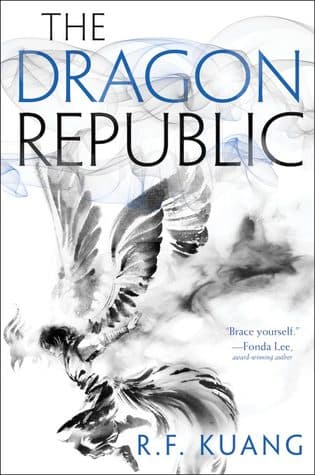
- The Dragon Republic
R.F. Kuang
4.3 (13k) average on GoodreadsFantasyExplores the brutal costs of war and rebellion in a fantasy setting.
- Words of Radiance
Brandon Sanderson
4.8 (207k) average on GoodreadsFantasyMcClellan's world-building is solid and effective, but it doesn't quite reach the intricate depth, philosophical rigor, and sheer scale of Sanderson's Cosmere, where underlying magical and societal structures are explored with greater detail and long-term implications. Sanderson often provides more explicit explanations for his magic systems, whereas McClellan's is more organically integrated into the narrative.
- Harry Potter and the Sorcerer's Stone
J.K. Rowling
4.5 (7M) average on GoodreadsFantasyRescued from a miserable life under the stairs, an orphaned boy discovers he's a wizard destined for a magical school, where he uncovers a dangerous secret tied to the dark wizard who murdered his parents.
- The Hunger Games
Suzanne Collins
4.3 (6.4M) average on GoodreadsFantasyIn a future where children fight to the death on live television, Katniss Everdeen volunteers for the arena, turning a death sentence into a fight for survival and a spark of rebellion.
- 1984
George Orwell
4.2 (3.1M) average on GoodreadsPoliticsIn a future where surveillance and thought control are absolute, a man's search for truth clashes with the Party, showing that hope can be a form of rebellion.
- Divergent
Veronica Roth
4.2 (2.9M) average on GoodreadsFantasyIn a society divided by virtues, a sixteen-year-old's difference from the norm starts a rebellion that threatens her world.





Enjoyed the summary?
A summary gives you the shape of the book. The book itself has the detail, the examples and the voice.
Find The Autumn Republic on AmazonAs an Amazon Associate, BookBrief earns from qualifying purchases. How we're funded