
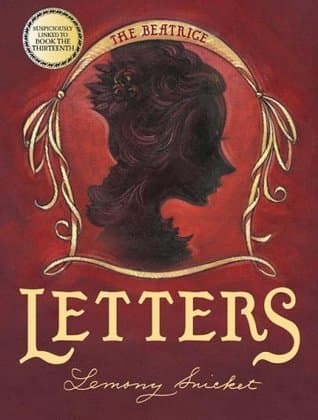
Synopsis
Covers the whole plot, including the ending.
- Difficulty
- Medium
- Pacing
- Moderate
- Mood
- Melancholy, Cryptic, Nostalgic, Bittersweet
- Read it if
- You have read and loved "A Series of Unfortunate Events" and crave more lore and emotional depth.
- Skip it if
- You have not read the main series; this book will be confusing and spoil major plot points.
The Beatrice Letters Plot Summary
Covers the whole plot, including the ending.
A Series of Unfortunate Letters
The book begins with a brief, sad introduction from Lemony Snicket. He sets a somber mood and warns the reader about the upsetting contents. He explains that these are letters between himself and a mysterious woman named Beatrice, offering fragmented glimpses into their complicated relationship and the calamitous world of the Baudelaire orphans. Snicket emphasizes the secrecy and sensitive nature of the letters, implying they hold painful keys to understanding 'A Series of Unfortunate Events.' He cautions the reader about the sorrow and unanswered questions that will come up, reinforcing the themes of loss and the futility of happiness in his work.
Beatrice's First Letter to Lemony
The first letter is from Beatrice to Lemony, dated before 'The Bad Beginning.' She writes with deep sadness and regret, explaining why she cannot marry him. Beatrice reveals she has returned the ring he gave her (implied to be an engagement ring) and is marrying someone else. This letter is deeply personal, hinting at a shared past and a love that, for reasons not yet fully explained, cannot happen. Her words suggest a sense of duty or outside pressure forced her decision, rather than a lack of affection for Lemony, leaving the reader to wonder what separated them.
Lemony's Desperate Reply
Lemony's response to Beatrice is a desperate plea, full of confusion and heartbreak. He struggles to understand her decision, questioning her sudden change of heart and her choice to marry another. His letter is a flood of unanswered questions and emotional turmoil, showing his deep love for Beatrice and his inability to accept their separation. He recalls shared memories and inside jokes, trying to remind her of their bond and hoping to change her mind. This letter reveals the depth of Lemony's personal tragedy and his profound sense of abandonment, painting a picture of a man dealing with immense personal loss.
Beatrice's Explanation of Duty
Beatrice's next letter clarifies her decision, though it offers little comfort to Lemony. She reveals her marriage is not for love of her new husband, but a necessary act tied to her involvement with V.F.D. (Volunteer Fire Department). She hints at complex organizational duties and an obligation that overrides her personal desires. This letter suggests their separation is a result of their commitment to a secret society and its dangerous work. Her words show resignation, indicating she made a sacrifice for what she believed was a greater good, even if it meant sacrificing her happiness with Lemony.
The Question of the Sugar Bowl
Throughout the letters, the 'sugar bowl' is mentioned repeatedly, becoming a central mystery. Both Lemony and Beatrice allude to its importance, its capture, and its contents, though its exact nature and purpose remain unknown. The letters suggest the sugar bowl holds important information or an item vital to the V.F.D. and the conflict between its factions. The pursuit of the sugar bowl is shown as a driving force behind many characters' actions, and its loss or acquisition has major consequences for the Baudelaire orphans and the wider V.F.D. story. It symbolizes a key piece of a larger puzzle.
Lemony's Vows and Beatrice's Legacy
In a sad letter, Lemony makes a promise to Beatrice. He vows to protect her children, Violet, Klaus, and Sunny Baudelaire, if anything happens to her. This commitment foreshadows Lemony's later role as their chronicler and distant protector. He expresses his lasting love and his determination to honor her memory and legacy, even in her absence. This letter shows Lemony's unwavering devotion and deep grief, revealing the personal reasons behind his relentless pursuit of the Baudelaire story and his attempts to explain the tragic events that befall them.
The Fire and the Orphans
While not stated in one letter, the impact of Beatrice's letters, especially those closer to the Baudelaire fire, hints at her death. Her letters become more urgent and somber, discussing dangerous assignments and the growing conflict within V.F.D. Readers can infer that Beatrice, as one of the Baudelaire parents, died in the fire that destroyed their mansion, leaving her children orphans. Lemony's later letters mourn her loss and the tragedy that befell her family, confirming that Beatrice is the deceased mother of the Baudelaire orphans, and her death is a central tragedy.
A Young Beatrice's Letter to Lemony
Towards the end of the collection, a letter from a different Beatrice appears, written by a young girl. This Beatrice is Kit Snicket and Dewey Denouement's daughter, adopted by Lemony Snicket after Kit's death. This letter, addressed to Lemony, her adoptive father, is full of youthful curiosity and affection. It offers a glimmer of hope amid the sadness, suggesting that while the original Beatrice is gone, her name and legacy continue. This introduces a cyclical element, where new life and relationships emerge from past tragedies, offering a bittersweet continuation.
Lemony's Final, Lingering Thoughts
In his final contributions, Lemony Snicket reflects on his lasting, unrequited love for the original Beatrice. He rehashes the pain of their separation and her death, and his ongoing commitment to documenting the Baudelaire orphans' misfortunes. His words are filled with melancholic resignation, acknowledging that while some mysteries may be partly solved, the fundamental tragedy of their lives remains. He hints at the continuing struggles of Violet, Klaus, and Sunny, reinforcing the idea that their story, and his own, is one of constant sorrow and the elusive search for truth and justice in a world often without both.
The Unanswered Questions
Despite giving important insights into the V.F.D. and the Baudelaire saga, 'The Beatrice Letters' leaves many questions unanswered. The exact contents and meaning of the sugar bowl remain unclear, the full extent of the V.F.D.'s operations is never completely revealed, and the reasons behind certain characters' actions are only partly explained. This intentional ambiguity reinforces the theme of the unreliable narrator and the difficulty of finding the full truth in a complex world. The letters deepen the mystery rather than fully solving it, inviting readers to keep thinking about the web of secrets and unfortunate events.
The Beatrice Letters Characters
Lemony Snicket
Protagonist/Narrator
The melancholic chronicler of unfortunate events.
Lemony Snicket is the author and narrator of 'A Series of Unfortunate Events' and the primary recipient/sender of these letters. He is a member of V.F.D., a secret organization, and was once deeply in love with Beatrice. He is a man haunted by loss, particularly the death of Beatrice, and his life's work is dedicated to documenting the tragic lives of the Baudelaire orphans. He is intelligent, melancholic, and often self-deprecating, using his wit to mask profound sadness. His detailed research and cryptic warnings are his way of honoring Beatrice and attempting to shed light on the V.F.D.'s secrets.
Relationships: Beatrice (Baudelaire) (Unrequited love, former fiancée); Beatrice (Snicket) (Adoptive father)
Beatrice (Baudelaire)
Central Figure/Deceased Love Interest
Lemony's lost love and mother of the Baudelaire orphans.
Beatrice is the enigmatic woman Lemony Snicket was deeply in love with and intended to marry. She is revealed to be the deceased mother of Violet, Klaus, and Sunny Baudelaire, who perished in the fire that destroyed their mansion. Her letters reveal her involvement with V.F.D. and her decision to marry another for reasons tied to her duties within the organization. She is depicted as intelligent, courageous, and self-sacrificing, making difficult choices for what she believed was the greater good. Her absence and Lemony's grief over her loss are central to the entire narrative.
Relationships: Lemony Snicket (Former fiancée, recipient of her love and regret); Bertrand Baudelaire (Husband); Violet Baudelaire (Daughter); Klaus Baudelaire (Son); Sunny Baudelaire (Daughter)
Violet Baudelaire
Mentioned/Protagonist
The inventive eldest Baudelaire orphan.
Violet is the eldest of the Baudelaire orphans, known for her exceptional talent in inventing and her ability to tie back her hair with a ribbon to concentrate. While not a direct correspondent in these letters, she is frequently mentioned by Lemony as one of the children he is striving to protect and whose story he is documenting. Her resourcefulness and intelligence are key to the orphans' survival against Count Olaf. Lemony's promise to Beatrice to look after her children implicitly includes Violet, highlighting his deep commitment to their well-being.
Relationships: Beatrice (Baudelaire) (Mother); Klaus Baudelaire (Brother); Sunny Baudelaire (Sister)
Klaus Baudelaire
Mentioned/Protagonist
The well-read middle Baudelaire orphan.
Klaus is the middle Baudelaire child, characterized by his love of books and his extensive knowledge, which he often uses to solve problems. Like Violet, he is frequently mentioned by Lemony Snicket as one of the children he feels responsible for protecting. His intellectual prowess is a consistent asset to the orphans in navigating their many predicaments. The letters deepen the reader's understanding of the tragic circumstances surrounding his parents' death and the V.F.D.'s involvement, which directly impacts Klaus's life and his pursuit of knowledge.
Relationships: Beatrice (Baudelaire) (Mother); Violet Baudelaire (Sister); Sunny Baudelaire (Sister)
Sunny Baudelaire
Mentioned/Protagonist
The infant Baudelaire orphan with sharp teeth.
Sunny is the youngest Baudelaire orphan, initially an infant with an unusual talent for biting and later developing a remarkable culinary skill and a knack for speaking in increasingly understandable, though still unique, phrases. Lemony's letters mention her as part of the trio he is devoted to. Her helplessness in the early books underscores the severity of the orphans' plight and the need for protection. The letters reveal the deeper, V.F.D.-related context of her parents' demise, which indirectly makes her a target of Count Olaf.
Relationships: Beatrice (Baudelaire) (Mother); Violet Baudelaire (Sister); Klaus Baudelaire (Brother)
Count Olaf
Antagonist/Mentioned
The nefarious villain pursuing the Baudelaire fortune.
Count Olaf is the primary antagonist of 'A Series of Unfortunate Events,' a greedy, untalented actor who relentlessly pursues the Baudelaire fortune. While not a direct correspondent, he is implicitly and explicitly mentioned in the letters as a dangerous figure involved in the V.F.D. schism. His actions are often a direct consequence of the V.F.D. conflict and the pursuit of the sugar bowl, connecting his villainy to the larger secret organization. Lemony's warnings about the dangers the orphans face directly pertain to Olaf's schemes.
Relationships: Baudelaire Orphans (Antagonist, attempting to steal their fortune)
Beatrice (Snicket)
Supporting/New Character
Kit Snicket's daughter, adopted by Lemony Snicket.
This Beatrice is a young girl, the daughter of Kit Snicket and Dewey Denouement. After Kit's death, she is adopted by Lemony Snicket, who names her Beatrice in honor of his lost love. Her letter to Lemony at the end of the collection offers a poignant, hopeful counterpoint to the pervasive sadness. She represents a continuation of the Snicket name and a new generation potentially involved with the V.F.D., suggesting a cyclical nature to the story and a chance for a less unfortunate future, or at least a different one.
Relationships: Lemony Snicket (Adoptive father); Kit Snicket (Biological mother); Dewey Denouement (Biological father)
Kit Snicket
Mentioned/Supporting
Lemony's sister and a V.F.D. member.
Kit Snicket is Lemony's sister and a fellow member of the V.F.D. She is mentioned in the letters, implicitly involved in the same dangerous missions as Lemony and Beatrice. She is revealed to be the biological mother of the second Beatrice. Her fate, detailed in 'A Series of Unfortunate Events,' is tragic, but her child's survival and adoption by Lemony offer a bittersweet continuation of the family line and the V.F.D.'s legacy. Her presence reinforces the pervasive danger faced by V.F.D. members.
Relationships: Lemony Snicket (Brother); Dewey Denouement (Lover, father of her child); Beatrice (Snicket) (Daughter)
The Beatrice Letters Themes
Unrequited Love and Loss
The main theme is Lemony Snicket's lasting, unrequited love for Beatrice and the deep loss he feels from their separation and her death. His letters are full of grief, regret, and a desperate longing for what could have been. Beatrice's letters convey her sadness about not being able to marry Lemony, showing their mutual, but tragically unfulfilled, affection. This theme is key to understanding Lemony's sad narrative voice and his dedication to the Baudelaire story, as seen in his promise to protect Beatrice's children and honor her memory after her death.
“My dearest darling, dearest, darling, dearest Beatrice, I write to you from the depths of my despair, for it seems that my life will never be happy again.”
The Nature of Secrets and Information
The book explores how secrets are everywhere and how powerful (and dangerous) information can be. The entire V.F.D. organization is built on secrets, codes, and hidden knowledge, as shown by the cryptic references to the sugar bowl and various V.F.D. missions. The letters themselves are fragmented truths and veiled hints, making the reader piece together the larger story. This theme shows how knowledge can be both a weapon and a shield, and how its manipulation can lead to both heroic acts and tragic outcomes, as seen in Beatrice's decision to marry for V.F.D. duties.
“There are some secrets which are better left untold, and there are some questions which are better left unanswered.”
Sacrifice and Duty
The theme of sacrifice, especially for a greater cause, is clear in Beatrice's actions. Her letters reveal she chose to marry someone other than Lemony, not because she didn't love him, but because of her duties within the V.F.D. This decision, and ultimately her death, highlights the high price paid by those dedicated to the organization. Lemony, in turn, sacrifices his personal happiness to tell the Baudelaire orphans' story, seeing it as his duty to Beatrice and a way to explain the V.F.D.'s complex history.
“I hope you will understand that sometimes one must do what is right, even if it is not what one wants to do.”
The Cyclical Nature of Tragedy and Hope
While mostly sad, the book also subtly touches on the cyclical nature of tragedy and the fragile presence of hope. The repeated mention of the name 'Beatrice,' ending with Lemony adopting Kit Snicket's daughter and naming her Beatrice, suggests that while individual lives end tragically, new beginnings and the continuation of legacies are possible. This offers a bittersweet resolution, implying that even in a world of misfortune, love and connection can last through new generations, balancing despair with the chance of a brighter future.
“Perhaps one day, when all our troubles are behind us, we will meet again under a more fortunate sky.”
Plot Devices & Literary Techniques
Epistolary Format
The story is told entirely through letters.
The entire book is presented as a collection of letters exchanged between Lemony Snicket and Beatrice, along with a few other correspondences. This epistolary format allows for a fragmented, subjective, and often unreliable narrative, mirroring the elusive nature of truth within the V.F.D. world. It creates a sense of intimacy and immediacy, drawing the reader directly into the characters' personal thoughts and emotional turmoil, while also emphasizing the gaps in information and the difficulty of piecing together a complete picture, much like Lemony Snicket's own struggles.
Unreliable Narrator
Lemony Snicket's perspective is colored by his personal grief.
Lemony Snicket, as the primary voice, acts as an unreliable narrator. His deep personal grief over Beatrice's death and their lost love colors his recollections and interpretations of events. While he strives for accuracy, his emotional state and the inherent secrecy of the V.F.D. mean that the reader only receives a partial, often biased, account. This device forces the reader to critically analyze the information presented, question motivations, and accept that some mysteries will remain unresolved, reinforcing the series' overarching theme of the elusive nature of truth.
MacGuffin (The Sugar Bowl)
An object of intense pursuit with unknown contents.
The 'sugar bowl' serves as a classic MacGuffin throughout the letters and the wider 'A Series of Unfortunate Events' narrative. Its exact contents and significance are never fully revealed, yet its pursuit drives many of the characters' actions and is repeatedly referenced as a crucial item in the V.F.D. conflict. This device creates suspense and mystery, providing a tangible, albeit vague, goal for the characters and a focal point for the V.F.D. schism, without requiring the reader to fully understand its precise nature. Its ambiguity enhances the sense of an unfathomable secret world.
Foreshadowing and Retrospection
Hints of future events and reflections on past tragedies.
The letters expertly weave together elements of foreshadowing and retrospection. Lemony's vows to protect Beatrice's children clearly foreshadow his role as their chronicler, while his lamentations over her death and the Baudelaire fire are retrospective accounts. This dual temporal perspective enriches the narrative, providing context for the main series while also offering glimpses into the tragic origins of its events. It allows the reader to understand the emotional weight behind Lemony's warnings and the enduring impact of past misfortunes on the present.
The Beatrice Letters Quotes
“Dearest Beatrice, I have not forgotten you. I have not forgotten your kindness, or your bravery, or your penchant for keeping secrets, or your love for the written word.”
“The world is a bad place, and good people are often punished for no reason at all.”
“It is a curious thing, the fate of letters. They can be lost, they can be found, they can be read, they can be ignored.”
“I hope you are not too miserable without me. I hope you are not too happy without me.”
“The truth, of course, is that I have always loved you. And I have always loved the idea of you.”
“There are many things in life that will make you miserable. But there are also many things that will make you happy. You just have to find them.”
“Sometimes I think I will never see you again. And then I think, what if I do?”
“A secret is not a secret if it is told to two people.”
“I often wonder what you are doing. I often wonder if you are wondering about me.”
“The world is full of questions, and very few answers.”
“I hope you are reading something good. I hope you are not reading something sad.”
“Every letter is a small act of hope. Every letter is a small act of despair.”
“I know that I am not the only one who misses you. I know that I am not the only one who remembers you.”
Quiz
10 questions on the plot and the characters. Each answer comes with a short explanation.
Question 1
Which character frequently uses the phrase 'With all due respect' in their correspondence within 'The Beatrice Letters'?
- Beatrice
- Lemony Snicket
- Captain Widdershins
- Jacquelyn S.
Show answer
B. Lemony Snicket Lemony Snicket is known for his formal and often melancholic tone, frequently beginning or ending his letters with 'With all due respect,' as he does in the introduction to 'The Beatrice Letters' itself.
Question 2
What is the primary format of 'The Beatrice Letters'?
- A series of journal entries
- A collection of poems
- A compilation of letters exchanged between characters
- A continuous narrative story
Show answer
C. A compilation of letters exchanged between characters The book is explicitly titled 'The Beatrice Letters' and consists entirely of correspondence, primarily between Lemony Snicket and Beatrice, but also including other characters.
Question 3
What is the name of the taxi company Lemony Snicket attempts to use to reach Beatrice?
- Lucky Limo Service
- Very Fancy Cars
- V.F.D. Taxi
- Baudelaire Cabs
Show answer
C. V.F.D. Taxi Lemony Snicket attempts to contact Beatrice via the V.F.D. Taxi, which is one of the many covert operations and code words associated with V.F.D.
Question 4
What significant item does Beatrice (the younger) send to Lemony Snicket, hoping to receive a response?
- A lock of her hair
- A drawing of a sugar bowl
- A copy of 'The Littlest Elf'
- A coded message in invisible ink
Show answer
C. A copy of 'The Littlest Elf' Beatrice (the younger) sends Lemony Snicket a copy of 'The Littlest Elf' with a note inside, hoping he will recognize her and respond.
Question 5
What is the primary emotional tone conveyed by Lemony Snicket's letters to Beatrice?
- Joyful anticipation
- Bitter resentment
- Profound regret and longing
- Confused amusement
Show answer
C. Profound regret and longing Snicket's letters are filled with reflections on his past with Beatrice, expressing deep sorrow, regret over their separation, and a persistent longing for her, even after her death.
Question 6
Which of the following is NOT a location mentioned in the letters as a place where Lemony Snicket attempts to meet Beatrice?
- The Last Chance General Store
- The Anxious Clown
- The Paltryville Public Library
- The Hotel Denouement
Show answer
C. The Paltryville Public Library While Paltryville is a location in the ASOUE series, the Paltryville Public Library is not listed as a specific rendezvous point in 'The Beatrice Letters.' The other options are indeed mentioned as failed meeting places.
Question 7
What is the significance of the phrase 'A Series of Unfortunate Events' in the context of the letters?
- It's a playful greeting between Beatrice and Lemony.
- It refers to the tragic circumstances that led to their separation and the events surrounding the Baudelaire orphans.
- It's the title of a play they both attended.
- It's a coded message for V.F.D. members.
Show answer
B. It refers to the tragic circumstances that led to their separation and the events surrounding the Baudelaire orphans. The phrase encapsulates the overarching tragedy of the series, particularly the events that prevented Lemony and Beatrice from being together and the struggles of the Baudelaire orphans, whose story Lemony is documenting.
Question 8
How does the younger Beatrice attempt to communicate with Lemony Snicket in her later letters, after her initial attempts with 'The Littlest Elf'?
- She sends him a series of encrypted telegrams.
- She leaves messages for him at various V.F.D. safe houses.
- She sends letters through a series of increasingly unreliable delivery methods, often with errors or omissions.
- She uses a secret bird messenger service.
Show answer
C. She sends letters through a series of increasingly unreliable delivery methods, often with errors or omissions. The younger Beatrice's letters become increasingly desperate and fragmented, delivered through unconventional means like a bottle, a kite, or a balloon, reflecting the chaos of her situation and the difficulty of reaching Lemony.
Question 9
What is the primary revelation about Beatrice (the elder) that is reinforced and deepened in 'The Beatrice Letters'?
- She was a villain working for Count Olaf.
- She was Lemony Snicket's beloved and lost love, and the mother of the Baudelaire orphans.
- She was a secret agent for a rival organization to V.F.D.
- She was a famous actress who faked her own death.
Show answer
B. She was Lemony Snicket's beloved and lost love, and the mother of the Baudelaire orphans. The letters confirm and elaborate on the tragic love story between Lemony Snicket and the elder Beatrice, revealing her as his intended bride and, crucially, the mother of the Baudelaire children, whose death profoundly impacted Lemony.
Question 10
The letters often contain anagrams or coded messages. Which of the following is an example of such a hidden detail related to a character's name in the book?
- The name 'Lemony Snicket' is an anagram for 'Kindly Emote Men.'
- The name 'Beatrice' is an anagram for 'A Secret I Be.'
- The character 'Bertrand' is an anagram for 'Brand Rent.'
- The character 'Jacquelyn S.' is an anagram for 'A Sly Quince J.'
Show answer
D. The character 'Jacquelyn S.' is an anagram for 'A Sly Quince J.' The name 'Jacquelyn S.' is indeed an anagram for 'A Sly Quince J.', which is revealed within the book as a typical Snicket-esque hidden detail. The other options are incorrect anagrams.
The Beatrice Letters FAQ
What is the primary purpose of 'The Beatrice Letters' in relation to the main 'A Series of Unfortunate Events' narrative?
'The Beatrice Letters' serves as a crucial bridge and an epilogue/prologue, offering glimpses into events before and after the main series. It primarily focuses on the correspondence between Lemony Snicket and Beatrice Baudelaire II, revealing the tragic love story between Lemony and the original Beatrice, and hinting at the fate of the Baudelaire orphans after 'The End.'
Who are the two main correspondents in 'The Beatrice Letters,' and what is their relationship?
The main correspondents are Lemony Snicket and Beatrice Baudelaire II. Lemony is the infamous narrator of 'A Series of Unfortunate Events' and the uncle of Beatrice II, who is the daughter of Kit Snicket and Dewey Denouement, adopted by the Baudelaire orphans. Their letters explore their shared past, present circumstances, and future plans to meet.
What significant revelation is made about the original Beatrice, the one Lemony Snicket loved?
The letters confirm that the original Beatrice was none other than the mother of Violet, Klaus, and Sunny Baudelaire. This revelation firmly establishes Lemony's deep personal connection to the Baudelaire tragedy and explains his profound melancholy and dedication to recounting their story.
What is the significance of the phrase 'B.B.' appearing throughout the book?
'B.B.' is a recurring initial that refers to multiple characters named Beatrice or connected to the name. It highlights the pervasive influence of the name Beatrice, linking Lemony's lost love, the Baudelaire children's mother, and their adopted daughter, creating a lineage of tragedy and hope.
Does 'The Beatrice Letters' offer a definitive happy ending for the Baudelaire orphans?
While it doesn't offer a 'happy' ending in the traditional sense, it provides a sense of closure and continuity. The letters confirm that the Baudelaire orphans survived their time on the island and went on to raise Beatrice II, indicating their continued commitment to protecting and nurturing, despite their past misfortunes.
How do the 'hidden' messages or coded elements contribute to the mystery of the V.F.D. and the Snicket family?
The book is filled with acrostics, anagrams, and other literary devices that hint at deeper layers of meaning and V.F.D. secrets. For example, some letters from Beatrice II contain acrostics spelling out phrases like 'V.F.D. is still alive,' reinforcing the ongoing struggle and the organization's continued, albeit fractured, existence.
What clues does the book provide about the ultimate fate of Count Olaf?
The letters don't explicitly detail Count Olaf's fate beyond 'The End,' but Lemony's melancholic tone and the focus on the aftermath imply his demise. The narrative shifts to the consequences of his actions and the survivors' efforts to rebuild, suggesting Olaf is no longer an active threat.
Are there any connections made between 'The Beatrice Letters' and the 'All the Wrong Questions' series?
While not directly stated, the tone, themes of mystery, and the exploration of Lemony Snicket's youth and early involvement with V.F.D. in 'The Beatrice Letters' strongly foreshadow or complement the prequel series. The letters deepen the understanding of Lemony's motivations and the origins of his knowledge, which are central to 'All the Wrong Questions.'
What is the significance of the recurring motif of the sugar bowl in the letters?
The sugar bowl, a central MacGuffin in 'A Series of Unfortunate Events,' continues to be a symbol of unresolved mystery and V.F.D. secrets. Its mention in 'The Beatrice Letters' reinforces its importance as an object containing vital information or an antidote, perpetually sought but never fully recovered, embodying the elusive nature of truth.
How does Lemony Snicket's emotional state evolve through his correspondence with Beatrice II?
Lemony's initial letters are steeped in profound sadness and regret over the original Beatrice, but as he corresponds with Beatrice II, a subtle shift occurs. He finds a renewed purpose and a glimmer of hope in connecting with his niece, seeing in her a continuation of the Beatrice legacy, which somewhat alleviates his pervasive melancholy.
What psychological impact does the name 'Beatrice' have on Lemony Snicket?
The name 'Beatrice' evokes a complex mix of deep love, profound loss, and endless guilt for Lemony. It represents his greatest joy and his greatest sorrow, driving his relentless research into the Baudelaire case and his desire to preserve the memory of the woman he loved, even through her namesake.
How do the Baudelaire orphans demonstrate their growth and resilience through their adoption of Beatrice II?
By adopting and raising Beatrice II, the Baudelaires showcase remarkable maturity and resilience. Despite their traumatic childhoods, they choose to embrace responsibility and provide a loving home, breaking the cycle of misfortune and proving their capacity for hope and nurture, even in a perilous world.
What psychological effect does the constant search for answers have on both Lemony and Beatrice II?
The constant search for answers drives both characters, but it also burdens them. For Lemony, it's a quest for understanding and atonement; for Beatrice II, it's a search for her family's history and her own identity. This shared quest binds them but also highlights the enduring psychological toll of unresolved mysteries.
Is the ending of 'The Beatrice Letters' ultimately optimistic or pessimistic?
The ending is a nuanced blend of both. While Lemony and Beatrice II express hope for their future meeting and the continuation of the V.F.D. mission, the persistent threats and the unresolved nature of many mysteries prevent a truly optimistic conclusion. It suggests a future of ongoing struggle, tempered by familial connection.
What is the deeper meaning behind Lemony Snicket's repeated apologies in his letters?
Lemony's apologies stem from a profound sense of guilt and regret, primarily over his perceived failures to save the original Beatrice and to prevent the Baudelaire orphans' misfortunes. His apologies are a form of self-flagellation, reflecting his deep empathy and his ongoing struggle with personal responsibility in the face of overwhelming adversity.
How does the structure of the book, using letters, enhance its themes of mystery and longing?
The epistolary format inherently creates a sense of longing and distance, as the correspondents are separated. It allows for gaps in information, requiring the reader to infer and piece together the narrative, mirroring the characters' own struggles to understand their past and connect with each other, thus deepening the mystery.
Does the book suggest that the cycle of unfortunate events is truly broken, or merely continuing in a new form?
The book leans towards the idea that the cycle of unfortunate events, while perhaps not 'broken,' is being actively resisted and transformed. The Baudelaire's adoption of Beatrice II and Lemony's continued efforts suggest a proactive stance against misfortune, indicating that while challenges persist, the response to them has evolved towards hope and resilience.
What philosophical statement does 'The Beatrice Letters' make about the nature of love and loss?
The book profoundly asserts that love and loss are inextricably linked, and that true love, even after great loss, can continue to inspire and motivate. Lemony's enduring love for Beatrice, despite her death, drives his entire narrative and connects him to her legacy through Beatrice II, suggesting that love transcends mortality and misfortune.
About the author
Lemony Snicket is the pen name of author Daniel Handler, known for his children's books featuring dark humor and whimsical storytelling. His series "A Series of Unfortunate Events" includes titles such as The Bad Beginning, The Reptile Room, The Wide Window, The Miserable Mill, The Austere Academy, and The Ersatz Elevator, which follow the misadventures of the Baudelaire orphans. Snicket's work has garnered a significant following and has been adapted into various media, including films and television.
Similar books
- Letters from a Stoic
Seneca
4.3 (21k) average on GoodreadsPsychologyA collection of letters used to convey philosophical ideas and personal reflections, similar to how Snicket uses letters to reveal plot and emotion.
- Harry Potter and the Sorcerer's Stone
J.K. Rowling
4.5 (7M) average on GoodreadsFantasyRescued from a miserable life under the stairs, an orphaned boy discovers he's a wizard destined for a magical school, where he uncovers a dangerous secret tied to the dark wizard who murdered his parents.
- The Hunger Games
Suzanne Collins
4.3 (6.4M) average on GoodreadsFantasyIn a future where children fight to the death on live television, Katniss Everdeen volunteers for the arena, turning a death sentence into a fight for survival and a spark of rebellion.
- 1984
George Orwell
4.2 (3.1M) average on GoodreadsPoliticsIn a future where surveillance and thought control are absolute, a man's search for truth clashes with the Party, showing that hope can be a form of rebellion.
- Divergent
Veronica Roth
4.2 (2.9M) average on GoodreadsFantasyIn a society divided by virtues, a sixteen-year-old's difference from the norm starts a rebellion that threatens her world.
- The Hobbit, or There and Back Again
J.R.R. Tolkien
4.3 (2.9M) average on GoodreadsFantasyA comfort-loving hobbit named Bilbo Baggins is whisked away by a mischievous wizard and a band of dwarves on an unexpected journey to reclaim stolen treasure from a fearsome dragon, discovering courage and a magical ring along the way.





Enjoyed the summary?
A summary gives you the shape of the book. The book itself has the detail, the examples and the voice.
Find The Beatrice Letters on AmazonAs an Amazon Associate, BookBrief earns from qualifying purchases. How we're funded