
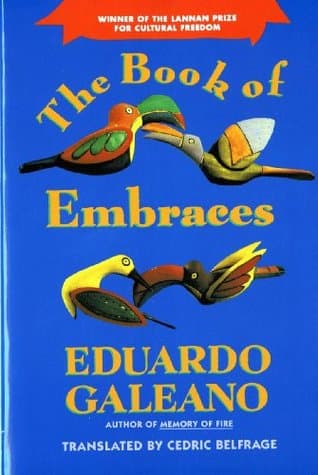
Core Idea
- Difficulty
- Medium
- Read it if
- You appreciate poetic prose, philosophical reflection, and a non-linear narrative structure that challenges conventional notions of history and truth through a collection of insightful, often poignant, short pieces. Ideal for those interested in Latin American perspectives, human rights, and the power of memory and imagination.
- Skip it if
- You prefer traditional academic arguments, a single overarching thesis developed systematically, or a strictly factual, chronological account. Not for readers who dislike highly fragmented narratives, allegory, or a blend of personal reflection, dreamscapes, and political commentary.
Key Takeaways from The Book of Embraces
The Power of Fragmented Truths
Truth is often found in the small, the overlooked, and the deeply personal.
Galeano shows that deep insights and universal truths can come from seemingly small moments, dreams, and personal stories. He uses a mosaic of interconnected fragments instead of grand narratives, suggesting that reality is not one thing but a collection of individual experiences and perceptions. This approach invites readers to find meaning not through direct teaching, but through how these diverse stories resonate with their own lives. It argues for the subjective nature of truth and the richness found in multiple perspectives, often highlighting voices marginalized by dominant historical accounts. The book itself shows that many small, potent truths can be more illuminating than a single, overarching idea.
“Each person is a world, a world of worlds, and each world contains a story, a story that deserves to be told.”
In the book: The entire structure of 'The Book of Embraces' is evidence, composed of hundreds of short, untitled vignettes, parables, and dreams rather than chapters or continuous narrative.
Try this: Cultivate a habit of noticing and valuing the small moments in your day. Keep a journal of dreams, overheard conversations, and personal reflections, recognizing that these fragments hold unique insights. Resist the urge to seek singular, definitive answers, instead embracing the complexity and multiplicity of perspectives in any situation.
Related ideas: fragmented-narrative, subjective-truth, personal-history
Memory as an Act of Creation
Remembering is not passive recall, but an active, imaginative reconstruction that shapes our present and future.
Galeano blurs the lines between memory, dream, and history, suggesting that our past is not fixed but a fluid landscape constantly reinterpreted by our present consciousness. He argues that remembering is an act of creation, where personal and collective histories are not just recounted but re-imagined and given new meaning. This creative act of memory is important for resisting forgetting, especially the stories of the oppressed and marginalized. By actively engaging with memory, we do not just preserve the past; we empower it to speak to the present, challenging dominant narratives and building empathy across time and experience. This dynamic view turns memory from a dusty archive into a living force.
“Memory is a mirror that makes us see ourselves, and a window that helps us see others. But it is also a forge that invents us, and a bridge that connects us.”
In the book: Galeano frequently recounts historical events through the lens of personal anecdotes or dreams, blending factual details with imaginative flourishes, such as 'The Right to Madness' or stories of forgotten heroes.
Try this: Actively engage with your personal and family history by interviewing elders, visiting old places, and reflecting on photographs, not just to recall facts, but to understand the emotional and personal resonances. When encountering historical accounts, question the perspective and consider what stories might have been omitted or reframed. Use storytelling to keep important memories alive, allowing them to evolve and gain new relevance.
Related ideas: collective-memory, historical-revisionism, narrative-identity
The Embrace of Contradiction
Life's deepest truths often reside in the tension between opposing forces.
Galeano's work thrives on paradox and contradiction, refusing to simplify complex realities into simple binaries. He embraces the tensions in human existence—joy and sorrow, hope and despair, freedom and oppression, love and hate—as essential parts of truth. Instead of trying to resolve these contradictions, he highlights their interplay, suggesting that real understanding comes from holding these opposing forces in dynamic balance. This perspective encourages a more nuanced view of the world, one that acknowledges life's messiness and complexity without becoming cynical. It is a call to find beauty and meaning not in uniformity, but in the vibrant, sometimes uncomfortable, dance of opposites.
“We are what we do to change what we are. And we are what we do to preserve what we are.”
In the book: Many of his short pieces present opposing ideas or situations in close proximity, such as 'The Right to Dream' juxtaposed with vignettes of harsh reality, or stories that show both the cruelty and profound kindness of humanity.
Try this: When faced with a difficult decision or a complex problem, resist the urge to choose one extreme over another. Instead, explore the validity of opposing viewpoints and seek to understand the underlying tensions. Practice holding conflicting emotions simultaneously, recognizing that sorrow can coexist with joy, and frustration with hope. Embrace ambiguity as a source of deeper insight, rather than a problem to be solved.
Related ideas: paradox, dialectics, ambiguity
The Subversive Power of the Ordinary
Revolutionary potential often lies hidden in everyday acts of resistance, love, and imagination.
Galeano consistently elevates the importance of seemingly minor events and ordinary people, showing their deep impact on the human spirit and history. He finds heroism not just in grand gestures but in quiet acts of defiance, the persistence of hope in bad situations, and the simple beauty of human connection. This perspective challenges the top-down view of history dominated by powerful figures and institutions. By focusing on the daily struggles and triumphs of common individuals, Galeano reminds us that change, both personal and societal, often begins with small, collective efforts and the human capacity for imagination and love, even when facing oppression.
“Many small people, in many small places, doing many small things, can change the world.”
In the book: Stories about anonymous individuals performing acts of kindness or defiance, such as a prisoner drawing a bird on a wall, or a woman finding joy in a simple meal despite poverty.
Try this: Recognize and celebrate the significance of your own small acts of kindness, creativity, and resistance. Don't underestimate the collective power of everyday choices and interactions to foster change. Seek out and amplify the stories of ordinary people who are making a difference in their communities, rather than solely focusing on grand narratives or celebrity figures.
Related ideas: grassroots-movements, everyday-resistance, human-dignity
Empathy Through Storytelling
Stories are powerful vehicles for transcending personal boundaries and fostering deep human connection.
Galeano's fragmented narrative style, while appearing disjointed, ultimately builds empathy. By presenting many diverse voices, experiences, and perspectives—often without explicit judgment—he invites the reader to understand others, to feel their joys and sorrows, and to grasp their struggles. His stories break down 'us vs. them' barriers, revealing the shared humanity beneath all differences. This is not just intellectual understanding; it is an emotional resonance that allows us to connect with others on a deep personal level. Through these vignettes, Galeano creates a collective consciousness, showing how shared narratives can weave us into a larger human fabric.
“A story is a bridge that connects us, a river that carries us, a mirror that shows us ourselves in others.”
In the book: His frequent shifts in perspective, from a child's dream to an old woman's lament, or a historical account of injustice, forcing the reader to constantly re-orient their emotional and intellectual viewpoint.
Try this: Actively seek out stories from diverse cultures and backgrounds, both through books and personal interactions. Practice active listening when others share their experiences, focusing on understanding their perspective rather than formulating a response. Use storytelling in your own life to connect with others, sharing personal anecdotes that reveal vulnerability and shared humanity.
Related ideas: narrative-empathy, collective-consciousness, interconnectedness
The Political Act of Imagination
Imagination is not an escape from reality, but a vital tool for challenging injustice and envisioning a better world.
For Galeano, dreaming, imagining, and creating are inherently political acts. In societies marked by oppression and despair, the ability to envision an alternative future, to hold onto hope, and to express oneself creatively becomes a powerful form of resistance. He argues that imagination allows us to transcend present limitations, critique existing power structures, and articulate the world as it could be, rather than just as it is. This is not escapism; it is a deep engagement with reality that seeks to reshape it. By including dreams and fantastical elements alongside harsh realities, Galeano shows that the human spirit's capacity for wonder and invention is essential for social change and liberation.
“The world is a pregnant woman, always giving birth to possibilities.”
In the book: His inclusion of dreams and fantastical elements ('The Right to Dream,' 'The Woman Who Dreamed') alongside stark political commentary and tales of suffering, suggesting they are equally valid and important parts of reality.
Try this: Engage in creative activities, whether writing, art, or music, as a means of personal and social expression. Allow yourself to dream big and imagine ideal futures, even if they seem impossible, as a way to clarify your values and goals. Support artistic and cultural initiatives that challenge norms and offer alternative visions of society, recognizing their role in fostering critical thought and hope.
Related ideas: utopian-thinking, cultural-resistance, creative-liberation
The Sacredness of the Human Body and Senses
Our bodies and senses are gateways to profound experience and understanding, often undervalued in modern life.
Galeano consistently grounds his philosophical explorations in the tangible world of the human body and its senses. He celebrates the tactile, the olfactory, the visual, and the auditory as essential ways of knowing and experiencing life. He often highlights moments where sensory details unlock deep emotional or spiritual truths, contrasting this with a modern tendency to intellectualize and abstract experience. This focus on the corporeal reclaims our full humanity, reminding us that understanding is not only in the mind, but in our complete engagement with the world through our physical being. It is a call to re-sensitize ourselves to the world's richness and to recognize the inherent sacredness in our embodied existence.
“We are made of stories, but also of flesh and blood, of senses that taste the world, touch the world, hear the world.”
In the book: Vignettes rich in sensory detail, describing the taste of food, the feel of a hand, the sound of music, or the smell of a place, often linking these to powerful memories or emotions.
Try this: Consciously engage your senses in everyday activities: truly taste your food, listen actively to sounds around you, notice textures and colors. Practice mindfulness exercises that focus on bodily sensations. Reconnect with activities that involve physical engagement and craftsmanship, recognizing the wisdom held within the body and its connection to the world.
Related ideas: embodied-cognition, sensory-experience, mindfulness
Challenging Official Histories
True history is often found in the margins, in the voices of the silenced and the stories suppressed by power.
Galeano is skilled at taking apart and challenging official narratives, especially those from colonial powers and oppressive regimes. He consistently seeks out counter-narratives, forgotten voices, and untold stories of those marginalized or erased from conventional history. This is not just an academic exercise; it is a moral imperative. By bringing these silenced histories to light, he exposes the biases in dominant historical discourse and shows how power shapes what is remembered and what is forgotten. His work reminds us that history is not a fixed record but a contested area, and that true understanding requires a continuous effort to listen to all voices, especially those on the periphery.
“History never says goodbye. History says, 'See you later.'”
In the book: Numerous anecdotes that retell historical events from the perspective of indigenous peoples, slaves, or ordinary citizens, often directly contradicting or adding nuance to accepted versions of history.
Try this: Actively seek out diverse historical perspectives beyond mainstream textbooks and media. Read works by authors from marginalized communities. Question the sources and biases of historical information you encounter. Support initiatives that preserve and promote the histories of underrepresented groups. Recognize that current events are often shaped by unacknowledged historical injustices.
Related ideas: postcolonialism, subaltern-studies, counter-history
The Enduring Quest for Meaning
Despite suffering and absurdity, the human spirit persistently seeks purpose and connection.
Throughout 'The Book of Embraces,' Galeano addresses the human need for meaning, even when facing great suffering, injustice, and life's inherent absurdity. His vignettes often highlight moments of deep existential longing, the search for connection, and the desire to leave a mark on the world. This quest is not presented as a grand philosophical endeavor, but as an intrinsic part of being human, expressed through love, art, resistance, and simple acts of being present. He suggests that meaning is not something found pre-made, but something actively created through our interactions with the world and each other. It shows the resilience of the human spirit, which, despite all odds, continues to seek purpose and beauty.
“What does the world want? It wants to be told. It wants to be loved. It wants to be made.”
In the book: The recurring themes of love, dreams, artistic expression, and the desire for justice that permeate the collection, even amidst stories of violence and despair.
Try this: Reflect on what truly gives your life meaning and actively pursue those activities or connections. Embrace moments of quiet contemplation and self-reflection to understand your deeper motivations. Engage in acts of creation, kindness, or advocacy that contribute to something larger than yourself. Recognize that finding meaning is an ongoing journey, not a fixed destination.
Related ideas: existentialism, human-condition, purpose-driven-life
The Earth as a Living Entity
Our planet is not merely a resource, but a sentient being with its own stories, wounds, and wisdom.
Galeano consistently gives the natural world sentience and personality, treating Earth not as an inanimate object but as a living entity that experiences, remembers, and reacts. He often personifies landscapes, rivers, and trees, linking their fate to humanity's and highlighting the deep interconnectedness between all forms of life. This perspective challenges an anthropocentric worldview, urging us to listen to the 'voice' of the land and to recognize our reciprocal relationship with our environment. By acknowledging Earth's capacity for memory and suffering, Galeano subtly critiques environmental destruction and advocates for a more respectful, empathetic relationship with the planet, suggesting that its stories are as vital as our own.
“The earth remembers. The earth suffers. The earth dreams.”
In the book: Stories where mountains speak, rivers lament, or trees hold ancient wisdom, often intertwined with narratives of indigenous peoples' connection to the land and the impact of colonial exploitation.
Try this: Spend time in nature with a mindful and respectful attitude, observing and listening as if the environment itself has something to communicate. Learn about and support indigenous perspectives on land stewardship. Advocate for environmental protection and sustainable practices, recognizing the long-term impact of human actions on the planet's health. Cultivate a sense of awe and reverence for the natural world.
Related ideas: ecocriticism, animism, environmental-ethics
The Book of Embraces Quotes
“The church says: the body is a sin. Science says: the body is a machine. Advertising says: the body is a business. The body says: I am a party.”
“Many small people, in many small places, doing many small things, can alter the face of the world.”
“To be free is to live without fear.”
“The first act of violence is to erase history.”
“Utopia is on the horizon. When I walk two steps, it retreats two steps. When I walk ten steps, it retreats ten steps. It is no use walking, I will never reach it. What is utopia for? It is for that: it is for walking.”
“Every person is a world, and every world is a person.”
“The right to dream is one of the most fundamental human rights.”
“The past is a memory that doesn't want to die.”
“To remember is to pass through the heart again.”
“The world is an immense book that has been written with tears and blood.”
“The greatest danger is not to dare.”
“Fear is a prison without walls.”
“They say that history repeats itself. It is a lie. History limps, but it does not repeat itself.”
“The journey is long and the road is hard, but the joy of walking is worth it.”
“We are all mortal, until the first kiss and the second glass of wine.”
Quiz
10 questions on the main ideas. Each answer comes with a short explanation.
Question 1
In 'The Book of Embraces,' what common form does Galeano often use to convey his observations and reflections?
- Academic essays with extensive footnotes
- Short, poetic vignettes, parables, and anecdotes
- Traditional linear narrative novels
- Scientific reports with empirical data
Show answer
B. Short, poetic vignettes, parables, and anecdotes Galeano's 'The Book of Embraces' is characterized by its mosaic structure of brief, evocative pieces that blend different literary forms to create a unique narrative style.
Question 2
Galeano frequently explores the theme of memory in 'The Book of Embraces.' What is one of his key arguments about memory's role?
- Memory is a purely objective record of past events.
- Memory is a political act, essential for resistance and identity.
- Memory is a burden that prevents progress.
- Memory is primarily a tool for personal nostalgia.
Show answer
B. Memory is a political act, essential for resistance and identity. Galeano often portrays memory as a vital force, especially for marginalized peoples, to remember their history, resist oppression, and shape their future, making it a profoundly political act.
Question 3
Which of the following best describes Galeano's overall philosophical stance in 'The Book of Embraces' regarding human potential?
- A cynical view, emphasizing the futility of human effort.
- An affirmation of human possibility and the power of small acts.
- A neutral, observational perspective without judgment.
- A focus on individual isolation and detachment.
Show answer
B. An affirmation of human possibility and the power of small acts. The book is celebrated for its 'exuberant world view and affirmation of human possibility,' often highlighting the significance of ordinary people and their everyday acts of resistance and creation.
Question 4
In the anecdote about 'The Function of Art,' a boy asks his father what art is for, and the father replies, 'It's for walking.' What concept does this parable primarily illustrate?
- Art is a luxury item for the wealthy.
- Art helps us to move, to transcend, and to see beyond our immediate reality.
- Art is only valuable if it depicts literal journeys.
- Art is primarily for physical exercise.
Show answer
B. Art helps us to move, to transcend, and to see beyond our immediate reality. This parable suggests that art's purpose is not merely aesthetic but transformative, enabling us to 'walk' or move towards new understandings, perspectives, and possibilities, embodying a core philosophical idea of the book.
Question 5
Galeano often uses dreams and surreal imagery. What is the typical effect or purpose of these elements in the book?
- To confuse the reader and obscure meaning.
- To highlight the hidden truths, desires, and subconscious realities.
- To provide comic relief from serious topics.
- To illustrate the author's detachment from reality.
Show answer
B. To highlight the hidden truths, desires, and subconscious realities. Dreams and surreal elements in Galeano's work often serve to break free from conventional logic, revealing deeper, often suppressed, truths about human experience, injustice, and longing.
Question 6
Consider the recurring motif of 'embraces.' What does an 'embrace' symbolically represent in Galeano's philosophical framework?
- A surrender to fate and inaction.
- A connection, solidarity, and recognition of shared humanity.
- A sign of weakness and vulnerability.
- A physical act devoid of deeper meaning.
Show answer
B. A connection, solidarity, and recognition of shared humanity. The 'embrace' in the title and throughout the book symbolizes the profound human need for connection, solidarity, empathy, and the recognition of our shared existence and struggles.
Question 7
Galeano's work is deeply rooted in Latin American history and culture. How does he typically integrate this context into his philosophical reflections?
- By exclusively focusing on pre-colonial myths.
- By using specific historical events and personal experiences as microcosms for universal truths.
- By providing academic historical analyses.
- By ignoring contemporary political issues.
Show answer
B. By using specific historical events and personal experiences as microcosms for universal truths. Galeano masterfully weaves personal anecdotes, historical fragments, and cultural references from Latin America into his broader philosophical inquiries, making the specific resonant with the universal.
Question 8
In the story 'The Right to Rave,' Galeano lists various 'rights' that seem absurd to conventional society, such as the right to be serious when one is not. What is the underlying philosophical argument behind these 'rights'?
- A call for anarchic chaos and disorder.
- A critique of oppressive norms and a defense of individual freedom and imagination against rigid systems.
- A literal demand for these specific rights to be enacted into law.
- An argument for complete moral relativism.
Show answer
B. A critique of oppressive norms and a defense of individual freedom and imagination against rigid systems. This piece is a powerful satirical critique of societal constraints and a passionate defense of human imagination, playfulness, and the freedom to defy conventional expectations, challenging what is considered 'normal' or 'rational'.
Question 9
Galeano often presents paradoxes, such as the idea that 'we are what we do to change what we are.' What is the philosophical implication of such statements?
- Human identity is fixed and unchangeable.
- Our identity is not static but constantly shaped by our actions and resistance against existing realities.
- Paradoxes are merely linguistic tricks without deeper meaning.
- Actions are irrelevant to self-definition.
Show answer
B. Our identity is not static but constantly shaped by our actions and resistance against existing realities. This paradox highlights Galeano's belief in the active, dynamic nature of identity. We define ourselves not just by our current state but by our ongoing efforts to challenge, transform, and create, particularly in the face of oppression.
Question 10
How does 'The Book of Embraces' encourage a practical application of its philosophical ideas in the reader's life?
- By providing a step-by-step guide to political activism.
- By inspiring readers to question dominant narratives, value small acts of resistance, and seek deeper human connections.
- By advocating for a withdrawal from social engagement.
- By instructing readers to memorize historical facts.
Show answer
B. By inspiring readers to question dominant narratives, value small acts of resistance, and seek deeper human connections. While not a literal instruction manual, the book's cumulative effect is to inspire readers to adopt a more critical, empathetic, and imaginative approach to life, encouraging them to find meaning and agency in their own experiences and connections, and to challenge injustices.
The Book of Embraces FAQ
What is 'The Book of Embraces' about?
'The Book of Embraces' is a unique collection of short texts, parables, anecdotes, dreams, and autobiographical fragments by Eduardo Galeano. It offers a mosaic of human experiences, injustices, and hopes, ultimately serving as an affirmation of human possibility and a call for empathy and social justice.
Does 'The Book of Embraces' have a linear narrative?
No, 'The Book of Embraces' does not follow a traditional linear narrative. Instead, it is structured as a series of interconnected, yet independent, short pieces that can be read in any order, each contributing to a larger thematic tapestry.
What is the meaning of 'embrace' in the book's title?
The 'embrace' in the title symbolizes connection, solidarity, understanding, and the act of holding onto humanity, memory, and hope in the face of adversity. It represents Galeano's philosophy of interconnectedness and the power of human bonds.
How does 'The Book of Embraces' differ from conventional philosophy books?
Unlike conventional philosophy books that often present arguments in a structured, academic manner, Galeano's work uses poetic language, stories, and personal reflections to convey philosophical insights. It prioritizes emotional resonance and evocative imagery over systematic argumentation.
Does 'The Book of Embraces' offer practical advice?
While not a self-help book, 'The Book of Embraces' offers profound insights into the human condition, social justice, and the power of memory, which can inspire readers to reflect on their own lives and perspectives. Its 'advice' is more existential and ethical than prescriptive.
What themes are explored in 'The Book of Embraces'?
The book explores a wide range of themes including memory, dreams, injustice, love, loss, hope, the power of storytelling, the struggles of Latin America, and the beauty and fragility of human existence. It weaves these themes together to create a rich tapestry of human experience.
Is 'The Book of Embraces' suitable for readers new to Galeano's work?
Yes, 'The Book of Embraces' is an excellent entry point for readers new to Eduardo Galeano. Its fragmented, poetic style allows for easy engagement with his unique voice and philosophical outlook without requiring prior knowledge of his other works.
How is 'The Book of Embraces' different from a collection of short stories?
While it contains many short narratives, 'The Book of Embraces' is more than a simple collection of short stories. Each piece, whether an anecdote, dream, or reflection, serves to build a broader worldview and philosophical statement, often blurring the lines between fiction, essay, and poetry.
Does 'The Book of Embraces' work as an audiobook?
Given its episodic and poetic nature, 'The Book of Embraces' translates very well to an audiobook format. The individual pieces are easily digestible in audio, making it a contemplative and engaging listening experience.
About the author
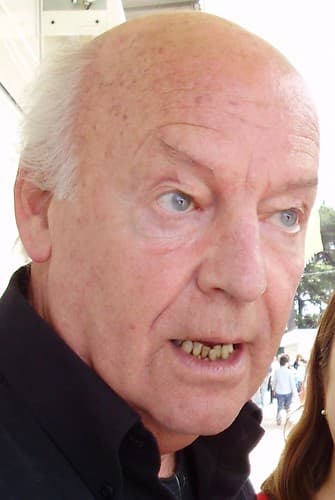
Eduardo Galeano was a Uruguayan writer and journalist known for his works that explore themes of history, politics, and identity in Latin America. His notable books include "Open Veins of Latin America," which examines colonialism and exploitation, "The Book of Embraces," a collection of reflections and stories, "Soccer in Sun and Shadow," which delves into the cultural significance of soccer, and "Genesis," a narrative that intertwines myth and history.
Similar books
- Open Veins of Latin America
Eduardo Galeano
4.3 (15k) average on GoodreadsPoliticsShares Galeano's critical perspective on history and power, though 'Embraces' is more poetic and personal.
- Ways of Seeing
John Berger
3.9 (251k) average on GoodreadsHistoryOffers a critical, humanistic lens on perception, culture, and power, presented in an accessible, thought-provoking manner.
- 1984
George Orwell
4.2 (3.1M) average on GoodreadsPoliticsIn a future where surveillance and thought control are absolute, a man's search for truth clashes with the Party, showing that hope can be a form of rebellion.
- Animal Farm
George Orwell
4.0 (2.7M) average on GoodreadsPoliticsA farm animals' rebellion against humans turns into a pig-led dictatorship, showing how power corrupts and revolutionary ideals are betrayed.
- Freakonomics: A Rogue Economist Explores the Hidden Side of Everything
Steven D. Levitt
4.0 (709k) average on GoodreadsBusinessThis book uses economic principles to reveal the surprising incentives behind everything from drug dealing and real estate to cheating teachers and the decline of crime.
- I Am Malala: The Story of the Girl Who Stood Up for Education and Was Shot by the Taliban
Malala Yousafzai
4.1 (419k) average on GoodreadsPoliticsA teenage girl from a Taliban-controlled valley refuses to give up her books, becoming a global voice for education even after an assassination attempt.





Enjoyed the summary?
A summary gives you the shape of the book. The book itself has the detail, the examples and the voice.
Find The Book of Embraces on AmazonAs an Amazon Associate, BookBrief earns from qualifying purchases. How we're funded