
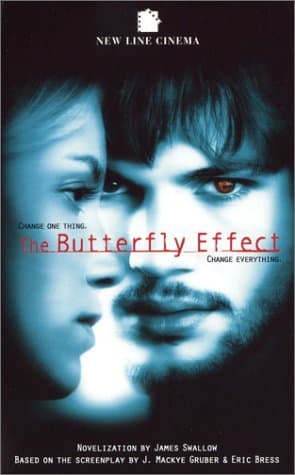
Synopsis
Covers the whole plot, including the ending.
- Difficulty
- Medium
- Pacing
- Variable
- Mood
- Dark, Disturbing, Melancholy, Intense, Psychological
- Read it if
- You enjoy dark, thought-provoking science fiction with a strong psychological element and are prepared for a bleak, complex narrative about the consequences of altering the past.
- Skip it if
- You prefer lighthearted stories, are sensitive to themes of child abuse and suicide, or dislike narratives with a consistently dark and often depressing tone.
The Butterfly Effect Plot Summary
Covers the whole plot, including the ending.
A Troubled Present and a Desperate Idea
Evan Treborn, a college student, has severe memory blackouts and emotional instability, which impacts his relationships, especially with his childhood sweetheart, Kayleigh Miller. He has vague, disturbing recollections of his past but cannot make sense of them. Frustrated by his current struggles and the pain of his loved ones, Evan discovers that by reading entries from his old childhood journals, he can mentally go back in time to inhabit his younger self. This ability lets him influence past events with his adult consciousness. He believes this power can help him fix his and his friends' broken lives, starting with an attempt to retrieve a crucial memory.
The First Ripple: Changing the Basement Incident
Evan's first attempt to alter the past involves the traumatic 'basement incident' where Kayleigh's abusive father, George Miller, forces Evan and Kayleigh to pose for a child pornography video. As his adult self in his childhood body, Evan tries to defy George and protect Kayleigh. He screams for help and tries to fight back, hoping to prevent the abuse. While he stops the specific filming incident, the immediate outcome is not what he expects. Instead of improving Kayleigh's life, his interference leads to George violently attacking Evan's mother, Andrea. This initial change, though seemingly positive in one way, immediately shows the unpredictable and often negative repercussions of altering the past, hinting at the 'butterfly effect'.
A New Reality: Kayleigh's Fate and Tommy's Rage
After his first intervention, Evan wakes up in a new present-day reality. He finds that Kayleigh, instead of being his college sweetheart, is now a heroin-addicted prostitute, completely estranged from him. His childhood friend, Lenny Kagan, is still traumatized, but their other friend, Tommy Miller (Kayleigh's brother), has become a violent, rage-filled psychopath, now in prison for murder. Evan's attempt to prevent the basement incident inadvertently led to a different, equally devastating set of circumstances for his friends. The direct link between his past action and the present's chaos becomes clear, forcing Evan to realize the instability of time and memory, and the danger of his new ability.
The Dog Incident and its Fallout
Determined to save Kayleigh and Tommy, Evan travels back to another pivotal moment: when Tommy, as a child, brutally killed a dog by setting it on fire. In this past, Evan, as his adult self, intervenes by grabbing the dog and running, preventing Tommy from committing the act. This intervention, however, has severe, immediate consequences. The dog, frightened, bites Evan, and the incident leads to Tommy being sent away to a strict military-style camp by his father, George, as punishment for his violent tendencies. This change aims to steer Tommy away from violence, but as Evan will soon discover, the universe often rebalances itself, sometimes brutally.
The Fraternity Life and Kayleigh's Suicide
Waking up in the present after preventing the dog incident, Evan finds himself in a seemingly ideal college life. He is a popular fraternity brother, financially stable, and has a bright future. However, the joy is short-lived. He soon learns that Kayleigh, in this timeline, is his girlfriend but suffers from severe depression and ultimately commits suicide by jumping off a bridge. This devastating outcome shows that even when Evan's personal life improves, his interventions often lead to tragic consequences for those he cares about most. The 'perfect' life he created for himself came at the cost of Kayleigh's existence, highlighting the moral dilemma of his actions.
Lenny's Trauma and the Bomb Incident
Evan next focuses on Lenny, who has been traumatized in every timeline. He recalls a past event where he, Tommy, and Lenny, as children, played with a homemade bomb that exploded, maiming Lenny. Evan travels back to this moment, determined to prevent Lenny's injury. He tries to stop the explosion by throwing the bomb away, but in his attempt, the bomb explodes in his own hands, causing him to lose both hands. This drastic self-sacrifice, while saving Lenny, leads to an incredibly dark and challenging present for Evan. It proves that even direct intervention with self-harm doesn't guarantee a positive outcome for others.
Prison Life and a Desperate Plea
After the bomb incident, Evan wakes up in the present as a double amputee, confined to a mental institution. His body is scarred, and his mind is fractured from the repeated temporal shifts. In this reality, he is heavily medicated and believed to be delusional due to his claims of time travel. He tries to explain his situation to a doctor, recounting his past interventions and the resulting chaos. The doctor dismisses his story as psychosis. Desperate, Evan manages to get hold of a journal and attempts another jump, hoping to find a path to a better future, despite the immense personal cost.
The Diner Confrontation and Tommy's Revenge
Evan travels back to a crucial moment where Tommy, fueled by years of abuse and rage, confronts and murders his father, George, in a diner. Evan, as his younger self, tries to intervene and prevent Tommy from committing the murder. In this timeline, Evan attempts to disarm Tommy or distract him. However, Tommy's rage is too deep. Instead of killing George, Tommy turns his knife on Evan, stabbing him repeatedly and killing him in the diner. This brutal outcome shows the futility of Evan's efforts when confronting deeply ingrained psychological damage and the inherent violence of some of his friends' paths.
The Final Sacrifice: Erasing Himself
After experiencing multiple horrific timelines, Evan realizes that his very existence, and his attempts to fix things, are the root cause of everyone's suffering. He concludes that the only way to truly save Kayleigh, Tommy, and Lenny from their tragic fates is to prevent himself from ever being born. He finds a memory of his mother, Andrea, pregnant with him, having a conversation with his father, Jason, in a hospital. This is the moment he chooses for his final, most drastic intervention.
The Hospital and the Umbilical Cord
Evan makes his final journey, traveling back to the moment of his own birth. As an infant, he uses his adult consciousness to deliberately strangle himself with his own umbilical cord in the womb, ensuring he is stillborn. This ultimate act of self-sacrifice erases his existence from the timeline, effectively preventing all the subsequent suffering and trauma that his life and his temporal interventions caused. It is a bleak but definitive solution to the chaotic butterfly effect he unleashed.
A World Without Evan
The film concludes with a montage showing the new, untroubled lives of his friends in a reality where Evan never existed. Kayleigh and Tommy are shown as happy, well-adjusted adults, having grown up without the traumas they experienced in every previous timeline. Lenny is also seen living a normal, healthy life. Evan's sacrifice successfully created a future where his loved ones could thrive, free from the dark influences of George Miller and the chaotic ripples of Evan's time-traveling interventions. The ending is bittersweet, as it confirms the success of his mission but at the cost of his own existence and any memory of him.
The Butterfly Effect Characters
Evan Treborn
Protagonist
A young man with the ability to alter his past through his childhood journals.
Evan is a complex and deeply troubled young man, plagued by severe memory blackouts and the psychological scars of a traumatic childhood. He is driven by a profound desire to protect and save those he loves, particularly Kayleigh, Tommy, and Lenny. Despite his intelligence and good intentions, his repeated attempts to alter the past inadvertently create increasingly chaotic and tragic alternate realities. He is compassionate, but his actions are often reckless due to his desperation.
Relationships: Kayleigh Miller (Childhood sweetheart, object of his protection); Tommy Miller (Childhood friend, object of his protection, often antagonist); Lenny Kagan (Childhood friend, object of his protection); Andrea Treborn (Devoted mother); Jason Treborn (Estranged, mentally ill father)
Kayleigh Miller
Supporting
Evan's childhood sweetheart, whose life is repeatedly devastated by his interventions.
Kayleigh is a fragile and deeply damaged character, a victim of her abusive father, George. She is Evan's primary love interest and the main impetus for many of his attempts to change the past. In various timelines, she is portrayed as everything from a loving girlfriend to a prostitute, a suicide victim, or a happy, well-adjusted woman. Her fate is inextricably linked to Evan's actions, and her suffering fuels his desperation.
Relationships: Evan Treborn (Love interest, protector/destroyer); Tommy Miller (Brother); George Miller (Abusive father)
Tommy Miller
Supporting
Kayleigh's brother and Evan's childhood friend, prone to violence and trauma.
Tommy is a volatile and deeply troubled character, scarred by his abusive father and his own inherent violent tendencies. In different timelines, he ranges from a violent psychopath to a relatively normal, well-adjusted individual. He is often a source of fear and danger, but also a victim of his circumstances. Evan's attempts to save him frequently backfire, leading to more extreme versions of his destructive behavior.
Relationships: Evan Treborn (Childhood friend, sometimes victim, sometimes aggressor); Kayleigh Miller (Sister); George Miller (Abusive father)
Lenny Kagan
Supporting
Evan's timid childhood friend, often a victim of the group's traumatic experiences.
Lenny is the most timid and vulnerable of Evan's childhood friends. He is consistently traumatized by the events of his youth, often suffering physical or psychological harm due to the group's dangerous activities or the actions of others. He represents the innocent bystander caught in the crossfire of Evan's attempts to fix the past. His quiet nature makes him a sympathetic figure whose suffering further motivates Evan.
Relationships: Evan Treborn (Childhood friend, protector/cause of trauma); Kayleigh Miller (Childhood friend); Tommy Miller (Childhood friend)
Andrea Treborn
Supporting
Evan's loving and protective mother, who struggles with her son's psychological issues.
Andrea is a caring and devoted mother who deeply loves Evan. She is constantly worried about his blackouts and psychological health, often seeking medical help for him. She is fiercely protective, especially after her husband's institutionalization. In some timelines, she suffers direct consequences of Evan's interventions, such as physical abuse, showcasing the collateral damage of his actions.
Relationships: Evan Treborn (Son); Jason Treborn (Mentally ill husband)
George Miller
Antagonist
Kayleigh and Tommy's abusive and predatory father.
George Miller is the primary human antagonist, a deeply disturbed and abusive man. He is responsible for the severe trauma inflicted upon Kayleigh, Tommy, and Evan during their childhoods. His actions, particularly the child pornography incident and his general cruelty, serve as the initial catalyst for Evan's desire to change the past. He represents the dark, inescapable forces of evil that Evan tries to eradicate.
Relationships: Kayleigh Miller (Abused daughter); Tommy Miller (Abused son); Evan Treborn (Victim of his abuse)
Jason Treborn
Mentioned
Evan's institutionalized father, who also possessed the ability to time travel.
Jason Treborn is Evan's father, who is institutionalized for what is believed to be mental illness but is later revealed to be the same time-traveling ability as Evan. He foreshadows Evan's struggles and ultimate fate, having tried to prevent his own birth to save his family. His presence, though mostly in flashbacks or as a cautionary tale, highlights the hereditary nature and tragic consequences of their shared power.
Relationships: Evan Treborn (Son, shares similar abilities and fate); Andrea Treborn (Wife)
The Butterfly Effect Themes
The Butterfly Effect and Unintended Consequences
This is the central theme, showing how even the smallest change in the past can lead to massive, unpredictable, and often devastating alterations in the present. Evan's repeated attempts to 'fix' his friends' lives consistently result in worse outcomes, demonstrating the futility and danger of tampering with causality. For example, preventing Kayleigh's sexual abuse in one timeline leads to her becoming a prostitute in another, and saving Lenny from the bomb results in Evan losing his hands. The film shows how every intervention creates a new, often darker, reality.
“For every action, there is an equal and opposite reaction. Only with this, there is no equal and opposite reaction. There are only consequences.”
Trauma and Repressed Memory
The film explores the impact of childhood trauma on adult lives and the psychological mechanisms of repression. Evan's blackouts are a manifestation of his mind's attempt to cope with unbearable memories. His journey is initially driven by a need to recall and understand these repressed events, believing that knowledge will bring healing. The repeated exposure to his past traumas, even as an adult consciousness, further fragments his mind, showing how trauma can persist and even deepen through reliving it, regardless of the intention to change it.
“They say you can never go home again. I say you can, but you'll never be the same.”
Fate vs. Free Will
The narrative constantly grapples with whether individuals can truly escape their predetermined destinies or if certain tragic events are inevitable. Despite Evan's best efforts and sacrifices, his friends often find themselves in equally dire, though different, circumstances. This suggests a powerful underlying current of fate or a universal equilibrium that resists drastic alteration. Evan's eventual conclusion, that his own existence causes the chaos, leans towards a fatalistic view where some outcomes are inescapable unless the very catalyst for change is removed.
“God doesn't want me to fix it. He wants me to break it.”
Sacrifice and Selflessness
Evan's journey culminates in the ultimate act of self-sacrifice. Initially, his interventions are somewhat self-serving, aimed at creating a better life for himself and his loved ones. However, as the consequences escalate, he realizes that the only way to truly save his friends is to erase himself from existence, preventing all the trauma he inadvertently caused. This transformation from a well-intentioned but flawed individual to a selfless martyr shows that true love and protection sometimes demand the greatest personal cost, even one's very being.
“The only way to save the people I love is to erase myself.”
Plot Devices & Literary Techniques
Journaling / Written Records
The physical medium through which Evan triggers his time-travel ability.
Evan's childhood journals, home videos, and photographs serve as the literal portals to his past. By reading or viewing these records, his adult consciousness is transported back to the exact moment they were created, inhabiting his younger self. This device grounds the fantastical element in a tangible, relatable action, making his ability feel more like a psychological phenomenon tied to memory and documentation rather than a purely scientific one. It also highlights the power of memory and the past to shape the present.
Memory Blackouts
Evan's symptom of repressed trauma and a narrative tool for revealing information.
Evan's severe memory blackouts serve multiple functions. Initially, they are a symptom of his deep-seated childhood trauma, hinting at the disturbing events he cannot recall. Narratively, they create suspense, as the audience, like Evan, is piecing together the fragmented past. They also explain why Evan doesn't fully remember the 'original' timeline, allowing for the reveal of new, altered realities with each jump. The blackouts underscore the psychological toll of his past and his unique ability.
Alternate Timelines / Multiverse
The consequence of Evan's time travel, creating distinct parallel realities.
Each time Evan alters the past, an entirely new and distinct timeline is created, showcasing a 'multiverse' of possibilities stemming from his interventions. This device is crucial for demonstrating the 'butterfly effect' in action, as Evan witnesses vastly different outcomes for himself and his friends. It allows the film to explore various 'what if' scenarios, highlighting the unpredictable nature of causality and the profound impact of even minor changes, ultimately leading to Evan's conclusion that no single 'perfect' timeline can be achieved through his actions.
Hereditary Time Travel / 'Gift'
The genetic predisposition for Evan's ability, inherited from his father.
The revelation that Evan's father, Jason, possessed the same time-traveling ability and also attempted to prevent his own birth adds a layer of tragic inevitability to Evan's plight. This device suggests that the 'gift' is also a curse, a genetic predisposition to a power that inevitably leads to self-destruction. It foreshadows Evan's ultimate fate and explains the source of his unique ability, grounding it in a familial, almost fated, context rather than a random occurrence.
The Butterfly Effect Quotes
“Every choice, no matter how small, sends ripples through the fabric of reality.”
“The past isn't just prologue; it's a living, breathing entity that can be rewritten.”
“Sometimes, the greatest good comes from the smallest, most unexpected alteration.”
“Fear is the mind-killer, but regret is the soul-crippler.”
“The universe doesn't forget. It just rearranges the pieces.”
“To truly understand a moment, you must understand all the moments that led to it.”
“Every decision is a gamble, especially when you're playing with causality.”
“The future is not set. It's a tapestry woven with threads of possibility.”
“Even the smallest change can unravel a carefully constructed lie.”
“The weight of what could have been is often heavier than the weight of what is.”
“Sanity is a fragile thing when you remember histories that never happened.”
“Sometimes, the only way to save a world is to let a part of it die.”
“The greatest power isn't to change the past, but to learn from it.”
“A single moment of courage can redefine an entire lifetime.”
Quiz
10 questions on the plot and the characters. Each answer comes with a short explanation.
Question 1
What is the primary motivation for the protagonist to travel back in time?
- To gain immense wealth and power.
- To escape a dystopian future.
- To mend the broken lives of those closest to him and resolve his repressed childhood memories.
- To prevent a global catastrophe.
Show answer
C. To mend the broken lives of those closest to him and resolve his repressed childhood memories. The book description explicitly states the protagonist's goal is 'to mend the broken lives of those closest to him' and implies this is linked to his 'repressed childhood memories'.
Question 2
What is the immediate consequence of each trip the protagonist makes into the past?
- He gains new, beneficial abilities.
- He discovers hidden family secrets.
- It brings chaotic results into the present.
- He loses a part of his memory.
Show answer
C. It brings chaotic results into the present. The book summary clearly states that 'every trip into the past brings chaotic results into the present'.
Question 3
What specific technique does the protagonist devise to travel back in time?
- He uses a complex time machine built in his laboratory.
- He performs a ritual involving ancient artifacts.
- He devises a technique of traveling back in time to inhabit his childhood body.
- He experiences spontaneous, uncontrolled jumps through time.
Show answer
C. He devises a technique of traveling back in time to inhabit his childhood body. The provided description states he 'devises a technique of traveling back in time to inhabit his childhood body'.
Question 4
The constant time travel leads to what overall negative effect for the protagonist and his timeline?
- He becomes immortal.
- It causes irreparable damage.
- He gains the ability to predict the future.
- He develops a new personality.
Show answer
B. It causes irreparable damage. The summary concludes that the repeated time travel leads to 'irreparable damage'.
Question 5
Which psychological concept is central to the protagonist's initial struggles and motivations?
- Cognitive dissonance.
- Stockholm Syndrome.
- Repressed childhood memories.
- Obsessive-compulsive disorder.
Show answer
C. Repressed childhood memories. The description explicitly mentions the protagonist 'struggling with the psychological effects of his repressed childhood memories'.
Question 6
What is the core paradox highlighted by the protagonist's repeated attempts to fix the past?
- The more he tries to change the past, the more it stays the same.
- Each attempt to improve the past only leads to further deterioration and chaos in the present.
- He can only change minor details, not major events.
- His past self resists his interventions.
Show answer
B. Each attempt to improve the past only leads to further deterioration and chaos in the present. The summary states 'every trip into the past brings chaotic results into the present, leading him to travel back again and again and causing irreparable damage', illustrating this paradox.
Question 7
The genre blend of 'Psychology, Fantasy, Science Fiction' suggests that the time travel mechanism is likely:
- Purely magical, without any scientific explanation.
- Strictly grounded in hard science and theoretical physics.
- A blend of a scientifically-conceived method (Science Fiction) with perhaps an element of the impossible or unexplained (Fantasy), all driven by psychological motivations (Psychology).
- A dream sequence that the protagonist never actually escapes.
Show answer
C. A blend of a scientifically-conceived method (Science Fiction) with perhaps an element of the impossible or unexplained (Fantasy), all driven by psychological motivations (Psychology). The combination of genres indicates that the time travel, while a 'technique', might not be purely scientific and could incorporate fantastical or unexplained elements, all serving a psychological narrative.
Question 8
Given the title 'The Butterfly Effect', what specific scientific concept is the novel most likely exploring in relation to time travel?
- Quantum entanglement.
- The theory of relativity.
- Chaos theory, where small changes in initial conditions can lead to large differences in later states.
- String theory.
Show answer
C. Chaos theory, where small changes in initial conditions can lead to large differences in later states. The 'Butterfly Effect' is a well-known concept from chaos theory, directly relating to how small changes in the past ('chaotic results') can have significant, unpredictable impacts on the future.
Question 9
The protagonist's repeated attempts to fix the past despite worsening outcomes suggest a struggle with what psychological pattern?
- Learned helplessness.
- Cognitive rigidity and a compulsion to repeat, despite negative reinforcement.
- The Dunning-Kruger effect.
- Projection.
Show answer
B. Cognitive rigidity and a compulsion to repeat, despite negative reinforcement. His continuous travel 'again and again' despite 'chaotic results' and 'irreparable damage' indicates a compulsive, rigid pattern of behavior, failing to adapt despite negative feedback, which aligns with cognitive rigidity and compulsion.
Question 10
Considering the themes, what might be a central philosophical question the novel poses about human agency and the past?
- Is it possible to achieve true happiness by ignoring one's past?
- Does altering the past ultimately diminish one's true identity, or is the past immutable and beyond human control?
- Is the future predetermined regardless of past actions?
- Can technological advancement truly solve all human problems?
Show answer
B. Does altering the past ultimately diminish one's true identity, or is the past immutable and beyond human control? The core conflict revolves around the protagonist's attempts to change the past and the 'irreparable damage' it causes, directly questioning the nature of the past and the extent of human power over it, and by extension, one's self.
The Butterfly Effect FAQ
What is the core premise of 'The Butterfly Effect' by James Swallow?
The book centers on a young man named Alex who develops a method to time-travel into his childhood self. His primary motivation is to rectify past traumas and mistakes that have haunted him and those he cares about, believing he can create a better present by altering key moments in his past.
What kind of technology or method does Alex use to travel back in time?
Alex's method of time travel is not technological in the traditional sense, but rather a mental or consciousness-based technique. He doesn't build a machine; instead, he projects his adult consciousness back into his younger body, re-experiencing and influencing events from within his past self.
What are the immediate consequences Alex faces after his initial attempts to change the past?
Each alteration Alex makes, no matter how small or well-intentioned, leads to unforeseen and often catastrophic changes in his present reality. He finds that fixing one problem often creates several new, more complex ones, leading to a rapidly deteriorating and unfamiliar present.
Who are some of the key people in Alex's life he tries to help or save in the past?
Alex primarily focuses on his family and close friends. He attempts to prevent the tragic accident involving his sister, Sarah, and tries to mend the strained relationship between his parents, believing these events are foundational to his own psychological struggles.
What is the central irony of Alex's repeated time travel attempts?
The central irony is that in his desperate attempts to 'fix' his past and create a perfect present, Alex only causes more damage and chaos, ultimately leading to a present far worse than the one he started with. His interventions, driven by good intentions, become the very source of his undoing.
Is there a specific 'point of no return' for Alex, where the damage becomes irreversible?
While there isn't one single, explicit 'point of no return,' Alex continuously crosses thresholds where the changes become increasingly profound and difficult to untangle. Each subsequent jump makes the original timeline almost impossible to recover, pushing him further into a spiral of unintended consequences.
Are there any clues early on that hint at the true nature of Alex's repressed memories?
Subtle hints regarding the unreliability of Alex's initial memories and his intense emotional reactions to certain triggers suggest a deeper, more traumatic truth. His obsessive need to 'fix' things points to a profound guilt or unresolved trauma that he may be misremembering or repressing.
Does anyone else in the story know about Alex's time-traveling abilities?
Initially, Alex keeps his abilities a secret, as the very nature of his time travel often erases or alters the memories of others in the 'new' present. However, as the timelines fracture, there are moments where echoes or fragments of past realities might subtly influence characters, or he might inadvertently reveal hints.
What is the significance of the 'butterfly effect' concept in the book's title beyond literal time travel?
Beyond the literal time travel, the 'butterfly effect' metaphorically represents the profound and unpredictable impact of small actions on complex systems, particularly Alex's psyche. It highlights how seemingly minor childhood events can ripple through a life, shaping personality and future outcomes in unforeseen ways, even without temporal manipulation.
How do Alex's repressed childhood memories influence his initial desire to time travel?
Alex's repressed memories create a deep-seated psychological wound and a distorted perception of past events, driving his compulsion to 'correct' what he believes went wrong. He's not just trying to fix external events, but also to resolve his own internal turmoil and guilt stemming from these unresolved traumas.
What psychological toll does repeated time travel take on Alex?
Repeated time travel exacts a severe psychological toll on Alex, leading to increasing disorientation, memory fragmentation, and a loss of his own identity. He struggles to distinguish between different realities, leading to paranoia, existential dread, and a profound sense of isolation as his world continuously shifts.
How does the narrative explore the concept of guilt and responsibility through Alex's actions?
The narrative deeply explores guilt as Alex feels responsible for past misfortunes and believes he can undo them. However, his attempts to 'fix' things only amplify his guilt, as he becomes directly responsible for the escalating chaos, forcing him to confront the limits of his control and the true nature of responsibility.
Does Alex ever come to terms with his past without trying to change it?
The core struggle for Alex is learning to accept his past rather than trying to erase or rewrite it. The narrative explores whether he can achieve this acceptance, or if his obsession with control and his inability to process trauma will ultimately consume him, regardless of the timeline.
Is there a definitive 'original' timeline, or does the story suggest a more fluid reality?
The concept of a definitive 'original' timeline becomes increasingly ambiguous as Alex's actions multiply. The story leans towards a more fluid reality, suggesting that the very act of observation and intervention fundamentally alters what 'was,' blurring the lines between past, present, and potential futures.
Could Alex's time travel be interpreted as a metaphor for a mental breakdown or psychological coping mechanism?
Yes, Alex's time travel can certainly be interpreted metaphorically as a manifestation of a severe mental breakdown or a desperate psychological coping mechanism. The shifting realities and fragmented memories could represent his mind's struggle to process trauma, creating elaborate internal narratives to avoid confronting painful truths.
Does the book offer a hopeful ending, or is it more of a cautionary tale?
The book leans heavily towards being a cautionary tale, illustrating the dangers of tampering with fate and the psychological perils of unresolved trauma. While there might be moments of clarity or resolution for Alex, the overall message emphasizes the destructive consequences of his actions rather than a triumphant outcome.
What philosophical questions does the book raise about free will versus determinism?
The book raises profound questions about free will versus determinism by showing how Alex's attempts to exert his free will over the past paradoxically lead to predetermined, chaotic outcomes. It explores whether certain events are 'meant' to happen, or if every choice, even an attempt to change the past, is just another link in a causal chain.
How does the story comment on the nature of memory and its reliability?
The story strongly comments on the fallibility and subjective nature of memory. Alex's repressed and altered memories are the catalyst for his journey, and as timelines shift, his own recollection of events becomes increasingly unreliable, highlighting how our past is not a fixed record but a constantly reinterpreted narrative.
About the author

James Swallow is a fiction author known for his engaging storytelling. His book "The Butterfly Effect" explores themes of cause and effect in a narrative that captivates readers. Swallow's works often blend elements of suspense and intrigue, showcasing his skill in crafting compelling plots.
Similar books
- Replay
Ken Grimwood
4.2 (30k) average on GoodreadsFantasyExplores the concept of reliving one's life with knowledge of the past, though with a different focus on consequences.
- Dark Matter
Blake Crouch
4.0 (11k) average on GoodreadsFantasyInvolves alternate realities and the profound impact of small choices on one's life and the lives of loved ones.
- 11/22/63
Stephen King
4.3 (420k) average on GoodreadsThrillerWhile King's novel focuses on a single, monumental historical event with meticulous detail and explores the moral complexities of such an alteration, Swallow's 'The Butterfly Effect' examines multiple personal incidents, offering a broader, albeit less historically grounded, exploration of the butterfly effect's chaotic nature. King provides deeper character immersion within a fixed historical context, whereas Swallow prioritizes the dramatic shifts in reality resulting from numerous changes.
- The Time Traveler's Wife
Audrey Niffenegger
4.0 (1.6M) average on GoodreadsFantasyNiffenegger uses time travel primarily as a metaphor for the challenges and complexities of a romantic relationship, focusing on destiny and interpersonal connection. Swallow, conversely, centers on individual agency and the direct, often destructive, consequences of attempting to rectify past personal traumas. While both explore the impact of time on personal lives, Niffenegger's approach is more romantic and character-driven, while Swallow's is more plot-driven and cautionary about altering the past.
- The Perks of Being a Wallflower
Stephen Chbosky
4.2 (1.3M) average on GoodreadsPsychologyThrough letters, a shy high school freshman learns to navigate first love, trauma, and self-discovery, stepping off the sidelines and into life.
- Eleanor Oliphant Is Completely Fine
Gail Honeyman
4.3 (708k) average on GoodreadsLiterary FictionA lonely woman's structured life changes when an IT guy and an elderly man help her learn to open her heart.





Enjoyed the summary?
A summary gives you the shape of the book. The book itself has the detail, the examples and the voice.
Find The Butterfly Effect on AmazonAs an Amazon Associate, BookBrief earns from qualifying purchases. How we're funded