
Synopsis
Covers the whole plot, including the ending.
- Difficulty
- Easy
- Pacing
- Moderate
- Mood
- Thought-provoking, Melancholy, Allegorical, Reflective
- Read it if
- You are looking for a powerful and accessible allegory about colonization, environmental impact, and the loss of indigenous cultures, suitable for both children and adults.
- Skip it if
- You prefer light-hearted stories without allegorical or somber themes.
The Rabbits Plot Summary
Covers the whole plot, including the ending.
The Arrival of the Rabbits
The story begins with native creatures, like marsupials, living peacefully in their natural land. Their life is simple and in harmony with nature. One day, they see strange vessels on the horizon, carrying a new species: the Rabbits. These Rabbits are few at first and seem curious, watching the land and its animals from afar. The native creatures watch with a mix of wonder and worry as these newcomers start to settle on their shores. This is the first big change to their long-standing way of life.
Initial Interactions and Misunderstandings
At first, the native creatures try to understand the Rabbits. They watch their strange customs and tools, noticing their different ways of moving and interacting with the environment. The Rabbits bring unfamiliar objects and start to change the land subtly. The natives feel uneasy because the Rabbits' actions do not seem to respect the existing balance. Attempts to communicate or understand each other do not work. The Rabbits seem focused on their own plans, not on fitting in with the land's culture and environment. The natives' initial curiosity slowly turns into confusion and alarm.
Expansion and Resource Depletion
As time passes, the Rabbits' numbers grow quickly. They expand their settlements, building fences and structures that divide the land. They use resources greedily, cutting down trees, digging up the earth, and polluting the water. The native creatures watch helplessly as their familiar landscape changes. The food they once had in plenty decreases, and natural homes are destroyed. The Rabbits' growth is constant and uncontrolled. They do not care about the environmental impact of their actions, leaving the native inhabitants confused and increasingly without their ancestral lands.
Technological Domination
The Rabbits bring more advanced technology, like machines that move earth and weapons that make loud noises and cause damage. These tools give them a clear advantage and make their control over the land and its original inhabitants stronger. The native creatures, with their simple tools and traditional ways, cannot compete or resist the Rabbits' technology. The size and power of the Rabbits' machines are overwhelming. This shows how fast and damaging industrialization can be, pushing aside the natural world and its traditional protectors. This leaves the natives feeling powerless and exposed.
Cultural Erasure and Displacement
With their land taken and resources gone, the native creatures are pushed to the edges. Their traditional gathering places are destroyed, their sacred sites ignored, and their way of life becomes impossible to continue. They become observers in their own land, watching as the Rabbits bring their own culture, language, and systems. The once connected native communities are broken apart and isolated. Their songs and stories fade. The displacement is not just physical but also cultural and spiritual. This leads to a deep feeling of loss and separation among the original inhabitants, as they try to keep their identity amid the overwhelming changes.
Environmental Devastation
The Rabbits' presence causes terrible environmental damage. Green forests become stumps, rivers are polluted, and the air fills with smoke and noise. The delicate balance of nature is completely broken, leading to widespread emptiness. The bright colors of nature are replaced by the grey and brown of industry and barrenness. The native creatures see their home destroyed forever. A land that once gave them everything they needed now lies scarred and used. This shows the deep and lasting harm done to the environment by uncontrolled growth and resource use.
The Weight of Memory
In the end, the native creatures have little left but fading memories of what their land once was. They remember when the rivers were clear, the trees were tall, and the animals thrived. The difference between their past and the empty present is sharp and painful. They look at a land changed forever by the Rabbits' constant transformation. The story ends with a deep sense of loss and an unanswered question about the future. It makes the reader think about the results of such widespread destruction and the lasting effect on those who lost everything.
The Rabbits Characters
The Native Creatures
Protagonist
The marsupial-like original inhabitants of the land, representing Indigenous Australians.
These creatures are the original inhabitants of the land, living in harmony with nature. They are depicted as gentle, observant, and deeply connected to their environment, symbolizing the Indigenous peoples of Australia. Their initial reaction to the Rabbits is curiosity, which slowly turns to confusion, alarm, and eventually, profound sorrow and helplessness as their land is taken and destroyed. They represent the victims of colonization, experiencing cultural displacement, environmental devastation, and the loss of their traditional way of life.
The Rabbits
Antagonist
The introduced species representing European colonizers.
The Rabbits are the newcomers to the land, arriving by sea. They are characterized by their rapid multiplication, their relentless expansion, their advanced technology (ships, machines, weapons), and their insatiable consumption of resources. They represent the European colonizers of Australia, driven by a desire to conquer, exploit, and transform the land to suit their own needs, without regard for the existing inhabitants or the ecological balance. They are depicted as powerful and overwhelming, symbolizing the destructive forces of colonialism and industrialization.
The Rabbits Themes
Colonialism and Invasion
The book's main theme is the story of European colonization of Australia. The Rabbits arriving by sea, their fast growth, new culture and technology, and pushing out the native creatures directly reflect the British invasion of Australia. The story shows how one-sided this process was, where the colonizers did what they wanted without understanding or respecting the existing inhabitants and their connection to the land.
“We didn't know where they came from. We didn't know what they wanted.”
Environmental Destruction
The book clearly shows the damaging effect of human activity on nature. The Rabbits' actions—cutting trees, polluting rivers, digging up land, and building fences—show the wide environmental harm caused by uncontrolled industry and using too many resources. The change from a green, alive landscape to an empty, scarred one warns about people not caring for environmental sustainability and the lasting results of such actions.
“They ate our grass. They ate our trees. They brought their own food. They brought their own animals. And they brought their own diseases.”
Loss of Indigenous Culture and Identity
The story captures the deep loss Indigenous peoples felt because of colonization. The native creatures are pushed aside, their traditional life broken, and their link to their ancestral land cut. The book shows how culture is erased when a strong power forces its systems and values, leaving the original inhabitants with only memories and a feeling of being separated from their own heritage. Their songs and stories are replaced by the Rabbits' noise and buildings.
“They made roads. They made houses. They made fences. And we were no longer in our own country.”
The Power of Memory and History
Despite much destruction and displacement, the native creatures remember the past. These memories remind them strongly of what was lost and help them resist being completely forgotten. The book suggests that remembering history, even painful history, helps understand the present and think about the future. The last pages, talking about 'whispers of the past,' show that historical events have a lasting effect and must be acknowledged.
“Who are these rabbits? We asked. And where did they come from? We asked.”
Plot Devices & Literary Techniques
Allegory
The entire narrative functions as a symbolic representation of Australian colonization.
The entire book is an allegory. The 'Rabbits' represent European colonizers, particularly the British, and the 'native creatures' represent Indigenous Australians. The events in the story—arrival by sea, rapid expansion, resource exploitation, technological dominance, and displacement—symbolically parallel the historical events of the colonization of Australia. This device allows complex historical and social issues to be presented in a simplified, yet powerful and emotionally resonant way, particularly for younger audiences, making the injustice clear without being overly explicit.
Anthropomorphism
Animals are used to represent human groups and their actions.
Marsupial-like creatures and rabbits are used to represent human populations, specifically Indigenous Australians and European colonizers, respectively. This anthropomorphism helps to create a sense of distance and universality, allowing readers to engage with the difficult subject matter without immediate preconceptions tied to specific human races. It also emphasizes the 'animalistic' or instinctual drives behind colonization (e.g., rapid reproduction, territorial expansion, resource consumption) and the vulnerability of indigenous species.
Juxtaposition of Imagery
Contrasting visuals highlight the change from pristine nature to industrial desolation.
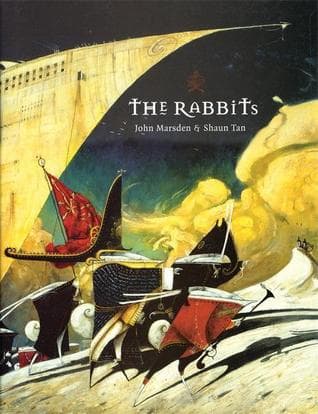
The book masterfully uses contrasting imagery to emphasize the devastating impact of the Rabbits. Early illustrations depict lush, vibrant landscapes with clear waters and abundant life, reflecting the harmonious existence of the native creatures. This is starkly juxtaposed with later images of barren land, smoke-filled skies, polluted rivers, and geometric industrial structures. This visual contrast powerfully conveys the theme of environmental destruction and the loss of natural beauty due to human intervention, reinforcing the narrative's emotional impact.
Repetitive Language and Rhetorical Questions
Simple, repetitive phrases build tension and emphasize the native creatures' confusion and despair.
The text employs simple, repetitive sentence structures, particularly questions like 'Who are these rabbits? We asked. And where did they come from? We asked.' and 'Where would it end? We asked.' This repetition creates a rhythmic, almost chant-like quality, echoing oral storytelling traditions. It also effectively conveys the native creatures' growing confusion, fear, and helplessness as they try to comprehend the incomprehensible actions of the Rabbits. The rhetorical questions serve to engage the reader and prompt reflection on the unanswered historical injustices.
The Rabbits Quotes
“The rabbits came many grandparents ago.”
“They didn't live in trees like we did.”
“They ate our grass. They chopped down our trees and scared away our friends.”
“They brought new animals that ate the grass and scared away our friends.”
“They didn't ask questions. They didn't speak our language.”
“They brought other animals with them, animals that trampled our crops.”
“They made their own houses, very tall houses, and they made roads and bridges and tunnels.”
“They didn't think like we did. They didn't feel like we did.”
“They took the children away.”
“They didn't understand us, and we didn't understand them.”
“They brought new food, and we ate it.”
“They brought new diseases, and we died.”
“We lost the fights. We lost the land. We lost the children.”
“They made a new country, but it wasn't ours.”
Quiz
10 questions on the plot and the characters. Each answer comes with a short explanation.
Question 1
In 'The Rabbits', what do the rabbits symbolize?
- Native Australian animals adapting to change
- European colonizers arriving in Australia
- Environmental conservationists
- Mythical creatures from Aboriginal folklore
Show answer
B. European colonizers arriving in Australia The rabbits are an allegory for European colonizers, representing their arrival, rapid spread, and destructive impact on Australia's environment and Indigenous cultures, as depicted through the story's events and imagery.
Question 2
What is the primary narrative perspective in 'The Rabbits'?
- First-person from a rabbit's viewpoint
- Third-person omniscient narrator
- First-person from an Indigenous Australian animal's viewpoint
- Second-person addressing the reader directly
Show answer
C. First-person from an Indigenous Australian animal's viewpoint The story is told from the perspective of Indigenous Australian animals, who observe and describe the rabbits' invasion and its devastating effects on their land and way of life, emphasizing the colonized viewpoint.
Question 3
Which of these events occurs as a direct result of the rabbits' arrival in the book?
- The native animals form an alliance with the rabbits
- The environment becomes more diverse and lush
- Widespread destruction of habitats and displacement of native species
- The rabbits quickly adopt Indigenous customs
Show answer
C. Widespread destruction of habitats and displacement of native species The rabbits' arrival leads to environmental devastation, including habitat destruction, pollution, and displacement of native animals, mirroring the historical impact of European colonization on Australia's ecosystems.
Question 4
How does the book illustrate the rabbits' technological advantage over the native animals?
- By showing the rabbits using simple tools like sticks and stones
- Through depictions of advanced machinery, ships, and industrial structures
- By having the rabbits communicate in a complex language
- By describing the rabbits as physically stronger and faster
Show answer
B. Through depictions of advanced machinery, ships, and industrial structures The rabbits are portrayed with advanced technology such as ships, machinery, and industrial infrastructure, symbolizing the technological superiority of European colonizers and their ability to rapidly transform and dominate the landscape.
Question 5
What theme is highlighted by the contrast between the rabbits' organized, industrial society and the native animals' harmonious existence?
- The benefits of modernization and progress
- The clash between industrialization and environmental sustainability
- The importance of cultural assimilation
- The inevitability of technological advancement
Show answer
B. The clash between industrialization and environmental sustainability This contrast underscores the theme of industrialization versus environmental sustainability, critiquing how colonizers' industrial practices disrupted Indigenous ways of life and caused ecological harm, as seen in the rabbits' destructive actions.
Question 6
In the book, how do the native animals initially react to the rabbits' arrival?
- They immediately attack and drive the rabbits away
- They welcome the rabbits and share resources
- They are curious and observant, but soon become overwhelmed and displaced
- They ignore the rabbits and continue their daily routines
Show answer
C. They are curious and observant, but soon become overwhelmed and displaced The native animals initially observe the rabbits with curiosity, but as the rabbits multiply and destroy the environment, they become overwhelmed, displaced, and powerless, reflecting the historical experience of Indigenous Australians during colonization.
Question 7
Which element of the book's imagery emphasizes the scale of the rabbits' impact?
- Close-up drawings of individual animals
- Vast, sweeping landscapes filled with rabbits and machinery
- Abstract patterns with no clear meaning
- Images of the rabbits living in small, isolated groups
Show answer
B. Vast, sweeping landscapes filled with rabbits and machinery The book uses expansive illustrations showing hordes of rabbits and large-scale industrial structures, visually conveying the overwhelming and widespread nature of colonization's environmental and cultural impact.
Question 8
What does the repetitive phrase 'and they brought new animals' in the book signify?
- The rabbits' efforts to introduce beneficial species
- The ongoing and relentless nature of colonization and its disruptions
- A celebration of biodiversity and ecological balance
- The native animals' adaptation to new companions
Show answer
B. The ongoing and relentless nature of colonization and its disruptions This repetitive phrase emphasizes the continuous and invasive process of colonization, where European settlers introduced non-native species (like rabbits historically) that further disrupted Australia's ecosystems, adding to the cumulative destruction.
Question 9
How does the book's ending reflect on the consequences of the rabbits' actions?
- It shows the rabbits leaving and the environment fully recovering
- It depicts a negotiated peace between the rabbits and native animals
- It presents a bleak, altered landscape with unresolved loss and change
- It concludes with the native animals adopting rabbit technology
Show answer
C. It presents a bleak, altered landscape with unresolved loss and change The ending portrays a devastated environment and a sense of irreversible loss, highlighting the long-term consequences of colonization—such as environmental degradation and cultural displacement—without offering a simple resolution.
Question 10
In terms of allegory, what does the rabbits' rapid reproduction and spread most directly critique?
- The slow pace of Indigenous cultural development
- The unchecked expansion and population growth of colonizers
- The inefficiency of European agricultural methods
- The biological superiority of introduced species
Show answer
B. The unchecked expansion and population growth of colonizers The rabbits' explosive population growth allegorically critiques the rapid and uncontrolled spread of European settlers in Australia, who overwhelmed Indigenous populations and ecosystems through sheer numbers and resource consumption.
The Rabbits FAQ
What is 'The Rabbits' about?
'The Rabbits' is an allegorical picture book that uses the arrival of rabbits in a new land to represent the colonization of Australia by Europeans. It follows the native animals (representing Indigenous Australians) as they witness the rabbits' destructive spread, which brings new technologies, diseases, and environmental devastation, ultimately overwhelming their way of life.
Why should I read 'The Rabbits'?
You should read 'The Rabbits' for its powerful and accessible allegory about colonization and environmental impact, told through stunning illustrations by Shaun Tan. It offers a poignant critique of historical events in Australia while resonating with broader themes of invasion, loss, and cultural destruction, making it a thought-provoking read for both children and adults.
What is the background/setting of 'The Rabbits'?
The setting is an unspecified land that allegorically represents Australia before and after European colonization. The native animals inhabit a diverse, thriving ecosystem, which is gradually transformed by the rabbits' arrival into a monotonous, industrialized landscape filled with factories, fences, and pollution.
What are the most memorable quotes?
Memorable lines include the repeated refrain 'The rabbits came many grandparents ago' to emphasize the passage of time and generational impact, and 'They didn't live in trees like we did' highlighting cultural differences. The concluding line, 'Who will save us from the rabbits?' underscores the natives' helplessness and ongoing struggle.
What writing style does the author use?
John Marsden uses sparse, poetic prose with a rhythmic, almost mythic tone, complemented by Shaun Tan's detailed, surreal illustrations. The text is minimalistic, allowing the visuals to carry much of the narrative weight and emotional depth, creating a layered storytelling experience.
What minor details add significant meaning?
Minor details like the rabbits' identical, uniform appearance symbolize the homogenizing force of colonization, while the native animals' varied species represent Indigenous diversity. Small visual elements, such as the rabbits' mechanical tools and the gradual graying of the landscape, subtly convey industrialization's creeping destruction.
What are some subtle foreshadowing moments?
Early illustrations show a single rabbit ship on the horizon, foreshadowing the impending invasion. The natives' initial curiosity about the rabbits' 'strange devices' hints at the technological upheaval to come, and the gradual replacement of native plants with foreign species prefigures the environmental takeover.
What unexpected character connections exist?
The rabbits are not individualized but represent a collective force, connecting to historical colonizers as a faceless, overwhelming entity. The native animals, though diverse, share a unified perspective as victims, creating a stark dichotomy between the invaders' anonymity and the natives' communal identity.
What are unspoken character motivations?
The rabbits' motivation is implied as a relentless drive for expansion and resource exploitation, mirroring colonial ambitions for land and wealth. The natives are motivated by a deep connection to their environment and a desperate desire to preserve their culture, though they remain largely passive in the face of invasion.
What psychological complexities do characters exhibit?
The natives exhibit trauma and confusion as their world is irrevocably changed, grappling with loss and helplessness. The rabbits display a lack of empathy or awareness of their impact, reflecting the dehumanizing effects of colonization and industrialization on both perpetrators and victims.
What are the major emotional turning points?
Key emotional turning points include the natives' initial awe turning to fear as the rabbits multiply, the heartbreaking scene of native animals being caged or displaced, and the final spread of pollution that symbolizes irreversible loss. The ending evokes a sense of unresolved grief and questioning.
How do relationship dynamics evolve?
The relationship shifts from distant curiosity to hostile imposition, as the rabbits ignore or override the natives' existence. The natives move from attempted adaptation to resignation, highlighting the power imbalance and the breakdown of any potential for mutual understanding or coexistence.
Which parts remain ambiguous or open-ended?
The fate of the native animals is left ambiguous—whether they survive, assimilate, or face extinction is not specified. The rabbits' ultimate intentions and whether change is possible remain open-ended, inviting readers to reflect on historical outcomes and future possibilities.
What are controversial scenes or decisions?
Controversial elements include the depiction of colonization as an inevitable, destructive force without portraying resistance or nuance, which some critics argue oversimplifies history. The passive victimization of the natives has sparked debate about agency and representation in allegorical storytelling.
'The Rabbits' ending explained: how it ends & what it means
The book ends with a polluted, barren landscape dominated by rabbits, as a native animal asks, 'Who will save us from the rabbits?' This signifies the ongoing legacy of colonization and environmental degradation, suggesting that the damage is pervasive and the future uncertain, with no easy resolution in sight.
About the author

John Marsden is an Australian author known for his works of fiction, particularly in the young adult genre. His notable books include "The Dead of Night," "Burning For Revenge," "The Night Is for Hunting," "Circle of Flight," and "The Rabbits," which explore themes of survival and resilience. Marsden's writing often reflects his interest in the complexities of adolescence and the human experience.
Similar books
- The Lorax
Dr. Seuss
4.3 (283k) average on GoodreadsFantasyBoth use allegory to explore environmental destruction and industrialization.
- Harry Potter and the Sorcerer's Stone
J.K. Rowling
4.5 (7M) average on GoodreadsFantasyRescued from a miserable life under the stairs, an orphaned boy discovers he's a wizard destined for a magical school, where he uncovers a dangerous secret tied to the dark wizard who murdered his parents.
- The Hunger Games
Suzanne Collins
4.3 (6.4M) average on GoodreadsFantasyIn a future where children fight to the death on live television, Katniss Everdeen volunteers for the arena, turning a death sentence into a fight for survival and a spark of rebellion.
- 1984
George Orwell
4.2 (3.1M) average on GoodreadsPoliticsIn a future where surveillance and thought control are absolute, a man's search for truth clashes with the Party, showing that hope can be a form of rebellion.
- Divergent
Veronica Roth
4.2 (2.9M) average on GoodreadsFantasyIn a society divided by virtues, a sixteen-year-old's difference from the norm starts a rebellion that threatens her world.
- The Hobbit, or There and Back Again
J.R.R. Tolkien
4.3 (2.9M) average on GoodreadsFantasyA comfort-loving hobbit named Bilbo Baggins is whisked away by a mischievous wizard and a band of dwarves on an unexpected journey to reclaim stolen treasure from a fearsome dragon, discovering courage and a magical ring along the way.






Enjoyed the summary?
A summary gives you the shape of the book. The book itself has the detail, the examples and the voice.
Find The Rabbits on AmazonAs an Amazon Associate, BookBrief earns from qualifying purchases. How we're funded