
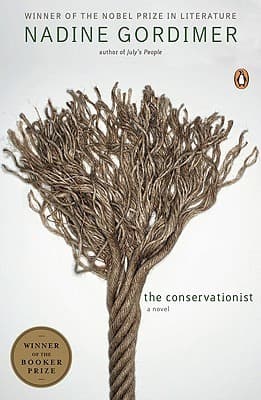
Synopsis
Covers the whole plot, including the ending.
- Difficulty
- Hard
- Pacing
- Slow
- Mood
- Atmospheric, Bleak, Reflective, Unsettling
- Read it if
- You are interested in complex literary portrayals of apartheid-era South Africa, psychological studies of isolation and dispossession, or allegorical narratives about land and power.
- Skip it if
- You prefer fast-paced plots, clear-cut resolutions, or straightforward character arcs. This book is dense and requires patience.
The Conservationist Plot Summary
Covers the whole plot, including the ending.
The Discovery on the Farm
Mehring, a wealthy white industrialist and part-time farmer, finds the decomposing body of an unknown Black man on his Natal farm. The body is near a culvert, partly in mud. Mehring tells the local police, who, after a quick investigation, call it the death of an 'illegal' Black person and show little interest in identifying the deceased. Mehring, despite his initial detachment, becomes preoccupied with the body, which he allows to be buried on his land. This event, seemingly minor, begins to erode his sense of control and ownership over his property and life, introducing an unsettling presence that will last throughout the story.
A Life of Privilege and Isolation
Mehring's personal life is shown through fragmented memories and current observations. His wife, Antonia, has left him for America, taking their daughter, Susie. His son, Terry, a conscientious objector, lives a counter-cultural life and visits rarely, creating a large emotional distance. Mehring's current mistress, an Angolan woman named Rosa, offers brief companionship but no deep bond. He is surrounded by material wealth—his farm, his business, his possessions—yet feels deep emotional isolation. He tries to control his environment, from managing his farm to interacting with his Black workers, but increasingly senses a lack of true connection or understanding.
The Farm's Unrest and Workers' Discontent
Mehring's relationship with his Black farm workers, especially his foreman, Jacobus, is full of unspoken tensions and power imbalances. He sees them as parts of his property, often referring to them as a group rather than individuals. However, the workers, sensing the changing political situation of apartheid South Africa, begin to assert their own will in subtle ways. Jacobus, while outwardly respectful, increasingly makes decisions independently, challenging Mehring's authority. The workers' families live on the farm, their lives connected to the land, but Mehring remains an outsider to their culture and community. He tries to implement new farming techniques and conservation efforts, but these are often met with quiet resistance or indifference from those who have a deeper, ancestral connection to the land.
Terry's Visit and Clash of Ideologies
Mehring's son, Terry, visits the farm, bringing a sharp contrast to his father's views. Terry is a young man critical of the apartheid regime and his father's role in it. He challenges Mehring's materialistic values and his treatment of the Black workers. Their conversations are often tense, showing a deep ideological gap. Terry represents a younger generation grappling with South Africa's moral complexities, while Mehring remains fixed in his beliefs and privileges. Terry's presence makes Mehring confront, however reluctantly, the ethical implications of his life and possessions, though he largely dismisses his son's perspective as naive idealism.
Rosa's Departure and Further Isolation
Rosa, Mehring's Angolan mistress, eventually leaves him. Her departure is quiet, reflecting the fading connections in Mehring's life. While their relationship lacked deep emotional intimacy, her presence offered companionship and distraction. Her absence further isolates Mehring, leaving him more alone on his vast farm. Her foreignness and her own experiences as an outsider in South Africa provided a different perspective, which Mehring, in his self-absorption, mostly failed to grasp. Her leaving highlights his inability to form lasting, meaningful bonds, reinforcing the novel's theme of emotional emptiness amid material abundance.
The Unmarked Grave and Unsettling Presence
The grave of the unknown Black man, initially a minor issue, begins to subtly but persistently influence Mehring's mind. It remains unmarked, a silent sign of the man's anonymity and the casual disregard for Black lives in apartheid South Africa. Mehring occasionally passes it, and its presence seems to challenge his ownership of the land. He finds himself thinking about the man, imagining different identities and stories for him, almost as if the deceased is a silent observer of Mehring's life. The grave becomes a physical representation of unresolved guilt and historical injustices embedded in the land itself, a constant, unsettling reminder of a reality Mehring would prefer to ignore.
Drought and Environmental Decay
The farm's natural environment begins to reflect Mehring's inner decay and the wider social unrest. A severe drought hits the land, turning fertile fields into dry, cracked earth. His crops fail, and his livestock suffer. Mehring's attempts at conservation and modern farming prove useless against nature's power. The drought symbolizes a deeper problem, a disruption of order beyond his control. It highlights his basic separation from the land, which he sees mainly as a resource to exploit rather than an ecosystem to respect. The farm, once a symbol of his wealth and power, becomes a source of frustration and loss.
The Flood and Further Destruction
Just as the drought peaks, a heavy rain begins, causing catastrophic floods. The rains turn dry riverbeds into raging torrents, overflowing banks and flooding the farm. Fences are washed away, buildings are damaged, and more livestock are lost. The floods represent another natural force beyond Mehring's control, further eroding his sense of mastery over his environment. The land, having been neglected and exploited, seems to retaliate with destructive power. The body in the culvert is unearthed and re-submerged, its presence resurfacing with the floodwaters, reinforcing the idea that the past and its injustices cannot be simply buried or forgotten.
Mehring's Mental Deterioration
As his personal relationships crumble and his farm suffers natural disasters, Mehring's mental state declines. He becomes more withdrawn, his thoughts fragmented and obsessive. He hallucinates and engages in internal monologues, blurring the lines between reality and his anxieties. His sense of self, tied to his possessions and control, unravels as these elements are stripped away. The unnamed man's grave, his workers' indifference, and his family's abandonment all contribute to growing paranoia and a deep sense of dread. He struggles to maintain a clear story of his life, finding himself increasingly lost within his own mind.
The Workers' Resilience and Autonomy
Throughout Mehring's decline, the Black farm workers, especially Jacobus, continue their lives with quiet resilience. They observe Mehring's struggles with a detached perspective, understanding that his problems are separate from their own. They continue their traditional practices, maintain their community, and adapt to the farm's changing conditions. Their connection to the land is not one of ownership but of belonging, a deep-rooted relationship that outlasts Mehring's temporary presence. Their independence, though often subtle, contrasts sharply with Mehring's increasing powerlessness.
The Unnamed Man's Final Resting Place
After the floods, the unnamed man's body is unearthed again. This time, the Black farm workers, led by Jacobus, rebury him. They do so according to their own customs, without Mehring's direct involvement or even his full awareness. This act is important; it shows their reclaiming of the land and their assertion of cultural practices over Mehring's nominal ownership. The man, who was 'illegal' and disposable to white authorities, is given dignity and a proper resting place by his own people. This event highlights the lasting power of community and tradition in the face of oppression.
Mehring's Ultimate Dispossession
By the novel's end, Mehring has lost everything. His family has left him, his mistress has gone, his farm is damaged by nature, and his workers have subtly asserted their own control. He remains on the farm, but his ownership is empty. The land, with its history and its people, ultimately rejects him. He is a 'conservationist' who has failed to conserve anything meaningful in his life or on his property. His wealth and privilege are not enough to give him true belonging or peace. He is left with the haunting presence of the unnamed man and the silent, enduring power of the land and its people, showing the final collapse of his colonial power structure.
Principal Figures
Mehring
Protagonist
A wealthy white South African industrialist and part-time farmer.
Mehring is a man defined by his possessions and his perceived control over his environment. He is shrewd in business, but emotionally distant and self-absorbed in his personal life. He embodies the white liberal-conservative paradox of apartheid South Africa, benefiting immensely from the system while professing a detached concern for 'conservation.' He views his Black workers as extensions of his property and struggles to comprehend their humanity or their deep connection to the land. His internal monologues reveal a fragmented mind, obsessed with order and ownership, yet increasingly unable to maintain either.
Relationships: Antonia (Estranged wife); Terry (Alienated son); Rosa (Mistress who eventually leaves him); Jacobus (Farm foreman, a relationship of unspoken tension and power imbalance); The Unnamed Man (The deceased Black man whose presence haunts Mehring)
The Unnamed Man
Catalyst/Symbolic Figure
The unidentified Black man whose body is found on Mehring's farm.
The Unnamed Man is a powerful symbolic presence rather than a character with dialogue or direct action. His decomposing body, found early in the novel, acts as a catalyst for much of the novel's exploration of guilt, ownership, and the legacy of apartheid. He represents the countless 'illegal' and disregarded Black lives in South Africa, reduced to anonymity by the system. His presence on Mehring's land, and the subsequent reburial by the workers, challenges Mehring's sense of ownership and forces a confrontation with the historical injustices embedded in the land. He is the silent witness to Mehring's unraveling.
Relationships: Mehring (His body is found on Mehring's land, haunting him); Jacobus and other workers (They ultimately rebury him with respect)
Jacobus
Supporting Character
Mehring's Black farm foreman.
Jacobus is a quiet, observant, and deeply rooted figure on the farm. He represents the enduring presence and wisdom of the indigenous Black population, whose connection to the land predates and will outlast Mehring's transient ownership. While outwardly deferential to Mehring, Jacobus possesses an inner strength and autonomy. He understands the rhythms of the land and the unspoken dynamics of power better than Mehring. He is the leader among the Black workers, subtly asserting their communal will and traditions, particularly in their handling of the unnamed man's body. He embodies resilience and a quiet resistance to the colonial mindset.
Relationships: Mehring (Foreman-employer relationship, marked by unspoken tensions); The other Black workers (Leader and respected member of the community)
Terry
Supporting Character
Mehring's estranged son, a conscientious objector.
Terry is the ideological foil to his father. He represents a younger generation of white South Africans who are deeply critical of apartheid and their parents' complicity. He is an anti-establishment figure, a conscientious objector, and intellectually engaged with social justice. His visits to the farm are marked by tense discussions with Mehring, where he challenges his father's values, materialism, and treatment of the Black workers. Though he is only present for brief periods, his perspective highlights the moral failings of Mehring and the broader white society. He is searching for a more ethical way of living, even if it means rejecting his inheritance.
Relationships: Mehring (Father-son, but deeply alienated by ideological differences)
Antonia
Mentioned Character
Mehring's estranged wife.
Antonia has left Mehring and South Africa, moving to America with their daughter, Susie. She is a figure from Mehring's past, representing his failed personal relationships and his inability to connect emotionally. Her departure symbolizes a rejection of the life Mehring offers and the broader social and political climate of apartheid South Africa. Though she is only mentioned, her absence contributes significantly to Mehring's profound sense of isolation and his inability to hold onto meaningful connections. She is a reminder of what Mehring has lost or pushed away.
Relationships: Mehring (Estranged wife)
Rosa
Supporting Character
Mehring's Angolan mistress.
Rosa is Mehring's mistress, an Angolan woman who provides him with fleeting companionship but no deep emotional connection. She is an outsider, a refugee from another African conflict, and her presence highlights Mehring's exoticization of women and his inability to form genuine bonds. She has her own history and experiences, which Mehring largely ignores in his self-absorption. Her eventual departure, like Antonia's, underscores Mehring's emotional barrenness and his inability to keep people in his life. She briefly introduces an external perspective on Mehring's world, but he remains insulated.
Relationships: Mehring (Mistress)
The Other Black Workers
Supporting/Collective Character
The collective group of Black laborers living and working on Mehring's farm.
The other Black workers are often presented as a collective, reflecting Mehring's generalized view of them. They represent the anonymous, exploited labor force under apartheid, but also a resilient community with a deep, ancestral connection to the land. They communicate through unspoken understandings, quiet resistance, and traditional practices. They are observers of Mehring's decline, embodying a wisdom and patience that contrasts sharply with his frantic attempts at control. Their actions, particularly in reburying the unnamed man, demonstrate their communal strength and their ability to assert their own culture and dignity despite oppression.
Relationships: Mehring (Employer-employee, with deep power imbalances); Jacobus (Follower/community member)
Susie
Mentioned Character
Mehring's daughter.
Susie is Mehring's daughter, who left South Africa with her mother, Antonia. She is mentioned only in passing, another absent family member who contributes to Mehring's isolation. Her departure, like her mother's, signifies a rejection of Mehring's life and the apartheid system. She represents another lost connection, another piece of Mehring's life that he failed to 'conserve.' Her absence highlights the complete breakdown of Mehring's family unit.
Relationships: Mehring (Daughter, estranged); Antonia (Mother)
Themes & Insights
Ownership vs. Belonging
The novel examines the idea of ownership, especially concerning land and people in apartheid South Africa. Mehring, as a white landowner, believes he 'owns' his farm and, by extension, controls his Black workers. However, the land itself, and the indigenous people who live on it, show a deeper sense of belonging that goes beyond legal title. The discovery of the unnamed man's body on Mehring's property immediately challenges his ownership, as the land becomes a burial ground for someone outside his control. The workers' eventual reburial of the man, according to their customs, further emphasizes this theme, showing that true belonging is not bought but earned through history, community, and respect for the land. Mehring's eventual loss of everything comes from his inability to understand this difference.
“He thought of the land as his, but it had its own memory, its own history that predated his claim.”
The Legacy of Apartheid and Colonialism
The Conservationist is set firmly in apartheid South Africa, exploring its moral and social decay. Mehring embodies the white privilege and psychological detachment the system created. His casual disregard for the unnamed Black man's life, the unspoken tensions with his workers, and his inability to form real relationships with Black individuals all reflect the dehumanizing effects of apartheid. The novel suggests that the land itself carries the scars of colonial conquest and racial injustice. The unnamed man's body, a symbol of the 'disposable' Black population, constantly reminds Mehring of the violence and exploitation that built his wealth and comfort. The workers' eventual reburial hints at a lasting indigenous culture that will reclaim its rightful place.
“The earth was no longer indifferent to what was put into it.”
Isolation and Disconnection
Mehring is a deeply isolated figure, despite his material wealth and superficial connections. His wife and daughter have left him, his mistress departs, and his son is ideologically distant. He cannot connect authentically with his Black workers, seeing them as a group rather than individuals. This emotional emptiness is a direct result of his self-absorption and his adherence to a system that creates division. His internal monologues show a mind breaking under the weight of this isolation. The vastness of his farm, which should offer comfort, instead reflects his inner emptiness. This theme suggests that true wealth is not material but relational, and that the dehumanizing aspects of apartheid lead to a deep spiritual and emotional void for those who benefit from it.
“He lived in the house alone, and the sounds of the night were the sounds of the farm, not of human company.”
Nature as a Reflective Force
Nature in 'The Conservationist' is not just a background but an active, almost living force that reflects and reacts to the human condition, particularly Mehring's moral and psychological state. The land, initially a source of pride and control for Mehring, gradually turns against him. The severe drought and subsequent floods mirror his inner decay and the unraveling of his life. The repeated unearthing of the unnamed man's body by the elements suggests that the land refuses to bury or forget the injustices committed upon it. Mehring's attempts at 'conservation' are ironically undermined by his own destructive nature and his basic separation from the natural world. The land ultimately asserts its own power, showing that it cannot be simply owned or controlled, but requires respect and balance.
“The earth knew its own, and would not keep what did not belong.”
The Elusiveness of Identity
The novel explores how identity is fluid and hard to grasp, especially through the unnamed Black man and Mehring's own self-perception. The unnamed man, stripped of his name and history by the state, becomes a screen onto which Mehring projects his anxieties and guilt. His lack of identity highlights the systemic dehumanization of Black people under apartheid. Conversely, Mehring, who defines himself by his possessions and social status, finds his own identity unraveling as these external markers disappear. His fragmented thoughts and internal monologues reveal a man struggling to maintain a clear sense of self in a world that is slipping beyond his control. The novel suggests that true identity is not found in ownership or social roles but in one's connection to community, history, and the land.
“What was a name, after all, when the man himself was nothing?”
Plot Devices & Literary Techniques
The Unnamed Body
The decomposing body of an unidentified Black man found on Mehring's farm.
This is the central plot device. The unnamed body acts as a constant, haunting symbol of the unresolved injustices of apartheid and the historical violence embedded in the land. Its discovery immediately disrupts Mehring's sense of control and introduces an unsettling presence that he cannot fully dismiss. The body's repeated disinterment by natural forces (drought, flood) emphasizes that the past cannot be buried or forgotten. It serves as a moral mirror for Mehring, forcing him to confront, however subconsciously, the ethical implications of his life and possessions. It also highlights the dehumanization of Black lives under the regime, as the authorities show no interest in identifying the deceased.
Internal Monologue/Stream of Consciousness
Mehring's fragmented thoughts and internal reflections dominate the narrative.
Much of the novel is narrated through Mehring's internal monologue, often fragmented and non-linear. This device allows readers direct access to his anxieties, obsessions, and self-deceptions. It reveals his emotional barrenness, his attempts to rationalize his privilege, and his gradual mental deterioration. The stream of consciousness blurs the lines between his perceptions and objective reality, reflecting his increasing isolation and inability to connect with the external world. It also highlights the psychological impact of living within a morally compromised system, showing how his mind struggles to maintain a coherent narrative amidst the unraveling of his life.
Pathetic Fallacy
The natural environment mirrors Mehring's internal state and the social decay of South Africa.
The weather and the state of the farm directly reflect Mehring's psychological decline and the broader social decay. The severe drought symbolizes his emotional barrenness, the lack of connection in his life, and the parched moral landscape of apartheid. The subsequent devastating floods represent the overwhelming forces beyond his control, mirroring the unraveling of his life and the eventual reclaiming of the land by nature and its original inhabitants. The land itself, through its resistance and destruction, acts as a sentient entity that refuses to be simply owned and exploited, reflecting the deep-seated injustices that Mehring embodies.
Symbolism of the Farm
Mehring's farm as a microcosm of South Africa and his personal life.
The farm functions as a powerful symbol, a microcosm of South Africa under apartheid. For Mehring, it represents his wealth, control, and colonial ownership. However, it is also a site of deep historical and racial tension, where the indigenous Black workers have an ancestral claim that supersedes his legal title. The farm reflects Mehring's internal state: as his personal life unravels, so too does the farm, succumbing to natural disasters and the quiet resistance of its inhabitants. It becomes a battleground for competing claims of ownership and belonging, ultimately demonstrating the futility of Mehring's attempts to 'conserve' a system built on injustice.
The Conservationist Quotes
“The only thing you could be sure of was that life would go on, whether you were there or not.”
“He knew he had to keep himself busy, or the silence would eat him.”
“The land was not his, not really. He was merely its temporary custodian.”
“There was no answer, except the answer of the land itself, which was always silence.”
“You couldn't escape what you were, not in this country.”
“The past was not dead; it was not even past. It was merely sleeping, waiting to be woken.”
“He had bought the land, but he had not bought the people who lived on it.”
“The wilderness was not empty; it was full of presences.”
“Everything changed, but nothing changed.”
“He was a man who lived in the present, but the present was always being invaded by the past.”
“The truth was not a single thing, but many things, shifting and elusive.”
“He felt a great weariness, a weariness that had nothing to do with physical exertion.”
“The dead man was still there, under the ground, a constant reminder.”
“The land was a mirror, reflecting back what he was, what he had done.”
Quiz
10 questions on the plot and the characters. Each answer comes with a short explanation.
Question 1
What is Mehring's primary occupation, which is central to his wealth and possessions?
- Diamond mining magnate
- Urban real estate developer
- Landowner and farmer
- Government official
Show answer
C. Landowner and farmer Mehring's wealth and status are derived from his ownership of a farm, which is the primary setting and source of his 'possessions' that refuse to remain objects.
Question 2
What significant event occurs early in the novel on Mehring's farm that disrupts his sense of control and order?
- A valuable crop is stolen by poachers.
- His main farmhouse burns down in a mysterious fire.
- The discovery of an unidentified black man's corpse on his property.
- A severe earthquake destroys much of his infrastructure.
Show answer
C. The discovery of an unidentified black man's corpse on his property. The discovery of the dead body is a pivotal early event that forces Mehring to confront issues of ownership, responsibility, and the presence of others on his land.
Question 3
Which of the following family members remains with Mehring throughout the entire novel?
- His wife
- His son
- His mistress
- None of the above; they all leave him.
Show answer
D. None of the above; they all leave him. The synopsis explicitly states that his wife, son, and mistress all leave him, highlighting his isolation and the crumbling of his personal life.
Question 4
What natural disasters plague Mehring's farm, symbolizing his losing battle against the land itself?
- Volcanic eruption and tidal waves
- Drought and then flood
- Tornadoes and hailstorms
- Locust plagues and wildfires
Show answer
B. Drought and then flood The description specifically mentions that 'drought, then flood, destroy his farm,' illustrating the land's resistance to his stewardship.
Question 5
How does Mehring's relationship with his foreman and workers evolve throughout the novel?
- It strengthens due to shared adversity.
- They become increasingly loyal and dependent on him.
- They become increasingly indifferent to his stewardship.
- They stage a violent uprising against him.
Show answer
C. They become increasingly indifferent to his stewardship. The synopsis states that his 'foreman and workers become increasingly indifferent to his stewardship,' reflecting the breakdown of traditional power structures.
Question 6
What symbolic role does the unidentified dead body play in the novel's overarching themes?
- It represents Mehring's past crimes and guilt.
- It symbolizes the ignored and dispossessed black population of South Africa, whose presence cannot be simply buried or forgotten.
- It serves as a literal plot device for a murder mystery.
- It is a metaphor for the dying prosperity of the farming industry.
Show answer
B. It symbolizes the ignored and dispossessed black population of South Africa, whose presence cannot be simply buried or forgotten. The dead body, repeatedly buried and unearthed, represents the inescapable presence and claims of the indigenous black population, whose humanity cannot be simply disposed of, especially in the context of apartheid South Africa.
Question 7
Mehring's concept of 'conservation' primarily refers to:
- Environmental protection and sustainable farming practices.
- The preservation of his own wealth, power, and the existing social order.
- The restoration of historical artifacts on his farm.
- Maintaining his family's traditional values and customs.
Show answer
B. The preservation of his own wealth, power, and the existing social order. The title 'The Conservationist' ironically points to Mehring's desire to conserve his privileged position and the status quo of apartheid, rather than genuine environmentalism.
Question 8
What is the ultimate fate of the unidentified body on Mehring's farm?
- It is finally identified and given a proper burial by his family.
- It is reburied by the black farmworkers in a traditional ceremony, claiming it as their own.
- It is removed by the authorities and cremated.
- It is left to decompose on the surface of the land.
Show answer
B. It is reburied by the black farmworkers in a traditional ceremony, claiming it as their own. Towards the novel's end, the workers re-inter the body with their own rituals, signifying their assertion of claim over the land and its history, circumventing Mehring's authority.
Question 9
The phrase 'his possessions refuse to remain objects' primarily refers to:
- His material goods breaking down due to neglect.
- The people and land he considers his property asserting their own agency and independence.
- His financial investments depreciating rapidly.
- His art collection coming to life at night.
Show answer
B. The people and land he considers his property asserting their own agency and independence. This phrase encapsulates the central theme: Mehring views people (his family, workers) and the land as extensions of his property, but they increasingly defy his control and reveal their own independent existence and claims.
Question 10
At the novel's conclusion, what is Mehring's general state or position?
- He has successfully rebuilt his farm and reconciled with his family.
- He has abandoned his farm to start a new life in the city.
- He is left isolated, his control diminished, and his claim to the land challenged by the enduring presence of the black community.
- He has been arrested for crimes related to the dead body.
Show answer
C. He is left isolated, his control diminished, and his claim to the land challenged by the enduring presence of the black community. Mehring ends the novel largely alone, his personal and professional life in disarray, and his ultimate ownership of the land undermined by the spiritual and practical claims of the black population, symbolized by the reburial of the body.
The Conservationist FAQ
What is the central conflict Mehring faces in 'The Conservationist'?
Mehring, a wealthy white South African farmer during apartheid, grapples with the disintegration of his control over his possessions and relationships. His attempts to impose order on his farm, his family, and the indigenous population are constantly undermined, reflecting the larger societal tensions and the land's own resistance.
Who is the unnamed Black man whose body is found on Mehring's farm?
The unnamed Black man is a significant symbolic figure, representing the marginalized and dispossessed Black population of South Africa. His unceremonious burial and subsequent re-emergence highlight Mehring's detachment from the human consequences of his society and the land's refusal to forget.
How do Mehring's relationships with his wife and son evolve?
Mehring's wife, Antonia, and his son, Terry, both leave him, symbolizing his inability to connect authentically even with his immediate family. Their departures leave Mehring increasingly isolated, highlighting his emotional barrenness and his preference for material possessions over genuine human bonds.
What role does the natural environment play in the narrative?
The land itself acts as a powerful character, resisting Mehring's attempts at control through cycles of drought and flood. It mirrors the social unrest and ultimately reclaims itself, suggesting that Mehring's ownership is superficial and temporary in the face of deeper, natural forces.
How does Mehring's foreman, Jacobus, interact with him?
Jacobus, Mehring's Black foreman, maintains a complex and often inscrutable relationship with Mehring. He exhibits a quiet defiance and increasing indifference to Mehring's authority, subtly undermining his control and representing the growing power shift and resistance among the Black workers.
What is the significance of the unnamed Black man's body being reburied by the farm workers at the end?
The reburial of the unnamed man by the farm workers, rather than by Mehring, signifies a profound act of reclaiming agency and dignity. It suggests that the land and its true inhabitants, the indigenous people, ultimately assert their claim over both the deceased and the farm itself, superseding Mehring's superficial ownership.
Are there any subtle indications of Mehring's declining mental state?
Mehring's increasing isolation, his obsessive focus on his possessions, and his inability to form meaningful relationships hint at a deteriorating mental state. His internal monologues often reveal a detachment from reality and a growing paranoia about losing control, reflecting his psychological unraveling amidst social change.
How do the various women in Mehring's life (wife, mistress, daughter of a worker) reflect different aspects of his character or society?
Antonia, his wife, represents the white liberal conscience that ultimately abandons the oppressive system. His mistress embodies a fleeting, superficial connection, while the daughter of a worker, though briefly desired, remains unattainable, highlighting Mehring's inability to truly bridge racial or social divides.
What is the psychological impact of Mehring's deep-seated need for control?
Mehring's pervasive need for control stems from a desire to maintain his privileged position and a fear of losing his possessions, which he equates with his identity. This need ultimately backfires, leading to his increasing isolation, frustration, and an inability to adapt to the changing social and natural landscape.
How does Mehring's perception of his farm differ from the reality experienced by his workers?
Mehring sees his farm as an asset to be managed and exploited, a symbol of his wealth and power. His workers, however, view it as their ancestral land, a source of livelihood often under exploitative conditions, and a place where their history and dignity are intertwined, creating a fundamental disconnect.
In what ways does Mehring exhibit a lack of empathy towards others?
Mehring consistently demonstrates a profound lack of empathy, particularly towards his Black workers and the unnamed deceased man. He views them as objects or extensions of his property rather than as individuals with their own lives and suffering, a characteristic deeply rooted in his apartheid-era privilege.
How does Mehring's internal monologue reveal his anxieties about the future of South Africa?
Mehring's internal thoughts are riddled with anxieties about the changing political landscape and the potential loss of his status and property. He often rationalizes his actions and dismisses the grievances of Black people, revealing a deep-seated fear of a future where his dominance is challenged.
Is Mehring a villain, a victim, or both?
Mehring is primarily a product and perpetrator of an oppressive system, making him a villain in his actions and attitudes. However, he is also a psychological victim of his own isolation and inability to adapt, trapped by his privilege and ultimately unable to find genuine connection or peace.
What is the ultimate fate of Mehring at the end of the novel, and is it definitive?
Mehring's ultimate fate is left ambiguous, but the implication is one of profound loss and irrelevance. His farm is effectively taken over by the land and its original inhabitants, suggesting his complete displacement and the end of his era, rather than a definitive physical death.
How does the novel critique the concept of 'conservation' in an apartheid context?
The novel critiques Mehring's superficial 'conservation' efforts, which focus on preserving his property and privilege, while ignoring the human and social destruction around him. It suggests that true conservation must include human dignity and justice, not just the preservation of land for personal gain, especially in a racially divided society.
Could the unnamed Black man be interpreted as a symbol of the collective unconscious or ancestral spirits of the land?
Yes, the unnamed Black man strongly symbolizes the collective unconscious and ancestral spirits of the land. His persistent presence and the workers' eventual reburial of him suggest that the land remembers its true heirs and that the injustices of the past cannot be simply buried or forgotten, even by those who wish to ignore them.
What is the significance of Mehring's son, Terry, being a 'hippie' who rejects his father's values?
Terry's rejection of his father's materialist and oppressive values highlights a generational shift and a burgeoning counter-culture that challenged apartheid norms. His departure signifies Mehring's failure to transmit his ideology, further isolating him and foreshadowing the eventual collapse of the system he embodies.
How does the novel use animal imagery to comment on Mehring's character?
Animal imagery frequently juxtaposes Mehring's attempts at control with the wildness of nature. His hunting activities and his treatment of animals often reflect his predatory and detached view of human relationships, further emphasizing his inability to connect authentically with the world around him.
About the author

Nadine Gordimer was a South African writer and political activist. She received the Nobel Prize in Literature in 1991, recognized as a writer "who through her magnificent epic writing has ... been of very great benefit to humanity".
Similar books
- July's People
Nadine Gordimer
3.5 (6k) average on GoodreadsLiterary FictionExplores racial and class tensions in South Africa, focusing on a white family's displacement.
- Disgrace
J. M. Coetzee
3.8 (87k) average on GoodreadsLiterary FictionExamines post-apartheid South Africa, dispossession, and a white man's fall from grace.
- The Grass is Singing
Doris Lessing
3.8 (11k) average on GoodreadsLiterary FictionA psychological study of a white woman in colonial Rhodesia, dealing with isolation and racial dynamics.
- Burger's Daughter
Nadine Gordimer
3.5 (2k) average on GoodreadsLiterary FictionGordimer's own Burger's Daughter (1979) also explores white South African identity and political commitment, but it is often considered more accessible in its narrative structure and more overtly concerned with political activism and the legacy of revolutionary parents. The Conservationist is arguably more abstract and symbolic, delving deeper into the subconscious and the land itself as a site of historical memory, making its political commentary more embedded in its literary form rather than explicit character actions.
- The Old Man and the Sea
Ernest Hemingway
3.8 (831k) average on GoodreadsLiterary FictionA Cuban fisherman's long struggle with a giant marlin becomes a story of endurance and dignity, now retold for young adults with illustrations, phonetic guides, and writing prompts in Traditional Chinese.
- One Hundred Years of Solitude
Gabriel García Márquez
4.1 (753k) average on GoodreadsLiterary FictionThrough the multi-generational story of the Buendía family, a mythical town deals with the repeating patterns of time, love, and solitude, as the extraordinary mixes with the ordinary.




Enjoyed the summary?
A summary gives you the shape of the book. The book itself has the detail, the examples and the voice.
Find The Conservationist on AmazonAs an Amazon Associate, BookBrief earns from qualifying purchases. How we're funded