BookBrief
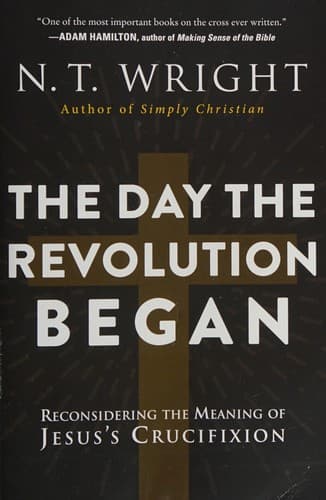
The day the revolution began cover

The day the revolution began Summary

N. T. Wright (2016)

Get the book

Goodreads Rating

4.30/ 5(2,446 reviews)

Genre

General

Summary Read

14 min

Book Length

6 hours

By BookBrief EditorialLast updated September 20, 2026

Track Your Reading

Sign in to track this book

My Notes

Only visible to you
N. T. Wright argues that Jesus' crucifixion wasn't just about sin, but the radical start of a revolution to restore all of creation through a new royal priesthood.

Core Idea

N. T. Wright argues that the traditional understanding of Jesus's death has been largely misconstrued, focusing too heavily on a transactional atonement theory that detaches the cross from its historical and eschatological context. Instead, Wright proposes that Jesus's death and resurrection inaugurated a new creation, a revolution that redefines the very nature of God's kingdom and humanity's role within it. The 'revolution' began not just with forgiveness of sins, but with the launching of God's long-promised new world, where heaven and earth are destined to be united, and where followers of Jesus are called to participate in this ongoing work of new creation, bringing healing and justice to the world.
Reading time
6 hours
Difficulty
Medium
✓ Read this if...
You are a Christian seeking a deeper, more historically grounded understanding of the atonement, the resurrection, and the practical implications of Jesus's work for your life and the world. You are open to challenging traditional theological frameworks and exploring a comprehensive vision of Christian hope and mission.
✗ Skip this if...
You are looking for a simple, concise explanation of salvation that adheres strictly to penal substitutionary atonement without further inquiry. You are not interested in detailed theological arguments or historical context.

Chat with this book

Ask anything about The day the revolution began and get instant answers grounded in the summary.

Key Takeaways from The day the revolution began

1

The Cross as Coronation, Not Just Absolution

Jesus' death is less about 'saving souls' from a fiery hell and more about God's enthronement and the commencement of a new creation.

Quote

The cross is not simply the place where God deals with sin; it is also, and perhaps even more fundamentally, the place where God becomes king.

Wright's main challenge to traditional Protestant theology is his new interpretation of the cross. He says the common 'penal substitution' theory, while partly true, is incomplete and often misleading. Instead, he proposes that Jesus' crucifixion, especially when seen through the Jewish story of a suffering Messiah, is God's decisive act to reclaim control over creation. It is Jesus' 'coronation' as the true king, signaling the defeat of cosmic evil and the start of 'new creation.' This is not just a metaphor; it is a historical event...

Supporting evidence

Wright extensively analyzes Pauline epistles (e.g., Romans 8, Colossians 1) and gospel narratives, highlighting how early Christians understood Jesus' death as a fulfillment of Old Testament prophecies concerning God's kingship and the restoration of Israel, which then expands to all creation.

Apply this

Christians should view their faith not merely as a personal escape route to heaven, but as active participation in God's ongoing work of bringing justice, beauty, and reconciliation to the world, reflecting the inaugurated kingdom of God.


new-creationkingdom-of-godchristus-victorpenal-substitution-critique
2

Covenant, Sacrifice, and Atonement Reimagined

The cross fulfills ancient covenantal sacrifices, not primarily as payment for individual sins, but as a means to restore humanity's vocation.

Quote

The purpose of Israel's sacrifices, and supremely of Jesus's death, was not simply to 'pay' for sins, but to restore the covenant relationship so that Israel (and then the church) could be God's priestly people.

Wright carefully examines the Old Testament ideas of sacrifice and covenant, arguing that traditional atonement theories often misunderstand their main purpose. He states that Israel's sacrifices were not just about pleasing an angry deity, but about maintaining and restoring the covenant relationship, allowing Israel to fulfill its priestly role to the world. Jesus' death, then, is the ultimate covenant sacrifice, not just 'paying a debt' but re-establishing humanity's original purpose as God's image-bearers, working with God in crea...

Supporting evidence

Wright draws heavily on Leviticus and the prophetic books, demonstrating how sin was understood as a rupture in the covenant that needed to be healed for Israel to be a light to the nations. He then links this to Jesus as the true Israel, fulfilling this priestly role.

Apply this

Understand atonement as a re-empowerment for mission, not just a past event. Engage in practices that mend broken relationships and contribute to the flourishing of creation, recognizing this as an aspect of priestly service.

covenant-theologyatonement-theoriespriestly-vocationisrael-and-church
3

The Vocation of Humanity: Priest-Kings

Humanity's original purpose, lost in the Fall, is restored through the cross: to be God's royal priesthood, bringing heaven and earth together.

Quote

The point of human beings is to be God's image-bearers, to reflect God's wise and creative rule into the world and to reflect the praises of the world back to God. This is the royal priesthood.

This is arguably the book's strongest idea, offering a powerful way to think about Christian ethics and mission. Wright argues that Genesis 1-2 describes humanity's original purpose as 'priest-kings' – those meant to cultivate and care for creation (royal) and mediate between heaven and earth (priestly). The Fall corrupted this purpose, leading to humanity's abandonment of responsibility and the breaking of creation. The cross, by dealing with sin and defeating evil, restores this purpose. Christians are called to live out this 'royal...

Supporting evidence

Wright grounds this in Genesis 1-2 (image of God, 'till and keep'), Exodus (Israel as a kingdom of priests), and 1 Peter 2:9 ('a royal priesthood'). He shows how Jesus perfectly fulfills this vocation, and how the church is called to participate.

Apply this

Actively engage in stewardship of creation, pursue justice in society, and create beauty in culture, seeing these as direct expressions of your restored human vocation as a co-laborer with God.

imago-deicreation-mandateroyal-priesthoodcultural-mandate
4

Rethinking 'Sin' as Vocation-Distortion

Sin is not merely breaking rules, but a distortion of humanity's divine purpose, leading to idolatry and cosmic corruption.

Quote

Sin is not just bad things we do; it is the distortion of our God-given vocation to be image-bearers, leading us to worship something other than God and to spoil the creation.

Wright redefines 'sin' in a way that fits with his larger story of creation and purpose. He moves beyond a legalistic view of sin as simply 'breaking God's rules' to see it as a deep twisting of humanity's intended purpose. Sin is idolatry – worshipping creation rather than the Creator – and this idolatry inevitably leads to the corruption of creation itself. When humans fail in their priestly and royal duties, the world suffers. This broad view of sin explains its widespread nature and its impact not just on individuals, but on syste...

Supporting evidence

He references Romans 1, illustrating Paul's argument that humanity's idolatry leads to moral decay and the corruption of creation. He also draws from Genesis 3, showing how the Fall was a rejection of vocation.

Apply this

Beyond confessing individual wrongdoings, reflect on ways you might be contributing to systemic injustices or environmental harm, recognizing these as manifestations of distorted vocation and idolatry. Seek holistic repentance and action.

idolatrysystemic-sincosmic-fallhuman-vocation
5

The Eschatological Significance of the Cross

The cross is the decisive moment when God's future new creation breaks into the present, initiating the final reconciliation of all things.

Quote

The cross is not simply about getting individuals to heaven. It is about God's future, the new creation, breaking into the present in Jesus, inaugurating the end of the old age and the beginning of the new.

Wright connects the cross directly to eschatology, arguing that it's not merely a past event but the foundational act that starts God's ultimate plan for cosmic renewal. The cross is the 'end of the old age' and the 'beginning of the new,' a decisive moment where God's future new creation is inaugurated in the present. This challenges the common idea that 'the end times' are solely about a future rapture or apocalypse. Instead, the change began with the cross, and Christians are called to live as agents of that inaugurated future, wor...

Supporting evidence

He draws on Paul's understanding of Jesus as the 'firstfruits' of the resurrection (1 Corinthians 15) and the 'new creation' (2 Corinthians 5:17), showing how the cross and resurrection are integrally linked to God's ultimate eschatological victory.

Apply this

Live with an eschatological imagination, seeing your daily actions, particularly those of justice and reconciliation, as contributing to the unfolding of God's new creation, rather than merely waiting for a future event.

inaugurated-eschatologynew-creationresurrectionkingdom-now-and-not-yet
6

The Limitations of 'Going to Heaven'

The popular focus on 'going to heaven when you die' often distracts from the biblical emphasis on God's redemption of the entire cosmos.

Quote

The idea that the Christian hope is simply 'going to heaven when you die' is a profound distortion of the biblical narrative, which consistently points to God's ultimate purpose of bringing heaven and earth together in a new creation.

Wright critiques the common evangelical focus on individual salvation as 'going to heaven' as a serious misunderstanding of biblical eschatology. He argues that this dualistic thinking, often influenced by Greek philosophy, downplays the importance of the physical world and humanity's role within it. The biblical story, from Genesis to Revelation, consistently points to God's intention to redeem and renew all creation, ending in 'new heavens and a new earth' where God lives with humanity. This is not about escaping a doomed world, but...

Supporting evidence

Wright references Revelation 21-22, where the New Jerusalem descends to a renewed earth, not humanity ascending to a disembodied heaven. He also critiques the Platonic influences on Christian theology.

Apply this

Shift your focus from merely securing a 'heavenly ticket' to actively participating in God's work of renewing the earth. Invest in tangible acts of love, justice, and creation care, recognizing their eternal significance.

cosmic-redemptionheaven-and-earthplatonic-dualismembodied-hope
7

Justice as a Core Outworking of Atonement

The cross not only makes individuals right with God but also commissions them to bring divine justice into a broken world.

Quote

The justice of God, revealed on the cross, is not simply a matter of courtroom acquittal but of God's passion to set the whole world to rights.

For Wright, the cross is deeply connected to God's justice, but not in the narrow, legalistic sense often understood. God's justice ('dikaiosyne') is his covenant faithfulness, his active determination to 'put the world to rights.' The cross is how God does this. Therefore, those who are 'justified' by faith are not just declared innocent but are enlisted into God's project of justice. This means that pursuing justice in society – fighting oppression, advocating for the marginalized, working for systemic change – is not an optional ad...

Supporting evidence

He often refers to God's 'dikaiosyne' in Romans and Psalms, emphasizing its active, restorative nature rather than a passive, retributive one. He links this directly to the mission of the church.

Apply this

Actively seek opportunities to pursue justice in your community and beyond, understanding it as a direct participation in God's work of 'setting the world to rights,' empowered by the cross.

divine-justicesocial-justicejustificationcovenant-faithfulness
8

The Eucharist as a Revolutionary Act

The Lord's Supper is not just a memorial, but a subversive act of communal participation in the inaugurated kingdom.

Quote

The Eucharist is not simply a private act of remembrance; it is a public, political act, declaring allegiance to the true King and rehearsing the feast of the new creation.

Wright elevates the Eucharist (Lord's Supper) from a mere symbolic ritual to a powerful, revolutionary act. He argues that it's a foretaste of the 'wedding feast of the Lamb,' a communal declaration of loyalty to Jesus as the true King, and a performance of the inaugurated new creation. By sharing bread and wine, Christians are not just remembering a past event; they are participating in the ongoing change, embodying the new covenant, and announcing the kingdom of God to the world. This understanding gives the Eucharist deep theologic...

Supporting evidence

He connects the Last Supper narratives to the Passover meal, highlighting its revolutionary and covenantal aspects. He also draws on Paul's instructions in 1 Corinthians, emphasizing the communal implications.

Apply this

Approach the Eucharist with a renewed sense of its communal, cosmic, and revolutionary significance. See it as a call to embody the kingdom values of justice, peace, and reconciliation in your daily life.

eucharistlord-s-suppernew-covenantcommunal-worship
9

The Cross as the Defeat of Empire

Jesus' crucifixion under Roman authority reveals God's ultimate triumph over all human powers and idolatrous systems.

Quote

The cross was not just a private transaction between God and the individual; it was a public, political statement, a divine 'no' to all human empires and their claims to ultimate authority.

Wright emphasizes the 'political' aspect of the cross, not in a partisan sense, but in its challenge to all human claims of ultimate authority. Jesus was executed by the Roman Empire, the dominant power of his day, for claiming to be King. The resurrection, then, is God's decisive affirmation of Jesus' kingship and a deep subversion of all earthly empires and their arrogant claims. The cross exposes the emptiness of human power structures built on violence, oppression, and self-worship. This perspective encourages Christians to critic...

Supporting evidence

He highlights the Roman context of Jesus' execution (Pontius Pilate, 'King of the Jews' inscription) and Paul's language about 'powers and principalities' being disarmed at the cross (Colossians 2).

Apply this

Critically analyze and challenge systems of power, both political and cultural, that promote injustice or demand ultimate allegiance, remembering that ultimate sovereignty belongs to Christ alone.

empire-critiqueprincipalities-and-powerschrist-the-kingpolitical-theology
10

A Renewed Sense of Christian Mission

The cross redefines Christian mission from 'saving souls' to participating in God's holistic restoration of creation.

Quote

The revolution that began on the cross commissions the church to a renewed mission: not simply to get people into heaven, but to be agents of God's new creation, bringing healing and hope to a broken world.

The culmination of Wright's argument is a radical redefinition of Christian mission. If the cross began God's new creation and restored humanity's purpose as priest-kings, then mission is far more comprehensive than traditional evangelism focused solely on individual salvation. Mission becomes participation in God's holistic project of cosmic restoration – bringing justice, beauty, healing, and reconciliation to every part of creation. This includes evangelism, but also social action, environmental care, cultural renewal, and ethical ...

Supporting evidence

Wright synthesizes his earlier points, demonstrating how the new creation, restored vocation, and inaugurated kingdom necessitate a comprehensive mission, drawing from the Great Commission interpreted through this broader lens.

Apply this

Broaden your understanding of Christian mission beyond traditional evangelism. Seek ways to embody God's love and justice in all areas of your life and community, contributing to the holistic flourishing of creation.

holistic-missionmissio-deicreation-carekingdom-mission

The day the revolution began Quotes

The day the revolution began is the day Jesus rose from the dead.

This is the central thesis of the book, stated early on.

The resurrection isn't just a promise of what will happen to us; it's the proof of what God has already done.

Wright emphasizes the present reality of the resurrection's power.

To believe in Jesus is to believe in the one who was sent, and to believe in the one who was sent is to believe in God.

Explaining the interconnectedness of belief in Jesus and God.

The cross and the resurrection are not two separate events but two sides of the same coin, the victory of God.

Highlighting the inseparable nature of the crucifixion and resurrection.

The revolution that began on Easter morning wasn't a bloody, violent overthrow of the Roman Empire, but a quiet, powerful inauguration of God's kingdom.

Contrasting the common understanding of revolution with Wright's theological interpretation.

We are called to be participants in that ongoing revolution, to live as citizens of God's kingdom here and now.

The call to Christian living in light of the resurrection.

The resurrection is the ultimate sign that God's purposes are unstoppable.

Emphasizing the certainty and power of God's plan.

If Jesus is not raised, your faith is futile and you are still in your sins.

Quoting or alluding to Paul's argument in 1 Corinthians 15.

The resurrection doesn't just tell us about Jesus; it tells us about the God who raised him.

Focusing on what the resurrection reveals about God's nature.

The Christian life is a life lived in the light of the resurrection, empowered by the Spirit.

Describing the essence of Christian existence.

The empty tomb is not an absence, but a presence – the presence of the risen Christ.

Reinterpreting the meaning of the empty tomb.

This is not a story of defeat, but of ultimate victory, a victory that echoes through history and into eternity.

Summarizing the overarching narrative of the Christian faith.

The revolution that began on Easter morning is a revolution of love, a revolution of hope, a revolution of transformation.

Expanding on the nature of the revolution initiated by Jesus' resurrection.

To live as Christians is to live as those who have been rescued from the powers of darkness and transferred into the kingdom of God's beloved Son.

Explaining the implications of salvation and kingdom citizenship.

Quiz

Test Your Knowledge

Ready to see how well you understood this book? Take our interactive quiz with 10 questions.

10
Questions
~5
Minutes
?
Best Score

The day the revolution began FAQ

N. T. Wright argues that Jesus' crucifixion was not solely about atoning for sins, but was the catalyst for a revolution that commissions Christians with a new vocation: to restore and reconcile God's creation. He posits that the Protestant Reformation didn't fully grasp this revolutionary aspect.

About the author

N. T. Wright is a leading scholar on the New Testament and the historical Jesus. His extensive work explores the context and implications of the early Christian movement, offering fresh perspectives on biblical texts.

Enjoyed the summary?

Support the author — grab the full book.

As an Amazon Associate, BookBrief earns from qualifying purchases, at no extra cost to you. How we're funded.

Get the book